
No one considers a fresh apricot to be candy. Yet, once the water evaporates from that very same apricot, many people mentally relegate it to the confectionery aisle. Fundamentally, it remains the exact same apricot, just stripped of most of its moisture.
The debate around dried fruit usually conflates two distinct issues. People compare unequal quantities (a handful of dried pieces versus a single fresh fruit) and blur the line between intrinsic fruit sugars and sugar added during processing. Both extremes are misleading: the claim that dried fruit is an unconditional superfood, and the notion that it is merely sugar disguised as fruit.
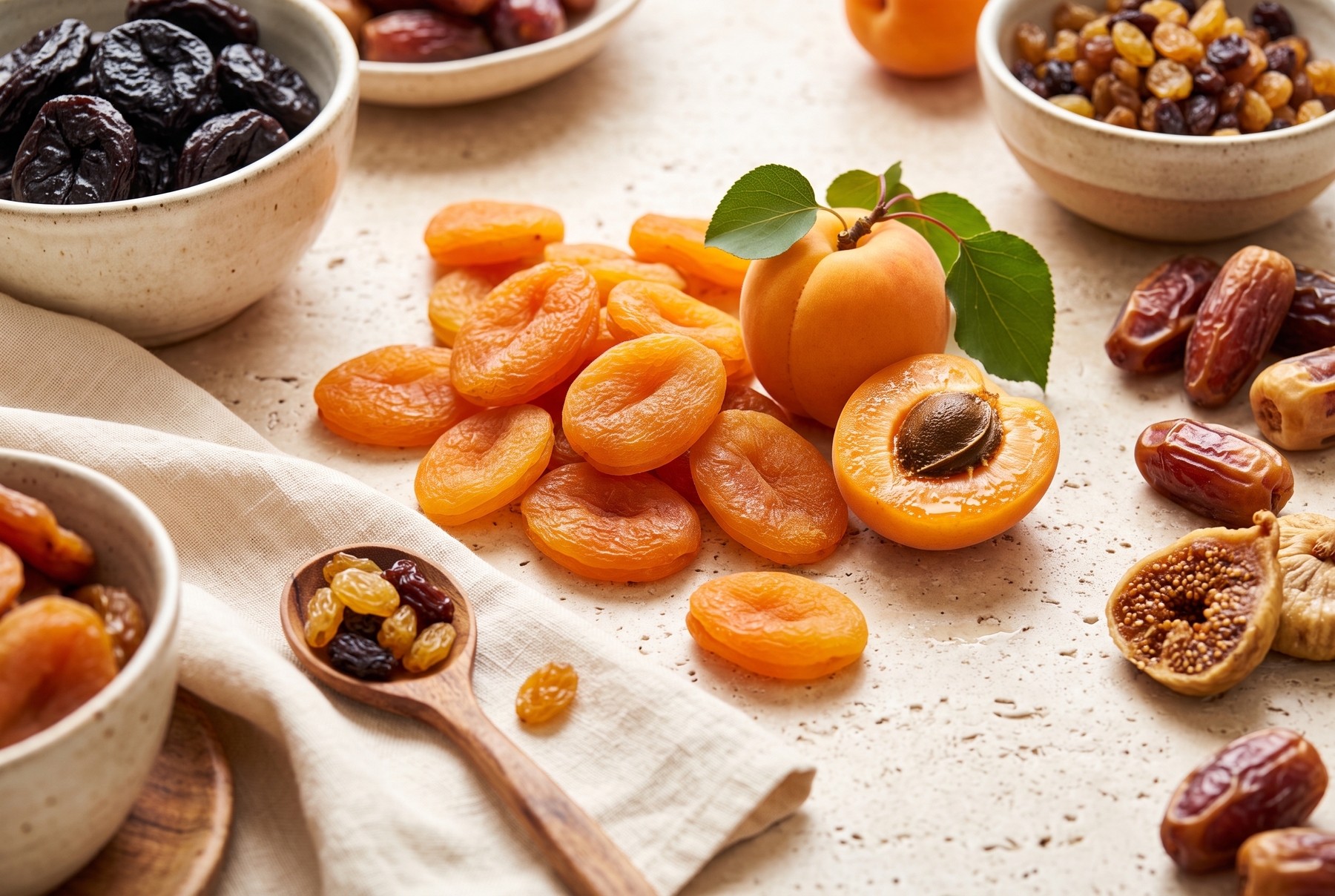
Dried fruit retains the vitamins and minerals of fresh produce, but packs significantly more sugar and calories into every 100 g (3.5 oz).
Table of Contents
- What Happens When Fruit Loses Its Water
- Is Dried Fruit Closer to Fresh Produce or Candy?
- Which Nutrients Actually Survive
- When Dried Fruit Wins and When Fresh Is Better
- Why Stopping at One Handful Is So Difficult
- Four Things to Check When Buying Dried Fruit
- Who Needs to Pay Extra Attention
- So, Is Dried Fruit Healthy or Just Concentrated Sugar?
What Happens When Fruit Loses Its Water
Fresh fruit consists primarily of water—grapes are about 80% water, and apricots contain even more. During the drying process (whether under the sun, in a dehydrator, or in an oven), the fruit loses the vast majority of this moisture. Everything else originally inside remains behind: sugars, fiber, minerals, and a portion of its vitamins. Now, however, all of these components are packed into a significantly smaller volume.
A 100 g (3.5 oz) serving of raisins contains roughly 299 kcal and about 65 g (2.3 oz) of sugar. That same 100 g (3.5 oz) of fresh grapes holds about a quarter of the sugars and calories. The grape did not magically transform into something else; the water simply evaporated, shrinking everything left behind.
Here is how the numbers break down across popular dried fruits.
| Product | Kcal / 100 g (3.5 oz) | Sugars / 100 g (3.5 oz) | Fiber / 100 g (3.5 oz) | Sugars per ~30 g (1 oz) Serving |
|---|---|---|---|---|
| Raisins | ~299 | ~65 g (2.3 oz) | ~4.5 g (0.16 oz) | ~20 g (0.7 oz) |
| Dried Apricots | ~241 | ~53 g (1.9 oz) | ~7 g (0.25 oz) | ~16 g (0.56 oz) |
| Prunes | ~240 | ~38 g (1.3 oz) | ~7 g (0.25 oz) | ~11 g (0.39 oz) |
| Dates | ~282 | ~63 g (2.2 oz) | ~8 g (0.28 oz) | ~19 g (0.67 oz) |
| Dried Figs | ~249 | ~48 g (1.7 oz) | ~10 g (0.35 oz) | ~14 g (0.49 oz) |
| Sweetened Cranberries | ~308 | ~73 g (2.6 oz) | ~5 g (0.18 oz) | ~22 g (0.78 oz) |
The exact numbers for your dried fruit may vary slightly depending on the variety and processing method. The final row stands in a category of its own: cranberries are almost always sweetened during processing, causing their sugar content to surpass even dates, despite their reputation as a tart, healthy berry.
Dried fruit remains true fruit, even though its sugars and calories are concentrated into a fraction of the original size.
Why a Small Handful Contains Multiple Fruits
A couple of dates or a few dried apricot halves disappear in a minute. Achieving that same sugar intake from fresh produce requires eating a much larger volume, which also takes considerably longer to chew. For perspective, dietitians equate a 30 g (1 oz) serving of dried fruit to roughly 80 g (2.8 oz) of fresh fruit. Thirty grams translates to about one tablespoon of raisins or three dried apricots. Visually, the portion looks modest, but in terms of energy and sugar, it equals a full serving of fresh fruit.
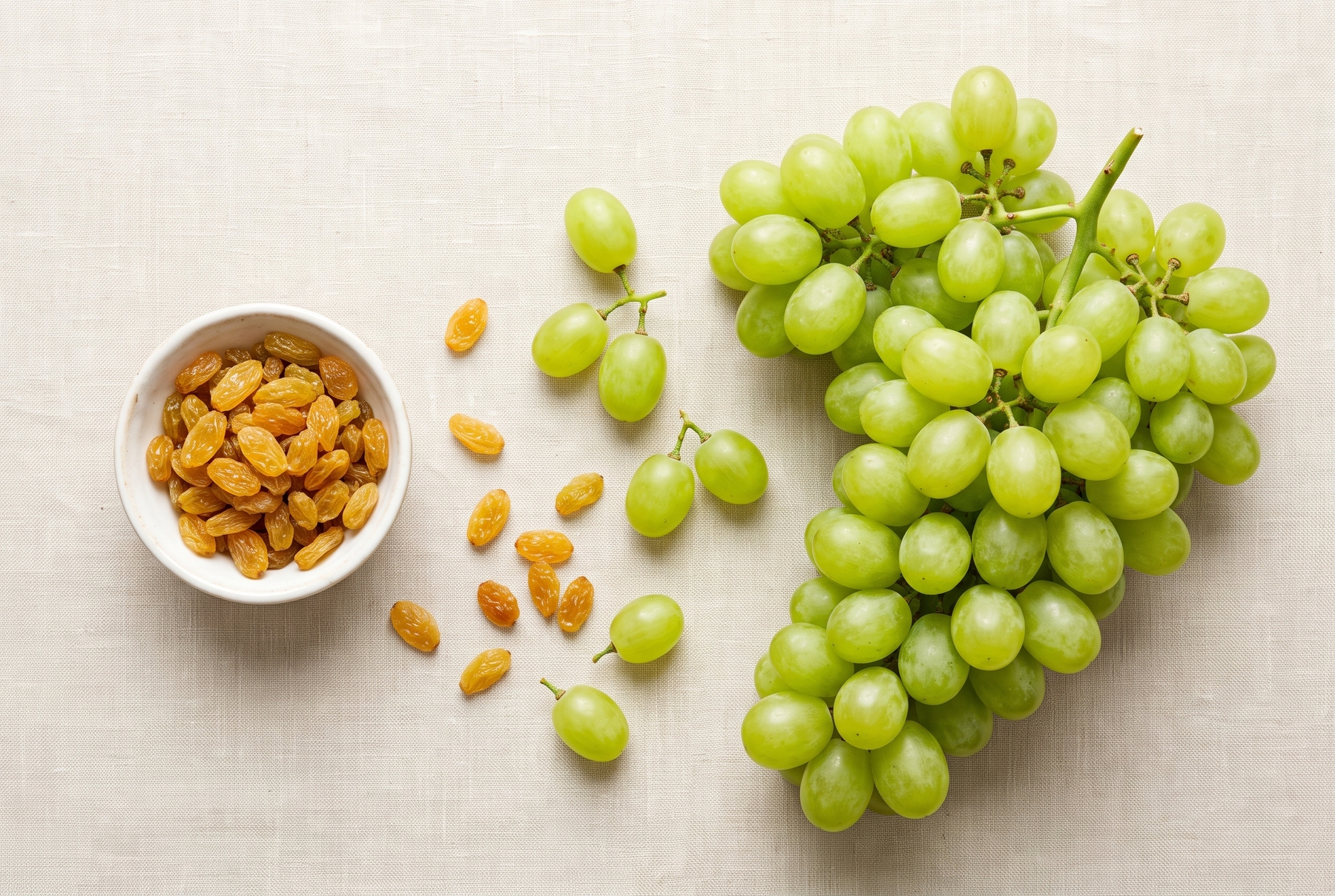
As water evaporates, the fruit shrinks, concentrating its natural sugars and dietary fiber into a much smaller volume.
Is Dried Fruit Closer to Fresh Produce or Candy?
The sugars in plain, whole dried fruit did not come from a sugar bowl; they are the exact same fructose and glucose molecules present in the fresh fruit. Conversely, candied fruits, sweetened dried mango, or commercial dried cranberries have extra sugar added during manufacturing. The ingredient list reveals this immediately, as sugar or syrup will appear as a separate entry.
However, a “natural” label and the absence of additives do not make the sugar content irrelevant. Total sugar load and caloric density matter to the body, though the food matrix also plays a crucial role. Dietary fiber slows carbohydrate absorption, which is why many unsweetened dried fruits—such as dried apricots, prunes, dates, and raisins—maintain a low-to-medium glycemic index (GI). Dried figs generally score higher, while fruits infused with syrup or coated in sugar behave very differently in the bloodstream.
Where to Draw the Line: Simply Dried vs. Sweetened
Unsweetened raisins, prunes, and dried apricots are simply dehydrated produce. Dried cranberries, pineapple, mango, and cherries are frequently steeped in syrup or dusted with sugar, pushing them much closer to confectionery. Distinguishing between the two is easier than it seems. Front-of-package claims like “eco,” “natural,” or “guilt-free” reflect marketing rather than reality. Turning the package over to read the ingredient list and nutrition facts panel provides the real answer. Any added sugar, syrup, or glaze must be declared in the ingredients.
Which Nutrients Actually Survive
Sugar is not the only component concentrated during dehydration. Dried fruits retain dietary fiber, potassium, and a portion of their antioxidants; dried apricots, for instance, provide a notable amount of iron. Gram for gram, dried fruit contains more fiber than its fresh counterpart, with prunes being particularly rich in it.
Still, the drying process does not preserve every nutrient equally. Vitamin C is highly sensitive to heat and oxygen exposure, meaning very little survives dehydration. Assuming dried apricots offer the exact same vitamin profile as fresh apricots is a mistake: some compounds endure, while others degrade. Checking the nutritional data for the specific product is always the best approach.
In traditional home cooking, dried fruit was never treated as a trendy superfood. Cooks simmered it into kompot (a traditional Eastern European stewed fruit beverage), folded it into pastry fillings, or served a small handful alongside hot tea. A few pieces with tea, a spoonful of raisins in morning oatmeal, and mindlessly eating half a bag while working represent vastly different nutritional realities.
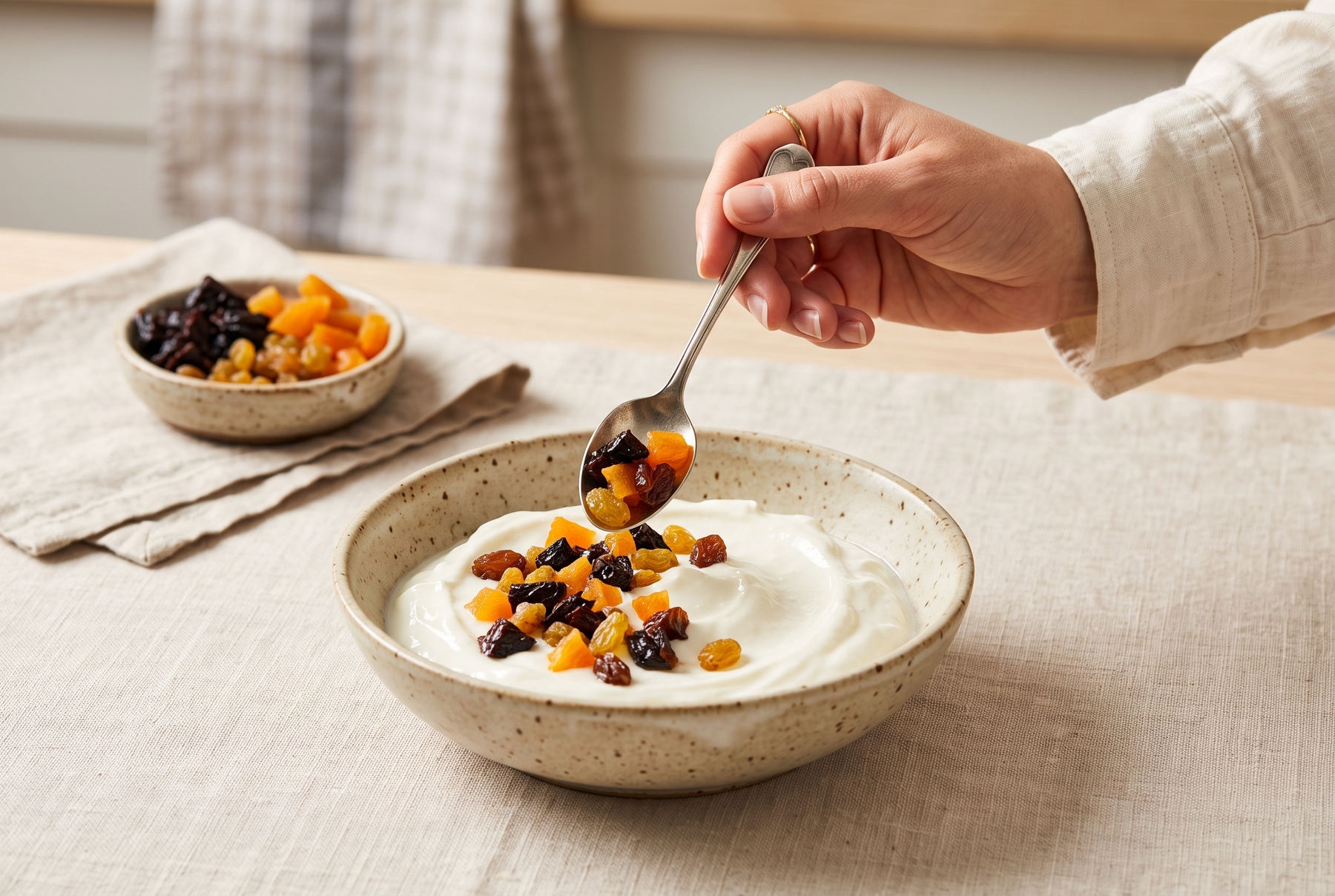
A spoonful of dried fruit in oatmeal or yogurt boosts dietary fiber and serves as a nutrient-dense alternative to refined sugar.
When Dried Fruit Wins and When Fresh Is Better
Dried fruit excels when portability and shelf life are priorities. It travels well without bruising, making it ideal for commuting or hiking, and easily stirs into oatmeal, tvorog (Eastern European farmer’s cheese) or cottage cheese, rice pilaf, and baked goods. On the trail, dried fruit delivers dense energy at a fraction of the weight, and in the pantry, it outlasts fresh produce by months.
For everyday snacking at home, fresh fruit usually has the upper hand for a different reason. Its high water content slows down eating and provides a larger, more filling volume for fewer calories. Eating a crisp apple takes much longer than chewing a handful of raisins with the equivalent caloric value. The better choice ultimately depends on context: dried fruit shines on a mountain trail, while fresh fruit makes more sense at a desk.
Why Stopping at One Handful Is So Difficult
Overeating dried fruit is notoriously easy: the pieces are intensely sweet, compact, and effortless to grab one by one from a large bag. A few pieces vanish unnoticed, followed by a few more, until half the package is gone. Consuming that same number of fresh apricots or apples would require significant time and trigger satiety signals much earlier.
Treating Dried Fruit as an Ingredient Rather Than an Endless Snack
Adopting a few simple habits changes how dried fruit functions in a diet. Portioning a small amount into a bowl and putting the bag away works far better than eating straight from the package. Pairing dried fruit with oatmeal, cottage cheese, or yogurt anchors it as part of a meal rather than a mindless finger food. A small sprinkle in porridge, salads, or dairy dishes adds plenty of flavor without needing to replace fresh produce entirely. The standard dietary guideline of a 30 g (1 oz) serving acts as a helpful benchmark rather than a rigid rule.
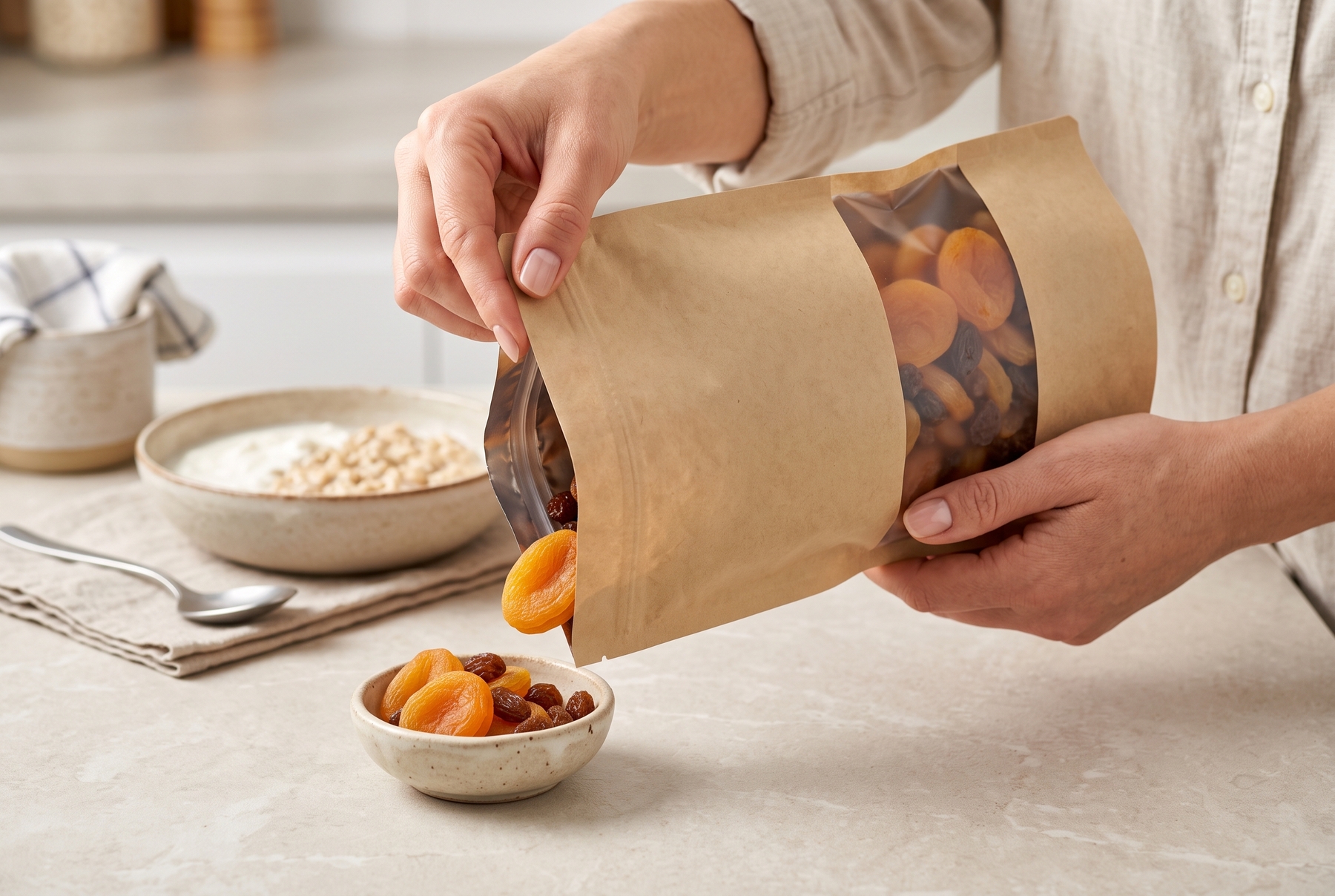
To prevent excess sugar intake, nutritionists recommend measuring out a single serving of dried fruit—about 30 g (1 oz)—in advance.
Four Things to Check When Buying Dried Fruit
- Ingredients: scan for added sugars, syrups, glazes, or vegetable oil coatings;
- Processing style: verify whether it is whole dehydrated fruit or candied pieces;
- Nutrition facts per 100 g (3.5 oz): use this to gauge just how concentrated the product is;
- Packaging and storage conditions: heat and moisture spoil dried fruit much faster than most shoppers realize.
A special note applies to sulfur dioxide (SO₂, often listed as preservative E220). Producers use it to treat light-colored dried fruits, especially apricots, to lock in their vibrant color and inhibit mold growth. Left untreated, a drying apricot oxidizes, turning a dull, dark brown rather than staying bright orange. Sulfur dioxide is a widely approved food additive. However, in 2022, the European Food Safety Authority (EFSA) noted it could not confirm a safe acceptable daily intake due to insufficient data, leaving the compound under ongoing review rather than giving it a permanent pass. Individuals with sulfite sensitivities and asthma patients must pay particular attention to this label. Calling the additive “poison” is inaccurate, just as assuming dark, unsulfured apricots are automatically healthier is flawed—they simply dry differently and take on a darker hue.
Who Needs to Pay Extra Attention
For anyone managing carbohydrate intake, blood sugar levels, or overall caloric density for medical reasons, portion sizes of dried fruit carry much more weight than they do for the average person. Pre-portioning servings becomes especially practical in these scenarios. Specific dietary protocols for diabetes or gastrointestinal conditions belong in a conversation with a healthcare provider rather than a general article.
When feeding young children, dried fruit presents a practical safety concern unrelated to sugar. Pediatric guidelines classify whole raisins and firm chunks of dried fruit as potential choking hazards for toddlers; for this age group, pieces should be soaked to soften, finely chopped, or mashed, and always served under supervision.
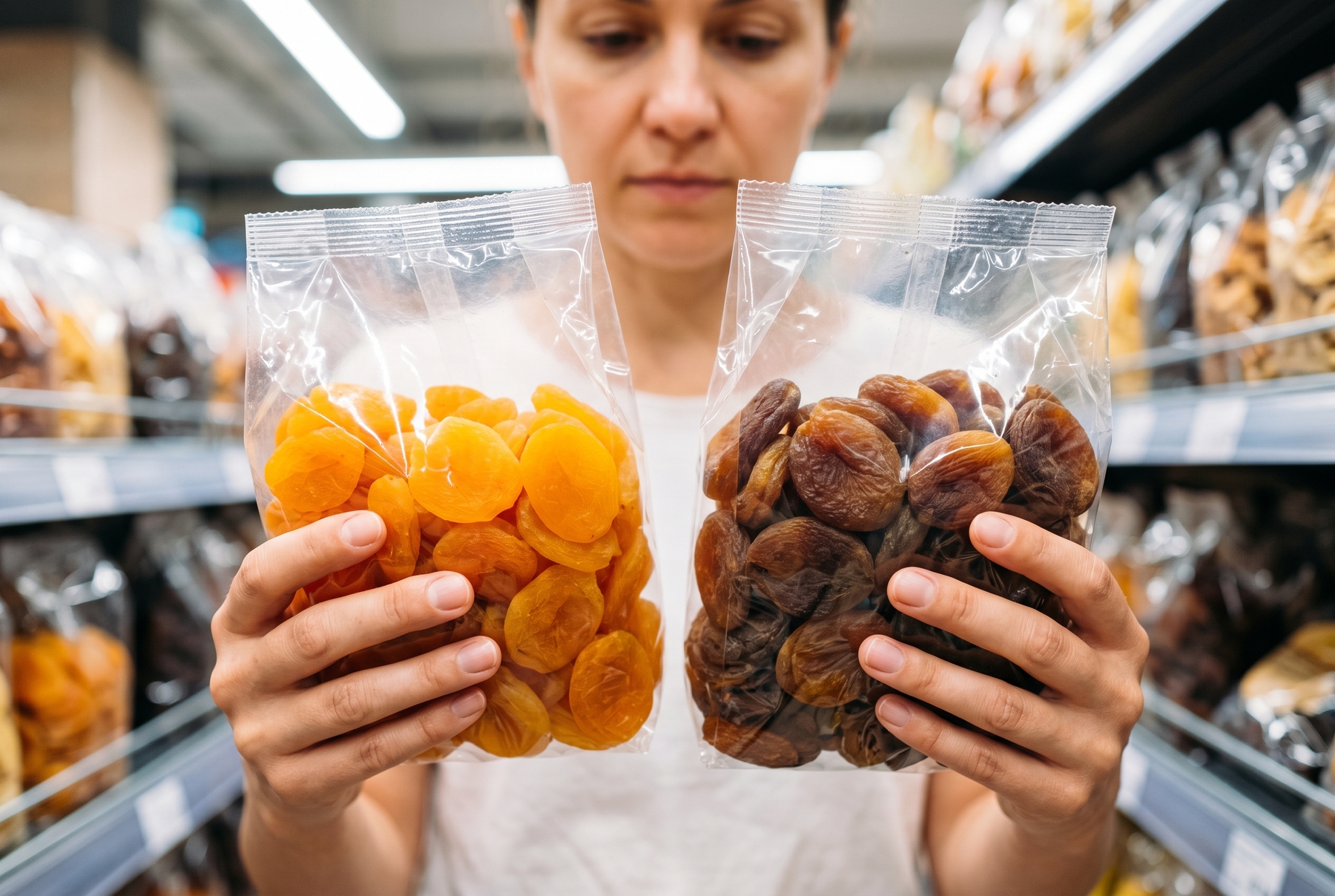
The vibrant orange hue of commercial dried apricots comes from sulfur dioxide (E220) treatment, whereas untreated apricots naturally darken as they dry.
So, Is Dried Fruit Healthy or Just Concentrated Sugar?
It is both at once, and there is no contradiction in that. Dried fruit packs a high concentration of natural sugars into a low-moisture package, making portion size the deciding factor. Yet it remains a whole-fruit product offering dietary fiber and essential micronutrients, which keeps it firmly out of the candy category by default. Evaluating the specific package in your hand—its ingredient list, serving size, and role on your plate—makes far more sense than debating the abstract healthfulness of dried fruit as a whole.
Standing in the grocery aisle, the real question is not “Am I allowed to eat dried fruit?” Instead, the inquiry is quieter and more grounded: What is actually in this bag, how much do I plan to eat, and why am I choosing fruit in this specific form? The answer rarely sits on the front of the pouch next to the illustration of a sun-ripened apricot. Almost always, it waits in the small print on the back.
0 comments