
My mother used to buy kefir without a second thought. Reaching out, she would grab a bottle with a green cap—and that was it. Her local grocery store carried only one option. Perhaps two. There was no ‘live’ kefir, no ‘thermostatic’ variety, and no mention of ‘prebiotics for immune flora support.’ It was just kefir—in a glass bottle, sealed with a foil cap that easily yielded to a thumb.
Today, the dairy aisle tells a different story. An average supermarket easily stocks twenty to twenty-five variations. Kefir at 1%, 2.5%, 3.2% fat, bio-kefir, Bifidok, Bifilife, thermostatic, farmer’s style, ‘with lactulose,’ ‘for immunity,’ ‘natural with no substitutes’ (whatever that means), meant for children, drinkable, and extra thick. Tucked somewhere at the end of the shelf sits a simple white bottle making no promises, which most people barely notice.
Standing before this display, you realize that what began as a quest for a simple staple has turned into a labyrinth. Kefir is fundamentally straightforward—a Soviet-era, almost homemade comfort food. Yet, the longer you stare at these labels, the less you understand what you are actually buying and what you are paying for.
Here is the truth. The health benefits of kefir do not depend on the large print splashed across the front of the packaging. The real value hides on the back: in the fine print of the ingredients, the fat percentage, the production date, and two or three technical terms that most shoppers glance over and ignore. It sounds tedious, but these are the very details that determine quality.
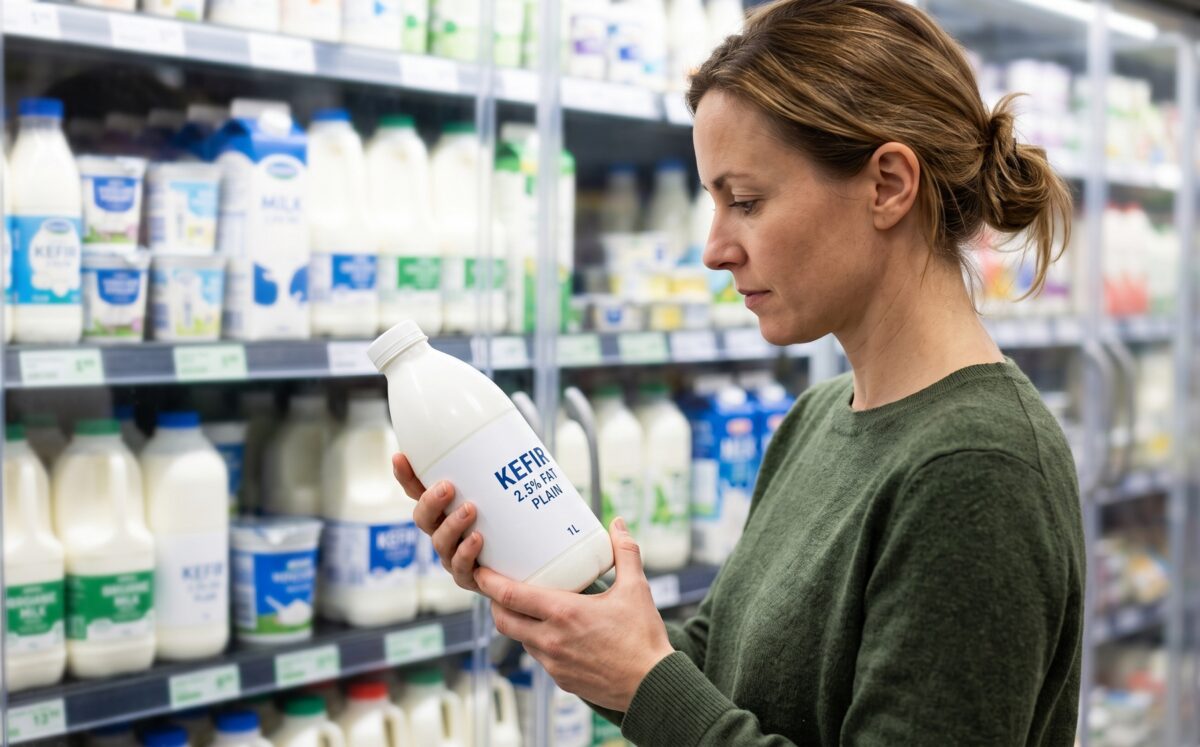
When choosing kefir, evaluating the information on the back—such as ingredients, fat content, and production date—proves far more important than focusing on the brand name.
Table of Contents
- 1. The Name. Kefir vs. Kefir Product: Understanding the Difference
- 2. The Ingredients of Real Kefir: Why It Is a Truly Living Food
- 3. Thermal Processing: When Pasteurization Does Not Harm Kefir
- 4. Fat Content: Why 0% Is Not a Panacea
- 5. Shelf Life: The Longer It Lasts, the More Doubts Arise
- Types of Kefir: Are They Worth the Extra Cost?
- How Proper Kefir Should Look and Smell
- Which Kefir Works Best for Different Culinary Needs
1. The Name. Kefir vs. Kefir Product: Understanding the Difference
There is an enormous technological gap between kefir and a ‘kefir product.’
Labels reading ‘kefir product,’ ‘cultured milk beverage with kefir cultures,’ or ‘kefir-based product’ signify adjacent categories rather than genuine kefir. Scrutinizing the ingredient list is especially crucial here: they often contain added sugar, fillers, flavorings, stabilizers, and extra dairy components.
The ideal composition for everyday kefir is simple: milk and a starter culture of kefir grains (a symbiotic matrix of bacteria and yeast). If the wording on the label drifts toward ‘kefir cultures,’ ‘based beverage,’ or features a lengthy ingredient list, the packaging demands closer inspection.
2. The Ingredients of Real Kefir: Why It Is a Truly Living Food
Authentic kefir consists of milk fermented with kefir grains. This symbiotic culture hosts both lactic acid bacteria and yeast working in tandem—which gives kefir its distinct character: tangy, slightly effervescent, and invigorating. It is not a sweet, creamy mass, nor is it watery cultured milk—it is something with real personality and a sharp edge.
Yogurt is milder, thicker, and often loaded with sweet additions. Ryazhenka (a traditional baked milk beverage) smells of baked milk with caramel undertones—warm and enveloping. Prostokvasha (a simpler clabbered milk) offers a more uniform acidity without the yeasty notes. Kefir leans closer to something sharp and refreshing: it slightly tingles the tongue and leaves a clean, rather than heavy, aftertaste.
The specific taste of kefir does not appeal to everyone, but for those who love it, it remains one of the most straightforward options in the entire dairy aisle.
The Ingredient List: The Shorter, the More Honest
An ideal kefir ingredient list contains two ingredients: milk and starter culture. Sometimes there are clarifications: standardized milk (meaning milk adjusted to a specific fat percentage), whole milk, skim milk, or reconstituted milk. These are standard manufacturing terms and should not cause alarm.
Other additions should raise a red flag. Sugar in kefir—why is it there? Fruit fillings transform it into a different product altogether, moving away from true kefir. Starches and stabilizers indicate that the texture was achieved artificially. Flavorings have absolutely no place in real kefir. Vegetable fats in a product labeled as kefir are not just a minor nuance. They are a stop sign: such an item should not be sold as regular kefir; it belongs in a different category with a different name.
If the front of the packaging promises immunity, lightness, gut health, and other vague, wholesome benefits, turning the bottle around to read the ingredients is a wise move. The back label usually speaks more honestly.
3. Thermal Processing: When Pasteurization Does Not Harm Kefir
A common misconception persists: ‘live’ kefir must be made from raw milk, and if the milk is pasteurized, the product is dead, offering zero benefits.
In commercial facilities, milk is almost always pasteurized for safety reasons—this is standard practice. A live starter culture is then introduced into this milk for fermentation. Pasteurizing the milk before fermentation does not hinder kefir’s benefits: post-fermentation, it thrives with the very bacteria and yeast we buy kefir for.
The real question lies elsewhere. What happens to the kefir after it has already fermented?
If the product undergoes thermal processing after fermentation, it may remain edible and safe, but it ceases to be live kefir in the traditional sense. In this case, shoppers should look for words like ‘thermized,’ ‘fermented product,’ or ‘produced using kefir technology’ on the label—manufacturers are required to state this, though the print can sometimes be suspiciously small.
Good kefir does not have to come from raw milk. Pasteurizing milk prior to adding the culture is not an issue. Heating the finished kefir after fermentation—that is where the real compromise happens.
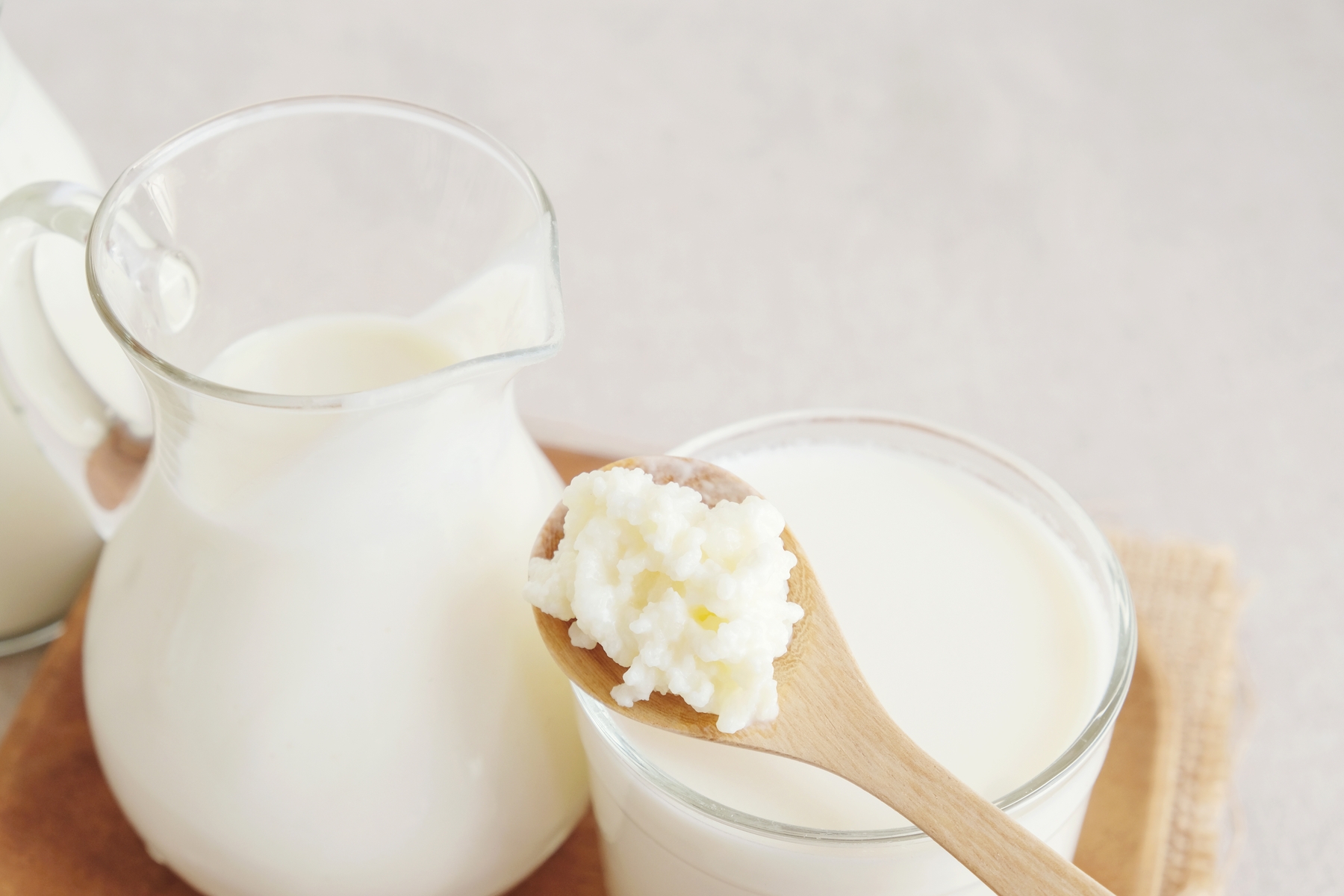
Authentic kefir represents a living food, created through the fermentation process of a symbiotic culture known as kefir grains.
4. Fat Content: Why 0% Is Not a Panacea
A frequent question arises: which fat percentage in kefir is the healthiest? The familiar logic of ‘less fat equals healthier’ does not apply universally, and certainly not with kefir.
Yes, non-fat kefir carries fewer calories, but it often tastes more sour and watery. Drinking it leaves you hungry again an hour later. For most people on a standard diet, 2.5–3.2% fat kefir is much more satisfying: it is milder in acidity, richer, and registers as real food rather than just liquid in a bottle.
Non-fat options are appropriate if someone is consciously reducing caloric intake, following a doctor’s recommendation, or using the kefir in pancake batter, cold soups, or smoothies—where the fat content plays almost no role.
Full-fat, whole milk kefir shines at breakfast, as a snack, in marinades, or in okroshka (a traditional cold soup). It excels where flavor and satiety are paramount. The right fat percentage comes down to personal taste and culinary intentions.
5. Shelf Life: The Longer It Lasts, the More Doubts Arise
The shelf life of kefir depends on both the packaging and the technology used. Tetra Paks preserve the product longer than thin plastic cups—this is expected. High-quality packaging safely extends the life of kefir.
However, if a kefir boasts a shelf life of three weeks or more, it is time to read not just the ingredients, but the full product name, the fine print, and the storage instructions. Look for terms like ‘thermized,’ ‘fermented product,’ or ‘using kefir technology.’ The shelf life of natural kefir generally falls between ten and fourteen days. A prolonged shelf life is not an immediate reason to abandon the purchase, but it is a reason to scrutinize the label.
In the store, kefir should always be taken from the refrigerator, not from a warm promotional display in the aisle. Checking the date is essential. The packaging should be free of bloating, leaks, or deformities. At home, it must be stored in the refrigerator, tightly sealed.
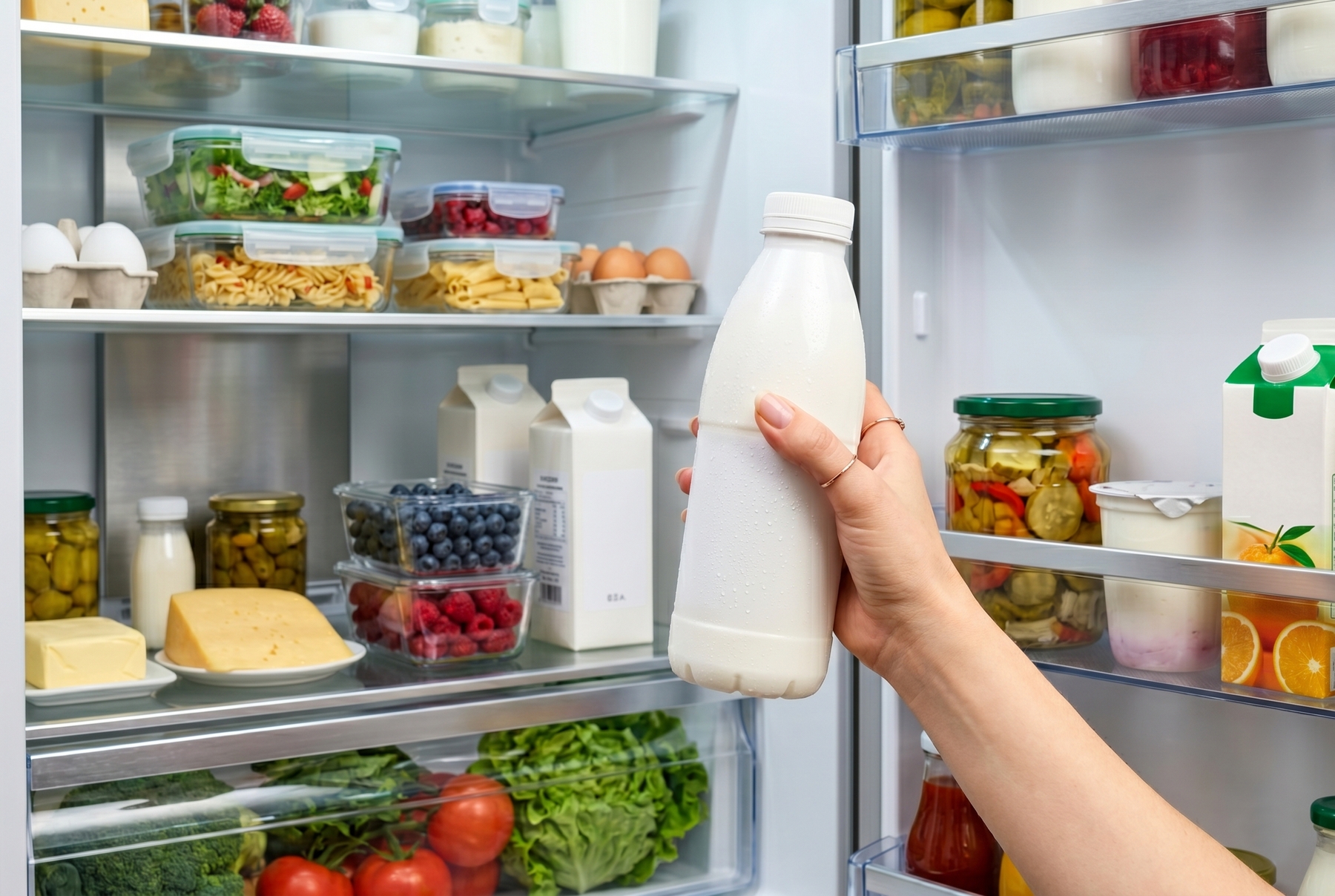
Maintaining proper temperature control both in the store and at home ensures that kefir retains its beneficial properties.
Types of Kefir: Are They Worth the Extra Cost?
What Is Thermostatic Kefir and How Does It Differ from Regular Kefir?
Thermostatic kefir ripens directly in the bottle or cup, rather than in a massive vat from which it is later poured. This gives it a distinct texture: denser, more delicate, with a curd that remains mechanically unbroken. Sometimes the flavor is slightly milder, evoking a homemade feel—reminiscent of what a grandmother might ferment in a jar on a windowsill.
Many appreciate this style. However, the word ‘thermostatic’ does not automatically make the product the healthiest option on the shelf. It describes the production method and consistency, not necessarily the overall quality. The ingredients and shelf life of thermostatic kefir demand the same attention as any other variety.
Bio-kefir, Bifidok, and Everything with a ‘Bifido’ Prefix
Standard, high-quality kefir with a short ingredient list is by no means an empty product. It naturally hosts beneficial microflora from the starter culture.
The ‘bifido’ versions distinguish themselves by introducing additional bifidobacteria or emphasizing specific cultures. It sounds excellent, but the actual benefits depend on the quality of the starter, proper temperature control during transport, and an honest ingredient list.
If a bio-kefir contains sugar, fruit fillings, and flavorings, while a regular kefir with a two-ingredient list sits nearby—the latter is likely the superior everyday choice. The prefix ‘bifido’ does not negate the need to read the label.
How Proper Kefir Should Look and Smell
Good kefir presents as white or creamy-white. It should be uniform. A slight separation of whey is not a catastrophe; shaking the bottle usually resolves it. The aroma should be clean, distinctly cultured, and slightly sharp—exactly as intended. It must never smell musty, harsh, or harbor strange, off-flavors.
Moderate tartness is desirable. Bitterness is not. Uncharacteristic flakes, mold, or a pungent odor mean the product should be discarded—there is no need for heroics to save a couple of dollars.
If the kefir has become more acidic but remains within its expiration date, was stored in the refrigerator, and shows no signs of spoilage, it is perfect for pancakes, fritters, chicken marinades, or baking dough. Sour kefir often performs even better than fresh in batters: it reacts robustly with baking soda, yielding fluffy baked goods with a slightly crisp exterior and a tender crumb. But if the date has passed, the packaging has swollen, the smell is suspect, or the taste is strange—do not try to save it through baking; pour it down the drain.
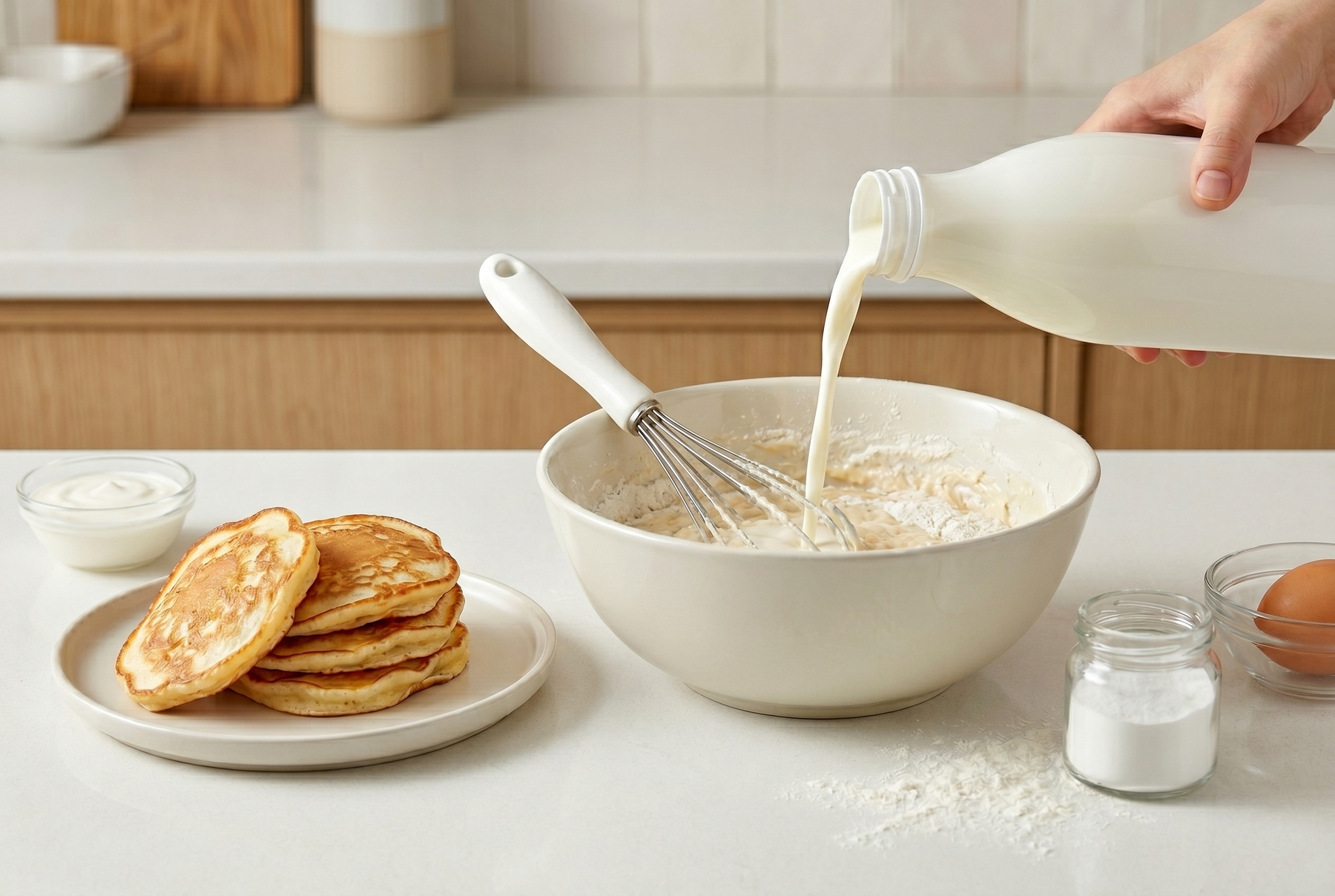
Kefir functions as an ideal baking ingredient: its natural acidity reacts with baking soda, ensuring incredibly fluffy pancakes and fritters.
Which Kefir Works Best for Different Culinary Needs
- For daily drinking: No sugar, no additives, choosing a fat content that suits your goals and taste. No unnecessary text on the label.
- For children: No sugar, no flavorings, featuring a transparent ingredient list. There is no need to make kefir an obligation or force them to drink it ‘because it is healthy.’
- For okroshka (cold soup): Not overly thick, boasting a good tang. A fat content of 1–2.5% is convenient, but this is primarily a matter of personal preference.
- For pancakes and fritters (blini and oladyi): Kefir with pronounced acidity works best. Buying an expensive thermostatic version is unnecessary—a simple, even slightly over-soured kefir performs beautifully, provided all storage conditions were met.
- For meat marinades: Regular kefir without sugar or additives. The acidity and dairy components tenderize meat fibers, working exceptionally well on chicken. A few hours in kefir with garlic and black pepper transforms the meat: it becomes tender, acquiring a slight tang that cooks off during roasting, leaving the meat incredibly juicy.
Good kefir does not need to be artisan, thermostatic, adorned with three types of ‘bifido’ cultures, or promising a new lease on life. More often than not, the best choice in the dairy aisle is a boring bottle with a solid ingredient list, a straightforward fat content, and an honest, cultured milk aroma.
A couple of words in the ingredients. A reasonable date. And the refrigerator as its permanent residence—both at home and in the store.
0 comments