
Bread in itself rarely frightens parents. The real anxiety arises when the diet goes off track: your child pushes away their plate of food for the third day in a row and reaches for the bread basket, leaving you calculating how much real food they actually consumed.
Bread inherently does not ruin a child’s nutrition, nor does it become a problem simply because a child loves it. It comfortably coexists in a diet alongside soup, porridge, meat, and vegetables, right up until the moment it starts replacing them. A single slice of bread at lunch is never the issue. The trouble begins when bread becomes the only food a child accepts, serving as a tool to comfort, distract, or stall until bedtime, gradually replacing normal meals.
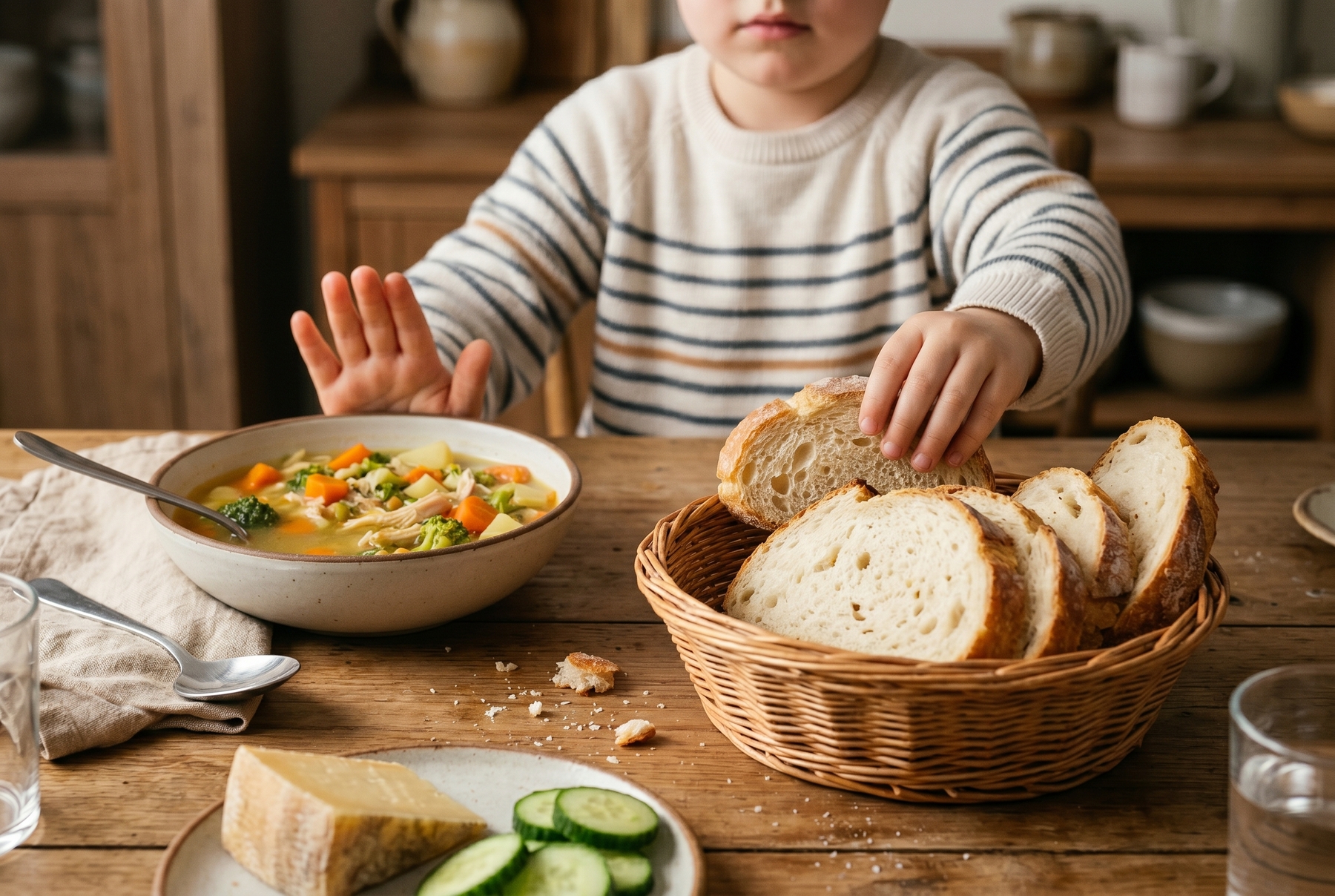
When bread begins pushing out main dishes, it becomes a reason to analyze a child's eating habits.
Table of Contents
- Why A Child Loves Bread And Frequently Asks For It
- When A Child Eats A Lot Of Bread, But It Remains Normal
- When To Pay Closer Attention
- Which Bread Suits A Child: Differences Matter
- The Main Mistake: Fighting Against Bread
- What To Do If A Child Constantly Asks For Bread
- What To Do If A Child Eats Only Bread And A Couple Of Other Foods
- Home Cheat Sheet: Is Everything Alright?
- A Few Quick Ideas To Make Bread Work For The Diet
- Bread In Its Proper Place
Why A Child Loves Bread And Frequently Asks For It
Why Bread Feels Safe To A Child
Bread is soft. It requires little chewing, holds no surprising flavors, neither burns nor tastes sour, and lacks any alarming aromas. For a child, this represents a meal with minimal risk: they take a bite and instantly know what to expect. Compare this to soup containing unfamiliar floating ingredients, or a vegetable stew that changes texture from day to day. Bread remains consistently the same. It provides quick satiety and that precise physical comfort which adults, frankly speaking, also seek when breaking off a crust on their way from the stove to the table.
When Bread Becomes A Habit
Bread often ends up in a child’s hands entirely unrelated to hunger. Parents hand it over to stop tears in a line. They offer a piece before dinner because the child insists. They use it to reward picking up toys, or to buy ten minutes of peace while finishing the cooking.
Truthfully, a crust of bread occasionally saves the evening, and this does not make anyone a bad parent. Having three children of my own, I perfectly remember evenings when the youngest whined, the eldest screamed over homework, and the middle one demanded attention. Yes, a slice of bread and butter bought me 15 minutes of silence during those moments. One isolated episode defines nothing. It becomes concerning if bread serves as the universal answer to everything: the child feels bored, tired, upset, or argues with a sibling, and the solution consistently involves offering bread.
Sometimes A Child Truly Remains Hungry And Fills Up On Bread
A third scenario exists, and it likely represents the most common one: the child under-eats during main meals and compensates with bread. A liquid breakfast, such as sweet cocoa paired with a couple of cookies, sustains fullness for about 40 minutes. A lunch consisting solely of a side dish without protein disappears just as quickly. When a plate lacks sufficient meat, fish, eggs, cottage cheese, healthy fats, and vegetables, the body soon demands food again, and bread emerges as the most accessible option.
You do not need medical diagnoses or laboratory tests here. Simply looking honestly at what the child ate since morning and evaluating their daily table routine provides enough insight.
When A Child Eats A Lot Of Bread, But It Remains Normal
In most cases, there is nothing special to scrutinize. If a child grows, gains weight according to their curve, runs, sleeps, maintains an appetite for familiar dishes, and happens to love bread, they simply love it. In many cultures, bread graces almost every dining table: soup with bread, main courses with bread, a slice alongside a cutlet. This represents a food culture rather than a symptom.
Bread served next to other food should not bother anyone. If it suddenly runs out, the child calmly finishes lunch without it, and nothing terrible occurs. An extra slice dipped into a thick borscht (a traditional Eastern European beet soup) remains perfectly normal. Parents only need to look closer when bread becomes the only item a child agrees to eat.
When To Pay Closer Attention
Bread Pushes Everything Else Aside
Certain behaviors warrant attention: a child refuses breakfast, lunch, and dinner, yet asks for bread half an hour later. The plate remains untouched, while a whole loaf disappears instantly. This includes situations where a child exclusively eats white bread, buns, or crackers, flatly refusing anything else. A less obvious variation also exists: the child seemingly agrees to eat, but only “with bread,” ultimately consuming a full slice and a couple of spoonfuls of soup merely for appearances.
When Bread Helps Manage Emotions
Food possesses the ability to comfort, which holds nothing inherently terrible: everyone occasionally eats to cope with a hard day. Different signs should raise concern. When a child reaches for bread not out of hunger, but out of boredom, anxiety, resentment, or a lack of occupation, the issue extends beyond their diet. Parents must look at the broader picture: whether the child sleeps enough, faces overload from after-school activities, or experiences stress at the dining table. If lunch daily features shouts of “eat immediately” accompanied by sniffles, bread quickly transforms into the only food they can claim without a battle.
Symptoms You Cannot Write Off As A Habit
If a love for bread accompanies other physical signs, parents should consult a pediatrician rather than guessing in the kitchen.
A visit to the doctor becomes necessary if you notice:
- regular abdominal pain, especially after eating;
- noticeable bloating, heaviness, or frequent stomach complaints;
- chronic constipation or, conversely, frequent loose stools;
- poor weight and height gain, when the child seems frozen in place;
- a sharp change in appetite without an obvious reason;
- constant lethargy, paleness, or irritability;
- rashes, itching, or other allergy-like reactions.
Certain individuals experience conditions where wheat and bread genuinely pose a problem. With celiac disease, the immune system reacts painfully to gluten (a protein found in wheat, rye, and barley), eventually damaging the intestinal lining. Wheat allergies occur when the immune system responds to its specific proteins. Sometimes the issue lies in food intolerance: neither an allergy nor an autoimmune mechanism exists, yet the stomach reacts just as unpleasantly. Distinguishing these conditions by eye remains impossible. When alarming signs appear, undergoing doctor-prescribed tests proves wiser than removing bread randomly. If celiac disease is suspected, an abrupt elimination of gluten before testing can blur the clinical picture and complicate the diagnosis.
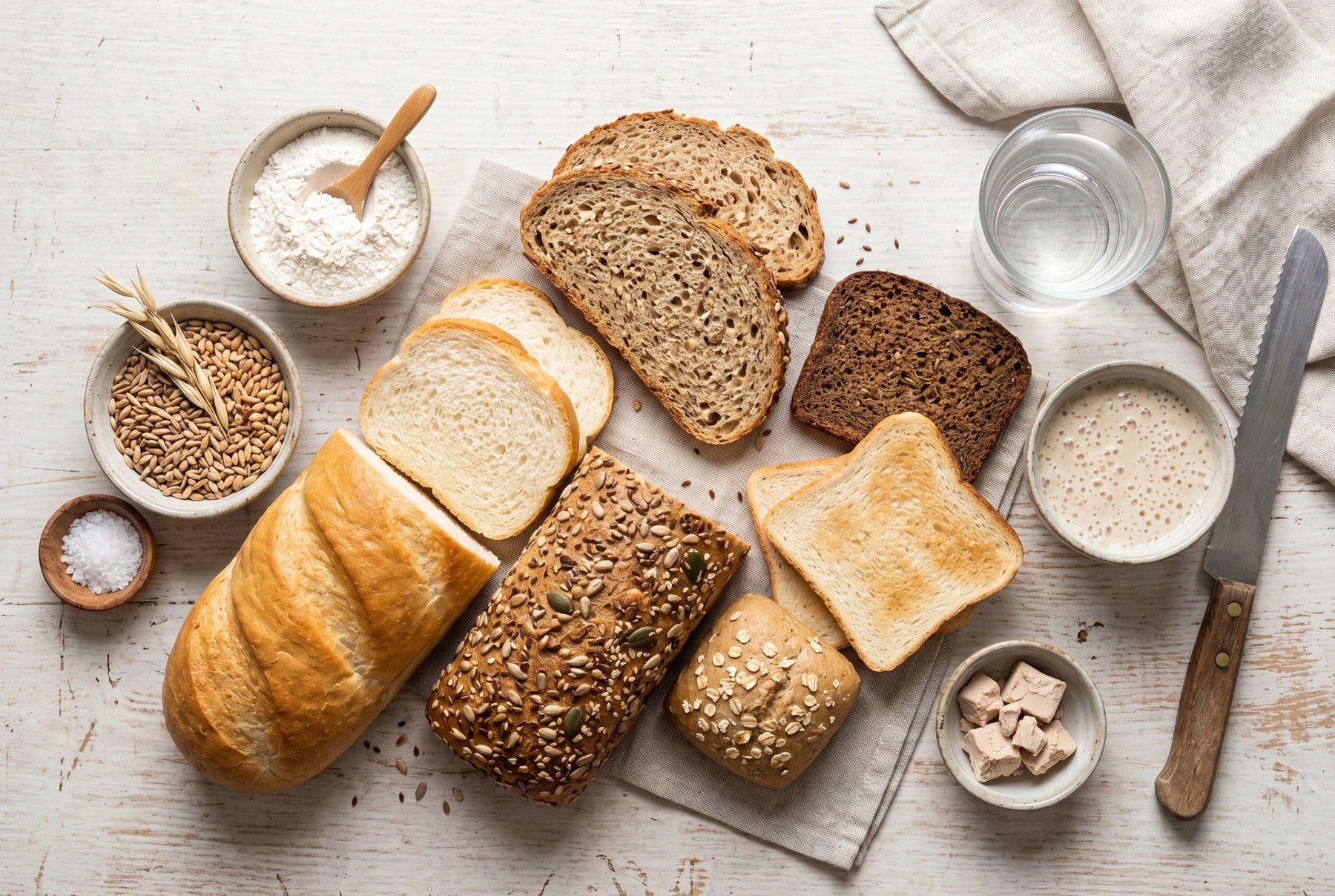
Different bread varieties carry distinct nutritional values; whole grain options contain more dietary fiber and sustain fullness much longer.
Which Bread Suits A Child: Differences Matter
White, Whole Grain, Rye, Toasting Bread: How They Differ
Not all bread is created equal, and this matters for a child’s table. A white loaf remains the softest and most familiar to a child, yet it lacks dietary fiber and fails to satisfy hunger for long. Whole grain bread carries a rougher flavor but offers more fiber, sustaining fullness much longer. Rye bread, carrying a distinct tanginess and dense crumb, does not appeal to every child, especially young ones, as its bold taste requires an acquired appreciation. Airy toasting bread works conveniently for sandwiches, yet the sliced varieties in plastic bags frequently contain sugar, oils, and softening additives, demanding closer attention to the ingredient list. Generalizing remains impossible: decent toasting bread exists alongside white loaves featuring long lists of random ingredients. Parents must check the composition rather than the name.
What To Look For In The Ingredients
An excellent basic ingredient list stays short and recognizable: flour, water, sourdough starter or yeast, and salt. Sometimes it includes a little sugar (which yeast needs to work) and vegetable oil. Seeds, bran, and whole grains represent a bonus rather than a cause for alarm. A long list alone does not signal doom: emulsifiers and improvers often support texture and shelf life, and most remain perfectly safe. Sugar, however, requires attention. If it appears among the first ingredients, you hold a sweet pastry rather than everyday sandwich bread. Bread should not taste sweet. Sweet sliced bread leans closer to a dessert pastry than a companion for soup.
How Trustworthy Bread Looks
Hands and nose, rather than the label, determine everything here. Fresh bread feels resilient: pressing the crumb makes it slowly return to its shape. If a finger sinks in leaving a dent while the crumb feels sticky, the bread either remains raw inside or has already started spoiling. The aroma must stay simple and bready. Any sourness, alcohol scent, or musty odor means a hard stop. The golden rule regarding mold: if even a tiny speck appears on the crust, the entire loaf goes into the trash, rather than just cutting off the suspicious corner. Mold grows through deep threads, meaning the unseen portion usually spans wider than it appears.
Storing bread at home proves easiest in a breadbox or a fabric bag placed in a dry spot. A plastic bag causes it to become damp and moldy much faster, especially if sealed inside while still warm.
The Main Mistake: Fighting Against Bread
Declaring bread an enemy instantly transforms it into the most desired object in the house. A forbidden product always tastes better. I lived through this: the more persistently you say “do not take more bread,” the more often you find crumbs under pillows and half-eaten crusts behind the sofa. Children master the art of eating stealthily, leaving parents devoid of both dietary control and normal conversations about food.
A parent’s goal does not involve defeating a loaf of bread. You neither need to forbid bread, demonize it, nor hand it out as a reward for eating broccoli (which only increases its value). Bread simply needs returning to its ordinary place: next to soup, porridge, and meat, serving as a component of the meal rather than a trophy or a consolation prize.
What To Do If A Child Constantly Asks For Bread
Give Bread Some Support
The most effective strategy involves stopping the confiscation of bread and starting to add elements to it. I use a simple formula to build bread-based meals for a child: bread plus protein, plus a vegetable or fruit, plus a dairy or fat component. A slice of bread alone satisfies hunger for about an hour. That same slice topped with cream cheese, a cucumber round, and a slice of turkey maintains fullness significantly longer because the protein and fat slow down the entire digestion process.
In practical terms, this means toast with an egg and a tomato; bread featuring cream cheese and cucumber; a turkey sandwich paired with lettuce and an apple slice; a piece of bread accompanying thick soup instead of replacing it; or bread with cheese and a piece of boiled chicken.
The bread never vanished. It simply works as part of a team now, rather than taking the fall for the entire lunch alone.
Fit Bread Into The Meal Schedule
Bread stays within meal boundaries much better when the meals actually have boundaries. If a child chews on something every 20 minutes, they arrive at lunch lacking an appetite, refuse their soup, ask for bread again, and the cycle repeats. Introducing a strict military schedule remains unnecessary. Parents simply need a rough understanding of breakfast, lunch, an afternoon snack, and dinner times, avoiding handing out bread in between just because a child asks. Between meals, offering water or, if the child truly feels hungry, a proper snack—like fruit, yogurt, or a balanced sandwich—works far better than handing them a dry piece of bread on the go.
Negotiate Without Pressure
Half the success lies in phrasing. “Stop eating only bread” forces a child into a defensive position, guaranteeing things will only worsen. A calm, non-restrictive approach yields better results: “let’s add something to the bread so you stay full longer,” “we are having bread with soup today,” or “let’s choose what goes into our sandwich first, and then cut the bread.”
The distinction remains subtle, yet a child feels it. The first scenario takes something away. The second scenario offers a choice and leaves the bread on the table, simply surrounded by other foods.
Gradually Expand Flavor Profiles
Flavors expand through presentation forms rather than persuasion. Parents can serve the exact same bread in a dozen ways, turning a routine lunch into a small adventure. Toasting bread cubes in the oven creates homemade croutons for soup (which taste better than store-bought ones and lack unnecessary additives). Slicing thin breadsticks pairs perfectly with soft cheese or a vegetable dip. Setting up a DIY sandwich station allows a child to select their own fillings from several bowls.
Parents definitely should avoid hiding “healthy” foods through deception. A child eventually discovers a zucchini hidden inside a meat patty, forcing you to rebuild the mealtime trust you worked so hard to establish. A transparent plate always beats a game of vegetable hide-and-seek.
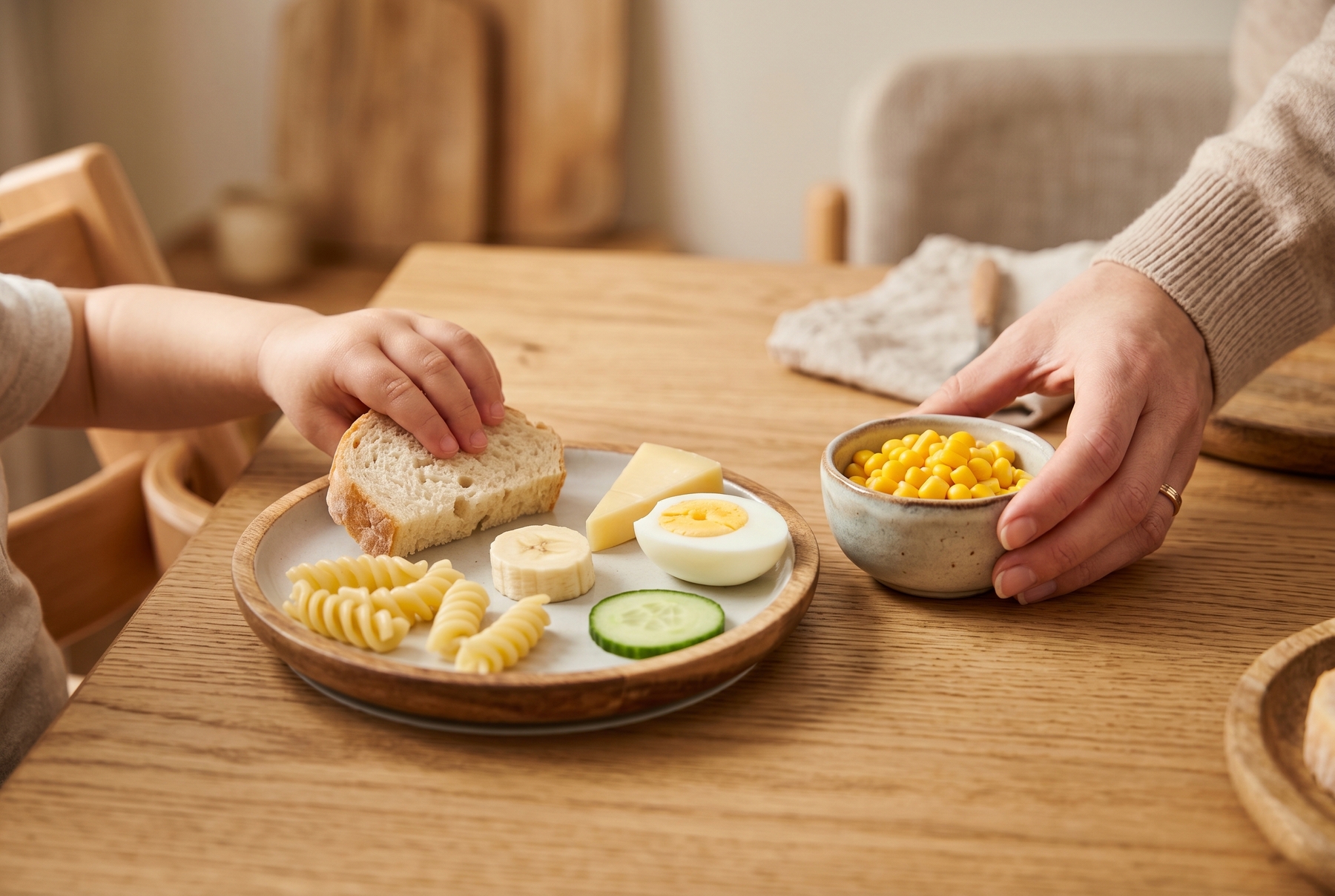
Offering new foods next to their favorite bread helps a child gradually adapt to diverse flavors without applying pressure.
What To Do If A Child Eats Only Bread And A Couple Of Other Foods
Some children maintain an edible list that fits on the palm of a hand: bread, plain pasta, maybe a banana, and a sausage. This presents a completely different scenario, where applying pressure poses the highest risk. The harder you force them, the narrower the list becomes: the child builds defenses, and the food they happily ate yesterday lands on the blacklist tomorrow.
Practical steps actually help. Keep an unjudging record of what the child genuinely eats for a week: the actual food volume often exceeds what you imagined during moments of panic. Inspect the snacks: if a constant stream of cookies and juice flows between meals, the child arrives at the table full and devoid of hunger. Introduce new items alongside their “safe” foods: placing an unfamiliar product on the same plate as their beloved bread feels less intimidating. Avoid bargaining at the table: “one more spoonful for grandma” turns dining into a transaction and destroys the appetite. If the diet remains genuinely restricted and fails to expand for months, or if weight loss and severe food anxiety occur, consulting a pediatrician or a pediatric dietitian represents a normal, proactive step rather than a defeat.
Severe picky eating sometimes goes beyond mere capriciousness, revealing a specific condition that specialists address. The mere fact that you monitor the situation already holds significant value.
Home Cheat Sheet: Is Everything Alright?
Keep a few calm, non-threatening questions in mind to quickly assess the situation:
- does the child eat anything besides bread throughout the day;
- does protein reach the plate: eggs, meat, fish, cottage cheese, cheese, or legumes;
- do vegetables or fruits appear in at least a format the child accepts;
- does bread completely replace breakfast, lunch, or dinner;
- are there any alarming symptoms concerning their stomach, weight, or overall well-being;
- has bread become the sole method for calming the child down.
If almost all answers bring peace of mind, you can exhale safely. Accumulating two or three concerning points in a row does not signal a need for panic, but rather a reason to calmly observe for a week and, if necessary, visit a doctor.
A Few Quick Ideas To Make Bread Work For The Diet
Here are several combinations easily assembled from everyday groceries without running to the store.
For breakfast: toast topped with an egg and tomato; bread smeared with cream cheese and thin cucumber slices; rye bread paired with a slice of lightly salted fish.
For an afternoon snack: crispbread topped with cottage cheese and an apple slice; half a cheese sandwich partnered with a glass of kefir (a fermented milk drink); homemade croutons alongside a handful of berries.
In a lunchbox: a chicken and lettuce sandwich accompanied by separately sliced cucumbers; a lavash (flatbread) roll stuffed with cheese and herbs; breadsticks served with a couple of hard cheese rounds.
For dinner: bread served with thick soup; toast holding an omelet and stewed vegetables; a sandwich layered with liver pâté and a pickle.
When the fridge looks completely empty, the basics save the day: bread, eggs, and cheese. Bread paired with a boiled egg and a pinch of salt. A hot cheese sandwich toasted on a dry pan. A slice of bread topped with mashed cottage cheese and either a sprinkle of salt or a spoonful of jam. It may lack aesthetic perfection, but the child stays full, which represents the entire point.
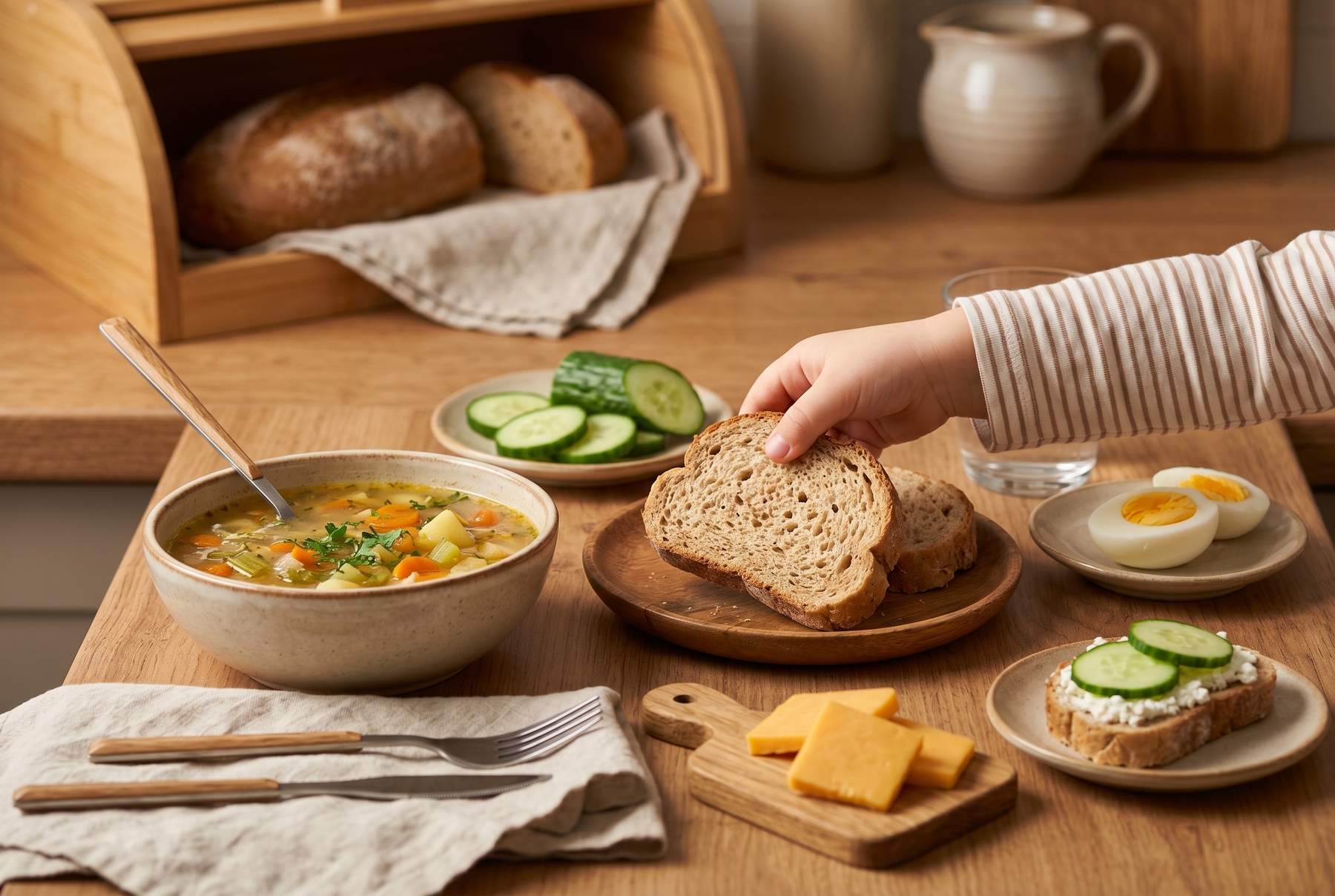
Bread serves as an excellent partner for proteins and vegetables. Combined with cheese or an egg, it transforms into a satisfying and healthy lunch component.
Bread In Its Proper Place
Removing the anxiety makes everything simpler. The bread crust poses no danger; the panic surrounding it causes the real harm: negotiations at every plate, strict bans, and hidden crumbs under pillows. Look at the entire day comprehensively rather than focusing on a single loaf of bread: evaluate what the child ate, how they sleep, how they grow, and whether their body sends signals requiring a doctor’s attention.
Allow the bread to sit peacefully in the breadbox, right where it belongs. It belongs next to a bowl of soup, a cucumber slice, and a piece of cheese, serving as just one component of an ordinary lunch.
0 comments