
It was February, during one of my first projects in Moscow. I was just figuring out the local cuisine: what people ate, how the market smelled, what home cooks kept on the shelf above the stove. The interns were sharp. One showed particular initiative.
I stepped out for five minutes. I returned to thick blue smoke. This was not a mild ‘something overcooked’ situation—it was real smoke that catches in the throat and clings to clothes. It smelled of burnt sunflower seeds, sharp and acrid. The intern stood by the stove looking confused, tongs in hand, while a filet mignon sat in the pan. It was good meat. He was cooking it in unrefined sunflower oil he had brought from home. ‘My grandmother’s, from Kuban (a famous agricultural region in Southern Russia), very aromatic.’
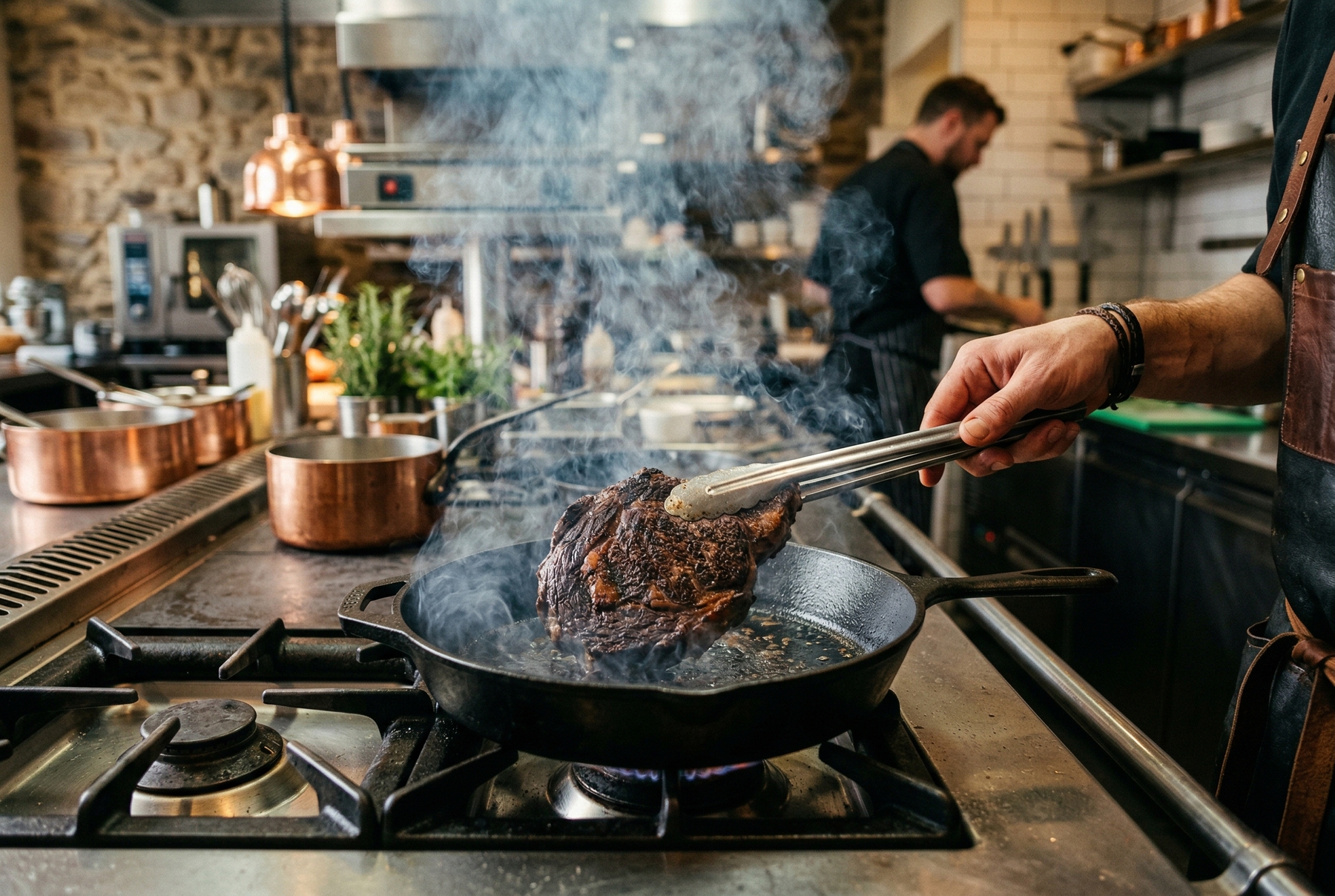
When oil begins to smoke, it breaks down and releases carcinogens, hopelessly ruining the flavor of even the finest cut of meat.
The fire alarm went off forty seconds later.
The meat was not burnt in the traditional sense. It had soaked up a bitter, rancid flavor that no sauce or spice could mask—I state this without exaggeration. The intern expected a scolding. I sat on a stool and asked only one thing: ‘At what temperature does this oil start to burn?’ He did not know. No one had ever explained it—not in culinary school, nor in previous kitchens.
That is exactly where I will start.
Table of Contents
What Is A Smoke Point
Oil does not just spontaneously catch fire. Every oil has a specific temperature where it begins to break down: fats decompose, releasing acrolein and other volatile compounds with that characteristic acrid smell. This is the smoke point, and the name captures the meaning perfectly: you literally see smoke rising above the pan.
Before reaching this point, the oil functions exactly as it should. It conducts heat, creates a crust, and facilitates the Maillard reaction—the process that gives cooked meat its golden color and roasted aroma. Once past that point, the process breaks down. It ceases to be food in any normal sense, becoming a source of bitterness and carcinogens that settle on your product.
Fortunately, the smoke point is a measurable value. Refined sunflower oil reaches its limit around 230°C (446°F). Extra virgin olive oil breaks down between 160 and 190°C (320 and 374°F), depending on the olive variety, region, and specific batch. Avocado oil handles 270°C (518°F) and higher. Clarified butter (ghee) smokes around 250°C (482°F). Refined olive oil peaks at about 220°C (428°F).
People make the same mistake repeatedly for a simple reason: labels rarely provide this information. Habit takes over. Cooks rely on the logic that ‘grandmother did it this way, and everything was fine.’
Expensive Oil And The Myth Of Healthy Frying
I have observed one typical scenario countless times. A home cook buys an expensive bottle of extra virgin olive oil, reads ‘natural’ and ‘unrefined’ on the label, and uses it to fry syrniki (traditional Eastern European fried quark pancakes). They believe they are doing the right thing, investing money in their health.
Meanwhile, a completely different chemical reaction happens in the pan. The oil heats to 180-190°C (356-374°F), which already exceeds its smoke point. It begins to burn, releasing the exact compounds the cook wanted to avoid. Simultaneously, the heat destroys the polyphenols—the very compounds that make this unrefined olive oil expensive in the first place. Polyphenols give unrefined olive oil its antioxidant properties, but they break down rapidly when heated above 180°C (356°F).
The syrniki turn bitter. A brown, sticky residue coats the pan and refuses to wash off easily. The cook mistakenly blames the oil quality.
Unrefined oils—flaxseed, pumpkin seed, unfiltered olive, mustard, or Kuban sunflower oil—are magnificent products. They carry rich flavors, aromas, and beneficial acids that heat destroys. Their true purpose lies elsewhere: dressing a salad, finishing a hot dish after taking it off the heat, dipping bread with salt, or seasoning sauerkraut. They do not belong in a frying pan.
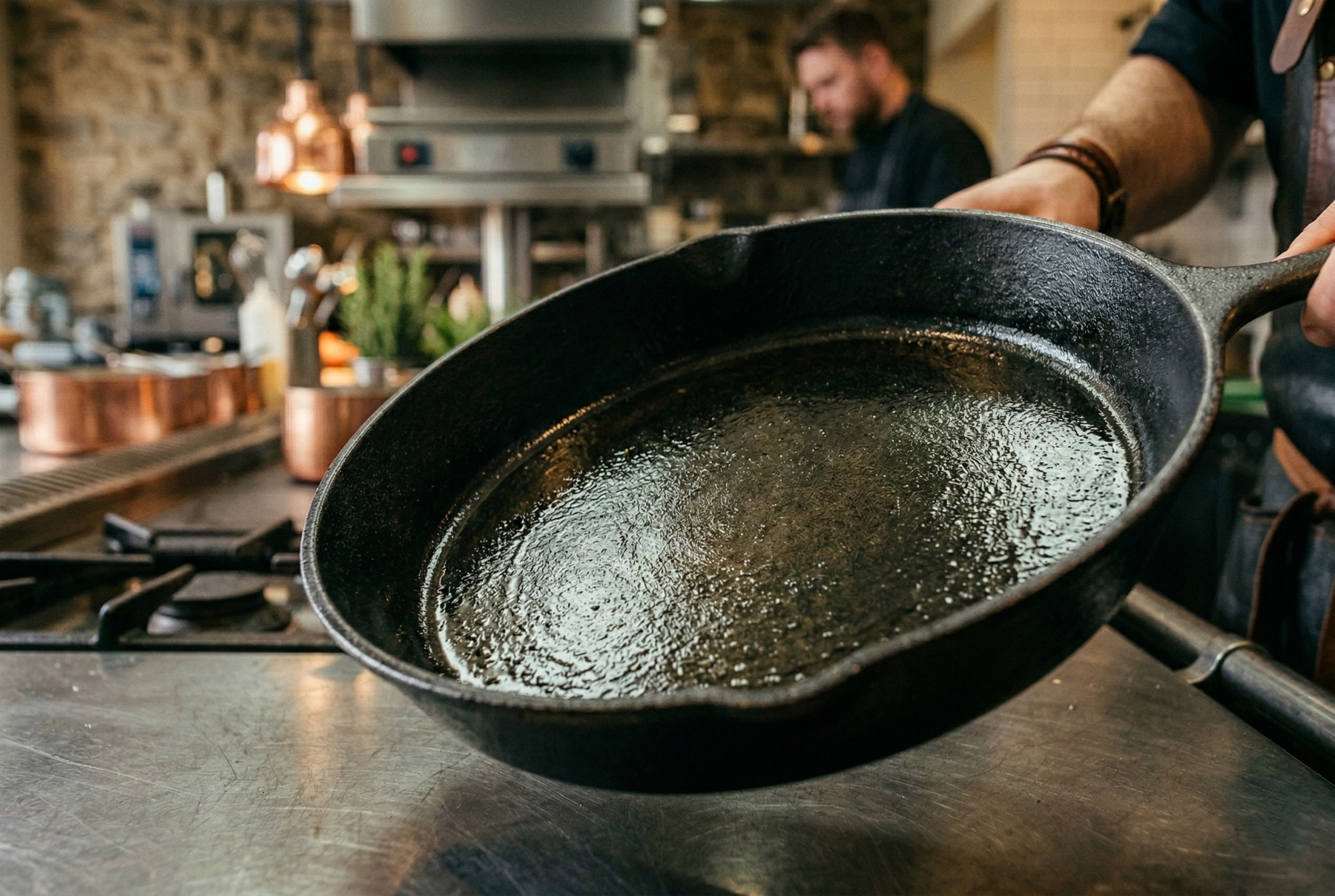
Properly heated oil becomes fluid and begins to shimmer slightly, signaling that the ingredients are ready to be added.
How Oil Looks Right Before It Burns
The first thing I teach interns is to watch the pan rather than watch the clock.
Properly heated oil in a skillet visibly ‘comes alive.’ It becomes more fluid and begins to shimmer slightly. Tilting the pan reveals that the oil runs thin and fast, almost like water down slanted glass. This indicates the correct working temperature. The ingredients are ready to go in.
A thin blue wisp of smoke rising from the surface means you are too late. The only solution is to remove the pan from the heat, let it cool, wipe it out with a paper towel, and pour in fresh oil.
The smell tells the same story. Burning oil smells sharp, with a bitter or acidic edge—a sensation that hits instantly and clearly. Hot, refined working oil carries almost no scent. When unrefined oil heats up, it starts smelling like roasted seeds or nuts, signaling immediately that you poured it into the wrong pan.
Choosing The Right Oil For The Task
High-Heat Frying: Steaks, Wok, Deep Frying
Cooking a steak on a home stove demands high heat, quick decisions, and an oil with a smoke point of at least 220°C (428°F).
Refined sunflower oil works perfectly. It remains inexpensive, flavor-neutral, and widely available. Its only drawback is a lack of native flavor profile. However, when searing a steak, this becomes an advantage—you taste the meat, not the oil.
Avocado oil offers more stability and a superior fatty acid profile. It costs more, but a little goes a long way, and its refined version boasts a remarkably high smoke point, which is ideal for high-heat cooking.
Clarified butter remains one of the most underrated ingredients in domestic kitchens. The clarification process removes water and milk proteins (the exact components that cause regular butter to burn). What remains is pure butterfat with a deep, nutty aroma. Its smoke point sits around 250°C (482°F); a steak cooked in this fat develops a noble flavor profile unattainable with plant-based oils. Kitchen professionals call it ‘clarified butter’ or ‘ghee’—the essence remains the same. Traditional Russian rendered butter from the farmer’s market matches these properties perfectly. I highly recommend using it.
Delicate Frying: Syrniki, Fish, Sautéing
This requires temperatures of 160-190°C (320-374°F). Refined olive oil (specifically refined, not extra virgin, as it is lighter and more neutral), refined sunflower oil, or grapeseed oil perform best here.
Refined olive oil offers a compromise, providing a slightly more Mediterranean character than sunflower oil without the temperamental nature of extra virgin. It serves as an excellent everyday choice for cooking fish, chicken breast, zucchini, and eggplants over medium heat.
Finishing And Dressings: Zero Heat
Extra virgin, unrefined sunflower, pumpkin seed, flaxseed, sesame, and walnut oils belong here.
Flaxseed oil requires a special mention. If the oil smells like fish oil straight from the bottle, it has gone rancid. It must be thrown away. Fresh flaxseed oil carries a restrained, slightly grassy scent with no harshness. You must never heat it, not even to 100°C (212°F): its omega-3 fatty acids oxidize rapidly and irreversibly. When dressing a warm dish, pour it directly onto the food on the plate, right before serving.
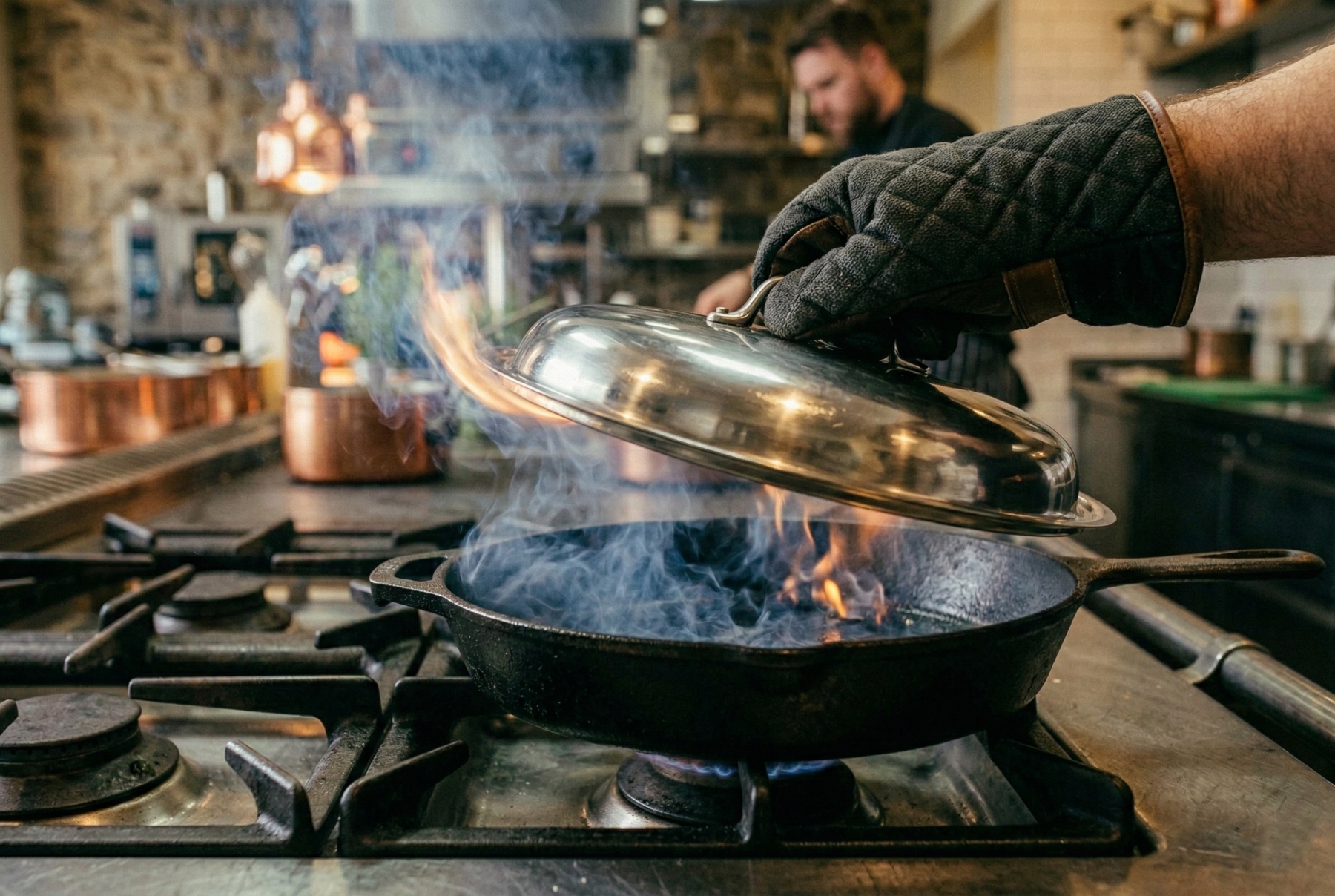
Water must never be used if oil catches fire in a pan. The correct method involves covering the pan with a lid and removing it from the heat.
What To Do If The Pan Is Already Burning
This requires specific attention because human instinct often fails here.
The situation: the oil smokes and catches fire. Panic sets in. A sink with running water sits nearby. It seems logical.
Water contacting scorching oil instantly turns into steam, expanding to 1700 times its original liquid volume. This steam throws the burning oil upward and outward—creating flaming droplets that reach the ceiling. This results in severe burns, a potential house fire, or at best, a ruined kitchen.
The correct sequence is brief: remove the pan from the burner. Cover it with a lid if one is within reach. Do not lean over it, do not inhale the smoke, and do not pour anything into it. Let it cool naturally. Afterward, wipe it clean with a paper towel, add fresh oil, and start over.
Spices cannot mask a burnt flavor. Turmeric and cumin will not save scorched meat. Starting over always proves faster than trying to resuscitate a ruined dish.
The Final Verdict
Three oils cover the vast majority of home cooking needs. Refined sunflower oil handles high-heat searing. Refined olive oil manages medium-heat cooking. Any unrefined oil finishes the dish on the plate, with absolutely no heat applied.
Avocado oil and clarified butter make excellent additions for those looking to expand their culinary arsenal. They justify their price tags completely.
That intern, by the way, stayed with the team. A month later, he could flawlessly determine when the oil was ready for cooking just by looking at the surface. He watched for that slightly livelier texture, the increased fluidity, the first gentle shimmer. He used to think it was intuition. Now he understood the science.
0 comments