
Summer heat sets in. You brew a proper pot of loose-leaf tea, perhaps a classic Indian Assam or a Krasnodar blend (a traditional Russian tea grown in the Caucasus) that has been sitting on the shelf smelling wonderfully earthy. You toss in a handful of ice or, patience permitting, place the pitcher in the refrigerator. An hour later, you pull out something murky and entirely unappetizing.
The flavor remains fine. However, drinking it suddenly feels less appealing: suspended particles float in the glass, ruining the aesthetic experience.

A properly prepared iced tea maintains its crystal clarity and aesthetic appeal even when heavily chilled.
Table of Contents
The Tea Cream Effect
Food science literature has a specific name for this phenomenon: tea cream. The term sounds appealing, but the visual result falls flat.
The mechanism proves more complex than standard culinary articles suggest. Polyphenols—primarily tannins—join forces with caffeine, proteins, polysaccharides, and mineral ions from the water to form this haze. At high temperatures, these components exist independently within the solution. As the temperature drops, they bind together into larger particles that lose their water solubility, suspending themselves as a cloudy mist.
Rapid chilling triggers this process rather noticeably. Yet, blaming thermal shock alone misses the bigger picture. The scale of cloudiness also depends on the brew’s concentration, the specific tea composition, and the water’s hardness. Calcium and magnesium ions, abundantly present in hard tap water, bind further with polyphenols and accelerate the precipitation. Brewing the exact same tea with soft bottled water versus hard municipal tap water often yields drastically different results.
A quick experiment demonstrates this perfectly: adding a splash of boiling water to cloudy iced tea raises the temperature, breaks apart the particles, and instantly clarifies the brew. The fix remains temporary, as the process repeats once the tea cools again. Still, it serves as a reliable emergency trick to make a pitcher presentable just before serving.
5 Methods to Brew Transparent Iced Tea
These five methods tackle the same problem through different pathways: they either prevent the haze from forming in significant amounts or create conditions that keep it to an absolute minimum.
1. The Cold Brew Method
Practical experience shows this to be the most reliable approach.
Steeping tea in cold or room-temperature water for 8 to 12 hours changes the game. Low temperatures slow down the extraction process, producing a distinctly different chemical profile than hot brewing, which generally yields a smoother, remarkably clearer beverage. Cold brewing still extracts polyphenols, but it does so in a different ratio and avoids the thermal surge that forces them into a high-concentration solution during hot brewing.
Standard proportions require 10 to 12 grams (about 0.35 to 0.42 oz) of loose-leaf tea per liter (33.8 fl oz) of cold water. Green tea needs only 6 to 8 hours, while black tea benefits from an overnight steep.
Time remains the only drawback here. This method fails if you need iced tea within an hour. For make-ahead preparation, however, no better option exists.
2. The Dilution Method
Brewing a concentrate requires roughly 20 grams (0.7 oz) of tea per 500 ml (16.9 fl oz) of water, steeped for the standard 3 to 4 minutes. The crucial next step involves letting it cool to room temperature entirely on its own. Skipping the refrigerator and avoiding ice at this stage is essential.
Gradual cooling generally results in a cleaner appearance compared to immediate contact with ice. Once cooled, diluting the concentrate with cold water in a 1:1 ratio precedes the final addition of ice.
While slightly less transparent than cold brew, it works several times faster, making it an excellent working compromise.

Controlling the cooling process remains crucial for maintaining clarity when using the dilution or double-strength methods.
3. The Sugar Shield
Many cooks intuitively add sugar or syrup to hot tea before chilling, which often results in a clearer brew. The effect becomes noticeable at a minimum quantity of roughly 60 to 80 grams (2.1 to 2.8 oz) per liter (33.8 fl oz), yielding a distinctly sweet beverage.
Scientific data on this method remains contradictory: some studies suggest sugar actually worsens cloudiness in black tea, though green tea behaves differently. The secret likely goes beyond chemistry, as sweet iced tea typically involves more dilution and extra ice, naturally lowering the haze concentration. This method serves best those who inherently prefer sweet tea.
4. The Ice Mountain
Coffee shops frequently rely on this technique. It starts with brewing a double-strength tea: 20 grams (0.7 oz) per 500 ml (16.9 fl oz) instead of the standard 10 grams (0.35 oz) per liter. After a standard steeping time, the hot concentrate is immediately poured over a massive quantity of ice.
Ice volume dictates success here. A mere handful fails; a bowl or pitcher packed to the brim is necessary. The melting ice dilutes the strong brew to a normal strength. This rapid chill and dilution result in fewer polyphenols than an undiluted hot brew, leaving virtually no suspended haze.
Perfect clarity evades this method, but achieving a highly presentable pitcher in ten minutes becomes entirely realistic.
5. The Acid Trick
Stirring a couple of tablespoons of fresh lemon juice into a liter of tea alters the solution’s acidity, frequently improving its visual clarity. The flavor profile undeniably shifts—lemon iced tea becomes an entirely different beverage that might not appeal to purists.
Chemically, the results vary: several studies indicate that lowering the pH actually increases cloudiness rather than reducing it. Lemon juice often masks the problem more than it solves it. Those who enjoy a tart profile will find this approach perfectly acceptable.
The Bonus Trick: A Pinch of Baking Soda
This technique originates from the American South, where cooks have used it for generations without overthinking the science. Adding a literal pinch of baking soda—about one-eighth of a teaspoon per liter—to hot tea immediately after brewing works wonders. A quick stir and a minute of resting precede the normal chilling process.
Changing the acidity does the heavy lifting: a more alkaline environment significantly suppresses haze formation. The baking soda flavor remains undetectable at such small quantities, though the starting water quality plays a major role.
This alkaline shift carries a slight downside: it alters the stability of certain polyphenols, especially in green tea, potentially shifting the color slightly. It hardly qualifies as a disaster, but it warrants awareness. Filtered water resolves the issue more reliably without side effects, leaving baking soda as a backup plan when filters fail and cloudy tea becomes an issue.
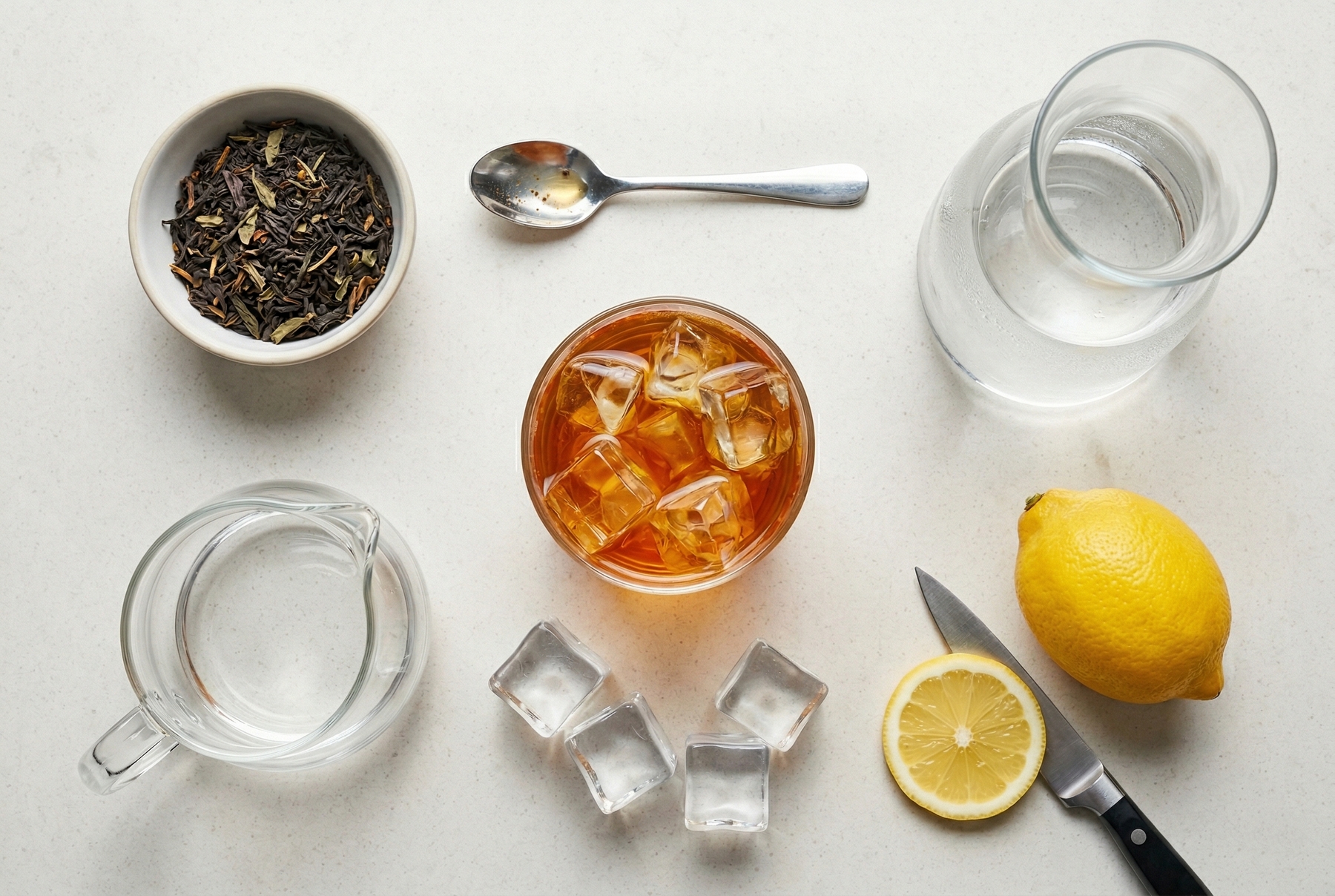
Water quality and the choice of loose-leaf tea directly influence the ultimate clarity of the beverage.
The Perfect Iced Tea Checklist
Several foundational parameters influence the final result even more than the chosen preparation method.
Water. Filtered or soft bottled water takes absolute priority. Hard municipal tap water consistently underperforms across all five methods. This goes beyond mere taste preferences: calcium and magnesium ions actively participate in haze formation, making their concentration a direct factor in clarity.
Tea. Large loose leaves work best. The fine dust found in standard tea bags extracts far too quickly, reliably producing a denser, murkier brew simply due to the massive surface area exposed to water. A whole-leaf black or green tea provides a solid foundation. Whether opting for a Nilgiri, an Assam, or a Krasnodar blend, the specific variety remains a matter of taste rather than technique.
Proportions. Standard hot brewing calls for 10 grams (0.35 oz) of loose-leaf tea per liter (33.8 fl oz) of water. Cold brewing demands slightly more—about 12 grams (0.42 oz)—because low-temperature extraction yields a less intense flavor.
Steeping Time. Hot brewing requires 3 to 4 minutes for black tea and no more than 2 to 3 minutes for green tea. Oversteeped tea releases excess bitterness and a higher concentration of polyphenols, directly aggravating the clouding effect upon cooling. Cold brewing parameters shift to 6 to 8 hours for green tea and 8 to 12 hours for black.
Color. Black tea should deliver a clear, uniform amber or honey-brown hue. Green tea should appear pale golden and almost transparent when held to the light. The haze that settles at the bottom after a few minutes is not leaf sediment, but the very chemical suspension discussed earlier.
Vessel. Glass or ceramic pitchers always outperform plastic alternatives. Plastic absorbs aromatic compounds over time, eventually transferring stale flavors into fresh batches. The effect starts subtly but becomes unmistakable after multiple uses.
If the iced tea still emerges cloudy, adding a sprig of fresh mint, a few raspberries or currants, and a couple of lemon wedges saves the day. Against a backdrop of vibrant fruit and herbs, the murkiness stops looking like a technical flaw and starts looking like an intentional rustic recipe. The physics remain unchanged, but guests on the patio will notice nothing but a beautiful summer drink.
0 comments