
Our distant ancestor who once popped an unfamiliar berry into his mouth just out of curiosity likely left no descendants. The one who first smelled it for a long time, rolled it in his fingers, frowned, and eventually threw it away lived to see the morning. And the next morning, too. We are the descendants of the latter.
This caution has a name: food neophobia, or the fear of unfamiliar or new food. It sounds like something that needs curing, but essentially it is a natural brain setting, not a malfunction. When an adult on the third night of vacation asks for the same tomato pasta again, he is not showing narrow-mindedness. He is listening to a very quiet and ancient voice: the familiar has not killed him yet, which means the familiar is safe.
If as an adult you order a Caesar salad in every restaurant and this salad has never let you down, you are perfectly fine. Truly. This is not a whim or lazy taste buds. A mechanism that is hundreds of thousands of years old works inside, and arguing with it through willpower is about as productive as commanding yourself not to fear heights.
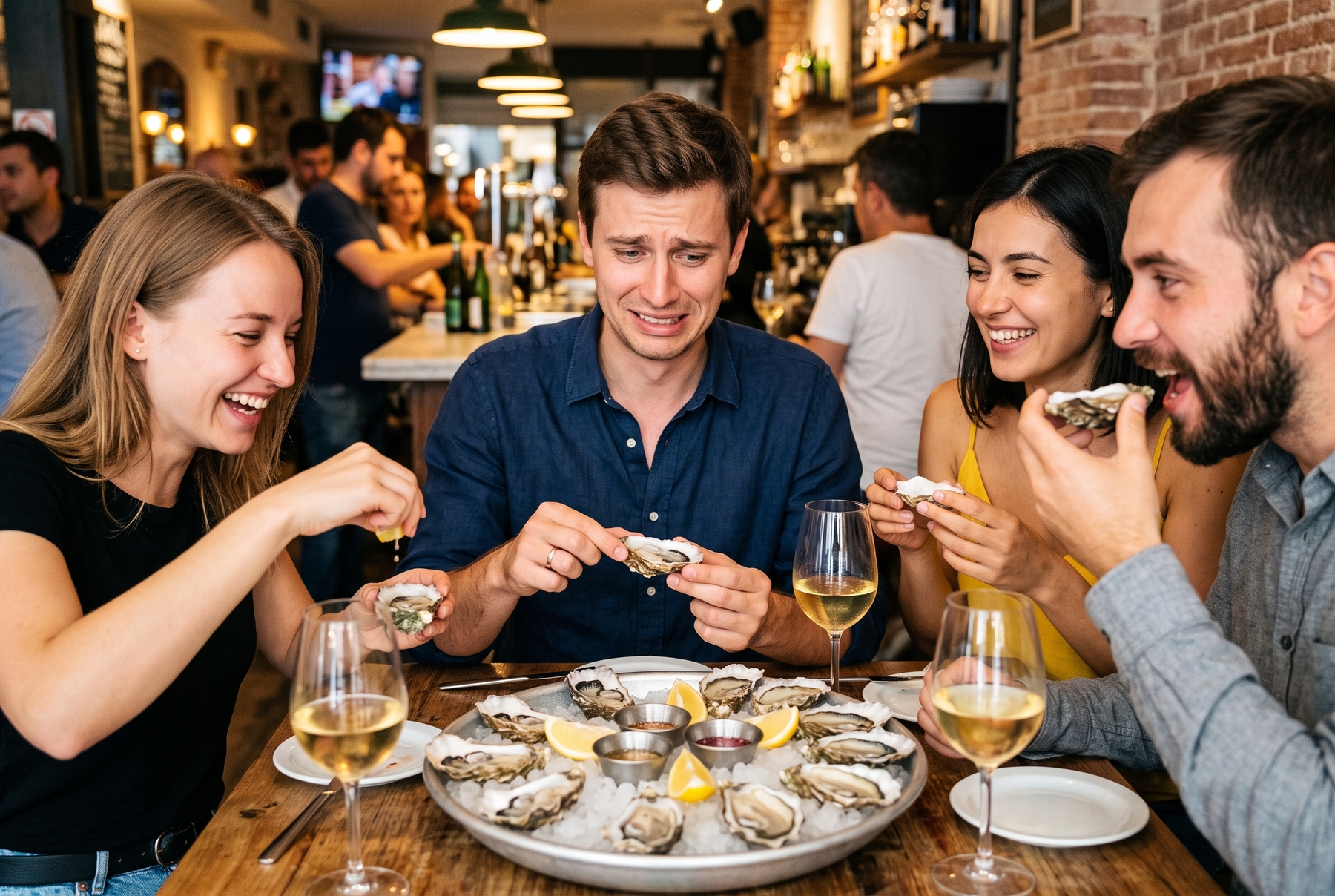
Food neophobia is an ancient defense mechanism of our brain. Unfamiliar food is perceived as a potential threat, causing instant wariness and reluctance to try new things.
Table of Contents
The Evolution of Fear: Why the Brain Chooses Macaroni and Cheese
The Trap of the Familiar
The brain is lazy, and this is a compliment. It saves energy and hates uncertainty. A familiar plate is a long-solved equation for it: it understands how many calories are there, it understands what happened yesterday after the same food, it understands that the body will survive this. Unfamiliar food is an open question without an answer. Open questions cost dearly, so the brain prefers not to take risks.
The amygdala, a small area deep inside the brain, is responsible for quickly assessing a threat. It triggers before consciousness does. You see something slippery, gray-beige, of unfamiliar shape on your plate, and your body has already braced itself: your shoulders slightly tense, the hand holding the fork slows down. Cowardice has nothing to do with it. The watchman is simply doing its job, and doing it proactively.
The strength of this watchman varies for everyone, and this is something to accept as a given. Someone reaches for new things easily, someone needs time and three attempts. Part of the difference is written in the genes, part is trained by life and family. Neither makes a person better or worse at the table. It is just that some have a lower threshold, others a higher one.
Why Texture Frightens More Than Taste
Here is what is forgotten most often. It is not the taste that prevents trying new food, but an unfamiliar texture. The brain is ready to forgive, taste, and get used to bitter or sour flavors. However, something slippery, trembling, or unexpectedly crunchy where softness was expected causes almost physical protest.
An oyster in the mouth is cold, felt by the tongue as something alive. Aspic (kholodets, a traditional meat jelly) trembles on a spoon and dissolves on the tongue into a warm film. A well-fried grasshopper crunches like a chip, but the brain firmly knows there is not a hint of a chip here. It is not about the chemistry of taste. It is about the brain linking an atypical texture with danger: slime can mean spoilage, strange resilience can mean unripeness or rot. This connection is ancient and bypasses logic.
Therefore, a person who calmly eats burning spicy food may pale from one spoonful of meat jelly. Bitterness receptors have nothing to do with it. The behavior of the product in the mouth is what frightens.
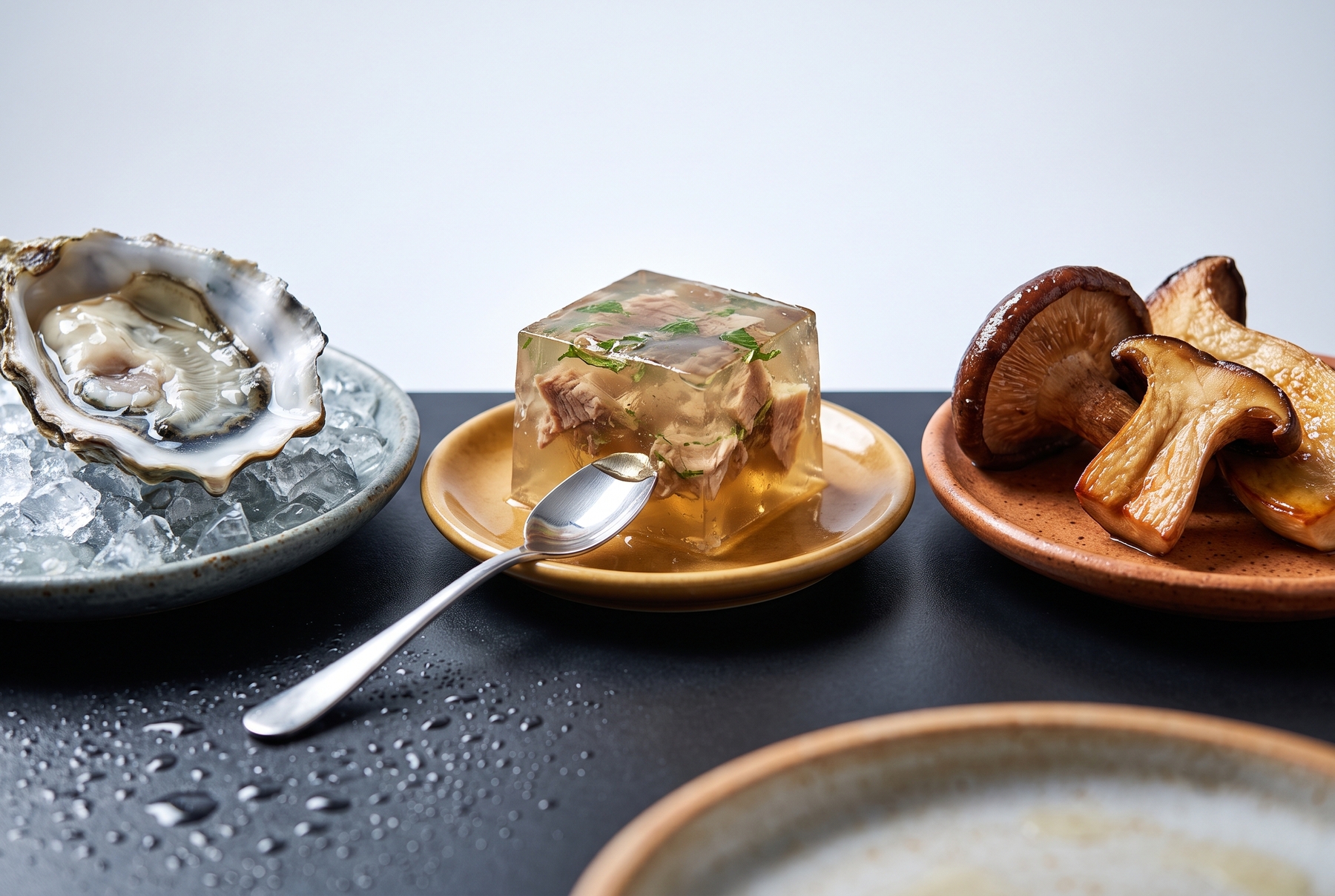
Often it is not the taste itself that frightens us, but the unfamiliar texture. Slippery oysters, trembling meat jelly (aspic), or springy mushrooms are subconsciously associated by the brain with danger or spoilage.
A Greeting from Childhood: How the Taste Armor Forms
We do not enter our adult diet with a blank slate. By the age of 30, everyone has gathered an impressive list of “what I don’t eat.” Mostly, it is not gathered by us.
Recall the phrase many have heard: “You won’t leave the table until you finish eating.” Usually, the plate held something healthy and unloved: overcooked broccoli, fish with bones, liver with a metallic aftertaste. A child sits over cooling food, tension thickens around, and food turns into a punishment. The brain does not remember the taste. It remembers the emotion. Twenty years later, an adult looks at broccoli, feels slight irritation, and cannot explain where it comes from. An anchor set at a family dinner at age six simply triggers.
There is a second force: the environment. We eat what our pack eats. A child watches what parents put in their mouths, what friends chew in the yard, and reads the boundaries of the edible. In one culture, it is normal to eat insects, in another — raw fish, in a third — blue cheese, and each is sure that its food is right and others’ food is frightening. No one is born with a disgust for moldy cheese. It is learned. Or not learned.
Understanding this removes a lot of guilt. Your food fears are not a sign of weakness, but a map drawn for you long before you started choosing yourself. This means dietary habits can be gradually changed, and the diet expanded.
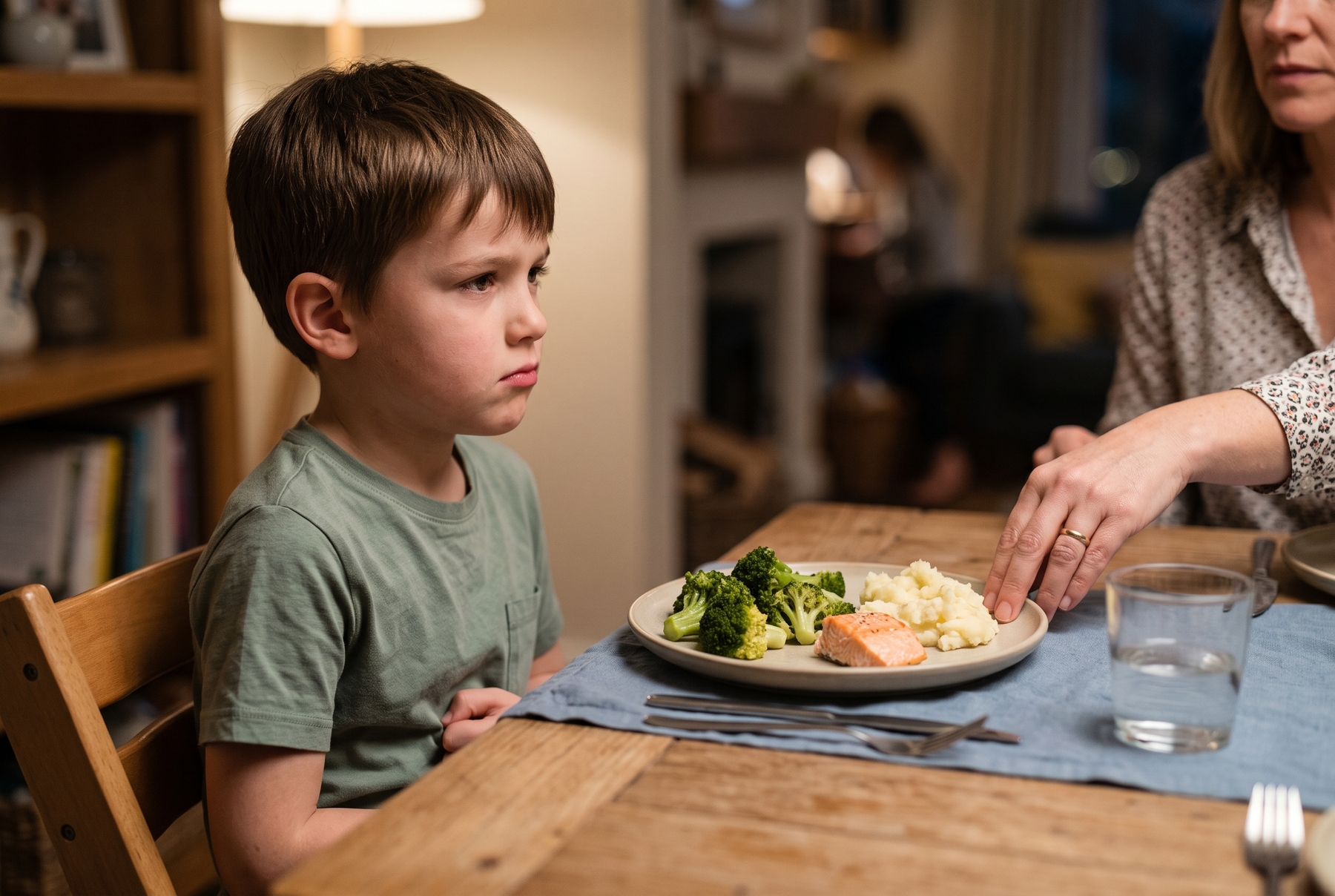
Forcing someone to eat during childhood creates a lasting negative anchor. The brain remembers the unpleasant emotion of parental pressure for decades, rather than the taste of a healthy vegetable.
Mindfulness Instead of Willpower
The main rule for those who want to learn to try new food sounds unusual: do not force yourself. Willpower is a poor assistant here. If a product causes genuine sickness, a throat spasm, or outright nausea, the brain is saying “no” not whimsically, but seriously. Breaking this by force is harmful. This reinforces disgust, not a habit.
It is important to distinguish two different states, because from the outside they look similar.
The first is slight anxiety before the new. There is a little sinking feeling in the pit of the stomach, curious and slightly fearful at the same time. You can and should work with this state. It passes once you take the first small step.
The second is deep physical disgust. The throat tightens, the mouth fills with saliva not from appetite at all, the body literally moves away from the plate. This is a signal to stop. Not today. Perhaps not with this product at all, and this is normal: there are things that are unpleasant specifically to your body, and respecting this is wiser than fighting yourself.
The difference is simple. Anxiety calls for cautious trying. Disgust asks to leave. Learning to hear exactly what is happening to you right now is more useful than any list of trendy superfoods.

When expanding your diet, it is important not to force yourself. Listening to your sensations is key: mild anxiety can be gently overcome, but with strong physical disgust, tasting is better postponed.
The Strategy of Small Steps: How to Carefully Expand Your Diet
It is better to expand your diet and flavor horizons not by leaps, but by short steps that the brain simply does not have time to trigger anxiety for. Below are three techniques that help get used to new products gently and without pressure.
The Rule of One Safe Neighbor
Do not put a full plate of the unfamiliar in front of yourself. This is a sure way to scare yourself off before the first bite. Do the opposite: let 80% of the plate be your favorite food, and allocate a modest corner to the new product.
It works like this. The brain sees familiar chicken, familiar rice, everything is under control, there is no anxiety. And nearby, in a safe neighborhood, lies a small piece of the new. Trying it in a full and calm state is much easier than when hungry and alert.
Flavor bridges work well separately. You take a familiar dish and change one detail in it. Love chicken? Pour an unfamiliar sauce over it, leaving everything else as is. Eating pasta? Add one new ingredient, without touching the base. The brain clings to the familiar base and lets the new in through the side door more easily.
Tasting Without Obligation
A psychological trick that removes half the tension: allow yourself to spit it out in advance. Keep a napkin handy and give yourself the honest right not to swallow if it really does not go well.
It sounds frivolous, but it works precisely. Half the fear of new food is the fear of falling into a trap: what if it is disgusting, and you have to finish it out of politeness. As soon as the brain understands that no one will force you to finish eating, that you can touch it with the tip of your tongue and stop, the stakes drop. And with them, anxiety drops. One trial binds you to nothing. It is a reconnaissance, not signing a contract.
Start with tiny portions. Not a spoon, but half a spoon. Not a piece, but the very edge. The task of the first contact is not to eat your fill, but to show the brain a simple thing: it was unfamiliar, and nothing terrible happened. After three or four such safe encounters, the product quietly moves from the “threat” column to the “I know” column.
Playing With Texture and Temperature
Remember that texture is what frightens most often? This means it can be changed, leaving the taste in place. The body perceives the same product in different states completely differently.
Does boiled broccoli frighten you, its soft, slightly slimy looseness? Bake the florets in a hot oven (220 °C or 425 °F for about 20 minutes) until the edges are crispy. It is the same vegetable, but in the mouth there is crunch instead of slime, and the smell of roasted nuts instead of watery steam.
Do not like the texture of mushrooms, their rubbery resilience under the teeth? Do not chew them at all. Blend them into a cream soup until velvety smooth, and the problem disappears: the taste remains, the frightening resilience leaves.
Afraid of fish because of its characteristic smell? Do not start with boiled fish (which has the strongest smell), but with smoked fish or fish baked under an herb crust. The presentation changes everything, and you move towards the product from the side where it resists less.
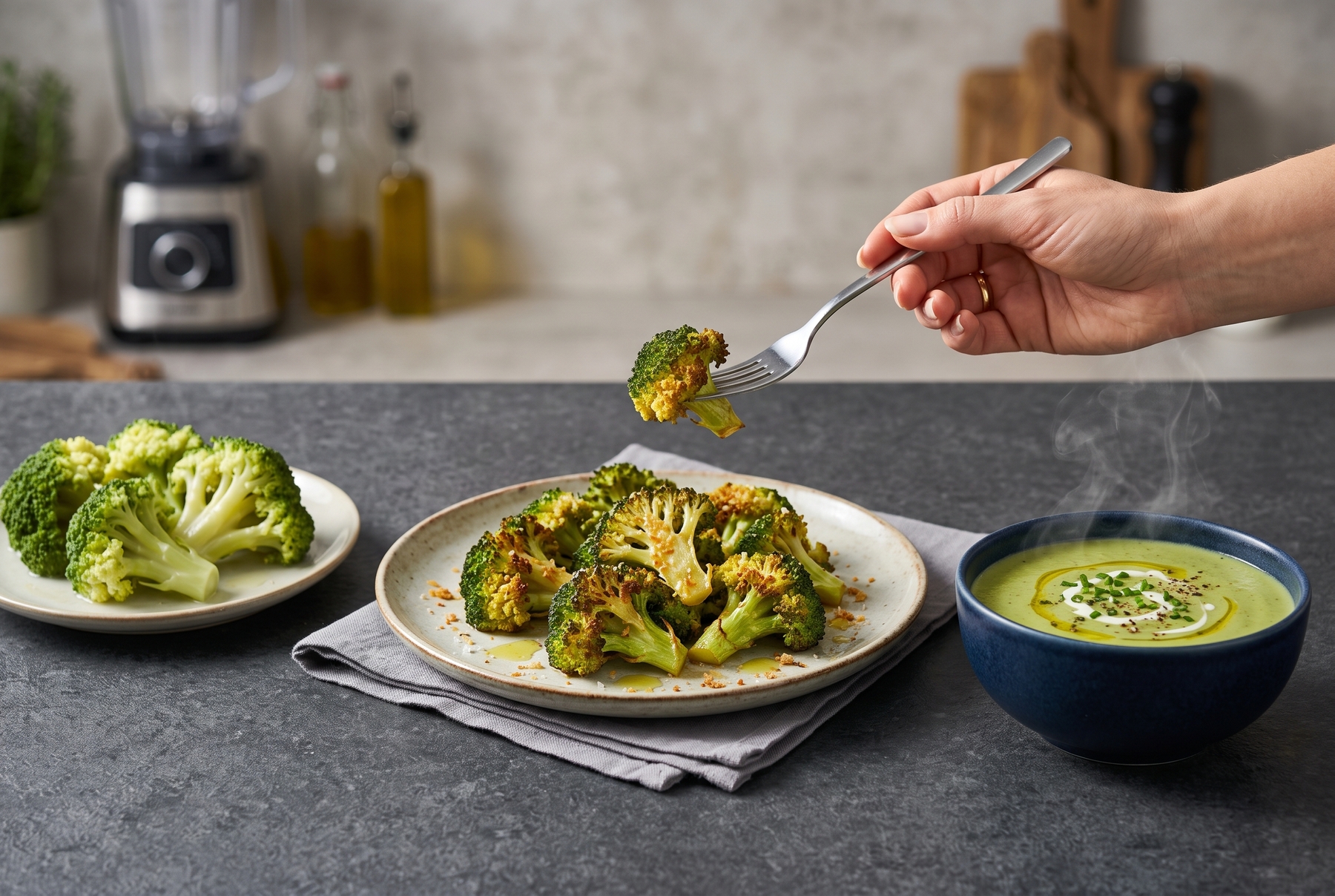
Experimenting with texture helps trick fear. If boiled broccoli is unpleasant, roasting it in the oven until crispy or blending it into a velvety cream soup offers a delicious alternative.
5 Tips for Restaurants and Travel
An unfamiliar cuisine on a trip or in a new restaurant is a separate story. It is easy to get confused here and out of habit poke at the most understandable thing. A small cheat sheet to try new things without stress.
- Ask about texture, not just taste. The waiter will describe the taste willingly, but it is often something else that frightens you. Ask directly: is it soft, crispy, chewy? Slippery or dense? Knowing in advance what will be in your mouth is already half the calm.
- Clarify spiciness in comparisons. “Not very spicy” means different things to everyone. Ask to compare: spicier than jalapeño or milder? It is easier to hit your threshold this way and not get burned on the first bite.
- Order dishes to share, not a portion for yourself. Sharing several small dishes with a group is safer than ordering one large unfamiliar plate. If you try a spoonful and do not like it, you can move on to the next dish with less money wasted.
- Look for a familiar support in an unfamiliar dish. If there is something native in the composition (chicken, rice, dough, cheese), the new is perceived more calmly. Start with dishes where not everything is unfamiliar, but only a part.
- Do not order three exotic dishes at once. One new dish per evening is enough. The brain needs a break between discoveries, otherwise it will shut down and resist harder next time.
And the last, purely mechanical observation. A product that you have tasted and survived calmly at least once, the brain quietly shifts from the “dangerous” folder to the “already know” folder. Next time, anxiety will decrease. After several encounters, it will fade to nothing, and at some point, you will catch yourself reaching for that meat jelly that recently made you pale.
0 comments