
Someone who polishes off a family-size bag of potato chips over the course of an evening rarely sits down on the couch feeling ravenous. Their willpower is usually intact, too: they can easily walk past a bakery display and resist finishing their kid’s cold French fries. Something far stranger is at play.
Asking that person half an hour after the final credits roll what the last three handfuls tasted like yields a blank stare. Those bites simply do not exist in their memory as a distinct event. All that remains is salt on the fingertips, the crinkle of foil, and a vague sense of having eaten a bit too much. The actual pleasure ended somewhere in the first third of the bag, yet the hand kept moving for another 20 minutes.
What exactly does a screen do to our attention, and how does it so effortlessly turn a standard portion into a double one?
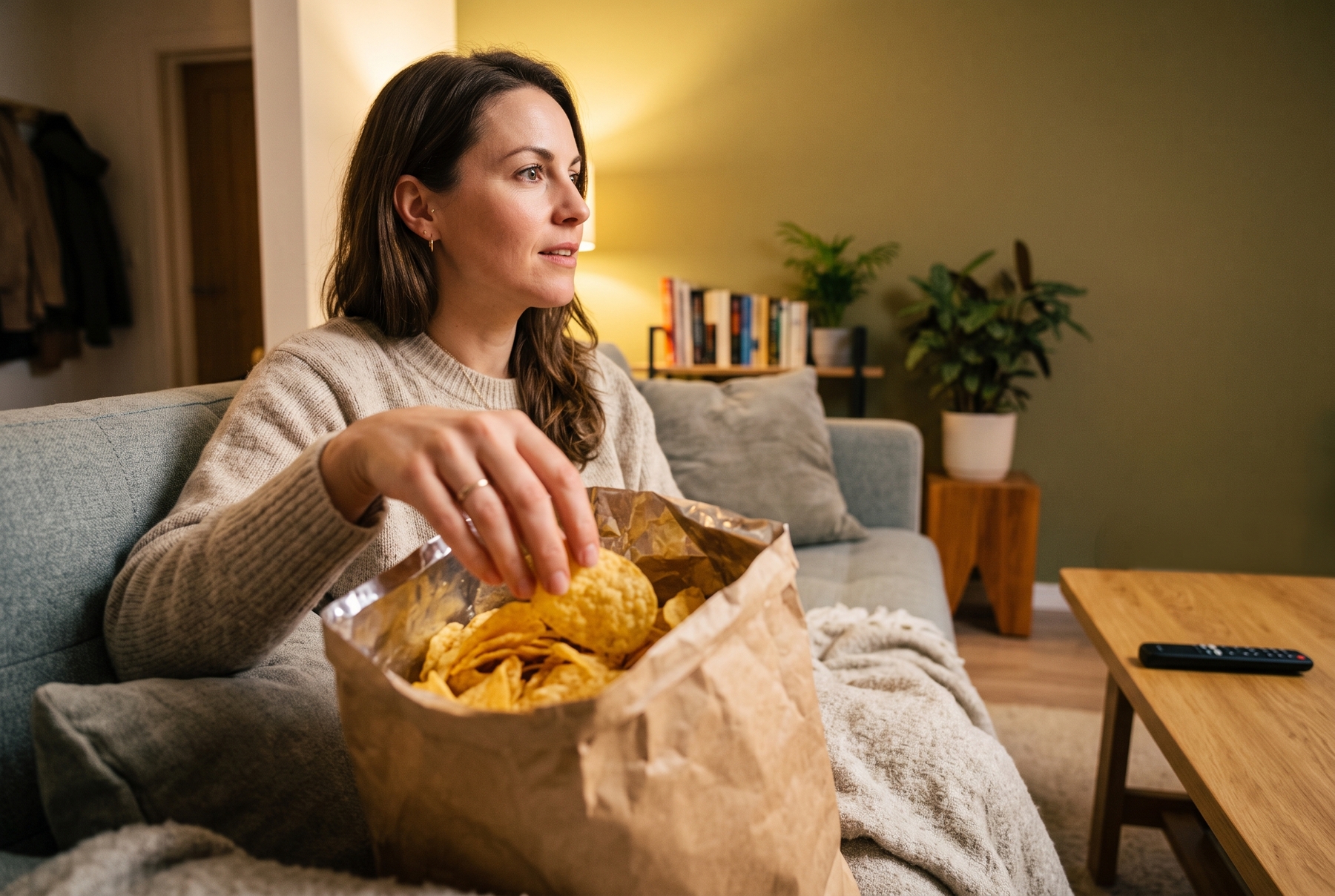
When a screen absorbs our attention, snacking shifts onto autopilot and fullness cues register too late.
Table of Contents
- Screens Don’t Make Us Hungrier—They Blind Us to Our Food
- Why the Last Handfuls Vanish from Memory
- Why a Series Finale Triggers a Craving for Crunch
- Why Finger Foods Are the Ultimate Screen Magnet
- How the Package Quietly Becomes the Portion
- The Episode Runs for 40 Minutes, the Flavor Lasts for Five
- When Eating in Front of the TV Is Perfectly Fine
- How to Eat Less in Front of the TV Without Relying on Willpower
- A One-Night Experiment: Three Moments to Watch For
Screens Don’t Make Us Hungrier—They Blind Us to Our Food
These are the mechanics of distracted eating. A storyline demands continuous focus: tracking dialogue, reading facial expressions, and remembering who lied to whom in the previous episode. A familiar salty cracker requires zero monitoring. Consequently, chewing happens almost entirely below the radar of conscious awareness.
Satiety is a complex mechanism. It does not flip on like a switch at a specific second; rather, it builds from the stretching of stomach walls, hormonal signaling, eating pace, fading flavor intensity, the sight of an empty plate, and the working memory of how much has already been consumed. While some of these signals operate independently of our focus, others require active perception—and noticing them in front of a screen is notoriously difficult.
Claiming that television simply “shuts off fullness” would be an overstatement. An updated meta-analysis on distracted eating published in the spring of 2026 examined 50 studies involving adults; 40 measured food intake during the distraction itself, while 10 tracked the subsequent meal. On average, distraction barely altered the amount eaten during the immediate meal, with the effect hovering on the edge of statistical significance. However, passive distractions like watching television correlated with higher intake, whereas tasks demanding active mental effort showed no such effect. Furthermore, participants who ate while distracted consistently consumed more at their next meal.
In short, a screen does not necessarily amplify hunger. Instead, it renders the food less noticeable, making the quiet internal cue of “I have had enough” much easier to miss.
Why the Last Handfuls Vanish from Memory
Meal memory directly shapes how much a person eats later. Researchers tested this with a straightforward method: before offering a snack, they asked participants to write down what they had eaten for lunch. Those who specifically recalled that day’s lunch ate less. In another study, participants were guided to focus on the flavor and texture of their midday meal; as a result, the lunch was remembered more vividly, and evening snack intake dropped.
The first handful of popcorn registers in high definition: the warm, slightly toasted aroma, the crisp crunch, the immediate hit of salt on the lips. By the fifteenth handful, the flavor barely registers. The bite happened, yet it leaves almost no trace in the brain, allowing a person to genuinely believe an hour later that they ate far less than they actually did.
Still, the screen does not take all the blame. Research shows that people consistently underestimate how much they eat regardless of screens, and the margin of error grows alongside the portion size: the more food consumed, the wider the miscalculation. Watching television simply makes it easier to eat larger amounts unnoticed, while a hefty portion further distorts our ability to gauge the total volume.
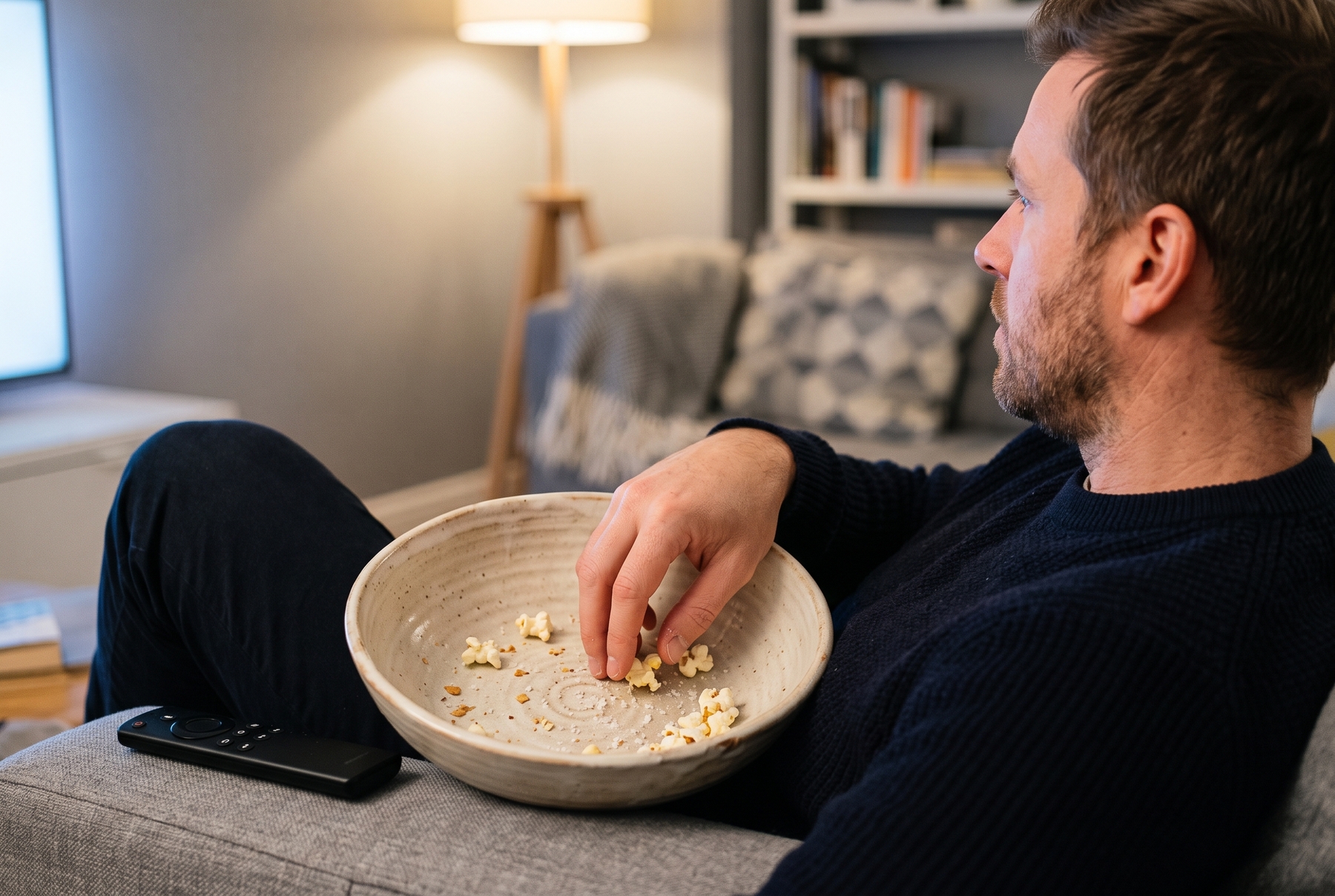
By the end of a movie, the final handfuls of a snack are often eaten out of sheer inertia, leaving almost no trace in memory.
Why a Series Finale Triggers a Craving for Crunch
Habit quickly layers itself onto this sensory blind spot.
The formula is simple: the couch, the same time of night, a familiar opening theme song, and a go-to snack, repeated thirty times. Within a month or two, the urge to nibble surfaces simply because the evening routine has begun. Physical hunger has nothing to do with it; the visual cue of the screen alone prompts the brain to expect its usual accompaniment.
Years of meditation practice can build a useful everyday skill: the ability to catch an impulse in its very first second. From the inside, the thought “I am hungry” and the thought “I turned on a show and remembered snacks exist” feel nearly identical. Telling them apart is easiest during the first couple of seconds, before both impulses blur into what feels like genuine appetite.
Why Finger Foods Are the Ultimate Screen Magnet
Not all foods lend themselves equally to autopilot consumption. Losing track is remarkably easy with small, bite-sized items eaten by hand—foods that can be pulled piece by piece without pausing or taking your eyes off the screen.
Potato chips, seasoned rye croutons, nuts, roasted sunflower seeds, popcorn, cookies, or candies sitting in a bowl on the coffee table all fit the bill. Nutritional profiles are beside the point here; what matters is how effortlessly the count slips away. Nobody loses track of a rich beet soup like borscht because the spoon sets a deliberate rhythm and the bottom of the bowl appears well before the final slurp. A steak demands a knife and both hands. Tangerines require peeling, leaving a pile of fragrant rinds on the table as hard physical evidence.
A bag of chips leaves no such trail until the very end—just a sheen of oil on the fingertips and fine salt crystals discovered on the sofa armrest for the rest of the night.
How the Package Quietly Becomes the Portion
Eating straight from a bag, box, or communal bowl erases any visible boundary, allowing the entire package to quietly register as a single serving.
Portion and package sizes have been studied extensively. A landmark 2015 Cochrane review analyzed 61 studies encompassing more than 6,700 participants. Across the board, people consistently ate and drank more when presented with larger portions, packages, or tableware.
The promise of “just a little bit” holds up only when “a little bit” is physically defined. The exact same handful of almonds placed in a small ramekin versus pulled from an open 400 g (14 oz) bag creates two entirely different eating environments: the first establishes a clear finish line, while the second offers none at all.
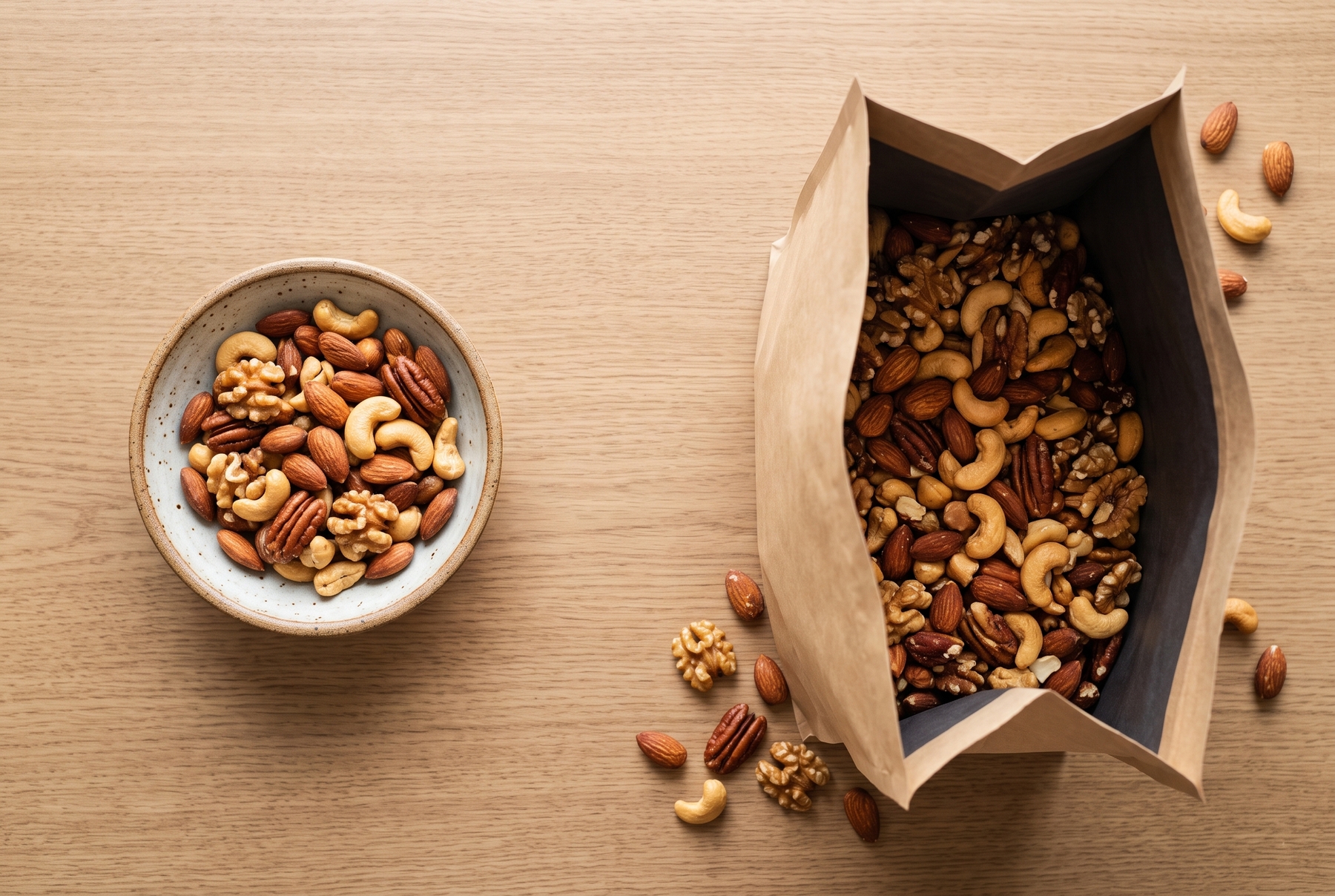
Serving snacks in a separate bowl creates a clear visual boundary, unlike eating straight from a bottomless bag.
The Episode Runs for 40 Minutes, the Flavor Lasts for Five
A snack usually loses its magic long before the episode wraps up.
The sensory thrill of the first few bites fades fast: the salt dulls, and the crunch retreats into background noise. Meanwhile, the plot marches on. Once snacking merges with watching, an empty bowl signals an abrupt end to a comforting physical routine for the hands. The urge arises to fetch a refill, tear open a second pack, or pour a drink.
Continuing to eat often has nothing to do with flavor and everything to do with keeping the mouth and hands occupied while the eyes remain glued to the screen. When eating serves merely as fidgeting, a snack stretches out long after the actual enjoyment has vanished.
At least a streaming platform occasionally pauses to ask if you are still watching. A sleeve of cookies offers no such courtesy.
When Eating in Front of the TV Is Perfectly Fine
There is no need to advocate for austere dinners eaten in complete silence. Friday movie night with buttered popcorn, family pizza during a season premiere, or a slice of cake alongside a favorite comfort show requires zero fixing.
Taking a closer look makes sense only when almost every evening in front of the TV ends with eating more than intended, while the flavor of the second half of the portion completely fails to register. The same applies to eating out of sheer inertia, devoid of hunger or pleasure—especially if the credits roll leaving behind physical heaviness, guilt, or annoyance over the volume consumed.
Everyday mindless grazing during a show should not be confused with an eating disorder. When episodes of overeating come with a distressing sense of lost control, happen frequently, trigger deep shame, or lead to compensatory behaviors, rearranging snack bowls is not the answer; that calls for the support of a qualified healthcare professional, such as a psychiatrist or a therapist specializing in eating disorders. Diagnosing oneself over a single evening with a bag of chips, however, is completely unnecessary.
How to Eat Less in Front of the TV Without Relying on Willpower
Reshaping the environment ahead of time works far better than banking on evening self-control.
Portion First, Press Play Second
Transferring the desired amount into a bowl or onto a plate and returning the main package to the kitchen cupboard changes the game. Keeping the bag out of arm’s reach—off the coffee table and away from the couch—establishes a clear physical boundary. A plated portion has a visible end, revealing the bottom of the dish well before the final bite.
Avoid Starting a Show on an Empty Stomach
Skipping dinner turns an attempt to “just not snack” into a losing battle against genuine physiological hunger, making sheer willpower useless. Eating a proper meal beforehand, or intentionally building a substantial, plated snack into the evening plan, prevents ravenous grazing.
Slow Down for the First Three Bites
Lingering over the first two or three bites sets a strong mental anchor: noticing the temperature, the hit of salt, the crispness, and how the flavor shifts by the second chew takes barely twenty seconds. Turning popcorn into a solemn mindfulness retreat is unnecessary; simply registering the start of the snack helps encode it into memory.
Disrupt the Autopilot Path from Bowl to Mouth
Switching hands—using the left hand if right-handed, or the right if left-handed—breaks the seamless, unconscious loop between bowl and mouth. An unfamiliar movement demands a fraction more focus and naturally inserts a brief pause between bites. The goal is not ambidexterity, but gently nudging the snack out of automatic mode.
Using chopsticks to eat popcorn, cheese puffs, or croutons works on the same principle. Picking up each piece individually slows the pace and keeps the hand from diving into the bowl on reflex. A practical bonus: fingertips, sofa armrests, and the remote control stay entirely free of grease and salt.
Insert a Thirty-Second Pause Before Refilling
Banning second helpings outright rarely works. Inserting a brief buffer between the first bowl and a refill proves much more effective: once the bowl is empty, waiting thirty seconds allows time to ask a single question. Is this a craving for actual food, or just a desire to keep the motion going? If genuine hunger is present, getting a second portion is completely fair. Those thirty seconds simply separate a conscious decision from an automatic reach.
Choose Foods That Demand Physical Effort
In-shell pistachios, whole sunflower seeds, tangerines, pomegranates, or whole nuts requiring a nutcracker naturally regulate eating speed. Having to peel, hull, or crack between bites slows the rhythm and leaves behind undeniable visual evidence: a growing pile of shells, rinds, or pits that clearly tracks how much has been eaten.
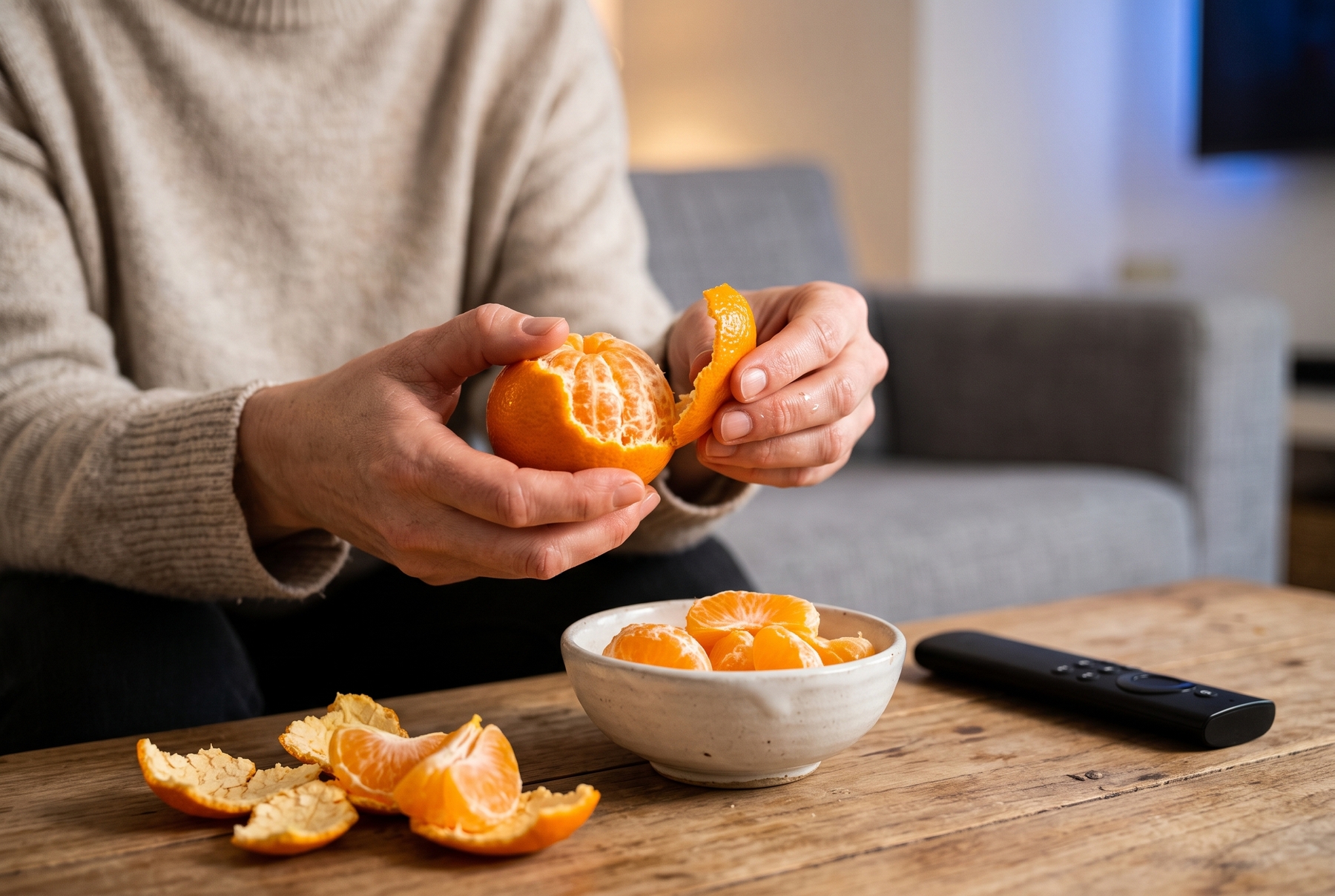
Foods that require peeling or shelling naturally slow down the eating pace and leave a visible trail of how much was consumed.
A One-Night Experiment: Three Moments to Watch For
Testing these dynamics requires no diets or calorie counting. Picking a regular evening snack, placing a normal portion into a separate bowl, and leaving the package in the kitchen sets the stage. While watching a show as usual, simply keeping an eye out for three specific moments reveals a lot.
- The exact bite when the food stops tasting exciting. This almost always happens long before the bowl is empty.
- The precise second the thought of a refill first crosses the mind—not the trip to the kitchen, just the initial spark of the idea.
- Whether any physical hunger exists in that moment, such as a hollow feeling in the stomach, rumbling, or low energy, or if the body feels completely satisfied.
Skipping the refill is not even required. The entire point is simply noticing, at least once, how the urge for “just a little more” actually operates.
0 comments