
In the morning, your child leaves a few spoonfuls of oatmeal in the bowl, and you polish them off. A couple of hours later, the crust of a sandwich disappears into your mouth. Lunchtime brings a bite of a meat patty; afternoon snack leaves half a syrnik (a traditional Eastern European farmer’s cheese pancake); dinner yields a few stray forkfuls of pasta from their plate. Not once during this sequence did you actually sit down to eat. You never pulled a plate from the cupboard for yourself, nor did the thought “I am having a snack right now” ever cross your mind. You were simply clearing the table.
Consequently, if you ask yourself honestly in the evening whether you snacked between meals, the honest answer feels like a confident no: just breakfast, lunch, and dinner, with nothing in between.
We readily recognize a whole sandwich as a meal, yet we frequently overlook half a sandwich salvaged from a toddler’s plate, even though it is the exact same food. Let’s unpack where this nutritional blind spot comes from, what it can snowball into, and how to handle it—starting with the central question of why finishing someone else’s leftovers never actually registers as eating.

Finishing leftovers from a child's plate often happens unnoticed and on autopilot while clearing the table.
Table of Contents
- Why Polishing Off Leftovers Doesn’t Feel Like Eating
- Why Your Hand Moves Faster Than Your Brain
- “It’s a Shame to Waste It”: The Ultimate Justification
- What the Actual Problem Is
- When It’s an Issue—and When Everything Is Fine
- How to Break the Cycle
- How to Train Yourself to Notice the Habit
- Three Questions Instead of a Ban
Why Polishing Off Leftovers Doesn’t Feel Like Eating
A standard meal is a miniature event with a clear beginning and end. You decide to eat, choose a dish, portion it out, sit down, chew, and get up from the table. Even if the entire process takes five minutes, your brain logs a distinct mental receipt—”I ate”—making the event easy to recall later.
Grazing on leftovers skips every single one of those steps. Nobody makes a conscious decision to eat, and more importantly, nobody chooses the portion size; whatever happens to remain on the plate simply ends up in your hand. The event has no hooks to catch onto your memory. Your body, of course, receives and digests the calories just like anything else. The issue lies not in digestion, but in your internal daily food log, where the episode is completely missing. In your mind, you weren’t eating; you were clearing your child’s plate. Memory directly influences appetite here: studies show that people asked to recall their recent lunch before an afternoon snack end up eating less, whereas when an eating episode never registers in the first place, there is nothing to recall.
A second factor explains why children’s leftovers slip past our radar far more easily than other nearby food. Everything on a child’s plate carries someone else’s label: it is “their oatmeal” or “the kid’s cheese pancake.” Finishing someone else’s portion registers as tidying up after another person rather than having your own snack. Testing this mental trick is simple: transfer that same half-eaten syrnik onto a clean communal plate, take a piece for yourself, and the narrative in your head immediately shifts to “I ate half a pancake.” The food hasn’t changed, only the framing, yet that label drives perception far more powerfully than the food itself. “I had a pancake for a snack” sounds like a meal; “I finished up after the kid” sounds like a crossed-off item on a household chore list.
Why Your Hand Moves Faster Than Your Brain
While memory mechanics explain why the episode fades, a separate question remains: why does it happen at all when you had no intention of eating? The answer is that finishing leftovers has long ceased to be an isolated decision, evolving instead into a seamless link in a habitual chain. Your child finishes eating, you gather the dishes, you walk toward the kitchen sink, the leftover bite goes into your mouth en route, and the plate lands in the basin. Repeat this exact choreography a couple hundred times, and it fuses into a single fluid motion where your hand executes its part automatically, requiring no executive command.
The surrounding environment only reinforces this autopilot. Parents almost always polish off scraps while standing and multitasking: dishes balanced in one hand, the other handing a napkin to a toddler, the next chore queuing up in the mind, a phone buzzing nearby. Zero bandwidth remains for registering flavor or quantity. Expecting willpower to intervene at the crucial second is futile; willpower requires a pause for reflection, whereas here, a well-worn neural highway leads straight from the table to the sink, making a brief, unscheduled stop at your mouth.
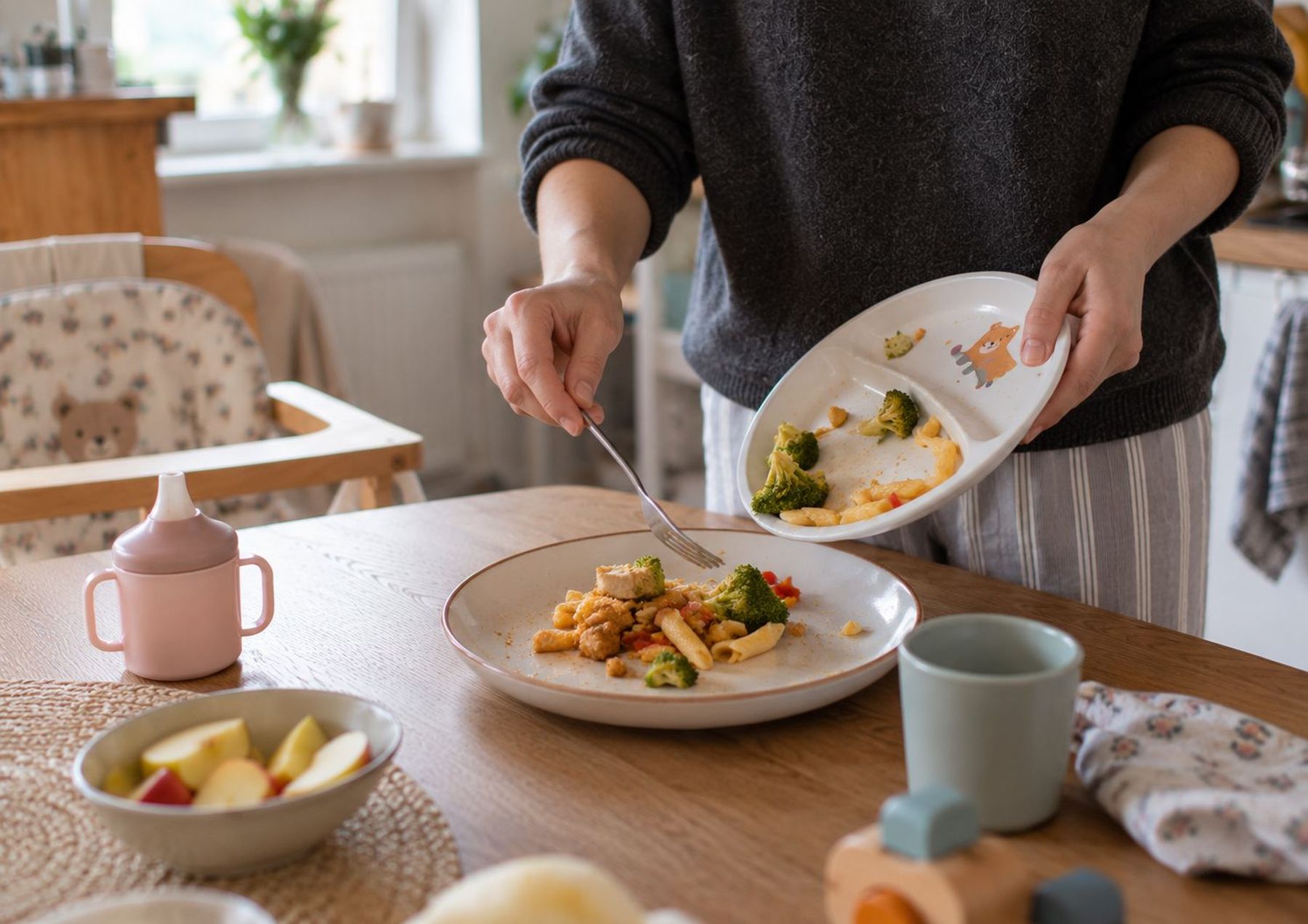
Bites and spoonfuls from a child's plate throughout the day add up to a full extra meal.
“It’s a Shame to Waste It”: The Ultimate Justification
Suppose you actually catch yourself in the act and pause for a second. That is the exact moment when the hardest-to-argue motive enters the chat. “It’s a shame to throw it away” sounds so virtuous and reasonable that it instantly shuts down internal debate, making eating the scrap seem like the only responsible exit strategy.
Throwing away food genuinely feels unpleasant, and nobody would argue otherwise. The trap lies in how seamlessly “it’s a shame to waste it” translates in our heads into “therefore, I must eat it.”
What the Actual Problem Is
On the surface, finishing a child’s leftovers sounds completely benign—and often, it stays that way. Once it solidifies into a daily reflex, however, it carries three distinct consequences, and identifying which one applies to you makes all the difference.
When uncounted bites pile on top of full breakfasts, lunches, and dinners day after day, the sheer volume quietly accumulates. Visualizing this requires no kitchen scale: just imagine taking every single bite salvaged from your kid’s plates throughout the day and placing them onto one empty dinner plate instead of into your mouth. By evening, that plate usually holds a remarkably substantial meal. Sometimes the body self-corrects—you might feel hungry slightly later or naturally dish up a lighter dinner, offsetting part of the surplus. Yet that biological recalibration is rarely exact, especially when family meals run on a strict schedule rather than true hunger cues. Over time, regular table-clearing bites can gradually show up on the scale. Still, that is neither a moral failing nor, frankly, the most compelling part of the story.
The real issue isn’t the extra grams of food, but the fact that a significant portion of your daily nourishment bypasses your consciousness entirely. You didn’t choose it, you barely tasted it, and you don’t remember it. We can only manage, savor, or decline things that enter our field of awareness. Autopilot eating strips away choice, culinary pleasure, and even the satisfying memory that makes a treat worthwhile in the first place. Ultimately, you consume the food, yet get nothing out of the experience in return.
Furthermore, every time food enters your mouth without a conscious decision, you actively strengthen the neural pathway for mindless eating. The brain internalizes a rudimentary script—”food in sight means eat”—and eagerly deploys it elsewhere: in front of the television, standing before an open refrigerator, or during moments of fatigue and stress. Consequently, grazing off a child’s plate rarely exists in a vacuum; it is usually just one symptom of a broader behavioral automatism. By practicing that reflex on toddler scraps, you inadvertently train it to take over everywhere else.
When It’s an Issue—and When Everything Is Fine
None of these consequences get triggered by an occasional half-eaten apple slice. Closer examination is only warranted when several signs converge at once: the habit plays out almost daily, multiple episodes stack up between morning and night, the scraps layer on top of already adequate meals, and the aftermath frequently leaves behind physical heaviness, guilt, or quiet frustration with yourself. That specific combination is well worth untangling.
Conversely, if you occasionally finish your child’s food, feel zero guilt, easily recognize your natural hunger and fullness cues, and don’t feel like your daily diet is happening behind your back, nothing needs fixing. Finishing leftovers is not a pathology, and this piece isn’t aimed at parents who are already at peace with their habits. Instead, it speaks to a very different, widely familiar scenario: “I eat pretty well at mealtime, yet I seem to be grazing all day long—and I just realized a huge chunk of that comes straight off my kid’s plates.”
Drawing a clear line around more serious territory is also important. Everyday table-clearing habits do not constitute an eating disorder, and diagnosing yourself over a few spoonfuls of leftover porridge makes no sense. However, if overeating happens frequently, brings a distressing sense of losing control, triggers deep shame, or sparks an urgent need to “work off” the food afterward, the issue goes far beyond a mindless pause by the kitchen sink. Those signals warrant reaching out to an eating behavior specialist—a step far more constructive than any kitchen lifehack.

The mindset that wasting food is a shame often drives parents to automatically finish cold leftovers after their children instead of declining them.
How to Break the Cycle
Imposing a strict ban on finishing leftovers is not only ineffective, it actually backfires: a rigid “never again” rule transforms an ordinary cheese pancake into forbidden fruit, which only sours your relationship with food. The true goal is restoring the moment of conscious choice that currently slips through the cracks. Because different triggers drive the habit, different strategies work best to address them.
Give the Food a Portion, a Name, and Your Own Plate
Whenever you decide to eat a leftover, resist the urge to pop it into your mouth straight from the child’s dish while standing up. Transfer the exact amount you want onto your own clean plate, and mentally label the act: “I am now eating half a cheese pancake.” While this technique sounds almost naively simple, it restores every missing cognitive detail. Suddenly, the food acquires a defined portion size, a clear boundary, and an owner—giving your brain a fair chance to realize you weren’t actually hungry after all.
Decide the Leftover’s Fate While It Is Still on the Plate
Every leftover scrap faces three possible futures: going into an airtight container for later, getting eaten right now, or going into the trash or compost. The entire trick lies in making that executive call before the food crosses your lips, rather than after. In the default scenario, the sequence runs backward: you swallow the bite first, then belatedly realize the decision was seemingly made without you. Injecting a one-second pause and asking “Do I genuinely want to eat this?” right at the start of the table-clearing route derails the autopilot. Saying no isn’t even mandatory; reclaiming ownership of the choice is what counts.
Give “Food Waste Guilt” an Outlet Other Than Your Stomach
Leftovers can easily go into a storage container to join the next meal, bolster a soup, or round out your own lunch later on. Better yet, trim the surplus right at the source: when roughly the same amount of food gets left behind day after day, the initial serving is almost certainly too generous. Plating smaller starting portions and offering seconds upon request leaves nothing behind to tempt you at cleanup time. Just be careful not to solve your own habit at your child’s expense—pressuring a kid to clean their plate just to protect your peace of mind is never the answer.
If You Are Simply Too Busy to Eat, Sit Down for a Real Meal
Parents of young children frequently go the entire day without a proper meal: between feeding, cooking, and wiping down high chairs, they survive on stray scraps because there is never a quiet moment to sit down with a plate. Under those conditions, mindfulness pauses and self-reflection questions stand no chance; raw biological hunger is driving the bus, and willpower cannot argue down an empty stomach. The solution isn’t outlawing scraps, but acknowledging “I am genuinely hungry” and feeding yourself properly: your own plate, nutrient-dense food you actually crave, and ten uninterrupted minutes sitting at the table. Once your stomach is truly satisfied, cold toddler leftovers lose their magnetic pull all on their own.
How to Train Yourself to Notice the Habit
Every strategy above hinges on one prerequisite: catching the exact moment of grazing, which is notoriously skilled at hiding in plain sight. Dedicating a couple of ordinary days to simple, judgment-free observation works wonders here. Skip the calorie trackers and kitchen scales; instead, every time you are about to eat something off your child’s plate, snap a quick photo of the remnant on your phone, and then go ahead and eat it if you still want to. Flipping through your camera roll at the end of the evening reveals the exact volume of food that normally vanishes without a trace during the day. Two days of photo logging is plenty—turning this into permanent self-surveillance is unnecessary, and beating yourself up over the photos is counterproductive.
Moving forward, two brief daily guidelines help maintain awareness. First, count everything eaten on your feet as a real meal. Any bite popped into your mouth while standing over the sink is a snack, not a nutritional zero, and silently acknowledging that fact restores the episode’s status as eating right where it usually gets lost. Second, watch for the physical cue rather than the food itself. The window of choice doesn’t open when the food is already in your mouth; it opens two seconds earlier, the exact instant your hands pick up your child’s dirty plate. Learning to spot that tactile trigger turns the rest of the process into simple mechanics.
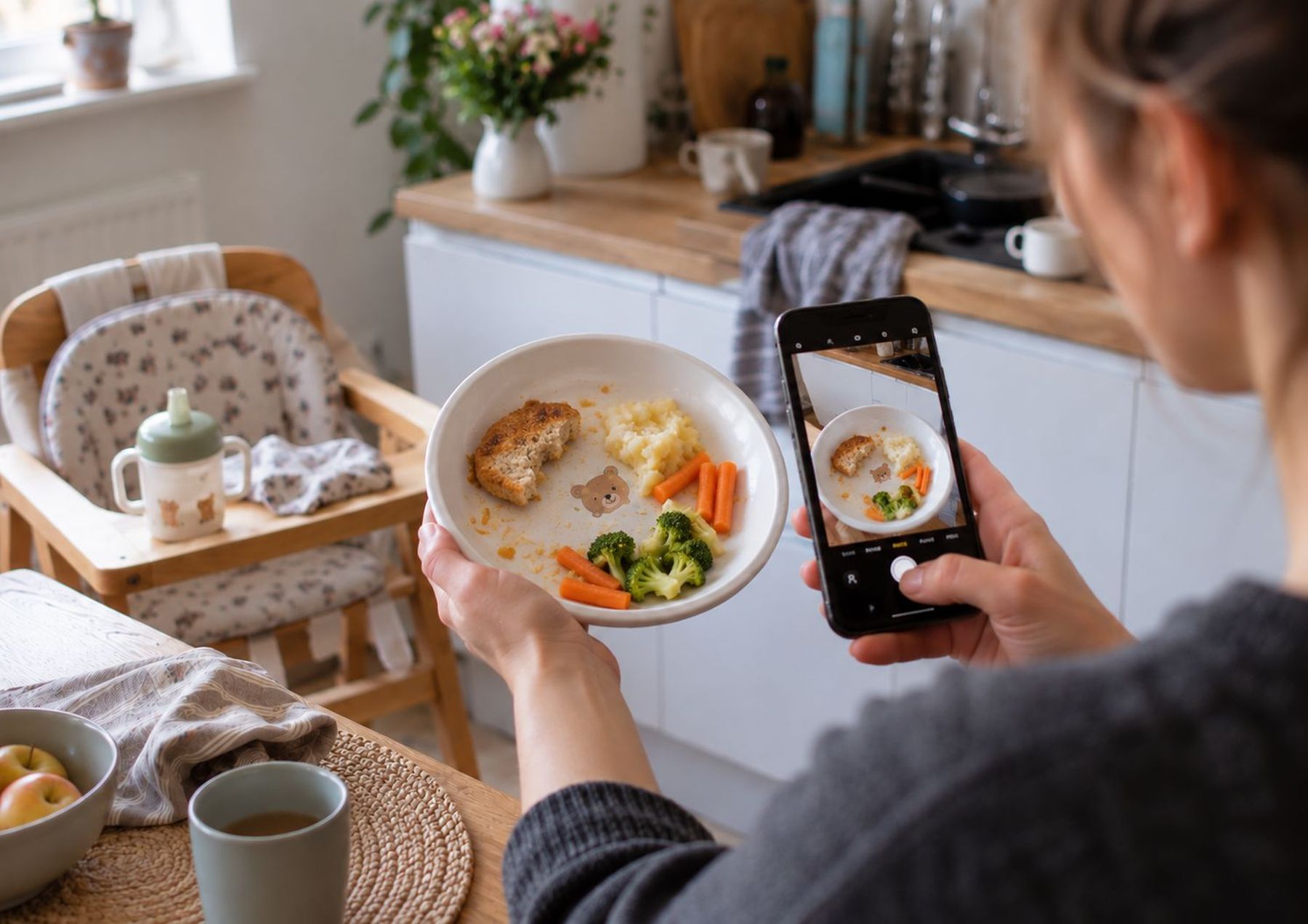
Photographing leftovers before eating them restores mindfulness and reveals the true volume of food consumed during the day.
Three Questions Instead of a Ban
If you take only one tool away from this entire piece, make it these three questions. Right before polishing off the next leftover bite, ask yourself:
- Am I actually hungry right now?
- If this piece of food weren’t sitting directly in front of me, would I go open the fridge to look for something to eat?
- Do I genuinely want to taste this specific food, or do I just want this plate to be empty?
There are no right or wrong answers here. If you discover you are hungry, fix yourself a proper plate. If you genuinely crave that specific bite of cheese pancake, savor it gladly—that is culinary pleasure, not a transgression. Simply asking the question does all the heavy lifting by pulling the behavior out of autopilot, which is more than enough.
Coming full circle back to that busy morning kitchen, what made every stray bite invisible was never its tiny size, but the fact that it never once felt like a decision to eat—it was simply housekeeping that quietly morphed into a meal. Rather than forbidding yourself from ever finishing a scrap, practice catching the exact split second when “clearing the table” turns into “having a snack.” Sometimes you will realize you are genuinely hungry, sometimes you will decide you truly want that bite of pancake, and plenty of times you will realize you never wanted it at all. The moment you can tell those scenarios apart, the plate stops making decisions for you.
Ultimately, what turns those scattered leftovers into an extra daily meal isn’t one massive portion, but a dozen tiny decisions you never noticed making.
0 comments