
My grandmother washed chicken with such diligence, as if it had just returned from a week-long hiking trip. The faucet was turned on full blast, the bird went under the stream from all sides, and then into the sink. The argument “it is more hygienic” was an ironclad rule in her kitchen. Objecting was useless: decades of family experience and unwavering confidence stood behind it.
But if you try doing this in a professional kitchen—for example, in a culinary school or a Michelin-starred restaurant—the chef stops you before you even touch the faucet. The issue lies not in saving water, but in safety.
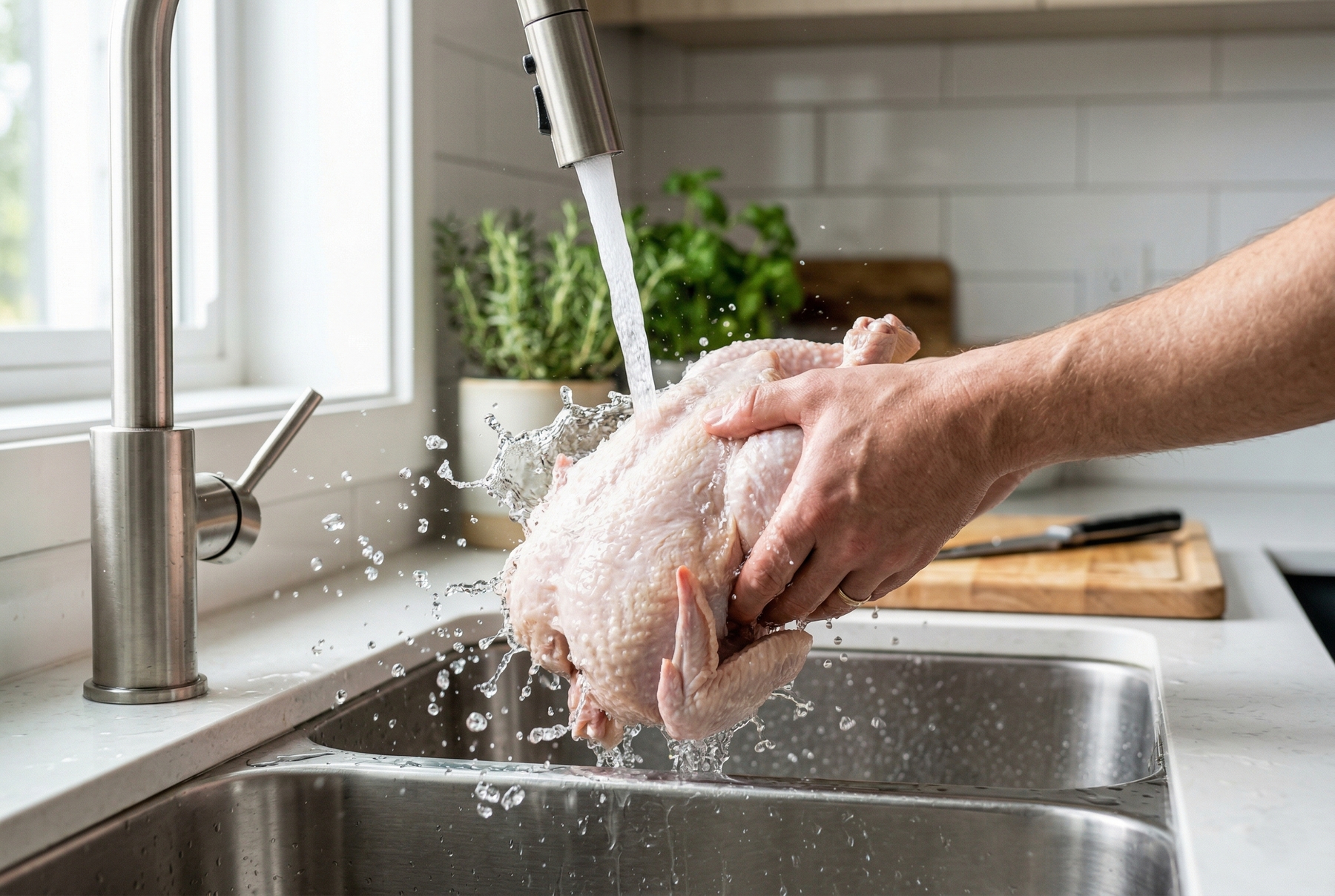
Washing chicken under a strong stream of water spreads dangerous bacteria, such as Salmonella, across the kitchen within a three-foot radius.
Your broiler chicken awaits its turn tonight. If the reflex to “rinse first” still lives in your kitchen, understanding a few key facts is essential.
Table of Contents
What Happens Under The Running Water
Holding the bird under the faucet means water hits the meat’s surface under pressure. Every drop that strikes the skin shatters into thousands of tiny splashes: so small the eye cannot see them, yet large enough to transport live bacteria. These droplets settle on the sink, the faucet, the countertop, the towels, and the plates drying nearby. Believing you are making the kitchen safer actually distributes the microflora evenly across its entire perimeter.
The two main passengers on raw poultry are Salmonella and Campylobacter. Both thrive at room temperature, and both cause acute food poisoning. Research shows that contaminated splashes from washing poultry fly up to a meter (about 3 feet) around the sink. That single meter easily encompasses your cutting board, a resting knife, and the hand towel hanging on its hook.
Cold tap water kills absolutely nothing in the process. It acts as a vehicle, not a disinfectant. It washes visible dirt down the drain while simultaneously spreading whatever failed to wash away across all adjacent surfaces. The sink itself becomes contaminated afterward, a detail many people conveniently forget.
The Myth: “But The Bacteria Must Be Washed Away!”
The logic seems undeniable: there are bacteria, there is water, so washing them away makes sense. The problem is that bacteria on meat do not sit on the surface like dust on a bookshelf. They embed themselves in micropores, in skin folds, and within the tissue structure. Water is physically incapable of washing them out in the way we imagine. It might dislodge a fraction of the cells from the surface, but the main colony stays put. Meanwhile, part of that colony ends up on your hands, in the sink, and in the surrounding splashes.
Only one thing kills them: temperature. Vinegar, lemon juice, or soaking in saltwater offer no help here.
For poultry, the number is specific: the internal temperature must reach 74°C (165°F). This heat destroys Salmonella, Campylobacter, and most other pathogens. A meat thermometer costs far less than a single visit to the gastroenterologist.
Checking the thickest point of the cut, away from the bone (usually the breast, though verifying multiple spots makes sense for a whole bird), is the only reliable method. The color of the juices, the recipe stating “40 minutes,” or the feeling that “it seems ready” do not count. The thermometer and the number are all that matter. Juices turn clear for various reasons, making this an outdated indicator of doneness. Forget about it completely.
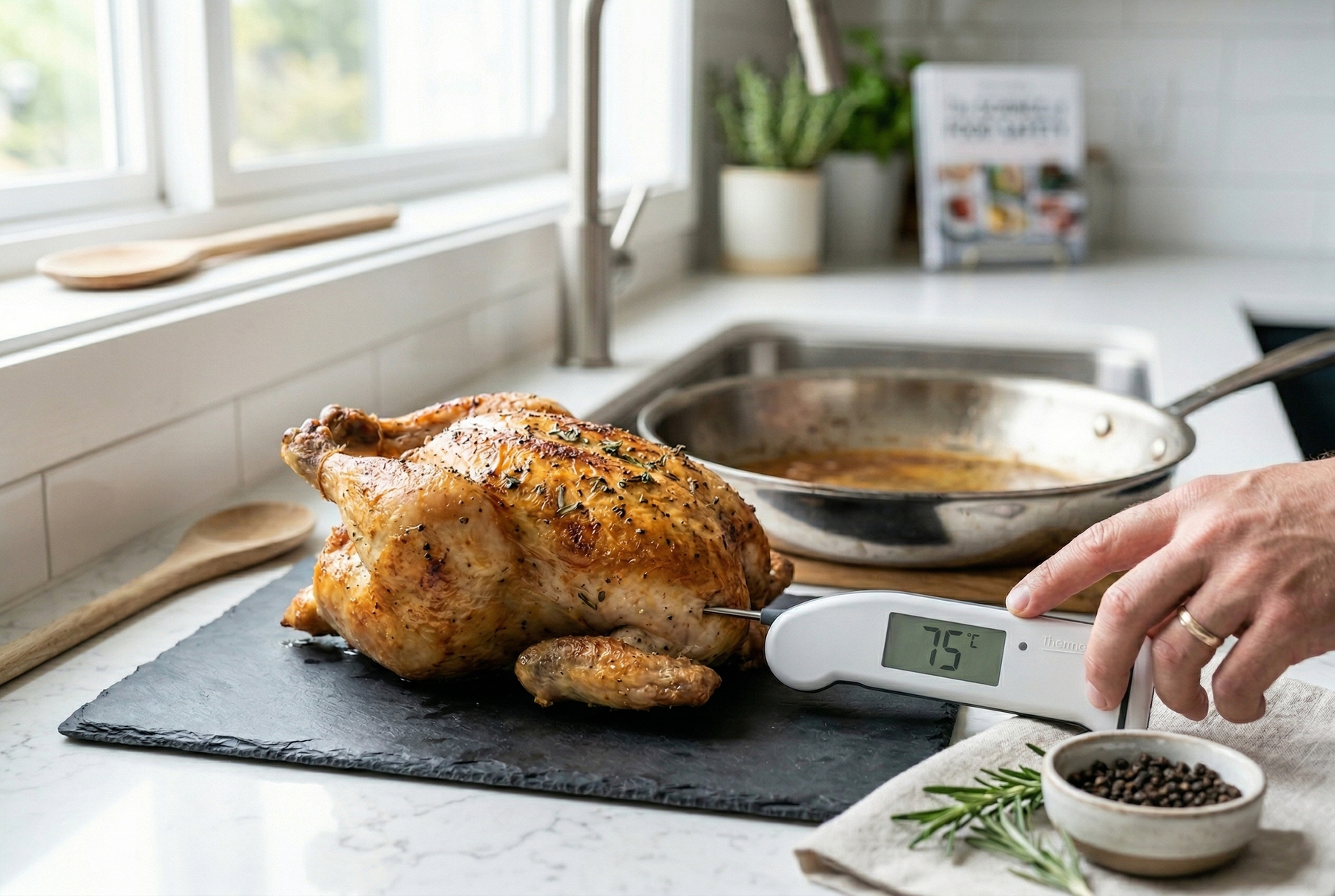
Heating poultry to 74°C (165°F) is the only way to ensure its safety. A culinary thermometer serves as the best tool for this.
What About Steaks And Chops?
The rule applies to all meat, not just poultry. Pork, beef, and lamb follow the exact same principle. Water fails to make them safer, yet faithfully spreads everything unwanted around the kitchen.
Washing meat also brings another downside: a culinary one.
The Maillard reaction (the browning of the surface at high temperatures due to the interaction of amino acids and sugars) demands a dry surface. When excess moisture remains on the meat, the pan first spends its energy evaporating that water, delaying the surface from heating to the necessary temperatures. During this time, the meat steams rather than sears. Instead of a golden, slightly crispy crust, you receive a pale, damp surface lacking both aroma and flavor.
The rule remains straightforward: blotting instead of washing. Using a sturdy paper towel and applying firm pressure on all sides turns the meat’s surface matte-dry and almost velvety to the touch. This condition perfectly prepares it for the pan. The towel goes straight into the trash, never resting nearby on the countertop.
What To Do If The Chicken Is Objectively Dirty
Honestly, farm-raised poultry presents a different story. Store-bought chicken in plastic packaging generally arrives clean. However, buying a whole bird at the farmers’ market or directly from a farmer means it might harbor residual feathers, small blood clots, or bone dust across the surface if the bird was chopped on site.
A single feather or a small blood spot is easily handled by a thick paper towel on a targeted basis. You simply remove the debris, discard the towel, and wash your hands. No water or faucet comes into play.
Dirt and bone dust left after chopping represent a different challenge. Rubbing such a surface with paper drives cellulose firmly into the meat (which later affects the taste). Washing it under a strong tap creates a bacterial fountain across half the kitchen.
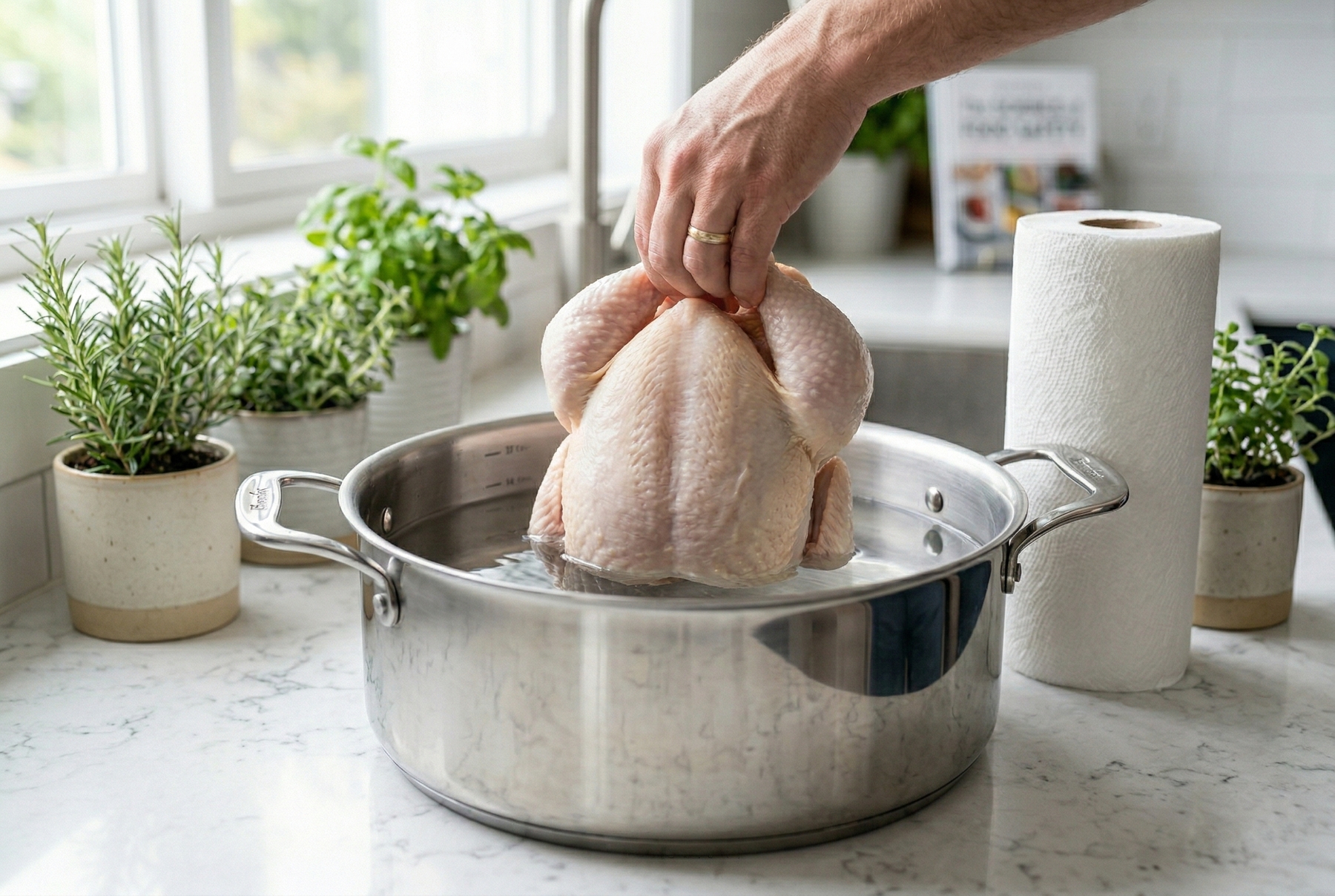
Submerging heavily soiled farm poultry in a pot of water prevents the formation of bacterial aerosols.
The pot method offers a necessary compromise that works excellently in practice. Filling a deep pot or bowl—large enough to submerge the whole bird—with water allows you to gently lower the meat without sudden movements. The vessel’s walls suppress splashes, preventing aerosol formation almost entirely while the bone dust washes into the water. You rotate the bird and take it out.
One crucial detail often gets overlooked: the water in the pot now acts as a bacterial broth. Pouring it out requires a slow, careful motion as close to the drain as possible without splashing. Afterward, washing the pot and sink with soap is mandatory, rather than merely rinsing them. Soap helps wash away bacteria mechanically, a task simple rinsing fails to accomplish.
Thoroughly drying the bird itself with thick kitchen towels on all sides is the next vital step. Sending wet poultry to the pan means giving up any hope of a proper crust.
One separate point needs addressing: things that no method can cure. Sticky slime on the surface, or a sour or ammonia-like smell upon opening the package are not impurities that wash away. They are signs of spoilage and toxins. Such poultry goes straight into the trash without negotiation. Neither washing nor prolonged thermal processing offers any help at this stage.
What To Do If You Have Already Washed The Chicken
Reflexes possess strong power. Turning on the faucet over meat for twenty years straight makes stopping on the first try difficult. Nothing terrible has happened yet, but cleaning up properly is essential.
- Patting the chicken dry and continuing cooking as discussed ensures safety: thermal processing does its job, and reaching 74°C (165°F) internally fixes the issue.
- Washing the sink, the faucet, and the entire surrounding area requires a sponge with dish soap, followed by a disinfectant. Letting it sit for two to three minutes before rinsing is the proper way.
- The cutting board, if it sat nearby, demands the same treatment. Plastic proves easier in this regard since cleaning and fully sanitizing it takes less effort. Wood requires more attention because it absorbs moisture.
- Washing hands with soap for a minimum of 20 seconds is mandatory. This rule is no mere formality: 20 seconds of mechanical friction with soap effectively removes the bulk of contamination, whereas 5 seconds falls short.
- Replacing the sponge used in the sink is the best course of action. If a new one is unavailable, thoroughly washing it with dish soap and leaving it to dry completely is the alternative, as a damp sponge quickly turns into a breeding ground.
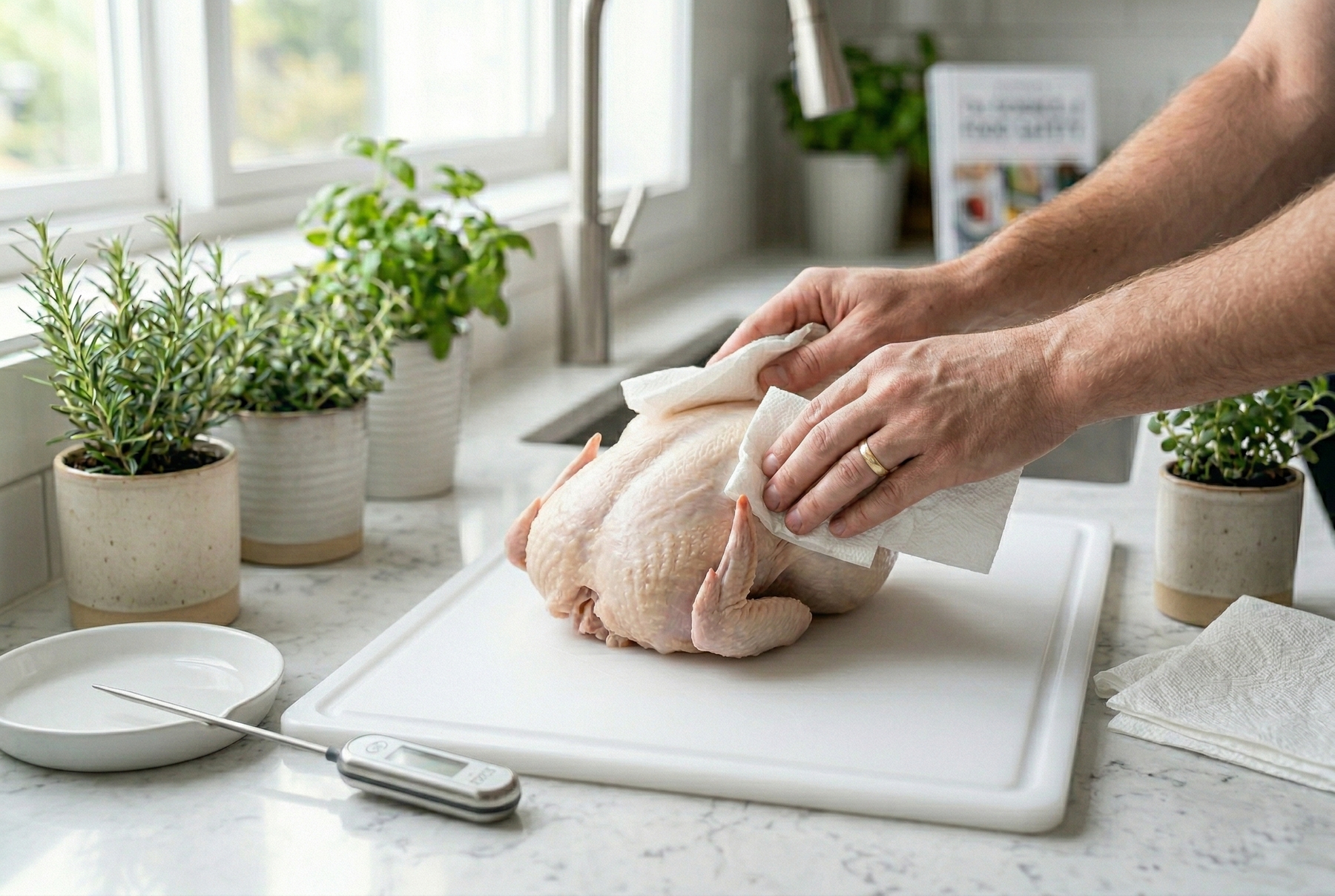
Using paper towels instead of water achieves the dry meat surface necessary for a perfect golden crust.
The Ideal Poultry Preparation
- Taking the bird out of its packaging directly onto a plastic cutting board sets the right foundation.
- Avoiding water entirely keeps the kitchen safe.
- Blotting with paper towels on all sides until the surface is matte-dry acts not as an optional step, but as the basis for any decent crust.
- Carving the meat follows.
- Washing hands thoroughly with soap is imperative.
- Cooking while monitoring the temperature with a thermometer guarantees success: aiming for 74°C (165°F) in the thickest part, away from the bone.
People habitually wash poultry for one reason: the illusion of control. Seeing running water and watching it wash something away creates the feeling of doing the right thing. Physically, this moment merely transfers microflora from one surface to several others, but because this process remains invisible, the brain feels satisfied.
Grandmother was right about one thing: raw meat commands serious respect. The method she used, however, missed the mark.
0 comments