
The soup is ready. A cook takes a taste, frowns, and reaches for the salt shaker. They add a generous pinch, then taste again. The broth has become acceptable. However, the potatoes remain mealy, the meat is slightly bland, the carrots feel entirely disconnected, and the flavors simply refuse to meld into a cohesive whole. Formally, everything was executed correctly. Practically, it was not.
Salt was present, but it failed to perform its intended job. We frequently question how to properly salt our food, fixating purely on exact grams, yet the issue is rarely about quantity alone. Salt within a dish masterfully controls moisture, manages protein structures, and dictates exactly how ingredients release their juices and absorb flavor. Consequently, while the question of ‘how much’ absolutely matters, the question of ‘when’ is occasionally far more critical. Salting a simmering soup too late means the liquid quickly absorbs the seasoning, while chunks of potatoes, meat, or grains that simmered in unsalted water remain structurally flat from the inside out. The broth will taste fine, but the potatoes within it will be incredibly dull. This creates that eternal culinary sensation of ‘something is missing,’ even with a completely full salt shaker nearby.

Layered salting allows the flavors of the ingredients to fully unfold, seamlessly uniting the broth and its components.
Table of Contents
- Why Adding Salt in Stages Yields Superior Results
- How Much Salt to Add: A Pinch Is Not a Reliable Unit of Measurement
- Fine, Coarse, or Flaked: How the Specific Type of Salt Impacts the Result
- What Needs Advance Salting: Meat, Fish, and Eggs
- Ground Meat: Meatballs and Burgers Require Radically Different Approaches
- How to Properly Salt Fish: Less Time, More Focused Attention
- Eggs: When Early Salt Improves Final Texture
- Dry Brining, Wet Brining, and Marinating: Three Distinct Culinary Methods
- What Requires Early Salting: Sautéed Vegetable Bases and Grains
- Soups and Broths: The 'Salt Only at the End' Rule Is Deeply Flawed
- Pasta: Mastering the Salty Boiling Water
- Legumes: Salt Does Not Hinder Their Softening
- Potatoes: Mashed, Pan-Fried, and Roasted
- Mushrooms, Eggplants, and Zucchini: Salt Directly Dominates Moisture Control
- Salads and Fresh Vegetables: How Salt Dramatically Alters Delicate Textures
- Sauces: Why Highly Reduced Dishes Are Terribly Easy to Over-Salt
- Baking and Desserts: Salt Strongly Dominates Even Where It Is Least Expected
- Why Food Can Taste Noticeably Under-Seasoned: When the Problem Lies Beyond the Salt Shaker
- How to Truly Understand When Enough Salt Is Finally Enough
- Common Culinary Missteps
Why Adding Salt in Stages Yields Superior Results
Layered Salting: How to Apply the Technique
Salt dissolves in hot liquid within seconds. However, penetrating a dense potato or a thick cut of meat from the inside out requires significant time. The later the salt is introduced into the cooking process, the less opportunity it has to transform the ingredients internally.
Boiled and stewed dishes benefit immensely from a deliberate, three-stage approach. Introducing a moderate pinch of salt at the very beginning ensures that the foundational flavor profile starts building from the first minutes, preventing raw ingredients from cooking in empty water. Adding another measured pinch in the middle of the process—when new components like dry grains, fresh vegetables, or another layer of meat enter the pot—helps tighten the overall taste. The final touch predictably arrives just a couple of minutes before the dish is finished, once it becomes clear exactly how much liquid remains and how deeply the contents have reduced.
The simplest example involves a humble potato. Boiling it in entirely unsalted water and subsequently dropping it into a heavily seasoned, finished dish guarantees it will remain utterly bland on the inside.
Exactly How Salt Influences Flavor Perception
People often casually claim that salt ‘unlocks aroma,’ but this phrase feels rather vague. In reality, salt brilliantly amplifies the overall perception of flavor while actively suppressing harsh bitterness. Natural sweetness and savory umami become significantly more pronounced—these are the exact tastes that impart profound depth to a rich broth or vibrant intensity to a crushed tomato. Salt actively assists ingredients in releasing their natural juices and deeply alters protein structures, a factor that proves particularly crucial when cooking meat and fish. Aromas appear vividly brighter not due to some magical ‘unlocking’ property, but simply because the overall flavor profile becomes infinitely more cohesive.
In short, salt brings everything into razor-sharp focus. Bitterness turns noticeably quieter, sweetness and umami confidently step forward, and the dish ceases to feel muddled.
How Much Salt to Add: A Pinch Is Not a Reliable Unit of Measurement
Why ‘a Pinch’ Is a Highly Subjective Concept
A ‘pinch of salt’ serves as an excellent measurement strictly if both the recipe developer and the home cook share the exact same hands. Naturally, this is rarely the case. A pinch grabbed by someone with large hands utilizing coarse sea salt differs three to four times in volume from a delicate pinch taken by someone with slender fingers utilizing fine table salt. A standard teaspoon offers slightly more reliability, but it remains decidedly unstable: fine salt packs much more densely and weighs significantly more than a spoonful of large, coarse crystals.
Recipes heavily relying on vague pinches work perfectly within a single kitchen. Moving to another kitchen changes the entire equation.
How Culinary Professionals Think About Salt
A seasoned chef who salts entirely by eye does not rely on magic hidden in their fingertips. This technique is firmly backed by years of accumulated experience: they instinctively recognize the exact mass of the product sitting in front of them, the specific type of salt held in their hand, and the desired final result. Ultimately, the hand flawlessly remembers the necessary motion without requiring a digital kitchen scale.
For domestic cooking, maintaining concrete guidelines measured in grams proves significantly more convenient, particularly when dealing with raw meat, complex doughs, fermentation brines, or a massive pot of soup.
Several Concrete Guidelines: The comfortable salinity level for a finished dish most frequently falls safely within the range of 0.6–1% salt by total mass:
- Water for boiling in large volumes (pasta, pelmeni [Russian meat dumplings], vareniki [pierogi], potatoes): 10–12 g (approx. 0.35–0.4 oz) of salt—roughly 2 level teaspoons—per 1 liter (34 fl oz) of water (1–1.2%). The water will impart only a fraction of its flavor to the product before being poured down the drain, meaning the cooking environment itself must be distinctly salty.
- Soups and broths: 8–10 g (approx. 0.3 oz) per 1 liter (34 fl oz) of liquid (0.8–1%). Importantly, if a soup will reduce over a long simmer, starting strictly with 5–6 g (0.2 oz) and executing a final seasoning adjustment at the end is highly recommended.
- Grains (buckwheat, rice for side dishes, quinoa): 5–7 g (approx. 0.2 oz or 1 level tsp) per 200 g (7 oz) of dry grains. Unlike pasta, grains absorb water almost entirely, so the rule of 1% of the total mass (grain + water) applies perfectly here.
- Ground meat (for homemade burger patties, meatballs, golubtsi [stuffed cabbage rolls]): 10–15 g (0.35–0.5 oz) per 1 kg (2.2 lbs) of meat (1–1.5%). Commercial standards for factory-made pelmeni hover around 1.5%, but for home kitchens, 1–1.2% (10–12 g) represents the most common and comfortable choice.
- Comfortable salinity for finished stewed dishes (ragouts, goulash): This typically lands perfectly in the 0.6–1% range of salt relative to the total mass of the ingredients.
- Plov (pilaf): 25–30 g (0.9–1 oz) of salt for a classic kazan (traditional cast-iron cauldron) containing 1 kg (2.2 lbs) of rice, 1 kg of meat, and 1 kg of carrots. This equates to roughly 1–1.2% of the dish’s total weight. The cardinal rule involves adding salt directly to the zirvak (the intensely flavored meat and vegetable base simmered with water) before introducing the rice. To the palate, the liquid zirvak should taste slightly over-salted; the entirely bland rice will absorb this excess beautifully.
- Dry brining meat (steaks, whole chicken, buzhenina [roasted pork]): 8–12 g (0.3–0.4 oz) per 1 kg (2.2 lbs) of weight (0.8–1.2%).
- Sauerkraut: 20–25 g (0.7–0.9 oz) per 1 kg (2.2 lbs) of cabbage (2–2.5%). This is a remarkably strict proportion: using less than 2% causes the cabbage to turn unpleasantly soft and potentially spoil, while exceeding 2.5% severely stalls the vital fermentation process.
- Lightly salted red fish (gravlax style): 30–40 g (1–1.4 oz) per 1 kg (2.2 lbs) of fillet (3–4%). Mixing the salt with sugar (in a reliable 2:1 ratio of salt to sugar) frequently creates an impeccable flavor balance.
- Bread, pizza, and savory doughs: 15–22 g (0.5–0.8 oz) per 1 kg (2.2 lbs) of flour (1.5–2.2%). A ratio of 1.5% suffices for delicate dumpling dough, while hearty artisan breads demand closer to 2%.
All of these serve merely as guidelines. The immediate presence of parmesan, smoked bacon, cured olives, soy sauce, anchovies, briny capers, or deeply concentrated bouillon instantly alters the calculation.
Fine, Coarse, or Flaked: How the Specific Type of Salt Impacts the Result
Three Distinct Varieties of Salt for Different Culinary Tasks
Fine salt dissolves the fastest and packs most densely into a measuring spoon. It proves incredibly convenient for complex doughs, liquid marinades, smooth sauces, and any preparation requiring flawless, even distribution.
Coarse salt naturally excels at dry-brining meats: its substantial crystals are easily felt between the fingers, making it far more difficult to accidentally over-season the cut of protein.
Flaky salt (such as fleur de sel, Maldon, and similar artisanal varieties) provides not just flavor, but essential texture: delivering a delicate, crisp, distinctly salty burst upon the surface that standard fine salt simply cannot replicate.
Salting a thick steak with coarse salt before aggressively searing is highly advised. Finishing a freshly dressed heirloom tomato salad with a few delicate flakes genuinely elevates the dish. Every specific culinary task demands its corresponding type of salt.
Iodized Salt: Not Suitable for Every Kitchen Situation
For the vast majority of everyday meals—comforting soups, porridges, boiled potatoes, braises, and pan sauces—iodized salt performs flawlessly. However, selecting pure sea or kosher salt completely devoid of additives is generally preferred for fermentation and certain preserved goods, especially when explicitly required by a trusted recipe, as iodine and harsh anti-caking agents can negatively impact both the delicate fermentation process and the final flavor profile.
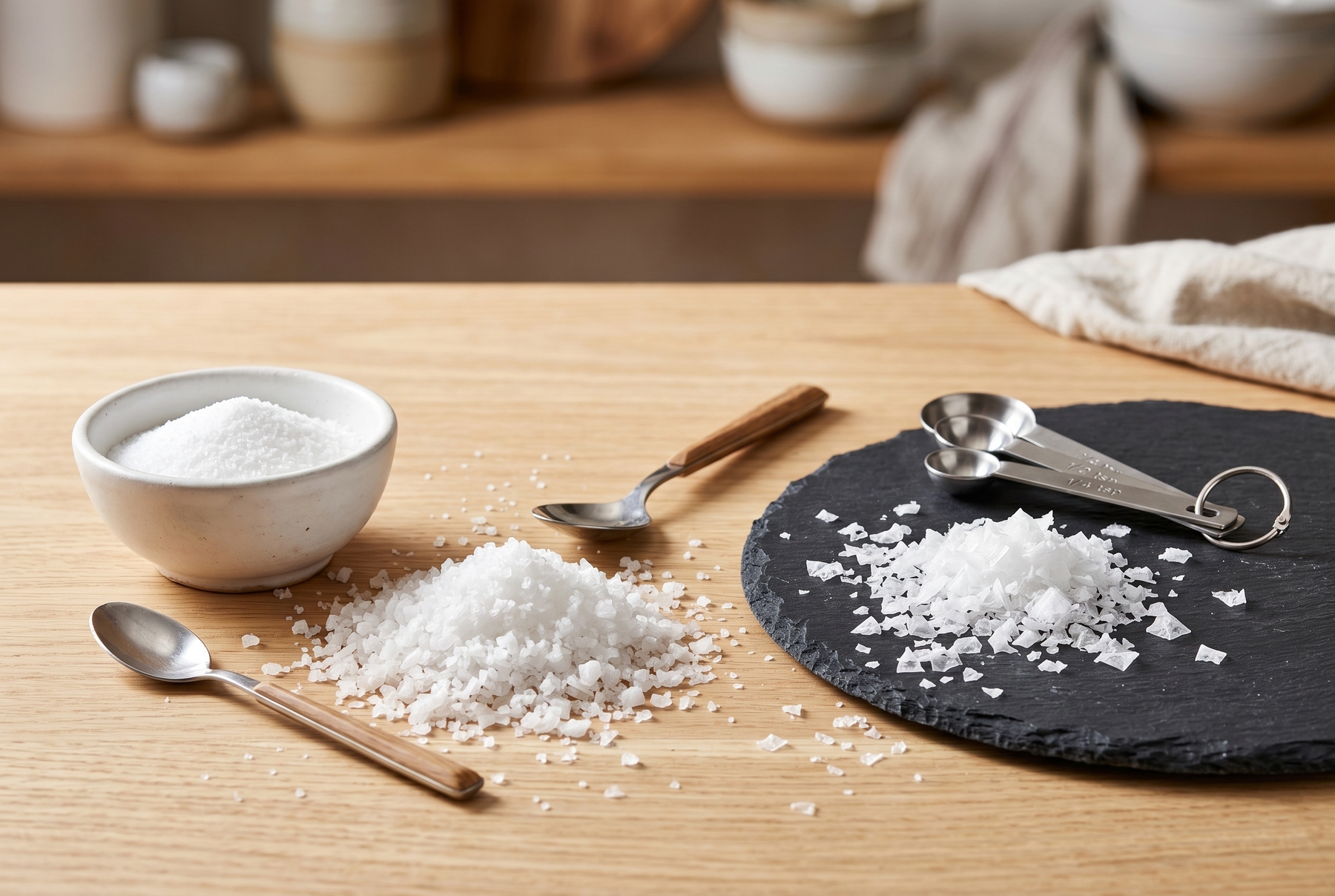
Fine salt is ideal for sauces, coarse salt excels with meat, and flaky sea salt (fleur de sel) serves as the perfect finishing touch before serving.
What Needs Advance Salting: Meat, Fish, and Eggs
When to Properly Salt a Steak and Large Cuts of Meat
Salting a steak should occur either immediately prior to searing (meaning the seasoned meat hits the scorching pan instantly) or well in advance. Allowing an absolute minimum of 40–60 minutes is crucial. Thicker cuts thoroughly benefit from being heavily salted several hours ahead or even left uncovered on a wire rack in the refrigerator overnight.
The most problematic approach imaginable involves salting roughly 10–20 minutes before cooking. The surface has already drawn out significant moisture, yet it has not had sufficient time to cleanly reabsorb or dry out. Consequently, the highly desired crust on such meat develops incredibly poorly.
Observing exactly what happens when meat is salted well in advance is quite fascinating. The salt actively extracts internal moisture to the surface—a totally natural phenomenon that typically alarms beginners. A wet film, occasionally forming distinct liquid droplets, actively appears on the exterior. Subsequently, a highly concentrated brine forms, which slowly and partially reabsorbs back into the deep muscle fibers. The surface eventually dries out again, adopting a matte, slightly taut appearance. Thoroughly patting the meat completely dry with paper towels immediately before searing guarantees a proper crust: deeply browned, redolent of roasted proteins and caramelized pan juices, rather than a sad, grey, steamed exterior. Failing to aggressively dry the meat will allow residual surface moisture to instantly transform a scorching skillet into a tragic makeshift steam bath.
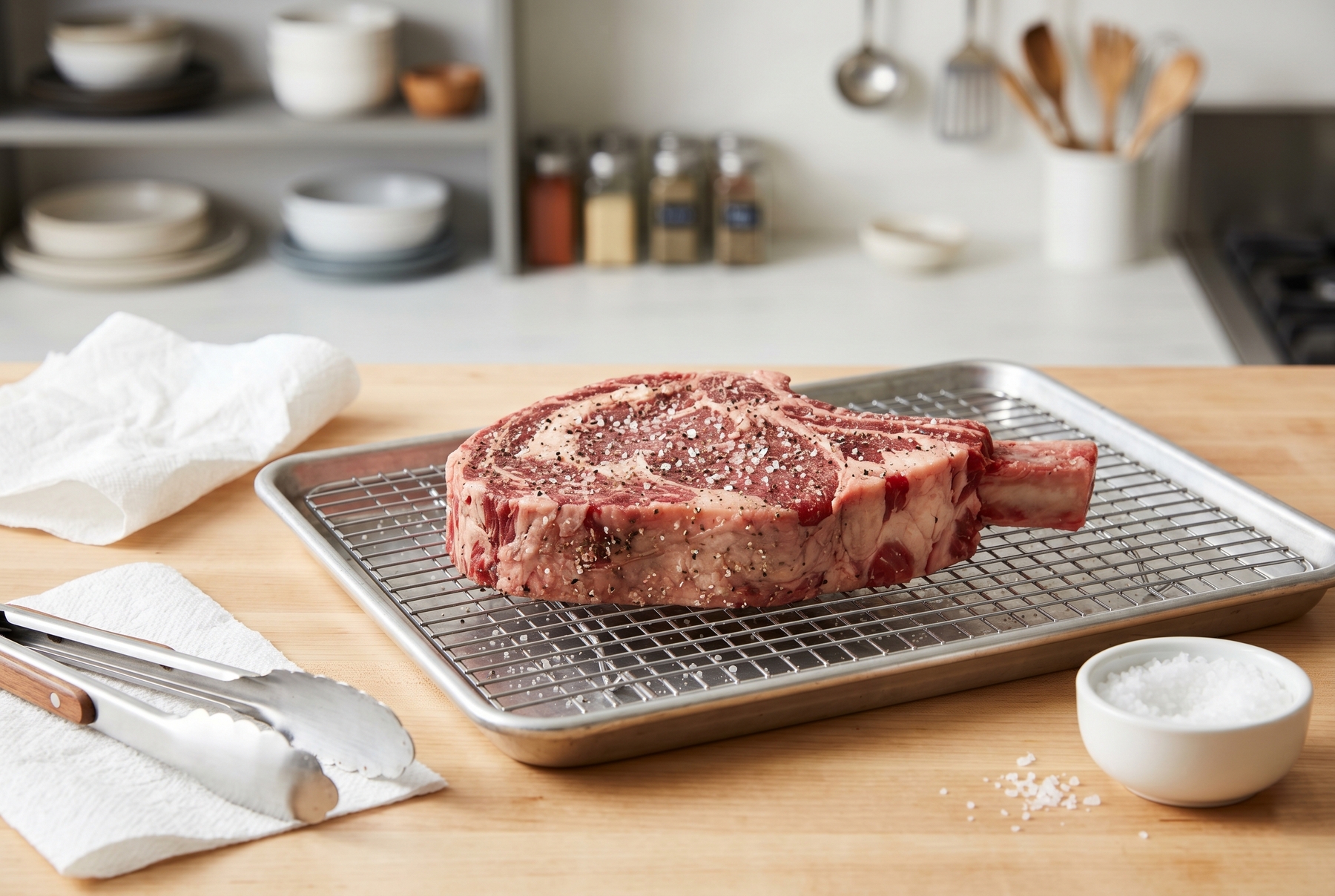
Salting a steak well in advance helps develop a flawless crust while preserving the intense juiciness of the meat inside.
Chicken: Salt as a Reliable Insurance Policy Against Dryness
Salting a lean chicken breast 30–60 minutes prior to cooking yields far superior results; extending this timeframe is even better if daily schedules permit. Subjecting a whole bird to a dry brine for several hours or overnight is highly recommended. The salt actively assists the poultry in firmly retaining its natural moisture during cooking while distributing a balanced, savory flavor evenly throughout the entire thickness of the meat.
While salt alone cannot magically transform an overcooked, chalky chicken breast into a culinary masterpiece, it will undoubtedly rescue it from becoming unpalatably dry.
Ground Meat: Meatballs and Burgers Require Radically Different Approaches
Meatballs and Patties: Adding Salt During the Mixing Phase
For standard homemade cutlets or meatballs, incorporating the salt directly into the ground meat during the active mixing phase is absolutely essential. It directly aids the meat proteins in tightly binding the mixture together: the patties hold their shape beautifully in the hot pan and develop a noticeably more cohesive structure. The primary caveat involves actively avoiding over-mixing: aggressively kneading salted ground meat significantly densifies the final internal texture.
Burgers: Exterior Salting Right Before the Sear
Crafting excellent burgers involves an entirely different objective: achieving a tender, incredibly juicy patty with an open, loose structure, rather than a dense, tightly packed puck of meat. Therefore, generously salting solely the exterior directly before it hits the grill or smoking skillet is the absolute optimal method.
Pre-mixing pure salt deeply into ground beef destined for a burger initiates an aggressive protein binding process, resulting in a patty boasting an unpleasant density uncomfortably close to that of a breakfast sausage.
How to Properly Salt Fish: Less Time, More Focused Attention
When to Salt Fish Before Pan-Searing or Baking
Fish naturally features a significantly more delicate cellular structure than meat, rendering extended brining times entirely unnecessary. A thin fillet of white fish requires merely 5–10 minutes. Thicker fillets of cod, halibut, or fatty salmon benefit from 15–30 minutes. Naturally oily fish tolerate the salting process with marginally greater ease. Subjecting fish to an excessively long brine actively toughens it even before any heat is applied: the delicate proteins firm up, transforming the flaky texture into something distressingly bouncy and almost rubbery.
However, this slight tightening effect genuinely carries a distinct structural advantage: salt gently firms the superficial proteins, ensuring the delicate fish is far less prone to falling apart dramatically during pan-searing. A highly fragile fillet of tilapia or pollock, seasoned merely a few minutes prior and carefully flipped with an offset spatula, exceptionally maintains its structural integrity significantly better than an entirely unseasoned piece casually tossed directly into a hot pan.
Marinades Utilizing Soy Sauce Constitute an Active Brine
Marinating fish heavily in soy sauce, fermented miso paste, pungent fish sauce, or savory anchovy paste effectively places it deeply into a highly saline environment. Consequently, the addition of pure granular salt must be rigorously minimized, or safely eliminated entirely.
Eggs: When Early Salt Improves Final Texture
Omelets and Scrambled Eggs Actively Benefit from Early Salting
Salting raw eggs in advance is highly advantageous. The widespread culinary fear of early salting likely stems from sunny-side-up preparations, where the physical dynamics are genuinely different. Seasoning a beaten omelet mixture or scrambled egg base roughly 10–15 minutes before cooking is perfectly acceptable. The salt actively assists the egg proteins in tightly retaining moisture, ultimately yielding an exceptionally tender, weeping-free texture.
Sunny-Side-Up Eggs Are an Entirely Different Matter
Seasoning sunny-side-up eggs proves far more convenient at the very end of cooking or directly served on the plate: this allows for highly precise control over seasoning the rich yolk and the set egg white entirely separately. Naturally, if the finished dish directly incorporates sharp cheese, salty ham, smoked fish, or briny feta, the precise quantity of additional salt must be proportionally reduced.
Dry Brining, Wet Brining, and Marinating: Three Distinct Culinary Methods
Dry Brining: Less Excess Water, Far Superior Crust
Applying a dry brine strictly entails rubbing salt directly onto the exterior surface of the ingredient without adding any accompanying liquid. This serves as an outstanding technique for thick steaks, bone-in chicken, rich pork, and large roasting poultry. The product refrains from absorbing any unnecessary water, the surface dries out effortlessly prior to searing, and the resulting caramelized crust is noticeably superior. It solidly remains the most versatile method for roasting or pan-searing all forms of meat.
Wet Brining: Securing Supplemental Internal Juiciness
A wet brine consists entirely of water heavily infused with dissolved salt, frequently accompanied by raw sugar and whole spices. It purposefully allows the ingredient to actively absorb additional moisture. This technique proves particularly invaluable for lean cuts prone to drying out aggressively during high-heat cooking, such as boneless chicken breasts, whole turkey, and lean pork tenderloin. Thoroughly patting the product entirely dry with paper towels immediately after removing it from the brine is absolutely critical. Otherwise, instead of a deeply browned, majestic crust, the pan creates a steamy environment resulting in a flabby, pale, anemic surface.
Marinades: Salt Frequently Hides Deep Inside
Soy sauce, miso paste, fish sauce, anchovies, prepared commercial condiments, and numerous savory flavor pastes natively carry immensely substantial quantities of salt. Whenever these feature prominently within a wet marinade, adding extra granular salt must be strictly curtailed. Critically evaluating the inherently salty components is an essential first step before ever instinctively reaching for the salt cellar.
What Requires Early Salting: Sautéed Vegetable Bases and Grains
Soffritto, Mirepoix, and Sautéed Bases: Salt Helps Vegetables Form the Foundation
Introducing salt early to vegetable bases destined for hearty soups or rich ragouts is rarely about making the finished dish taste purely ‘salty’. Instead, it actively encourages raw onions, carrots, celery, or bell peppers to release their internal moisture noticeably faster, enabling a gentle, beautifully even softening process.
The classic French mirepoix (onions, carrots, celery), the deeply rooted Italian soffritto (the exact same trio), the Spanish sofrito (onions, garlic, tomatoes), and the traditional Eastern European sautéed soup base all operate on an identical logic: this is absolutely not aggressive, high-heat searing meant to build a deep crust, but rather a slow, methodical sweating of raw vegetables to establish a deeply aromatic foundation. Initially, raw chopped onion is harsh and pungent, emitting sharp, eye-watering aromas. After roughly ten minutes over medium heat with a modest pinch of salt, it radically transforms—becoming deeply tender, translucent, and exuding a gentle, slightly caramelized sweetness. This profoundly transformed state directly provides the fundamental depth that elevates the entire dish.
Creating a beautifully soft, highly aromatic base strictly requires early salting. Conversely, achieving crispy, deeply browned edges absolutely necessitates delaying the salt until much later in the cooking process.
Grains: A Flavor Deficit Impossible to Fix From Above
Side dishes heavily featuring buckwheat, bulgur, fluffy quinoa, or steamed rice distinctly benefit from being salted at the very beginning of the boiling process. The savory flavor beautifully distributes itself deeply within the structure of the grain as it cooks, rather than superficially lingering entirely on the exterior. Boiling earthy buckwheat in entirely unsalted water and subsequently aggressively sprinkling salt over the finished bowl guarantees that while the immediate aroma might seem vaguely correct, the deep interior of every single kernel will remain profoundly bland.
When cooked grains eaten entirely without an accompanying sauce taste papery and utterly flavorless, the true culprit is almost always a strict failure to adequately salt the cooking liquid at the appropriate time.
Essential nuances: for traditional plov (pilaf), salt enters the highly concentrated zirvak (the underlying broth base) directly. Conversely, proper risotto demands a highly cautious, restrained approach to early salting, given that the deeply reduced chicken stock and the finishing shower of aged parmesan already contribute intensely substantial salinity to the final dish.
Soups and Broths: The ‘Salt Only at the End’ Rule Is Deeply Flawed
When to Precisely Salt Soups and Broths During the Simmer
For a foundational, long-simmered broth: salting very lightly right at the start or immediately after diligently skimming the impurities is advised. For internal vegetables and raw grains: seasoning moderately directly as they enter the simmering soup is always best. The final, critical adjustment: performing a definitive taste test at the very end, once the true volume of remaining liquid and the exact extent of the reduction are perfectly clear.
If a delicate stock is destined for a lengthy, aggressive reduction, or if it is being purposefully transformed into a deeply concentrated demi-glace, early salting must be incredibly restrained. For intensely robust broths, executing the final seasoning only after cleanly straining proves far more reliable: the actual final volume becomes visibly apparent, drastically minimizing the dreaded risk of an overly salty disaster. A full liter of unreduced stock and a half-liter of deeply reduced, sticky concentrate represent two fundamentally distinct culinary entities.
Stubbornly choosing between ‘everything at the beginning’ and ‘everything at the end’ is an exercise in futility—layered, staggered seasoning consistently yields significantly superior, multidimensionally delicious results.
Pasta: Mastering the Salty Boiling Water
Pasta absolutely must be salted via its highly seasoned cooking water. A perfectly cooked piece of pasta should taste inherently delicious even before encountering a single drop of sauce—this principle is paramount. A reliable baseline: roughly 10–12 g (0.35–0.4 oz) of salt (approximately 2 level teaspoons) per liter (34 fl oz) of rapidly boiling water. Ignore the old culinary adage advising water ‘as salty as the sea’: actual seawater is aggressively, unpalatably briny, a harshness that delicate durum wheat pasta absolutely does not require.
If the boiled pasta emerges completely bland, and is subsequently drowned in mountains of parmesan and showered with topical salt, the final culinary result will be aggressively unpredictable. Salting the boiling water operates with remarkable uniformity: the saline solution permeates the dough dynamically during the active cooking process, ensuring the savory seasoning resides deep within the pasta rather than merely clinging awkwardly to its surface.
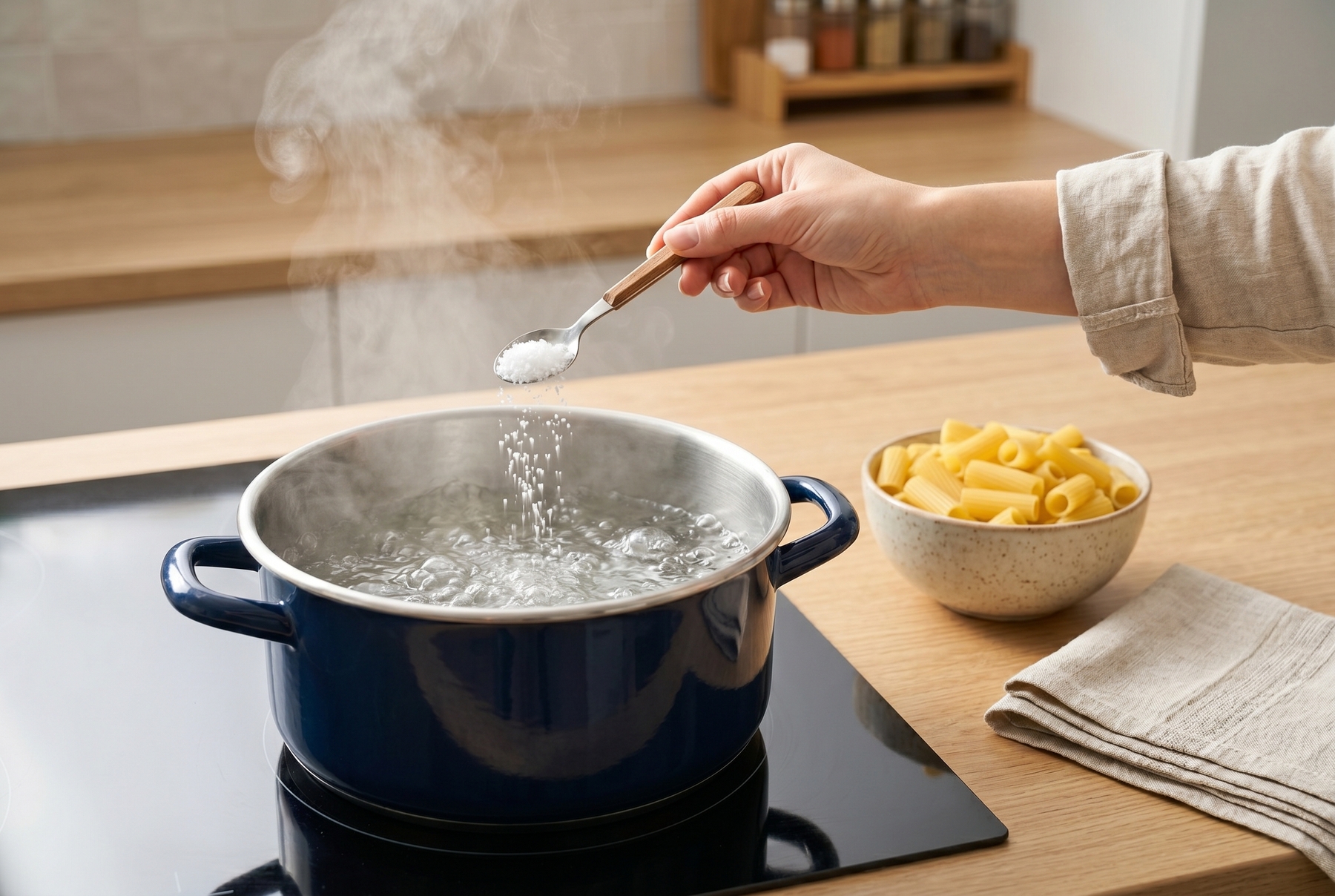
Pasta must be salted in its boiling water, ensuring the seasoning penetrates deeply into the dough rather than merely resting on the surface.
Legumes: Salt Does Not Hinder Their Softening
Contrary to a deeply entrenched culinary myth, salt itself is absolutely not the enemy of tender beans, split peas, or chickpeas. The true culprits aggressively impeding proper softening are old, desiccated beans (those quietly languishing on pantry shelves for a year or two), excessively hard water heavily laden with calcium, and—most crucially—acidic ingredients.
Tomatoes, sharp vinegar, and fresh lemon juice should be introduced strictly after the legumes have fully achieved their desired, creamy tenderness. An acidic environment drastically retards the natural softening of complex cellular walls, potentially leaving stubborn beans simmering on the stove for an additional hour without making any textural progress. Conversely, utilizing moderately salted water throughout the entire boiling process actively assists the seasoning in penetrating and flavoring the dense interior of the bean with perfect uniformity.
Potatoes: Mashed, Pan-Fried, and Roasted
For Mashed Potatoes: The Salt Firmly Belongs in the Water
Boiling starchy potatoes destined for a rich mash in properly salted water is strongly recommended. This guarantees the essential seasoning penetrates deeply within the tuber, rather than relying entirely on the butter and hot milk folded in at the absolute end. Salting exclusively at the finishing stage frequently results in a superficially seasoned mash: the topmost layer perfectly registers on the palate, while the actual potato solids buried beneath remain distinctly hollow.
The boiling liquid must be noticeably, yet not aggressively, salty. Aim for the exact salinity profile of a robustly seasoned soup broth, rather than a harsh pickling brine.
When to Salt Pan-Fried Potatoes: Crust First, Seasoning Second
When pan-frying potatoes, strictly delaying the salt until the final stages—once a deeply golden, shattered crust has fully established itself—is the superior technique. Early salting rapidly and aggressively extracts vital moisture from the potato pieces, forcing them to lazily stew in their own expelled juices rather than vigorously browning. The auditory difference is deeply striking: the sharp, dry sizzle of proper frying is entirely replaced by the dull, wet, disappointing sound of steaming moisture.
- Fry aggressively until a robust, deep crust forms;
- Introduce the salt;
- Toss thoroughly;
- Allow an additional minute or two for the delicate seasoning to fully distribute and beautifully adhere.
Roasted Potatoes: Proper Salting Heavily Depends on the Cut
For rustically, thickly cut potatoes, aggressively tossing them with salt, olive oil, and bold spices prior to entering the hot oven works flawlessly. However, if the potatoes are sliced paper-thin and achieving a shattering, ultra-crispy texture is the primary objective, salting very moderately before roasting and executing a final, heavy seasoning immediately upon exiting the oven is optimal: heavily pre-salted thin slices tend to lose their delicate crunch significantly faster.
Mushrooms, Eggplants, and Zucchini: Salt Directly Dominates Moisture Control
When Early Salting Sabotages the Proper Crust
Mushrooms, tender eggplants, and fresh zucchini natively possess immensely high water contents. Early salting ruthlessly and rapidly extracts this moisture. If the skillet firmly lacks sufficient thermal mass or is visibly overcrowded, these delicate vegetables immediately begin stewing in their own expelled liquids: water heavily pools uselessly at the bottom, zero crust development occurs, and the end result is a decidedly soggy, unappealing mass smelling faintly of boiled vegetables.
Achieving a beautifully caramelized crust firmly dictates frying first, then salting. Desiring a meltingly soft, deeply stewed texture absolutely allows for early, aggressive seasoning.
Eggplants: The Tedious Bitter Purge Is Largely Obsolete
Executing a preliminary heavy salting undeniably assists in actively purging excess moisture and dramatically firming the spongy texture slightly prior to frying. However, modern commercial eggplant cultivars contain virtually none of the harsh, aggressive bitterness that historically demanded they be buried under salt and heavily pressed for hours. This technique has beautifully transitioned into a highly specific tool for texture management, rather than remaining a mandatory, unskippable ritual for every single eggplant entering a domestic kitchen.
Salads and Fresh Vegetables: How Salt Dramatically Alters Delicate Textures
Why Cucumbers and Tomatoes Rapidly Turn Mushy
Salt forcefully extracts internal moisture directly through cellular walls via osmosis. Consequently, fresh salads heavily reliant on cucumbers, ripe tomatoes, tender greens, and highly aqueous vegetables mandate salting at the absolute last second before serving, assuming a crisp, vibrant texture is the ultimate goal. A cucumber slice heavily salted twenty minutes in advance will invariably create a tragic puddle at the bottom of the salad bowl, quickly transforming into a flaccid, limp shadow of its former self, heavily characterized by a soft skin and distinctly dull coloring.
Occasionally, harnessing this precisely destructive property works entirely to our culinary advantage: heavily salting shredded raw cabbage and aggressively massaging it for a slaw miraculously softens the incredibly tough fibers and actively purges unwanted bitterness. Salting harsh, raw onions effectively subdues their aggressive pungency, rendering them noticeably mellower and sweeter. Salting crisp radishes rapidly creates an exceptionally quick, brightly flavored pickle. Ultimately, salt natively possesses the dual capability of either hopelessly ruining a delicate salad by reducing it to a watery swamp, or brilliantly taming the abrasive edge of an aggressive allium.
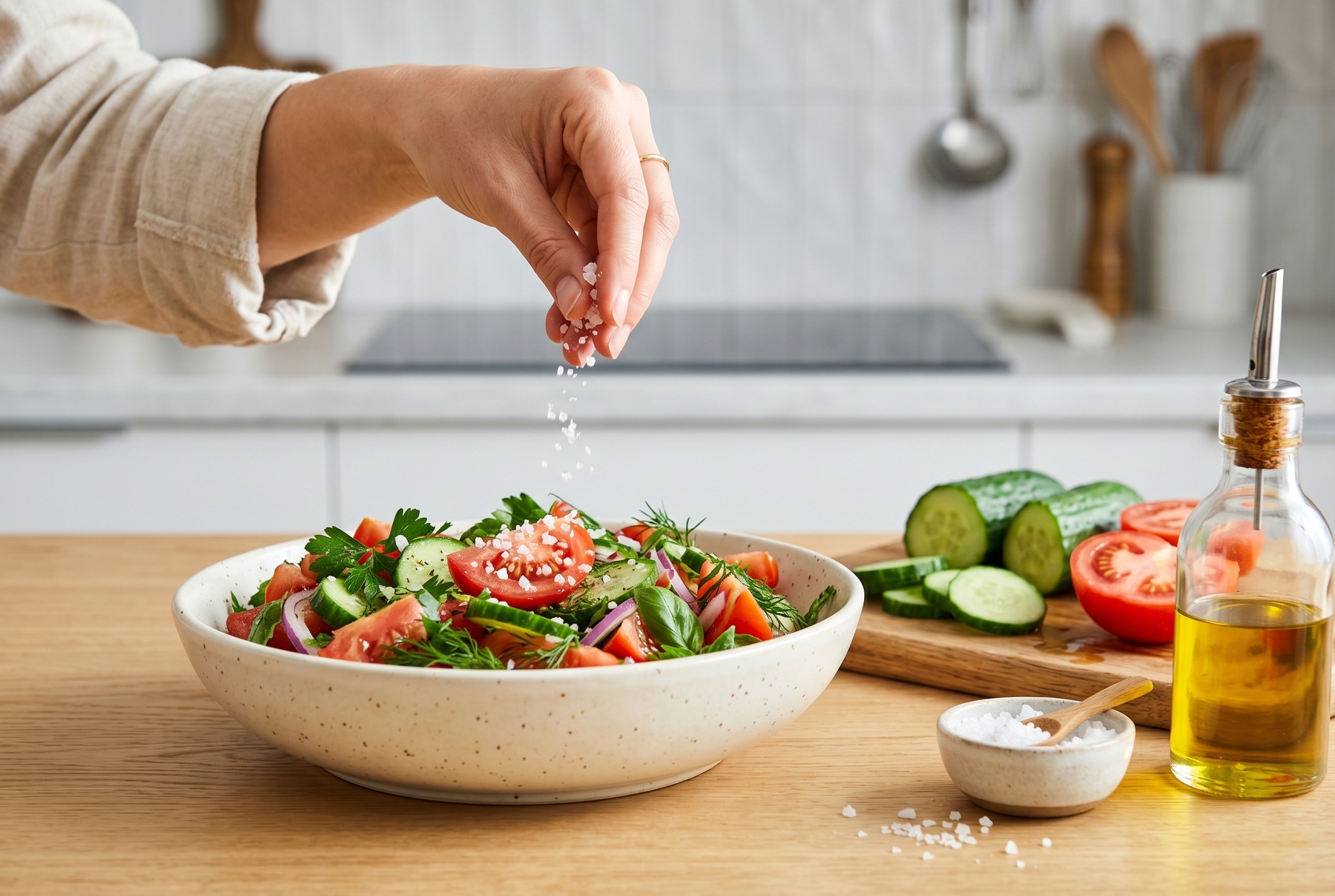
Fresh vegetables should be salted immediately before serving to prevent them from releasing excess moisture and to preserve their crisp texture.
Sauces: Why Highly Reduced Dishes Are Terribly Easy to Over-Salt
Sauces Deeply Prone to Drastic Volume Reduction
A classic, slow-simmered tomato sauce, a rich cream reduction, a deep mushroom gravy, a heavily simmered meat ragout, or a highly complex demi-glace simply cannot be thoughtlessly salted with a massive, final dose at the very beginning of the lengthy cooking process. As the liquid slowly but steadily evaporates, the absolute quantity of salt remains completely static, causing the overall flavor profile to concentrate dramatically. A beautiful sauce tasting perfectly balanced thirty minutes ago can rapidly evolve into an unpalatably saline disaster by the end of the long simmer, entirely without any additional salt ever being introduced. Incorporating a modest pinch at the beginning ensures the raw ingredients cook beautifully; the primary, definitive seasoning adjustment must naturally occur strictly at the end, once the sauce has perfectly achieved its final, desired viscosity and its actual deficits become glaringly obvious.
Inherently Salty Ingredients: Parmesan, Olives, Bacon, and Soy Sauce
A delicate pasta gorgeously finished with a mountain of aged parmesan, a vibrant salad heavily studded with creamy feta or sharp bryndza, a rustic soup fortified with smoky bacon, an umami-rich pan sauce leaning heavily on soy, a robust ragout generously dotted with cured olives, or any preparation heavily relying on briny capers or intensely savory anchovies—every single one of these explicitly introduces an incredibly potent source of inherent salinity into the final dish. Allowing these aggressively salty components ample time to fully release their complex flavors into the surrounding culinary environment is utterly mandatory before ever daring to confidently reach for the salt shaker.
Baking and Desserts: Salt Strongly Dominates Even Where It Is Least Expected
The Crucial Pinch of Salt in Sweet Desserts
Salt brilliantly amplifies the human palate’s distinct perception of deep dark chocolate, rich burnt caramel, deeply roasted nuts, and cultured butter. Excluding it entirely frequently renders sweet desserts distinctly flat and profoundly one-note. This principle operates flawlessly in complex cookies (most notably intense chocolate chip variations), deeply fudgy brownies, sticky artisanal caramels, delicate shortbread doughs, and even simple morning pancakes or crepes. Simply try incorporating a delicate pinch of flaky salt into a dark chocolate ganache and critically comparing it alongside an entirely unsalted version—the resulting elevation in deep flavor is startlingly palpable.
Bread: Salt Firmly Governs Deep Structure, Not Merely Flavor
Within the highly technical realm of bread baking, salt’s essential responsibilities extend remarkably far beyond mere flavor enhancement. It actively regulates wild yeast behavior (an excessive quantity severely retards yeast activity), fundamentally dictates the tight, elastic formation of the vital gluten network, and heavily influences exactly how the dough maintains its structural integrity during the critical, lengthy proofing stage. Omitting salt entirely yields a loaf that is not merely bland: the overall flavor drastically blurs, the internal crumb structure becomes tragically unexpressive, and the dough itself inevitably behaves entirely unpredictably while baking in the extremely hot oven. A highly reliable baseline for the vast majority of artisan baking formulas is roughly 1.5–2.2% salt relative to the total weight of the flour.
Why Food Can Taste Noticeably Under-Seasoned: When the Problem Lies Beyond the Salt Shaker
The Four Fundamental Levers: Salt, Acid, Fat, and Sweetness Operate in Perfect Unison
Salt brilliantly brings a flavor profile deeply together, bright acidity dramatically lifts it, rich fat deeply rounds it out, and mild sweetness gently softens the rough culinary edges. If a dish presents as undeniably dull, the underlying, hidden issue is rarely a simple lack of salt.
A seemingly bland soup might not genuinely be begging for more salt, but rather a vibrant, finishing squeeze of fresh lemon juice or a bright splash of high-quality vinegar—acidity brilliantly elevates the entire flavor spectrum simultaneously, perfectly mimicking the exact amplifying effect of salt. Rich, heavily marbled meats frequently demand a sharp, distinctly acidic counterpoint deeply within their accompanying side dish or bright sauce. A simmering, acidic tomato sauce occasionally requires a highly modest pinch of sugar and an additional ten minutes over exceptionally low heat, rather than more salt: this gently suppresses the harsh acidity, beautifully allowing the deep, intrinsic tomato essence to flourish. A seemingly flat, lifeless salad might simply be crying out for a proper, creamy emulsification of fat and acid, rather than another massive handful of salt. Correcting a faintly bitter sauce is frequently achieved far more effectively by introducing a touch of balancing sweetness or deeply enriching fat, rather than mindlessly reaching for the salt cellar.
How to Truly Understand When Enough Salt Is Finally Enough
Properly Applied Salt Genuinely Never Dominates the Foreground
An impeccably salted dish genuinely never registers on the discerning palate primarily as intensely ‘salty.’ Instead, the inherent flavors simply become significantly more intensely themselves: a potato tastes profoundly more like a potato, roasted chicken becomes deeply savory, a ripe tomato appears vibrantly brighter, and dark chocolate assumes an incredible, lingering depth. The salt silently and brilliantly supports the entire culinary structure, adamantly refusing to draw unnecessary attention to itself. If a dish is immediately perceived explicitly as ‘salty’—the delicate threshold has already been unfortunately crossed.
Tasting Must Always Occur at the Correct Serving Temperature
Dishes intended to be beautifully served cold frequently demand slightly more aggressive applications of both deep salt and bright acidity: drastically lowered temperatures notoriously and severely mute human flavor perception. Conversely, steaming hot dishes intuitively appear incredibly aromatic, which significantly alters exactly how inherent salinity is perceived on the palate. Rich fats and lingering sweetness possess an uncanny ability to deeply mask salt; consequently, a heavily enriched, thoroughly buttery sauce might easily conceal far more salt than initially apparent. Following any introduction of precise seasoning, actively allowing it a moment to properly dissolve and distribute—ranging from thirty seconds to several minutes—is absolutely critical before ever attempting a secondary taste test.
When evaluating complex soups, hearty ragouts, intricate plovs, or slowly braised, deeply rich dishes, strictly tasting the liquid component is a fundamental error. Securing an actual chunk of the simmering potato, the tender braised meat, or the cooked grain is absolutely paramount. The surrounding broth might taste utterly perfect, while the thick potato safely suspended within it remains distressingly under-seasoned.

A flawless balance of salt, acidity, and fat imparts profound depth and completion to the flavor of home-cooked meals.
Common Culinary Missteps
- Salting exclusively at the very end. The surrounding broth will certainly become adequately salty, but the complex internal structures of the potatoes, meat, and hearty grains safely suspended within it will likely remain utterly bland.
- Failing to account for massive reduction. A simmering sauce tasted perfectly balanced. It thickened beautifully, yet suddenly transformed into an aggressively over-salted disaster. This exact scenario occurs far more frequently than one might assume, particularly concerning intensely reduced, savory meat and tomato-based sauces.
- Ignoring inherently salty ingredients. Aged parmesan, briny feta, smoked bacon, cured olives, pungent capers, intense anchovies, soy sauce, and intensely savory fish sauce already function entirely as forms of liquid or solid salt. If they heavily feature in a final dish, the addition of pure granular salt must be drastically reduced.
- Salting highly aqueous vegetables far too early. Mushrooms, delicate zucchini, and spongy eggplants immediately begin stewing in their own rapidly expelled juices if the skillet lacks the necessary thermal mass to comfortably handle the sudden influx of moisture. The elusive caramelized crust vanishes, entirely replaced by a decidedly soggy, unappealing mass.
- Blindly trusting outdated dogmas regarding eggs, beans, and fish. All three of these highly delicate ingredients absolutely can—and frequently should—be salted well in advance, albeit utilizing vastly different culinary methods, for distinctly varying durations, and successfully achieving entirely unique culinary objectives.
Introducing salt at the precise, correct moment actively transforms an individual’s entire fundamental approach to cooking far more profoundly than strictly adhering to any single recipe. That crucial first pinch right at the beginning brilliantly assists raw ingredients in fully opening up. A strategic hit of salt directly in the middle effectively gathers and flawlessly binds disparate flavors as the dish slowly gains deep complexity. The final, carefully considered adjustment ultimately provides laser-like precision, rather than desperately attempting to mask earlier culinary errors.
0 comments