
A dishwasher rarely ruins cookware on its own. It simply performs the exact task it was engineered for: heating water, dissolving harsh alkalis, blasting pressurized jets, and holding everything in continuous contact with surfaces for an hour, ninety minutes, or sometimes three hours. The problem always lies in the material of the cookware itself, which simply isn’t built to survive that environment.
That is why generic lists of dishwasher-forbidden items often fall short. A blanket rule like “never machine-wash skillets” explains nothing: raw cast iron, nonstick-coated stainless steel, and enameled pans behave completely differently inside the wash chamber. Evaluating the material and construction makes all the difference—whether an item is a single solid piece or glued together, whether decorative trim sits on top of the glaze, and whether the metal relies on a protective coating.
Below is a category-by-category breakdown, ranging from kitchen workhorses that endure automatic washing for decades to delicate pieces that belong strictly in the sink.
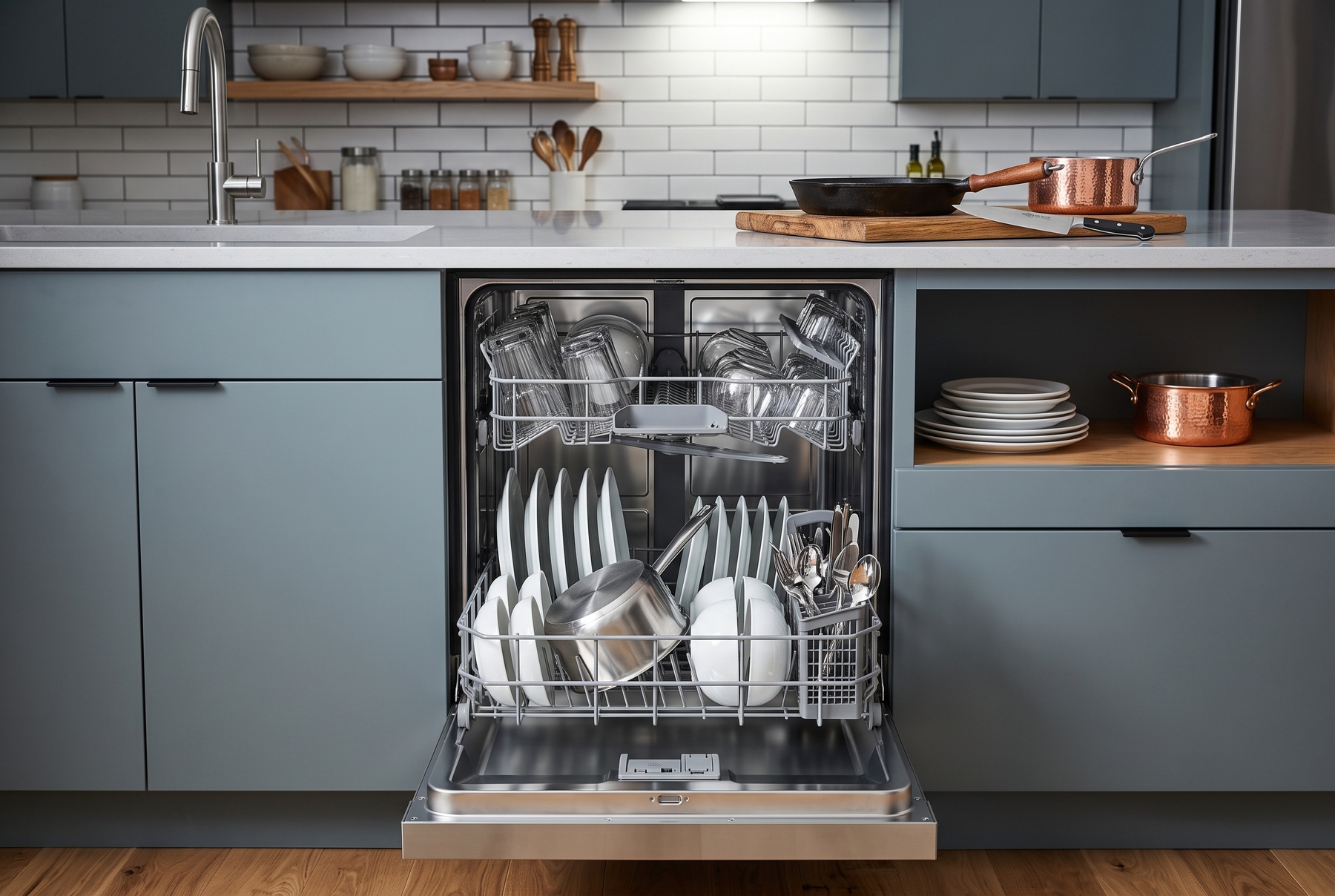
A dishwasher filled with clean dishes and everyday kitchen utensils.
Table of Contents
What Actually Happens Inside the Wash Chamber
During a wash cycle, several distinct forces go to work simultaneously, and each one targets specific materials.
- Temperature. Standard cycles typically heat water to 50–65 °C (122–149 °F), while heavy-duty sanitizing cycles reach 70 °C (158 °F) and above. Then comes the intense heat of the drying phase.
- Alkaline Chemistry. Automatic dishwasher detergent is significantly more aggressive than liquid dish soap, packing alkalis, enzymes, and oxygen bleach. It strips away baked-on grease without physical scrubbing, but it also attacks any surface reactive to high-pH chemicals.
- Prolonged Water Exposure. A complete cycle runs anywhere from one to three hours. For porous materials, this acts like a prolonged, hot soak.
- Pressurized Jets. High-pressure sprays easily dislodge lightweight items, sending them knocking against neighboring dishes.
- The Drying Cycle. Rapid moisture extraction immediately follows hours of soaking. Wood and glued joints rarely forgive this kind of stress.
Wood suffers from the soaking-and-drying extremes, aluminum reacts poorly to alkali, and glued assemblies fail under heat. Delicate glassware succumbs to the combination of high temperatures and overly soft water. The exact same cycle means entirely different things to different materials.
What Can Go in Without a Second Thought
These categories endure automatic washing for years, and any caveats here are purely cosmetic.
Stainless Steel
Pots, mixing bowls, colanders, and sheet pans handle the machine effortlessly. Stainless steel shrugs off alkaline detergents and never warps. Chalky white residue or rainbow-tinted stains on the surface simply point to hard water or an empty dishwasher salt reservoir; the metal itself remains completely unharmed.
Standard and Borosilicate Glass
Thick-walled tumblers, mason jars, and glass baking dishes thrive here. Delicate, thin-stemmed wine glasses present a bigger challenge: soft water paired with high heat and alkaline detergent gradually etches the microscopic top layer of the glass, leaving it permanently cloudy (a phenomenon known as glass corrosion). Delicate stemware requires a short, low-temperature cycle at 45–50 °C (113–122 °F) and a properly filled rinse aid dispenser.
Evenly Glazed Ceramics
Everyday plates, mugs, and bowls made of standard glazed ceramic wash beautifully. Watching for rim chips is the only real maintenance: a nicked edge catches on the rack tines, causing the crack to spread. Ceramic pieces with unglazed, porous bottoms absorb water during the cycle and consequently take longer to dry than the rest of the load.
Plain Porcelain Without Gilding or Hand-Painting
Smooth, factory-applied glaze withstands hundreds of cycles. Trouble only starts when decorative elements sit on top of the glaze; any gold or platinum rim trim will inevitably dull and rub away over time.
Silicone Molds and Spatulas
Culinary-grade silicone tolerates temperatures far exceeding anything a dishwasher generates. The only quirk is that silicone tends to hold onto a faint, soapy grease film. Placing molds open-side down near the spray arms—without trapping them under large plates—keeps them residue-free.
Dishwasher-Safe Plastics
Polypropylene and Tritan survive the cycle intact when placed on the top rack. Most residential machines house the exposed heating element at the bottom of the tub, and thin plastic lids placed on the lower rack warp predictably.
Stainless Steel Flatware
Mixing forks and spoons in the caddy prevents “nesting”—when two spoons press tightly together, water cannot reach between the surfaces. Silver and stainless steel should never share the same basket; physical contact between these two metals in a wet, alkaline environment triggers a reaction that leaves dark tarnish spots on the silver.
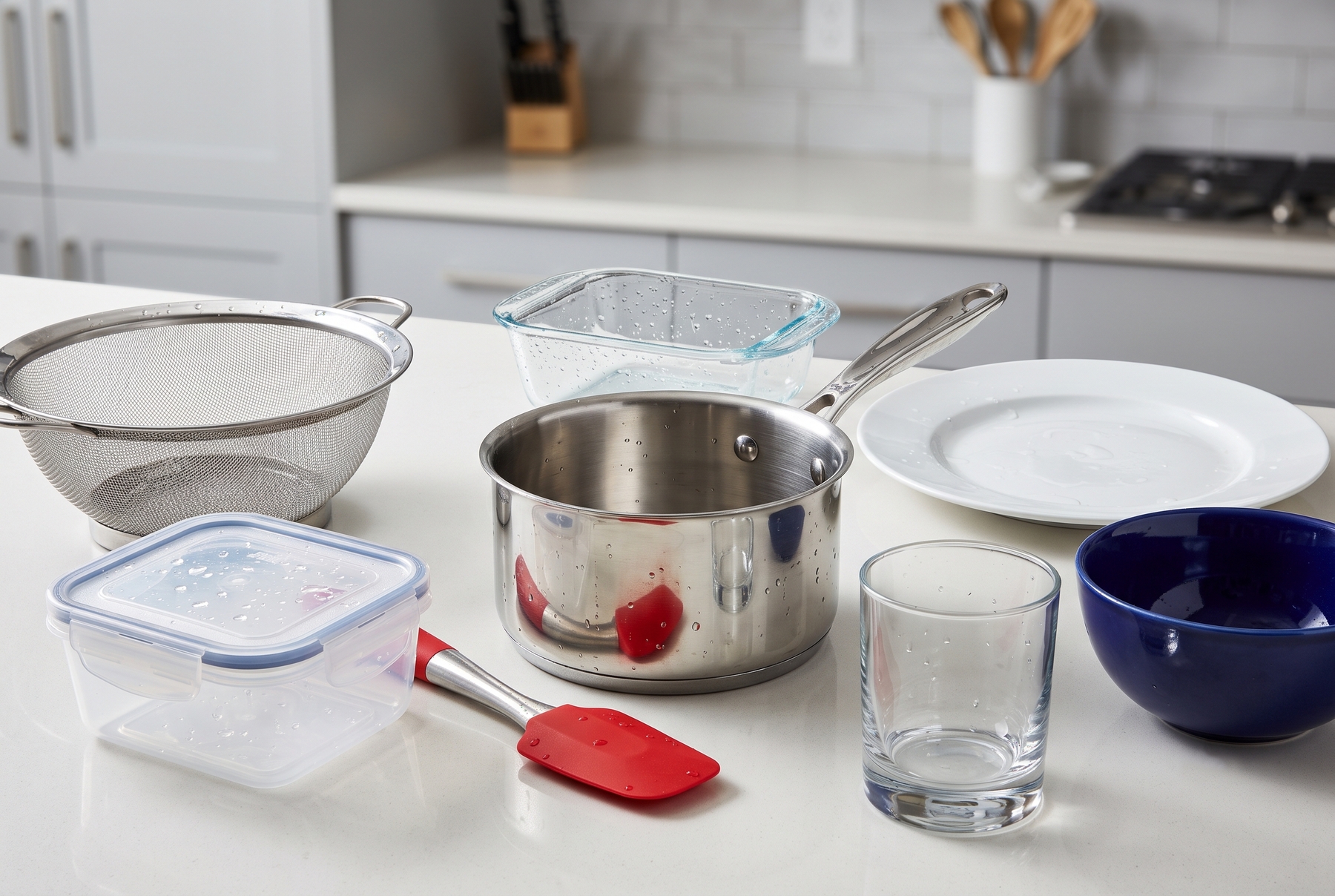
Cookware made from stainless steel, borosilicate glass, silicone, and certified plastics handles automatic washing effortlessly.
Dishwasher-Tolerant, With Caveats
This is the most nuanced part of the kitchen. Success here depends entirely on construction details rather than the wash cycle itself.
Quality Kitchen Knives
Alkaline detergent won’t dissolve a steel blade, but the cutting edge is extraordinarily vulnerable. A finely honed edge measures just microns thick, and any slight knock against neighboring metal leaves microscopic nicks. While invisible to the naked eye, the dulling effect becomes obvious to the hand within a week. Pressurized water jets constantly jostle knives against the rack, accelerating the damage. Furthermore, high-carbon steel—common in traditional Japanese blades—develops orange rust spots in a single cycle.
Inexpensive utility knives made of soft stainless steel face very little risk when laid flat on the top cutlery tray, isolated from other items. However, any knife featuring a stacked or wooden handle belongs in the sink: those assemblies rely on adhesives and rivets that degrade under heat and moisture.
Nonstick Skillets
Survival here depends entirely on the manufacturer, and that is not just a legal disclaimer. Brands that engineer modern, reinforced nonstick coatings frequently certify them as dishwasher-safe, and these pans perform reliably for years. Conversely, budget pans with thin PTFE coatings quickly lose their release properties, their painted exteriors oxidize and chalk, and grease begins seeping out from around the handle rivets.
Checking the care manual for a specific pan provides the only definitive answer. If a nonstick surface already shows scratches or peeling, the dishwasher will rapidly accelerate its demise: alkaline detergents aggressively oxidize the exposed aluminum core beneath the damaged coating.
Wooden Cutting Boards
Wood absorbs water unevenly, swells, and then releases that moisture just as unevenly during a thirty-minute heated drying cycle. This pulls the wood fibers in opposing directions, causing the board to warp like a sheet of paper left in the rain and splitting the end grain. Edge-glued butcher blocks also pull apart right at the seams.
Washing a board by hand takes less time than loading it into the rack: hot water, a quick scrub with a brush, toweling dry, and storing upright does the trick. Rubbing the surface once a month with food-grade mineral oil until saturated keeps the fibers sealed.
Bamboo Kitchenware
Botanically, bamboo is a grass rather than a hardwood, and bamboo utensils are manufactured by pressing and laminating thin strips together with resin. Those glue joints represent the fatal weak spot; bamboo spatulas and cutting boards exposed to the dishwasher delaminate long before the material itself wears out.
Cast Iron: Why the Machine Strips It Bare
A well-maintained cast-iron skillet relies on its seasoning—a layer of polymerized fat bonded to the metal that feels matte and slightly slick. Dishwasher detergent is formulated to strip away every trace of grease, taking that hard-earned protective seasoning right along with the food residue. Bare cast iron meeting hot water and humid air produces a coat of orange rust within hours.
(My son absentmindedly loaded my cast-iron skillet into the dishwasher exactly once; I discovered it the next morning covered in orange streaks and smelling distinctly of raw iron.)
Many manufacturers permit automatic washing for enameled cast iron, though even they recommend hand-washing for longevity. Chipped enamel along the exposed rim becomes an all-too-common sight after a couple hundred cycles.
Copper Cookware
Copper oxidizes and darkens rapidly when exposed to alkali and high heat, turning a mirror-polished exterior matte and blotchy. Decorative copper pieces coated in clear lacquer lose that protective finish in peeling strips. Furthermore, traditional tin linings inside culinary copper are remarkably soft and easily abraded. Copper demands hand-washing in warm water, followed by an acidic polish—half a lemon dipped in kosher salt restores the luster instantly.
Aluminum: Raw vs. Anodized
Raw aluminum reacts directly with alkaline detergents. A single cycle turns untreated metal dark gray, chalky, and matte, sometimes leaving powdery white deposits and microscopic pitting across the surface. Traditional aluminum moka pots, vintage bakeware, and cast aluminum Dutch ovens (like traditional Central Asian *kazans*) must stay out of the machine.
Hard-anodized aluminum fares slightly better thanks to its dense, electrochemically sealed oxide layer. Yet aggressive detergents eventually break down even anodized surfaces, causing the dark finish to fade in patchy spots. Consequently, most manufacturers still specify hand-washing for hard-anodized lines. Checking the stamp on the bottom of the pan is essential here, as general rules do not apply.
Insulated Travel Mugs and Thermoses
Vacuum-insulated drinkware relies on an airtight, sealed void between two stainless steel walls. The extreme temperature swings inside a dishwasher, combined with high-pressure jets, can compromise the resin plug or weld sealing that vacuum. Once moisture breaches the inner wall, the thermal insulation vanishes completely, sometimes leaving audible water sloshing inside the lining. This damage is irreversible.
Several modern drinkware brands engineer their tumblers to be top-rack dishwasher-safe. Regardless of how the body is washed, the lid assembly always requires dismantling: oils and coffee residue trap easily beneath silicone gaskets where dishwasher jets simply cannot reach.
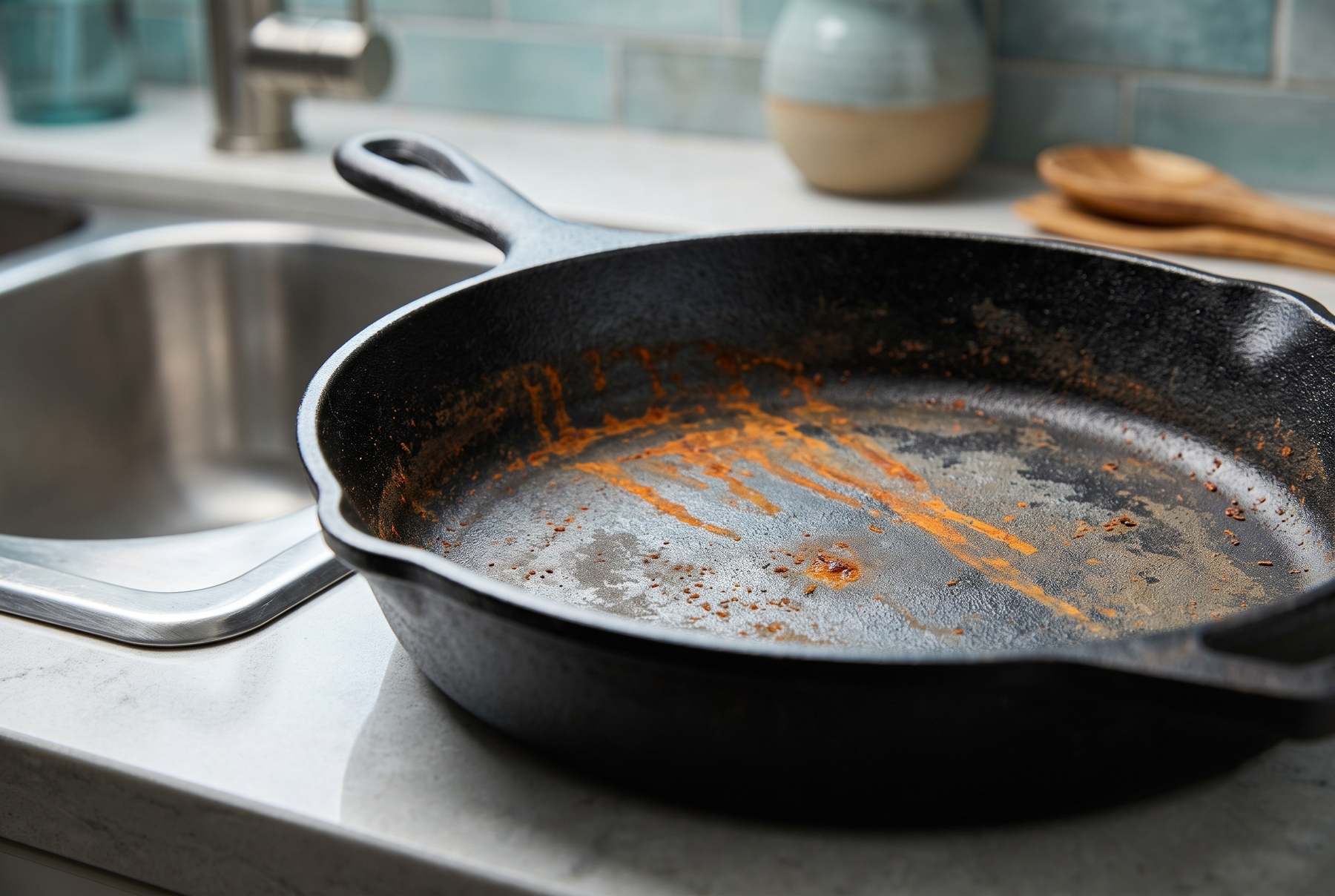
Running cast-iron cookware through the dishwasher strips its protective seasoning layer and triggers immediate rust.
What Belongs Strictly in the Sink
- Lead Crystal. Much softer than standard glass, crystal suffers surface etching from alkaline detergent, losing its prism-like brilliance to a permanent matte haze.
- Gold and Platinum Trim. Precious metal accents sit on top of the ceramic glaze and rub away completely within a few dozen cycles.
- Overglaze Hand-Painted Ceramics. The same vulnerability applies here: the pigment lacks a protective layer of clear glass over the top.
- Wooden Utensils. Spatulas, spoons, boards, and wooden-handled tools warp, crack, and develop rough, raised grain.
- Chef’s Knives. Both the microscopic cutting edge and the glued handle scales suffer permanent damage.
- Damaged Nonstick Pans. Machine washing rapidly accelerates peeling and oxidizes the exposed metal core.
- Raw Aluminum. Undergoes a direct, chalky chemical reaction with alkaline detergents.
- Glued Assemblies. Mugs with bonded handles, strainers with wooden inserts, and tableware with applied decorative accents fall apart as adhesives fail.
- Vintage and Heirloom Dishware. Older glaze formulations and pigments remain unpredictable, and antique pieces were never engineered to withstand modern appliance chemistry.
Quick Answers to Common Questions
- What about skillets? Stainless steel and enameled steel handle the machine effortlessly; raw cast iron and copper never belong inside; nonstick pans depend strictly on the manufacturer’s rating.
- Pot lids? Tempered glass lids with stainless steel rims generally wash fine, though dirty water often traps under the metal band—removing and towel-drying them promptly helps. Lids with wooden knobs require hand-washing.
- Wooden handles on saucepans and fine-mesh sieves? Hand-wash only. Wood joins to metal via adhesives or friction-fitting, and both methods loosen and rot when subjected to hot water and heated drying.
- Plastic food storage containers? Top rack only, far away from the lower heating element. Removable silicone lid gaskets should be pulled out and washed separately to prevent mold.
- Why did my glassware turn cloudy? Testing the surface with a drop of distilled white vinegar reveals the culprit. If the glass clears up within a minute, it is simply hard-water limescale, indicating a need to refill the dishwasher salt and rinse aid. If the haze remains, the glass surface is permanently etched and scattering light.
- Why do knives go dull in the machine? Pressurized water jets knock the blade against metal tines, while alkaline chemicals corrode the microscopic cutting edge.
- What does the symbol on the bottom mean? An icon showing plates or glasses beneath water droplets or spray lines confirms the manufacturer tested the item for automatic washing. A temperature number printed alongside it—such as 55 °C (131 °F) or 65 °C (149 °F)—indicates the maximum heat threshold the piece can tolerate.
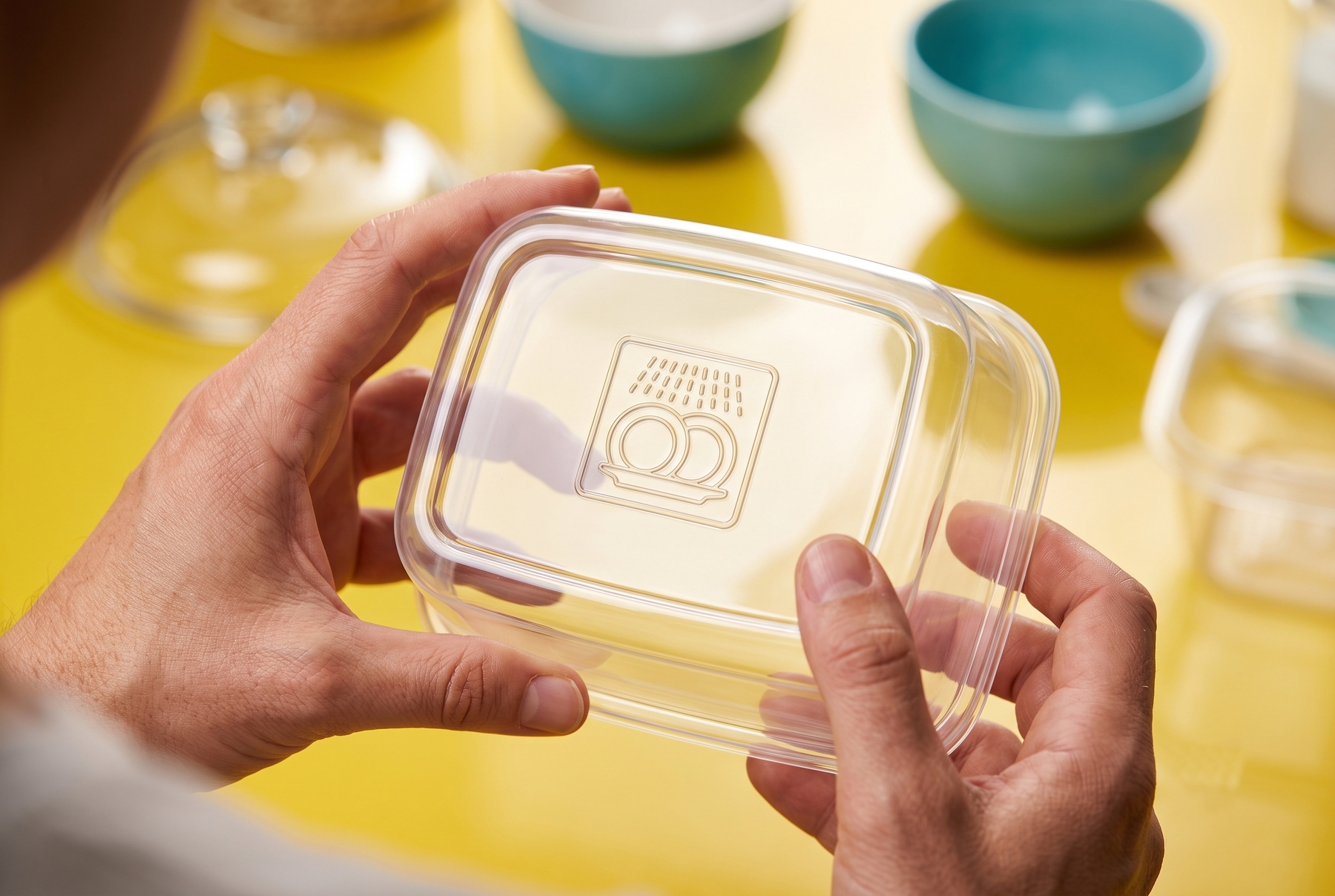
A specialized symbol stamped on the base of cookware confirms it has been tested for safe automatic washing.
Five Rules That Solve Nearly Every Dilemma
- Flipping the item over to check the manufacturer’s stamp answers the question more accurately than any general guide.
- Evaluating the raw material and assembly method matters far more than the name of the kitchen tool.
- Washing good chef’s knives by hand takes twenty seconds under running water and saves years of edge retention.
- Keeping wood, raw cast iron, and untreated aluminum out of the wash chamber prevents instant ruin.
- When in doubt over an unmarked piece, running a short, low-temperature cycle or defaulting to the kitchen sink is the safest bet.
The vast majority of modern cookware survives the dishwasher without issue; trouble only arises with a handful of specific materials that react predictably poorly to heat and alkali. Etched crystal and worn gold leaf can never be restored. Rusted cast iron, however, is entirely salvageable: scrubbing away the orange corrosion with an abrasive pad, wiping the bone-dry pan with a whisper-thin coat of high-smoke-point oil, and baking it at 200–230 °C (390–445 °F) rebuilds the protective seasoning from scratch.
0 comments