
You have made this mayonnaise four times. Maybe five. Every time, it turned out thick, glossy, and perfectly tangy. Guests asked for the recipe. You shrugged: nothing special, just an egg, oil, a blender, and five minutes.
Today, guests are arriving in an hour. You take out the egg, mustard, oil, and vinegar. You do everything as usual. You turn on the blender. And you watch yellowish flakes form in a cloudy, oily puddle inside the jar. It is not a sauce. It is simply a disappointment.
It feels as though the mayonnaise sensed your fear. You start to wonder if your technique is off today, if the oil failed you, or if the moon phases misaligned.
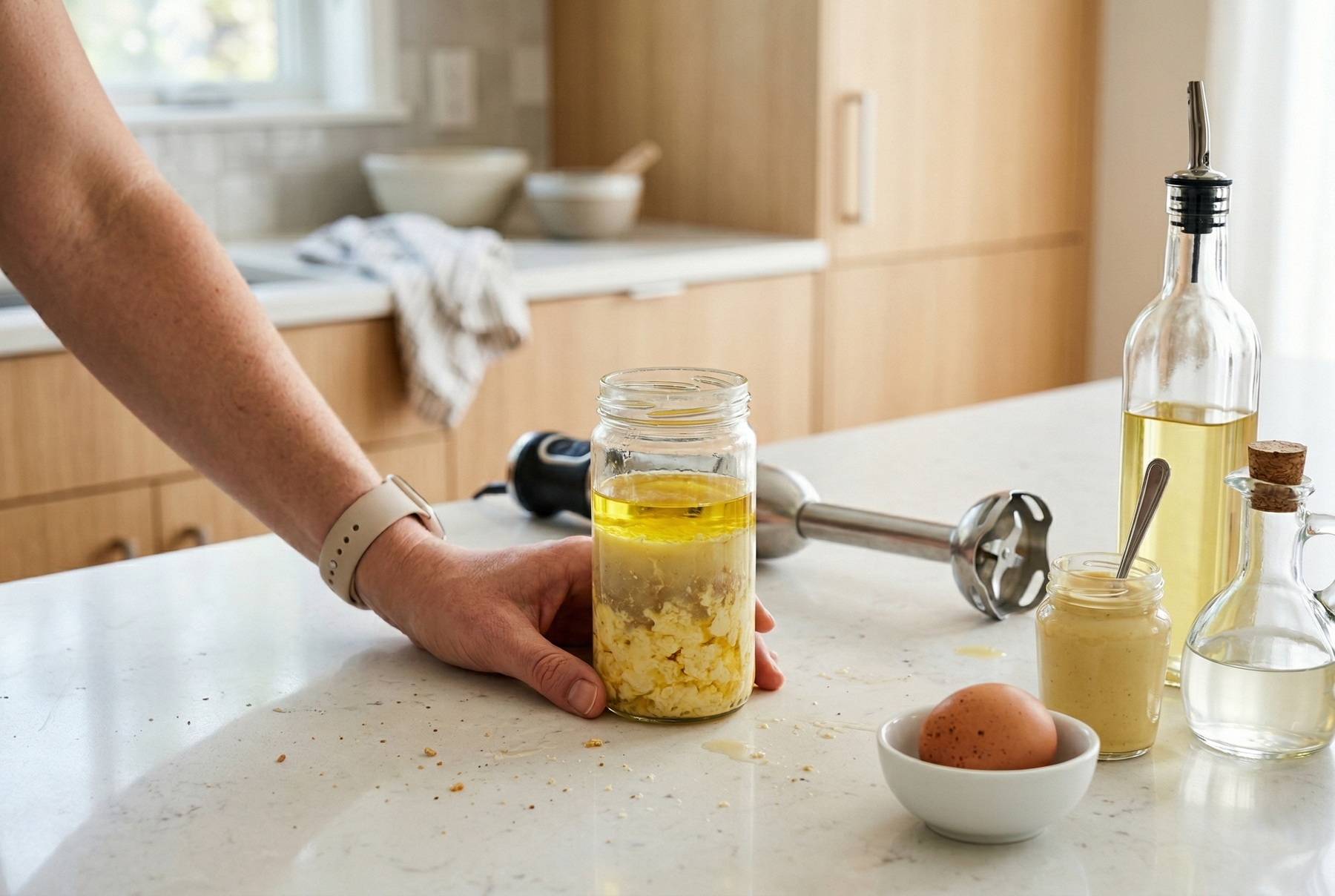
When the emulsion fails: characteristic yellowish flakes and unprocessed oil are visible in the jar due to flawed technique.
This is nonsense. Mayonnaise feels nothing. A physical process does not react to a cook’s mood, and no moon affects how lecithin behaves in a cold egg yolk. Separation happens for specific reasons, and each one can be controlled. Understanding exactly what went wrong makes the fix easy.
Here are the primary mistakes. An egg straight from the fridge, sitting at 4–6°C (39–43°F) instead of a room temperature of 20°C (68°F). A container that is too wide. Moving the blender prematurely. Generally, it is never just one mistake: they accumulate, and each subsequent error increases the risk of the emulsion breaking.
Table of Contents
Why Mayonnaise Breaks
Oil and water do not mix. Shaking a jar of oil and water and waiting a minute reveals they separate as if nothing happened. Oil has non-polar molecules, water has polar ones, and there is no physical mechanism connecting them. Shaking only creates a temporary dispersion, not an emulsion.
Mayonnaise consists of 70–80% oil. The rest is the water phase, hidden in the yolk (about 50% of its weight), mustard, vinegar, and lemon juice. Holding these two mediums together requires a mediator. In chemistry, this is called an emulsifier.
The lecithin in the egg yolk does this job in mayonnaise. The lecithin molecule is cleverly designed: one end is attracted to water (hydrophilic) and the other to fat (hydrophobic). It literally coats every oil droplet, isolating it from neighboring drops and preventing them from merging back together. Mucilages (slimy substances from the seed coat) perform a similar function in mustard. This is exactly why mustard in mayonnaise is not just for flavor: it is a full-fledged co-emulsifier. Removing the mustard makes the emulsion noticeably less stable.
One egg yolk contains about 1.2 g of lecithin. This is enough for roughly 180–250 ml (6–8.5 fl oz) of oil. Adding more means the lecithin falls short: the oil droplets stick together and float up. This is why proportions matter more for the physics of the process than just for taste. With a medium egg yolk, the lecithin content is slightly lower, making it safer to stick to 180 ml (6 fl oz) of oil.
Temperature makes things even trickier.
Lecithin works most efficiently at room temperature. A cold yolk provides lecithin in a less mobile state, causing it to emulsify oil more slowly and less effectively. Simultaneously, cold oil is more viscous: it breaks down into small droplets with difficulty, and the smaller and more uniform the droplets, the more stable the emulsion. Ultimately, the blender spins two phases around the jar that are in no rush to combine, and no mechanical force can compensate for the temperature difference.
The solution is simple. The egg must be taken out of the refrigerator 30–40 minutes before cooking. The oil sitting on the kitchen counter is usually already fine. If the apartment is cold in winter, below 18°C (64°F), placing the glass of oil in warm water for fifteen minutes helps.
A quick note on Extra Virgin olive oil.
Unrefined cold-pressed oil is rich in phenolic compounds. These make the oil nutritionally beneficial, but they carry a sharp, astringent taste. In a resting state, this flavor is barely noticeable. However, the high-speed blender blades break the oil into microscopic droplets, dispersing the bitter polyphenol compounds straight into the emulsion. The result is not a mild olive note, but a harsh bitterness that is impossible to mask. Adding more salt or sugar only makes it worse.
If an olive aroma is desired in the finished mayonnaise, folding one tablespoon of Extra Virgin oil into the already assembled sauce by hand with a spoon is the best approach. The blender is no longer needed at this point, and the flavor turns out exactly as intended.
The base for homemade mayonnaise is refined sunflower or canola oil. It offers a neutral taste, excellent emulsification properties, and no conflict with lecithin.
Acidity deserves a separate mention. Vinegar or lemon juice performs a dual function in mayonnaise. First: flavor balance. Second: lowering the pH to 3.8–4.0. This level of acidity suppresses the reproduction of pathogenic bacteria, which is crucial considering the yolk in the sauce is raw. A 9% white vinegar works sharper and faster, while lemon juice acts milder and adds aroma. The choice depends on the dish the mayonnaise will accompany.
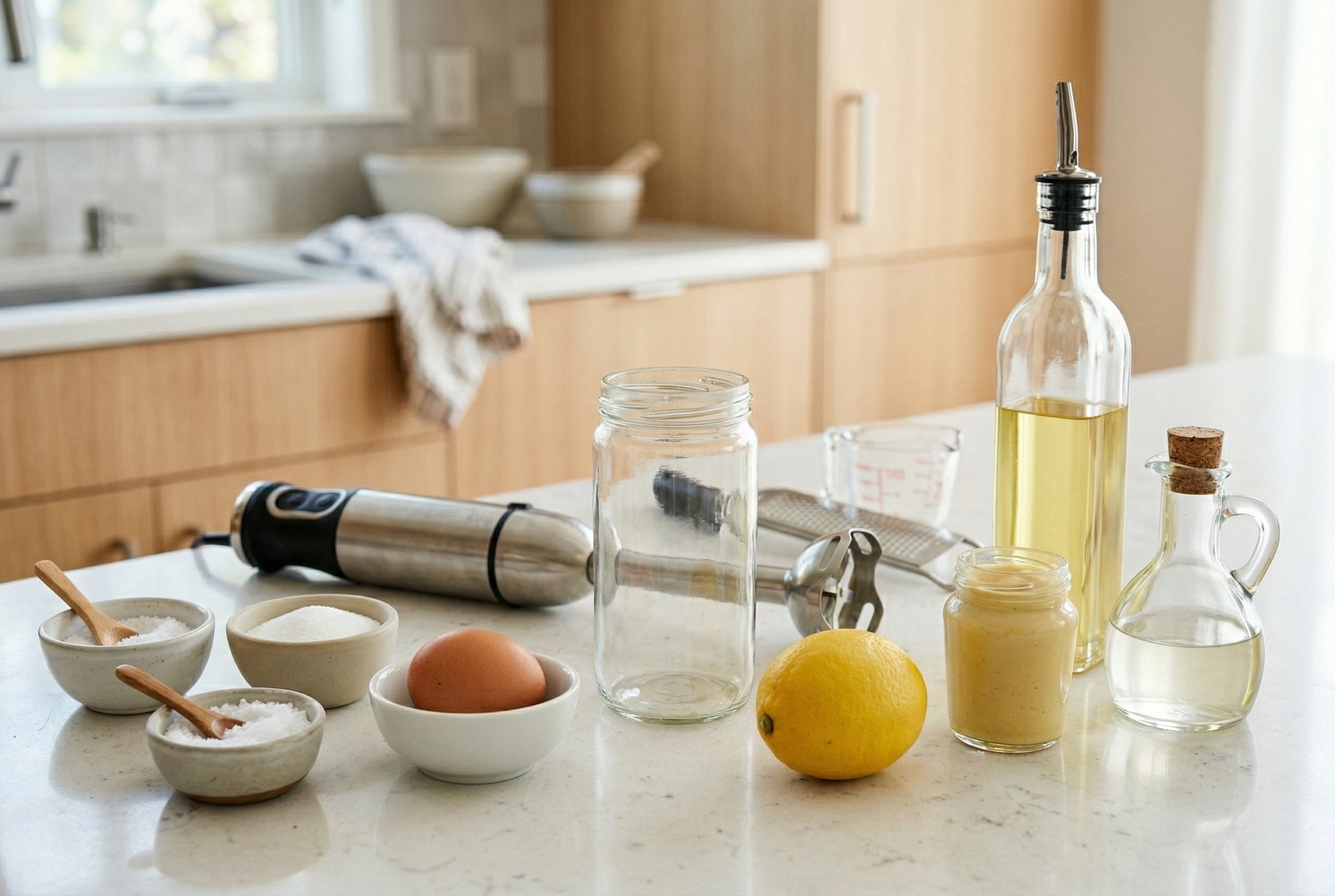
Everything needed for the perfect sauce: keeping all ingredients at room temperature is crucial for a stable emulsion.
How to Do Everything Right and in What Order
About the Equipment
A wide bowl is the most common mistake in making homemade mayonnaise, yet it is rarely mentioned.
In a wide container, the blender grabs the entire mass at once. The oil flies outward, the attachment splashes around, and the yolk’s lecithin does not have time to process all the layers simultaneously. The yolk is not confined: it moves freely along the bottom and does not concentrate in the zone of maximum mechanical impact. The blender is essentially spinning idly.
A narrow container, just slightly wider than the immersion blender attachment, is required. A standard half-liter (16 oz) wide-mouth jar works almost perfectly: the neck is about 7–8 cm (3 inches), allowing the attachment to fit with roughly a centimeter of clearance on the sides. This specific gap creates the necessary hydrodynamics. The oil does not splatter; instead, it is pulled into the blades from bottom to top. The yolk gets trapped between the bottom and the attachment—exactly where pressure and speed are highest. Emulsification begins a second after turning it on.
A tall measuring cup, typically included with the blender, also works perfectly due to its correct geometry.
Ingredients and Proportions
Everything must be at room temperature. This factor solely determines whether the emulsion will form at all.
| Ingredient | Amount |
|---|---|
| Whole egg (Large) | 1 |
| Refined sunflower or neutral oil | 180–200 ml (6–6.8 fl oz) |
| Table mustard (smooth) | 1 tsp |
| White vinegar (9%) | 1 tsp |
| Lemon juice (instead of or with vinegar) | 1 tbsp |
| Salt | 0.5 tsp |
| Sugar | 0.5 tsp |
A few notes on the components.
Mustard. Smooth Dijon or standard smooth mustard is the best choice. They are smooth, disperse well in the emulsion, and release the necessary emulsifying agents. Grainy mustard leaves large particles and disrupts a uniform texture. Powdered mustard technically works, but it needs to be dissolved in a small amount of water or vinegar and allowed to swell for fifteen minutes.
Sugar. Many skip it, considering it unnecessary. It is not for sweetness: it balances the harshness of the acid and rounds out the flavor. For 200 ml (6.8 fl oz) of oil, half a teaspoon is barely there, yet clearly noticeable in the finished sauce.
Whole Egg vs. Single Yolk. The egg white also participates in stabilizing the emulsion, helping to hold the structure. Mayonnaise made with a whole egg is slightly lighter in color and texture. A yolk-only version is denser and richer. Both options work perfectly, with only a minor difference.
Loading Order
At the bottom of the jar: egg, mustard, salt, sugar, acid. All together, in any order.
On top: the oil. All at once. In classic whisk recipes, oil is added drop by drop precisely because a human hand cannot create enough shear force around the yolk. The blender solves this problem: the attachment creates such a powerful vortex that the oil effortlessly breaks into micro-droplets, even in large quantities.
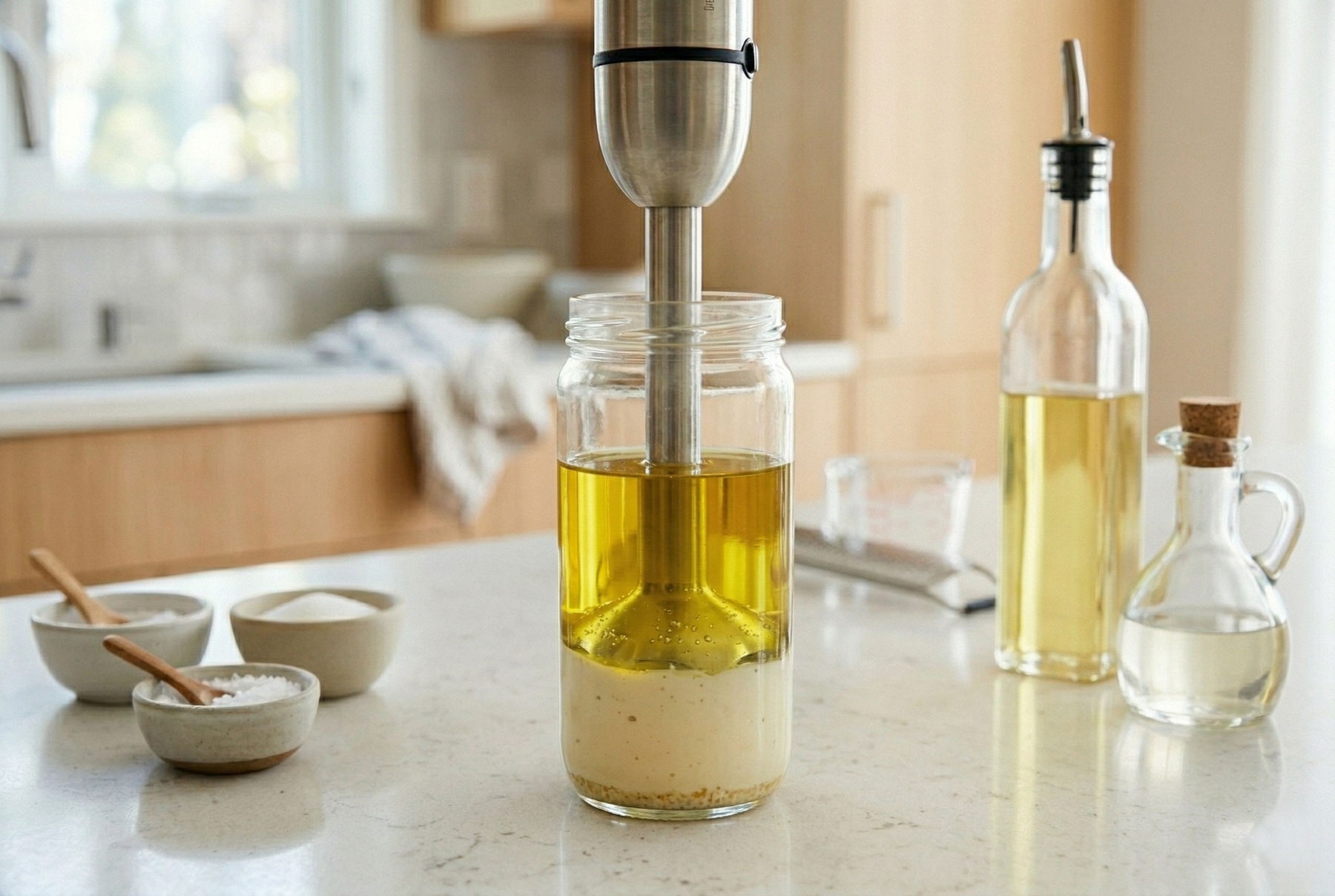
The secret to success: press the blender to the bottom and keep it perfectly still until a thick white sauce emerges.
The Process Itself
Lowering the attachment directly over the yolk, pressing it firmly to the bottom, and cranking it to maximum speed is the next step. Then comes the most crucial part—freezing and not moving the blender.
Watching the bottom of the jar reveals a thick white mass appearing within 5–7 seconds. It creeps upward, slowly drawing in the oil. The lecithin has already bonded with the lower layers, and the droplets have become smaller and more uniform. Now—slowly, very slowly—the blender can be lifted, capturing the remaining oil layer by layer. The entire process from turning the machine on to a finished sauce takes 25–40 seconds.
Moving the blender before that white mass appears at the bottom guarantees the emulsion will fail. A few seconds of patience decide everything here.
Adjusting the Flavor
The finished mayonnaise should be tasted immediately. If it lacks acidity: a few drops of vinegar or lemon juice, and the blender for three seconds. If it is too thick: a teaspoon of cold water, and the blender for five seconds. If an olive aroma is desired: a tablespoon of Extra Virgin olive oil, folded in by hand with a spoon.
Consistency directly depends on the amount of oil. At 150 ml (5 fl oz) per yolk, it yields a relatively loose sauce suitable for dressing. At 200–220 ml (6.8–7.5 fl oz), it becomes dense and perfectly spreadable. Pushing past 250 ml (8.5 fl oz) compromises stability, causing the mayonnaise to separate in the fridge within hours.
Raw Eggs and Shelf Life
The fear of raw eggs in home cooking is understandable.
Salmonella can reside on the shell or inside the egg, making it impossible to entirely eliminate the risk with raw mayonnaise. What realistically mitigates it: selecting eggs without cracks or visible dirt, storing them below 4–6°C (39–43°F), and washing hands and equipment before prep. A cracked egg belongs in the trash, not the blender.
The second barrier is acid. Vinegar or lemon juice drops the pH of the mayonnaise to 3.8–4.0. At this acidity level, the growth of pathogenic bacteria is suppressed, lowering the risk. Removing acid from the recipe means removing a safety barrier, not just making the mayonnaise less tangy.
Storage temperature is critical. Homemade mayonnaise without preservatives keeps in the refrigerator for 3–4 days. Not a week. After four days, whipping up a fresh batch is the proper move: it takes under a minute, and the ingredients are cheap.
Store-bought mayonnaise lasts for months due to completely different reasons: it contains preservatives (potassium sorbate, sodium benzoate), and every batch undergoes industrial high-pressure homogenization with strict pH control. Homemade is a different story. It must be stored in an airtight jar: contact with oxygen accelerates oil oxidation and creates an environment for aerobic bacteria. Storing it in the fridge immediately after preparation is mandatory.
Pregnant women, the elderly, and those with weakened immune systems should approach raw eggs with caution. For them, using pasteurized liquid eggs (sold in cartons at large supermarkets) is an excellent alternative. Mayonnaise forms from these using the exact same technique, and emulsification occurs seamlessly.
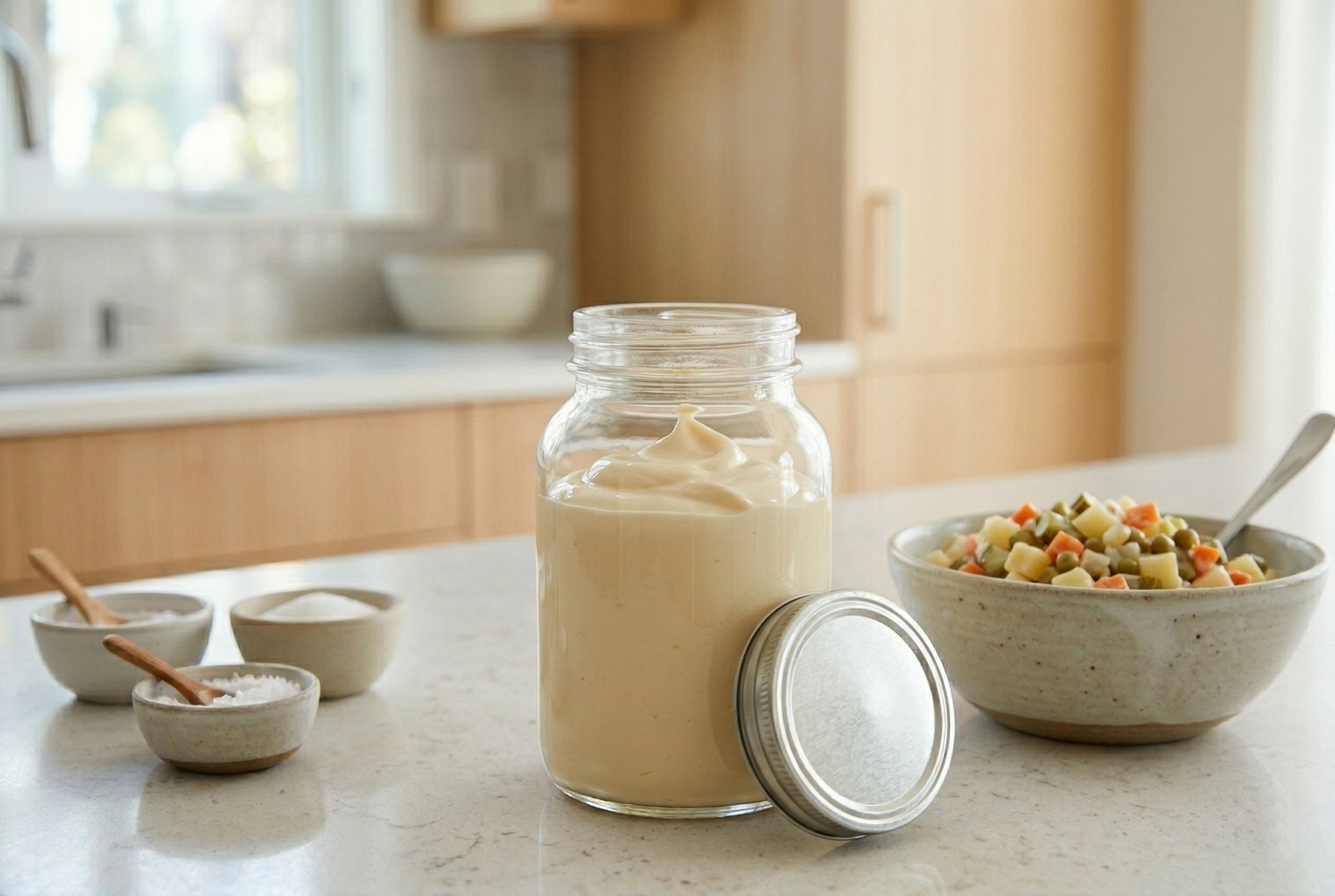
The result of proper technique: a thick, glossy mayonnaise that holds its shape perfectly and is ideal for dressings.
What to Do If Mayonnaise Separates
So the blender was moved too early, leaving a jar full of flakes.
Do not throw it away.
Taking a fresh, clean jar is the first step. Dropping one fresh egg yolk or a teaspoon of mustard (which contains enough mucilage to act as the new core of the emulsion) to the bottom sets the stage. Turn on the blender. And begin introducing the separated mass into the jar, one teaspoon at a time, without rushing. Slowly. The yolk or mustard becomes the new center, attracting the already processed oil droplets from the failed sauce. The lecithin redistributes, and the emulsion reforms.
Within five minutes, it is mayonnaise once again. It might be slightly less dense, sometimes carrying a marginally stronger egg flavor. It should be refrigerated immediately and used within three days.
If a spare yolk is unavailable, trying a teaspoon of very hot water is an option. It sometimes works, sometimes does not. It is a kitchen hack rather than a technological standard, but when the guests are already in the elevator, it is worth a shot.
Separated mayonnaise does not mean spoiled ingredients. The oil, yolk, and mustard are all still there; only the emulsion broke. And it can almost always be glued back together.
0 comments