
My first apartment featured a wooden block holding twelve knives. It was a gift from my parents. Heavy and handsome, it claimed half the countertop. I used exactly three of them. The rest merely stood handles-up, collecting dust between their grips.
A year later, an internship took me to Paris. My kitchen there had a magnetic strip with just five knives. It was more than enough. In fact, they performed better than my showpiece set back home because they were used for their intended purposes and honed regularly.
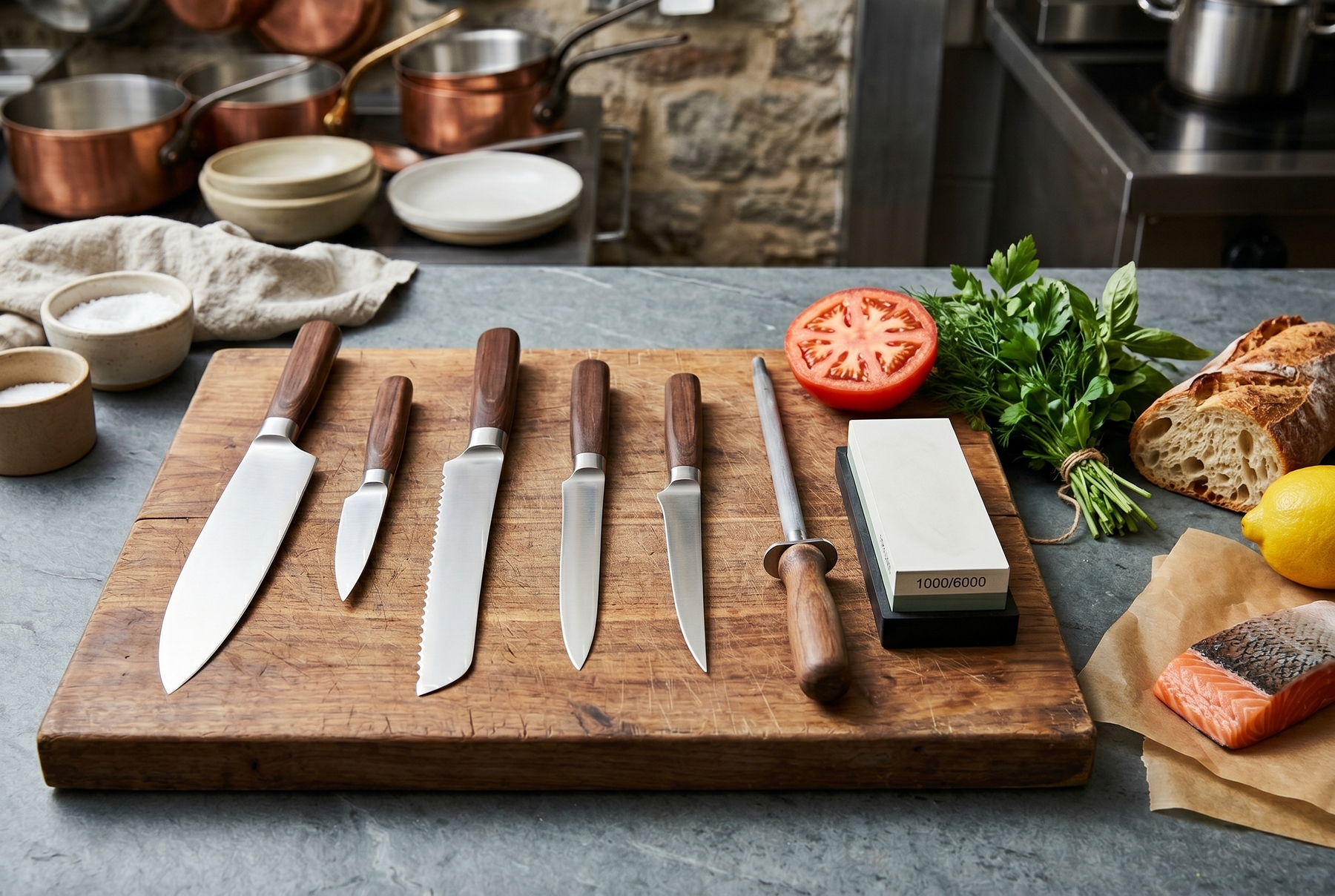
A complete foundational set for the home kitchen: chef's, bread, utility, paring, and boning knives alongside essential maintenance tools.
Table of Contents
- Why Settle For Five When You Could Have Twenty
- Which Knives You Need In The Kitchen: Who Is Who On The Cutting Board
- Honing And Sharpening Knives: Two Different Things
- How To Hone A Knife: Thirty Seconds Before Cooking
- Sharpening Knives On Whetstones: When Honing Is No Longer Enough
- Knife Care: How We Destroy Our Kitchen Tools
- Final Thoughts
Why Settle For Five When You Could Have Twenty
Most home kitchens overflow with gadgets. A special knife for grapefruit. A separate one for oysters. A cheese knife with giant holes in the blade (which, by the way, does not work). People buy these tools thinking they might come in handy someday, only to abandon them in a drawer for years.
In a professional kitchen, excess equipment quickly becomes a hindrance. Cooks grab the basic tools and master them. A chef’s knife in the hands of someone who knows how to use it slices everything from delicate herbs to dense pumpkins. At home, however, a person might buy a dedicated herb cutter simply because they never learned how to hold a standard knife.
Five kitchen knives cover nearly every task in a home kitchen. The rest is mostly marketing and pretty packaging.
Which Knives You Need In The Kitchen: Who Is Who On The Cutting Board
The Chef’s Knife: The Kitchen Workhorse
Boasting a blade length of 20 to 25 centimeters (8 to 10 inches), a wide profile, and a comfortable handle, this is the primary tool in any basic set. Almost all prep work begins here. It shreds cabbage, dices meat, minces herbs, and crushes garlic cloves flat. The weight should assist the hand, allowing the blade to fall naturally without requiring excessive downward pressure.
The Santoku (a Japanese general-purpose kitchen knife) is shorter and lighter. It features an almost straight edge, meaning cooks chop with an up-and-down motion rather than the rocking technique used with a European chef’s knife. It works beautifully for smaller hands or for those who prefer precise control over brute force. Personally, I rely on a European chef’s knife, as I appreciate its momentum. When slicing through three kilograms (6.6 lbs) of onions, that extra weight makes a noticeable difference.
The proper grip involves resting the index finger and thumb directly on the blade, just past the bolster (the thick junction between the blade and handle). This technique provides superior control over the steel. Gripping only the handle reduces precision and fatigues the hand much faster.
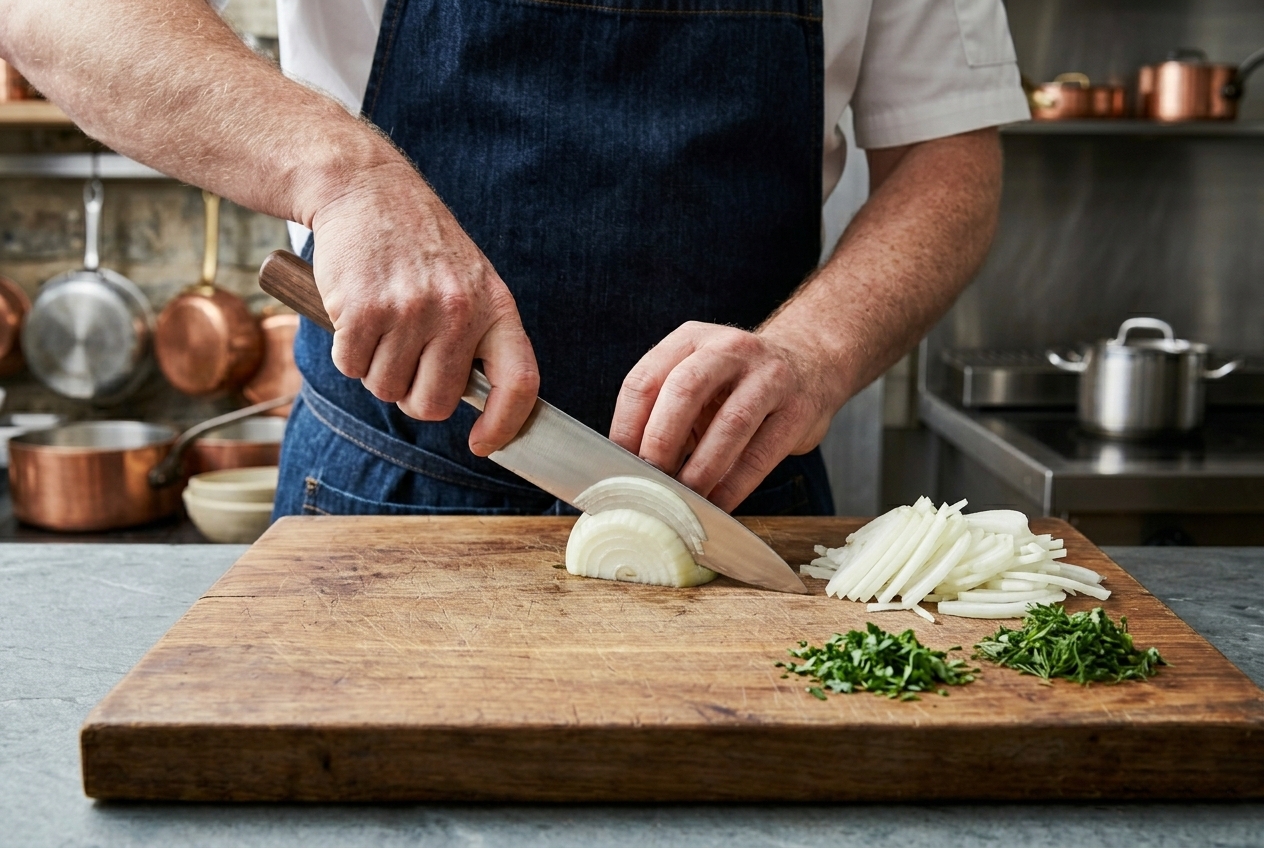
The chef's knife represents the most critical kitchen tool. A proper pinch grip ensures total control and safety during rapid prep work.
The Paring Knife: Where Precision Matters
Measuring 7 to 10 centimeters (3 to 4 inches), this versatile short blade tackles delicate tasks. It peels apples, cores bell peppers, removes potato eyes, and zests lemons. A chef’s knife simply cannot maneuver in these tight spaces because its blade is far too large.
A paring knife operates in the air, not on the cutting board. Holding the ingredient aloft, the cook pulls the blade inward with a short, controlled motion. The steel must be stiff, without any flex, to ensure a confident and clean cut.
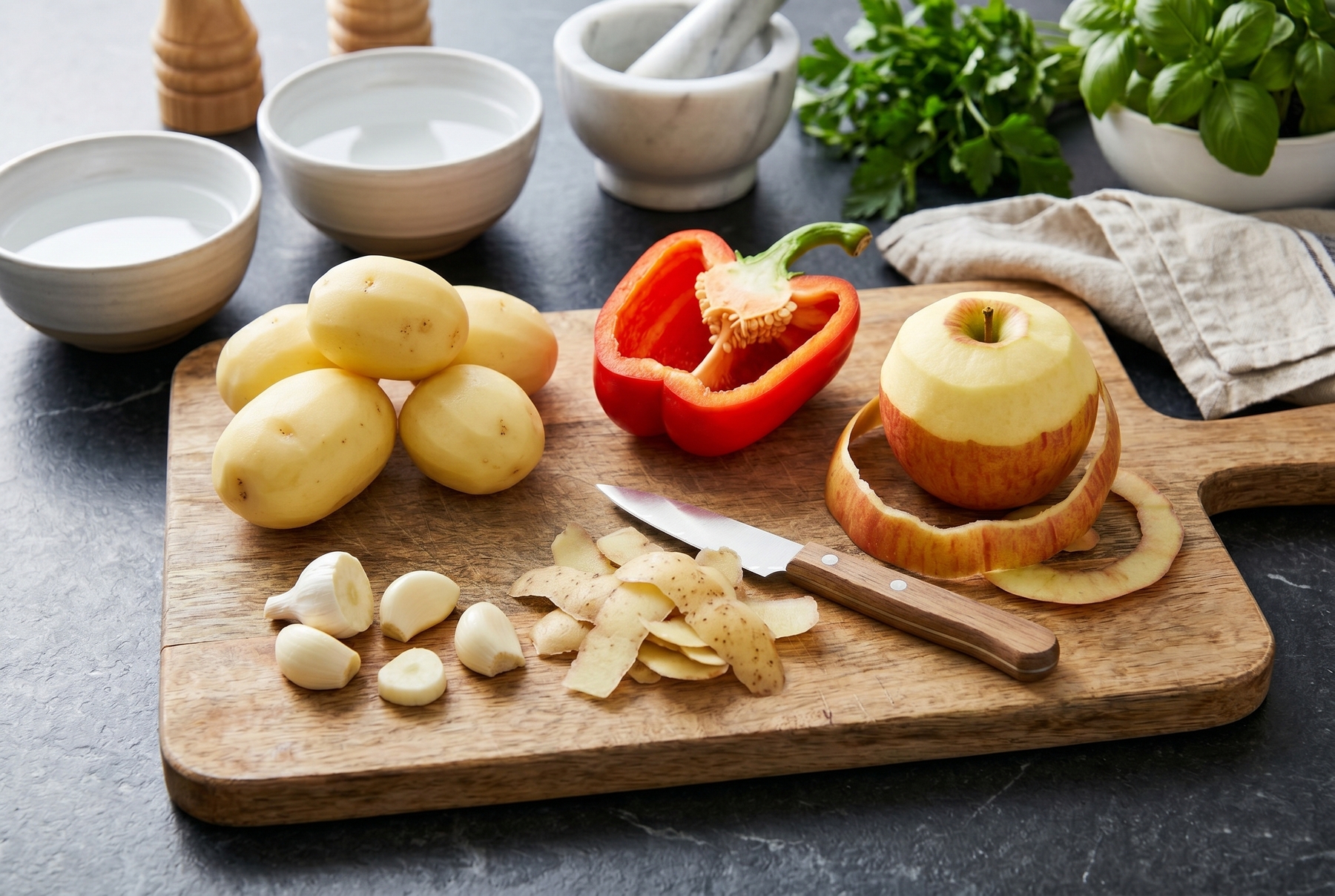
The short blade of a paring knife excels at intricate handheld work, from peeling root vegetables to coring fresh fruit.
The Bread Knife: Not Just For Baguettes
This serrated blade measures 20 to 25 centimeters (8 to 10 inches). Many people assume it serves solely for slicing bread. In reality, a serrated knife saves the day whenever a smooth edge would slip or crush an ingredient instead of cutting it.
Think of a fresh crusty baguette. Ripe tomatoes with paper-thin skins. Delicate sponge cakes that a standard edge would simply flatten into a pancake. Oranges also yield more easily to a serrated edge, as the teeth bite effortlessly into the rind without bruising the fruit.
A bread knife never requires sharpening. Its teeth either perform their job or wear down to the point where replacing the knife becomes the most practical solution. A quality serrated blade generally lasts five to seven years under heavy use.
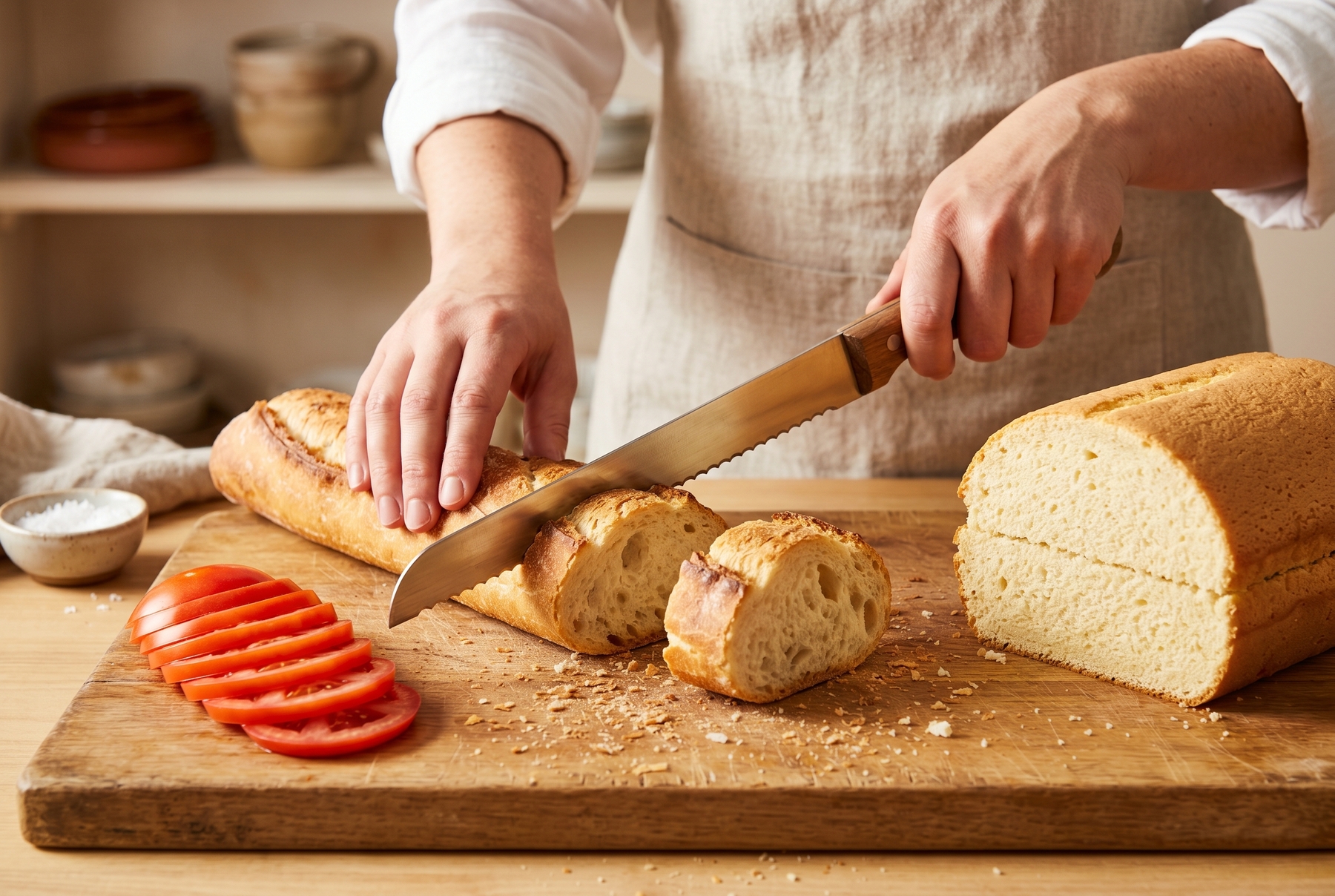
A serrated bread knife proves indispensable not just for crusty baked goods, but also for slicing delicate ingredients like tomatoes.
The Utility Knife: For Everything Else
Measuring 12 to 15 centimeters (5 to 6 inches), this tool bridges the gap between the chef’s knife and the paring knife. Slicing sausage for sandwiches, dicing cheese, cutting cucumber rings, or peeling a carrot all feel much more comfortable with a utility knife than with a bulky chef’s blade.
Many cooks underestimate its value. They purchase gorgeous specialty knives while entirely ignoring this mid-sized workhorse. Then, halfway through meal prep, they realize the chef’s knife is too large for the task and the paring knife is too small, forcing them into an awkward compromise.
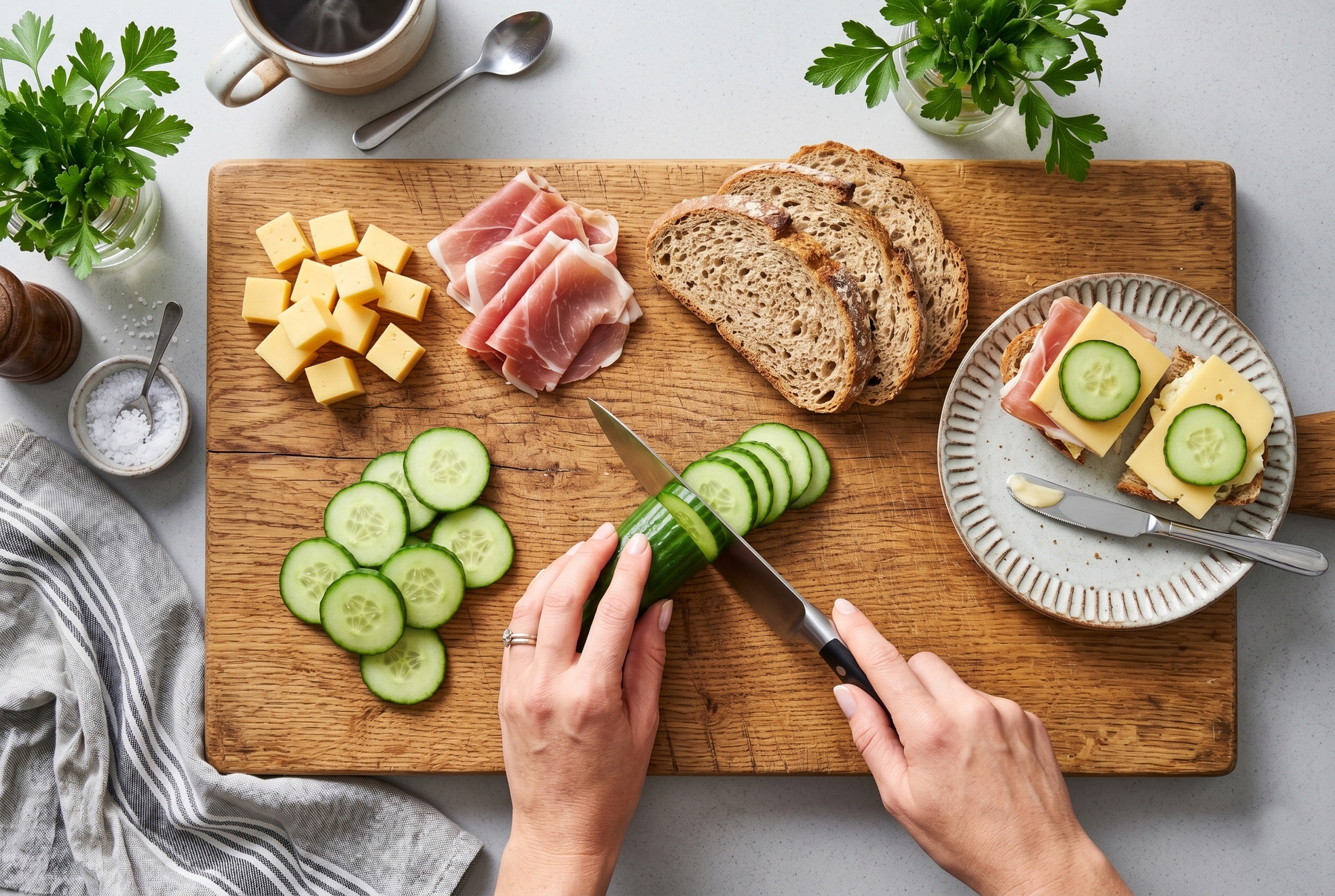
The mid-sized utility knife handles quick everyday tasks flawlessly, seamlessly transitioning from slicing cheese to prepping sandwich vegetables.
The Boning Knife: Navigating Around Bones
This features a narrow, flexible blade ranging from 15 to 18 centimeters (6 to 7 inches). Its primary purpose involves separating meat from bones, removing silver skin from tenderloins, and filleting fish. The flexible steel contours around the bone, maximizing the meat saved.
A boning knife does not see daily action. However, breaking down a whole chicken or fabricating a whole fish (which saves quite a bit of money) becomes nearly impossible without one. A chef’s knife is too rigid and thick, which results in mangling the meat rather than gliding cleanly along the bone.
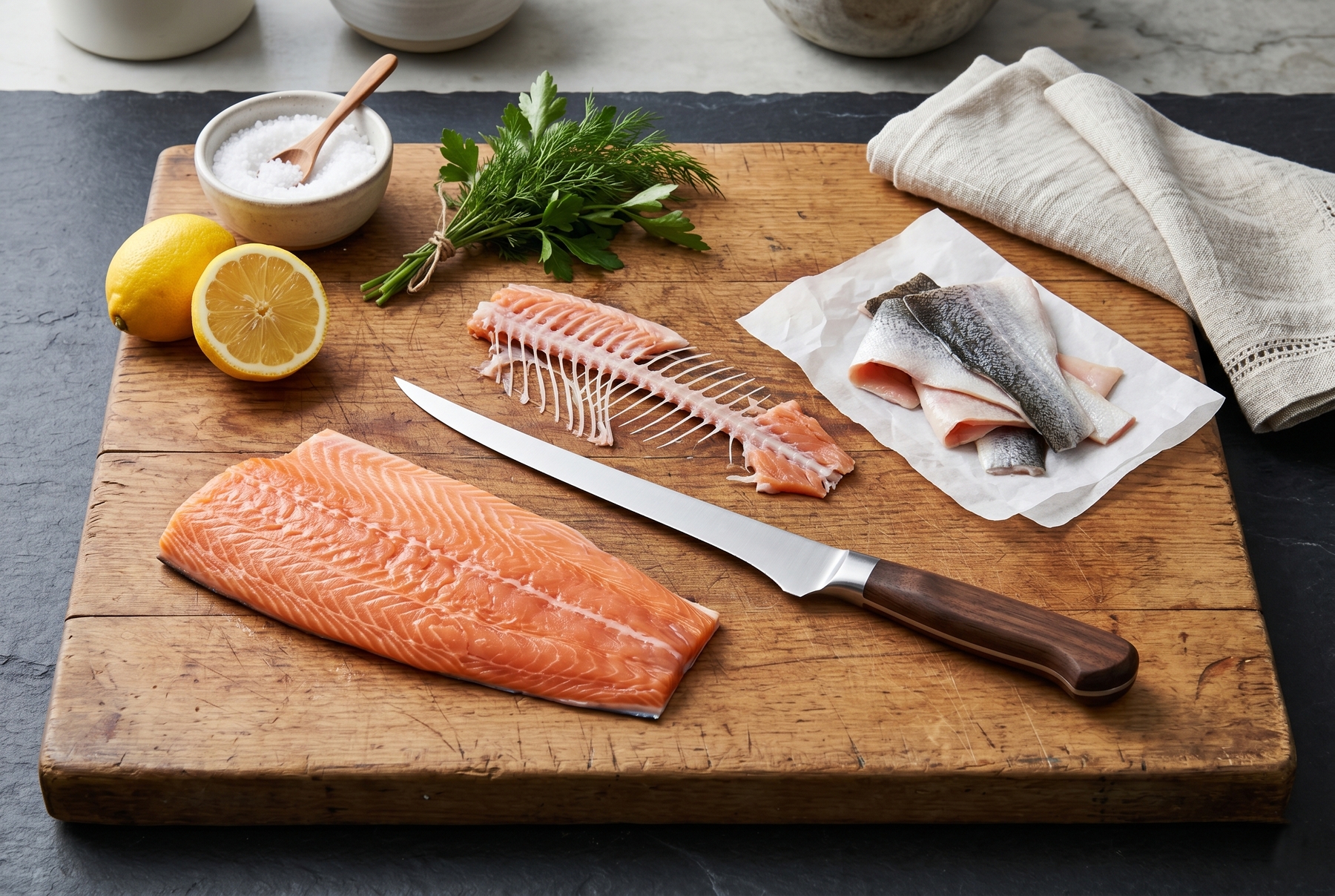
A narrow, flexible boning knife allows cooks to separate meat from the bone cleanly and fillet whole fish with minimal waste.
Honing And Sharpening Knives: Two Different Things
The honing rod (a metal steel) is frequently mistaken for a sharpener. In truth, it does not sharpen the knife at all. It realigns microscopic folds on the cutting edge that occur naturally during prep work. Under a microscope, the edge looks like a delicate ribbon of metal. Contact with cutting boards, bones, and tough vegetables bends it slightly out of alignment. The honing rod simply pushes it back into the center.
Sharpening, on the other hand, physically removes metal from the blade to create an entirely new edge. This process requires abrasive stones of varying grits. Sharpening is only necessary every few months, provided the blade receives regular honing.
Confusion arises when a person neglects sharpening for years and attempts to salvage a dull blade with a honing rod. It is completely useless. Once the steel wears down or the edge becomes severely compromised, no amount of honing will help. The blade needs a whetstone.
How To Hone A Knife: Thirty Seconds Before Cooking
A honing rod is a steel shaft with extremely fine ridges. The cook holds it vertically, resting the tip on a board or towel to prevent slipping. Pressing the knife against the top of the rod at a 15 to 20-degree angle, the user sweeps the blade downward in a gentle arc, simultaneously pulling it from the handle to the tip.
The angle matters immensely. Too steep, and the edge suffers damage. Too shallow, and the effort yields no result. Visually, the gap between the spine of the knife and the honing rod should roughly equal the thickness of a pinky finger.
The resulting sound should ring smooth and steady, without any harsh scraping or squealing. A screeching noise indicates excessive pressure or an incorrect angle. Three or four passes on each side accomplish the task. Nothing more is needed. The edge stands perfectly straight once again.
Honing before every cooking session sounds slightly fanatical, but in practice, it takes barely thirty seconds. The knife remains in prime working condition, and full sharpening sessions become much less frequent.
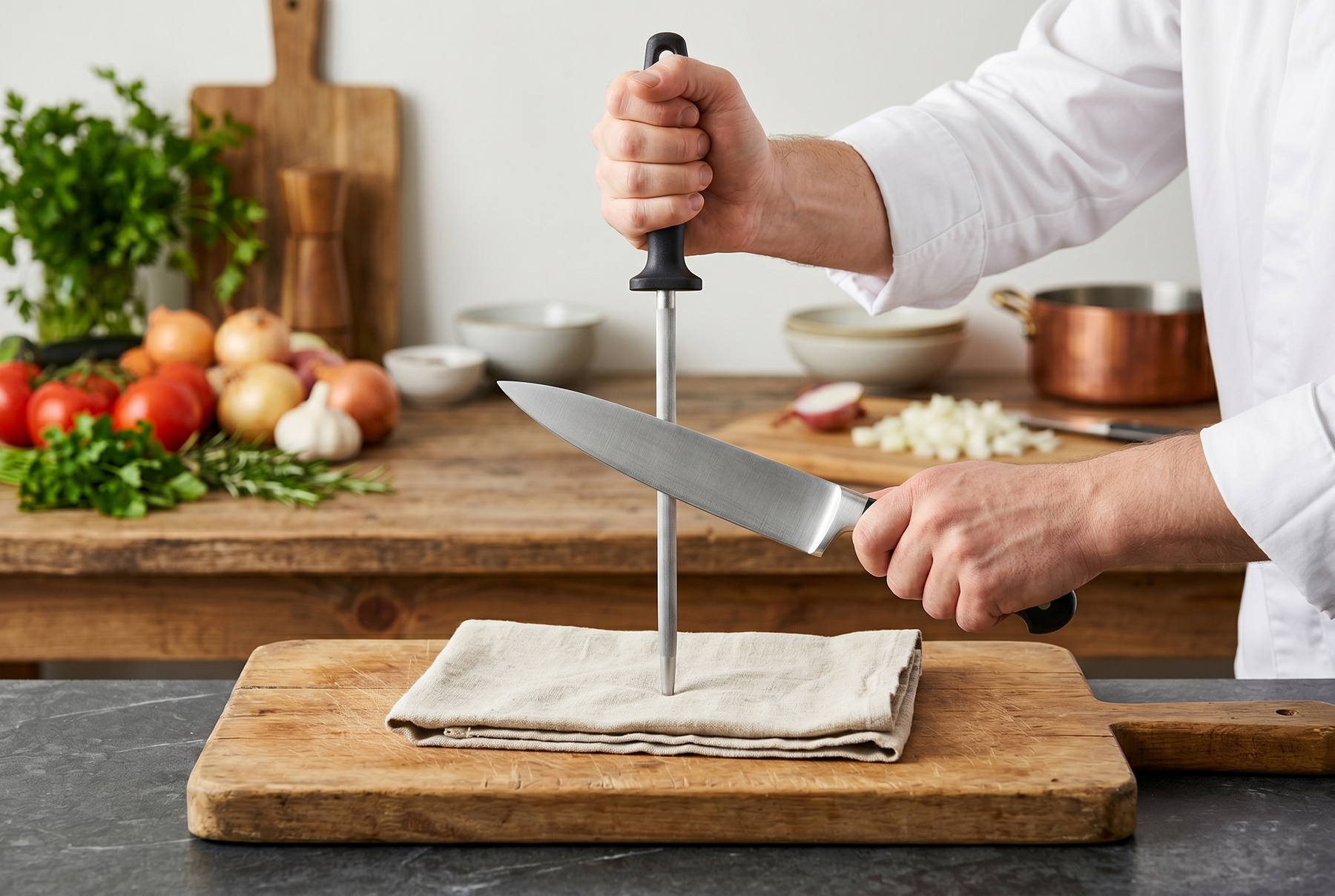
A quick honing session before cooking realigns the microscopic edge, keeping the blade dangerously sharp without requiring a whetstone.
Sharpening Knives On Whetstones: When Honing Is No Longer Enough
A blade has officially gone dull if it crushes a ripe tomato even after a thorough honing session. Slipping off an onion skin instead of piercing it, or leaving ragged, bruised edges on fresh herbs, also signals defeat. At this stage, a honing rod offers no salvation.
Whetstones come in various grit levels. A lower number indicates a coarser grain. Two stones easily suffice for a home kitchen: a 1000-grit stone handles the primary sharpening, while a 3000 to 6000-grit stone refines and polishes the edge.
Soaking the stone in water for about ten minutes prepares it for action. The knife meets the stone at the same 15 to 20-degree angle used for honing. Pushing the blade away while applying even pressure along its entire length creates the new edge. Maintaining a consistent angle remains the most crucial factor. Early attempts often feel clumsy, which is entirely normal. Muscle memory develops over time.
The grinding continues until a burr forms on the opposite side of the blade—a microscopic lip of metal easily felt by gently running a thumb away from the edge. Once the burr appears, the cook flips the knife and repeats the process on the other side. Switching to a fine-grit stone removes the burr and leaves the edge beautifully polished.
Testing the result requires only a sheet of paper. Slicing through paper held in the air reveals the blade’s condition. A properly sharpened knife glides through effortlessly, leaving a clean cut without tearing or crumpling. Any snagging or required pressure indicates that the sharpening angle wavered.
Restoring a single knife takes about twenty minutes once the hands remember the rhythm. The very first attempt might consume an hour. Eventually, finding the correct angle becomes pure instinct.
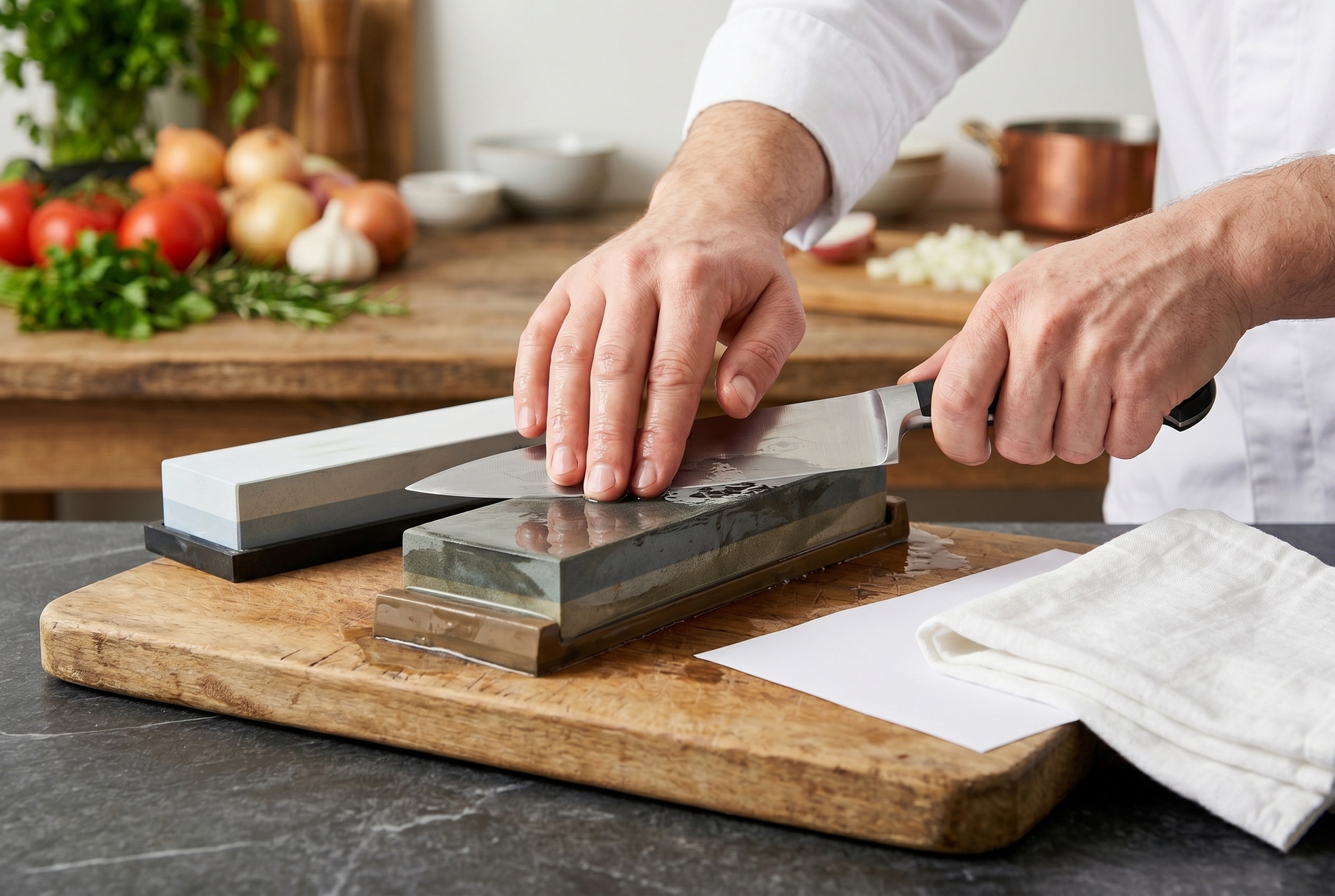
When honing is no longer enough, a whetstone restores the edge. Maintaining a consistent 15 to 20-degree angle ensures a razor-sharp finish.
Knife Care: How We Destroy Our Kitchen Tools
The Glass Cutting Board. It looks sleek and washes beautifully. It also ruins a knife’s edge within a fortnight. Glass possesses a much higher hardness than steel. Wood and high-quality plastics provide a much softer, safer landing.
The Dishwasher. Harsh detergents, extreme temperatures, and collisions with other utensils spell disaster. The blade oxidizes, while wooden handles dry out and splinter. Subjecting a knife to the dishwasher severely shortens its lifespan. Rinsing it under the tap and wiping it dry takes merely seconds.
The Utensil Drawer. Blades scrape against each other, tangling with forks and spoons. The delicate edge warps and chips. Knives belong on a magnetic strip or nestled in a slotted wooden block. If a drawer remains the only option, outfitting the blades with protective guards is non-negotiable.
Slicing Frozen Foods. A fine edge simply crumbles under such stress. Cooks should wait until the chicken completely thaws, or reach for a heavy meat cleaver instead. A chef’s knife does not moonlight as a crowbar.
Using Knives As Screwdrivers, Levers, Or Can Openers. I have seen people prying open jars or lifting metal lids with a chef’s knife. The delicate tip and edge were never engineered for such abuse. The blade might not snap immediately, but invisible micro-fractures compromise the metal. It will eventually shatter at the most inconvenient moment.
Final Thoughts
Knowing a tool will not fail makes cooking infinitely easier. A ripe tomato yields to a single stroke. A fish breaks down flawlessly without wasted flesh. Fresh herbs remain pristine and crisp, rather than turning into a bruised mush on the cutting board.
Five essential knives and a honing rod remain securely on the magnetic strip. The whetstone only emerges from the cupboard every few months.
0 comments