
You buy a bag of Kenyan beans in Moscow for a couple of thousand rubles. You try it in the cafe, and it tastes like red currant, hibiscus tea, and cotton candy. You take it home to Rostov-on-Don, a city known for its hard water. You open it, brew it, and suddenly your mouth is filled with notes of burnt rubber and an astringency resembling unripe persimmon.
The beans are identical, the grind size is dialed in, and the temperature is perfect. Yet the flavor has vanished, leaving nothing but bitterness. The problem lies in the coffee water. More precisely, the issue is what is dissolved in it. Coffee consists of 98% water, and this is the ultimate trap: water does not merely dilute the beverage; it extracts acids, sugars, oils, and bitterness from the ground beans. What ultimately ends up in your cup depends entirely on chemistry.
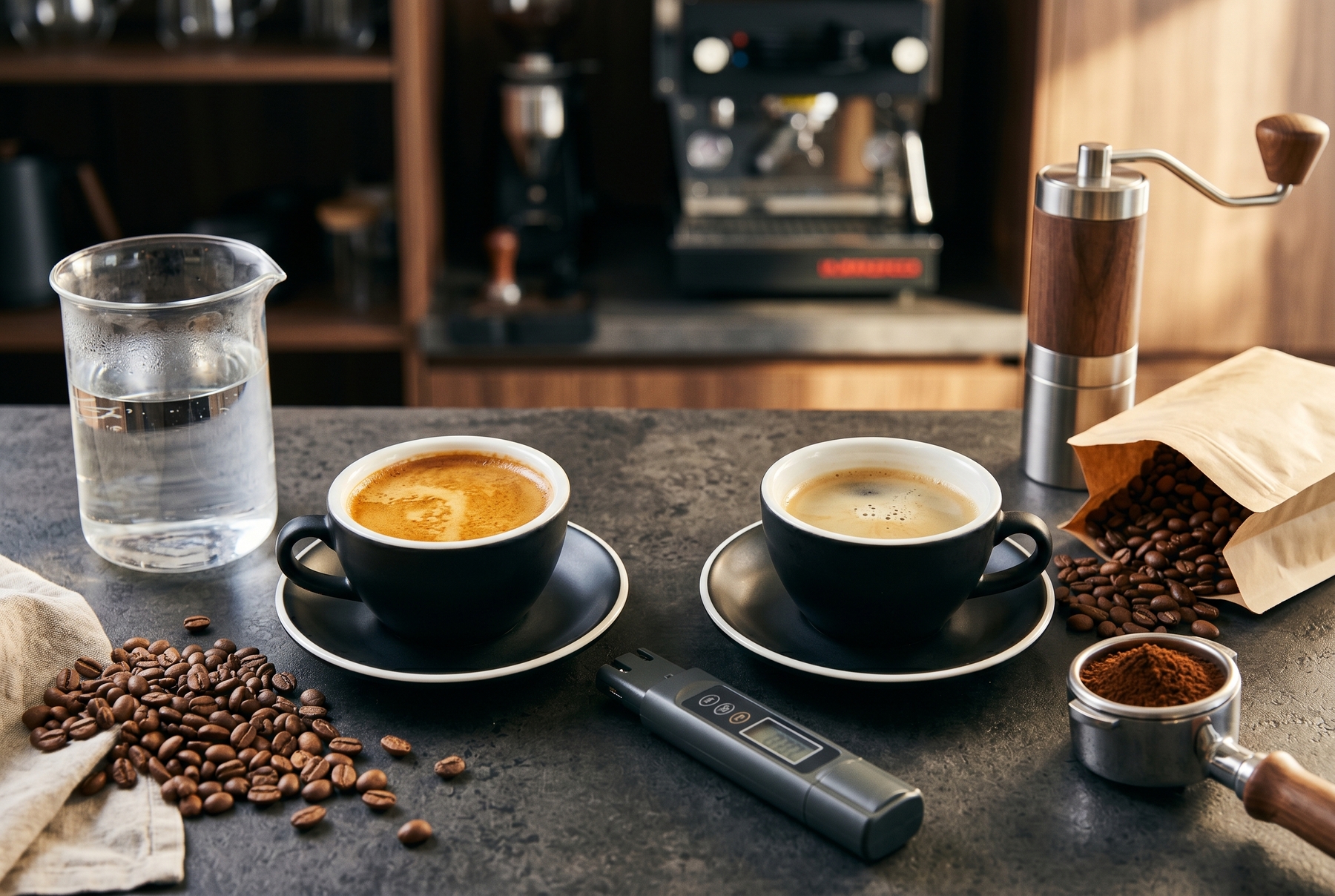
The correct mineral balance in water is critical for achieving a harmonious flavor profile and a dense crema.
Table of Contents
- Water Is Not a Neutral Medium, but a Solvent
- Water Mineralization for Coffee: What Numbers to Look for on the Bottle
- Regional Water Differences: Why the Same Coffee Tastes Different
- How a TDS Meter Offers a Quick Reality Check
- Home Solutions: How to Test Coffee Water and Choose a Filter
- When Your Coffee Tastes Too Bitter
A coffee-enthusiast friend of mine used to consider water a neutral background until he started measuring the TDS (Total Dissolved Solids) and water hardness in various parts of the country. It turned out that clean tap water in St. Petersburg and clean tap water in Voronezh act as completely different solvents for coffee.
Water Is Not a Neutral Medium, but a Solvent
Coffee contains hundreds of organic compounds: acids (chlorogenic, malic, citric), sugars, oils, and bitter alkaloids like caffeine and trigonelline. Water extracts these compounds from the ground beans unevenly. It all comes down to the minerals and their exact quantities.
Distilled water for brewing coffee seems like a logical choice: it contains nothing, meaning nothing will interfere with the flavor. In practice, the opposite is true. Such water performs poorly because it lacks the minerals necessary to extract flavor and keep acidity in check. The resulting beverage is watery; the taste quickly falls flat, and the aroma barely lingers.
Ions are essential here. Dissolved minerals accelerate extraction and fundamentally alter the flavor in the cup.
Three components matter most in coffee water: magnesium, calcium, and bicarbonates. They dictate whether the cup will be sweet and full-bodied or descend into flat bitterness.
Magnesium Enhances Acidity, Calcium Provides Body, and Alkalinity Mutes Flavor
Magnesium (noted as Mg²⁺ in water analyses) helps light roasts display their acidity more clearly. Berry and citrus notes do not collapse into hollow sourness. Without magnesium, coffee often tastes muted; the acidity is present, but there is little flavor behind it.
A water analysis reading of 10–30 mg/L is a good target to aim for.
Calcium (Ca²⁺) is crucial for the body of the beverage. In espresso, calcium helps form the crema, that appealing foam on the surface. Water that is too soft will make the coffee watery, even when using excellent beans.
Calcium levels can range from single digits to a few dozen. Beyond 50 mg/L, the risk of limescale buildup in an espresso machine rises significantly. This is well known in southern regions and parts of Moscow, where the water is notoriously hard. The taste might remain acceptable, but the boiler and tubes quickly become encrusted with scale.
Bicarbonates Are More Complicated
Water labels typically list the bicarbonate ion content (HCO₃⁻), whereas coffee recommendations more commonly refer to alkalinity. This is the water’s buffering capacity, calculated in terms of calcium carbonate (CaCO₃). These are closely related concepts. Water with high alkalinity neutralizes acidity. In a light roast, acids deliver berry, citrus, and tea-like notes, but excessive alkalinity mutes them. Instead of currant and tea, a dry, cardboard-like aftertaste remains.
For specialty coffee, the highest grade of coffee beans, alkalinity (in terms of CaCO₃) is generally kept within the 40–70 mg/L range. At higher alkalinity levels, the delicate acidic notes fail to shine through. At levels that are too low, the beverage sometimes becomes harsh and scratchy on the throat.
The key to great coffee is not a single number, but the delicate balance of magnesium, calcium, and alkalinity. This combination dictates exactly what ends up in your cup.
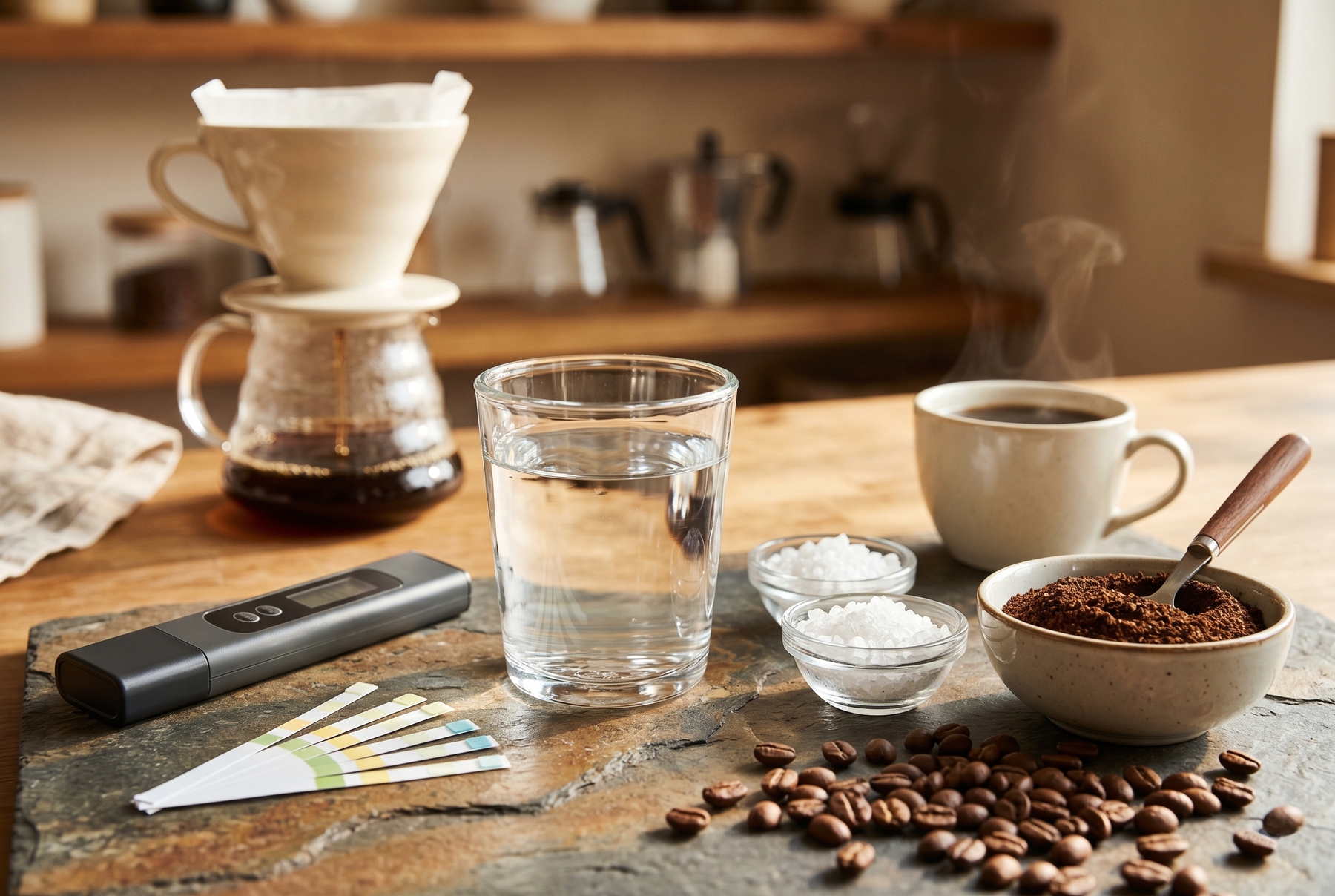
Controlling water quality at home requires a TDS meter, test strips, and a basic understanding of magnesium and calcium levels.
Water Mineralization for Coffee: What Numbers to Look for on the Bottle
TDS stands for Total Dissolved Solids. It is measured in mg/L or ppm, which can be treated as identical units for everyday reading purposes.
The Specialty Coffee Association (SCA) establishes an optimal TDS range for coffee brewing: 75–250 mg/L. Below 75 mg/L, the water frequently lacks the minerals required for proper extraction. Above 250 mg/L, the mineral content becomes overwhelming, and the coffee can develop a chalky or salty flavor.
Bottled water labels display a line for Mineralization or Total Mineralization, which is the TDS value.
Most bottled water brands feature this composition table on the back label. When a brand omits the mineral breakdown, it is best to avoid it for coffee brewing, as the results will be entirely unpredictable.
Testing popular regional brands reveals stark differences. Some commercial spring waters sit perfectly within the brewing range, while others are either too soft (TDS around 50) or overly mineralized (TDS over 300). Every region has its own local brands, but the approach remains the same: grab a bottle, check the composition table, and compare it with the optimal ranges.
Regional Water Differences: Why the Same Coffee Tastes Different
Tap water in cities like St. Petersburg tends to be incredibly soft, with an average TDS of 50–80 mg/L. It frequently lacks the minerals necessary for a balanced extraction. The resulting coffee feels thin, lacks body, and features a disjointed, sharp acidity. Locals often complain about sour or watery espresso, but the culprit is usually the municipal water supply, not the beans.
Large metropolises like Moscow present a more complex picture. Central districts might have relatively soft water, while suburban and southern neighborhoods deal with harder water, where TDS can reach 200–300 mg/L. Espresso machines accumulate limescale much faster, but the cup often boasts a heavier body. Light roasts lose their vibrant acidity because the high alkalinity neutralizes it.
In southern regions, the water is frequently too hard, characterized by high levels of calcium and bicarbonates. Dark roasts often perform better in these areas, as their bitterness and heavy body align with the water’s profile. Light roasts, however, turn into a muddled, over-extracted mess.
In Central Asian cities like Almaty and Tashkent, the water is notoriously hard, with TDS sometimes exceeding 400 mg/L. This water produces a muddy flavor with a distinct mineral aftertaste in the cup. Without rigorous filtration or bottled water, specialty coffee in these regions rarely reaches its full potential.
The exact same coffee evolves dramatically across different cities, driven entirely by the underlying water chemistry.
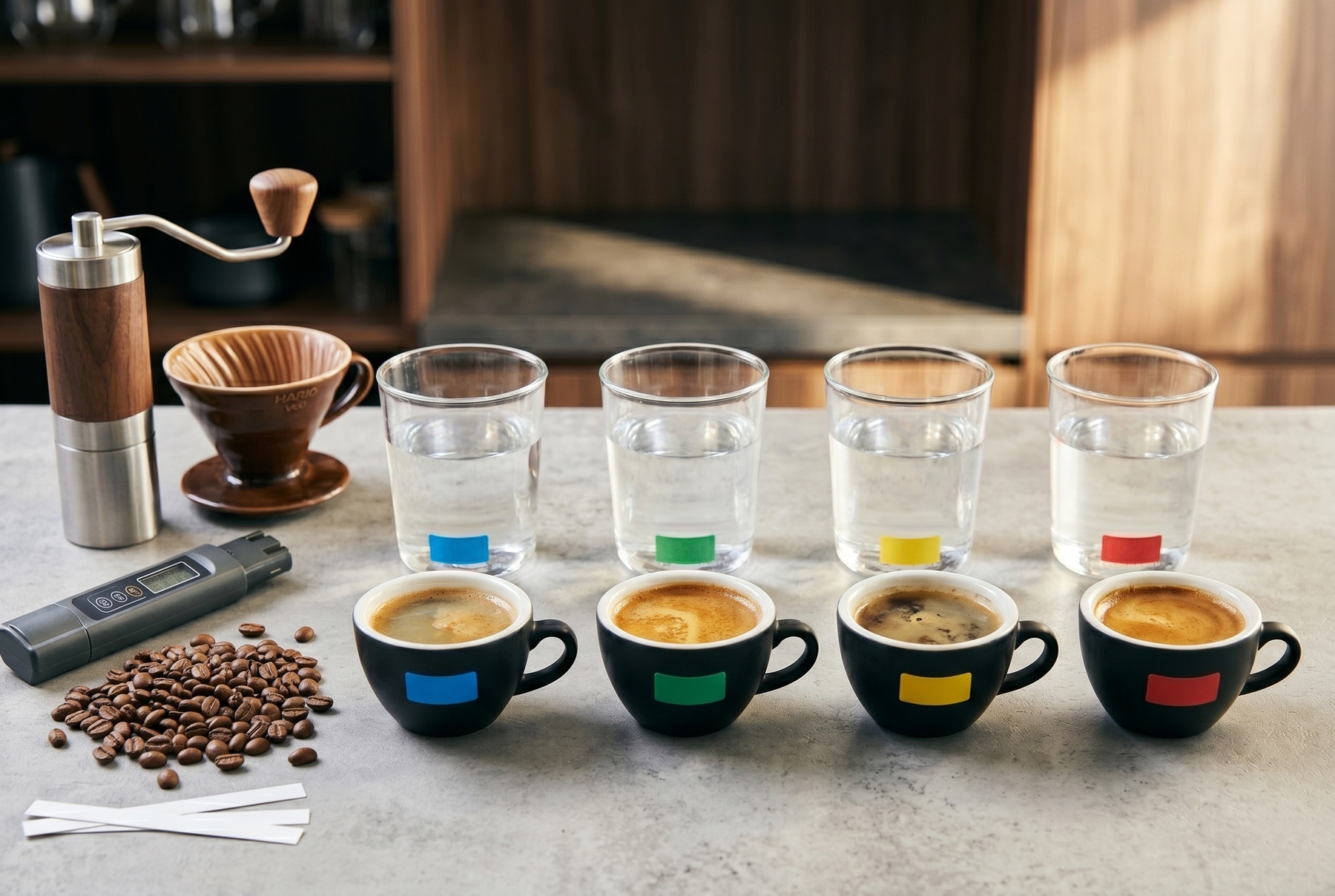
The exact same coffee bean can yield vastly different results depending on the regional water chemistry.
How a TDS Meter Offers a Quick Reality Check
Three years ago, the lab replaced the filter on our reverse osmosis system. The following morning, a standard Colombian brew tasted entirely flat, as if the finished beverage had been diluted with water, despite the beans, grind, and brewing method remaining identical.
The new filter had slashed the TDS to a mere 15 mg/L, rendering the water nearly distilled. The extraction failed completely. Lacking essential ions, the flavor remained locked inside the grounds. This prompted a habit of testing water at home, in cafes, and at friends’ houses. Even within a single city, the numbers fluctuate wildly. Tap water in central districts might read 120 mg/L, while a suburban district clocks in at 280 mg/L.
Home Solutions: How to Test Coffee Water and Choose a Filter
Understanding the water flowing from your tap is the crucial first step. A TDS meter makes this effortless: simply measure the tap water directly. Without one, examining the scale in a kettle provides clues. A white, crumbly scale that flakes off easily indicates hard water. If there is almost no scale but the kettle’s interior looks dull with a gray film, the water is soft.
Aquarium test strips offer another alternative. They indicate hardness and pH levels. While not incredibly precise, they are perfectly adequate for home use.
Water Filter Pitchers: A Crucial Caveat
Most standard filter cartridges reduce hardness and scale rather than adding minerals. They are ideal for hard water when excess minerals need to be stripped away. Some manufacturers produce specialized cartridges with magnesium or mineralizing additives, which are useful for soft water. However, verifying the results with a TDS meter is always a safer bet than blindly trusting packaging claims.
Reverse Osmosis With a Mineralizer
This is a precise yet expensive solution. The system purifies water almost to zero, and then a mineralizer reintroduces a portion of the salts. Mineralizers can be adjustable, allowing for manual TDS tuning, or non-adjustable, offering a fixed composition. The adjustable models offer greater convenience but come with a higher price tag.
If a reverse osmosis system is already installed, checking for a mineralizer is essential. Many households install systems without one, resulting in pure distillate. While fine for drinking, this spells disaster for coffee.
Choosing the Right Bottled Water for Coffee
For those who prefer to avoid the hassle of filters, purchasing bottled water with an appropriate TDS (75–250 mg/L) while checking magnesium and calcium levels is an excellent alternative. Keeping a dedicated stash just for brewing coffee is more expensive than filtering, but it offers unmatched simplicity.
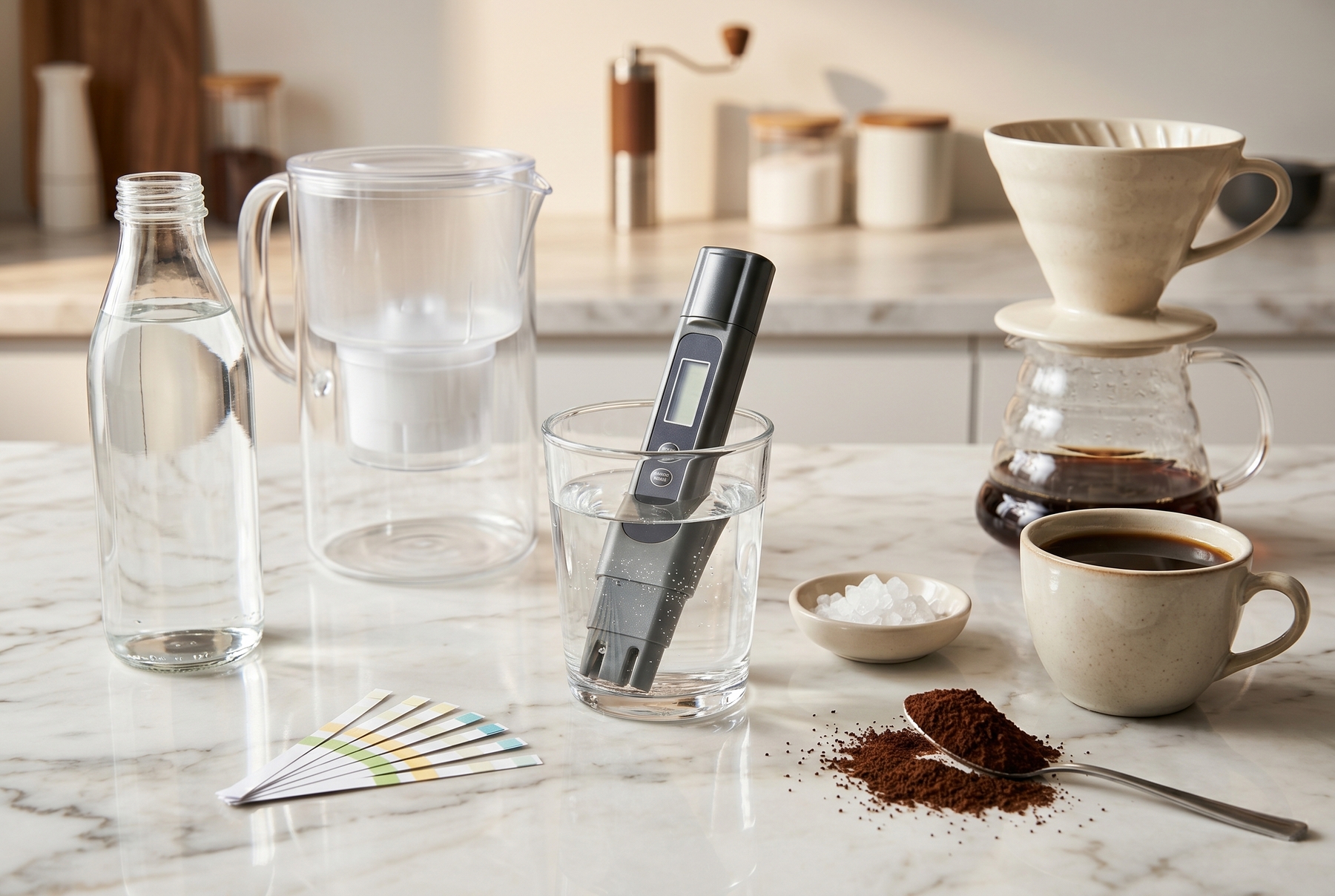
Utilizing water filters or carefully selected bottled water helps prevent excessive bitterness and limescale buildup.
When Your Coffee Tastes Too Bitter
Brewing coffee with poor-quality water often results in overwhelming bitterness, but pouring it down the drain feels like a waste. Fortunately, there is a last-resort trick.
Adding a tiny pinch of salt to the cup works wonders. Just a few crystals of coarse, non-iodized salt will suffice. Salt suppresses the bitterness receptors on the tongue. It does not chemically remove the bitterness from the beverage, but it makes it significantly less perceptible. The effect is remarkably similar to how salt enhances sweetness in baking.
Adjusting the grind size for the next brew provides a secondary solution. When coffee turns bitter due to over-extraction, meaning too many bitter compounds were pulled from the beans, a slightly coarser grind will correct the issue. Conversely, if the coffee tastes sour and harsh, it suffers from under-extraction: the water pulled the acids out first but failed to extract enough sweet and bitter compounds to create balance. In this scenario, a finer grind is necessary.
A basic TDS meter is highly affordable, and standard models provide sufficient accuracy for home testing. Test strips are equally inexpensive, and a bottle of suitable water costs very little. Brewing one cup with empty, reverse-osmosis water and another with properly mineralized water provides a striking comparison in both flavor and the rich color of the espresso crema.
0 comments