
The most unusual cheese on this list is not blue, does not contain larvae, and does not smell like an old cellar. It is the humble white Queso Paraguayo (a traditional fresh cheese from Paraguay), which locals use to bake Sopa Paraguaya. This dish translates as soup but actually turns out to be a dense corn casserole that people cut with a knife and eat in slices. The secret lies in the fact that great cheeses are famous not only for their taste but also for how they become the very language of local cuisine.
What follows are the thirty-three most famous cheeses in the world. These are names familiar not just to cheesemongers, but to almost anyone on earth. There is no need for tasting knives, obligatory grapes on the side, or an intimidating tone. This is simply a guide to what each cheese is, how it smells, and what working with it in your own kitchen actually entails.
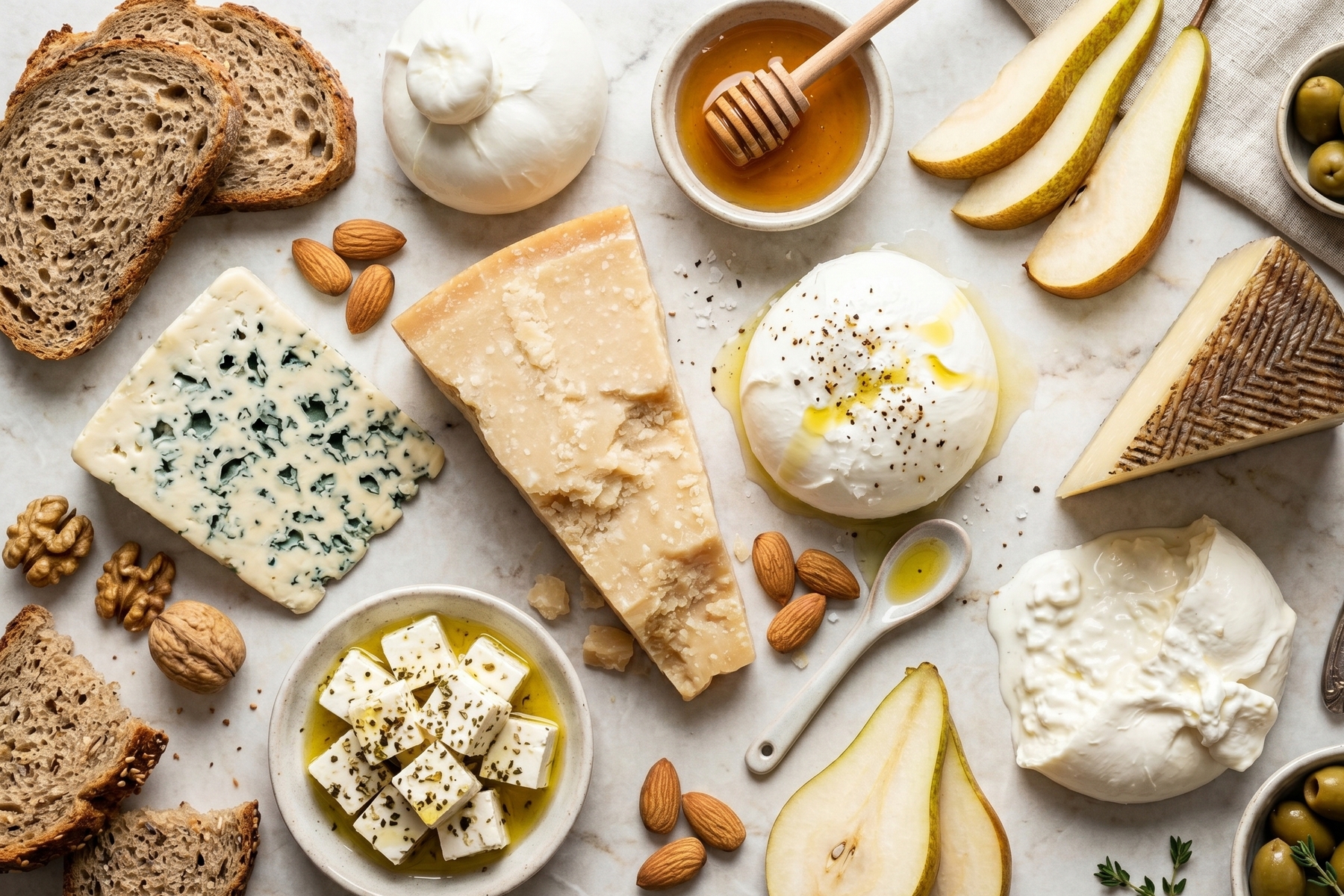
Assortment of famous world cheeses, including Parmesan, Mozzarella, Dorblu, and Manchego with honey and pears.
Table of Contents
- Cheese as a Regional Passport
- How to Read a Cheese Board Without Getting Lost
- Italy: Where Cheese Holds the Dish Together
- France: A Cheese for Every Personality
- Spain, Greece, and the Balkans: Salt, Sheep, and Brine
- The Caucasus and Neighbors: Cheese That Stretches and Lives in Brine
- Switzerland, the Netherlands, and England: Cheeses That Became the Standard
- Northern Europe: Coziness, Smoke, and Discipline
- The Americas: Cheese Meant for the Dish, Not the Display
- The Middle East and Asia: Cheeses Beyond the European Showcase
- How to Assemble a Cheese Board if You Are Not a Sommelier
- How to Choose Cheese: Aroma, Texture, and the Label
- Cheat Sheet: Which Cheese Goes Where
- Fame Begins With a Role in a Dish
Cheese as a Regional Passport
Without Parmesan, Italian pasta loses its voice. A Greek salad missing Feta lacks its essential brine, and Khachapuri (Georgian cheese bread) without Suluguni (a traditional Georgian stringy cheese) will not stretch in a beautiful thread behind a fork. A famous cheese anchors an entire culinary tradition, often defining a dish that simply would not exist without it. Behind every name on this list stands a specific place: a pasture, a climate, a breed of cattle, a custom of salting or smoking, and a cellar harboring a very particular mold.
How to Read a Cheese Board Without Getting Lost
Thousands of cheese varieties exist worldwide, but mastering a few key terms makes any deli counter less intimidating. Hard and semi-hard cheeses differ in density and moisture. Brined cheeses live and mature in salted water. Blue cheeses are pierced with noble mold. Fresh cheeses offer immediate enjoyment, while aged ones wait for months in cellars. Then comes the milk: cow, sheep, goat, or water buffalo. Every other variation—salt, enzymes, pressing methods, and cellar temperatures—only enhances these fundamental parameters.
Milk Dictates Almost Everything in Cheese
Cow’s milk provides the creaminess and the soft, accessible flavor found in most supermarket cheeses. Sheep’s milk is richer and sweeter, carrying a grassy note and a density that leaves a buttery trace on the tongue; it serves as the foundation for Manchego, Pecorino, and Roquefort. Goat’s milk reveals itself instantly through a tart freshness and that distinctive “animal” aroma that sometimes startles beginners, though it is simply the natural character of the breed. Water buffalo milk is the most delicate and moist, offering a sweet background that defines authentic Mozzarella. A single recipe applied to different milks yields entirely different cheeses.
What Aging Does to Cheese
Young cheese remains moist, soft, and tastes of pure milk. Over time, it loses water, becomes denser, turns saltier, and develops nutty and spicy tones. Older cheeses feature crunchy crystals of salt and amino acids, which pop audibly between the teeth when biting into aged Gouda or Parmesan. However, age does not automatically equal quality. A vibrant salad demands a young Queso Fresco, while a rich pasta requires a mature, crystalline Parmesan, and swapping their roles makes little culinary sense.
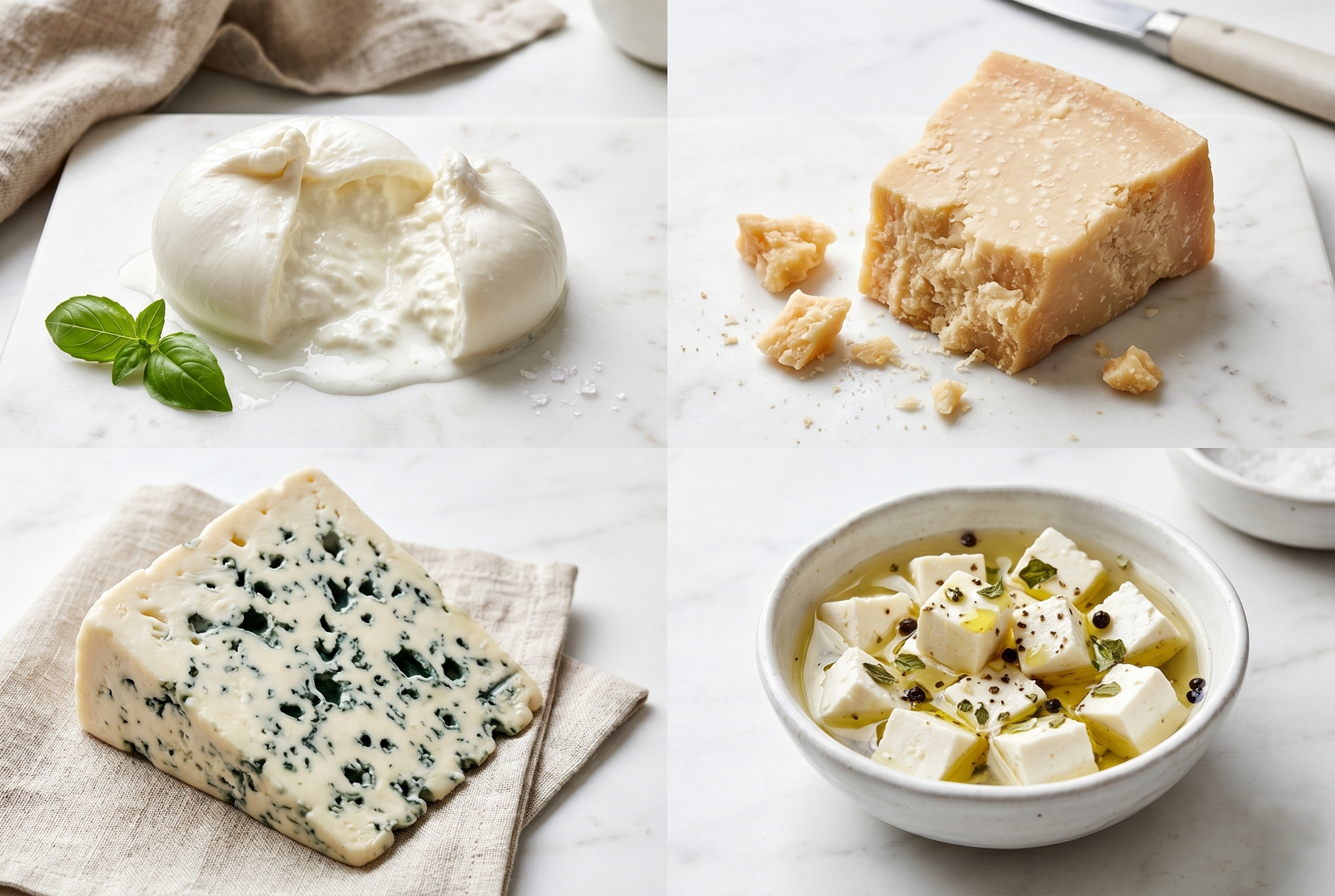
Four main textures: delicate Mozzarella, aged Parmesan, piquant Roquefort, and brined Feta.
Italy: Where Cheese Holds the Dish Together
Italians treat cheese as a structural element. One variety gets grated over pasta, another melts seamlessly, a third is eaten fresh, and a fourth is tossed in at the very end purely for a salty finish. Without these Italian cheeses, the country’s culinary identity would simply not exist.
Parmesan (Parmigiano Reggiano)
The undisputed king of umami and aging. Authentic Parmesan matures for 12 to 36 months—and sometimes longer—in a few select provinces in northern Italy. During this time, those signature crystals grow inside, creating a delightful crunch. The flavor is nutty and briny, leaving a long finish that requires no accompaniment. Grating it over pasta, risotto, or a vegetable soup deepens the dish without the need for additional sauces. Similar hard cheeses labeled “parmesan” might be acceptable, but they are not the same thing. The protected designation guarantees the milk, the region, and the timeline, whereas an unnamed alternative only guarantees the price.
Mozzarella
The complete opposite of Parmesan. Soft, moist, and milky, this cheese thrives on freshness rather than a long stay in a cellar. Slicing open a ball releases a gentle whey, while the flesh springs back and pulls slightly into delicate fibers. Mozzarella made from water buffalo milk (Mozzarella di Bufala) tastes sweeter and more tender, whereas the cow’s milk version (Fior di Latte) feels simpler and more familiar atop a pizza. The main rule remains constant: fresher is always better, as yesterday’s Mozzarella has already lost half its charm.
Gorgonzola
Here, blue mold does not signify spoilage. Cheesemakers introduce it intentionally and keep it strictly controlled, resulting in a creamy texture with a piquant sharpness around the edges. The soft Dolce variety spreads on bread like butter, while the dense Piccante delivers a punch of salt and pepper. Serving a wedge alongside a pear, walnuts, and a slice of crusty bread, or stirring it into hot risotto, clearly illustrates why Italians embraced mold in cheese in the first place.
Pecorino Romano
An assertive, salty sheep’s milk cheese. In Roman pasta dishes, it frequently functions almost as a sauce itself. Grating it into starchy pasta water and egg binds the mixture into a creamy emulsion, forming the backbone of Carbonara and Cacio e Pepe. Blindly substituting it for Parmesan rarely works. Pecorino carries more salt and a sharper bite, often overpowering a dish meant for mellow umami and leaving nothing but saltiness on the palate.
Ricotta
Strictly speaking, Ricotta is not a cheese; it comes from the whey left over from producing other cheeses. The texture is delicate, almost like a cream, and the flavor remains sweet and pristine. This ingredient shines in ravioli fillings, cheesecakes, and Sicilian Cannoli, or simply served for breakfast with honey and bread. Spotting true Ricotta at home is easy thanks to its grainy, moist crumb that contains no hint of salt.
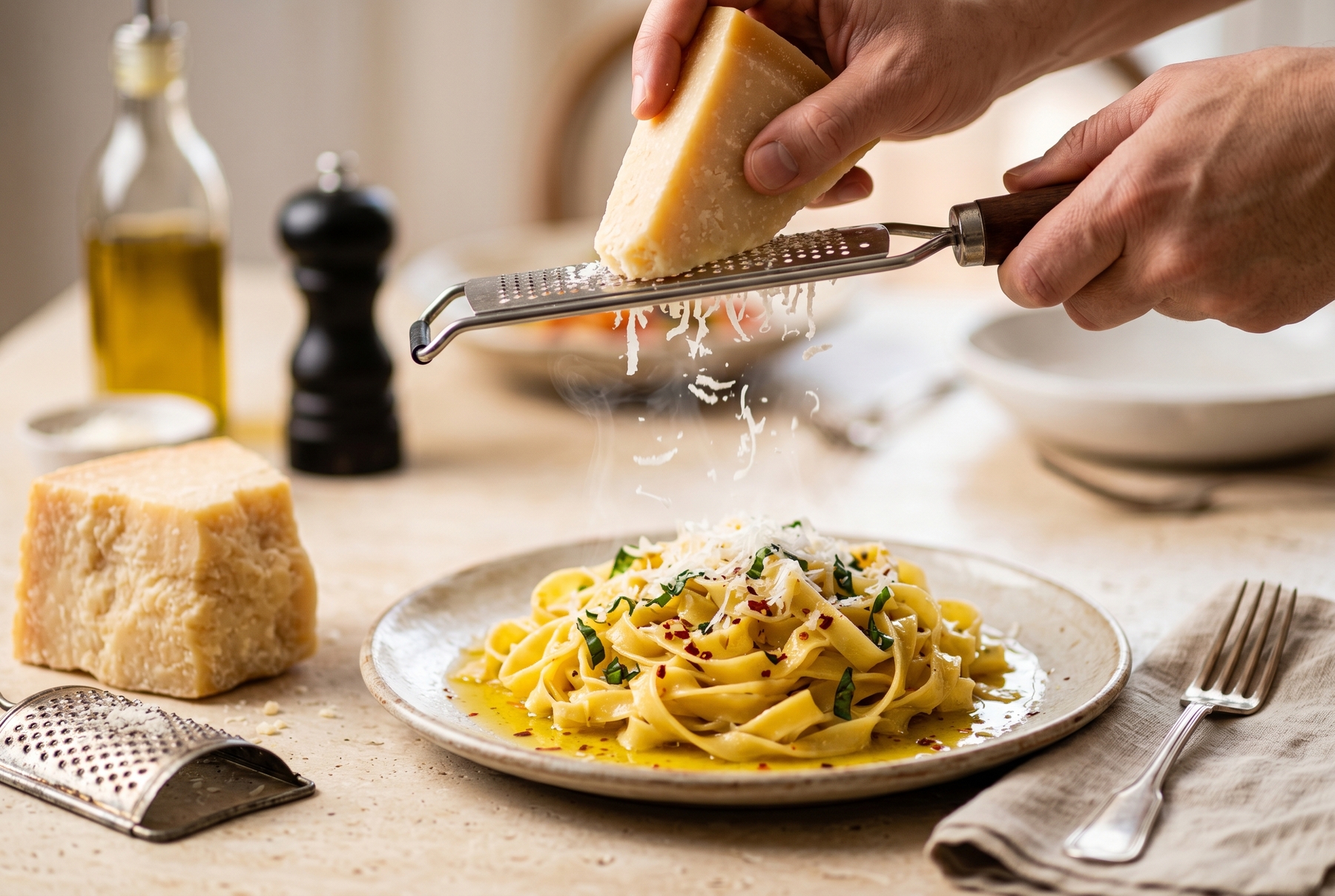
Italian Parmesan adds a profound umami flavor to pasta.
France: A Cheese for Every Personality
French cheeses—from Brie and Camembert to Roquefort—carry remarkably different aromas. They might smell of a damp cellar, rich cream, earthy mushrooms, hay, nuts, or occasionally wet straw. The spectrum runs from timid to thunderous.
Brie
A soft cheese with a white mold rind that remains creamy and exceptionally welcoming to beginners. Mature Brie sags under its own weight, its paste oozing near the rind while staying slightly firmer in the center. An ice-cold wedge straight from the refrigerator conceals its true character. Letting it rest at room temperature for half an hour allows a mushroomy, slightly yeasty aroma to blossom.
Camembert
A close relative to Brie, but smaller, bolder, and sometimes outright pungent. A mature Camembert projects a confident aroma laced with mushrooms and a slight hint of ammonia, while the paste turns viscous and dense. If Brie represents a polite introduction, Camembert feels like a deep, intimate conversation. Serving it cold mutes its voice, so bringing it to room temperature is essential.
Roquefort
One of the ultimate symbols of France. Surprisingly, this is a sheep’s milk cheese; it contains no cow’s milk whatsoever. The blue mold grows within limestone caves, yielding a moist, crumbly texture and a powerful salty flavor laced with sharp bitterness. It pairs flawlessly with honey, pears, and sweet wine. The sweetness neutralizes the salt, transforming harshness into profound depth.
Comté
An aged cheese from the Jura mountains boasting a nutty and fruity profile. A high-quality Comté offers complexity without aggression, echoing notes of burnt caramel, hazelnuts, and occasionally a subtle savory broth. This is the perfect cheese for understanding how complexity exists without sharpness. Savoring it on its own, cut into thin slices without any accompaniments, reveals its full spectrum.
Chèvre
The term “goat cheese” actually hides a dozen vastly different products. Young Chèvre is fresh and tart, with a delicate, chalky paste. As it ages, it firms up, develops a wrinkled rind, and speaks with a much more expressive voice. That signature “goat” aroma never implies spoilage; it serves as a defining part of its character, shining brightly in a roasted beet salad or spread over warm toast.
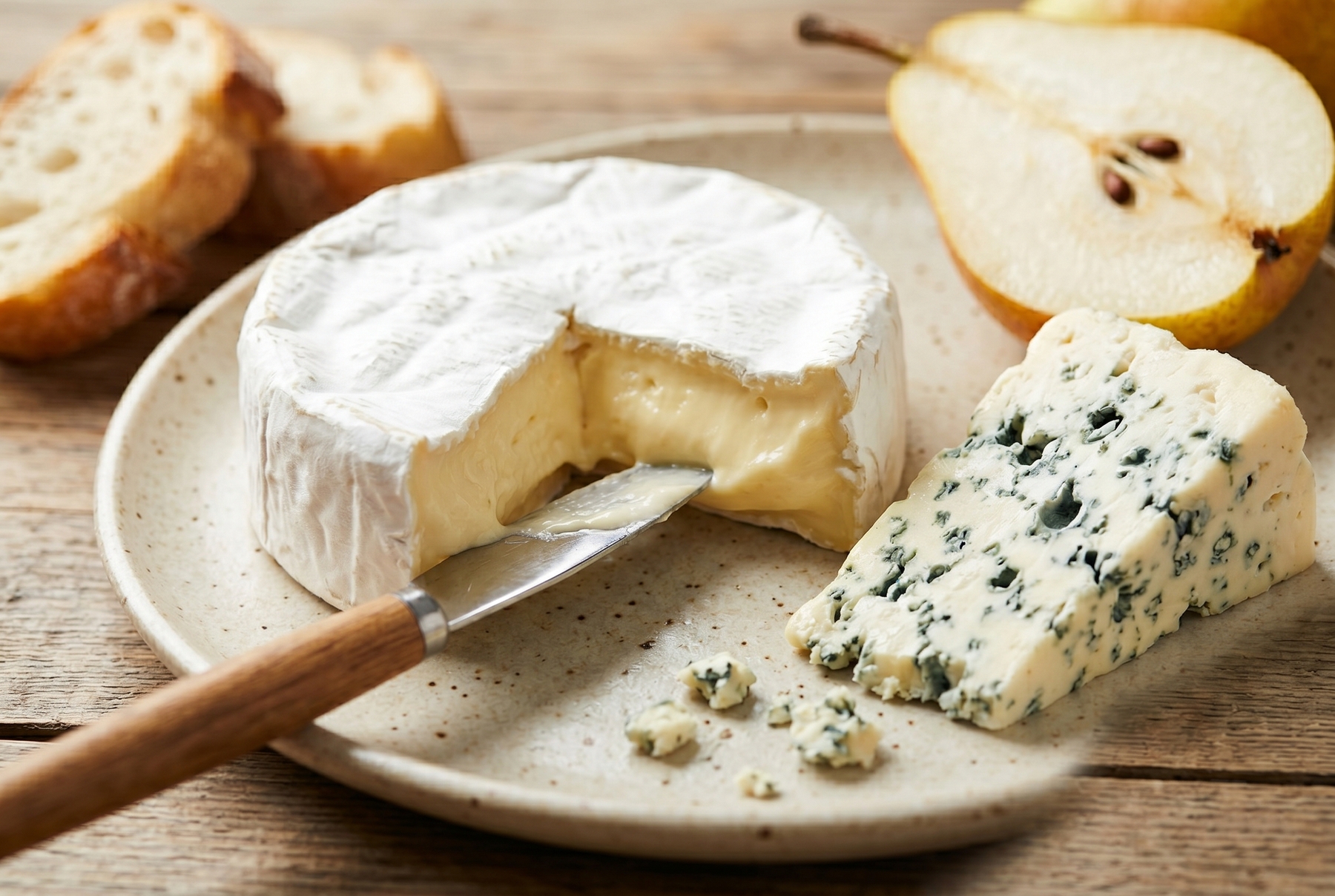
Classic French cheeses with white and blue mold paired with a ripe pear.
Spain, Greece, and the Balkans: Salt, Sheep, and Brine
The southern logic is straightforward. A hot climate, sheep and goat milk, and using salt and brine as preservation methods gave rise to many beloved brined cheeses. These varieties are made for eating alongside bread, vegetables, and wine, rather than sitting undisturbed on a fancy tasting board.
Manchego
The iconic Spanish sheep’s milk cheese, produced from Manchega sheep grazing on the La Mancha plateau. Dense and buttery, it features grassy and nutty undertones and a recognizable braided pattern on the rind. The classic pairing with quince paste (Membrillo) operates on the same principle as Roquefort with honey: the fruity sweetness beautifully offsets the cheese’s saltiness. Young Manchego stays mellow, while the aged version turns drier and sharper.
Feta
A Greek brined cheese made from sheep’s milk (sometimes blended with goat’s milk) that matures directly in salty water. This process results in a crumbly texture and a vibrant salinity. While many in Eastern Europe casually refer to Feta as Brynza, blending the terms ignores their distinct traditions and rules. Feta anchors a Greek salad, layers perfectly into filo pastry pies, and behaves beautifully in the oven, softening gracefully without melting into a puddle.
Brynza
An essential brined cheese of the Balkans, Eastern Europe, and the Caucasus (a crumbly white cheese similar to Feta but often sharper). Tying it to a single country would be a mistake. Brynza can be soft and crumbly or dense and springy, yet always retains a punchy saltiness from its brine. Crumbling it into salads, stuffing it into flatbreads and pies, or serving it for breakfast with tomatoes and herbs highlights its versatility. Soaking an overly salty Brynza in cold water briefly before eating helps remove the excess salt.
Halloumi
A true magician among cheeses. Instead of melting into a puddle in a hot pan, it fries to a gorgeous golden-brown crust. Inside, it maintains a firm, slightly squeaky texture that people adore. While Halloumi recently secured a protected designation of origin in Europe, its fame as a restaurant grilling sensation arrived much earlier. Searing a thick slab for a minute on each side and finishing it with a splash of lemon creates an instant, flawless appetizer.
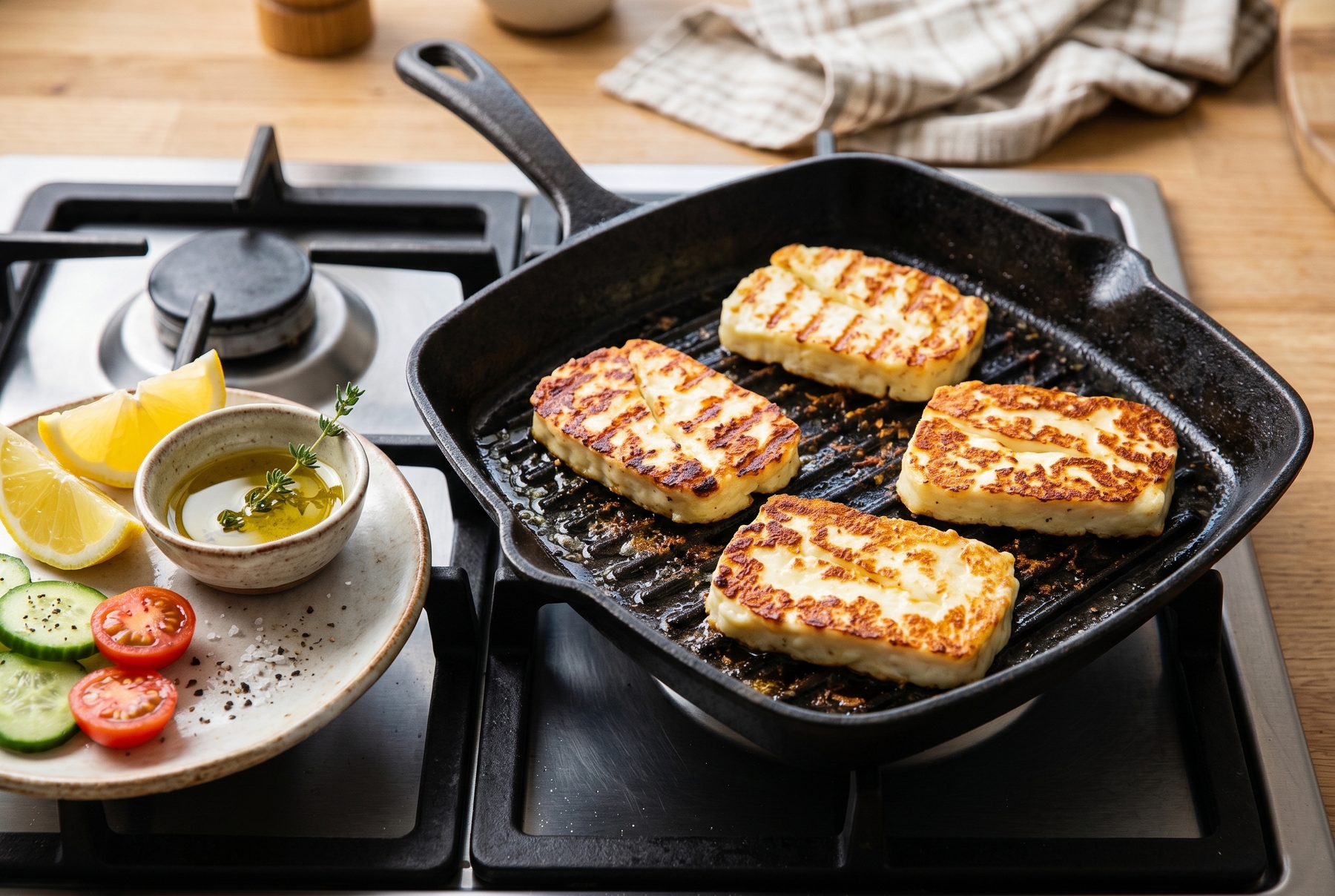
Halloumi is perfectly suited for frying thanks to its dense texture.
The Caucasus and Neighbors: Cheese That Stretches and Lives in Brine
For readers from Eastern Europe and the Caucasus, this territory feels like home. It is all about brine, elasticity, smoke, and generous family feasts.
Suluguni
A brined Georgian cheese showcasing a layered, elastic structure. When heated, it stretches into impossibly long, glorious threads. Young Suluguni smells of pure milk and carries a moderate saltiness, whereas the smoked version develops a golden rind and a rich, smoky aroma. Assembling an Imeretian Khachapuri (a traditional Georgian cheese bread) without it is simply impossible. When selecting Suluguni, squeezing it for elasticity and checking the aroma is crucial; a sour or sharp smell indicates the cheese has sat for too long.
Imeretian Cheese
The fresh, brined cousin of Suluguni and the secondary foundation of that very same Khachapuri. Soft, moist, and carrying a lactic tang, it melts differently and stretches far less. Not every stretchy cheese makes a good substitute for Suluguni, and not just any Suluguni can play the role of Imeretian cheese in a filling. The former provides the dramatic stringy pull, while the latter delivers tenderness and moisture.
Chechil
A fibrous brined cheese, pulled into thin strings and frequently braided into a tight plait or smoked. Salty and firm, it serves brilliantly as an appetizer. Pulling it apart into strands by hand alongside tea or a stronger beverage is a true joy. It remains a direct descendant of bustling Caucasian market stalls and lively home feasts.

Suluguni melts and stretches into long threads, creating the perfect foundation for Khachapuri.
Switzerland, the Netherlands, and England: Cheeses That Became the Standard
Even those completely indifferent to gastronomy recognize these names. They have become the ultimate global benchmarks.
Gruyère
A Swiss melting cheese that stars as the lead in fondues, gratins, and hot sandwiches. Dense and nutty, with a slightly sweet base, it dissolves into hot dishes as a silky, lump-free mass. Aging makes Gruyère drier and saltier, amplifying its prominent nutty notes.
Emmental
The quintessential “cheese with holes.” These characteristic eyes appear due to gas released by specific bacteria during maturation, forming bubbles that expand the paste from the inside. The flavor remains mild, slightly sweet, and nutty, entirely devoid of harshness. It serves as an incredibly convenient melting cheese for sandwiches and hot dishes, even though specific production nuances vary among makers.
Gouda
A Dutch cheese boasting two distinct lives. Young Gouda feels soft, elastic, and perfect for a simple sandwich. An aged Gouda (matured for a year or more) becomes dense and dark, developing a deep caramel-nut flavor and those delightful salt crystals that crunch under the teeth. Checking the age on the label, rather than simply looking at the picture, ensures you know exactly what you are buying.
Edam
A lighter, highly accessible Dutch cheese, typically encased in a red wax rind. It runs drier and less fatty than Gouda, offering a calm, slightly salty flavor. The wax coating and dense texture historically allowed it to travel across oceans without spoiling, making Edam a highly convenient export cheese long before the invention of refrigeration.
Cheddar
An English cheese that the world transformed into the universal flavor of burgers, sauces, and sandwiches. Mass-produced young Cheddar is soft, elastic, dyed orange, and melts evenly. In contrast, mature farmhouse Cheddar is an entirely different beast: crumbly, sharp, acidic, and lingering on the palate. Treating these two very different products under the same name does the authentic version a massive disservice.
Stilton
A British blue cheese made from cow’s milk. It stands dense, salty, and creamy-sharp, laced with beautiful marble veins of mold. Ironically, strict rules dictate that classic Stilton cannot be produced in the actual village of Stilton, which originally gave it its name. Serving it alongside port wine, walnuts, pears, and toast immediately explains why the British place it at the center of their Christmas table.
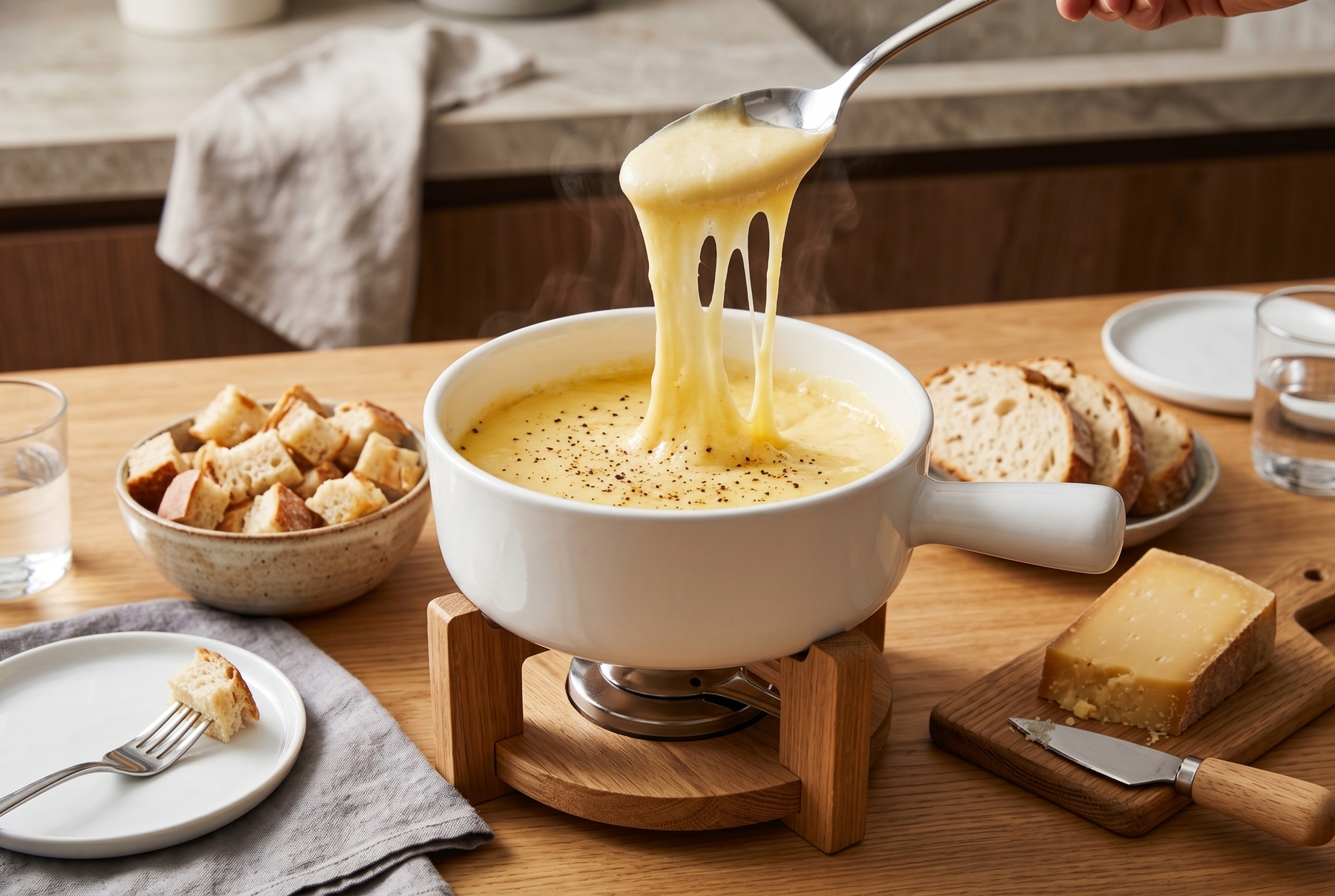
Melted Swiss Gruyère acts as the perfect base for a classic fondue.
Northern Europe: Coziness, Smoke, and Discipline
Not every famous cheese needs to be extreme. Sometimes, fame arrives simply through reliability and a gentle disposition.
Havarti
A Danish semi-hard cheese that remains soft and creamy, peppered with tiny eyes. It works wonderfully for sandwiches and breakfast spreads, melting perfectly in a hot press without frightening anyone with its aroma. This is a classic case where a cheese gains fame specifically for its accommodating character.
Jarlsberg
A Norwegian cheese sporting a mild nutty flavor and large eyes, looking quite similar to Swiss varieties. Friendly, mildly sweet, and free from any harsh notes, it acts as an excellent starting point for anyone wary of strong aromas and looking to ease into the world of cheese.
Oscypek
A Polish smoked sheep’s milk cheese crafted by the Górale (highlanders) in the Tatra Mountains from spring until autumn. It features a distinctive spindle shape and a decorative pattern imprinted by carved wooden molds. The flavor bursts with salt, smoke, and a touch of nuttiness. Oscypek holds a protected European designation, meaning only cheese made in the mountain region using traditional methods qualifies as authentic. Grilling it and serving it with lingonberry jam creates an unforgettable experience.
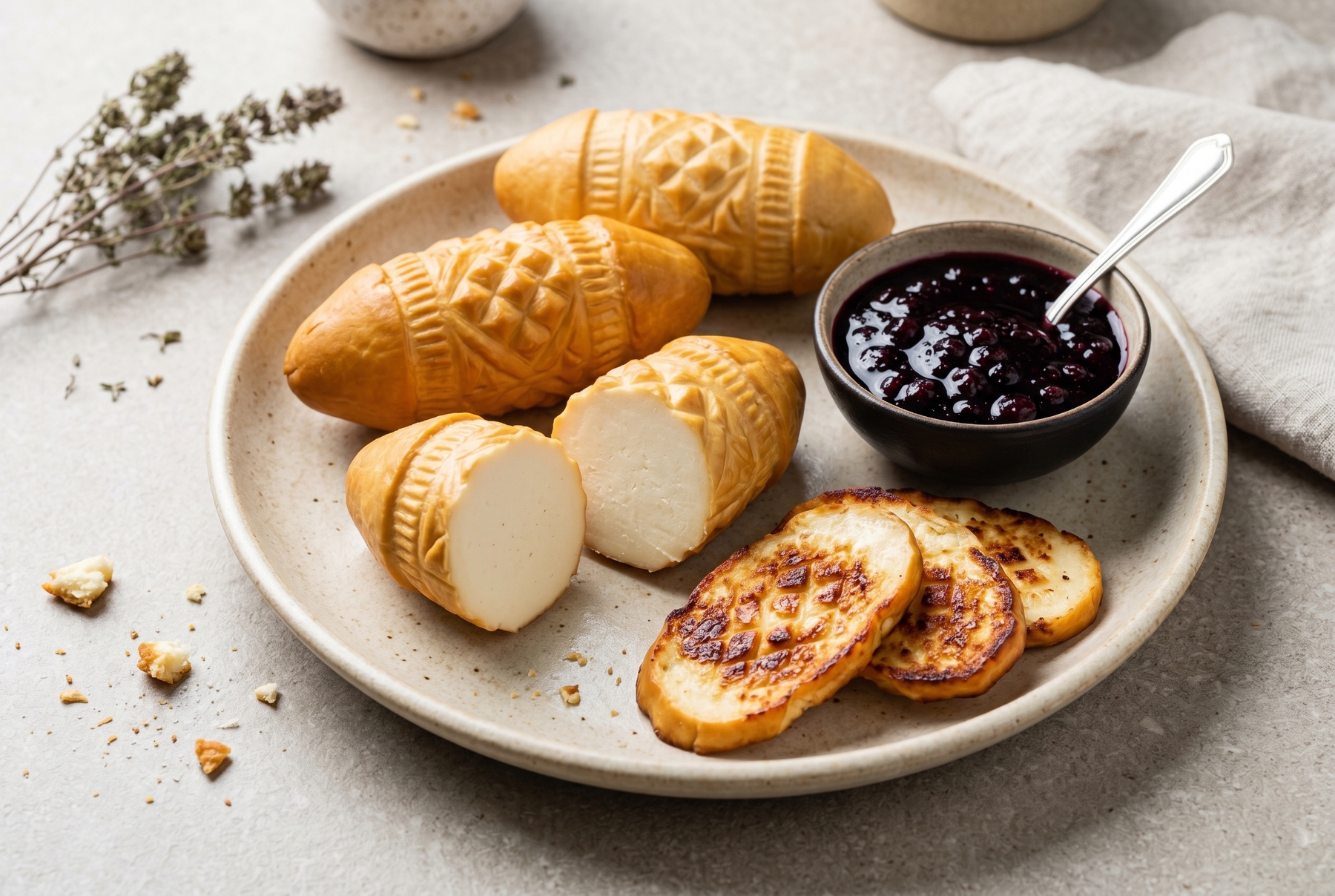
Traditional Tatra Oscypek served grilled with a side of berry sauce.
The Americas: Cheese Meant for the Dish, Not the Display
Not all great cheeses are destined to sit beside grapes and a tasting knife. These varieties do their best work inside the food.
Monterey Jack
An American melting cheese born from Californian-Mexican cuisine. Soft, moist, and neutral, it flows beautifully into quesadillas and nachos, forming a smooth, stretchy pull. The Pepper Jack variation, studded with pieces of hot chili, adds a lively fire to any dish.
Queso Fresco
A fresh Latin American cheese that crumbles rather than melts, softening the heat of spicy dishes with a cool, milky note. Sprinkling it over tacos, beans, and salads brings an essential balance. Tying it down to just one country ignores its widespread appeal; it is produced and eaten across all of Latin America, with various regional tweaks.
Cotija
A Mexican aged cheese that is salty and crumbly, most often serving as a final, striking accent scattered over a finished dish. Functionally, it resembles grated hard cheeses, yet calling it “Mexican Parmesan” stretches the truth: it relies on different milk, different technology, and yields a different flavor entirely. Both simply excel at adding salt and delivering the perfect finishing touch.
Queso Paraguayo
The titular hero of this article. This fresh Paraguayan cheese goes straight into Sopa Paraguaya (a dish called a soup, which is actually a dense corn casserole baked in a pan and sliced into squares). Finding Queso Paraguayo outside of Paraguay is challenging, so recipes often substitute it with a crumbly fresh cheese like Queso Fresco or young Mozzarella. The most important factor here is not the rarity of the cheese, but its role. Without it, the famous “soup” simply turns into ordinary cornbread.
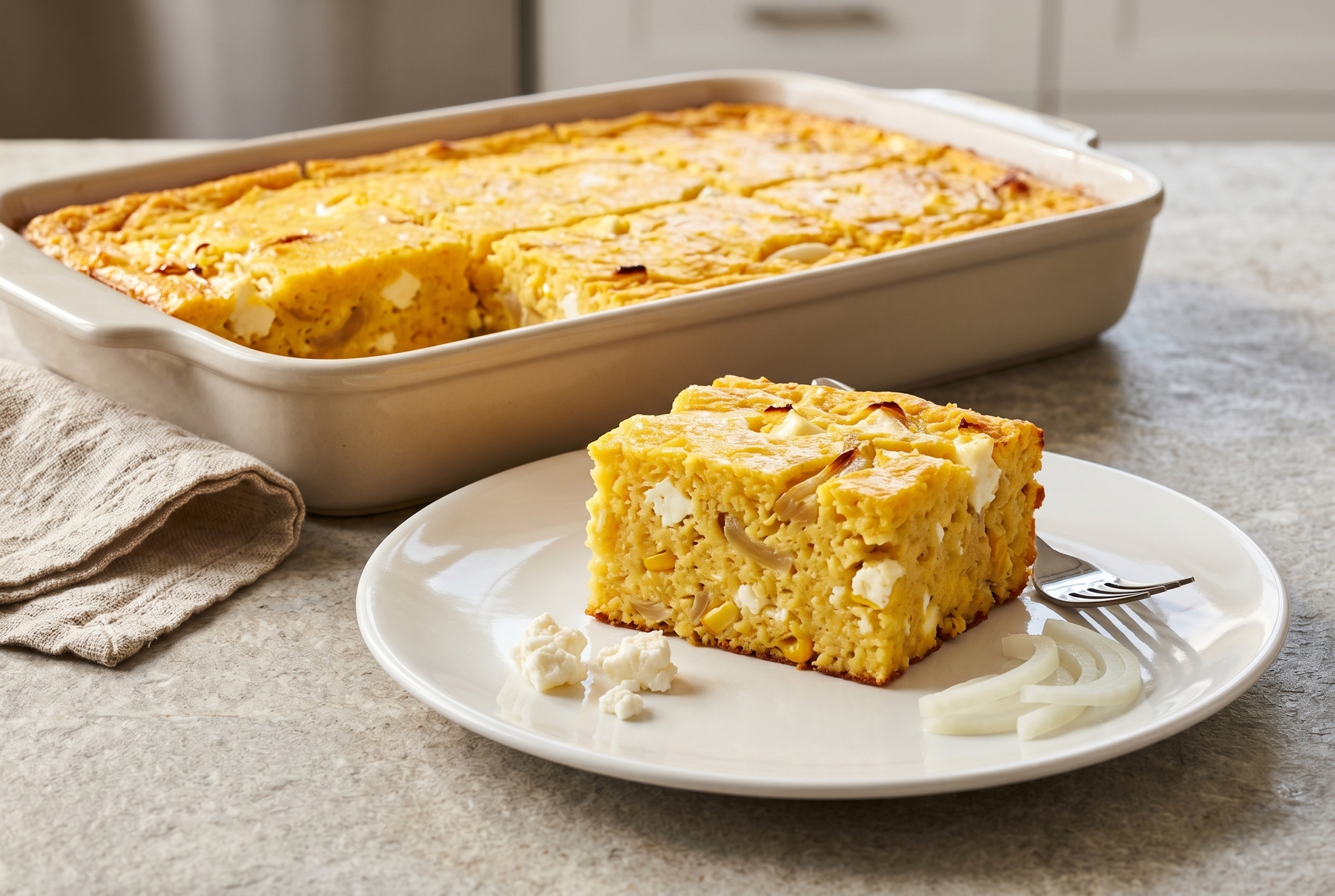
The famous Sopa Paraguaya, a dense corn casserole enriched with white cheese.
The Middle East and Asia: Cheeses Beyond the European Showcase
Global cheese culture hardly ends at the borders of France and Italy. Leaving these out would render the picture incomplete.
Paneer
An Indian fresh cheese that holds its shape brilliantly in curries and hot pans instead of melting away. Its softness and neutrality actually serve as its greatest assets. Paneer absorbs sauces and spices effortlessly, remaining a firm, bouncy cube with a delicate milky sweetness. Curdling it at home using milk and lemon juice takes barely half an hour.
Labneh
Strictly speaking, Labneh (a Middle Eastern strained yogurt) leans closer to a thick yogurt than a traditional cheese, yet it completely occupies the role of cheese on the dining table. A creamy, slightly tart mound, drizzled generously with olive oil and dusted with Za’atar, makes an incredible breakfast alongside warm flatbread. Its texture feels as delicate as extremely rich sour cream.
Akkawi
A Middle Eastern brined cheese, dense and salty. Cooks frequently soak it before eating to remove the excessive brine. Because it holds its shape well in the oven, it often stars in baked goods and sweet desserts like Knafeh (a sweet spun pastry layered with cheese), as well as shining on the breakfast table alongside bread and olives. The names and origins of these cheeses (Akkawi, Nabulsi, and their neighbors) often overlap, making the label the most reliable guide.
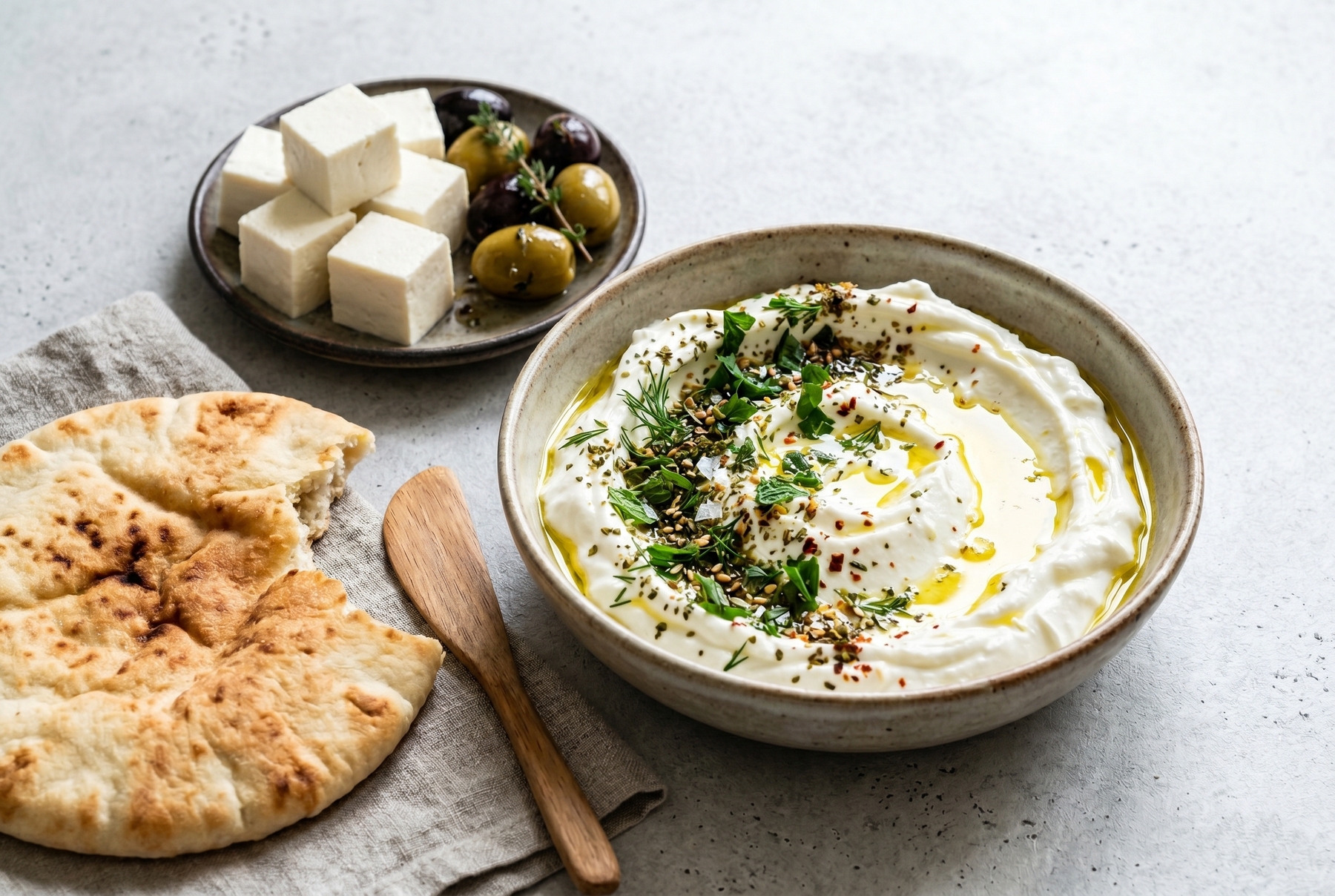
Delicate Labneh served with olive oil, fresh herbs, and flatbread.
How to Assemble a Cheese Board if You Are Not a Sommelier
The most common beginner mistake when building a cheese board is pure chaos. Placing five overwhelmingly strong cheeses next to each other simply causes them to drown one another out, leaving no distinct flavor behind. Contrast, rather than sheer quantity, always wins the day.
The 5-Cheese Formula
Selecting one from each group ensures the board virtually builds itself:
- One soft cheese (Brie or Camembert);
- One hard, aged cheese (Parmesan, Comté, or aged Gouda);
- One brined cheese (Feta or Suluguni);
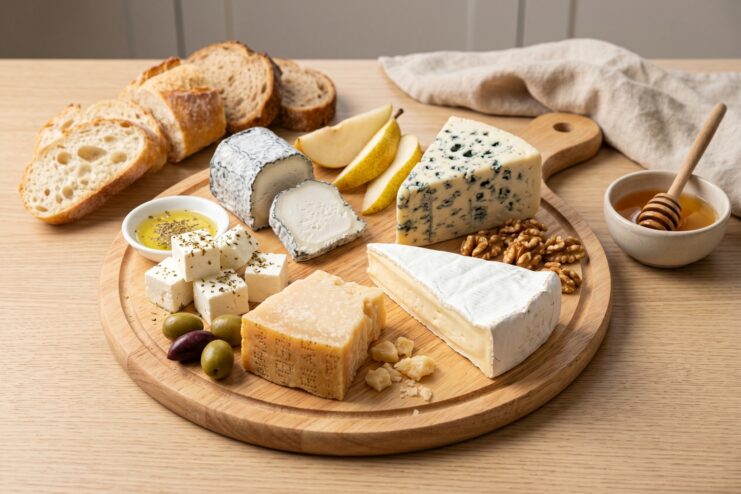
An example of a perfectly balanced cheese board with contrasting flavors and textures.
- One blue cheese (Roquefort, Gorgonzola, or Stilton);
- One goat or sheep cheese (Chèvre or Manchego).
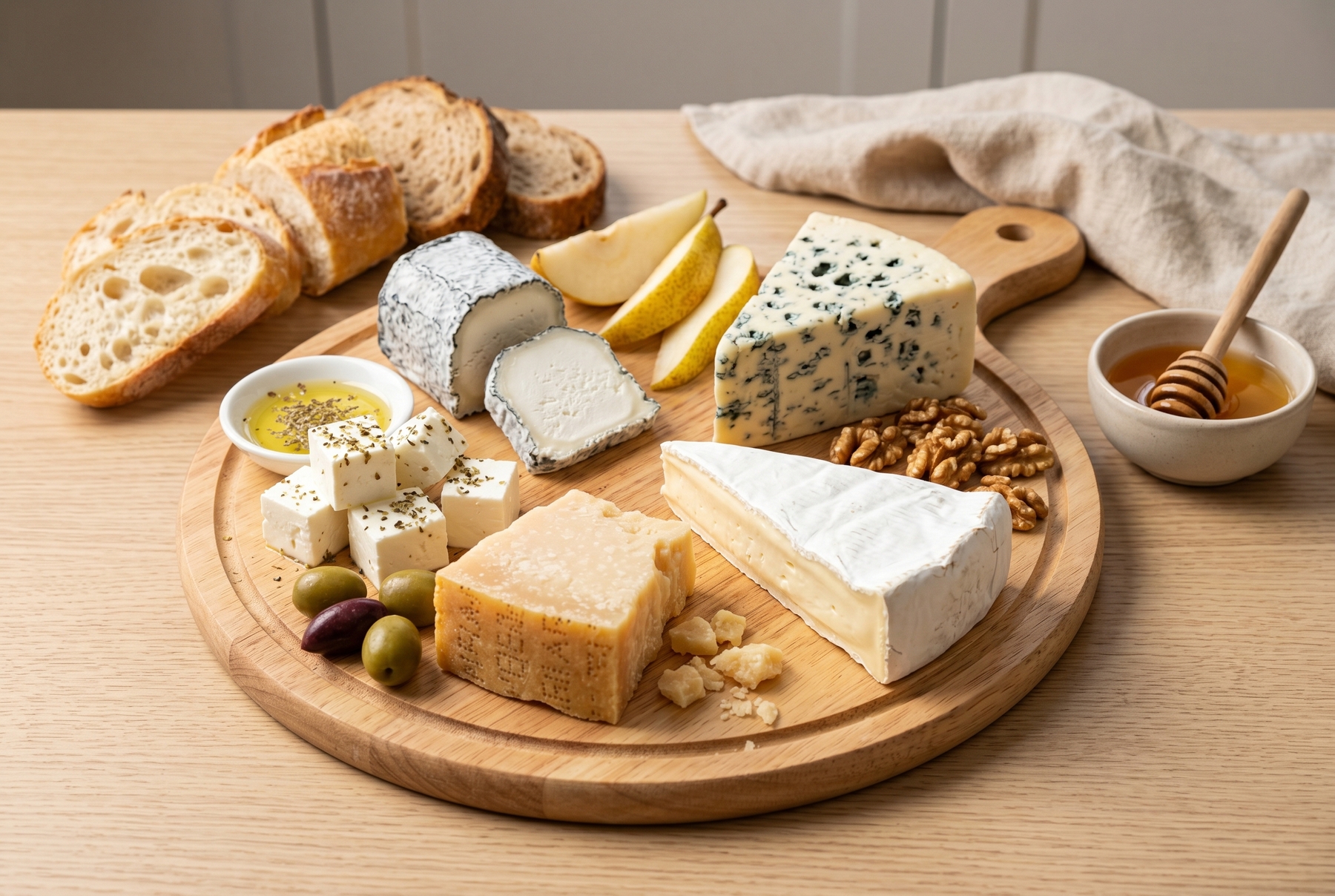
Arranging them in a circle from mildest to sharpest allows you to taste them in that exact order. Otherwise, a pungent blue cheese will obliterate everything you try afterward.
What You Can Actually Buy at the Supermarket
Not everyone lives next to an artisan cheese shop, and that is perfectly fine. An ordinary grocery store usually provides a respectable foundation: a hard Parmesan-style cheese, Suluguni or Mozzarella, Brynza or Feta, Gouda, Cheddar, Brie, and goat cheese. In some cases, a compromise causes no harm—young Gouda steps in for Havarti on a sandwich beautifully. In other cases, swapping names without a disclaimer falls short. A cheap, pre-sliced “Parmesan” might add salt to pasta, but it will never deliver the profound umami of a genuine Parmigiano.
What to Serve on the Side
Bread, pears, apples, honey, walnuts, olives, roasted vegetables, fresh herbs, and sun-dried tomatoes all make excellent companions. Accompaniments should support the cheese, not drown it in sugar. Resting a couple of pear slices next to Roquefort creates a wonderful dialogue, while burying every cheese under a mountain of jam turns the board into a dessert salad where the cheese completely disappears.
How to Choose Cheese: Aroma, Texture, and the Label
A good cheese reveals itself visually and aromatically long before you take a bite. You can evaluate it confidently by examining the rind, the smell, the texture, and the packaging.
What to Look For Visually
The rind should be even, free of suspicious slime, and devoid of deep cracks with dark, hardened edges. Excessive dryness and “sweated-out” fat on the cut surface indicate the cheese has been sitting far too long. For soft cheeses, examining the shape is key; a sprawling, bloated side signals trouble. Always check the packaging date and note the storage conditions in the display case.
How Good Cheese Should Smell
A powerful aroma is not inherently a flaw. A ripe Camembert, Roquefort, or Oscypek is supposed to smell loud—like mushrooms, a damp cellar, woodsmoke, or pungent sheep’s milk. Only off-putting scents should raise an alarm: a sour, yeasty smell, an overpowering ammonia reek, or any hint of ammonia in a fresh, young cheese. When in doubt about safety, relying on the expiration date and storage conditions makes far more sense than blind culinary heroism.
Where People Make the Most Mistakes
Eating cheese straight out of the refrigerator while it is still ice-cold remains a widespread error (soft and aged cheeses reveal twice as much flavor at room temperature). Storing every cheese wrapped in the same plastic allows a delicate Brie to absorb the aggressive scent of Roquefort. Substituting one cheese for another based solely on visual similarity rarely works out. Moreover, many assume that mold is either completely dangerous or perfectly noble, and that expensive cheese automatically tastes better, even though overpaying for aged cheese just to toss it into a fresh salad makes zero culinary sense.
Cheat Sheet: Which Cheese Goes Where
- For pasta: Parmesan, Pecorino;
- For salads: Feta, Brynza, Goat Cheese;
- For frying: Halloumi, Paneer;
- For melting: Gruyère, Cheddar, Suluguni, Monterey Jack;
- For the cheese board: Brie, Camembert, Roquefort, Manchego, Comté, Gouda;
- For baking and fillings: Ricotta, Imeretian, Queso Paraguayo, Feta.
Fame Begins With a Role in a Dish
A truly great cheese is more than just a recognizable name. It is the crucial ingredient without which a dish simply falls apart. Parmesan deepens a bowl of pasta, Suluguni stretches beautifully in Khachapuri, Feta lends its salty brine to a Greek salad, and Manchego carries the unmistakable taste of sheep’s milk and the Spanish plateau straight to the palate. Meanwhile, the humble Queso Paraguayo proves that sometimes the most fascinating cheese story begins with a dish called a soup, which arrives at the table as a solid slice meant for a knife.
0 comments