
Ask anyone at the table what the most important part of a “cod with sauce” dish is, and almost everyone will say the cod. It makes sense—the fish comes first in the name, it is what people pay for, and it is the reason they worry about overcooking. But place three plates of identical cod portions with three different sauces side by side, and you will find three entirely different dishes. In the first, the fish might be dry and boring. In the second, it is firm, clean, and possesses a restaurant-quality finish. In the third, the fish is entirely lost because the sauce overpowers everything.
In professional kitchens, poor dishes are rarely the fault of the fish. The blame usually lies with the accompaniment—it is the wrong choice, prepared incorrectly, or served in the wrong amount. However, sauces follow rules, and there are fewer rules than one might think.
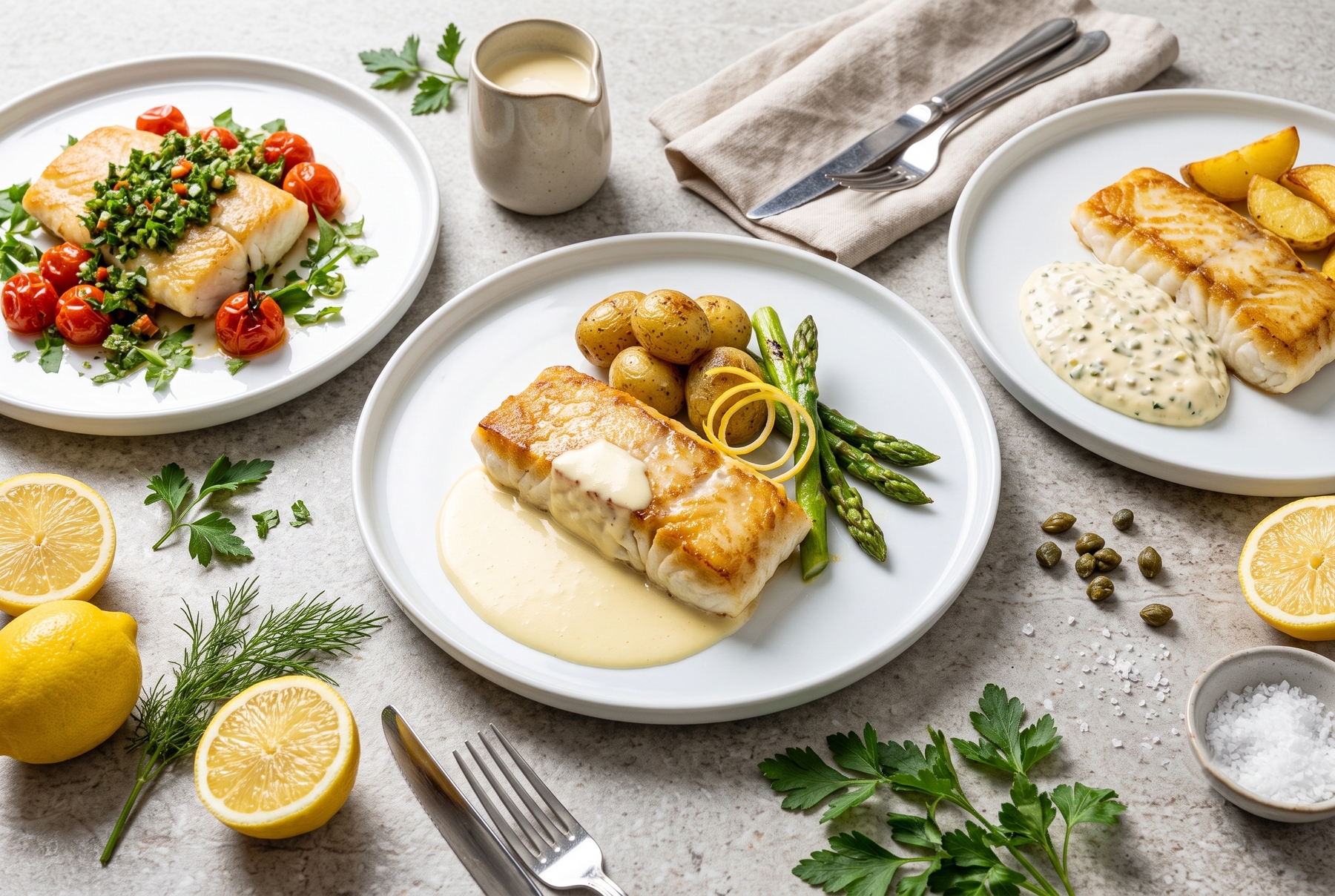
Three different sauces transform the exact same type of fish into completely distinct dishes.
Table of Contents
- Why Fish Needs a Sauce
- When It Is Best to Leave the Fish Alone
- How to Choose a Sauce Based on the Fat Content of the Fish
- How to Match a Sauce to the Cooking Method
- Twelve Sauces to Keep in Mind
- Which Sauce for Which Fish: A Breakdown by Categories
- Common Mistakes When Making Fish Sauces
- Restaurant-Style Presentation Without a Professional Kitchen
- Cheat Sheet
- How to Choose the Perfect Fish Sauce: The Bottom Line
Why Fish Needs a Sauce
A sauce primarily balances fat. Salmon, mackerel, herring, and halibut are naturally oily, and after three or four bites, the palate stops distinguishing flavors: the taste becomes flat and heavy. Acidity restores clarity. This is exactly why fatty fish has historically been paired with lemon, vinegar, capers, and pickled onions—not for “freshness” in a marketing sense, but to ensure every bite is as enjoyable as the first.
With lean fish, the objective is the opposite. It contains almost no fat, and leaving it on the heat for an extra minute causes it to lose moisture and dry out. A creamy, buttery, or emulsified sauce physically compensates for this dryness: it moistens the fibers, glides across the palate, and creates a perception of juiciness that the fish itself lacks. The difference between cod with Hollandaise sauce and cod on a dry plate is the difference between a fine restaurant and a cafeteria.
Sauces also provide aroma. Fish has a delicate scent that easily vanishes in the pan and is nearly impossible to restore with spices inside the cut. A sauce acts as an aromatic superstructure: dill, tarragon, zest, garlic, anchovy, and soy sauce are added externally and at the last moment, when nothing will evaporate.
Finally, a sauce brings the plate together. Fish, potatoes, and green beans without a sauce are simply three separate ingredients sitting side by side. With a sauce, they become a cohesive dish. This is its most underestimated function, yet the most noticeable in flavor.
When It Is Best to Leave the Fish Alone
Certain types of fish are only hindered by a sauce. Fresh sea bream (dorada), sea bass, turbot, high-quality tuna, and halibut with a pronounced natural flavor are prized precisely for their taste. Covering them with garlic cream is about as sensible as drenching an aged steak in ketchup.
A minimalist approach works best here: high-quality olive oil, lemon, coarse salt, and occasionally a few drops of the juices released by the fish during roasting. If a sauce is absolutely necessary, opt for something transparent and acidic: salsa verde, lemon oil, or a light beurre blanc. The more expensive and fresher the fish, the more delicate the accompaniment must be.
How to Choose a Sauce Based on the Fat Content of the Fish
Before selecting a sauce, it is essential to identify the ingredient at hand. The specific name of the fish is secondary—fat content and flesh density are what truly matter.
Fatty and Semi-Fatty Fish—salmon, trout, mackerel, herring, halibut, eel, and catfish. These varieties have plenty of flavor without any additions, but they can quickly become overwhelming. They require contrast: acidity, sharpness, fresh herbs, and umami. Heavy cream pairs with fatty fish only when combined with acid or mustard—otherwise, it results in “fat on fat,” making the dish overly heavy by the middle of the portion.
Lean White Fish—cod, pollock, pike-perch (zander), hake, haddock, and pike. Its flavor is clean, delicate, and in some cases nearly neutral. Such fish requires support: fat, creaminess, and a mild saltiness. Stark contrast overwhelms it. Acidity should be added cautiously, as it easily masks an already subtle flavor. This leads to classic pairings: cod with Hollandaise, pike-perch with Polish sauce (a traditional Eastern European butter and egg sauce), and pollock with tartar.
Lightly Salted and Smoked Fish is a separate category. It is already seasoned, as the salt and smoke have done half the work. Fermented dairy-based sauces, mustard-dill blends, and anything offering acidity and freshness pair perfectly with it. Adding salt to these pairings is almost never necessary.
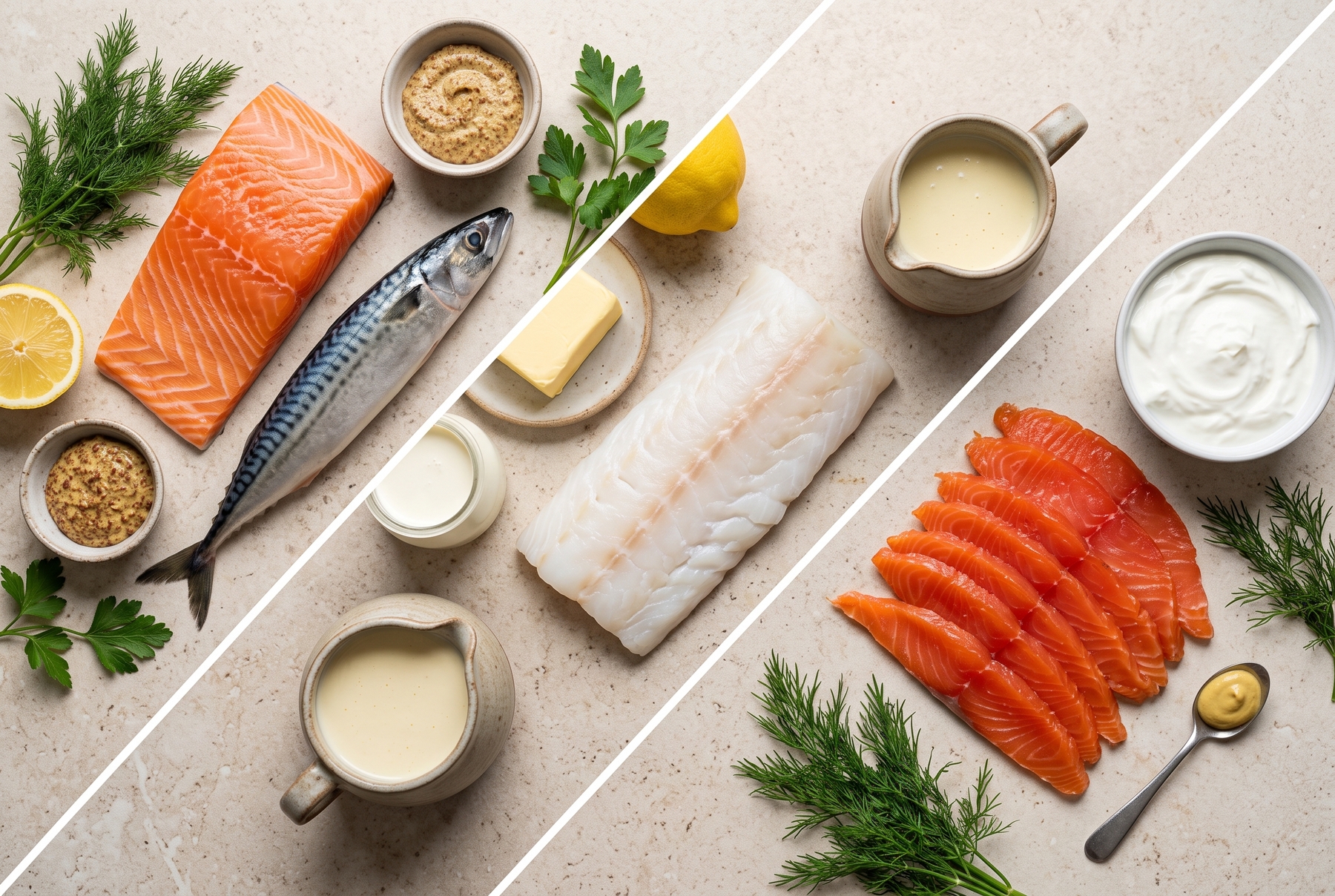
Pairing a sauce depends heavily on the fat content of the fish: lean varieties require fat, while oily ones need bright acidity.
How to Match a Sauce to the Cooking Method
The exact same salmon demands different sauces depending on its preparation. Pan-frying dries out the edges and creates a crispy crust: the sauce must relieve the dryness without making the crust soggy. Steaming leaves the fish tender but somewhat bland, calling for a sauce with character. Grilling introduces bitterness and smoke, which requires sweetness or acidity as a counterpoint.
| Cooking Method | What Happens to the Fish | Which Sauce Works |
|---|---|---|
| Pan-Frying | Dry edges, crispy crust | Tartar, creamy lemon, aioli—served on the side, not over the crust |
| Baking/Roasting | Even texture, mild flavor | Honey-mustard, creamy dill, tomato salsa |
| Steaming | Extremely tender, but lacks strong flavor | Hollandaise, beurre blanc, Polish sauce |
| Grilling | Smoke, slight bitterness, dried surface | Salsa verde, tomato salsa, garlic-yogurt, teriyaki |
| Boiling, Poaching | Clean flavor, high moisture | Polish sauce, Hollandaise, creamy lemon |
| Smoked and Lightly Salted | Salt and smoke are already present | Yogurt with dill, mustard, sour cream with lemon |
Twelve Sauces to Keep in Mind
1. Tartar Sauce
Tartar remains on menus worldwide for good reason: the acidity and crunch of pickled vegetables provide the perfect answer to fried breaded fish. It is salty, sharp, and slightly sweet, while the finely diced gherkins deliver the texture that soft fillets lack.
It pairs best with fried cod, pollock, hake, pike-perch, calamari, and anything battered and deep-fried. It is too coarse for delicately steamed fish.
Difficulty: Minimal. Yield: about 265 g (9.3 oz), for 4 servings.
Ingredients:
- thick mayonnaise — 150 g (5.3 oz)
- gherkins — 50 g (1.8 oz) (3–4 small ones)
- capers — 15 g (0.5 oz)
- shallot — 20 g (0.7 oz)
- parsley or dill — 10 g (0.35 oz)
- Dijon mustard — 1 tsp
- lemon juice — 15 ml (0.5 fl oz)
- black pepper
Preparation. Squeeze the excess moisture from the gherkins and capers using a paper towel, then chop them into 3–4 mm (0.15 inch) cubes. Finely chop the shallot and herbs. Mix everything with mayonnaise, mustard, and lemon juice, season with black pepper, and chill in the refrigerator for at least 20–30 minutes. Salt is usually unnecessary, as the capers and gherkins provide enough.
The most common home-cooking mistake is a watery tartar sauce. The gherkins and capers must be patted dry with a paper towel; otherwise, the sauce will run across the plate within twenty minutes. The second mistake is using a blender: tartar must be chopped by hand so the individual pieces remain distinct. Letting it rest in the refrigerator for half an hour allows the mustard and lemon to infuse the mixture.
A fair homemade shortcut involves mixing store-bought mayonnaise with gherkins, capers, lemon juice, and zest. This is already vastly superior to any jar labeled “tartar” on supermarket shelves.
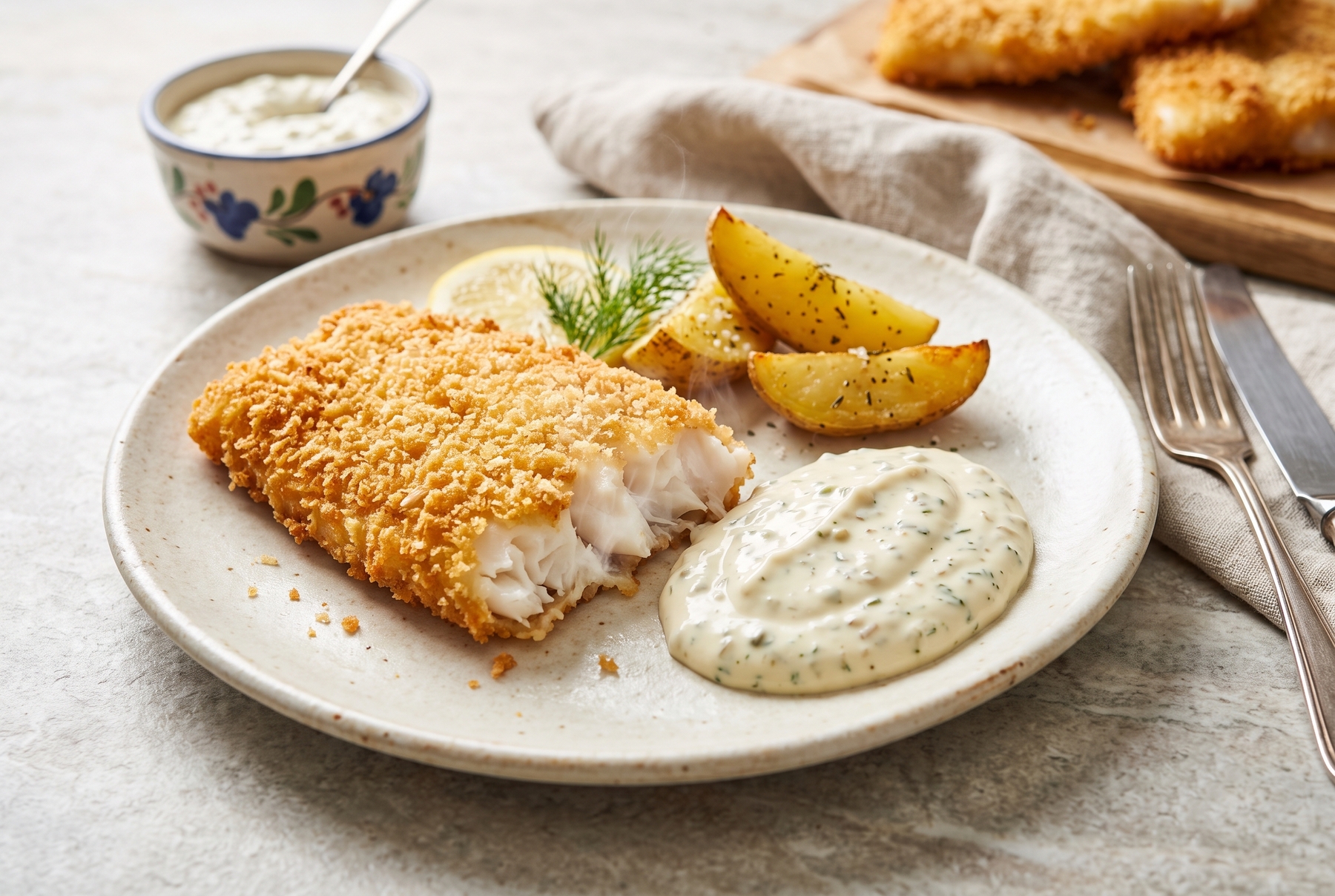
The crunchy pickles and capers in tartar perfectly complement battered and deep-fried fish.
2. Hollandaise Sauce
A warm emulsion of egg yolk and butter remains the unrivaled champion for white fish. The flavor is velvety and buttery with a precise acidic note; the texture resembles thick cream that melts over hot fish. Classic pairings include halibut, pike-perch, steamed cod, sea bass, poached salmon, alongside asparagus or broccoli.
Difficulty: High. Yield: about 265 g (9.3 oz), for 4 servings.
Ingredients:
- egg yolks — 3 pcs.
- butter — 180 g (6.3 oz) (clarified butter is best)
- lemon juice — 20 ml (0.7 fl oz)
- cold water — 1 tbsp
- salt — ⅓ tsp
- cayenne pepper — a pinch
Preparation. Melt the butter and let it cool until warm, about 50 °C (122 °F). Combine the yolks with the water and half of the lemon juice, place over a water bath, and whisk continuously for 3–4 minutes until the mixture thickens and leaves a trail from the whisk. The water under the bowl must not boil, and the mixture itself must not exceed 65–70 °C (149–158 °F). Remove from the heat and begin incorporating the warm butter: the first few spoonfuls should be added drop by drop, followed by a thin stream, whisking constantly. Season with salt, cayenne pepper, and the remaining lemon juice. Keep warm until serving, but off direct heat.
There are exactly three common mistakes. Overheating causes the yolk to coagulate, turning the sauce into scrambled eggs; work over a water bath without letting it boil. Pouring the butter too quickly breaks the emulsion; add the first few spoonfuls drop by drop while whisking constantly. Finally, prolonged storage ruins it—Hollandaise survives for about thirty to forty minutes in a warm place before separating on its own.
If the sauce does happen to split, remove it from the heat, add a spoonful of cold water, and whisk vigorously. If that fails, whisk a fresh yolk in a clean bowl and slowly stream the broken sauce into it. This technique works almost every time.
A note on safety: Hollandaise is prepared over gentle heat, meaning the eggs are not fully cooked. Always use very fresh eggs, or substitute pasteurized yolks for children, pregnant women, and individuals with compromised immune systems.
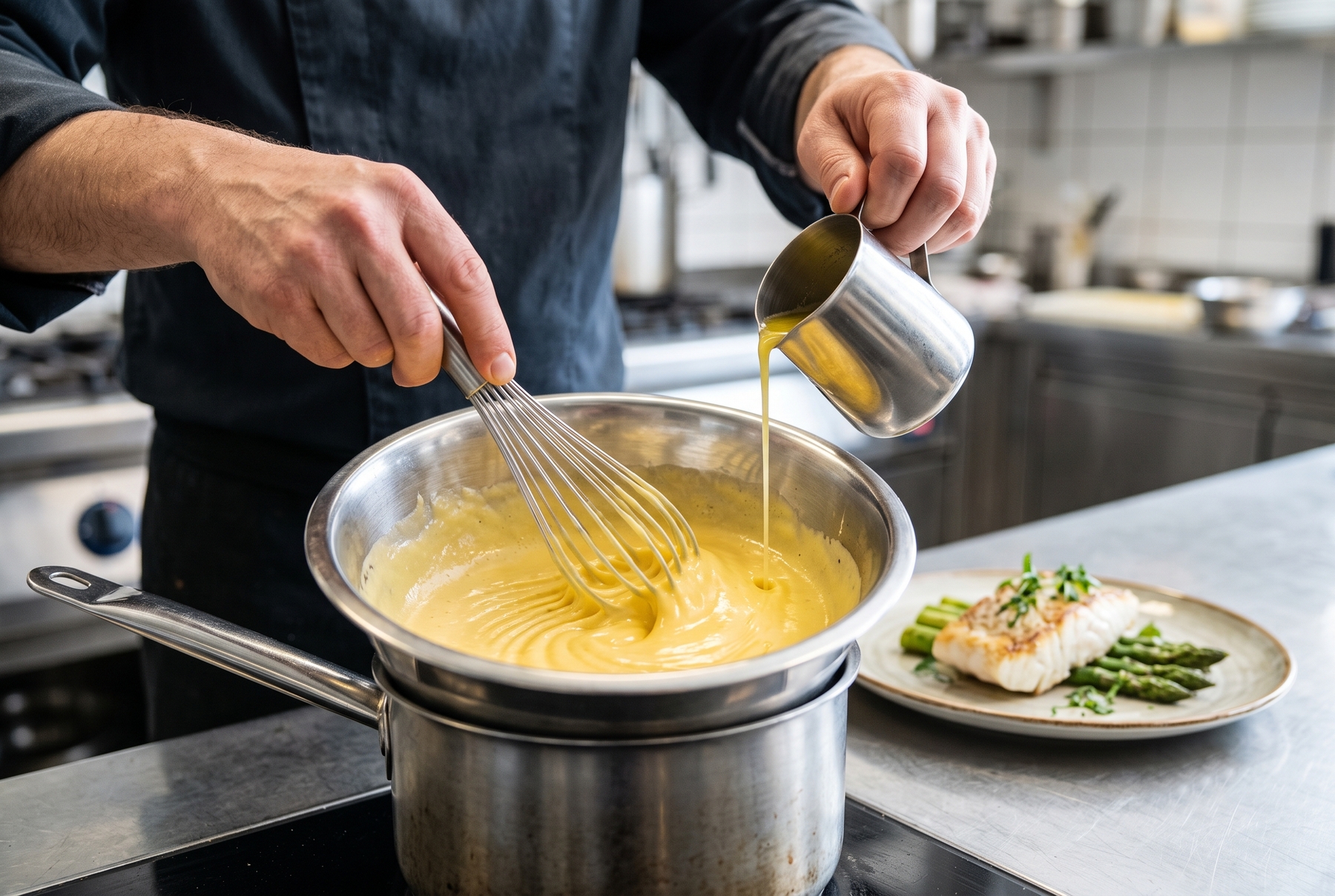
Hollandaise sauce is whisked over gentle heat on a water bath, carefully emulsifying melted butter into egg yolks.
3. Creamy Lemon Sauce
If one were to choose just one everyday sauce from this list, this is it. Soft, rounded, and featuring a clean tartness, it complements nearly everything: cod, pike-perch, salmon, trout, sea bream, and shrimp. It comes together in seven minutes in the exact same pan used to fry the fish, which is a significant advantage since the pan juices go straight into the sauce.
Difficulty: Low. Yield: about 220 ml (7.4 fl oz), for 4 servings.
Ingredients:
- heavy cream (30–33%) — 200 ml (6.8 fl oz)
- butter — 20 g (0.7 oz)
- shallot — 1 pc. (30 g / 1 oz) or 1 garlic clove
- lemon juice — 20 ml (0.7 fl oz)
- zest of half a lemon
- salt, white pepper
Preparation. Finely dice the shallot and sweat it in butter for 2 minutes without letting it brown. Pour in the cream, add the lemon zest, and reduce over medium heat for 4–5 minutes until the sauce begins to coat the back of a spoon. Remove from the stove, wait half a minute, and only then stir in the lemon juice. Season with salt and white pepper.
There is only one vulnerable point, but a critical one: combining lemon and hot cream. Acidity curdles milk proteins, giving the sauce a grainy texture. This is why the juice must be stirred in at the very end, off the heat; the zest, however, can be simmered. Also, ensure the cream is at least 30% fat: higher fat content creates a more stable emulsion against acidity. Using 10% half-and-half will almost certainly cause the sauce to split.
A simple shortcut involves mixing just cream, zest, a pinch of salt, and white pepper for a ready-to-go base. Simply squeeze lemon juice directly on the plate if you are afraid of curdling.
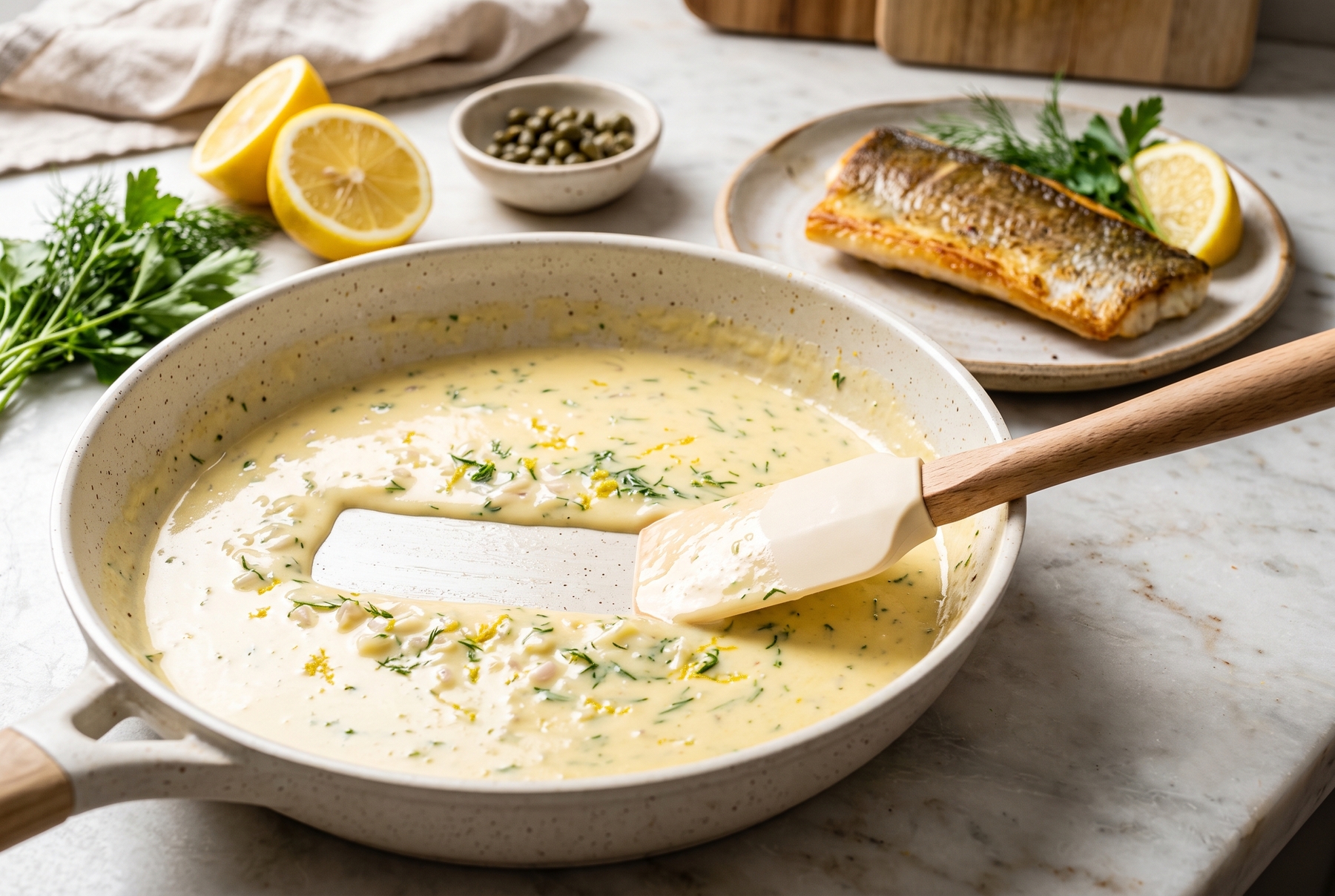
For a creamy lemon sauce, the lemon juice is stirred in at the very last moment, entirely off the heat.
4. Polish Sauce
In Russian and Eastern European cuisine, this has long been served with boiled and poached fish, remaining a staple simply because it works perfectly. Melted butter, chopped egg, lemon, and fresh herbs. No thickeners, no complicated techniques, and no risk of failure.
Difficulty: Minimal. Yield: about 230 g (8 oz), for 4 servings.
Ingredients:
- butter — 100 g (3.5 oz)
- eggs — 2 pcs.
- lemon juice — 20 ml (0.7 fl oz)
- parsley — 10 g (0.35 oz)
- salt
Preparation. Hard-boil the eggs for 8–9 minutes, cool them in cold water, and chop into fine dice. Melt the butter over low heat until it becomes a clear liquid, ensuring it does not sizzle or brown. Remove from the stove, stir in the eggs, lemon juice, and chopped parsley, then season with salt. Serve immediately—this sauce does not store well.
Its purpose is to restore the fat that boiling extracts. Boiled cod or pike-perch are somewhat plain on their own; the butter makes them succulent, the egg adds substance, and the lemon cuts through the richness. A classic presentation includes fish, boiled potatoes, and Polish sauce ladled over the top, requiring absolutely nothing else.
Avoid heating the butter too aggressively. The moment it begins to sizzle and darken, you are no longer making Polish sauce, but brown butter (beurre noisette)—a wonderful ingredient, but an entirely different one. Prepare this sauce at the last possible minute, as it separates and turns cloudy as it cools.
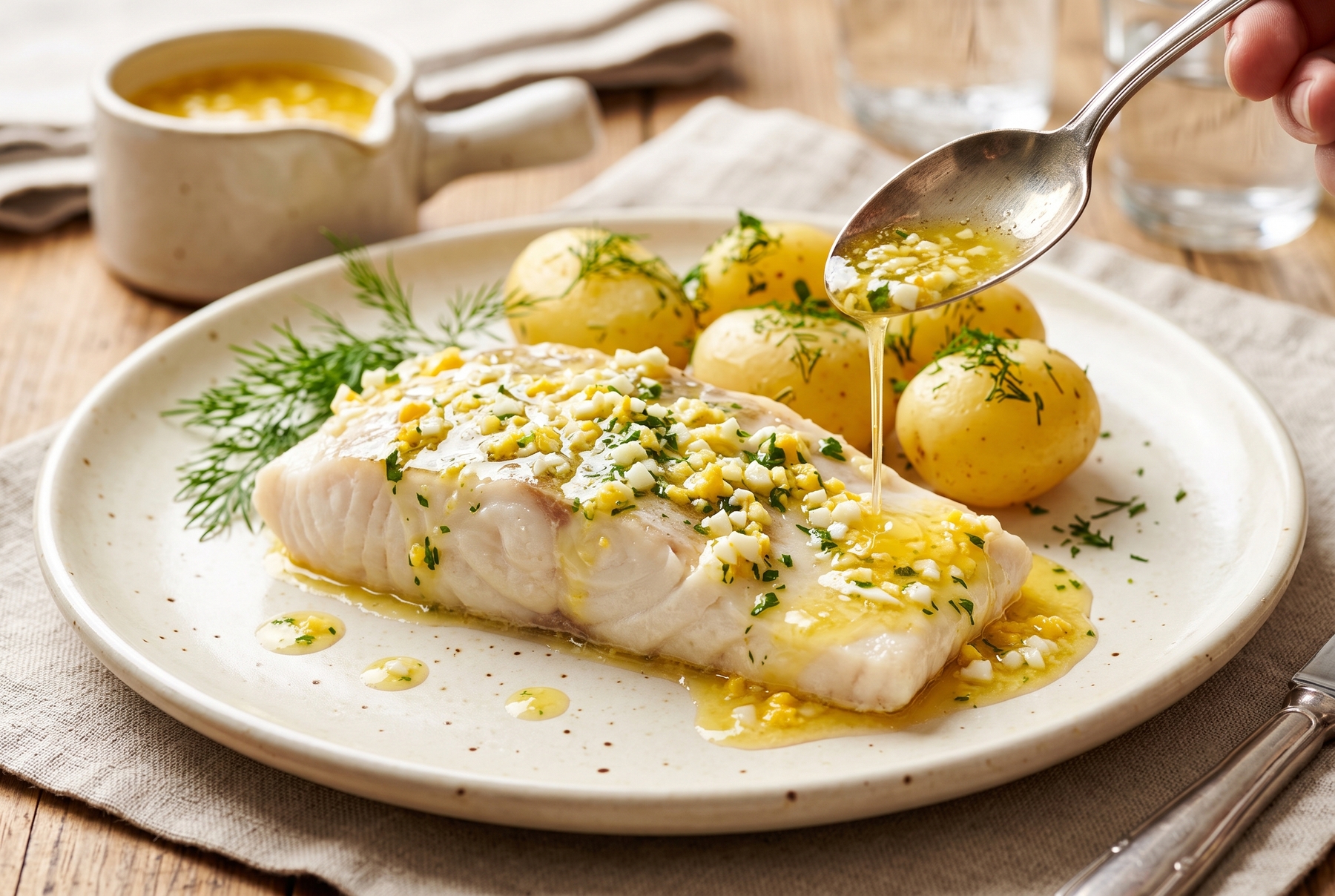
Polish sauce, made from melted butter and chopped egg, brings essential moisture back to boiled fish.
5. Honey-Mustard Sauce
This is a sauce intended for the oven or grill. Sweet, spicy, and sticky, it caramelizes under high heat to give salmon a glossy crust. It works best with fatty fish: salmon, trout, mackerel, and hot-smoked herring.
Difficulty: Minimal. Yield: about 150 g (5.3 oz), for 4 servings.
Ingredients:
- Dijon mustard — 40 g (1.4 oz) (2 tbsp)
- whole grain mustard — 20 g (0.7 oz) (1 tbsp)
- honey — 50 g (1.8 oz) (2 tbsp)
- olive oil — 30 ml (1 fl oz)
- apple cider vinegar or lemon juice — 15 ml (0.5 fl oz)
- salt, black pepper
Preparation. Gently warm crystallized honey until it flows smoothly. Combine both mustards with the honey, pour in the vinegar, and whisk until smooth. Then, slowly drizzle in the oil while whisking until the mixture becomes thick and glossy. Season with salt and pepper. Use half of the mixture as a marinade for 20 minutes, wiping off any excess before placing the fish in the oven. Apply the remaining half 5–7 minutes before the fish is done to create a perfect glaze.
The biggest mistake is slathering the fish at the very beginning and sending it into a hot oven. Honey and mustard contain sugars that burn faster than the fish can cook, leaving you with a dark, bitter film. Use half of the mixture as a 20-minute marinade, wipe off the excess before cooking, and apply the second half just five to seven minutes before the end of roasting.
Regarding proportions: for fatty fish, the ratio of mustard to honey is roughly one to one. For leaner fish, it is best to halve the sweetness; otherwise, the delicate flavor of the fish will be lost in the caramel.
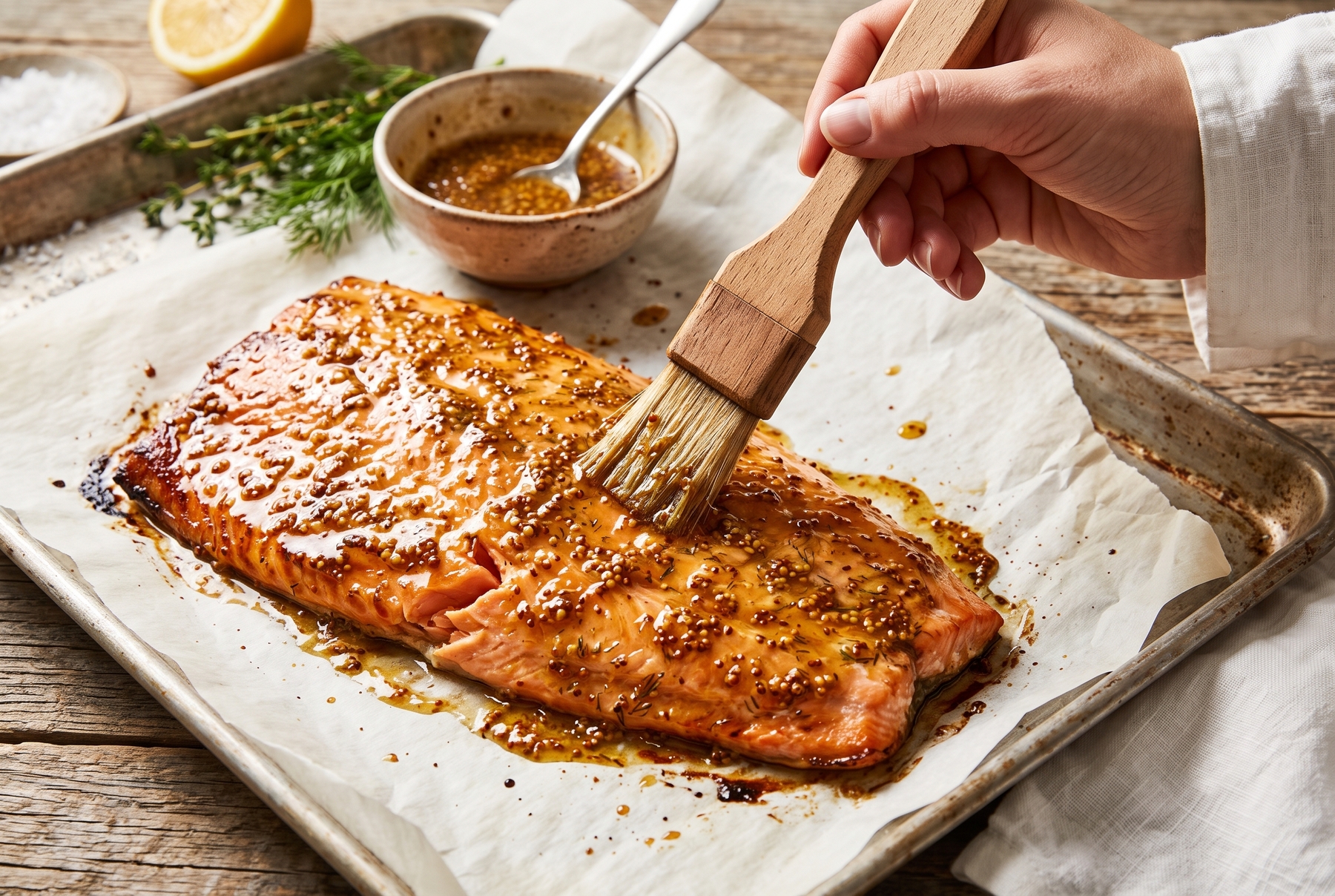
The honey-mustard mixture is brushed on just minutes before the fish finishes baking to create an appetizing glaze.
6. Garlic-Yogurt Sauce
A light alternative to mayonnaise-based options. Tangy, fresh, and carrying a sharp garlic bite, it excels where the fish is fatty or lightly smoked: grilled mackerel, herring, salmon, and roasted trout. During the summer, I choose this over cream sauces almost every time.
Difficulty: Minimal. Yield: about 250 g (8.8 oz), for 4 servings.
Ingredients:
- Greek yogurt or sour cream (20%) — 200 g (7 oz)
- garlic — 1–2 cloves
- lemon juice — 15 ml (0.5 fl oz)
- olive oil — 15 ml (0.5 fl oz)
- dill or mint — 10 g (0.35 oz)
- salt — ½ tsp
Preparation. Mash the garlic with salt into a smooth paste and let it sit for 10 minutes: during this time, its flavor develops and becomes more aromatic. For a milder sauce, use less garlic or gently warm a clove in warm oil for a couple of minutes. Mix the paste with the yogurt, lemon juice, and olive oil, then fold in the finely chopped herbs. Let it rest in the refrigerator for fifteen minutes, and be sure to taste it again before serving, as the garlic will have intensified significantly.
Two technical points must be noted. First, never heat the yogurt, as the proteins will curdle, resulting in a lumpy texture. This is strictly a cold sauce. Second, garlic gains potency over time in an acidic environment. What seemed moderate during preparation might become aggressive an hour later. Mash the garlic with salt, let it rest for ten minutes, and taste it right before serving.
Use thick Greek yogurt or sour cream with at least 20% fat. Drinking yogurt produces a thin liquid that will slide off the fish before the plate even reaches the table.
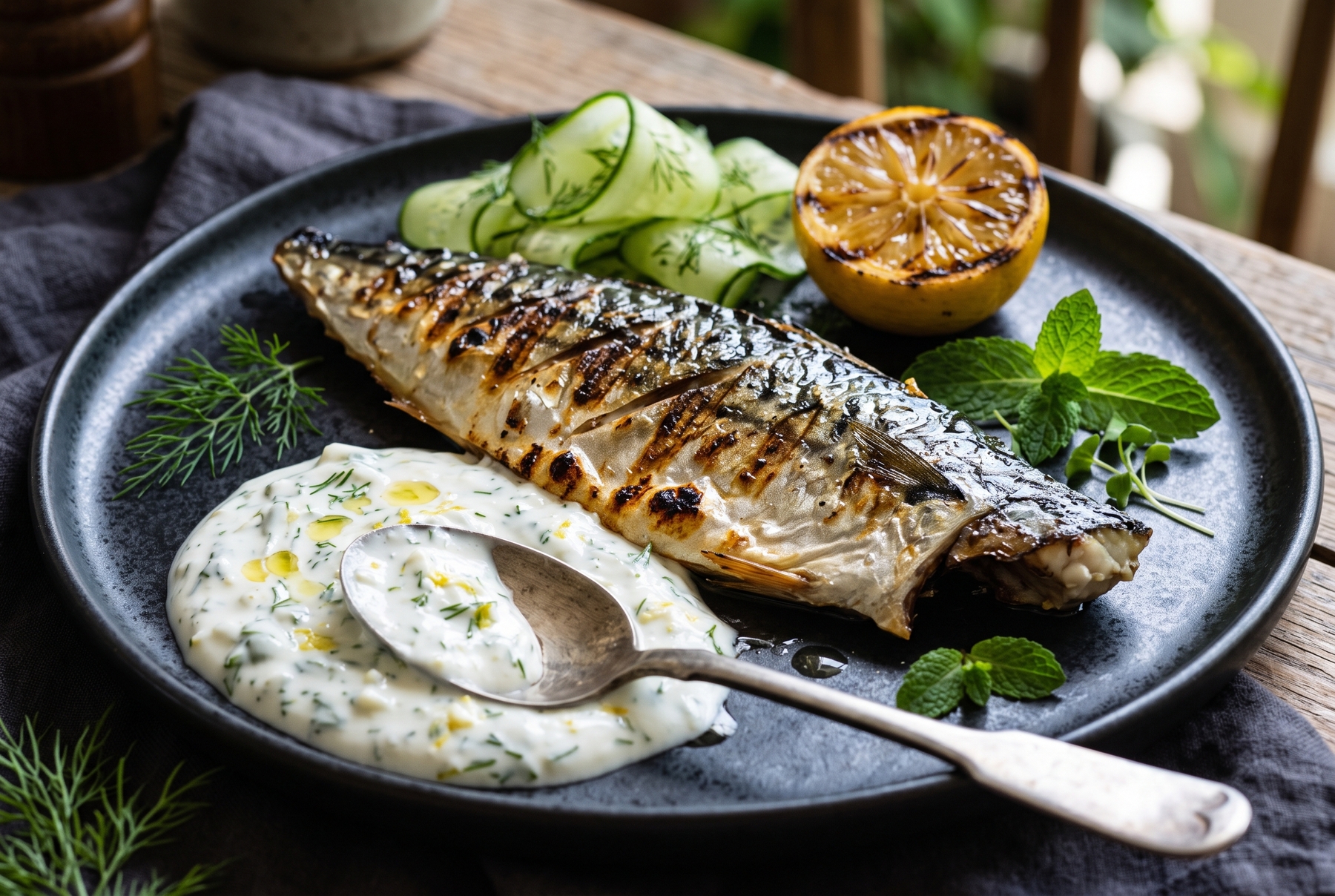
A refreshing garlic-yogurt sauce beautifully balances the rich, oily flavor of grilled mackerel.
7. White Wine Sauce (Beurre Blanc)
A classic beurre blanc represents the pure essence of the French culinary tradition and is the ultimate sauce for noble fish varieties: sea bass, sea bream, halibut, pike-perch, and scallops. The flavor is sharp and tangy yet incredibly buttery, offering a silky texture without a single lump. Adding a spoonful of heavy cream to the reduction acts as an insurance policy, making the emulsion significantly more stable.
Difficulty: Medium. Yield: about 180 ml (6 fl oz), for 4 servings.
Ingredients:
- shallots — 2 pcs. (60 g / 2 oz)
- dry white wine — 150 ml (5 fl oz)
- white wine vinegar — 30 ml (1 fl oz)
- heavy cream (30%) — 30 ml (1 fl oz)
- cold butter — 150 g (5.3 oz)
- salt, white pepper
Preparation. Finely mince the shallots, cover with wine and vinegar, and reduce over medium heat for 7–10 minutes until only 2–3 tablespoons of thick, syrupy liquid remain. Pour in the cream and heat gently for half a minute. Reduce the heat to the absolute minimum and vigorously whisk in cold butter cut into 15–20 g (0.5 oz) cubes, adding the next piece only after the previous one has fully emulsified. From this moment on, the sauce must not boil: while the wine base is boiled down vigorously, boiling destroys the finished emulsion. Strain through a fine-mesh sieve if desired, and season to taste.
A harsh alcoholic aftertaste is the most common complaint regarding this sauce, and the reason is always the same: the wine was not reduced enough. Use volume and aroma as guides: very little liquid should remain, and it should smell of acid and onions, not alcohol. Some alcohol always remains after reduction, so if this is an issue, substitute fish stock mixed with a spoonful of white vinegar to achieve a similar character.
Never let the sauce boil after incorporating the butter—the emulsion will instantly separate into butter and liquid.
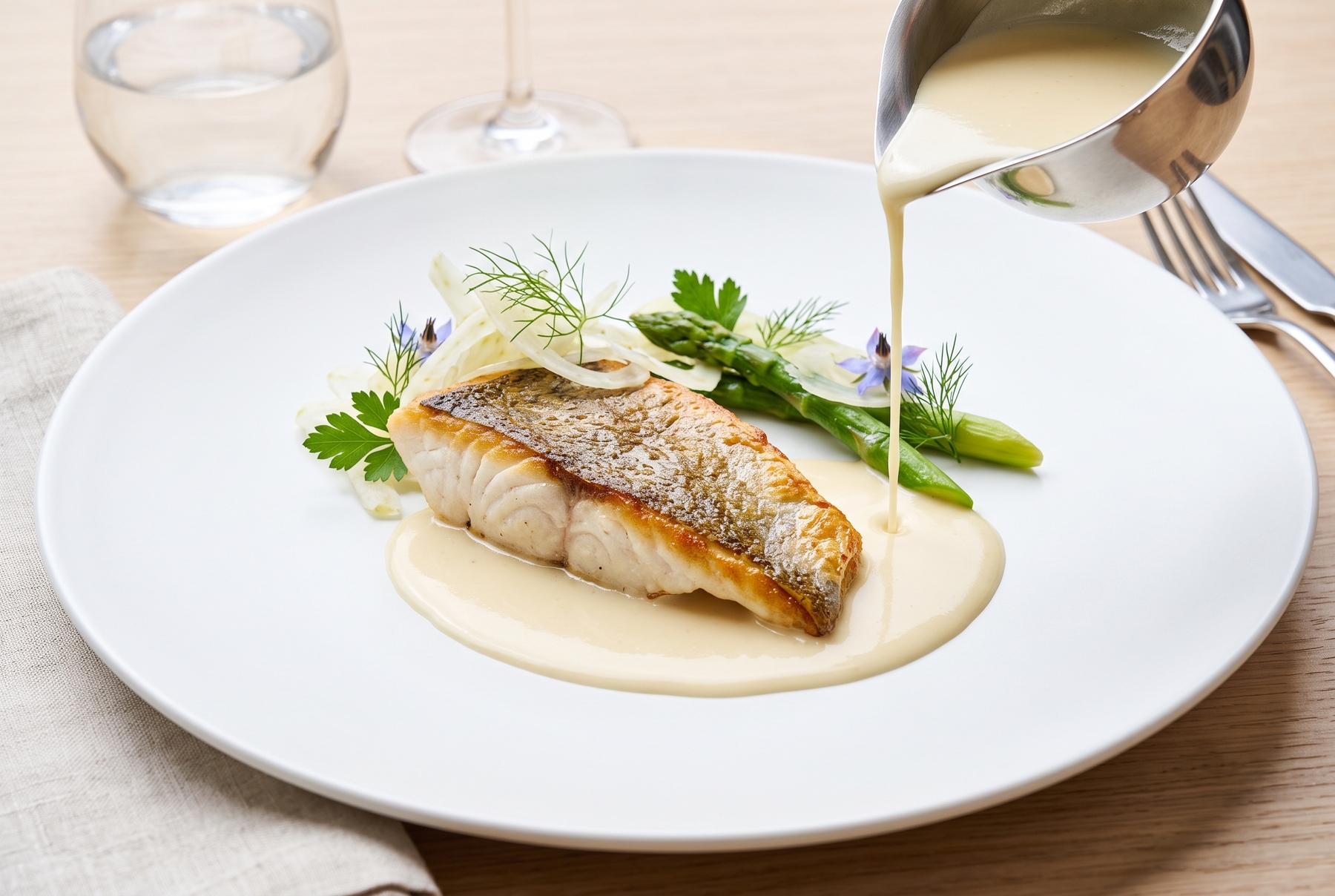
The silky beurre blanc, made from white wine and butter, is the ultimate accompaniment for noble white fish.
8. Creamy Dill Sauce
Salmon and dill are a nearly perfect match: the buttery sweetness of the fish pairs beautifully with the herbaceous, anise-like notes of dill. This sauce is comforting, homemade, and highly recognizable.
Difficulty: Low. Yield: about 220 ml (7.4 fl oz), for 4 servings.
Ingredients, Hot Version:
- heavy cream (30%) — 200 ml (6.8 fl oz)
- shallot — 1 pc. (30 g / 1 oz)
- butter — 15 g (0.5 oz)
- dill — 15 g (0.5 oz)
- lemon juice — 10 ml (0.3 fl oz)
- Dijon mustard — 1 tsp
- salt
Ingredients, Cold Version for Lightly Salted Fish:
- sour cream (20%) — 150 g (5.3 oz)
- Dijon mustard — 1 tbsp
- honey — 1 tsp
- white wine vinegar — 1 tsp
- dill — 15 g (0.5 oz)
- salt
Preparation. For the hot version: sweat the shallot in butter for 2 minutes, pour in the cream, reduce for 4–5 minutes until slightly thickened, remove from the heat, and stir in the mustard, lemon juice, and chopped dill. For the cold version: simply whisk the sour cream with the mustard, honey, and vinegar, add the dill, and let it rest for 15 minutes.
Lightly salted fish requires a different approach: sour cream mixed with mustard and a pinch of sugar. This is closer to a Scandinavian gravlax sauce, transforming lightly salted trout on rye bread from a simple sandwich into a refined dish.
Dried dill does not work here—it imparts a hay-like aroma instead of freshness. Avoid cooking the herbs as well: the aroma of dill is highly volatile, and just ninety seconds of boiling will leave nothing in the sauce but green color.
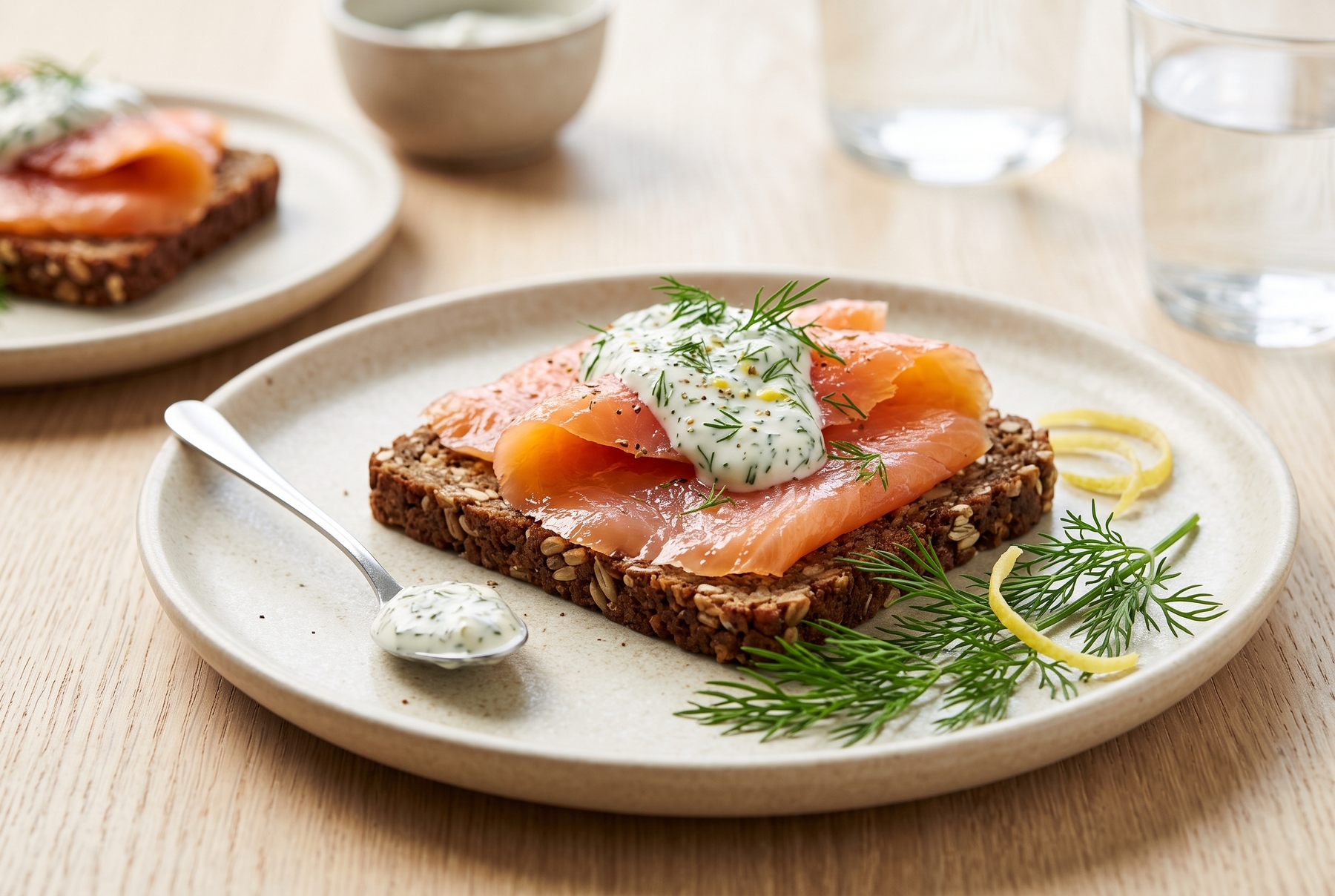
A cold, creamy dill sauce makes a simple open-faced sandwich with lightly salted fish incredibly expressive.
9. Salsa Verde
Italian salsa verde is my answer to the question, “What can I serve if I do not want heavy cream?” This sauce is thick, vibrant green, salty, and acidic, packing a powerful umami punch from the anchovies. It does not make a dish taste more “fishy,” only deeper. Do not confuse it with Mexican salsa verde, which relies on tomatillos and serves an entirely different purpose.
Ideal pairings involve anything grilled and anything fatty: tuna, mackerel, salmon, and sardines. It is surprisingly good with boiled white fish as well, especially during the summer months.
Difficulty: Low. Yield: about 180 g (6.3 oz), for 4–6 servings.
Ingredients:
- parsley leaves — 40 g (1.4 oz) (a large bunch)
- capers — 20 g (0.7 oz)
- anchovy fillets — 4 pcs. (15 g / 0.5 oz)
- garlic — 1 clove
- white wine vinegar — 15 ml (0.5 fl oz)
- olive oil — 100 ml (3.4 fl oz)
- breadcrumbs — 20 g (0.7 oz) (optional)
Preparation. If using bread crumbs, soak them in vinegar for five minutes and squeeze out the excess. Hand-chop the parsley, capers, anchovies, and garlic on a cutting board—never in a blender—until they form a coarse crumb texture. Transfer the mixture to a bowl, add the vinegar, then pour in the olive oil and stir with a spoon. The sauce should remain somewhat loose, rather than turning into a uniform paste. Salt is generally unnecessary, as the anchovies and capers provide enough seasoning.
The only rule that must be strictly observed is to chop by hand rather than using a blender. A blender bruises the parsley, making it dark and bitter, and reduces the sauce to a homogenous paste lacking any texture. Prepare it no more than an hour before serving, as the vinegar gradually discolors the fresh herbs.
If you dislike anchovies, substitute them with a spoonful of caper brine. The flavor will lose some depth, but it will still be quite respectable.
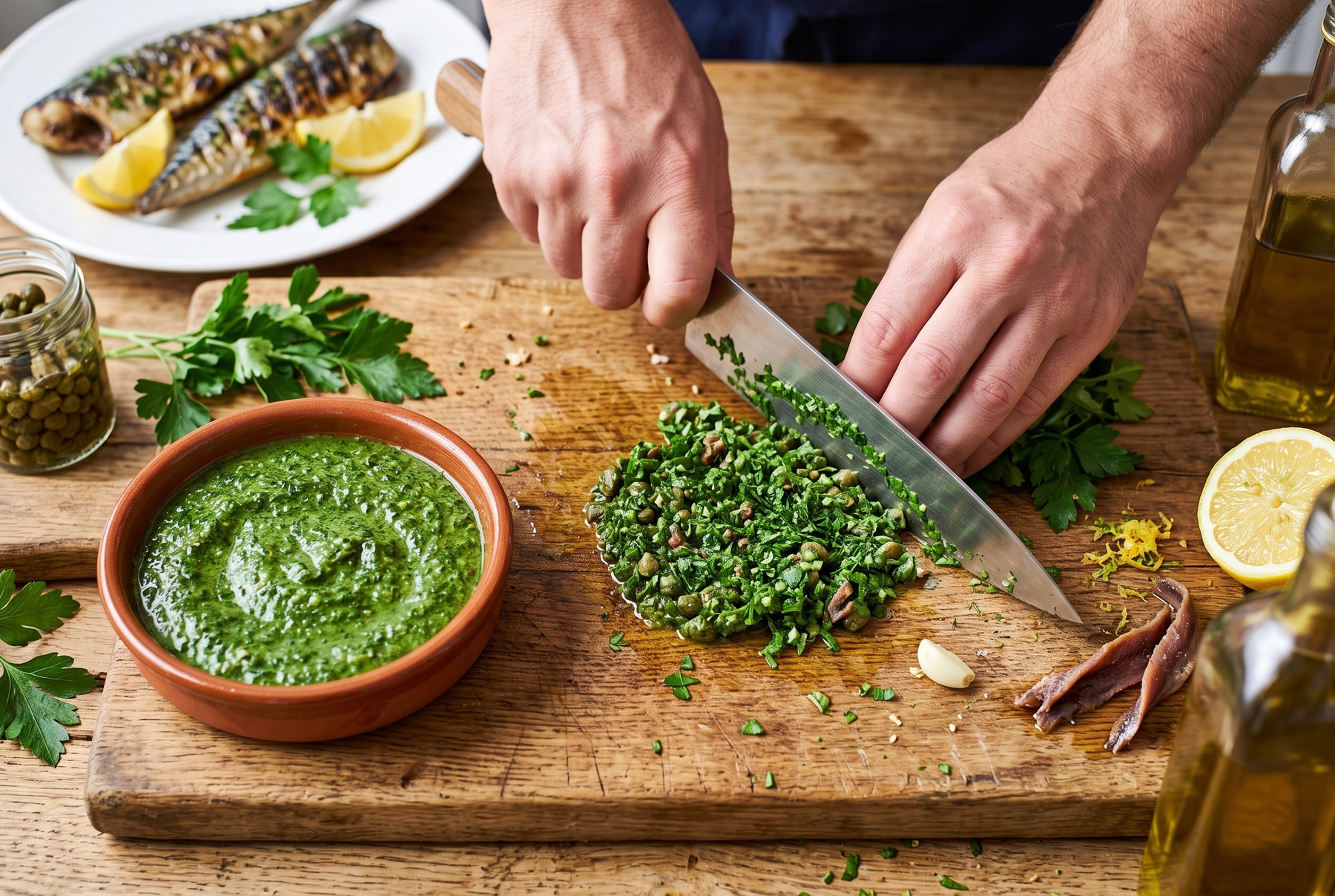
Salsa verde ingredients are chopped exclusively by hand to maintain the sauce's rustic, beautiful texture.
10. Aioli
Aioli is essentially a garlic emulsion that, in the Mediterranean tradition, accompanies anything fried: white fish, calamari, shrimp, potatoes, and bouillabaisse. Its dense, garlic-forward, and buttery flavor contrasts beautifully with a crispy crust.
Difficulty: Medium. Yield: about 200 g (7 oz), for 4–6 servings.
Ingredients:
- garlic — 2 cloves
- salt — ½ tsp
- egg yolk — 1 pc.
- Dijon mustard — ½ tsp
- neutral oil — 100 ml (3.4 fl oz)
- olive oil — 50 ml (1.7 fl oz)
- lemon juice — 15 ml (0.5 fl oz)
Preparation. Peel the garlic, remove the green germ, and pound it with salt in a mortar until it forms a smooth paste. Add the yolk and mustard, mixing until homogenous. Begin streaming in the blended oils: the first 20–30 ml (1 fl oz) must be added drop by drop, followed by a thin stream, working the pestle or whisk continuously. Once the sauce thickens to the consistency of mayonnaise, stir in the lemon juice and adjust the salt. All ingredients must be at room temperature, as a cold yolk is much harder to emulsify.
There are two things rarely mentioned about aioli. Intensely whisking certain robust extra virgin olive oils in a blender can produce a noticeably bitter emulsion. Mixing part of the oil with a neutral variety, or whisking it by hand, yields a more predictable result. Also, always remove the green germ from the garlic cloves: this is exactly what imparts sharpness and a lingering aftertaste.
Aioli clashes with delicate steamed fish: the garlic completely overpowers it. The bolder the cooking method—deep-frying, grilling, pan-searing—the more appropriate this sauce becomes.
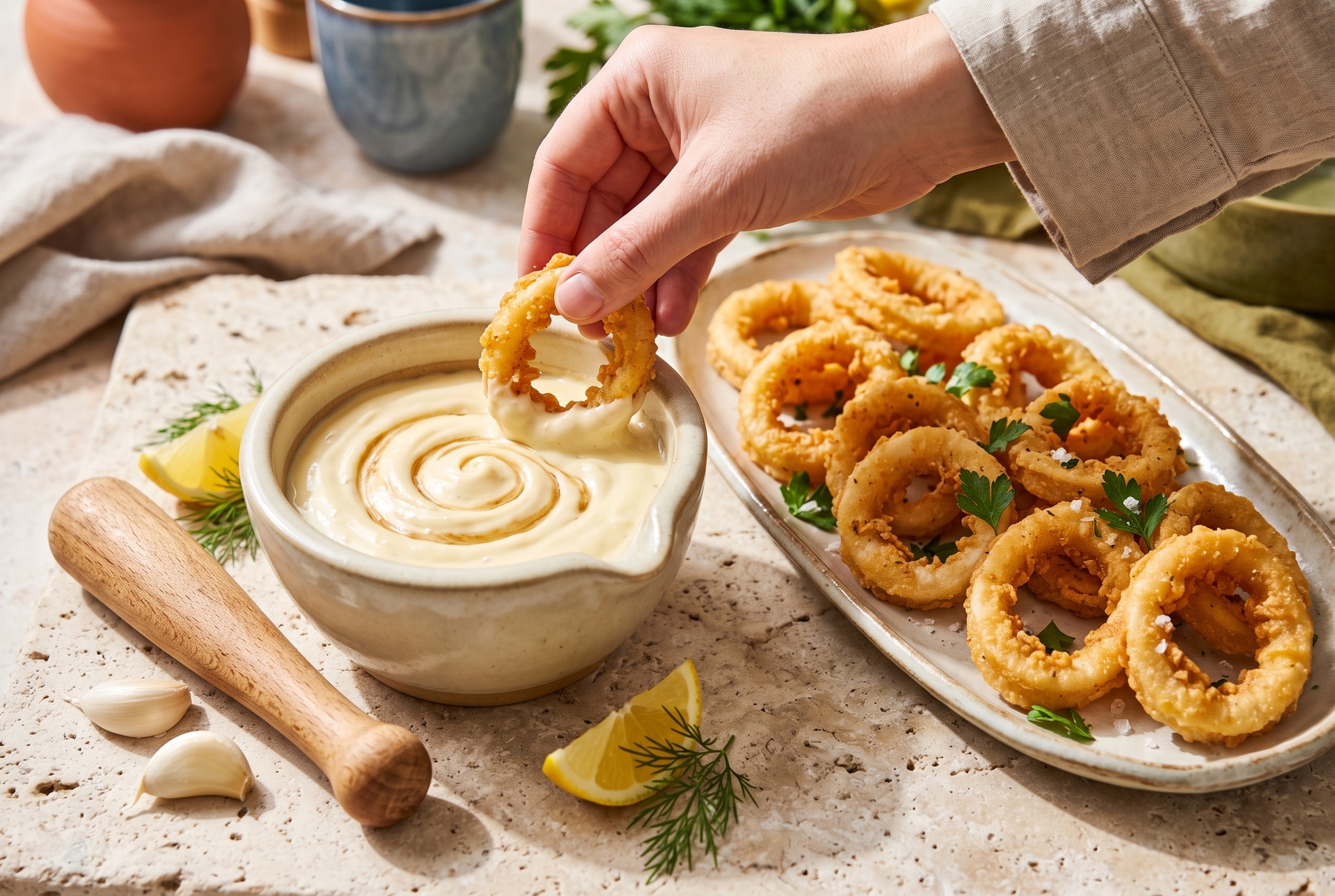
Dense garlic aioli pairs flawlessly with pan-fried fish and deep-fried seafood.
11. Teriyaki
A salty-sweet glaze loaded with umami, created almost specifically for fatty fish. Salmon, mackerel, tuna, and eel—the soy and sugar beautifully balance their oiliness, while caramelization provides a glossy sheen and a delicate, crisp crust.
Difficulty: Low. Yield: about 85 ml (2.8 fl oz), for 4 servings.
Ingredients, Classic:
- soy sauce — 60 ml (2 fl oz)
- mirin — 60 ml (2 fl oz)
- sake — 30 ml (1 fl oz)
- sugar — 20 g (0.7 oz)
Ingredients, Simplified:
- soy sauce — 60 ml (2 fl oz)
- honey — 40 g (1.4 oz)
- water — 60 ml (2 fl oz)
- grated ginger — 1 tsp
- garlic — 1 clove
Preparation. Combine all ingredients in a small saucepan, bring to a boil, and reduce over low heat for 5–8 minutes. The volume should reduce by approximately half. While hot, the sauce remains quite fluid, lightly coating a spoon; it will thicken significantly as it cools. For the simplified version, strain out the ginger and garlic at the end. Brush the sauce onto the fish in 2–3 layers during the final minutes of cooking, allowing each layer to set.
Technically, the process revolves entirely around reduction: boil the mixture until it resembles a thin syrup that coats the back of a spoon. It must be applied in the final minutes of cooking in two or three coats, letting each one dry slightly. Pouring it over the fish at the beginning guarantees burnt sugar.
The most crucial warning concerns salt. Soy sauce is inherently salty, so the fish itself requires almost no seasoning prior to cooking. Oversalted teriyaki cannot be fixed, and diluting it with water makes the flavor completely flat.
Teriyaki is disastrous for delicate white fish: it completely obliterates the natural flavor.
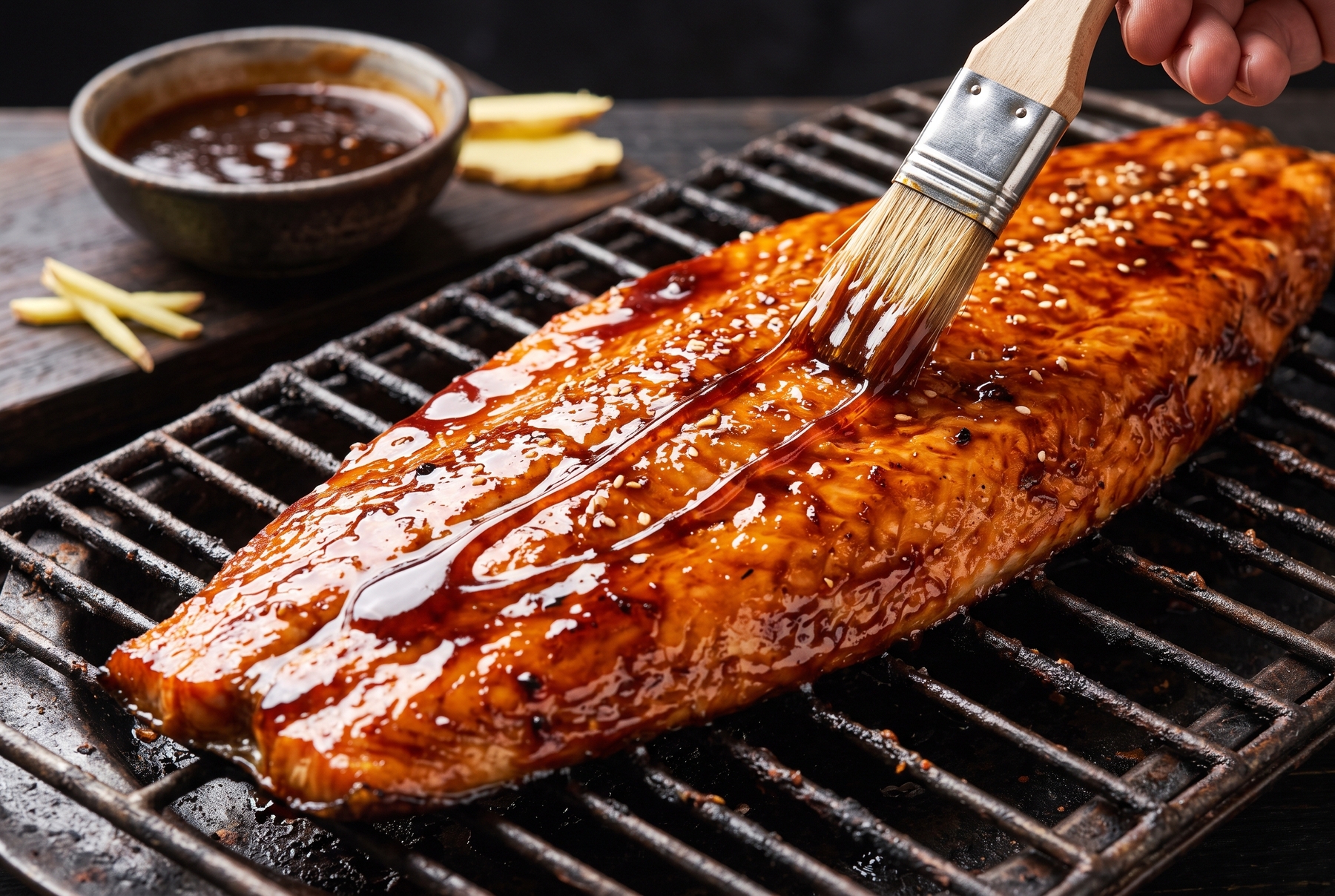
Teriyaki sauce is applied to the fillets merely minutes before grilling finishes to ensure the sugar does not burn.
12. Tomato Salsa
A summery sauce designed for grilled and white fish, relying entirely on freshness and acidity. Sea bream, sea bass, cod, tuna, and fish tacos—it works anywhere you want vibrant flavor without any heaviness. It takes ten minutes to make and requires no cooking or special equipment.
Difficulty: Minimal. Yield: about 300 g (10.5 oz), for 4 servings.
Ingredients:
- ripe tomatoes — 300 g (10.5 oz) (2 medium)
- red onion — 50 g (1.8 oz)
- cilantro or parsley — 15 g (0.5 oz)
- lime juice — 20 ml (0.7 fl oz)
- olive oil — 15 ml (0.5 fl oz)
- chili pepper — ½ pod
- salt — ½ tsp
Preparation. Quarter the tomatoes, slice away the seed cavities along with the juice, and dice the flesh into 5 mm (0.2 inch) cubes. Salt them, let sit for 5 minutes, and drain the excess liquid through a sieve. Finely mince the red onion and soak it for a minute in cold water mixed with a few drops of lemon juice, then pat dry. Remove the seeds from the chili and slice it as thinly as possible. Combine the tomatoes, onion, chili, and herbs, dress with lime juice and olive oil, and toss gently.
The only technical challenge is moisture. Tomatoes release juices rapidly, and within half an hour, the salsa is swimming in pink liquid. Remove the seeds and juices, dice the flesh into half-centimeter cubes, salt them separately, and let them drain for five minutes. It is also wise to soak the red onion in cold water with lemon juice for a minute—it removes the sharp bite while maintaining the crunch.
Assemble the salsa about fifteen to twenty minutes before serving. Any earlier and it will become watery; any later and the ingredients will not have enough time to meld.
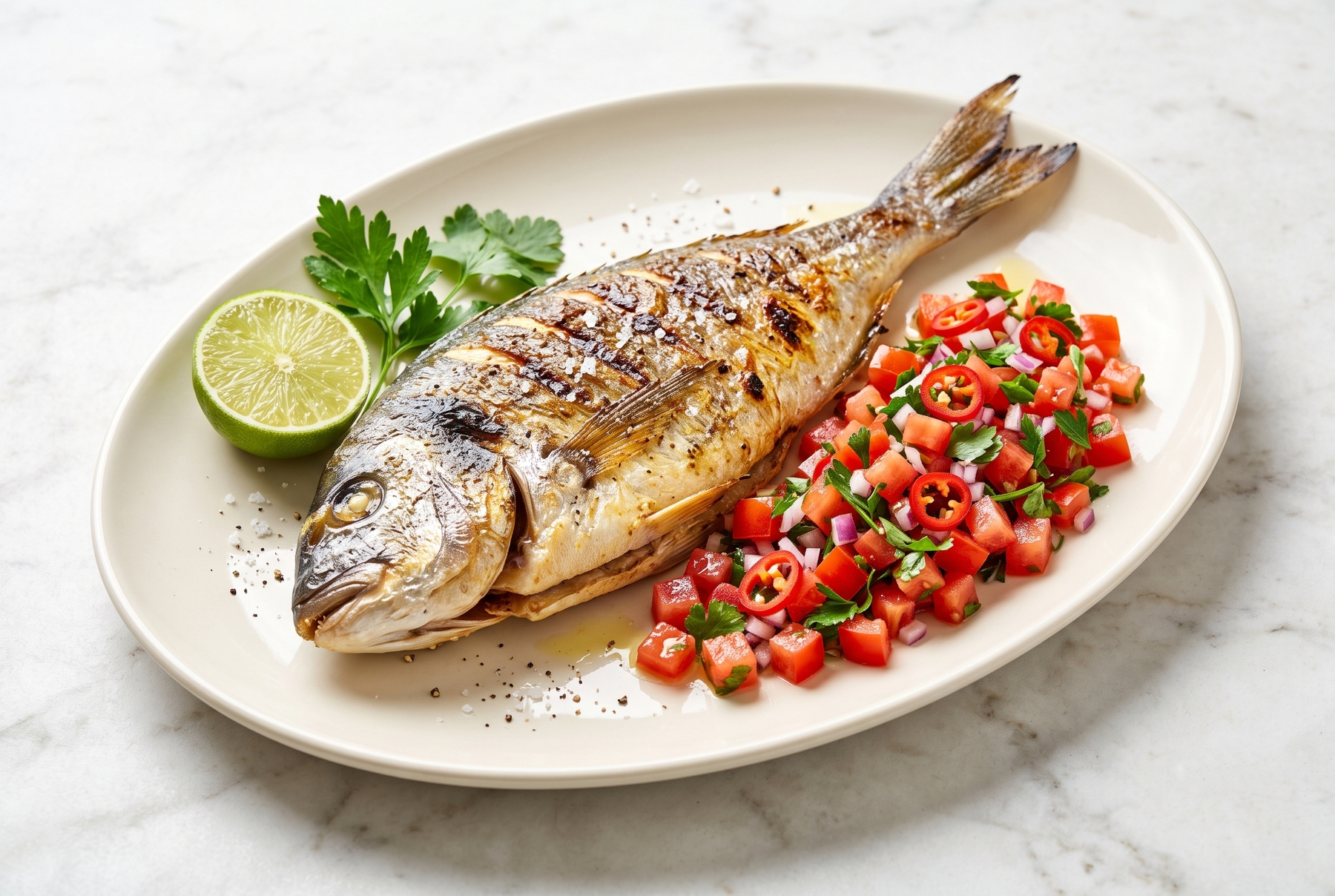
Fresh tomato salsa introduces a vibrant, zesty tartness to whole grilled sea bream or sea bass.
Which Sauce for Which Fish: A Breakdown by Categories
Salmon and Trout. Salmon and trout are rich and slightly sweet, requiring an acidic or spicy counterweight. Honey-mustard, creamy dill, teriyaki, salsa verde, and lemon yogurt sauces work brilliantly. Heavy cream sauces lacking acidity make the dish overwhelmingly filling.
Noble White Fish. Sea bream and sea bass need as little intervention as possible. Lemon with olive oil, beurre blanc, or a light tomato salsa. Anything dense and garlicky is entirely out of place here.
Lean White Fish. Cod, pollock, hake, haddock, and pike-perch desperately need fat and softness: Hollandaise, Polish sauce, creamy lemon, or tartar for fried variations. Measure acidity carefully, as these fish are much more delicate than they appear.
River Fish. Carp and catfish sometimes carry a muddy undertone, making acidity and aromatics a necessity rather than a luxury: garlic-yogurt, tomato salsa, or sour cream with dill and lemon. Pike represents the exact opposite: it is incredibly lean and dry, calling for fat, heavy cream, and butter.
Dense “Steak-Like” Fish. Tuna and halibut behave almost like meat. Tuna loves salsa verde, teriyaki, and soy dressings; halibut shines with Hollandaise and beurre blanc. Both dry out very easily, and a good sauce often saves the dish.
Mackerel and Herring. Maximum fat content demands maximum acidity: garlic yogurt, mustard sauce, pickled onions, and salsa verde.
Common Mistakes When Making Fish Sauces
The most frequent error is excessive acidity. Lemon seems harmless, and squeezing “just a little more” into the sauce ends up masking the flavor of the fish, leaving only sour notes behind. Add juice one teaspoon at a time and taste after each addition; an overly salty sauce can sometimes be fixed, but an overly acidic one is almost a lost cause. The only real remedy is fat: a spoonful of heavy cream or butter softens the acidity.
Garlic is another problem altogether. In a raw sauce, it does not remain static, but rather accelerates: after an hour, its flavor is three times as potent as when first tasted. Half a clove per serving of sauce is more than enough for delicate fish. Never taste a raw garlic sauce immediately after mixing—you are measuring something entirely different from what will actually be served.
Texture fails just as often. A sauce that sits on top of the fish in a stiff mound acts like a paste: it does not spread, does not mix with the fish, and is perceived separately in the mouth. The correct consistency involves a sauce slowly sliding off the spoon while leaving a thin coating. Adjust the thickness using broth, cream, potato cooking water, or lemon juice—but never all at once.
Temperature matters. Pouring a sauce straight from the refrigerator onto hot fish instantly cools the dish and mutes the sauce’s own aroma, as cold dulls the taste buds. Pull cold sauces from the fridge fifteen to twenty minutes before serving. Keep warm sauces around 55–60 °C (131–140 °F), but no hotter, or emulsified sauces will split.
Sweetness. Honey, teriyaki sugar, and sweet marinades are excellent only until the fish starts resembling a dessert. The sign of overkill is simple: after the first bite, you crave water instead of another piece.
Mayonnaise where lightness is required. Serving a mayonnaise-based sauce with steamed fatty salmon makes the dish feel overly heavy within two or three bites. Acidic dairy or herb-based sauces are almost always better for fatty fish, leaving mayonnaise for battered and fried variations.
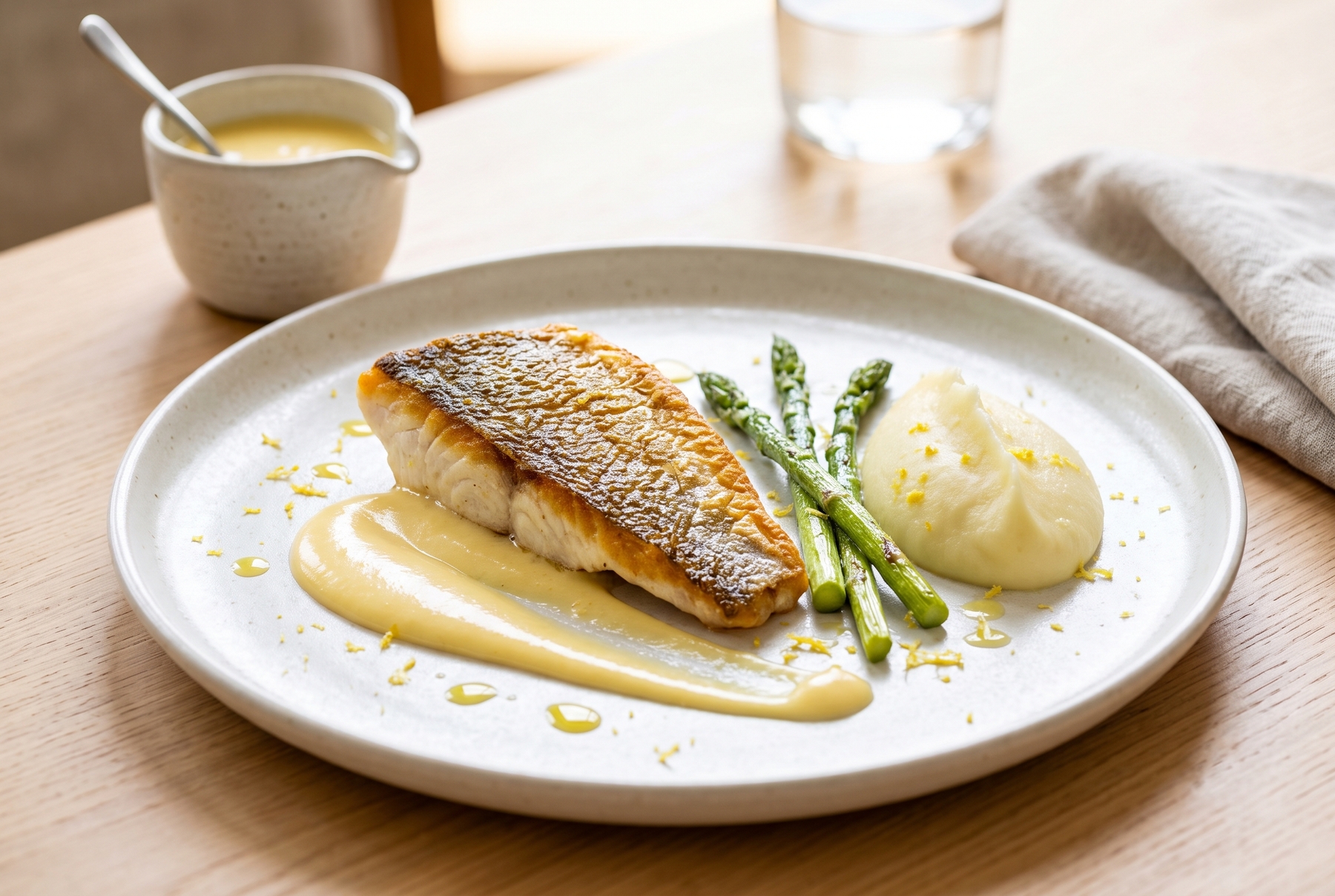
A drop of sauce dragged across the plate with the back of a spoon creates an elegant restaurant-style presentation.
Restaurant-Style Presentation Without a Professional Kitchen
The first thing that distinguishes a home-cooked plate from a restaurant presentation is the amount of sauce. Restaurants use approximately 30–50 ml (1–1.7 fl oz) per portion, which is about two to three tablespoons. Home cooks often pour twice as much, drowning the fish.
The second difference is placement. A sauce is placed underneath or beside the fish, never poured over it. There are two reasons: pouring it on top ruins the crispy crust you worked so hard for and completely hides the ingredient. The only exceptions are thin glazes like teriyaki and traditional poured sauces like the Polish egg-and-butter sauce.
A technique that works every time: place a spoonful of sauce on the plate and drag the back of the spoon across it in one direction to create a beautiful, swooshing streak. Thicker sauces look stunning when dotted in varying sizes along a curve. If the sauce is thin, pool it on the bottom of the plate and rest the fish on top—this keeps it from getting soggy while remaining the star of the dish.
Next come the effortless details. Lemon zest grated directly over the plate. A few drops of olive oil around the edge of the sauce. Finely chopped herbs, but without blanketing the dish—just a pinch strictly over the fish. Use a warm plate for hot dishes: cold porcelain sucks the heat out in seconds and kills the aroma of the sauce.
One more tip. Serve any remaining sauce separately in a small gravy boat. It looks confident and elegantly resolves the eternal debate between those who want extra sauce and those who prefer less.
Cheat Sheet
| Fish | Sauce | Richness | Side Dish |
|---|---|---|---|
| Salmon | Honey-mustard, creamy dill | Medium | Roasted vegetables, rice |
| Trout | Creamy lemon, yogurt with dill | Medium | New potatoes, asparagus |
| Sea bream (Dorada) | Lemon oil, light tomato salsa | Low | Grilled vegetables, green salad |
| Sea bass | Beurre blanc, olive oil with lemon | Low | Fennel, mashed potatoes |
| Pike-perch | Polish sauce, Hollandaise | Medium | Boiled potatoes, broccoli |
| Cod | Hollandaise, creamy lemon, tartar | High | Potatoes, spinach |
| Pollock | Tartar, creamy lemon | High | French fries, vegetable stew |
| Carp | Garlic-yogurt, sour cream with lemon | Medium | Buckwheat, braised vegetables |
| Pike | Creamy, Polish sauce | High | Potatoes, mushrooms |
| Mackerel | Yogurt with garlic, salsa verde | Low | Pickled onions, rye bread |
| Tuna | Salsa verde, teriyaki | Low | Rice, arugula, sesame |
| Catfish | Tomato salsa, garlic-yogurt | Medium | Rice, fresh vegetables |
How to Choose the Perfect Fish Sauce: The Bottom Line
A truly great sauce does not mask the fish—it amplifies it. If your thought after the first bite is “what an interesting sauce” rather than “what a wonderful piece of fish,” something went wrong: there is either too much garlic, too much acidity, too much sweetness, or simply too much sauce.
Everything else boils down to four variables: the fat content of the fish, the acidity of the sauce, its creaminess, and its freshness. Fatty fish demands acidity and fresh herbs, lean fish needs fat and softness, delicate fish is best left alone, while bold and smoky flavors pair wonderfully with sweetness or salty umami.
Once this logic becomes clear, cheat sheets are no longer necessary. You simply look at the piece of fish, remember how you intend to cook it, and the answer reveals itself.
0 comments