
Tasting a sauce sometimes reveals nothing to fault. The salt is right, the acidity is present, and the ingredients are sound. The first spoonful tastes great. Yet by the third or fourth bite, an urge arises to liven things up, even though the flavor balance is spot on. Reaching for the spice rack is a natural impulse. In the kitchen at a moment like this, however, the real focus belongs on texture.
Consider a classic comfort plate: mashed potatoes, braised meat, and a thick gravy ladled over the top. Individually, every component works well. Yet the mash is soft, the slow-cooked meat is equally tender, and the sauce coats the palate. The result is a plate where everything shares roughly the same consistency, making the meal feel monotonous very quickly. Scattering a few rings of crispy fried onions on top or setting a spoonful of crunchy pickled cucumber on the side suddenly pulls the dish together. The core recipe remains unchanged. The only difference is what happens in the mouth from one spoonful to the next.
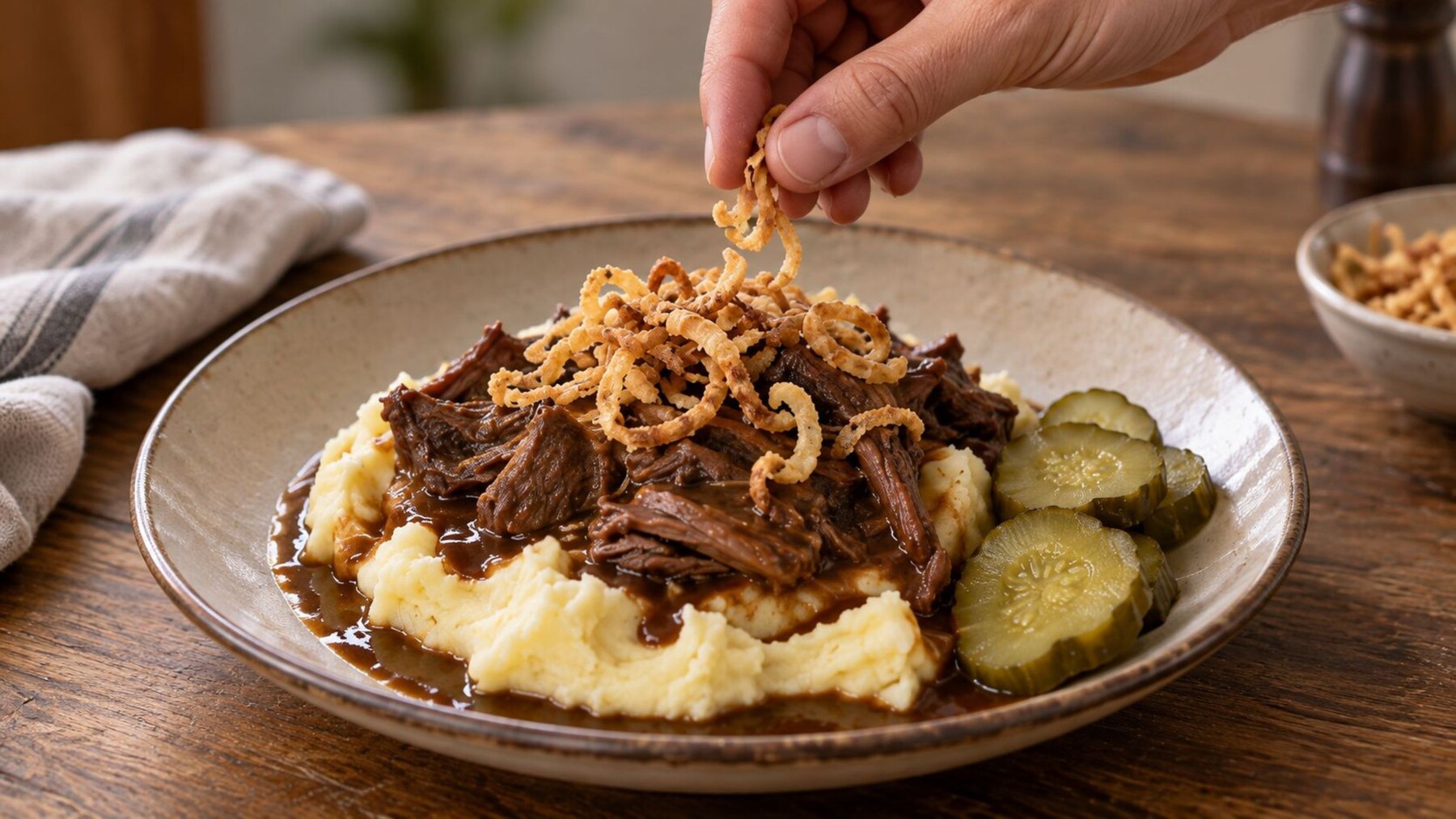
Crispy fried onions and pickled cucumber add essential crunch to soft mashed potatoes and braised meat.
Why does such a small element dramatically alter the impression of an entire plate? And how does a cook know which contrast to add, or when a dish is better left alone? Both questions deserve a closer look.
Table of Contents
- Texture Is Half of What We Call Delicious
- Why an Entirely Soft Plate Grows Tiresome
- Base and Contrast: Where to Begin
- Not All Crunch Is Created Equal
- Size Matters: Fitting the Crunch into a Single Bite
- Everyday Dishes Waiting for a Single Finishing Touch
- Moisture: The Ultimate Enemy of Crispness
- Why Crusts Lose Their Crunch Before Reaching the Table
- Looking Beyond the Deep Fryer for Crunch
- When Textural Contrast Is Unwelcome
- Finding the Right Ratio of Crunch
- Does Temperature Count as Texture?
- Five Pantry Staples for Instant Contrast
- Quick Reference: Matching the Base to the Contrast
- The Final Check Before Serving
Texture Is Half of What We Call Delicious
When someone says they love the taste of a dish, they almost never mean flavor alone. That single word encompasses a whole range of sensations: aroma, temperature, richness, juiciness, density, crunch, and the way food breaks down on the palate.
Potato chips offer the clearest proof. A chip that has gone stale still retains its salt and its aroma. Eating it is unpleasant all the same because the main attraction has vanished: instead of snapping, it bends and chews into a soft paste. Losing a single texture ruins the impression of the entire food.
We perceive crunch with more than just our teeth; we hear it, too. A fresh baguette announces its crust before any flavor registers, crackling beneath the knife and between the fingers. In sensory experiments where researchers altered the sound of a person’s own chewing, ratings of freshness and crispness shifted right along with the audio, even though the food itself remained identical. Sound is not mere background noise here; it is an active part of the sensation.
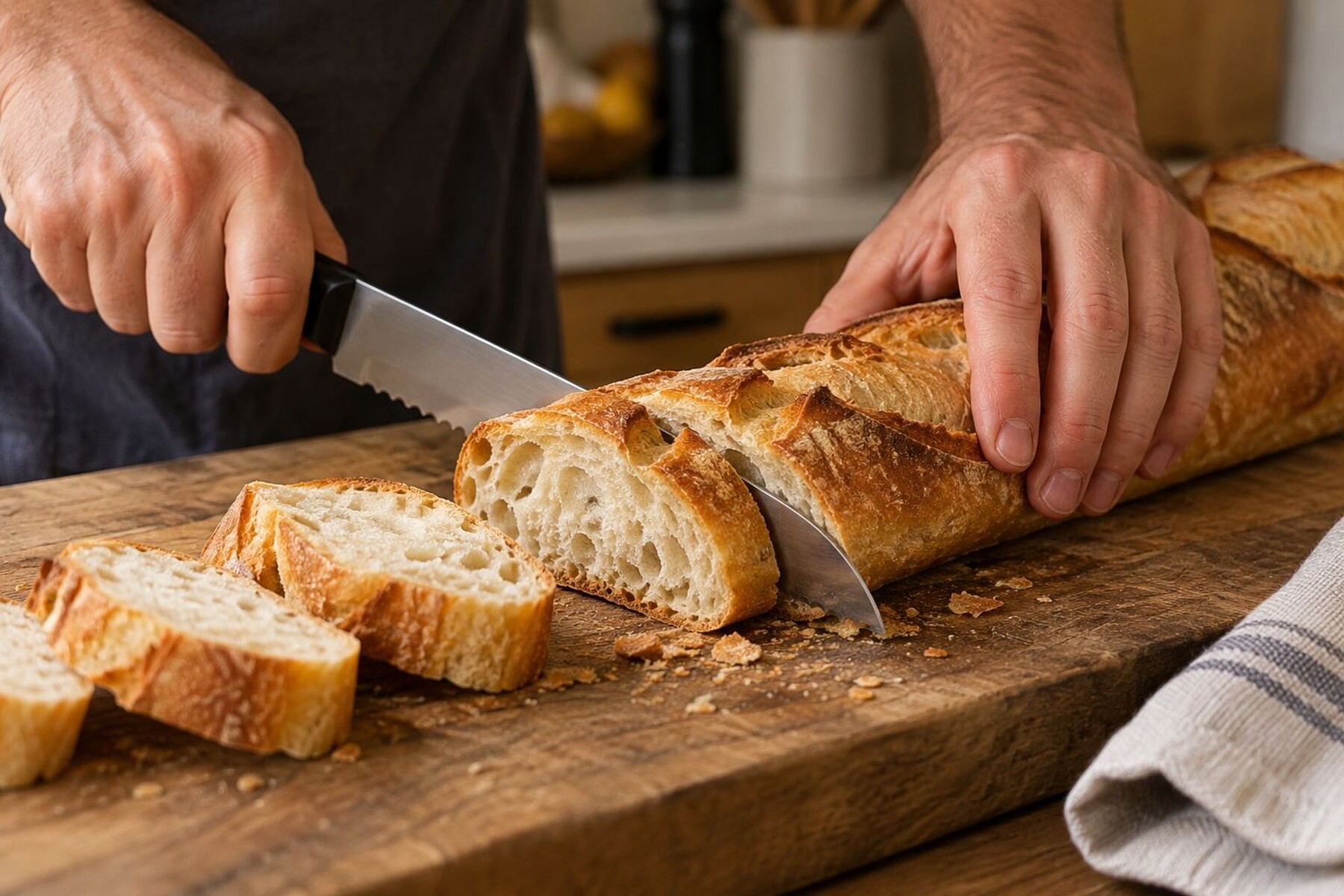
The sound of a crackling baguette crust shapes our perception of freshness before the very first bite.
Why an Entirely Soft Plate Grows Tiresome
Cooks usually reserve the word “flat” for flavor when a dish lacks salt or acid. Texture can fall flat in the exact same way. Softness itself is never the culprit: a delicate custard or a velvety purée can be magnificent precisely because of its uniformity. Monotony sets in only when multiple components on the same plate behave identically in the mouth.
When the palate knows in advance exactly what to expect from the next bite, attention to the meal gradually fades. Often, a single element that behaves differently is enough to wake things up: green beans blistered until crisp-tender rather than boiled soft, a crackling crust alongside a yielding filling, or a raw vegetable paired with a slow-braised one.
There is no rigid rule dictating that every dish must contain three distinct textures. Some diners crave bold contrast while others prefer subtlety, and much depends on the ingredients and the dish itself. Textural contrast is a culinary tool, not a law.
Base and Contrast: Where to Begin
Reducing the approach to a single habit comes down to asking two questions. First: what is the dominant texture in this dish? Second: what is it missing? Building an elaborate system of five competing textures is unnecessary. Identifying the main mouthfeel and deciding whether it needs a single counterpoint nearby usually does the trick.
When the Base Is Creamy
Puréed soups, risotto, polenta, hummus, and soft mashes are smooth and palate-coating. Brief, dry resistance works wonders here: something brittle or crumbly that refuses to argue with the base, merely interrupting its smoothness for a split second.
When the Base Is Soft and Juicy
Slow-braised meats, stewed eggplant, and braised cabbage fall apart into tender, moist fibers. They benefit from a crisp, snappy counterpart such as fresh cucumber, radish, raw cabbage, or tangy pickled vegetables. As a bonus, this kind of contrast brings welcome acidity and a burst of freshness.
When the Base Is Dry and Crispy
Pan-fried fish, schnitzel, falafel, and French fries already have plenty of crunch built in. Here, the formula flips: instead of piling on another dry texture, the palate craves a creamy, juicy, or pourable accompaniment.
This leads to an essential principle: textural contrast does not always mean adding crunch. Sometimes the crunch is already there, and softness is the missing piece.
Not All Crunch Is Created Equal
The single word “crispy” hides a wide spectrum of sensations, and each one interacts with food differently. Grouping them into four broad categories makes choosing the right counterpoint much easier.
Delicate, shattering crispness comes from potato chips, fried shallots, caramel shards, thin crackers, and blistered skins. It cracks, shatters, and almost immediately vanishes on the tongue. That fleeting nature makes it an ideal partner for ultra-soft dishes, creating a vivid yet brief encounter between textures.
Dry, fine crunch operates differently. Panko, toasted breadcrumbs, and sesame seeds create dozens of tiny points of resistance. This style of contrast scatters evenly across the surface of pasta, risotto, roasted vegetables, or creamy dips, entering the mouth right alongside the main component.
Dense crunch demands real chewing: think whole nuts, large seeds, or raw carrot sticks. Caution is necessary here. A whole hazelnut buried inside a silky mousse rarely makes the dessert more interesting; instead, the mouth is forced to switch abruptly from melting to grinding.
Finally, there is fresh, juicy crunch: cucumber, radish, crisp apple, celery, and young cabbage. The cell walls resist the teeth for a fraction of a second before releasing a burst of liquid. This lively snap excels alongside rich, salty, deep-fried, and slow-simmered dishes.
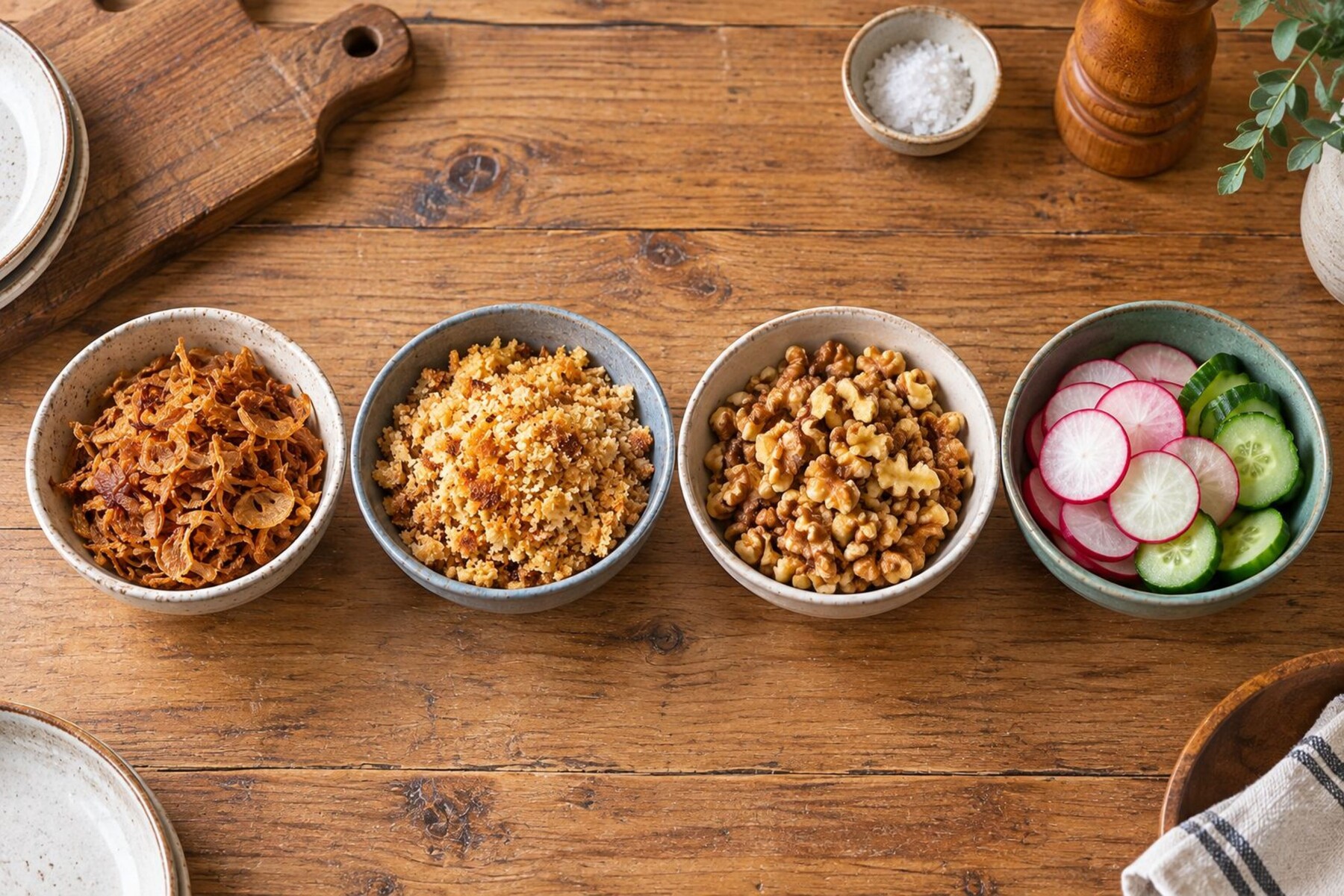
Different styles of crunch: from delicate fried onions and fine breadcrumbs to dense nuts and juicy radishes.
Size Matters: Fitting the Crunch into a Single Bite
Mismatched scale is one of the most common kitchen missteps. Even a well-chosen contrasting element fails if its size clashes with the rest of the dish.
Floating one giant piece of toasted bread on top of a velvety soup forces the diner to eat the toast first and the soup second. Those are two pleasant experiences happening in sequence rather than together. A small crouton fits onto the spoon right alongside the broth, allowing creamy and crispy to meet in the mouth simultaneously. That exact intersection is where true contrast lives.
Nuts follow the same logic. A large walnut half makes sense in a leafy salad where the greens are torn into substantial pieces. For a smooth pâté, a mousse, or a creamy pasta, chopping the nut finely works much better. The guideline is simple: the secondary texture should fit effortlessly into the same bite as the primary one.
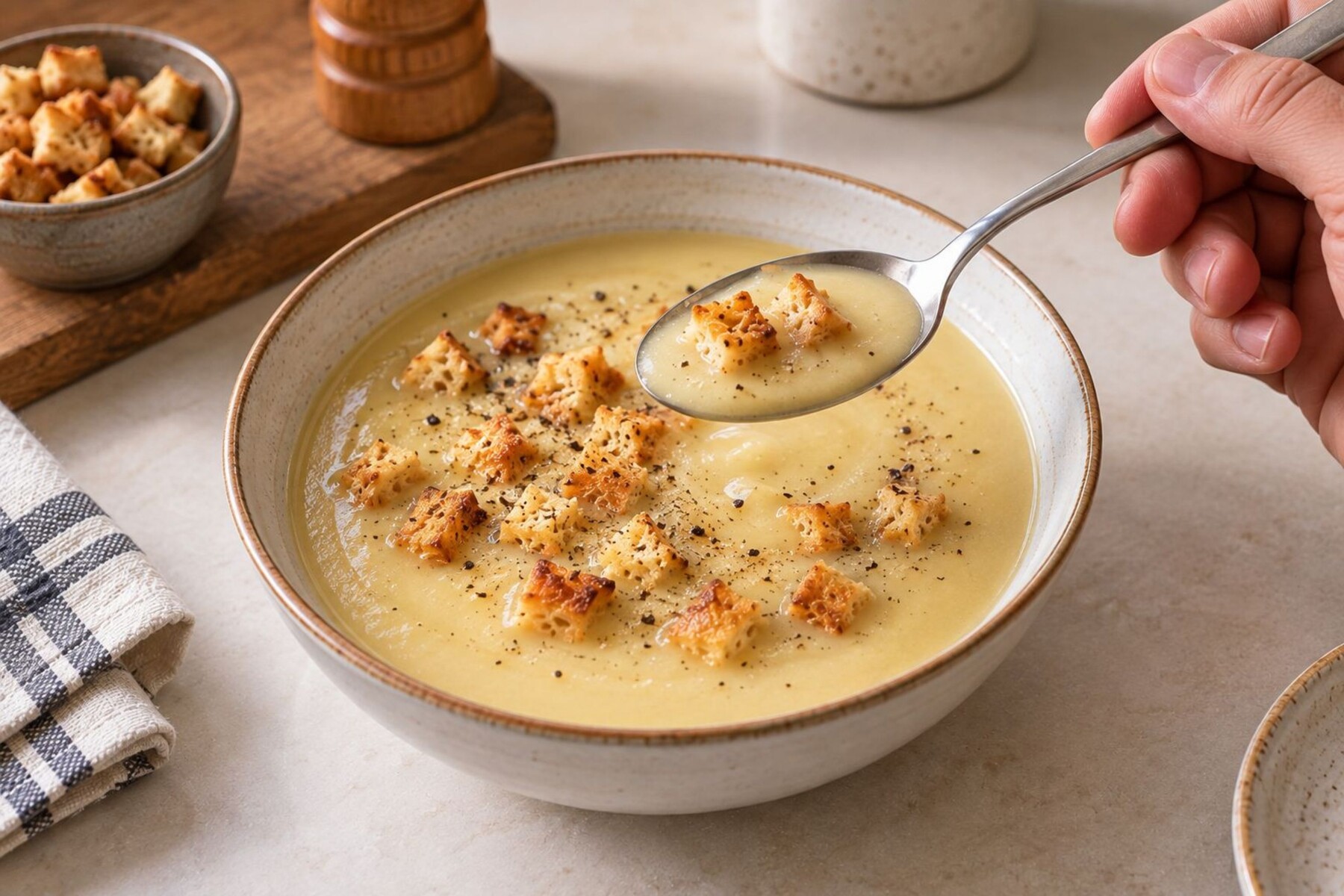
A crispy crouton should fit onto the spoon right alongside the soup, delivering contrast in a single bite.
Everyday Dishes Waiting for a Single Finishing Touch
Seeing how this principle plays out across familiar plates, from starters to desserts, brings the concept to life.
Puréed Soups
Pumpkin, mushroom, and cauliflower soups stay velvety from the first spoonful to the last. A modest scattering of croutons, toasted crumbs, or roasted seeds alters the rhythm of the bowl without disrupting the silky base. The garnish must remain an accent rather than turning the soup into a bowl of soaked bread.
Risotto and Creamy Pasta
Cooks spend time coaxing these dishes into a lush, emulsified state, so chasing contrast by leaving the rice or pasta undercooked is a mistake. Risotto grains should retain a gentle, toothsome core, never a hard crunch. Moving the structural contrast to the exterior works far better—such as a light dusting of toasted pangrattato (Italian crispy herb-and-garlic breadcrumbs) brightened with lemon zest. The creamy base stays true to itself while the dry element goes to work on top.
Mashed Potatoes with Crispy Onions
Silky mashed potatoes offer almost zero resistance to the tooth, making brittle fried onions stand out vividly. Two benefits happen at once here: the mouthfeel shifts, and a deep, savory roasted aroma joins the dish. It is a classic example of a garnish doing double duty.
Fried Fish and Schnitzel: Reversing the Formula
Once a golden, crackling crust is achieved in the pan, the goal is never to pile another dry ingredient on top. Preserving that hard-won crispness takes priority. Tartar sauce, aioli, herbed yogurt, or lemon-butter sauce belongs on the side, pooled underneath the protein, or served in a separate ramekin—never poured directly over the breading.
Braised Meat
Hours of gentle simmering leave meat and root vegetables spoon-tender, while the reduced braising liquid binds everything into a rich, uniform coat. A crisp, raw, or pickled garnish shines here: it introduces bite, cuts through the heaviness with bright acidity, and makes a dense meal feel noticeably lighter.
Creamy Desserts
Chocolate mousse, panna cotta, pastry cream, and ice cream welcome a delicate, fragile counterpoint like spun caramel, crushed wafer, shortbread crumbs, or praline shards. Desserts are where restraint matters most, however. When hard mix-ins take over, the luxurious primary texture loses its starring role.
Moisture: The Ultimate Enemy of Crispness
Dry crunch faces a relentless adversary in the kitchen: water. Croutons turn spongy in broth, breading goes limp under gravy, and granola loses its snap in yogurt. Porous, dry structures eagerly absorb liquid and quickly lose their ability to shatter.
Bringing a crispy garnish and a wet base together as late as possible is the best defense. Two straightforward habits solve the problem.
The first and most reliable method is storing dry and wet components separately, uniting them only in the bowl. Soup can simmer on the stove while croutons wait in an airtight jar, meeting just seconds before the spoon dives in.
The second habit protects freshly cooked crusts. When a dish calls for sauce, plating it underneath or alongside the crispy protein prevents premature sogginess.
This creates a practical workflow: most crunchy toppings can be prepped well in advance, provided they are added at the very last moment. That brief window between plating and the first bite determines whether the intended texture survives.
Why Crusts Lose Their Crunch Before Reaching the Table
Sometimes crispness vanishes before a sauce even enters the picture. The trouble usually starts during one of three cooking stages.
Surface moisture prior to breading or searing is the first culprit. Excess water steams the exterior and blocks rapid browning, which is why patting fish, poultry, or meat thoroughly dry with paper towels before hitting a hot pan pays dividends.
Oil that is too cool is the second pitfall. Breading lingers too long in lukewarm fat before setting, absorbing oil and turning heavy and sodden instead of crisp and dry.
The third mistake is the most frustrating. Resting a piping-hot cutlet directly on a flat plate traps escaping steam underneath, creating a miniature swamp under the food. While the top stays crunchy, the bottom turns mushy. Cooling fried foods on a wire rack solves this instantly: air circulates underneath, steam escapes freely, and the bottom crust stays intact.
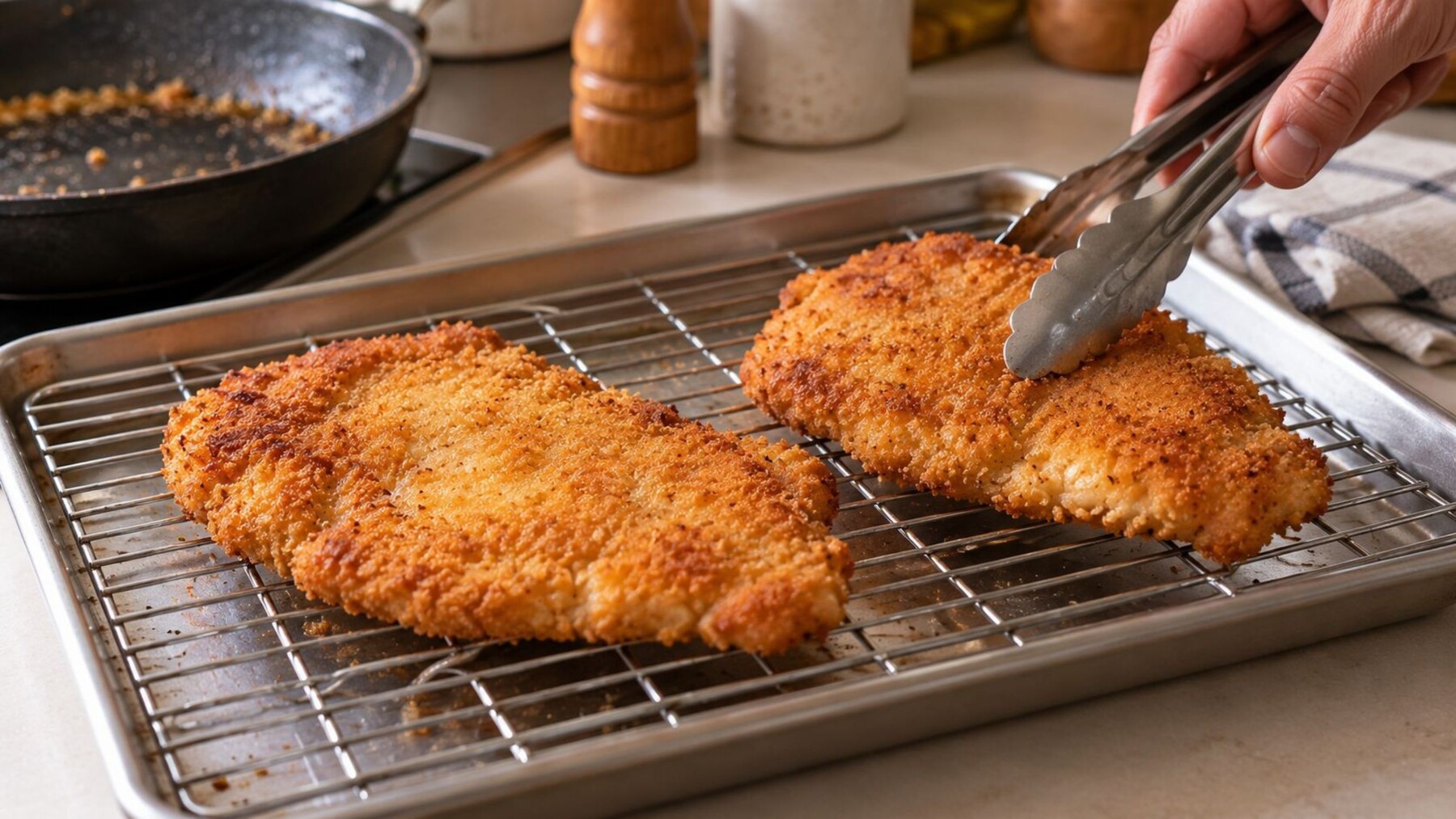
Resting fried food on a wire rack allows steam to escape, keeping the bottom crust dry and crispy.
Looking Beyond the Deep Fryer for Crunch
Achieving great texture never requires frying everything in sight; plenty of other methods build crispness. A dry skillet makes quick work of toasting breadcrumbs, nuts, and seeds. The oven excels at dehydrating croutons, crisping up spiced chickpeas, and turning thinly sliced vegetables into chips. High-heat grilling offers a different kind of contrast altogether: charred, blistered edges giving way to a juicy center, a technique that flatters asparagus, cabbage wedges, and sweet corn.
Meanwhile, plenty of produce arrives from the garden with built-in snap. Radishes, cucumbers, apples, carrots, and young cabbage often do more to wake up a heavy plate than another fried topping, all while requiring little more than a sharp knife.
Nuts and seeds, on the other hand, benefit immensely from a brief toast. Heat drives off residual moisture, tightens their snap, and wakes up their natural oils. Relying on aroma rather than dark color prevents burning: the moment a warm, nutty fragrance fills the kitchen and the surface takes on a light golden hue, they belong off the heat. Carryover cooking will finish the job.
When Textural Contrast Is Unwelcome
Assuming every dish needs a scattering of crumbs merely trades one kitchen habit for a new superstition. Certain culinary classics owe their entire appeal to uninterrupted silkiness. A proper custard, a glossy French sauce, a velvety pomme purée, and churned ice cream are celebrated precisely because they offer zero resistance on the tongue. Here, the complete absence of contrast is the whole point.
Other dishes already feature built-in textural interplay created during cooking. A seared steak pairs a caramelized crust with a tender center, a crusty sourdough loaf hides a pillowy crumb, and crème brûlée crowns rich custard with a sheet of brittle glass. When contrast is already woven into the dish’s DNA, piling on an extra topping just for the sake of a rule is redundant.
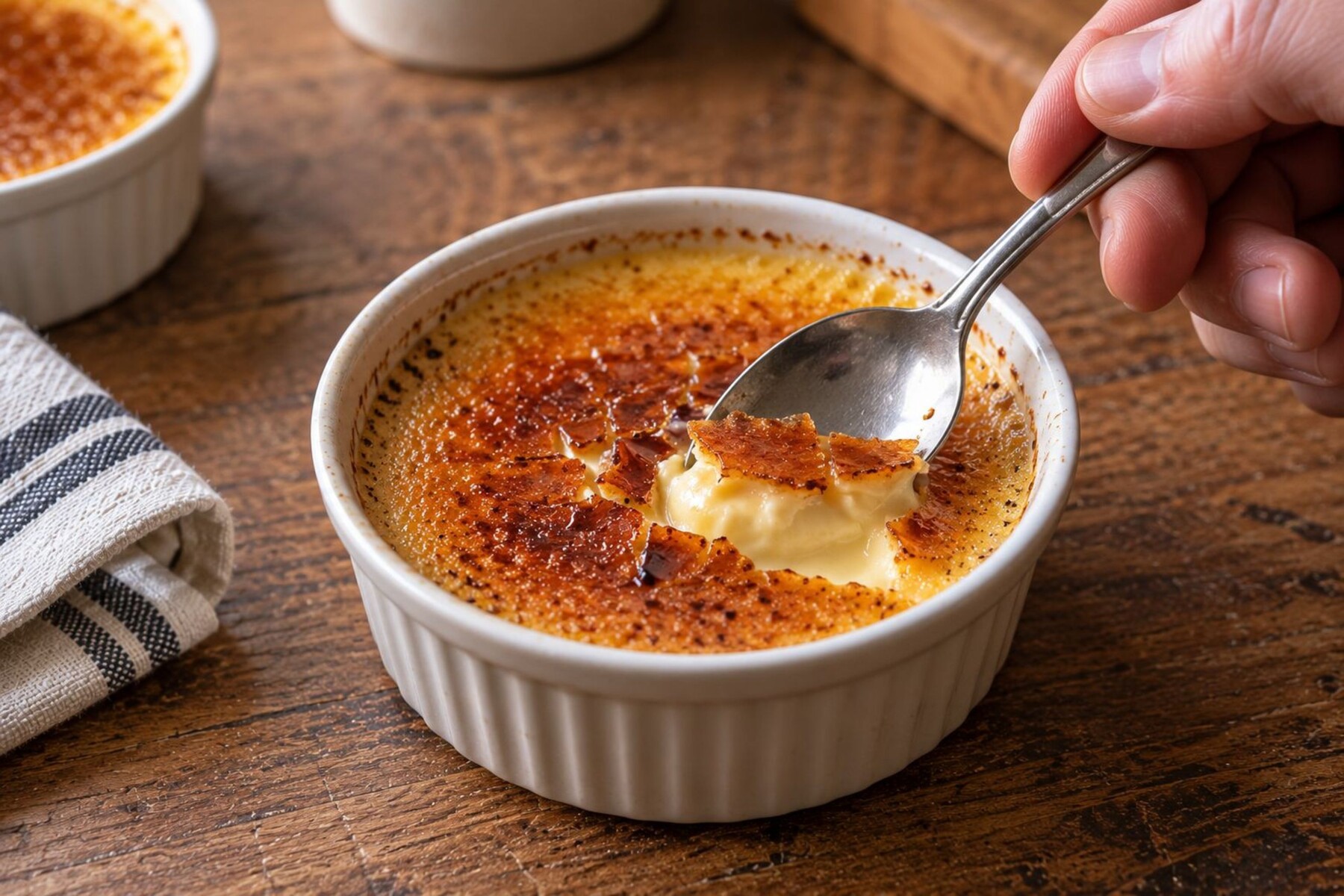
Crème brûlée has ideal contrast built right in: a brittle caramel glass atop silky custard.
Not every sudden shift in mouthfeel is pleasant, either. A stray piece of cartilage in tender meatballs, grit in salad greens, a fragment of eggshell in a cookie, or a fibrous piece of vegetable skin in a silky bisque all provide contrast, yet the diner registers them immediately as flaws. Textural interplay must feel intentional and controlled so the palate reads it as part of the design rather than a kitchen accident.
Flavor harmony remains non-negotiable, too. Pumpkin soup calls for garnishes that echo its autumnal warmth, just as dark chocolate demands companions that flatter cocoa. Texture answers how an ingredient feels, but flavor still has to justify why it was invited to the plate.
Finding the Right Ratio of Crunch
No universal formula dictates that exactly one-third of a dish must crunch. Function is a better guide: the contrasting element should appear often enough to keep the palate engaged without stealing the spotlight from the main component.
If the first spoonful leaves a diner thinking only about chewing through a mountain of nuts or croutons, the hand was too heavy. If a lone crunchy bit shows up at the very bottom of the bowl, it was too light. Well-calibrated contrast punctuates the primary texture intermittently without staging a takeover.
Does Temperature Count as Texture?
Strictly speaking, temperature is a separate sensory property. On the plate, however, thermal contrast heightens excitement just as effectively as crunch. Warm apple pie à la mode, hot roasted potatoes dolloped with cold sour cream, and molten chocolate cake paired with chilled cream all thrive on the interplay of hot and cold.
The same rule of restraint applies here: the more sensory tricks crowded onto a single plate, the harder it becomes to keep them balanced. Contrast elevates a meal right up until the moment it tips into chaos.
Five Pantry Staples for Instant Contrast
Keeping an exhaustive arsenal of toppings is unnecessary. A small rotation of storable staples covers almost any situation at the stove.
Toasted breadcrumbs (pangrattato). Stale bread pulsed into crumbs and sizzled in olive oil with salt forms a blank canvas for garlic, lemon zest, fresh herbs, anchovy, or chili flakes. It is unbeatable whenever a dish needs a fine, dry crunch.
Toasted nuts. Storing them whole in an airtight container and chopping them to order makes it easy to match the exact scale of the dish.
Seeds. Pumpkin, sunflower, and sesame seeds deliver instant texture with almost zero prep.
Quick-pickled onions. Instead of dry crispness, they bring a juicy snap paired with bright acidity—ideal for cutting through rich, heavy plates.
Homemade croutons. Baking them until thoroughly dry and storing them away from moisture guarantees a reliable crunch on demand.
Quick Reference: Matching the Base to the Contrast
| Primary Texture | What Is Often Missing | What to Try |
|---|---|---|
| Creamy | Brittleness / Snap | Toasted crumbs, seeds, croutons |
| Soft and Fibrous | Crispness | Crispy fried onions, radish, cucumber |
| Rich and Fatty | Fresh, juicy crunch | Pickled vegetables |
| Crispy and Dry | Creaminess | Pan sauce, aioli, smooth purée |
| Fried | Juiciness | Fresh salsa, raw vegetables, bright sauce |
| Smooth Dessert | Fragile shatter | Caramel shard, wafer, chopped nuts |
| Braised / Stewed | Freshness and bite | Crisp cabbage, raw onion, cucumber |
The Final Check Before Serving
Pausing before carrying a plate to the table allows for three quick mental questions. What is the dominant texture here? Does it need a counterpoint? And if it does, will that contrast survive until the first bite? Answering those three questions is usually enough to know whether to reach for a finishing touch or leave the dish alone.
When a dish felt unfinished in the past, the automatic habit was to search for the missing piece in the flavor profile: another pinch of salt, a squeeze of lemon, a crack of black pepper, a dusting of Parmesan. Sometimes that instinct is spot on. Just as often, though, the salt and acid are already balanced, and the real issue is that the mouth experiences the exact same sensation from the first bite to the last. At that point, the plate is asking for a shift in sensation rather than another seasoning.
That shift does not always have to be loud crunch. Some dishes call for a delicate shatter, others for crisp freshness, and still others for a pool of velvet sauce. Great textural contrast never begs for solo applause; it simply makes reaching for the next forkful irresistible.
0 comments