
The walls of an old smokehouse feel tacky to the touch. A dark brown residue builds up on them over decades, giving off a pungent aroma that lingers on a jacket even after three washes. That residue is settled smoke condensate—what wood smoke leaves behind as it cools.
The food industry makes liquid smoke from this exact same condensate.
Shoppers who wince at the words “smoke flavoring” on a sausage label usually view traditional chamber smoking as the gold standard. Yet both methods share the same raw material. Furthermore, wood smoke contains hundreds of distinct chemical compounds, and several of them landed on regulatory watchlists decades ago, with strict legal limits governing their presence in smoked foods.
So, is liquid smoke actually more dangerous than a traditional smokehouse? There is no short answer, and the long one turns out to be inconvenient for both sides of the debate.
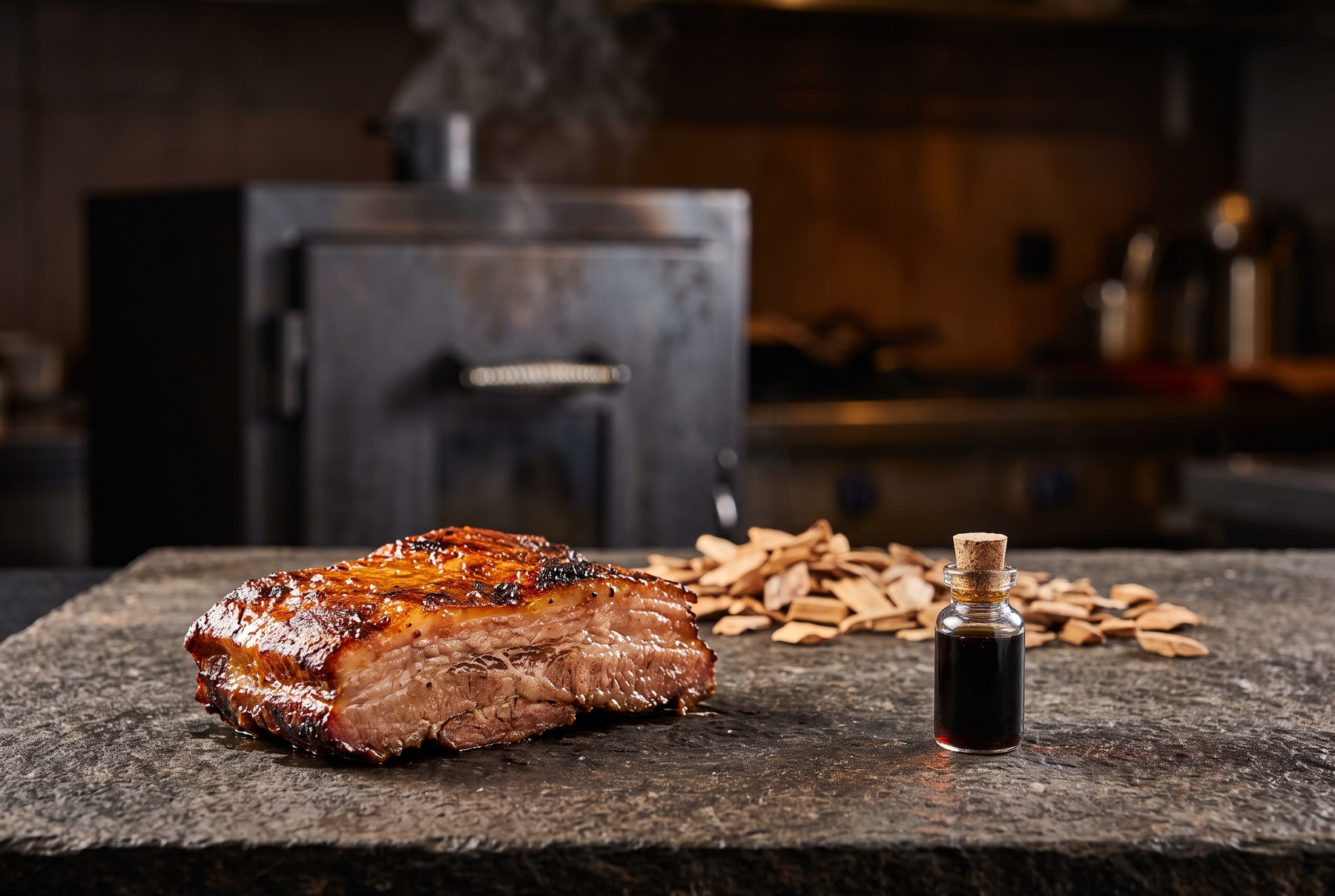
Smoked meat and liquid smoke share the exact same raw material origins, differing mainly in how thoroughly producers filter out heavy tars.
Table of Contents
How Liquid Smoke Is Made
Smoldering, Condensation, and Filtration
Producers burn hardwoods—such as beech, alder, oak, or hickory—until they smolder at tightly controlled temperatures with limited oxygen. They channel the resulting smoke through water or an alcohol-based liquid, then fractionate and purify the mixture. During fractionation, technicians separate the liquid into distinct components based on boiling points and molecular weight, discarding the unwanted heavy tars.
Regulatory documents refer to the remaining liquid as a “primary product.” Manufacturers blend this base into finished commercial flavorings by adding a carrier such as water, oil, salt, or maltodextrin powder.
Phenols drive most of the aroma; these are the exact compounds that give smoked fish its distinctive, slightly medicinal, campfire tang. Carbonyl compounds (aldehydes and ketones) create the golden-brown crust by reacting with the proteins on the food’s surface. This is the exact same chemical reaction that bronzes the skin of a mackerel hanging in a traditional smoking cabinet.
Food safety regulations in both Europe and the Eurasian Economic Union (a trade bloc of post-Soviet states) define smoke flavorings the same way: a mixture isolated from traditional wood smoke by fractionating and purifying condensates. Chemists do not synthesize anything from scratch.
In terms of raw material origin, the bottle and the smokehouse are indistinguishable.
Why Manufacturers Choose the Bottle Over the Chamber
Traditional chamber smoking is notoriously fickle. Woodchip moisture, airflow, outside air temperature, and how tightly the racks are loaded all play a role; two batches of pork belly from the exact same smokehouse can emerge with noticeably different colors and smoke intensity. Liquid flavoring delivers strict repeatability that food scientists can write into a production spec sheet and verify in a quality-control lab.
Hygiene and logistics also tip the scale: factories do not need to build dedicated smoking chambers, scrape hardened creosote tar off walls, or push exhaust smoke through industrial scrubbers.
Food technologists originally championed liquid smoke for another major reason: safety. Purifying the condensate strips out a massive portion of polycyclic aromatic hydrocarbons (PAHs)—the tarry, carcinogenic compounds that form whenever organic matter burns incompletely. According to assessments by Germany’s Federal Institute for Risk Assessment (BfR), foods made with purified smoke flavorings generally contain far lower levels of these hydrocarbons than traditionally smoked meats.
However, the bottle cannot replicate every function of a smokehouse. Real smoke dries out the surface of the meat while depositing natural acids and phenols that slow down microbial growth. Liquid flavoring works purely for taste and color, leaving the sausage’s shelf life entirely dependent on salt, sodium nitrite, refrigeration, and vacuum packaging.
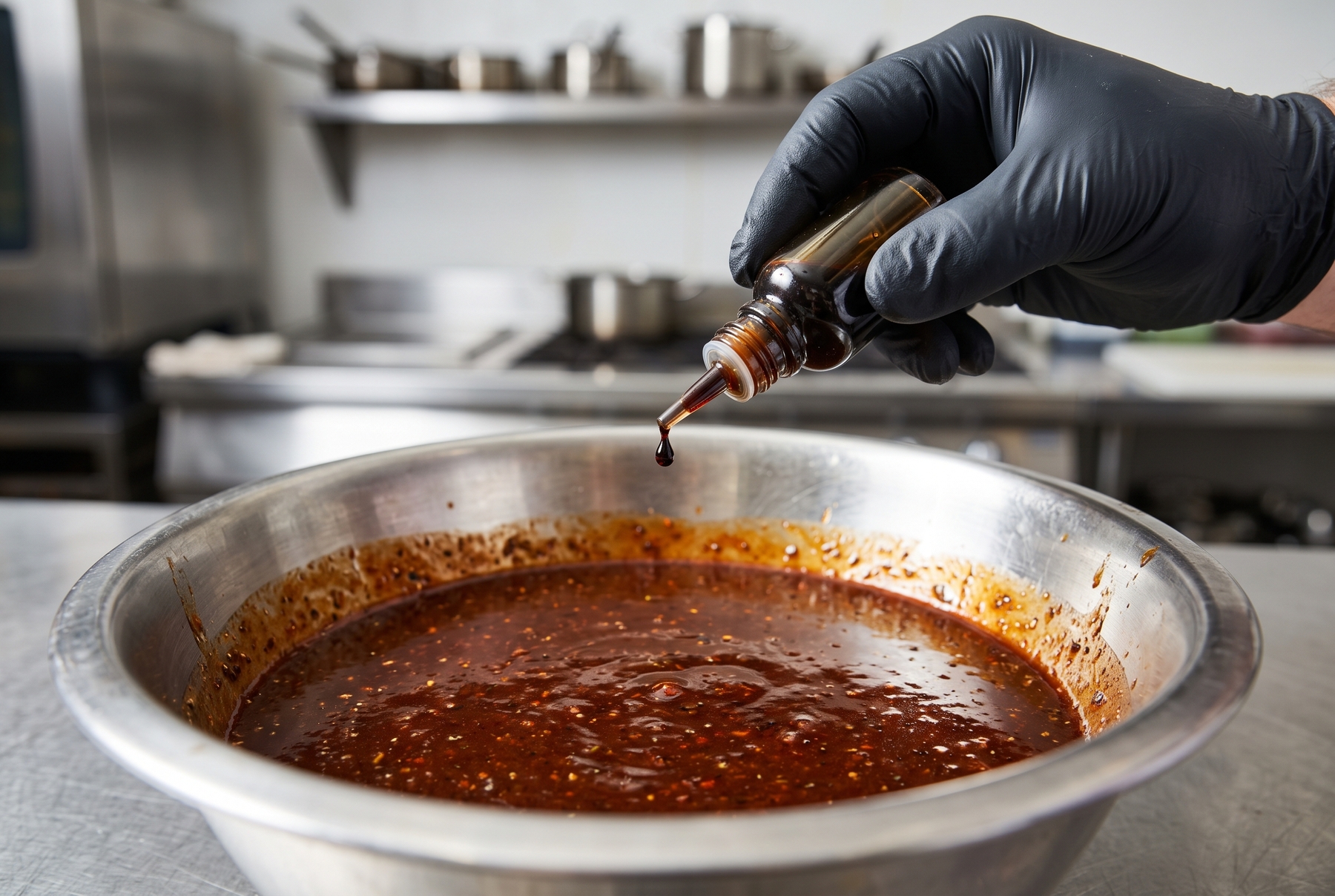
Adding liquid smoke requires precise dosing; just a few extra drops introduce a harsh bitterness and an unpleasant medicinal note.
Where the Fears Come From
“If It Says ‘Smoke,’ It Must Have Carcinogens”
Tarry hydrocarbons show up on backyard charcoal grills, inside rustic smokehouses, and along the blackened edges of burnt toast. The most notorious of these compounds is benzo[a]pyrene, which toxicologists use as a marker for the entire PAH group.
In the Eurasian Economic Union, regulators cap benzo[a]pyrene in smoked meats at 0.001 mg/kg. That equals one microgram per kilogram (about 0.000000016 oz per lb)—one part per billion by weight. Baby food regulations ban it entirely. The European Union regulates both benzo[a]pyrene alone and the combined total of four related PAHs, setting maximum limits for smoked meat at 2 and 12 micrograms per kilogram (2.2 lbs), respectively.
On this specific metric, purified condensate easily beats raw chamber smoke. The heavy tars that settle directly onto meat in a traditional smokehouse get filtered out during the industrial fractionation stage.
Worrying about tarry hydrocarbons makes scientific sense, but the little bottle of liquid smoke is not the primary culprit.
“It Is Pure Chemistry”
In everyday conversation, people use the word “chemical” as a synonym for poison. In reality, the word says nothing about safety. The aroma of freshly roasted coffee comes from hundreds of volatile chemical compounds, yet nobody calls a morning espresso a chemical cocktail.
Conversely, “natural” does not automatically mean “harmless.” Traditional wood smoke is entirely natural, yet its chemical complexity and toxicity profile easily outstrip almost any commercial food additive.
Food marketers understood this psychology decades ago and constantly play with phrasing. “Pyrocatechol” sounds menacing on a label, whereas “natural beechwood smoke extract” sounds rustic and cozy—even though both terms can describe the exact same bottle. (During my food science training in Belgium, instructors ran us through blind tastings, and even trained palates struggled to consistently tell traditional smoking apart from liquid condensates.)
How Liquid Smoke Differs From Traditional Smoking
Uniform Flavor Distribution
Smoke in a chamber works over several hours, penetrating slowly from the outside in. The meat loses moisture while its surface dries out, creating a distinct flavor gradient: the outer crust smells intensely smoky, while the meat near the bone remains mild. When processors mix liquid flavoring directly into ground meat or brine, the smoke profile distributes evenly throughout the entire batch.
This difference is obvious as soon as you slice the meat. An industrial cooked-and-smoked sausage (a staple deli style in Eastern Europe where emulsified sausages are steamed and then smoked) tastes identical at the dead center and along the casing. In a slab of chamber-smoked bacon, the outer edge is darker, firmer, and carries a completely different aromatic punch than the center.
Overdosing is another clear giveaway. Concentrated smoke allows zero margin for error: a few extra drops introduce an acrid bitterness and a medicinal, band-aid note that neither salt nor acid can mask.
Safety: What Changed in 2023
Up until 2023, the scientific consensus favored liquid smoke flavorings: fewer tarry hydrocarbons, exact dosing, and clean laboratory oversight. Then, the European Food Safety Authority (EFSA) re-evaluated eight primary smoke products whose market authorizations were up for renewal, applying a much stricter testing methodology.
Under EFSA’s updated framework, if even a single component within a complex mixture damages DNA in live organism studies, regulators must treat the entire mixture as potentially genotoxic.
Scientists identified furan-2(5H)-one in six of the eight commercial smoke condensates, and they could not rule out its potential to damage DNA. Four of those six products also contained pyrocatechol, which raised the exact same red flag. Both compounds form naturally whenever wood breaks down under intense heat. In the autumn of 2023, EFSA delivered its verdict: based on current data, researchers could not rule out genotoxicity risks, meaning the agency could not confirm the safety of any of the eight evaluated primary products.
Germany’s Federal Institute for Risk Assessment (BfR) pointed out a crucial context that most news headlines missed: those exact same DNA-damaging compounds are completely expected in traditional smokehouse meats, too. The liquid smoke hadn’t changed over the past decade. What changed were the analytical tools—more sensitive tests replaced older DNA-damage assays—and the regulatory rules governing complex chemical mixtures.
For substances that directly damage DNA, toxicologists cannot establish a safe threshold dose. At the same time, calculating the exact real-world risk remains difficult, especially because fractions of these complex smoke condensates still remain chemically unidentified.
The updated review process flagged compounds present in both the bottle and traditional wood smoke. Even so, regulators did not equate the legal status of traditional smokehouses with commercial flavorings.
Where Liquid Smoke Hides in the Grocery Store
Shoppers encounter smoke condensates across dozens of aisles: cooked-and-smoked sausages, frankfurters, bacon, and pork belly; vacuum-packed mackerel, herring, and salmon; processed and brined cheeses labeled “smoke-flavored”; barbecue sauces, bacon-flavored potato chips, savory snacks, instant noodles, marinades, and plant-based meat alternatives. Plus, of course, the standalone bottles sold in the condiment aisle.
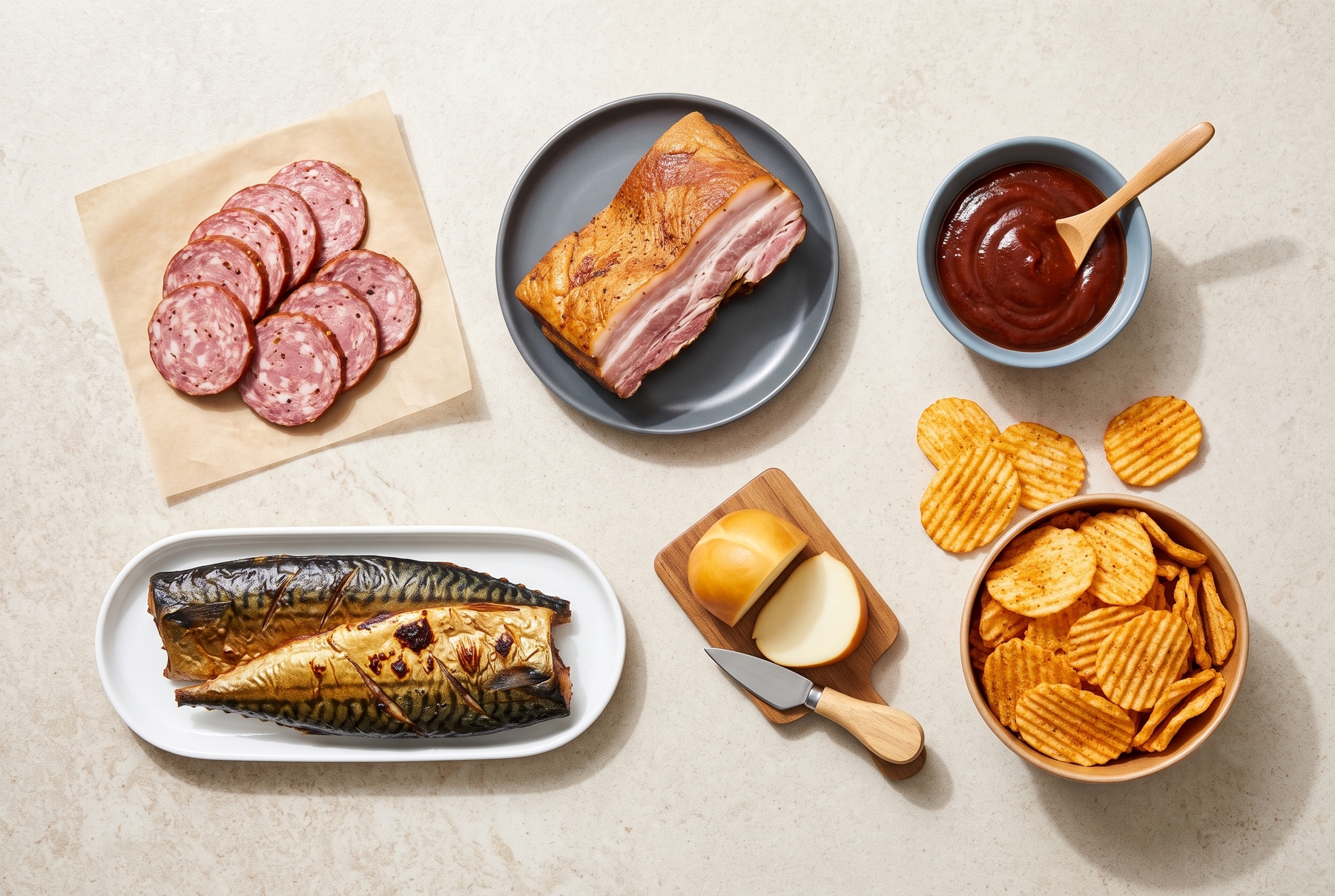
Food manufacturers widely use liquid smoke and smoke condensates in sausages, fish, cheeses, barbecue sauces, and savory snacks.
Reading the Label: What Matters More Than “Smoke Flavoring”
An ingredient list tells you how a food was made, not how unhealthy it is. Avoiding smoke flavoring at the supermarket is easy enough, but swapping the package rarely changes the nutritional reality: a traditionally smoked sausage without added flavorings is still a processed meat packed with the exact same levels of salt and saturated fat. Reading the label is far more useful when you focus on the big picture of what is actually inside the package:
- Salt per 100 g (3.5 oz): in smoked meats and fish, sodium levels impact cardiovascular health far more directly than any trace aromatic additive;
- Fat and sugar, especially in commercial barbecue sauces, where sugar frequently claims the second spot on the ingredient list;
- Ingredient order: regulations require manufacturers to list ingredients by descending weight, and smoke flavoring almost always sits at the very end, meaning it makes up mere fractions of a percent;
- Product naming conventions: legally, “smoked” and “smoke-flavored” signal two entirely different manufacturing processes;
- Sodium nitrite in cured meats: the preservative responsible for both preventing botulism and locking in that classic pink deli color.
Seeing “smoke flavoring” at the tail end of an ingredient list simply reveals the factory technology. Salt, fat, and nitrites are what actually determine how that food fits into a healthy diet.
What the Regulators Decided
Following EFSA’s scientific opinions, the European Commission declined to renew the market authorizations for these additives. A regulation passed on July 31, 2024, officially delisted all ten registered primary smoke products in the EU (manufacturers of two products didn’t even bother applying for renewal).
European lawmakers split the phase-out transition periods by food category:
- Until July 1, 2026, for products where manufacturers add liquid smoke purely for flavor: savory snacks, soups, sauces, and ready-to-eat meals;
- Until July 1, 2029, for categories where liquid condensates partially or fully replace traditional chamber smoking: cheeses, meats, processed fish, and roe.
With the first deadline rapidly closing in and the second still years away, smoke-flavored cheeses and sausages remain on European supermarket shelves for now.
Meanwhile, in the Eurasian Economic Union, smoke flavorings remain legal under existing technical regulations, and authorities have not introduced a ban mirroring the EU’s phase-out. Even within the European Union, the ban targets those specific registered primary condensates rather than outlawing the entire concept of purified smoke technology forever.

EFSA laboratory evaluations highlighted genotoxicity risks in specific liquid smoke components, prompting a phase-out by European regulators.
Is Liquid Smoke Dangerous? The Bottom Line
On its own, liquid smoke is no more dangerous than traditional chamber smoking—and when it comes to heavy, tarry hydrocarbons, it is usually much cleaner. The real issue is the company it keeps: in processed meats, smoke flavoring sits alongside high levels of salt, saturated fat, and nitrites, a nutritional trio that epidemiologists understand far better than any trace flavoring. The International Agency for Research on Cancer (IARC) classified processed meat as a Group 1 human carcinogen back in 2015, and the words “smoke flavoring” on the label had nothing to do with that verdict.
Dietary frequency matters far more than the mere presence of the additive. Stirring a few drops of liquid smoke into a home marinade once a month and eating 100 g (3.5 oz) of smoked deli sausage every single morning belong in completely different risk categories.
For home cooks who keep a bottle in the pantry, liquid smoke works best in micro-doses: just a few drops per 500 g (1.1 lbs) of marinade, whisked in thoroughly rather than drizzled on top. An overdose betrays itself instantly with a harsh, acrid bite on the tongue.
Cooks can also build deep, smoky notes without reaching for the bottle: Spanish smoked paprika (pimentón), Lapsang Souchong black tea steeped into a brine (producers dry the tea leaves over pinewood fires), or a hard, dark sear in a screaming-hot cast-iron skillet all do the trick. In fairness, cold-smoked paprika also contains tarry hydrocarbons—Germany’s BfR even published a separate risk assessment on it years ago. Smoke flavor is, by definition, a byproduct of combustion; it is never chemically sterile.
For now, European makers of smoked cheeses and sausages have until July 1, 2029, to reformulate—after which their labels will either reflect a return to real wood smoke or debut a newly approved condensate that wasn’t on the old regulatory list.
0 comments