
A specific kind of disappointment arises when you expect one thing and receive another. You walk into a place with a “Ramen” sign, see the correct bowls, neon kanji on the wall, and a waiter in a Japanese-print apron. You sit down, order, and they bring you… noodle soup. It is salty, hot, and generally edible. But it is not ramen.
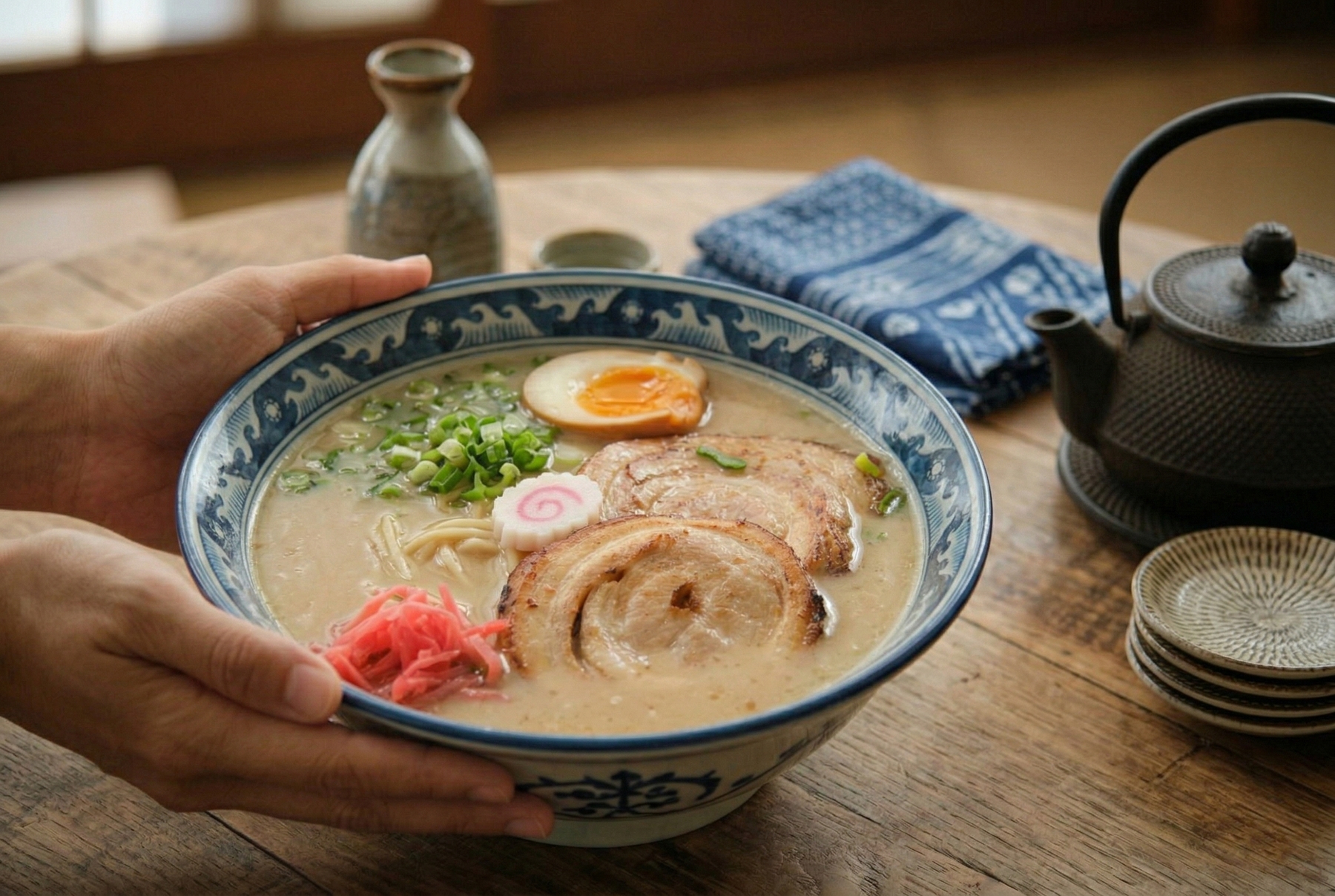
A classic ramen showcasing perfect architecture features bouncy noodles, tender chashu pork, and a marinated egg immersed in a rich broth.
I have eaten ramen in Tokyo’s Shitamachi district, in tiny shops the size of a train compartment where the sole chef stands three steps away, and you can hear him slicing the meat. I tasted it in Osaka at spots with queues forming at six in the morning. I had cheap bowls at the station in Hakata and expensive ones in trendy Shibuya venues displaying a Michelin plaque. And yes, I have tried ramen shops in Moscow, Madrid, and Amsterdam. The gap between the genuine article and an imitation becomes instantly apparent. It reveals itself literally at first glance at the bowl.
Ramen functions as an ensemble. It features several independent layers, each prepared separately and assembled in a strict order following a specific logic. If a chef treats even one element carelessly, the entire melody collapses. Below, I will explain where cooks most frequently hit false notes.
Table of Contents
Sign 1. Broth Without Body
Pouring a glass of water, adding salt, and dropping in a pinch of MSG perfectly illustrate the taste of a bad ramen broth: intensity without depth, salt without body.
A proper *tonkotsu* (a rich broth made by boiling pork bones) is an entirely different substance. Pork bones boil not just for a long time, but extensively at high temperatures, allowing the collagen to largely transition into the broth. The fat breaks down into minute particles and remains suspended. This creates an emulsion, not simply a fatty stock. In terms of density, proper *tonkotsu* resembles liquid milk more closely than water. Pouring it into a glass reveals an opaque liquid. Taste-wise, it defies the conventional notion of “strong meat broth.” A good *tonkotsu* delivers not only density but also roundness, the sweet depth of bones, and a richness that does not float separately on top but gathers into a unified, almost creamy sensation.
A thin film forms on the surface of a good bowl of broth a few seconds after serving. This fat layer might look strange to the uninitiated, but the fat retains the heat. It is a good sign.
You can check this immediately by tilting your spoon to see how the broth drips. A watery broth flows quickly and cleanly. A normal one leaves a slight trail and stretches a bit. If it flows like water, the broth suffers from dilution or a quick two-hour simmer using a concentrate.
Flavor intensity presents another issue. Not every ramen style needs to be as dense as *tonkotsu*. Styles like *shoyu* (soy sauce-based) or *shio* (salt-based) can be transparent. However, even a transparent broth must exhibit layering: the top note from the *tare* (the concentrated flavor base, which I will explain later) arrives first, followed by a long aftertaste from the base. A bad ramen delivers a single flavor that vanishes instantly.
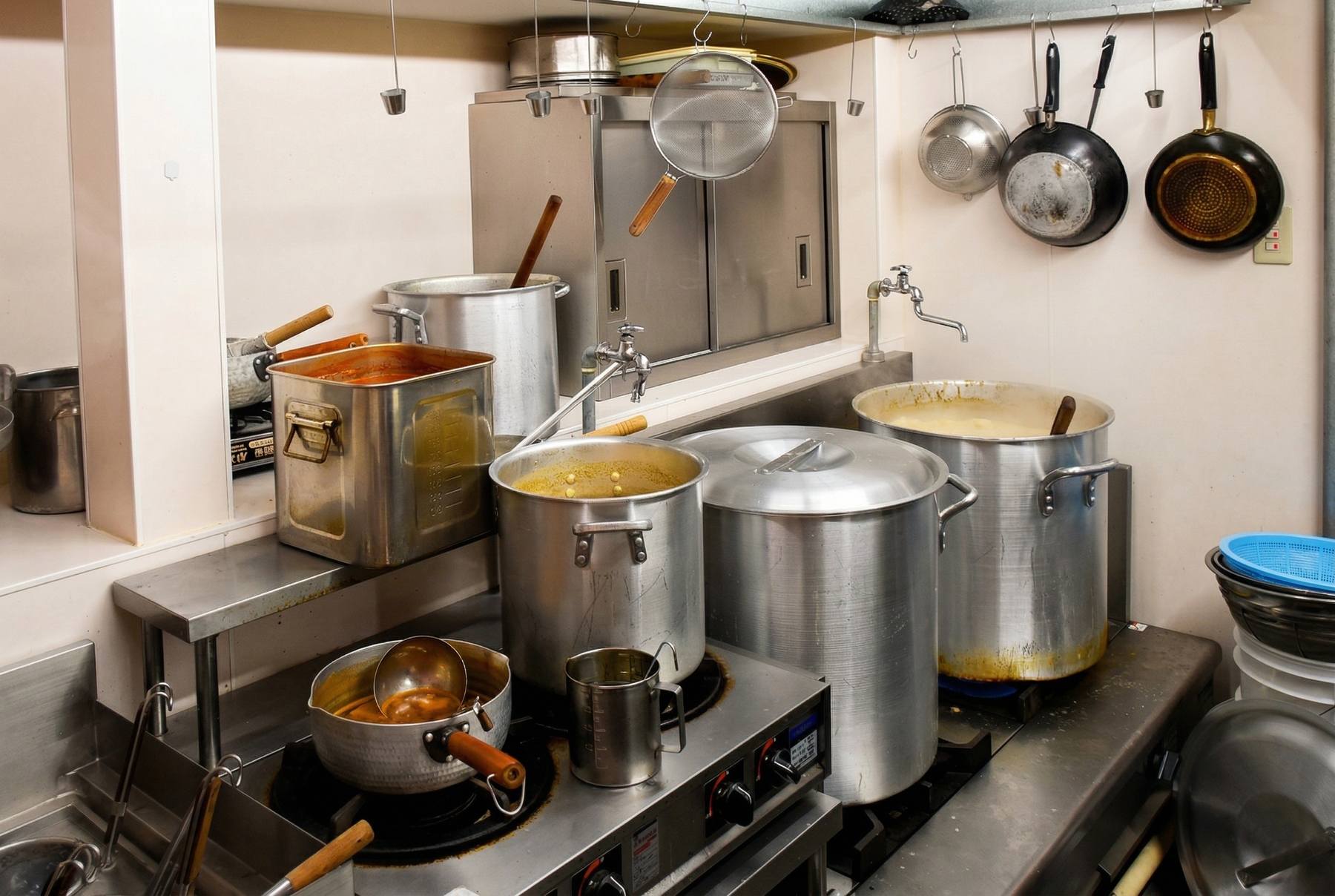
The secret of authentic ramen lies in the broth, which simmers for long hours to achieve ideal density and flavor.
Sign 2. Noodles Without Elasticity
One of the most persistent ramen myths suggests that the noodles can vary—rice, buckwheat, or glass. They cannot. Classic ramen features wheat noodles exclusively. The specific character comes from the dough mix: makers add *kansui*, an alkaline mineral water containing sodium or potassium carbonate and bicarbonate. This *kansui* imparts elasticity and that slight slipperiness as the noodles move through the broth. The dough contains no eggs. The alkaline reaction produces the yellow color, not egg yolks.
A good ramen shop, especially a Hakata-style one, will ask about your preferred noodle texture: *katame* (firm), *futsu* (standard), or *yawaraka-me* (soft). Hakata, the birthplace of *tonkotsu*, popularizes *barikata*: very firm, almost crunchy in the center. If they do not ask, it is not necessarily a bad thing, but it remains a telling detail.
Bad noodles look pale and washed out. They suffer from overcooking or being cooked in advance. The surface feels slimy rather than springy. Picking up a bunch with chopsticks reveals they cannot hold their shape—they simply stretch and break.
Noodles continue to cook in the bowl after serving. The hot broth ensures that every extra minute makes them softer. This fact dictates how you should conduct yourself over the bowl.
Etiquette Guide: Eating Ramen for the First Time
The five-minute rule applies literally: servers deliver ramen piping hot, and after five minutes, the noodle texture begins to change. The Japanese treat this seriously, without irony. The moment the bowl touches the table, conversation takes a back seat. Chatting while the noodles swell in the broth simply breaks the norm. You eat first, then talk.
Loudly slurping noodles (*zuzutto*) does not indicate bad manners. Drawing the noodles in with air pulls the aroma through the nasopharynx, allowing the broth to unfold entirely differently from when eaten with a spoon. A similar process occurs during wine tasting. People do not condemn this; instead, they consider it the proper way. Slurping boldly in a ramen shop shows no awkwardness, but rather signifies that the diner understands exactly why the bowl sits before them.
Many proper ramen shops let you request *kaedama*—an extra portion of noodles for free or a nominal fee. But a rule applies: you must order it while broth still remains in the bowl. Will they pour you more broth? Never. That lies at the heart of the matter: you must pace yourself to finish the precious broth to the last drop, not the other way around.
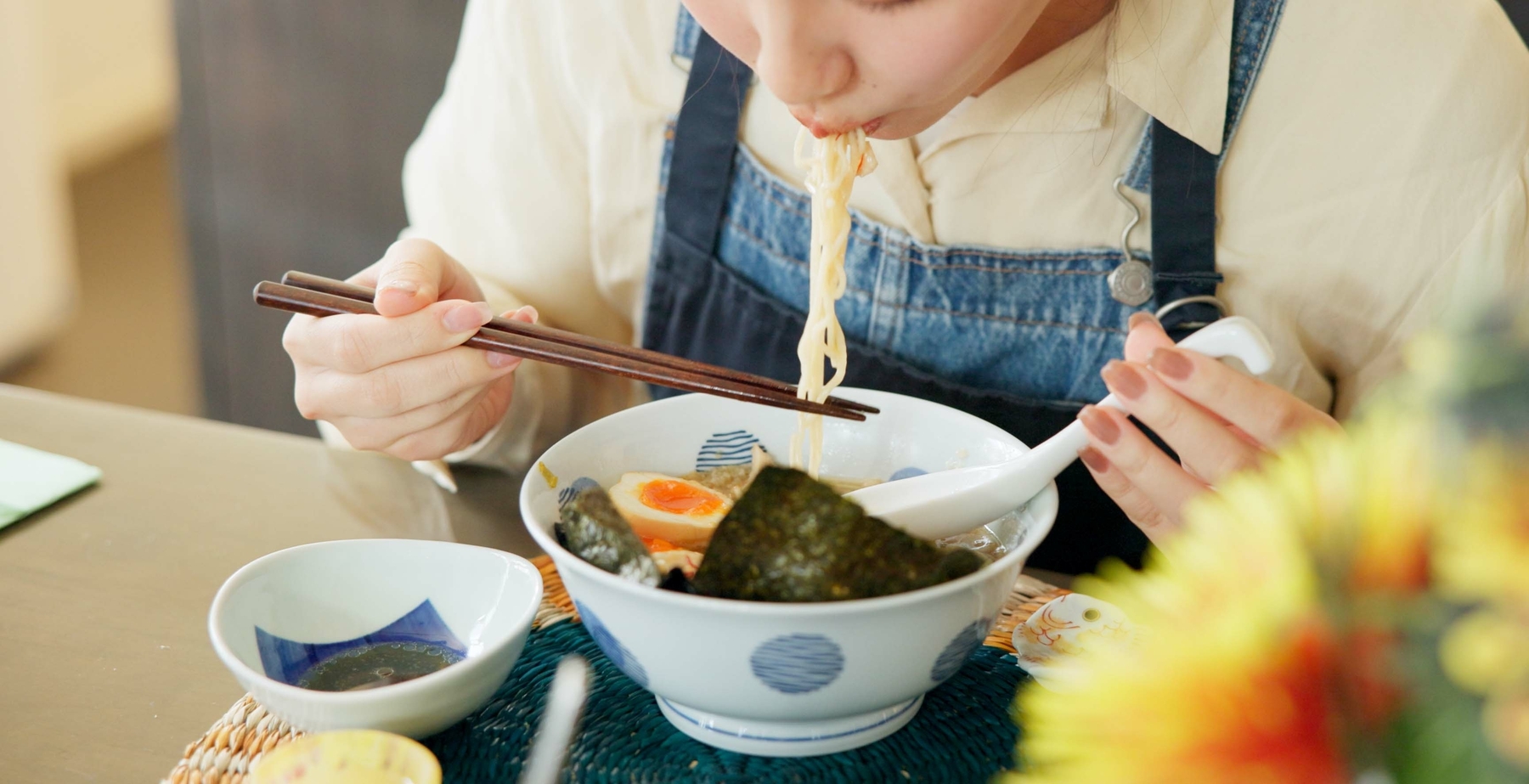
Slurping noodles with a characteristic sound acts not just as a tradition, but as a method to better experience the aroma and flavor.
Sign 3. Meat You Have to Chew
*Chashu* (derived from Chinese *char siu* but prepared differently) consists of pork belly or loin, rolled, tied, marinated, and prepared through slow braising or even confit, depending on the establishment’s style. Properly prepared *chashu* springs back slightly under a gentle chopstick press and immediately begins to fall apart along the fibers. You do not need to chew it. It melts on its own.
Bad ramen meat looks like this: the edges appear even and dried out, the cross-section shows a gray or uniformly brown color to the very center, and the texture feels dense. If you pick it up with chopsticks and it holds its shape perfectly, you are dealing with boiled pork that someone sliced and placed on top. It is not true *chashu*.
The serving temperature of the meat raises another issue. *Chashu* should arrive warm. Chefs either add it to the hot broth at the last moment or warm it up slightly beforehand. A cold piece in hot broth means the meat simply sat in the fridge and went straight into the bowl.
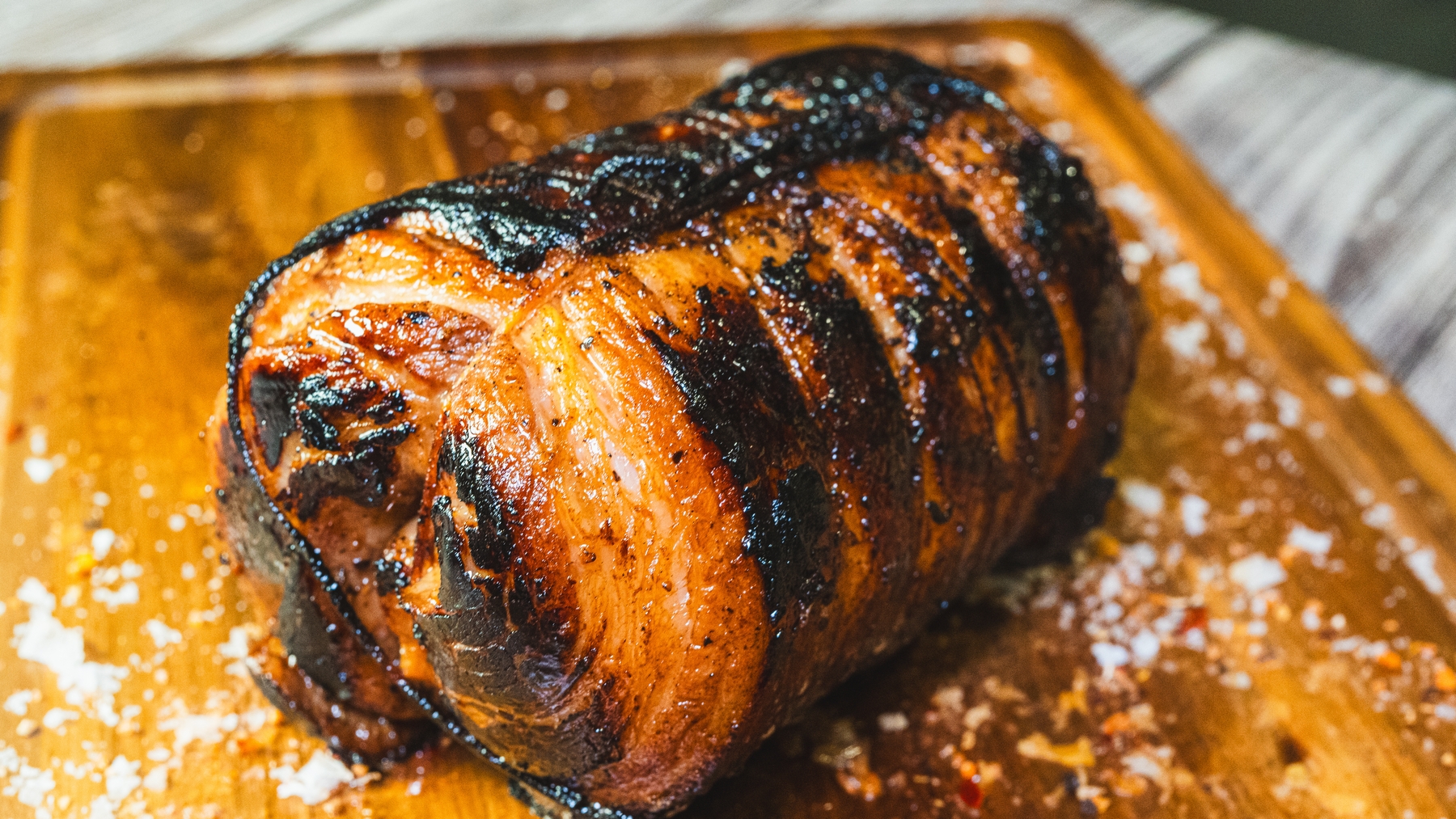
Properly prepared chashu remains incredibly tender and easily falls apart along the fibers when pressed.
Sign 4. The Gray Egg
*Ajitama* (a soft-boiled marinated egg) serves as another ramen element that proves almost impossible to hide or fake. Its condition reveals itself instantly.
A perfect egg boils just long enough for the white to set completely while the yolk remains creamy—neither liquid nor hard. Cut open, the yolk looks like thickened jam: it stretches, holds its shape, and boasts a rich orange color. After boiling, the egg marinates in a mixture of soy sauce, mirin, and sake (sometimes with added *dashi* stock). The white takes on a brown hue on the outside, and the flavor becomes layered: saltiness on the exterior, yolk richness on the interior.
A gray ring around the yolk indicates overcooking. Excessive heat causes the sulfur in the white to react with the iron in the yolk, producing that characteristic grayish-green tint. An egg with a gray ring suffered from overcooking.
If the yolk feels hard and crumbles, it underwent standard hard-boiling without time and temperature control. Marinating cannot fix the texture afterward.
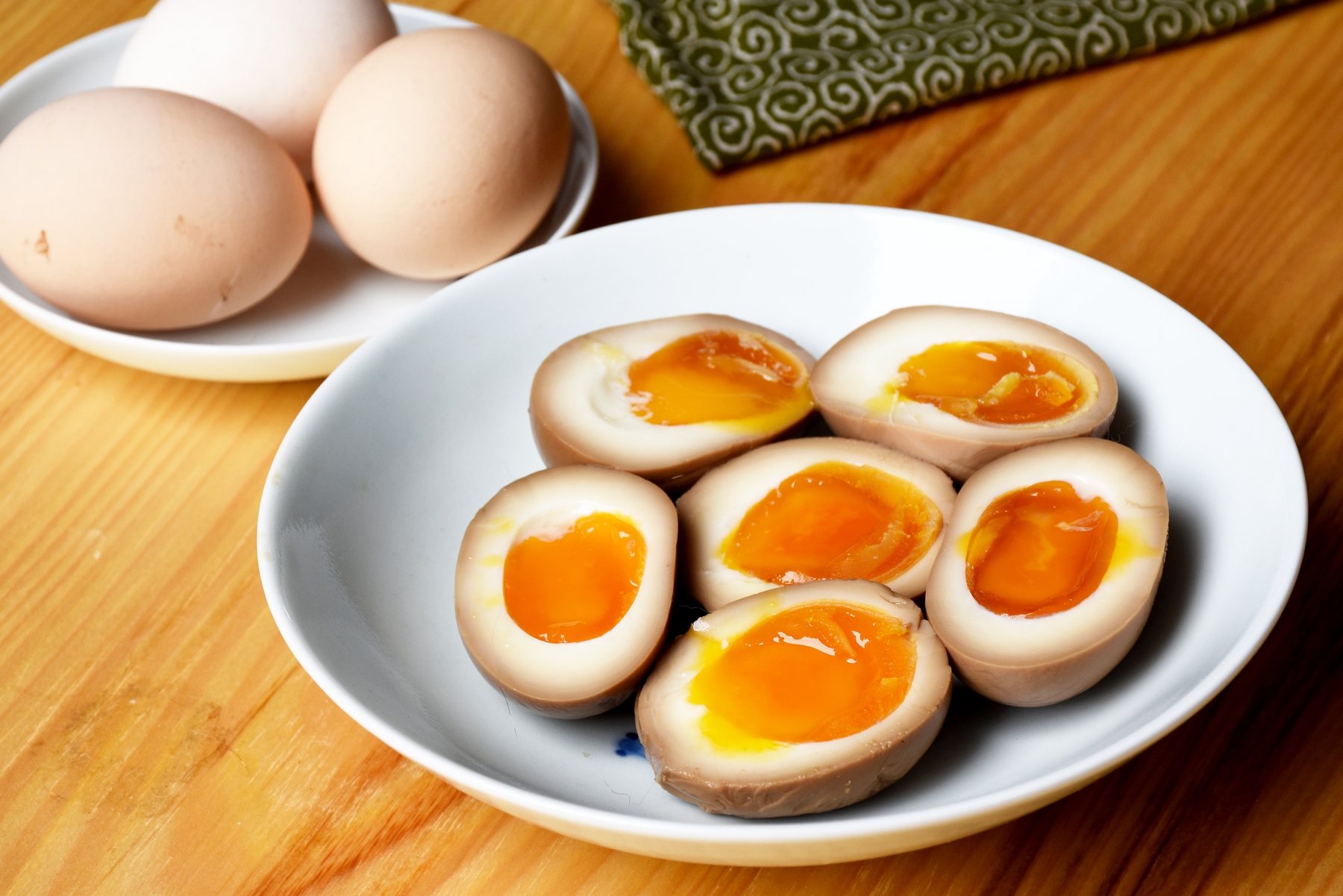
The ajitama egg serves as a crucial quality marker, presenting a yolk with a thick jam consistency and no gray rings.
Sign 5. Chaos in the Bowl
Ramen comes together in a strict sequence. First, the *tare* goes to the bottom of the bowl: this concentrated flavor base consists of a few spoons of thick paste or sauce. The *tare* type defines the style: *shoyu* (soy), *shio* (salt), or *miso*. Next, the chef pours in the hot broth and stirs immediately to dissolve the *tare* evenly. Then, the noodles go in—neatly folded into a bunch. Finally, the toppings arrive: meat, egg, *nori* (seaweed), green onions, *menma* (bamboo shoots), and other specific details depending on the shop.
If everything appears mixed from the start, it shows a hasty assembly or a lack of understanding regarding the sequence’s purpose. The flavor layering provided by correct assembly disappears: the broth mixes prematurely with toppings, the *tare* distributes unevenly, the meat sinks to the depths, and a mountain of corn, bean sprouts, and a slice of *narutomaki* piles up on top.
*Narutomaki* represents a standard traditional topping: a slice of Japanese fish cake with a distinct pink spiral. It signals trouble when it covers half the bowl and clearly functions as camouflage—plenty of pretty things on top hiding an empty broth below.
The quantity of toppings invites endless discussion. A heavily loaded bowl makes an impression. Yet in proper ramen, every element works for flavor, not visual volume.
Nori: How to Handle It Correctly
The sheet of *nori* rests on the edge of the bowl, protruding above the broth. Eating it dry serves no purpose: submerge the edge in the broth for 20-30 seconds, letting it absorb the fat and warm up. Then wrap some noodles in it or eat it alongside the meat. The flavor of *nori* in hot fatty broth transforms it into an entirely different product.
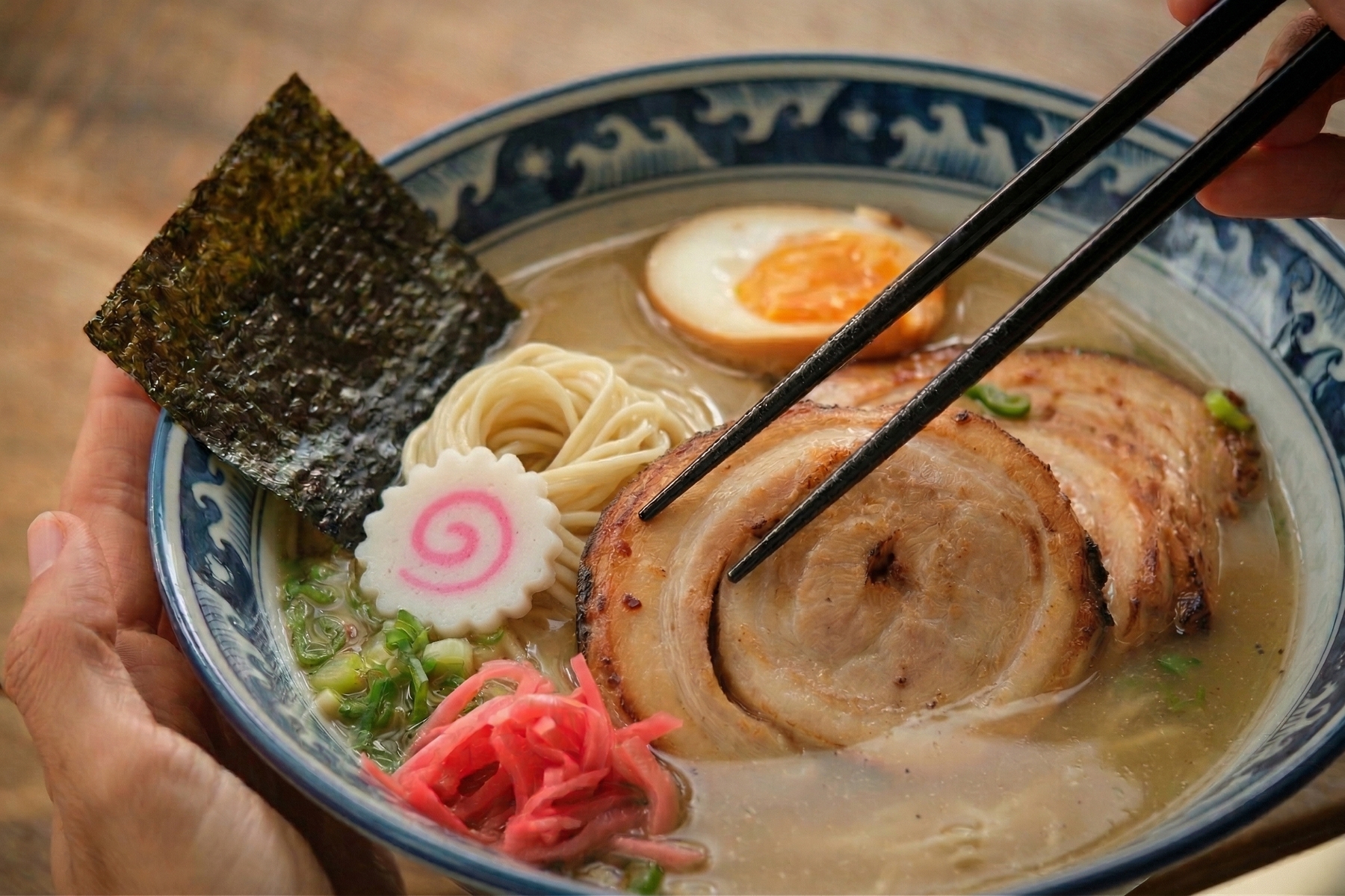
A sheet of nori and other toppings rest neatly on top, emphasizing the dish’s architecture.
Ramen Checklist: The First 30 Seconds After Serving
When the bowl lands in front of you, a brief window opens to assess everything:
- Broth: Opaque and dense (for *tonkotsu*) or transparent but with visible fat layers on the surface—a great sign. Watery and completely transparent in any style—a bad sign.
- Noodles: Slightly yellowish, tightly packed, holding their shape in a bunch. Pale and bloated means overcooked.
- Meat: The edges melt slightly from the hot broth, the cross-section displays a pinkish-gray hue rather than uniform brown.
- Egg: Halved, featuring an orange, creamy yolk. A gray ring explains everything.
- Assembly: Toppings placed carefully, not dumped. Each element clearly occupies its own space.
Usually, all this becomes apparent within the first thirty seconds. Often even sooner.
In a proper spot, all questions vanish after the first spoonful—you fall silent and simply enjoy. A well-assembled bowl of ramen represents more than hot soup; it weaves together richness, salt, fat, umami, textures, and aromas that unfold in sequence.
However, if an internal bargain begins (“the broth runs thin, but the portion looks huge”), you simply have ordinary soup before you. Authentic ramen became a global phenomenon—from Tokyo to New York—because when prepared correctly, it strikes not a single note, but an entire orchestra of flavor nuances. It embodies honest food: either everything works in perfect balance, or it falls apart completely.
1 comment