
Returning from the store and placing eggs in the fridge often sparks a familiar thought. In the supermarket, they sit on regular shelves without any refrigeration. A quick call to a grandmother usually confirms that she has kept eggs on the kitchen counter her whole life without issue. A five-minute internet search reveals two irreconcilable camps: one warns of salmonella, while the other argues that the fridge destroys flavor and ruins the protein structure. Everyone cites personal experience, and everyone remains absolutely certain.
In reality, both camps can be right. They are simply discussing different types of eggs and distinct food safety systems.
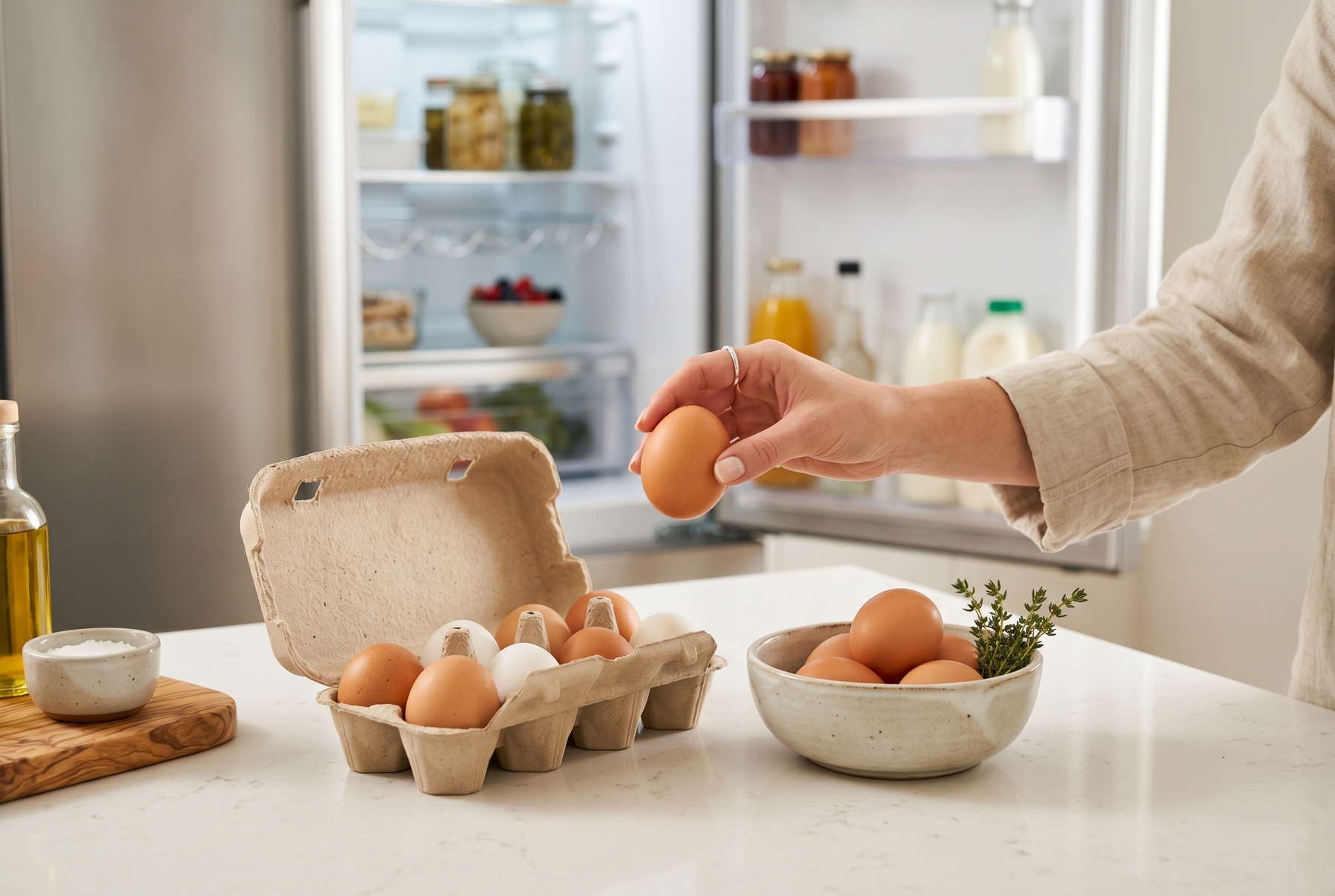
Choosing where to store eggs depends entirely on their commercial processing and how quickly they will be consumed.
Table of Contents
- Why Supermarket Eggs Are Not Refrigerated
- Why Americans Refrigerate Eggs While the French Do Not
- How and Where to Properly Store Eggs at Home
- To Wash or Not to Wash Before Storage
- How to Tell When an Egg Is Past Its Prime
- Egg Shelf Life: Determining Factors
- Common Egg Storage Mistakes
- The Short Answer: What to Do With Eggs at Home
- So Who Is Ultimately Right?
Why Supermarket Eggs Are Not Refrigerated
Unrefrigerated in the Store, Chilled at Home: Finding the Logic
In Russia and most of the CIS (Commonwealth of Independent States), the sight is familiar: eggs sit on a regular supermarket shelf next to grains. There are no refrigerated display cases. The shopper’s logic seems straightforward: if they stay warm in the store, keeping them at room temperature at home should be fine.
However, commercial stores and home kitchens operate under entirely different rules. Supermarkets maintain a stable temperature and have a rapid product turnover. Eggs do not sit there for months. At home, an egg might linger for weeks, warming up from a running oven and then cooling down near an open window. These are completely different environments.
The Main Divide: Washed Versus Unwashed
This distinction holds the answer to most storage questions.
A chicken egg possesses a natural protective layer on its shell. This cuticle is a thin organic film that seals the pores. It remains almost invisible to the eye, though it makes the shell feel slightly matte to the touch. This film acts as a formidable barrier, preventing bacteria from penetrating inside through the pores.
When eggs undergo commercial washing, the cuticle is partially or completely stripped away. Without this cuticle, the pores remain open. Such an egg looks significantly cleaner but loses its natural defense, becoming highly vulnerable to moisture and temperature fluctuations. Therefore, washed and unwashed eggs require completely different storage approaches.
Why Americans Refrigerate Eggs While the French Do Not
The American Model: Washed and Kept Cold
In the United States, legislation requires eggs to undergo mandatory washing and sanitization. Once the cuticle washes away, the entire supply chain—from the poultry farm to your kitchen—must operate at low temperatures. Keeping such an egg at room temperature noticeably increases health risks. This approach stems not from paranoia, but from a consistent system where every safety element connects to the next.
The European Approach: Unwashed and Naturally Protected
In the European Union, the commercial washing of eggs before sale is strictly prohibited. Authorities recognize that removing the cuticle introduces additional risks. Eggs are sold exactly as they are: in their natural protective coating. This type of egg remains much more resilient during short-term storage at room temperature because the natural barrier stays intact.
It is worth noting that a French grandmother keeping eggs in a kitchen basket usually buys smaller quantities and consumes them much faster. This reflects a different rhythm of consumption and a different scale of household management.
What Happens in Russia and the CIS
The situation remains more complex in this region. Commercial eggs from poultry farms undergo sorting and quality control: the shell must be clean, without cracks or visible dirt. Soiled eggs might receive additional treatment with approved solutions. However, this does not mean that all store-bought eggs are thoroughly washed before sale.
Alongside commercial options, consumers frequently buy eggs from local farmers, neighborhood markets, or countryside flocks. A widespread habit of storing eggs on the kitchen counter persists, inherited from times when a village kitchen in March might sit at a chilly 8°C (46°F).
Today’s urban kitchen—equipped with heated floors, running ovens, and direct sunlight streaming through apartment windows—differs drastically from a traditional village house.
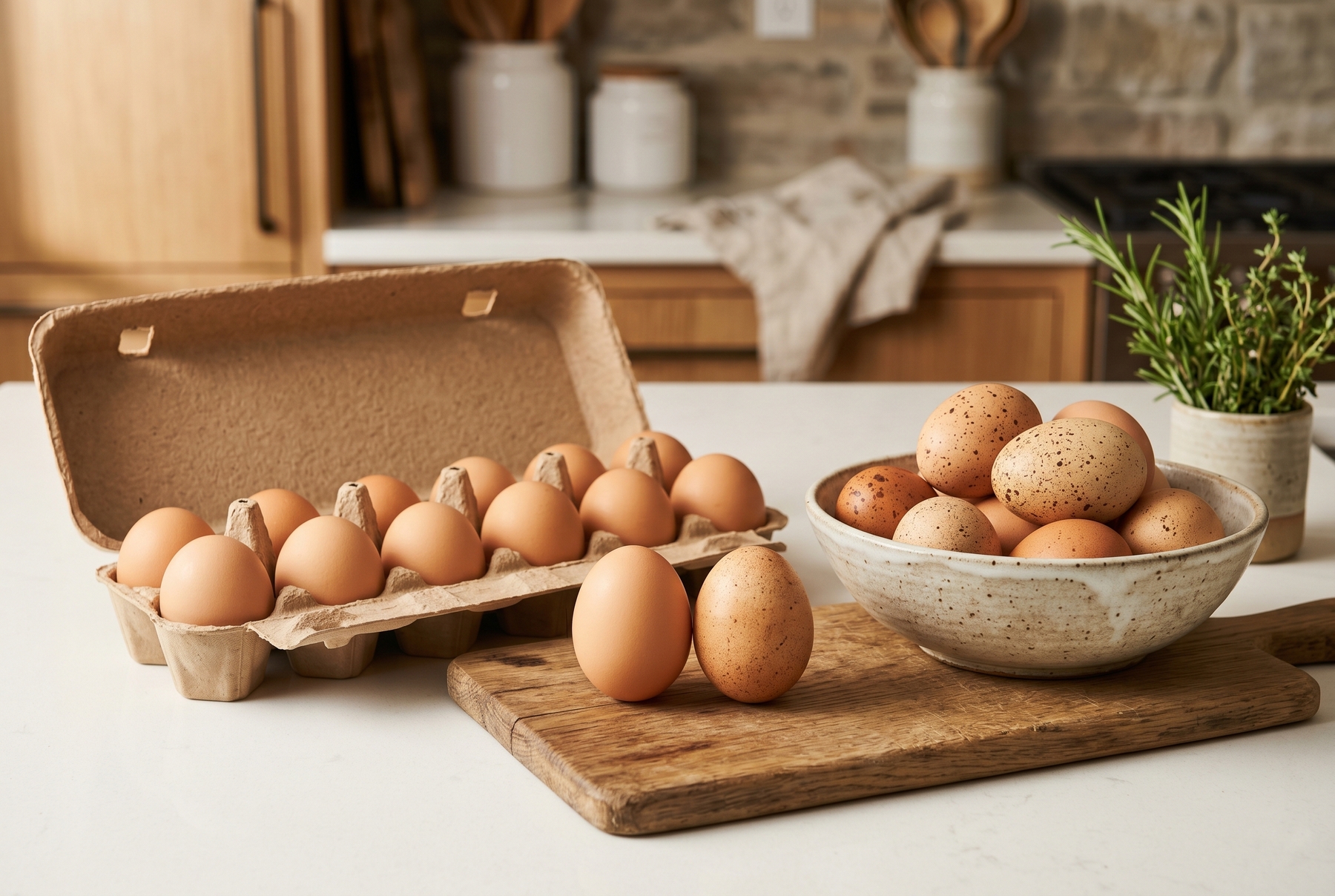
Farm eggs retain their natural protective cuticle, making them significantly more resilient to room-temperature storage.
How and Where to Properly Store Eggs at Home
The Refrigerator Wins Through Stability
For a standard urban apartment, a refrigerator offers one crucial advantage: a predictable temperature free from daily fluctuations, seasonal shifts, or the heat of an oven baking just a meter away. The egg ages more slowly, and the risk of microbial growth drops significantly. Leaving an egg on the counter overnight will not spoil it. However, comparing two weeks in a warm apartment to two weeks in a fridge yields entirely different results.
The Best Place to Store Eggs Inside the Fridge
The refrigerator door stands as the worst possible spot for eggs. It experiences the most unstable temperatures. Warm air rushes in every time someone opens the door. Eggs stored there suffer minor temperature shocks several times a day, alongside constant physical vibration. Manufacturers often include egg trays in the door for convenience, but this placement offers no benefits for the eggs themselves.
The best option involves placing eggs in the main compartment, closer to the back wall (but not touching the freezing zone). They thrive in their original packaging or a closed container, positioned pointed end down. The egg’s air cell sits at the blunt end, and this alignment keeps the yolk in a much more stable position. While not strictly critical, this habit certainly helps.
Why Keeping Eggs in Their Packaging Matters
Eggshells remain highly porous. The egg exchanges gases with its surrounding environment through these pores, which remains a normal physiological process even for unfertilized eggs. Odors penetrate inside through these exact same pores. Eggs left unpacked next to an open jar of marinated fish or a bowl of chopped onions will absorb those scents. It might not happen immediately, but three to four days provide plenty of time. An omelet haunted by a phantom smoky aroma rarely pleases the palate. Using the original carton or an airtight container completely solves this issue.
To Wash or Not to Wash Before Storage
Washing Before Storage: A Clear No
Scrubbing eggs right after grocery shopping and tossing them wet into the fridge proves to be a poor strategy. Water softens the cuticle and partially breaks it down. A wet egg in a fluctuating refrigerator environment develops condensation, and moisture on a porous shell creates the perfect breeding ground for bacteria. Washing an egg makes sense only immediately before cooking it.
Dealing With Visibly Dirty Eggs
Farm-fresh eggs carrying feathers and droppings fall into a special category. These shells are dirtier, their protective barrier acts less reliably, and their storage history prior to purchase often remains a mystery.
The safest practice involves storing them separately, using them quickly, and incorporating them only into fully cooked dishes. They have no place in homemade mayonnaise, tiramisu, or raw pastry creams. An egg with a rustic farmhouse character can taste incredible, but that does not automatically qualify it for raw preparations.
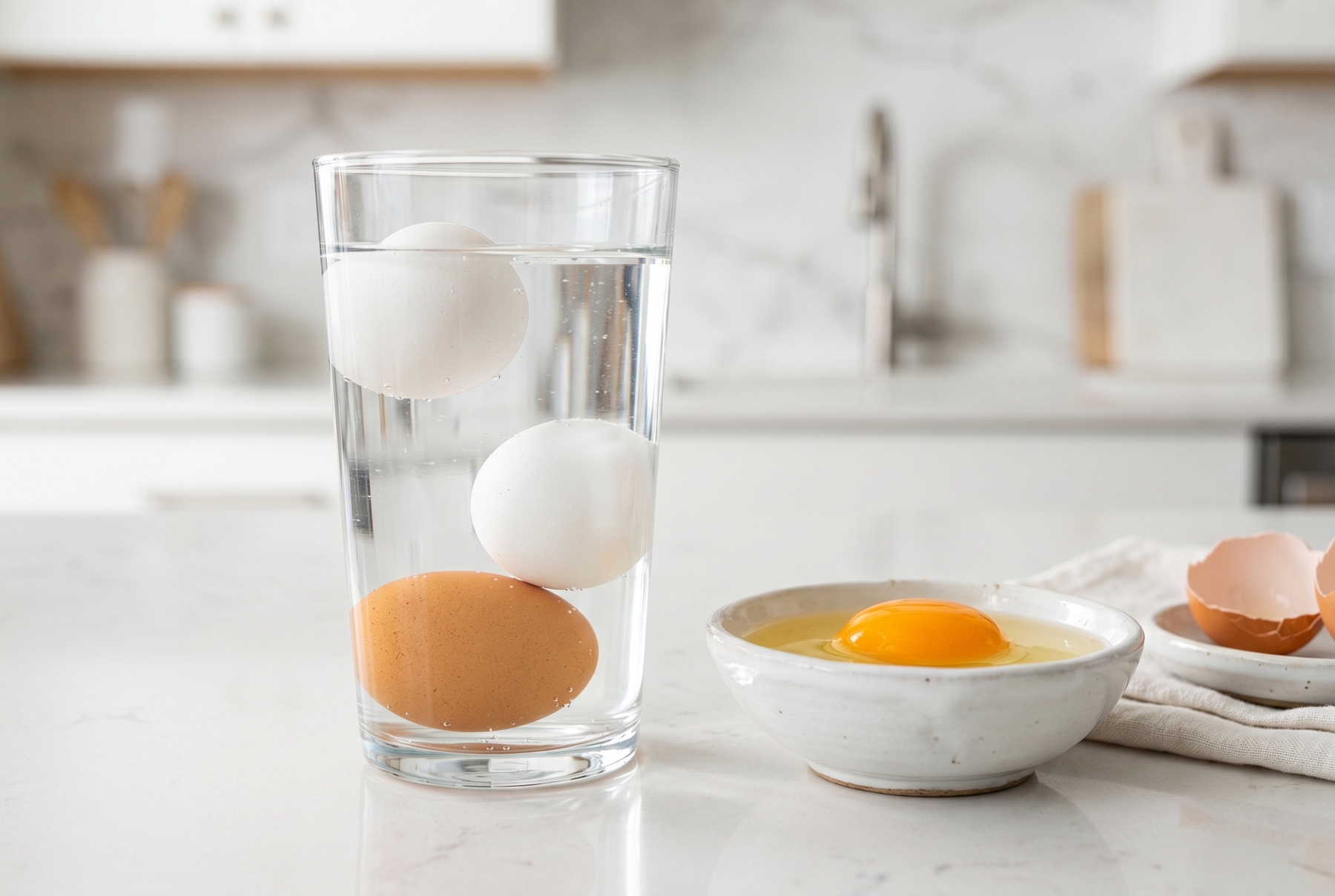
A simple household test: a fresh egg always sinks to the bottom, while an older one floats due to its expanding air cell.
How to Tell When an Egg Is Past Its Prime
Testing Egg Freshness in Water
This stands as a famous household test. Dropping an egg into a glass of water reveals its state: a fresh one sinks, while an older one floats. As an egg sits in storage, its internal moisture evaporates and the air cell at the blunt end expands, which directly causes the buoyancy.
This test indicates age, rather than guaranteeing safety. A floating egg signals a need for caution, not an automatic death sentence. Cracking it into a separate bowl and smelling it provides the fastest and most reliable answer.
Smell and Visual Cues Upon Cracking
A suspicious egg always requires cracking into a separate bowl. Dropping it directly into a mixing bowl or a hot skillet risks ruining an entire batch of batter or a whole meal.
A fresh egg displays a thick albumen (egg white) and a slightly jelly-like yolk that holds a convex shape and rich color. An older egg features a watery white that spreads immediately and a flattened yolk. Any unpleasant odor, no matter how faint, means the egg belongs in the trash.
Other Warning Signs to Look For
Cracks or chips on the shell demand attention. A sticky or unexplainably damp surface raises immediate red flags. Strange albumen colors (such as a greenish or pinkish tint) indicate spoilage. Mold on the shell happens rarely, but can occur during humid storage. Any of these signs carries a single meaning: the egg must be discarded.
Egg Shelf Life: Determining Factors
The shelf life depends on the egg’s grading category, storage conditions, shell processing methods, and temperature. No single universal number applies to every scenario. The fundamental rule involves checking the date, storing them in the fridge, and avoiding drastic temperature shifts. Eggs labeled as C0 or C1 (common Russian grading systems indicating Jumbo or Large sizes) often feature generous expiration dates, but testing the limits of those dates rarely proves wise.
How Long Hard-Boiled Eggs Last in the Fridge
Boiling an egg destroys the cuticle, coagulates the protein, and entirely alters the internal structure. A hard-boiled egg in its shell lasts about a week in the refrigerator. A peeled one survives for two to three days, preferably kept in a sealed container or submerged in water.
Boiling a dozen eggs for the week serves as a highly effective meal prep strategy. Boiling them and forgetting about them for a week and a half inevitably leads to food waste.
Dishes Featuring Raw and Soft-Cooked Eggs
Homemade mayonnaise, mousses, tiramisu, yolk-based creams, poached eggs, sunny-side-up eggs with runny yolks, and uncooked whipped egg whites require special attention. Three factors remain absolutely crucial for these dishes: the eggs must be pristine, the shells completely clean, and the source entirely reliable.
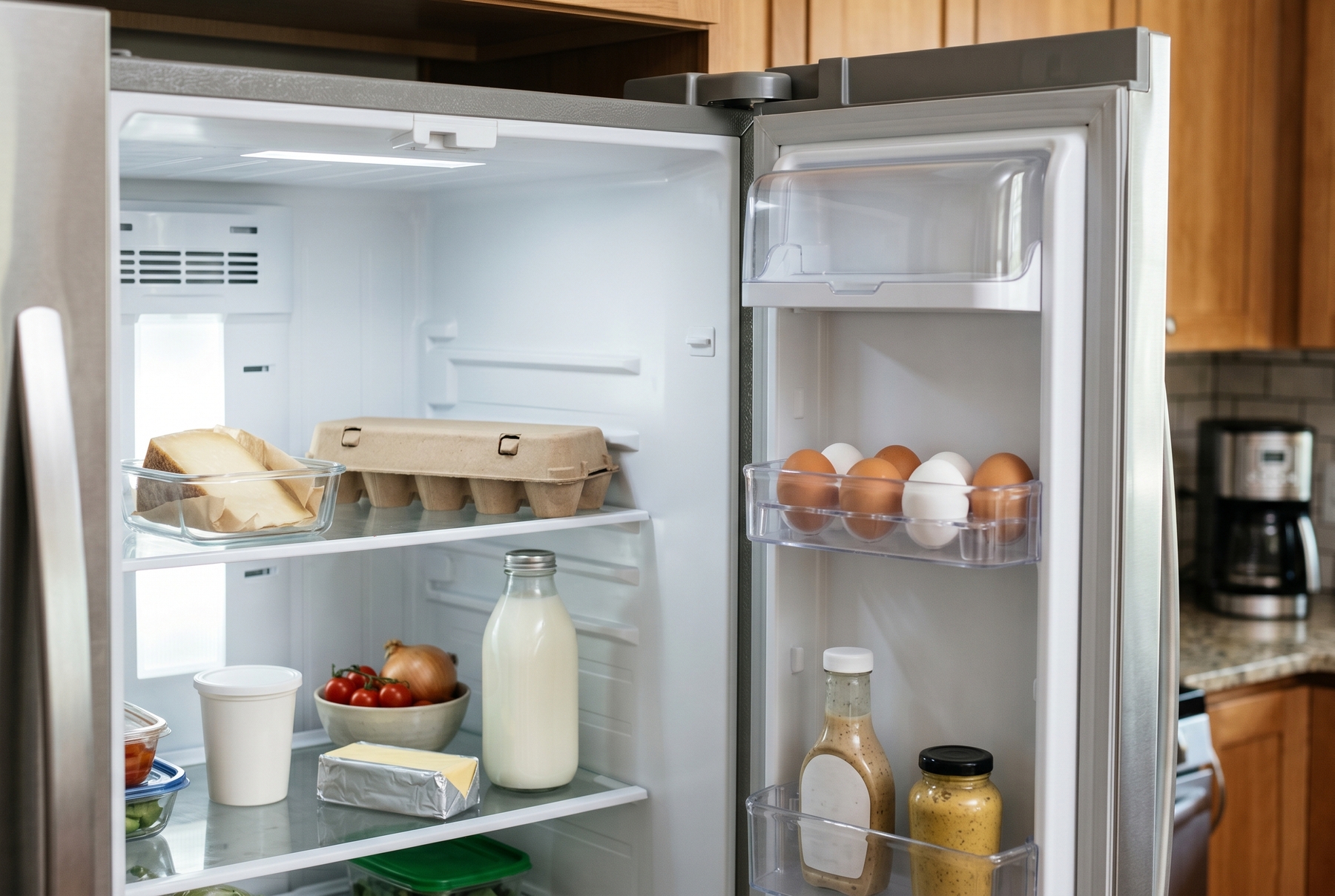
The refrigerator door remains the most unstable environment. Long-term storage requires the main shelf and the original packaging.
Common Egg Storage Mistakes
Shuttling Eggs Back and Forth
When a cold egg enters a warm kitchen, condensation forms a thin film of moisture over the shell. This causes no harm if the egg goes straight into a pan. However, returning it to the fridge and repeating this cycle multiple times gradually degrades both the cuticle and the protein quality. The simplest principle applies: take it out, use it immediately. Taking out twenty eggs only to put eighteen back makes little culinary sense.
Storing Next to Strongly Scented Foods
Eggshell porosity remains a constant factor. The practical takeaway involves keeping them away from open bowls of onions, smoked fish, or pungent marinades. Faint odors penetrate the shell in just a few days, while intense smells work even faster.
Saving a Cracked Egg for Later
A cracked shell signifies a compromised barrier. Such an egg must go into immediate use for a thoroughly cooked dish, or it belongs in the garbage. Saving a cracked egg for future use poses unnecessary health risks.
Assuming Farm Eggs Are Automatically Safer
A persistent myth surrounds countryside eggs. Farm-fresh eggs often boast superior flavor and richer yolks due to the bird’s varied diet. However, this does not make them sterile. Their shells generally carry more dirt, and their storage history prior to purchase frequently remains undocumented. A farm-fresh label does not provide an all-access pass for raw consumption.
The Short Answer: What to Do With Eggs at Home
Store-Bought Eggs: These belong straight in the refrigerator upon returning home. They thrive in the main compartment rather than the door, preferably in their original packaging. Washing them in advance offers no benefits, and checking the shell and date before use ensures safety.
Farm and Homegrown Eggs: Assuming these are automatically safer proves dangerous. Dirty eggs require separate storage and rapid usage. When preparing raw sauces or unbaked desserts, avoiding them remains the wisest choice unless their freshness and cleanliness are absolutely guaranteed.
Previously Refrigerated Eggs: These should never sit at room temperature for extended periods. Once they leave the fridge for cooking, they should be used right away.
So Who Is Ultimately Right?
The great egg debate exists because people unknowingly compare completely different products governed by different regulations. An American washed egg and a European unwashed egg represent two distinct products, not just one item with differing opinions attached.
For a modern urban apartment equipped with a standard refrigerator, the solution remains incredibly simple: utilize the main compartment, avoid the door, keep the original packaging, and skip the preemptive washing.
A grandmother’s countertop egg basket functioned perfectly within its historical context. However, that context shifted a long time ago.
0 comments