
Boiling pasta, draining it in a colander, plating the naked noodles, and ladling sauce on top from a saucepan is a common domestic habit with a predictable outcome. Within a minute, a reddish puddle pools at the bottom of the bowl while the spaghetti sits separately—slippery on the outside and bland within. The sauce sinks to the bottom and barely clings to the pasta.
Restaurant kitchens approach plating differently. The pasta arrives at the table with a satin sheen, twirled with a fork into a tight nest that holds its shape. There appears to be barely any loose sauce, yet it coats every strand evenly in a thin film that neither drips nor pools. Once the meal is finished, the bottom of the bowl remains nearly clean.
The final 60 to 90 seconds make all the difference, as the pasta finishes cooking directly inside the sauce.
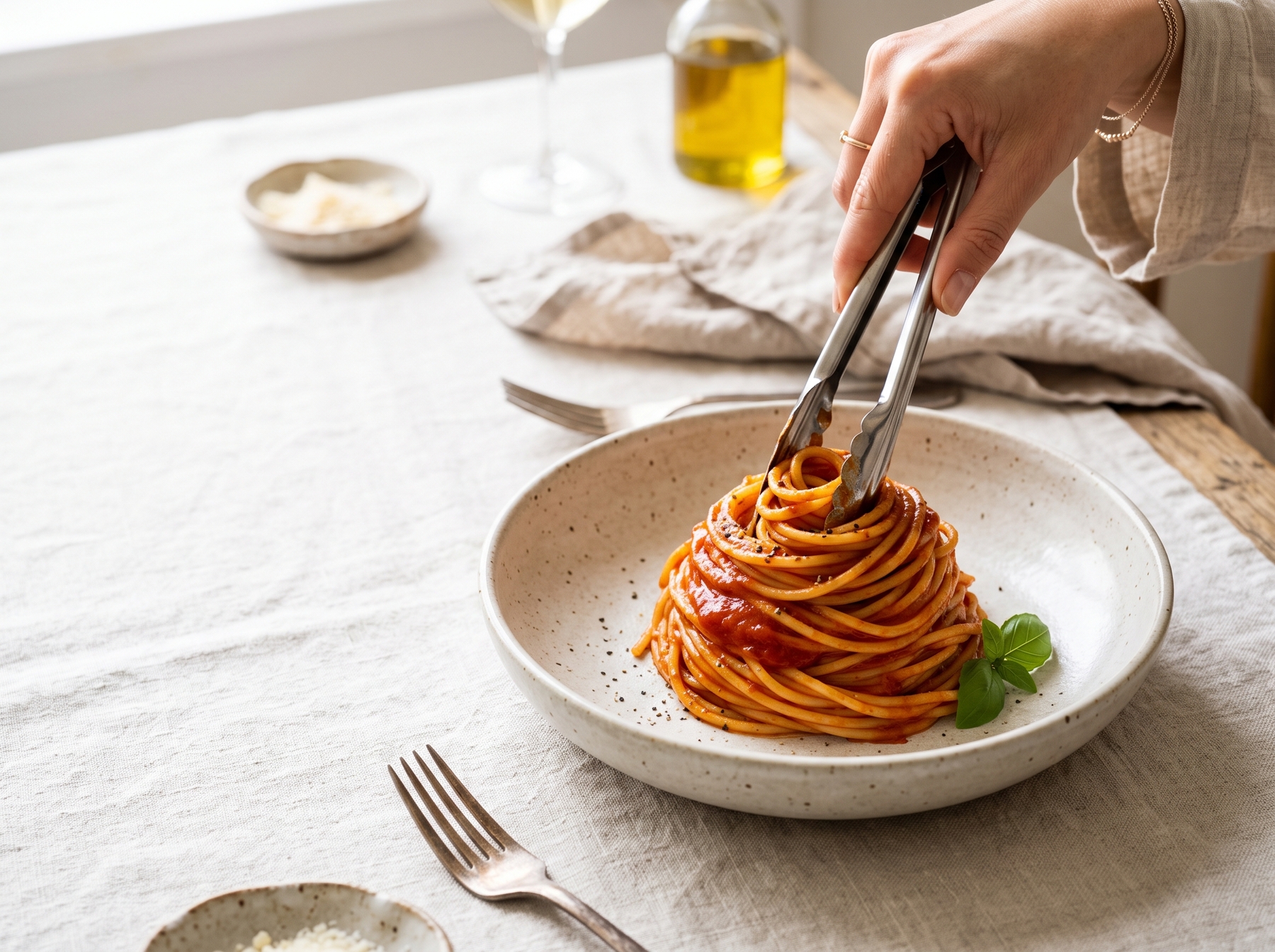
When finished properly in the pan, pasta twirls into a stable nest while the sauce coats every strand evenly without pooling at the bottom.
Table of Contents
- The Pot of Water Only Does Half the Work
- What Happens in the Skillet When Pasta Meets Sauce
- How to Finish Pasta in Sauce on the Stovetop
- The Biggest Mistake: Reaching Perfect Thickness on the Stove
- Butter, Cheese, and Last-Minute Additions
- Adapting the Technique to Different Sauces
- How to Tell When It Is Time to Plate
- 5 Common Mistakes That Ruin the Finish
The Pot of Water Only Does Half the Work
Boiling water serves to heat the dough, allow the starches to swell, and bring the pasta to a workable state. After that, the real magic happens in the skillet. In the pan, the pasta absorbs the flavor of the sauce, gets thoroughly coated, and reaches its ideal texture.
Consequently, cooks pull the pasta from the water before it reaches true al dente. It achieves that final stage of doneness in the skillet, hydrating with flavorful sauce rather than bland boiling water. The flavor difference is immediate: pasta finished in tomato sauce tastes savory and sweet all the way through, not just on the surface.
The popular advice to “boil for 2 minutes less than the package states” circulates widely in recipes, though it does not always hold true. That rule fails to account for how long the final pan-tossing stage actually takes. An aglio e olio requires just a minute in the skillet, whereas a thick ragù demands twice as long. Therefore, the exact moment to pull the pasta from the water shifts depending on the dish.
Watching the pasta itself is far more reliable than watching a timer. At the right stage, the noodle bends easily and is chewable, but biting into it reveals a denser, slightly chalky core. Snapping a strand of spaghetti in half exposes a pale dot in the center about the size of a pinhead. With short shapes like penne or macaroni, biting an edge is the easiest way to test the resistance.
Thickness matters much more than shape. Thin capellini overcooks in a flash, where the margin of error is a matter of ten seconds. Hollow bucatini heats through more slowly, offering a much wider buffer. Package cooking times work best as general guidelines, so tasting should begin 3 minutes before the lowest suggested time. Sticking to the same brand of pasta makes judging this window much easier in the future.
What Happens in the Skillet When Pasta Meets Sauce
Hot pasta continues to act like a sponge, drawing in moisture from whatever surrounds it. Inside the skillet, the noodles drink up liquid directly from the sauce, absorbing all its concentrated flavors in the process.
Simultaneously, the pasta releases surface starch, which helps the sauce adhere to the strands. This dissolved starch acts as a bridge, binding water and fat together. Stirring the pasta, shaking the pan, and agitating the noodles with tongs builds an emulsion. The fat breaks down into microscopic droplets that stay suspended in the liquid phase rather than separating into a greasy slick on top.
At the finish line, the pasta should not absorb the sauce until bone-dry; a thin, cohesive glaze of liquid needs to remain wrapped around every strand.
A well-executed finish leaves no watery puddle at the bottom of the bowl, nor does it turn the pasta into a dry clump that requires prying apart with a fork. The sauce clings to the noodles in a glossy micro-layer instead of sliding off.
Why Saving Pasta Water Matters
Cloudy pasta water holds dissolved starch and salt. While not magical on its own, this liquid thins out a dense sauce without diluting its flavor while simultaneously binding fat and water into a unified glaze.
Adding the water gradually—a splash at a time, followed by a few tosses with tongs, and another splash if the sauce remains too tight—yields the best control. Dumping a whole cup into the skillet at once floods the sauce, forcing a long evaporation over high heat while the pasta turns to mush.
Placing a mug in the sink right next to the colander serves as a visual reminder to scoop out some water before draining. Cooks forget this step with alarming regularity, so setting the mug out early prevents accidents. Transferring the pasta directly from the pot to the skillet using tongs or a spider strainer is even more reliable; residual water hitches a ride on the noodles, leaving the full pot of starchy liquid intact on the stove.
Universal measurements in tablespoons do not exist here. Starch concentration fluctuates based on the water volume (a smaller pot yields noticeably thicker liquid), the amount of pasta, the vigor of the boil, and the pasta itself. Bronze-die extruded pasta features a rough, matte surface that sheds significantly more starch into the water. Fresh egg pasta clouds the water even faster than dried shapes. Visual cues from the sauce in the pan always trump exact measurements written in a recipe.
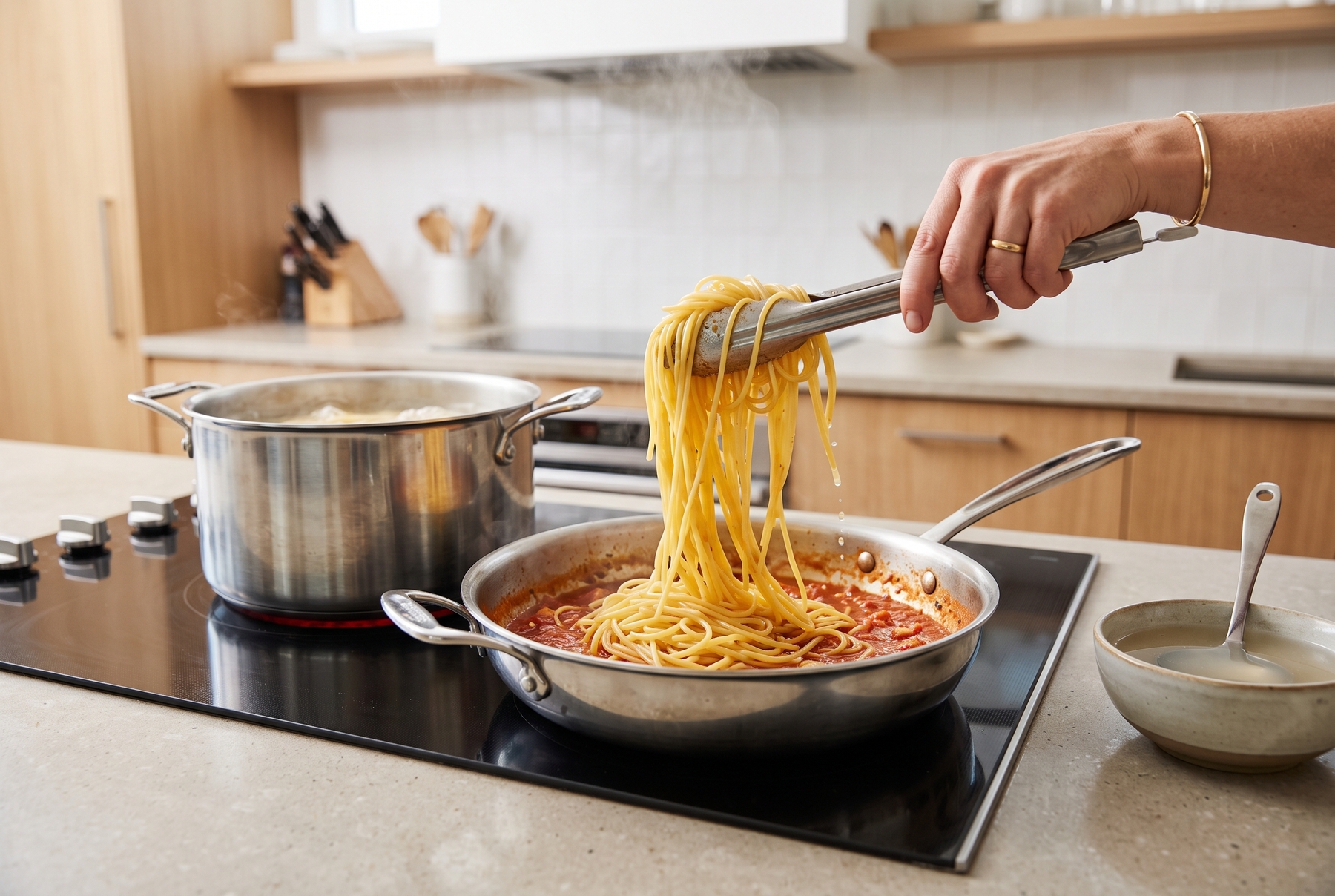
Moving pasta directly from the pot with tongs carries over a bit of starchy water to kickstart the emulsion.
How to Finish Pasta in Sauce on the Stovetop
By the time the pasta hits the skillet, the sauce must be fully cooked or moments away from completion. Adjusting seasoning or simmering raw ingredients once the spaghetti is already in the pan is too late; adding extra water or uncooked tomato extends the cooking time while the pasta continues to soften past its prime.
A wide skillet or a low-sided sauté pan allows the pasta to spread out in an even layer and move freely. For two servings, a pan measuring 26–28 cm (10–11 inches) in diameter works best. Narrow pots force the noodles into a tangled mass that resists even mixing, resulting in patchy sauce coverage. I own a vintage 1930s copper pan found at a flea market in Lyon, yet honestly, it offers zero advantage for this technique over a standard stainless steel skillet. Specialized cookware is completely unnecessary here.
Maintaining medium or medium-high heat keeps the process moving. Low heat leaves excess water sitting in the pan so the sauce never thickens, while the pasta bloats and loses its bite. Aggressive high heat evaporates moisture in seconds, and butter- or cheese-based sauces will split when overheated, causing the fat to separate irreversibly.
Tossing pasta in the air with a flick of the wrist looks impressive, though at home it usually creates more splatter than emulsion. Kitchen tongs, a sturdy spatula, and an occasional shake of the pan handle accomplish the exact same goal. The underlying principle is simple: pasta, liquid, and fat must constantly rub against one another, otherwise the starch cannot bind the elements together.
Visual cues guide the final seconds. For the first 20 seconds, the sauce looks overly loose and the pasta nearly swims in liquid. Soon, the liquid begins to trail behind the spatula, leaving a brief path across the bottom of the pan before closing back up. The surface turns glossy, coating the pasta and sliding down in a slow, thick wave when the skillet tilts. Even the sound shifts, transitioning from a wet sizzle to a quiet, thick bubble.
The Biggest Mistake: Reaching Perfect Thickness on the Stove
Sauce continues to thicken well after the burner is turned off. Both the skillet and the pasta retain heat, moisture keeps evaporating, and cooling starch binds water ever more tightly.
A sauce that looks slightly too loose in the skillet transforms into the exact right consistency after a minute on the plate. Conversely, pasta cooked on the stove until the sauce looks ideal will tighten up at the table, turning dense and dry until the fork lifts the entire portion as a single clumped mass.
Pulling the pan off the heat while the sauce remains slightly looser than the desired final state is the safest rule of thumb. Over-reduced sauces are easily rescued off the heat by adding a splash of pasta water and tossing vigorously. Returning the skillet to the hot burner is counterproductive, as the sauce will quickly seize up again.
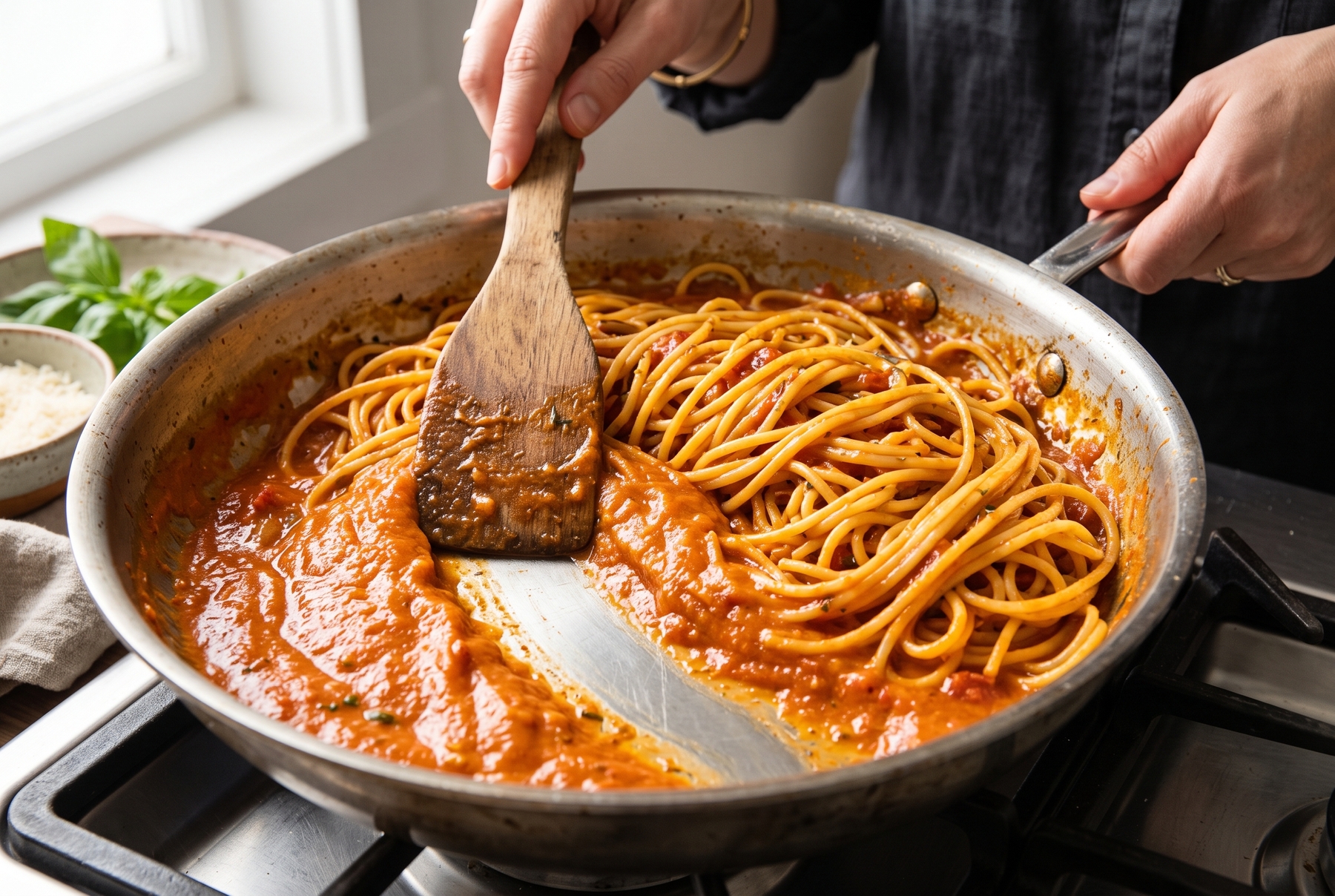
When a spatula leaves a brief trail across the bottom of the pan that closes in a slow wave, the pasta is ready to come off the heat.
Butter, Cheese, and Last-Minute Additions
Final texture depends not just on the amount of fat, but on the exact moment it enters the pan.
Olive oil belongs in a tomato sauce at the very end, drizzled in over moderate heat while tossing actively. At this stage, the sauce lightens slightly in color and develops a brilliant sheen. Pouring the oil in at the beginning and boiling it hard causes the fat to partially separate into greasy surface droplets.
Cold cubed butter incorporates best over low heat or entirely off the burner. Adding it piece by piece—waiting for one cube to melt into the emulsion before dropping in the next—keeps the sauce stable. A rolling boil rips the emulsion apart, leaving a clear slick of melted fat on top.
Hard aged cheeses require fine grating, as coarse shreds melt unevenly. Removing the skillet from the heat, letting it cool for a few seconds, and working the cheese in gradually with splashes of pasta water ensures a smooth melt. Excessive heat causes dairy proteins to tighten and squeeze out fat, trading a creamy sauce for stringy clumps stuck to the tongs. I once dumped a handful of Pecorino into a scorching hot skillet for cacio e pepe; the cheese instantly seized into rubbery threads, ruining the entire batch. Because no single temperature applies to all cheeses—behavior shifts depending on aging, fat content, and the volume of liquid in the pan—paying attention to the specific recipe and visual cues in the skillet is essential.
Italian kitchens call this final marriage of pasta, fat, and liquid mantecatura, derived from the verb mantecare (to whip or work into a creamy state). Chefs use the exact same term for finishing risotto, and the logic remains identical: fat enters last, accompanied by vigorous motion and moderate heat.
Adapting the Technique to Different Sauces
While the core mechanics stay the same, the focus shifts depending on the style of sauce in the skillet.
Tomato sauce benefits from a slight reduction beforehand, followed by a reconstruction using pasta water and starch once the noodles arrive. Simmering the sauce until it is slightly thicker than desired before adding the pasta accounts for the dilution from the starchy water. From there, active tossing and small splashes of water bring it to the perfect coating consistency.
With aglio e olio, balancing the two phases is the main challenge. The pan holds plenty of oil, very little water, and zero external binders. Adding starchy water cautiously—literally spoonful by spoonful—while shaking and stirring aggressively forces the oil and water to merge into a cloudy, creamy glaze. In an aglio e olio, the sauce only truly forms once the pasta is in the pan.
Cheese sauces demand strict temperature control above all else. Lowering or killing the heat early, working the cheese in stages, and adjusting the consistency with water entirely off the burner prevents splitting.
Meat ragù presents a different scenario. The sauce has already simmered for hours into a dense reduction, leaving nothing to evaporate. Here, the goal is distributing the meat evenly across the pasta shapes—tucking it into the ridges of rigatoni, inside hollow tubes, and between the wide folds of pappardelle. Moderate heat, a slightly longer stint in the skillet, and a surprisingly generous amount of pasta water prevent the final dish from tasting dry.
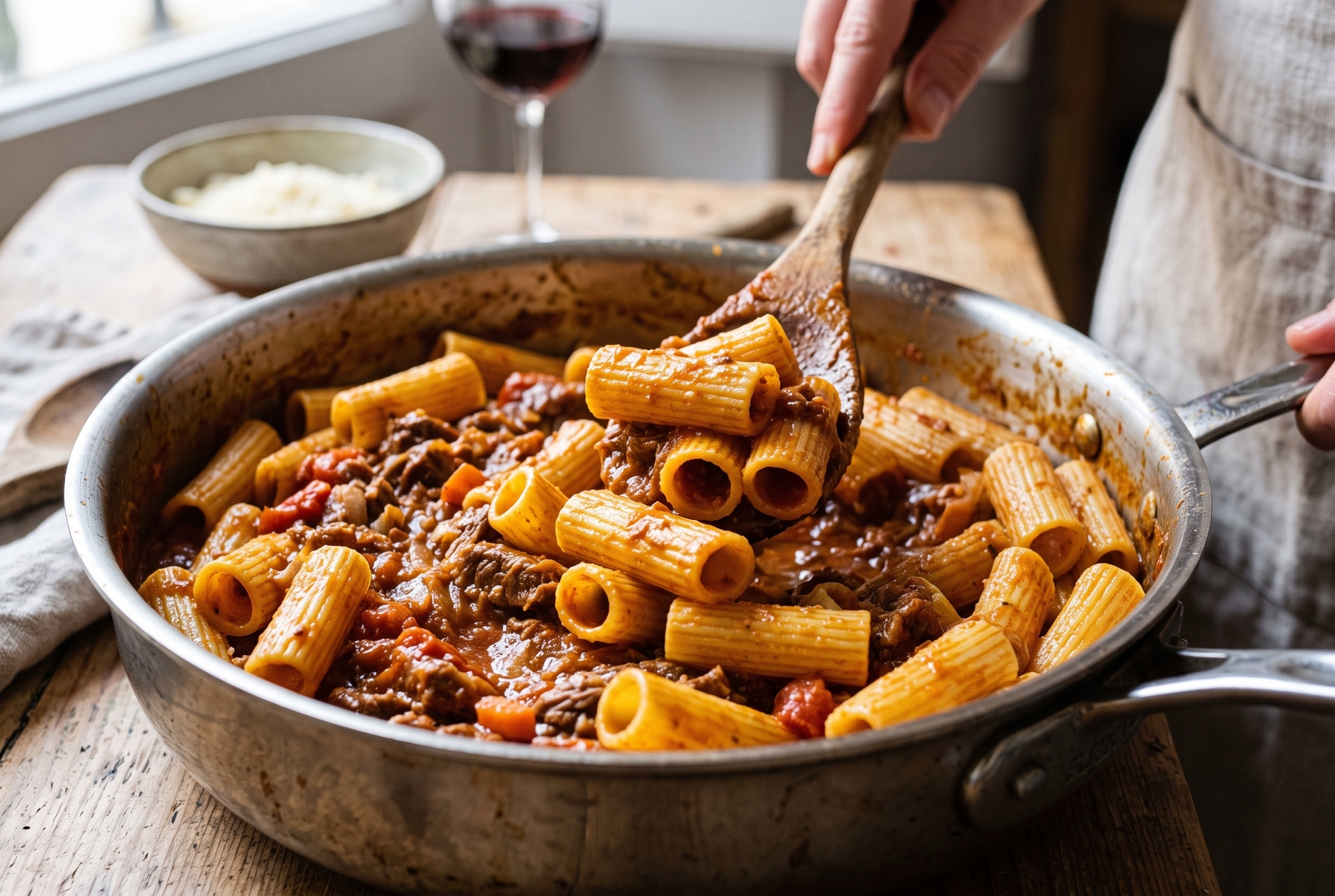
A dense meat ragù requires extra starchy water and pan time so the sauce can coat the tubes and settle into the ridges of the rigatoni.
How to Tell When It Is Time to Plate
Relying on sensory cues works much better than watching a stopwatch.
- Taste. The pasta retains a pleasant bite without a chalky center, and the interior tastes seasoned and infused with the sauce rather than plain water.
- Appearance. The surface gleams evenly from edge to edge, free of dry patches or broken oil slicks.
- The Pan. No watery moat pools at the bottom of the skillet, yet the noodles slide freely without dragging as a solid block.
- Movement. Tossing reveals a fluid, juicy mass. If the noodles start sticking together in a heavy clump, the pan needs more water.
- The Plate One Minute Later. The sauce clings to the strands, the bottom of the bowl stays mostly dry, and the portion remains loose rather than seizing into a brick.
5 Common Mistakes That Ruin the Finish
- Boiling the pasta completely. Fully cooked noodles have no room left to absorb liquid in the skillet and quickly turn mushy. To salvage it on the fly, cut the pan time down to 30 seconds, keep the heat at a bare minimum, and add a bit more water than usual to prevent drying out.
- Draining all the pasta water. A classic blunder usually realized while staring into an empty colander. Hot salted water from a kettle works in a pinch, though the resulting bond will be weaker. Setting a mug inside the sink before boiling prevents this entirely.
- Dumping the water in all at once. The sauce floods and the pasta swims. Instead of cranking the heat to boil it off—which overcooks the pasta—spoon out the excess liquid and emulsify the remainder over medium heat with vigorous tossing.
- Reducing to the perfect consistency on the stove. By the time the dish hits the table, it will be dry. Pulling the pan off the heat, adding a splash of water, and tossing off the burner restores the flow.
- Adding cheese or butter into a screaming hot pan. Clumps form and grease separates. Removing the skillet from the burner, waiting 20 seconds for the temperature to drop, adding a splash of water, and stirring persistently usually rescues the texture, even if a fully broken emulsion never completely recovers.
Pasta and sauce stop acting like two separate components that happened to meet on a plate. That final minute in the skillet fuses them into a single, cohesive dish.
Mastering the process comes down to reading consistency: starting with slightly undercooked pasta, adding starchy water in stages over medium heat, keeping the pan in constant motion, and stopping a moment before the sauce looks thick enough.
A quick swipe of a spatula across the bottom of the pan confirms the timing: if the parted sauce flows back together slowly rather than instantly flooding the gap, the pasta is ready for the plate.
0 comments