
If meat becomes dry after freezing, the freezer is not always to blame. Sometimes, it is ruined by a windowsill, a radiator, or our unwavering belief that it will just be faster this way.
You took a beautiful cut of beef out of the freezer in the evening. You left it on the edge of the sink or right on the counter. By morning, a puddle of meat juices, a grayish surface, and a lingering sense that the product had somehow wilted were waiting for you. If this sounds familiar, it is time to get down to business: we are breaking down how to properly and quickly defrost meat without ruining dinner.
Defrosting is the stage where you either preserve texture, juices, and flavor, or turn a great ingredient into a mediocre meal. It is not an optional prep step; it is part of cooking. Defrosting directly determines what will happen in the skillet an hour later.
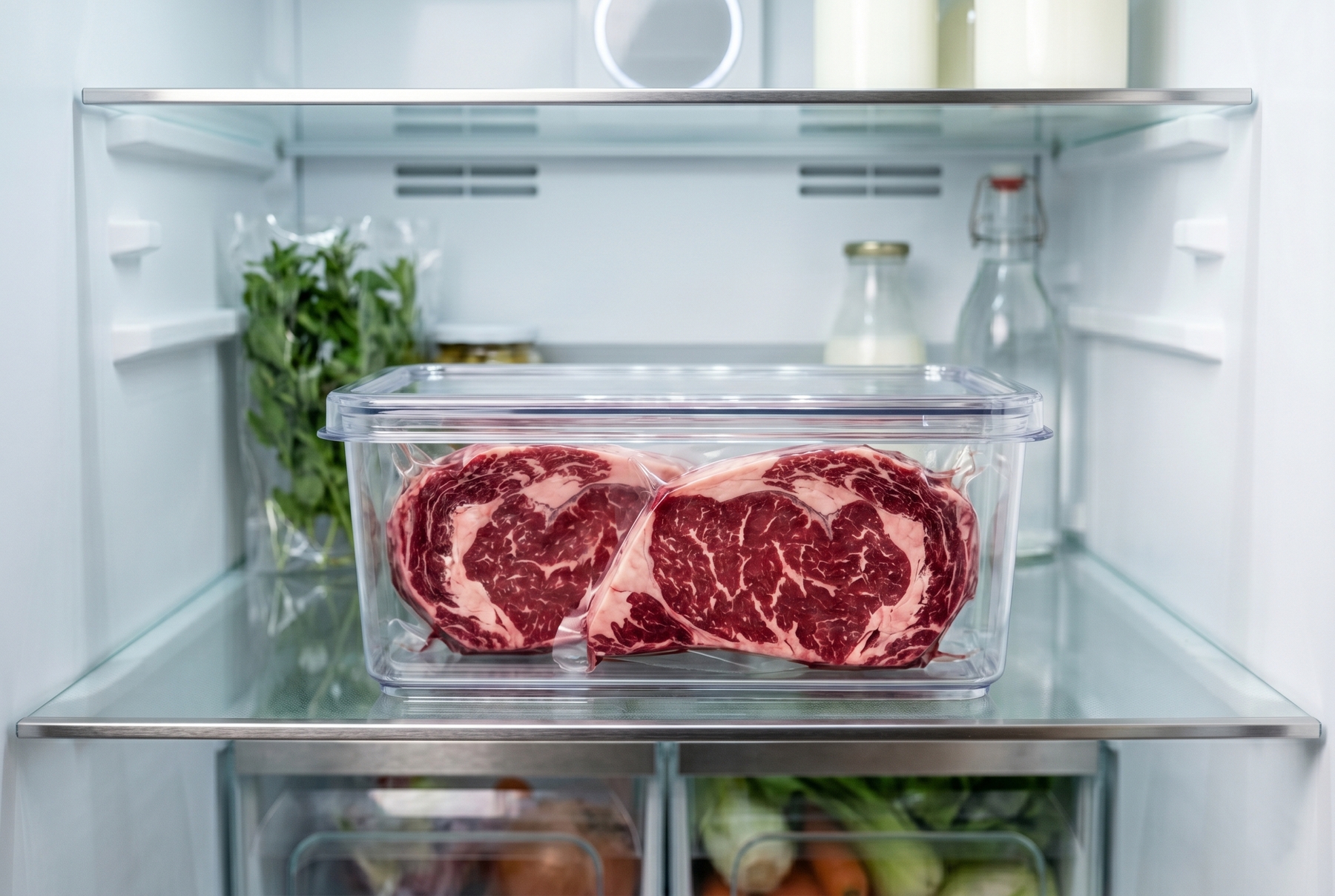
The refrigerator is the ideal place for proper defrosting: meat thaws gradually, preserving all its juices and texture.
Table of Contents
- What Happens to Meat in the Freezer
- Defrosting Meat in the Refrigerator: Slow and Proper
- How to Quickly Defrost Meat in Water (And Why It Must Be Cold)
- Defrosting Meat in the Microwave: Possible, but Manage Your Expectations
- Why You Should Never Defrost Meat at Room Temperature or on a Radiator
- How to Tell if Meat Is Fine After Defrosting
- Can You Refreeze Meat?
- Different Types of Meat Mean Different Nuances
- How to Freeze Meat So It Is Easier to Defrost Later
- A Quick Cheat Sheet: How to Defrost Meat Without Losing Quality
What Happens to Meat in the Freezer
The Ice Inside Meat Is Not Just Ice
Meat contains a lot of liquid. It is not just water: it is water packed with proteins, minerals, enzymes, and everything that builds flavor and juiciness. When frozen, this water crystallizes, and at this moment, speed is everything.
Fast freezing (like in industrial blast chillers at -35 °C (-31 °F) and below) produces small ice crystals. They fit into the spaces between muscle fibers with almost no damage. Slow domestic freezing in a standard freezer at -18 °C (0 °F) forms larger crystals. They press against the walls of muscle cells from the inside and gradually destroy them.
When meat begins to thaw, moisture leaks from the damaged cells. It flows out, creating that notorious puddle in the bag. The liquid in the bag is not blood; it is myoglobin (the protein that gives meat its red color), dissolved proteins, and water that the fibers can no longer retain. A more aggressive defrosting process leads to greater losses.
The surface of the meat always warms up faster than the center. During a rapid thaw, the cells in the outer layers break open first, and juices escape before the center even has a chance to thaw. The exterior becomes soft and wet, while the interior remains ice. Cooking at this stage ruins everything: the meat ends up steaming in its own juices in the pan instead of developing a proper sear.
Why Meat Sometimes Smells Like the Fridge After Freezing
This is not a defrosting issue. It is a storage issue. If meat is kept in a loosely closed bag or accidentally pressed against the freezer wall without protection, it dries out, oxidizes, and absorbs the odors of everything nearby: fish, onions, or leftover sauce in a container.
The solution happens in advance. Tight packaging before freezing is crucial: vacuum sealing is ideal, and wrapping tightly in multiple layers of plastic wrap without trapped air works well. A zip-top bag with the air squeezed out is a perfectly viable home option.
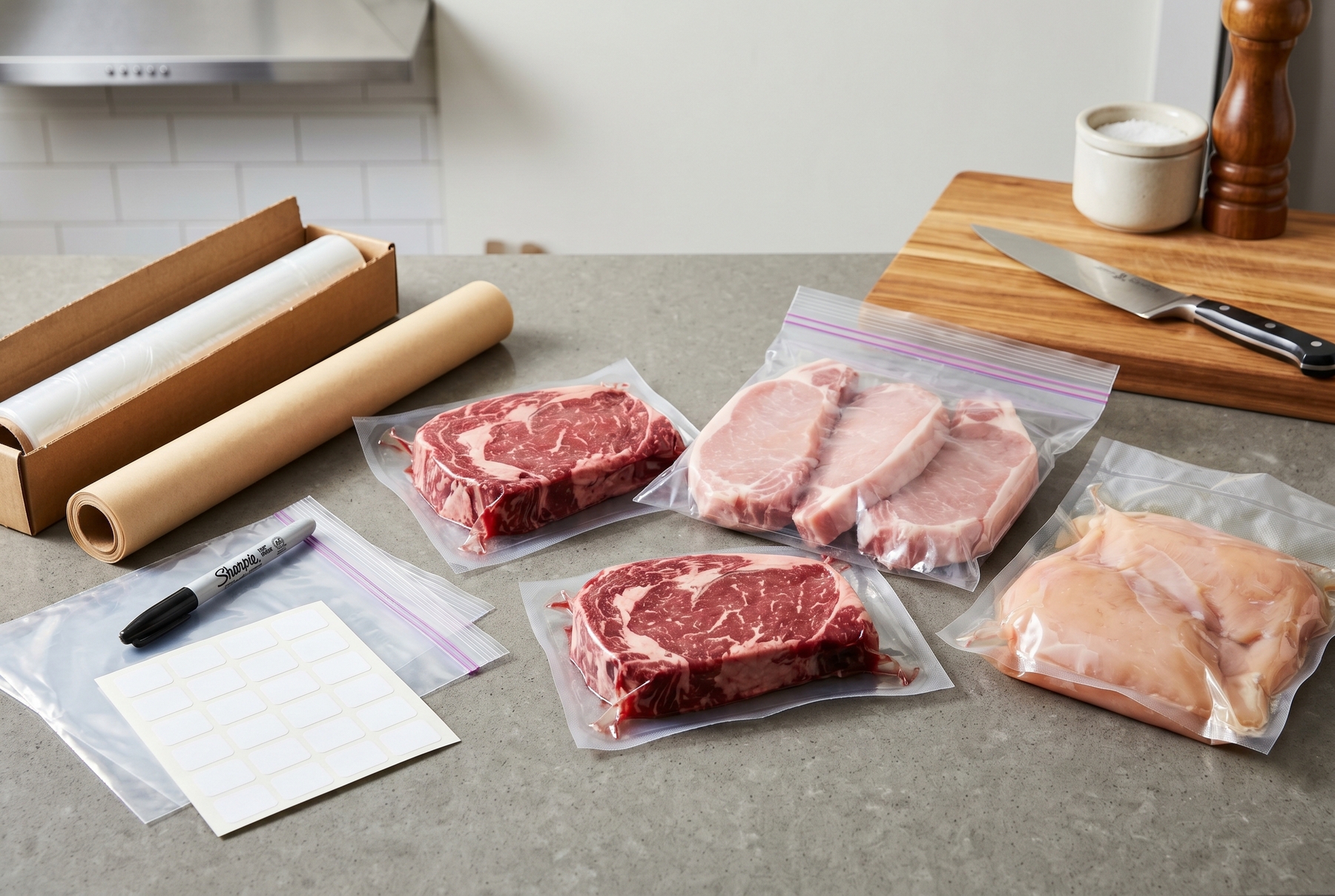
Hermetic sealing in zip-top bags or vacuum packaging prevents freezer burn and the absorption of unwanted odors.
Defrosting Meat in the Refrigerator: Slow and Proper
Why the Refrigerator Is the Gold Standard
The refrigerator is excellent because the meat remains in a safe cold environment the entire time and thaws without a sudden overheating of the outer layers. The surface still thaws before the center, but it does not spend hours in warm temperatures like it would on the counter or in hot water. Proteins do not start denaturing prematurely: this process triggers at around +40 °C (104 °F), and they are perfectly safe in the fridge.
In practice, timing varies. Chicken breasts or a small steak two to three centimeters (about 1 inch) thick take overnight, or about eight to ten hours. A large piece of beef weighing 1.5-2 kg (3.5-4.5 lbs), a whole chicken, or a pork shoulder requires 24 hours, sometimes up to 36. Ground meat thaws faster than whole cuts, but it requires more caution: it has a massive surface area exposed to air, making it spoil much more rapidly.
How to Place Meat in the Refrigerator Properly
Leaving the packaging on is best if it is intact and tightly sealed. If the packaging is unreliable or torn, transferring it to a container with a lid or a zip-top bag is necessary. Placing it on a plate or in a tray is essential: juices will inevitably leak, and it is better they stay there rather than pooling on the shelf. The bottom shelf of the refrigerator is the optimal spot: the meat sits lower than other foods, ensuring no raw juices can drip onto them.
Raw meat has no place next to prepared foods, open salads, cheese, or fresh herbs. Raw meat should generally be stored separately, and this principle becomes twice as important during defrosting.
How to Quickly Defrost Meat in Water (And Why It Must Be Cold)
When You Can Defrost in Water
Guests are arriving in two hours, dinner is needed today, and the meat is a frozen brick. It happens. Cold water works as an acceptable alternative, provided the rules are followed.
The meat must be hermetically sealed. A zip-top bag or vacuum packaging works perfectly. If the meat touches the water directly, it absorbs external moisture and loses some of its flavor before cooking even begins: the water washes away soluble proteins and minerals from the surface layers. The water must be cold—never warm, and absolutely never hot. Changing the water every 20-30 minutes is mandatory.
After this type of defrosting, cooking the meat immediately is required. Returning it to the fridge for later is not an option.
A small chicken breast weighing 300-400 g (10-14 oz) thaws in cold water in about 40-60 minutes. A kilogram (2.2 lbs) cut of beef takes about two hours, sometimes slightly more. The speed is noticeably faster than in the refrigerator because water transfers heat more efficiently than air.
Can You Defrost Meat in Hot Water?
Meat will defrost faster in hot water, but that is exactly why it is a terrible idea. The surface overheats rapidly, proteins begin to change structure, the meat turns gray, and it partially cooks on the outside while the center remains frozen. It is also a food safety nightmare: the surface of the meat quickly enters the temperature danger zone—roughly +4 to +60 °C (40 to 140 °F)—where bacteria multiply aggressively.
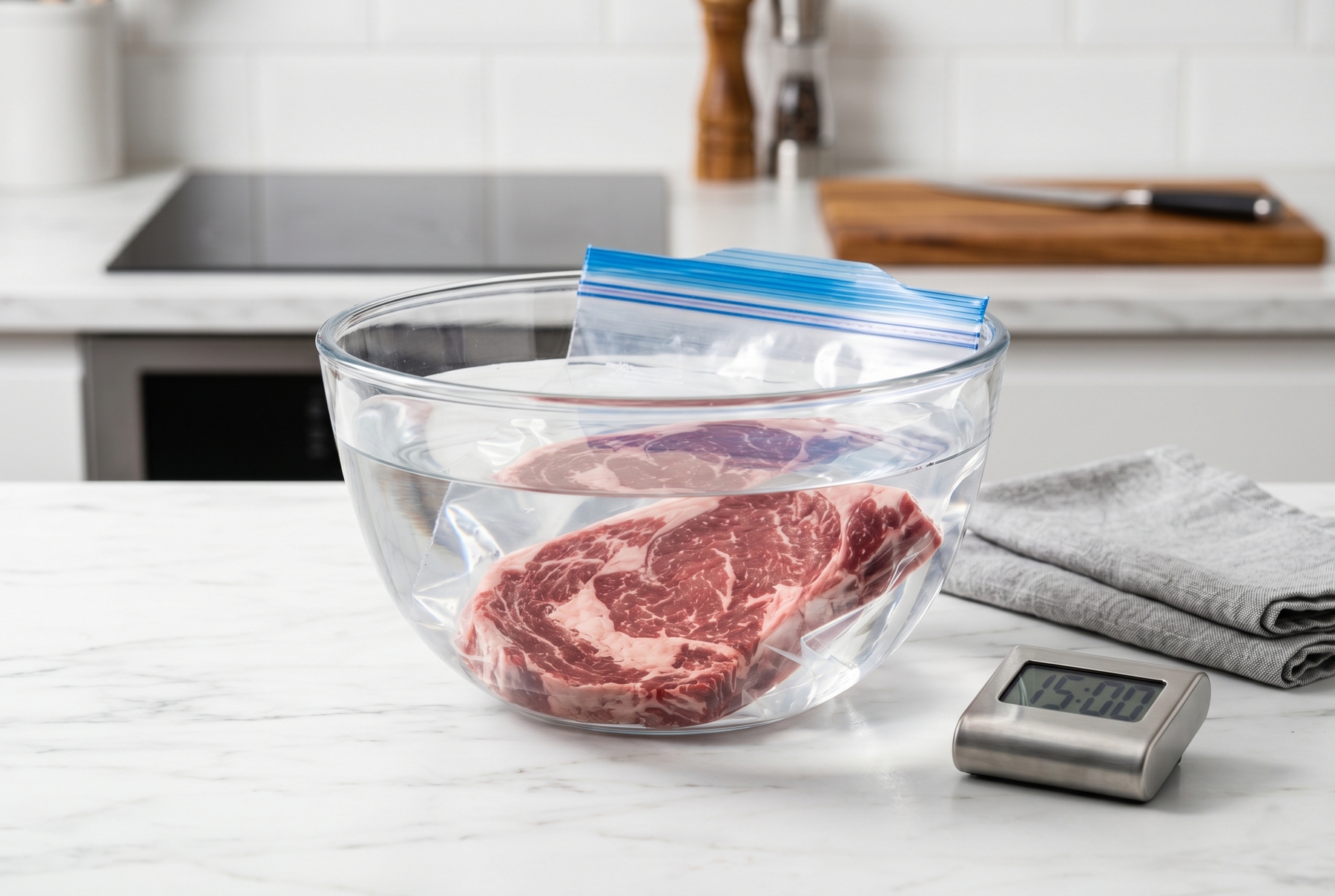
Defrosting in cold water is much faster than the refrigerator, but the meat must be in a hermetically sealed bag.
Defrosting Meat in the Microwave: Possible, but Manage Your Expectations
Why the Defrost Setting Is Not a Magic Button
Microwaves operate by emitting electromagnetic radiation that excites water molecules, generating heat. The problem is that liquid water molecules absorb radiation fundamentally differently than ice. Where the meat has already thawed, it heats up faster. Where there is still ice, it heats up slower. The result is entirely predictable: thin edges might start cooking while the thick center remains rock-hard.
The defrost setting reduces power and operates in pulses, allowing heat to redistribute during the pauses between heating cycles. This is better than full power. However, it is still not ideal: uneven heating persists, and the larger the cut, the more noticeable the discrepancy between its parts.
How to Quickly Defrost Meat in the Microwave if There Is No Other Option
Using the defrost setting is non-negotiable. Turning the meat every few minutes is essential. For separate pieces or parts (like chicken thighs or steaks), separating them as they begin to thaw and flipping each piece individually is the best approach. Removing the meat before it is completely warm is critical: taking it out a bit early while the center is still slightly cool preserves the texture. Cooking must happen immediately; microwave defrosting leaves meat in a state where delaying cooking is unsafe.
The microwave remains a last-resort option.
Why You Should Never Defrost Meat at Room Temperature or on a Radiator
Regarding the “Grandma Used to Do It” Argument
Yes, many people used to do it. Many people still do. However, this is not the best benchmark.
Meat left at a room temperature of +18 to +22 °C (64 to 72 °F) thaws unevenly. The surface can rise above the safe +4 °C (40 °F) mark long before the center fully thaws. Leaving meat on the counter for several hours is a bad idea because the outer layer sits in a risky temperature zone while the middle might still be frozen solid. Bacteria do not wait for the whole piece to thaw: they start working wherever it is already warm. For a small chicken breast, this means spending hours in hazardous conditions. For a large piece of pork or a whole chicken, it means six, eight, or even ten hours of exposure.
Why Room Temperature Ruins Flavor
Food safety is only half the problem.
A meat surface that has spent hours in the warmth looks wet and mushy. To the touch, it feels like a damp sponge. In the pan, this surface refuses to sear into a proper crust. Instead of the Maillard reaction, which delivers a beautifully browned exterior and deep aroma, you get steam and gray juices. The meat ends up braising in its own moisture because there is simply too much of it, and it leaks out faster than a crust can form.
The radiator is an entirely disastrous idea. At +50-70 °C (120-160 °F), temperatures common during the heating season, the meat surface warms to a point where proteins alter their structure. The outside is half-cooked, while the inside remains ice. This is not expedited defrosting; it is a guaranteed method for achieving a ruined texture before cooking even begins.
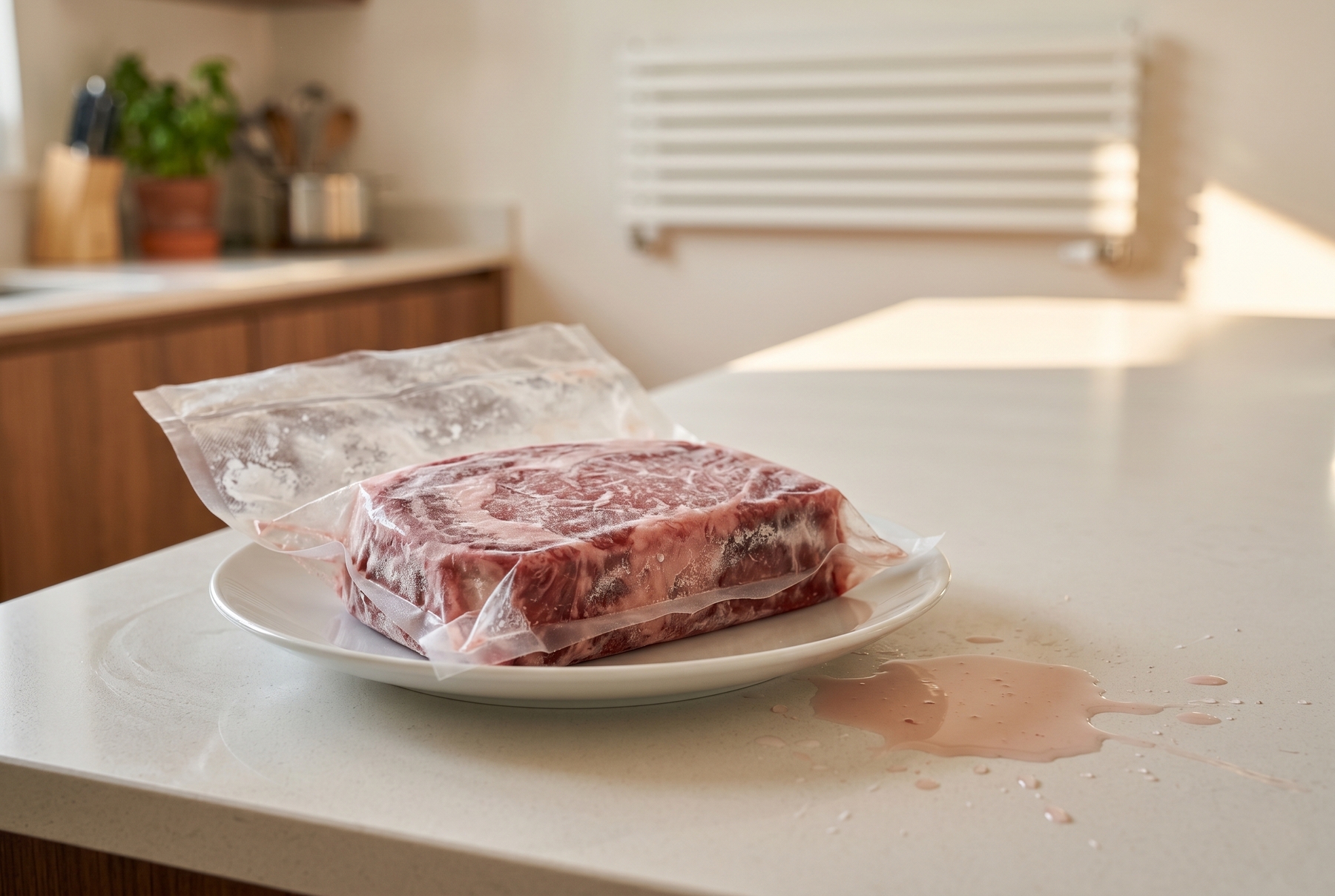
Defrosting at room temperature causes a massive loss of meat juices and creates an environment for bacterial growth.
How to Tell if Meat Is Fine After Defrosting
Appearance, Odor, and Texture
Normal signs include a mild meaty aroma. The surface is moist but not slimy. The color might be slightly darker than fresh meat. This is especially true for vacuum-sealed beef: without oxygen, it takes on a purplish-burgundy hue. However, once the package is opened, the familiar red color returns within a few minutes. A small amount of juice in the package is perfectly acceptable.
Bad signs include a sour or sharp odor with hints of ammonia. A sticky, slimy surface where your finger glides rather than just feeling moisture is a major red flag. Grayish-green patches or a bloated package indicate spoilage. If the product smells like anything other than meat, discarding it is the safest choice.
What to Do With the Escaped Juices
Attempting to return the juices to the meat using a marinade is a questionable idea. The juice has already escaped, and it will not absorb back in, especially over a short period. Marinades work differently: they penetrate the surface layers and alter their chemistry, but they do not replace lost internal moisture.
A more practical approach is necessary. Patting the surface dry with a paper towel before searing is essential. A dry surface guarantees a crust. A wet surface only provides steam and gray, braised meat. For steaks, this is the golden rule for a perfect sear. It applies equally to chicken breasts and pork.
Can You Refreeze Meat?
The Main Rule: It Depends on How It Was Defrosted
If the meat was defrosted in the refrigerator and remained cold the entire time, refreezing is possible, though quality will suffer. Another crystallization cycle will further damage fibers already weakened by the first freeze. Upon the next thaw, the meat will be softer and lose even more juice. For stews, beef stroganoff, soups, or fillings, this is negligible. For a steak, it will be quite noticeable.
If the meat was defrosted in cold water or the microwave, cooking it first is mandatory before freezing the finished dish or prep. Refreezing raw meat after these methods will not save it from the bacteria that have already multiplied.
How to Salvage the Situation if You Defrosted Too Much
Cooking everything at once is the best strategy. Using a portion today and incorporating the rest into a beef stroganoff, stew, pie filling, soup, or a grain bowl is a great solution. Freezing the leftovers as fully cooked meatballs or a Bolognese sauce for later is a smart move. Cooked meat in a sauce handles freezing much better than raw meat: the moisture is locked in by the sauce rather than relying on compromised muscle fibers.
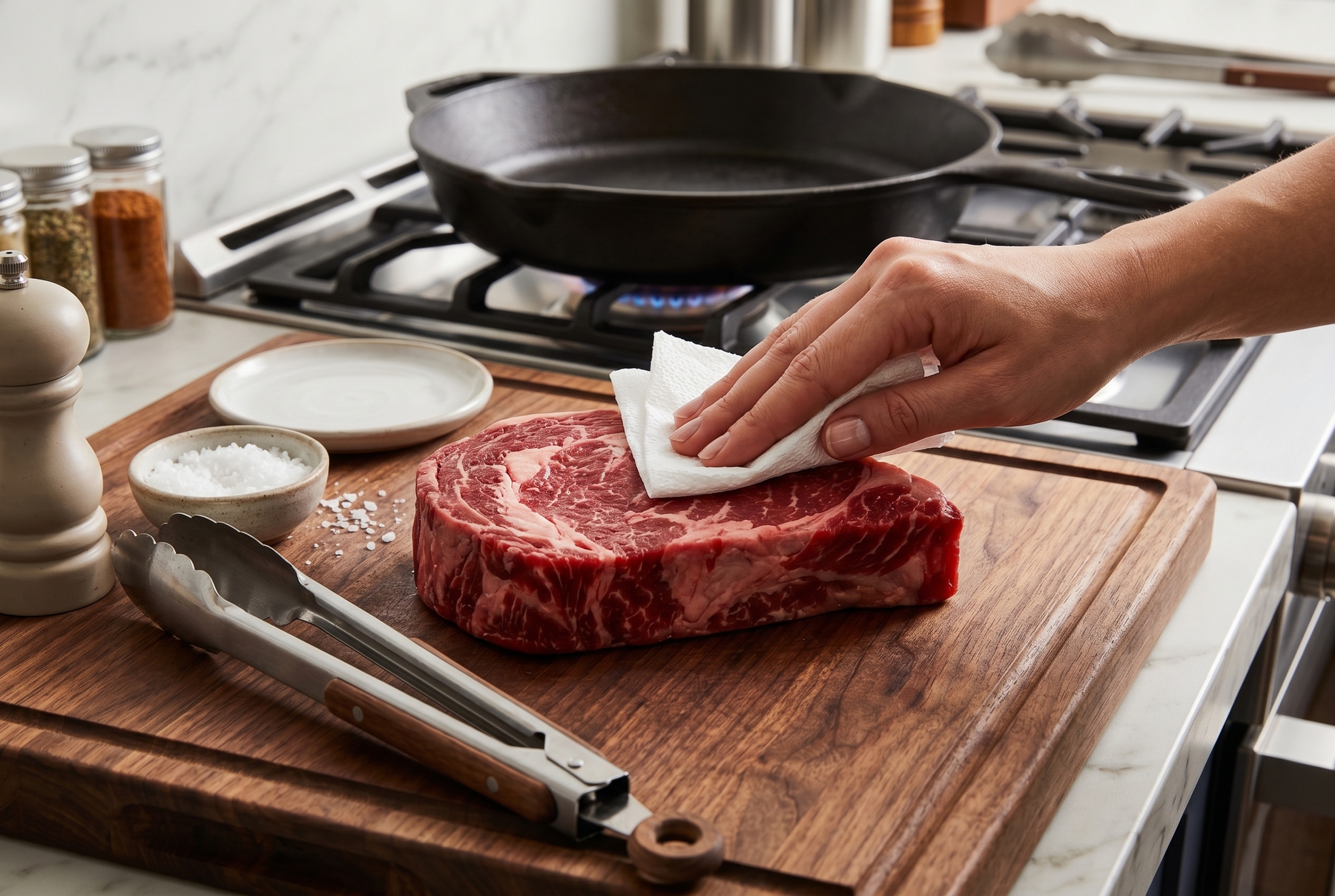
Patting the meat down with a towel is mandatory: only a dry surface provides a beautifully browned crust upon contact with the pan.
Different Types of Meat Mean Different Nuances
Chicken and Turkey
Mistakes with poultry are the most costly. This is a high-risk product: raw chicken can harbor Salmonella, Campylobacter, and other pathogens, making cold defrosting in the refrigerator especially crucial here. No counters, no windowsills.
Another critical point: washing chicken after defrosting is unnecessary and dangerous. It seems logical, but in practice, the water simply splashes bacteria across the sink, faucets, countertops, and everything nearby. Splashes travel farther than they appear. Thermal processing kills pathogens far more effectively than any washing.
Beef and Steaks
For steaks, a dry surface before searing is the ultimate rule for an excellent crust. Patting the meat down with a paper towel after defrosting is essential. If time permits, leaving the meat uncovered on a wire rack or plate in the fridge for another hour or two works wonders. The surface will dry out and condition slightly. On a scorching skillet or grill, this delivers an appetizing browned crust instead of a steaming effect.
Vacuum-sealed beef might smell slightly sour immediately after opening—this is perfectly normal for wet-aged vacuum beef. The odor dissipates after a few minutes of contact with the air.
Pork
Pork handles slow defrosting exceptionally well. During a warm thaw, it loses density quickly and releases a lot of juice: the structure of pork is softer than beef, and its fibers hold moisture poorly when heated. Drying the surface of pork before it hits the pan is absolutely mandatory.
How to Defrost Ground Meat
Ground meat is the most temperamental product. It lacks a protective, intact structure: it consists of already destroyed cells with a massive total surface area that easily surrenders moisture and spoils quickly. Thawing it in a thin, flat layer is far more convenient than dealing with a large frozen block.
The best trick is to flatten the bag of ground meat into a uniform sheet about 1-1.5 cm (about 0.5 inch) thick before freezing. The surface area exposed to cold air is larger, so it thaws evenly and swiftly—eliminating the need to chip away at a solid ice block and force it apart by hand.
How to Freeze Meat So It Is Easier to Defrost Later
Portions Fix Everything
Meat bought as a massive chunk and frozen whole always results in a compromise: you either defrost the whole thing or take nothing. Ten minutes of prep after shopping changes the game. Dividing the meat into task-specific portions (for soup, searing, steaks, or patties) is highly recommended. Packing each portion tightly and removing the air is vital. Steaks and patties should be separated by sheets of parchment paper so they do not require sheer physical force to break apart later. Writing the date and product type directly on the bag saves future headaches.
A vacuum sealer significantly reduces air contact: it means less risk of freezer burn, fewer off-odors, and better quality preservation. It does not make meat immortal, but for those who regularly buy in bulk, it is a genuinely valuable tool.
A System That Works in Practice
Bought today, prepped today: sorted for soup, searing, ground meat, and a quick dinner. Freezing ground meat flat is optimal. Packing steaks with parchment in between prevents sticking. Dating every single bag is helpful, because everyone eventually finds a mysterious package in their freezer that is either pork or a vague memory of a spring barbecue. With this system, thawing a two-kilogram monolith just for a single dinner portion becomes a thing of the past.
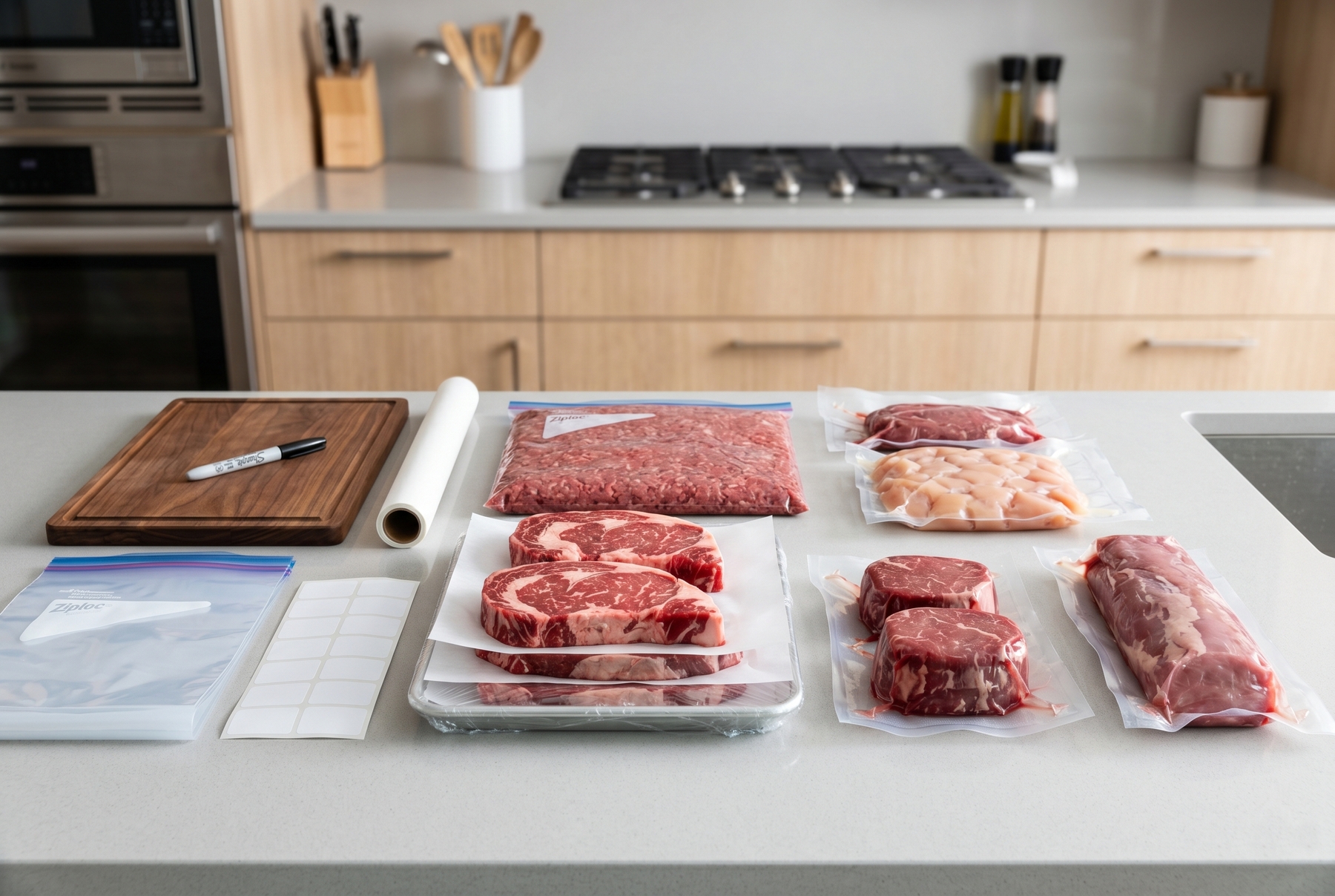
Dividing meat into portions before freezing is the best way to avoid refreezing and save time.
A Quick Cheat Sheet: How to Defrost Meat Without Losing Quality
Best Method: In the refrigerator, planned in advance, placed in a container or on a plate. Chicken and small cuts: overnight. Large cuts and whole birds: 24 to 36 hours.
Fast and Acceptable: In cold water, securely sealed in a waterproof bag, changing the water every 20-30 minutes. Cooking must follow immediately.
Only in Emergencies: Microwave on the defrost setting, flipping regularly, ensuring it is removed before becoming warm.
Never: On a radiator, in hot water, left on the counter overnight, or placed in direct sunlight on a windowsill.
Before Searing: Pat the surface completely dry with a paper towel. Always. This is especially vital for steaks, chicken, and pork.
If You Doubt the Smell: Just throw it away.
0 comments