
They stand side by side on the supermarket shelf. Dark bottles, characters, and labels boasting ‘classic,’ ‘traditional,’ ‘original,’ or even ‘premium.’ The labels promise the same thing: authentic Asian flavor, something ancient and genuine. Many shoppers do not know how to choose a good soy sauce, so they simply reach for the bottle with the most attractive label or the slightly lower price—grabbing it for their sushi rolls, rice, or marinade because the old bottle ran out.
Behind the identical appearance lie two fundamentally different technologies: slow fermentation and the rapid assembly of flavor from salt, coloring, and hydrolyzed protein.
The difference is chemical. One product contains hundreds of aromatic compounds, peptides, organic acids, and full-fledged umami. The other primarily provides salt with a meaty aftertaste. Interestingly, both can cost roughly the same.
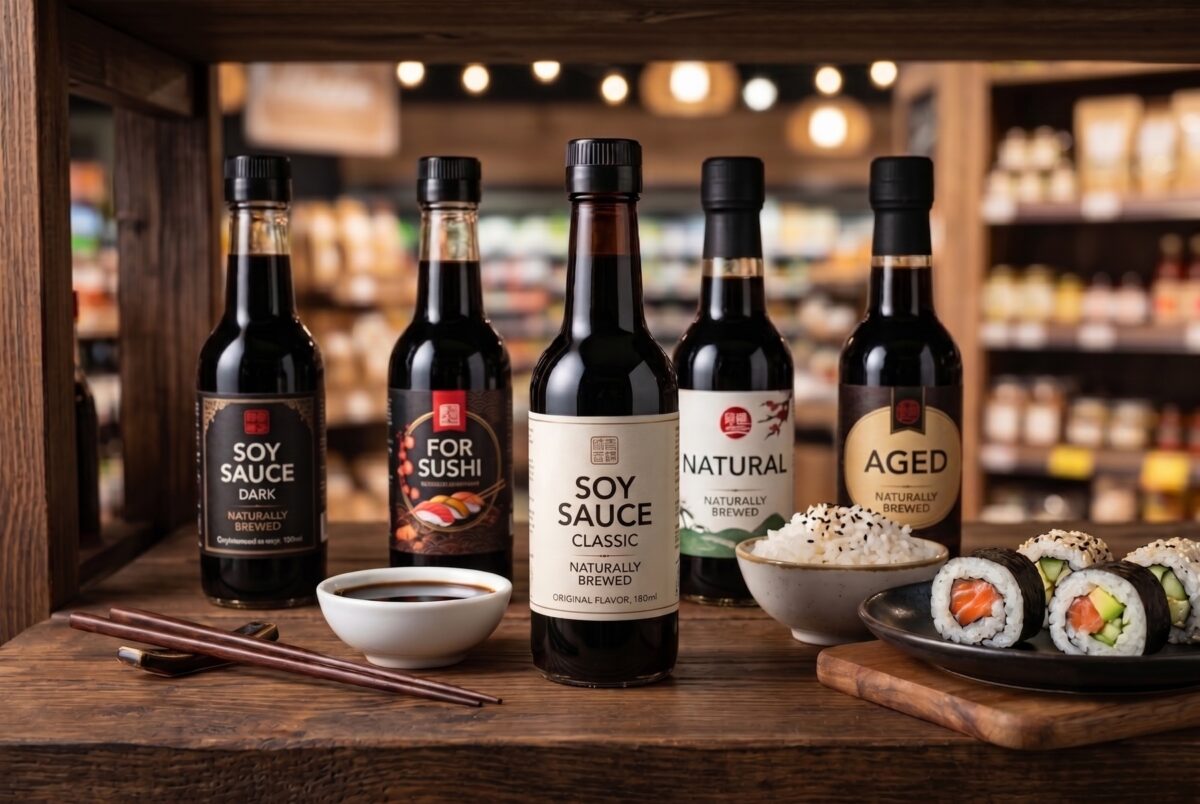
Dozens of soy sauce varieties line supermarket shelves, but fundamentally different production technologies hide behind beautiful labels.
Table of Contents
- What Happens Inside a Bottle of Authentic Soy Sauce
- The Ingredient List of Cheap Soy Sauce: Hydrolyzed Protein Instead of Fermentation
- Types of Soy Sauce: Japan, China, Korea, and Thailand for Different Culinary Tasks
- How to Read the Ingredient List: What Should and Should Not Be There
- What the Label Says: Useful Versus Decorative Information
- Color, Aroma, and Taste: What Can Be Understood Without a Laboratory
- Salt in Soy Sauce: Natural Fermentation Does Not Negate the Quantity
- Which Sauce Fits Which Culinary Task
- How to Choose Soy Sauce: A Cheat Sheet
- How to Store Soy Sauce After Opening and When to Replace It
- An Honest Ingredient List Matters More Than a Beautiful Bottle
What Happens Inside a Bottle of Authentic Soy Sauce
A classic naturally brewed soy sauce is built on four components: soybeans, wheat, salt, and water. This is not just an ingredient list; every component plays a specific role here.
Soybeans provide the protein base for umami, while wheat imparts aroma and a light grainy sweetness. Salt is necessary to control the fermentation (without it, the process would be completely unpredictable), and water binds them all together.
Next, in Japanese technology, koji enters the scene. Mold fungi of the Aspergillus oryzae genus initiate the breakdown of proteins and starches. The enzymes they release dismantle long molecules into shorter fragments. Then the moromi stage begins: the salty mash matures for months, sometimes even years. After pressing, when the liquid is separated from the solids, the sauce is heated; this pasteurizes the product, halts enzyme activity, and stabilizes the flavor.
I once watched a production facility open a barrel of moromi at the eighth month of aging. The smell was so dense and alive that workers from an adjacent shop came over to see what was happening. This is fermentation in action: not an abstraction from a textbook, but a very physical phenomenon.
During all this time, amino acids, organic acids, peptides, alcohols, and several hundred aromatic compounds form in the sauce. It is their combination that gives the sauce its caramel hue, roasted grain aroma, and characteristic umami. The value of natural fermentation lies not in any single molecule. The flavor stems from a complex balance of hundreds of components that cannot be convincingly replicated using isolated aromatic additives.
This results in a rich aroma that is not merely salty but carries notes of grain, caramel, and dried fruits. Without long aging, the chemical reactions simply do not have time to finish, leaving the flavor flat.
The Ingredient List of Cheap Soy Sauce: Hydrolyzed Protein Instead of Fermentation
Hydrolyzed vegetable protein or hydrolyzed soy protein allows manufacturers to achieve that meaty aftertaste without a long fermentation process. Soy meal is treated with hydrochloric acid at a temperature of around 100-120 °C (212-248 °F); the proteins break down into amino acids in a few hours instead of months. The mixture is then neutralized with an alkaline solution (such as sodium hydroxide), followed by the addition of coloring, salt, sugar, and sometimes flavorings.
Hydrolyzed protein is neither a banned substance nor a toxin. However, it is an entirely different product with a different chemical profile.
It lacks the aroma that slow fermentation provides. The spectrum of organic acids is completely different. Acid hydrolysis leaves behind undesirable impurities. Natural sauce contains practically none of these. The European Union regulates their levels in soy sauces, and reputable brands monitor this closely, but the mere fact highlights that the technology is not neutral.
If a bottle says ‘traditional’ but the ingredient list includes hydrolyzed protein, artificial coloring, and flavorings, it is an imitation. In a marinade or a heavily seasoned wok dish, the difference gets masked by spices and heat treatment, making such a sauce adequate. However, one should not expect the depth of real soy sauce from it.
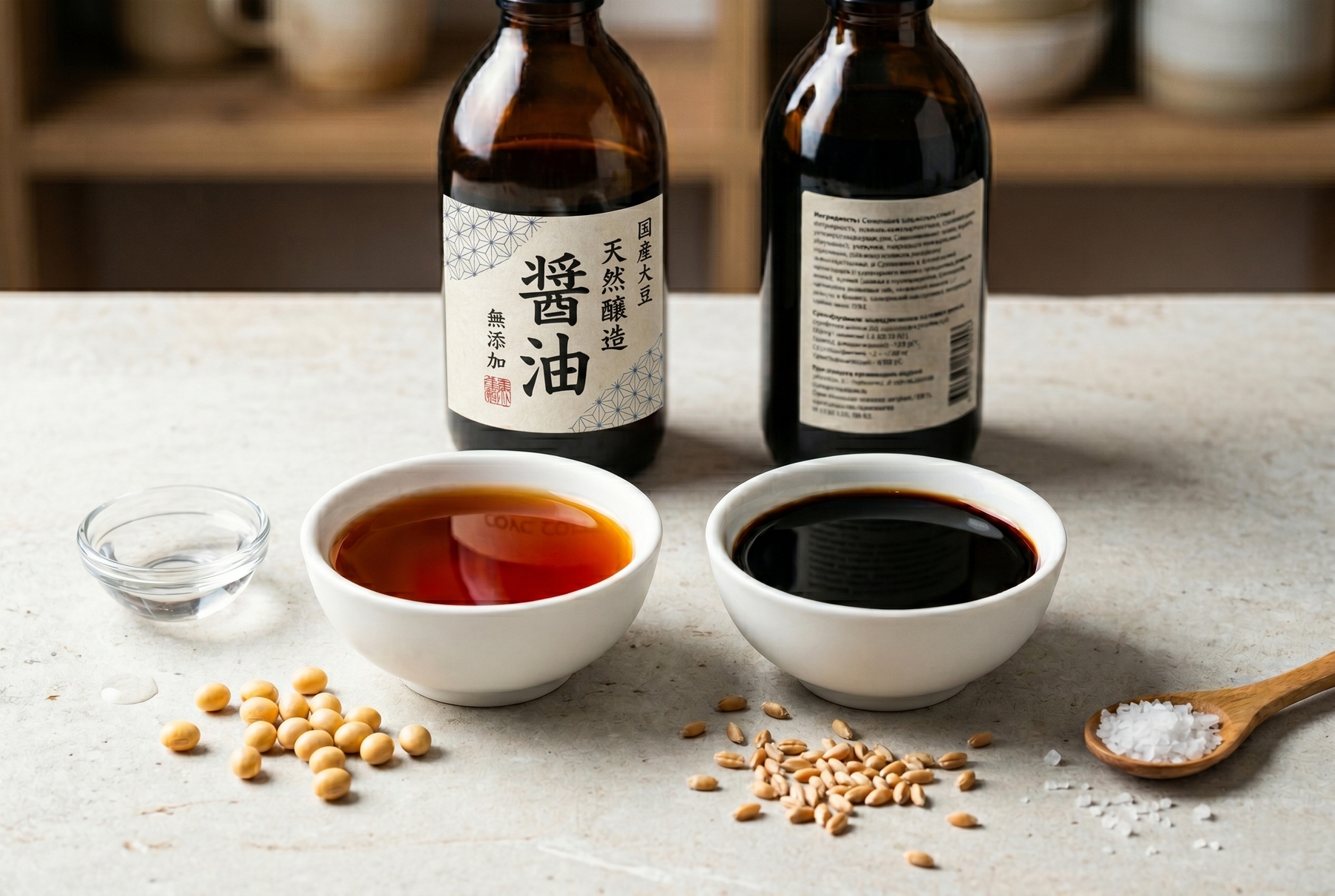
A classic ingredient list includes only four components: soybeans, wheat, salt, and water. Everything else is an unnecessary additive.
Types of Soy Sauce: Japan, China, Korea, and Thailand for Different Culinary Tasks
A common mistake is assuming that Japanese sauce is always superior to Chinese, or that any imported bottle is automatically of higher quality. Each Asian culture has its own types of sauces tailored for specific dishes.
Japan
The Japanese system features five primary styles.
- Koikuchi – the most common style, making up the vast majority of Japanese production. Dark and versatile, it works well as a table condiment, in marinades, and with rice, noodles, fish, meat, and vegetables. When a recipe simply calls for ‘soy sauce’ without specification, it almost always means koikuchi.
- Usukuchi – lighter in color but often saltier in concentration. Cooks use it when it is important not to darken the dish, such as in clear broths, braised vegetables, and delicate sauces. The word ‘light’ here does not mean ‘less salty,’ which is a frequent misconception.
- Tamari – contains minimal or no wheat. Dense, rich, and deep in flavor. It shines as a finishing sauce or with delicate fish, though it is less versatile for general cooking.
- Shiro – a very light sauce with a high proportion of wheat, essential for dishes where a dark sauce would ruin the color.
- Saishikomi – a ‘double-brewed’ or twice-aged sauce. It is the thickest and richest of the five styles, perfect for sushi, sashimi, and simple dishes where the sauce stands out as an independent flavor.
China
In Chinese cuisine, an essential pair dominates.
- Light Soy Sauce – the primary salty sauce, light in color, used for seasoning and umami.
- Dark Soy Sauce – darker, thicker, and often enriched with caramel, molasses, or sugar. It provides color, shine, and a glaze for braised dishes.
The main distinction between light and dark soy sauce is crucial. ‘Light’ does not imply dietary or low-sodium; it simply denotes its primary function. Substituting light sauce with dark sauce results in a dark, heavy, and often overly sweet dish. Caramel or molasses in dark Chinese sauce is not a sign of poor quality. Within the logic of Chinese cooking, they belong there. The problem arises when such a product is marketed as an all-purpose sauce without explaining its actual culinary purpose.
Korea
The term ganjang covers several distinct types.
- Guk-ganjang: intended for soups and broths. It is lighter, saltier, and carries a sharp flavor.
- Yangjo-ganjang: a naturally brewed all-purpose sauce. In terms of usage, it is the closest equivalent to Japanese koikuchi.
- Jin-ganjang – the most deceptive category for shoppers. Under this name, mass-market products based on rapidly broken-down soy proteins or blends with hydrolyzed protein frequently appear.
The only solution is reading the ingredient list rather than trusting beautifully printed Korean letters.
Thailand and Southeast Asia
Thai soy sauce operates differently than Japanese or Korean varieties.
- Light Thai Sauce (si-ew khao) – an everyday salty sauce for umami.
- Dark Thai Sauce (si-ew dam) – darker, thicker, and slightly sweeter, functioning similarly to Chinese dark sauce.
- Sweet Soy Sauce (si-ew wan) – distinctly sweet and syrupy, used for fried noodles and glazing. This represents an entirely separate category of products.
- Indonesian Kecap Manis – thick, packed with sugar and spices. Evaluating it by the criteria of a versatile Japanese soy sauce makes no sense. It is a different tool for a different cuisine.
A good Chinese dark sauce for braised five-spice pork might be the best choice in a specific kitchen – far better than a poor-quality Japanese ‘sushi sauce’ loaded with coloring and artificial flavors. Bad products exist in every culinary tradition. Good ones do, too. The first step involves choosing the cuisine and the task; the second step involves reading the ingredient list.
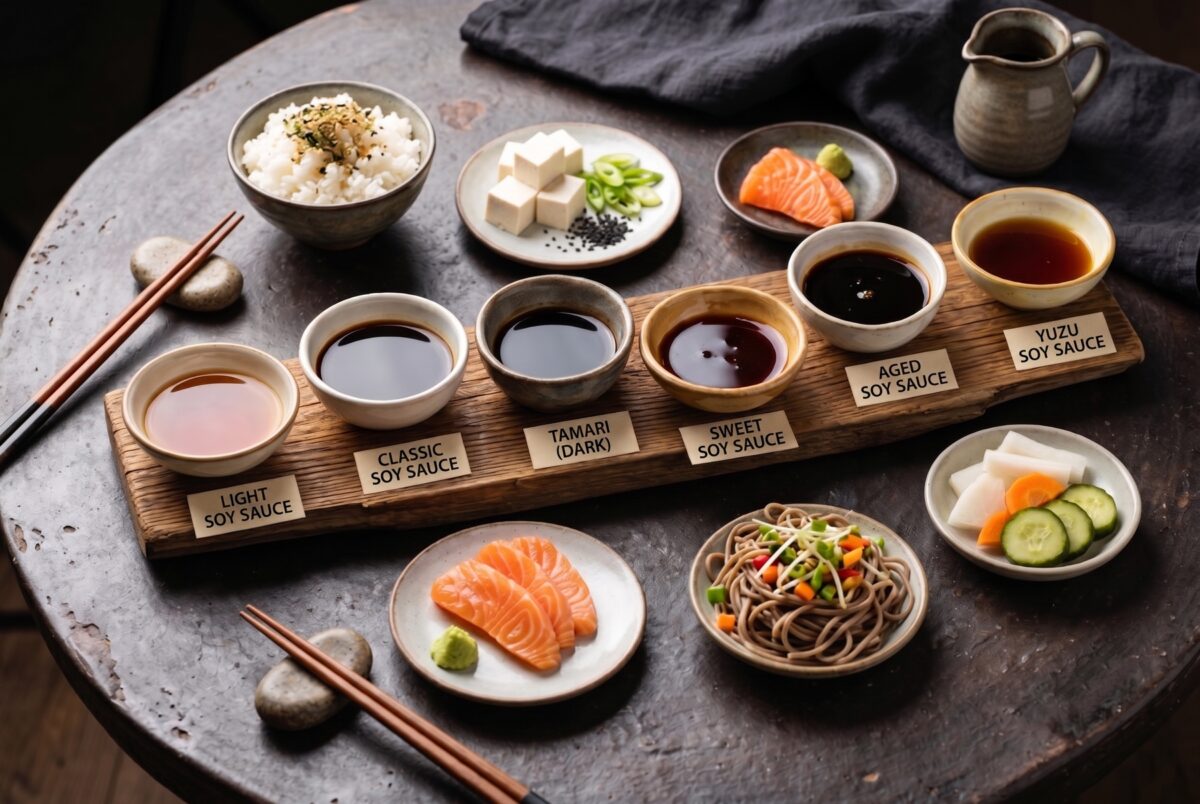
Japan, China, and Korea boast their own sauce production traditions, ranging from light and salty to thick and sweet varieties for different culinary applications.
How to Read the Ingredient List: What Should and Should Not Be There
The ideal foundation for a natural all-purpose soy sauce consists of water, soybeans, wheat, and salt. The order of components may vary, and alcohol sometimes appears as a preservative. This is perfectly normal. Added sugar, vinegar, or yeast extract do not automatically ruin a product. However, the more of these extras present, the closer one must examine the label: is this a natural sauce, a regional classic, or merely an imitation?
It is best to decline the purchase if the ingredient list includes:
- hydrolyzed vegetable protein or hydrolyzed soy protein; the umami here is derived through acid hydrolysis rather than fermentation;
- artificial flavorings; the flavor was simulated chemically instead of being achieved through brewing;
- caramel coloring – a red flag in a product posing as an all-purpose naturally brewed sauce (though for Chinese or Thai dark sauce, added sugar, caramel, or molasses can be a standard part of the style);
- flavor enhancers in a product marketed as traditional;
- a remarkably long ingredient list for something that should be a simple fermented product.
What the Label Says: Useful Versus Decorative Information
Certain words genuinely indicate the production technology. Look for ‘natural fermentation’ or ‘naturally brewed.’ On imported labels, terms like naturally brewed, fermented soy sauce, and sometimes honjozo for Japanese products indicate a naturally brewed sauce. The word ‘brewed’ by itself serves as a helpful signal, but only when paired with a proper ingredient list on the back.
Words that guarantee absolutely nothing include ‘classic,’ ‘traditional,’ ‘original,’ ‘premium,’ ‘Asian,’ ‘for sushi,’ ‘for wok,’ and ‘based on an ancient recipe.’ The real truth always lies on the back label, printed in small type, which consumers read far less frequently.
Color, Aroma, and Taste: What Can Be Understood Without a Laboratory
Testing a sauce at home by sight and smell is quite simple.
The color of a good natural sauce appears alive: amber-brown, reddish, or dark ruby. Pouring a small amount onto a white plate reveals its transparency and an inner glow. A thick, opaque black liquid lacking any vibrant hue offers a reason to be cautious, although this alone is not a definitive sentence, as some styles are naturally darker.
A high-quality sauce boasts an aroma far more complex than just salt. It features grain, fermentation, a caramel undertone, something reminiscent of prunes, and occasionally an earthy mushroom note. An imitation usually has a harsh and one-dimensional smell: salt hits first, followed by something chemical or overly sweet, lacking any real depth.
The taste of a naturally brewed sauce is undeniably salty, but there is substantial volume behind that salt. Umami stands out as an independent layer. The aftertaste lingers pleasantly. My colleagues and I once conducted a blind tasting of eight sauces, ranging from budget to premium. Just three seconds after tasting the imitation, only a harsh saltiness remained in the mouth – and nothing else. The naturally brewed sauce held its flavor for about twenty seconds. The difference proved so obvious that no one made a single mistake. A cheap imitation delivers a one-dimensional taste: a sharp hit of salt, occasional sweetness, and then an abrupt end, leaving nothing behind.
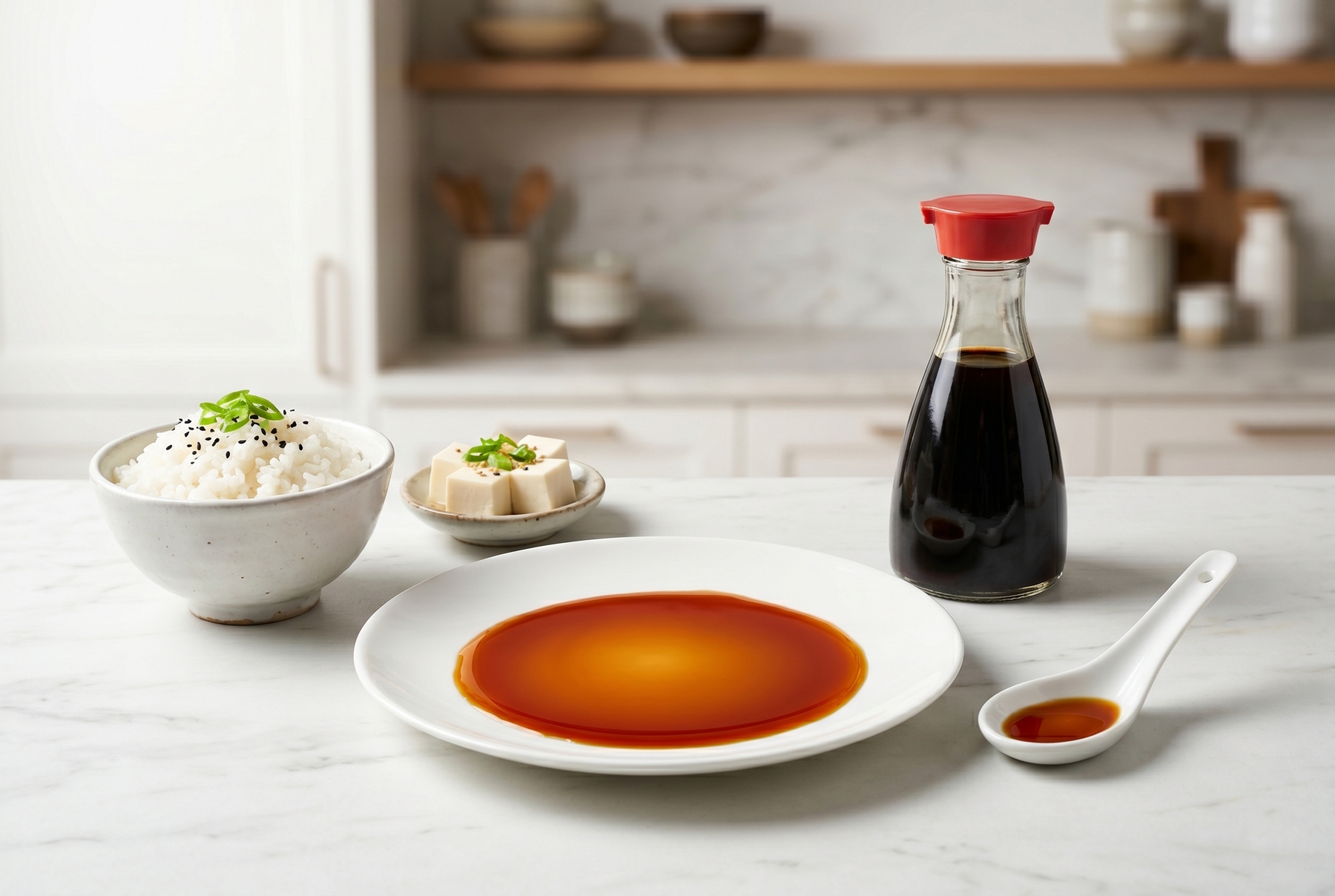
Naturally brewed soy sauce remains transparent and features a rich reddish-brown or ruby hue.
Salt in Soy Sauce: Natural Fermentation Does Not Negate the Quantity
Soy sauce is a high-sodium product regardless of the technology. A standard Japanese koikuchi contains about 15 to 18 grams of salt per 100 milliliters (about 3.4 fl oz). Usukuchi sometimes contains even more. The natural brewing technology speaks to the quality and complexity of the flavor, but it does not magically transform the product into a health food. However, real sauce goes much further: a single teaspoon will impart more flavor to a dish than a full tablespoon of a flat, salty alternative.
If health conditions require limiting sodium intake, use the sauce sparingly or look for reduced-sodium options. On imported labels, these usually say reduced sodium or less sodium. Their flavor profile differs slightly, but natural fermentation certainly exists within these versions as well.
Which Sauce Fits Which Culinary Task
Determining the best soy sauce for sushi rolls, rice, noodles, and everyday cooking: a versatile naturally brewed koikuchi or a similar product with a short ingredient list works perfectly. It suits most homemade dishes without unnecessary complications.
For Chinese stir-fries and wok dishes: keeping a pair on hand works best. Use a light soy sauce for the primary salty flavor and a dark soy sauce for color, shine, and glazing. One cannot substitute the other; the dish will turn out either colorless or unpleasantly dark and heavy.
For Korean soups and banchan: use Korean ganjang as intended. Japanese sauce yields a different profile – less sharp, with a different acid balance – and the soup will simply taste wrong.
For marinades: a simple sauce gets the job done. In a marinade, the salt, acid, spices, and heat treatment do the heavy lifting, largely masking the complex aroma. Yet, if the marinating time is short and the sauce acts as the main ingredient, the difference in quality remains noticeable.
For serving at the table, with sushi, rice, tofu, boiled eggs, or raw vegetables: this is where natural fermentation matters most. The sauce works directly and other ingredients do not overpower it, making it impossible to hide a flat, artificial flavor.
How to Choose Soy Sauce: A Cheat Sheet
Buy it if the ingredient list is short: soybeans, wheat, water, salt, and perhaps alcohol. The label indicates natural fermentation or, on imported packaging, says naturally brewed. It lacks hydrolyzed protein. It has no artificial flavorings. The style of the product is clear: versatile, light, dark, Korean, or sweet – not an absurd ‘everything all at once.’
Put it back on the shelf if the ingredient list features hydrolyzed protein (on imported labels: hydrolyzed vegetable protein, hydrolyzed soy protein) or a ‘soy sauce flavor’ additive. Reject it if it contains too much sugar and coloring for a basic all-purpose product. If the front proudly proclaims ‘traditional’ and ‘premium,’ but the word ‘brewed’ appears nowhere. If the product promises to work simultaneously for sushi, woks, meats, salads, and ‘Asian cuisine in general,’ this points to marketing rather than authentic technology.
Exceptions certainly exist. An inexpensive sauce with a clean ingredient list and a note about fermentation is absolutely worth trying. Conversely, an expensive bottle sporting a long list of chemical additives should remain on the shelf; a high price tag will not save it.
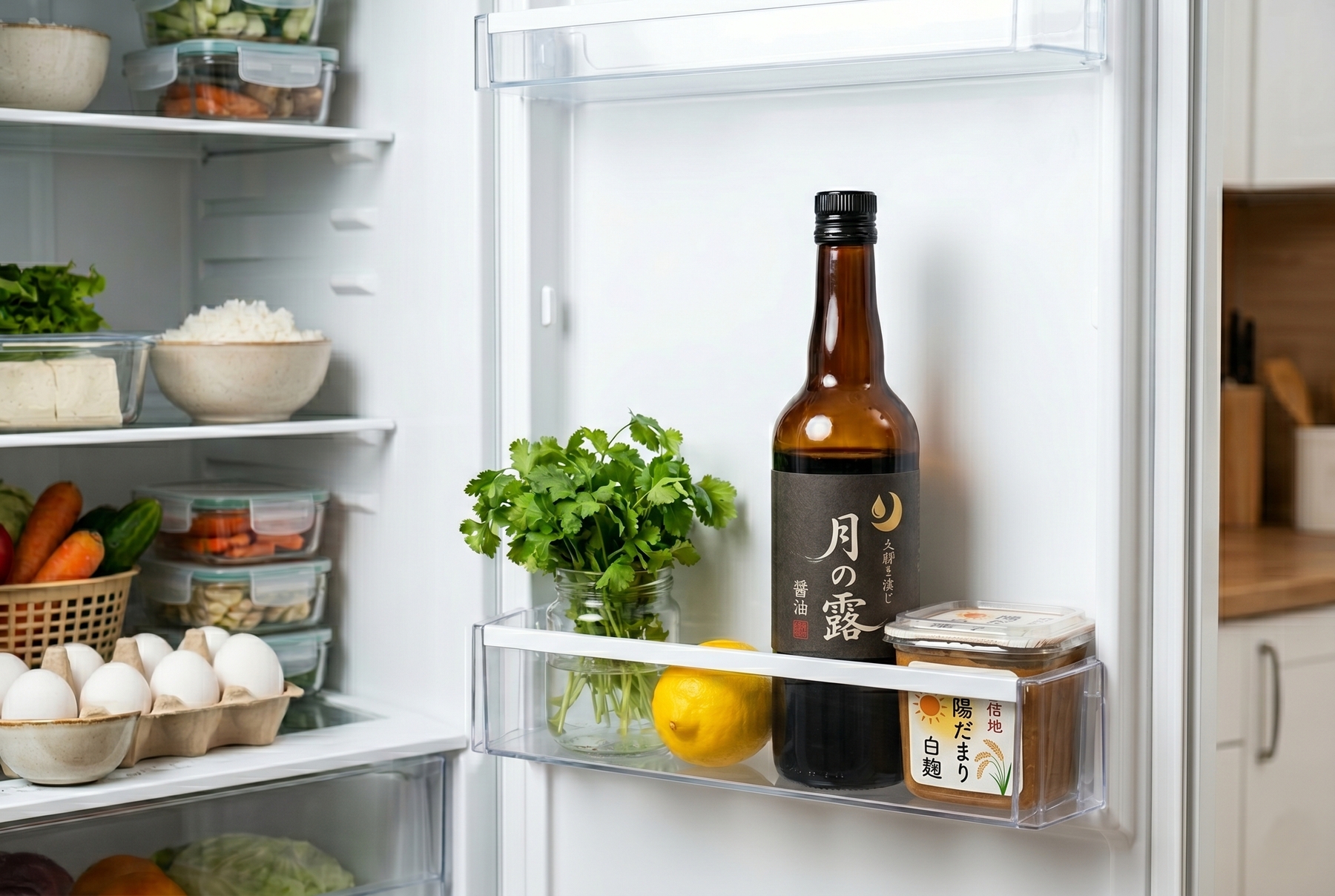
To preserve the complex aroma of fermentation, keeping an open bottle of natural sauce in the refrigerator is highly recommended.
How to Store Soy Sauce After Opening and When to Replace It
Salt and fermentation provide the sauce with stability, but the aromatic compounds still break down over time. Once opened, oxygen does its work: the aroma becomes rougher, the taste flattens, and delicate fragrant notes simply evaporate.
An unopened bottle keeps perfectly in a pantry unless the manufacturer specifies otherwise. After opening, moving it to the refrigerator – or at least a cool, dark place – preserves its quality, especially if the sauce is naturally brewed and not used daily. I keep an open bottle of koikuchi in my refrigerator door, usually finishing it within a month or six weeks. During this time, the aroma remains practically unchanged. That exact same bottle, left for six months in a warm cabinet above the stove, ends up smelling completely different: sharper, rougher, and completely lacking the pleasant grain note that prompted its purchase.
The signs that it is time for a replacement are obvious: the smell turns harsh, musty, or unpleasant. The taste devolves into rough salt with zero depth. Such a sauce will no longer elevate a dish; it will merely make it salty.
An Honest Ingredient List Matters More Than a Beautiful Bottle
A naturally brewed sauce does not need to be the most expensive, imported from Japan, or purchased at a specialty store. However, it must be transparent: featuring a specific style, a specific technology, and a short ingredient list.
The label ‘naturally brewed’ accompanied by four recognizable ingredients guarantees that the sauce matured for months, accumulating a complex aroma. It will make the flavor of any dish richer, not just saltier.
0 comments