
An expensive green tea sits on the shelf. Next to it is a canvas bag of a grandmother’s mint and linden blend. In the cupboard are ordinary black tea bags for everyday use. Added to this is the habit of pouring boiling water from a freshly switched-off kettle over everything.
The result is predictable. The green tea becomes so bitter that one wants to add sugar or simply pour it out. The herbal blend smells not of a summer meadow, but of hay from a pharmacy box. The tea bag stays in the mug for twenty minutes because it was forgotten, and the tea turns dark, harsh, and distinctly astringent, drying out the tongue.
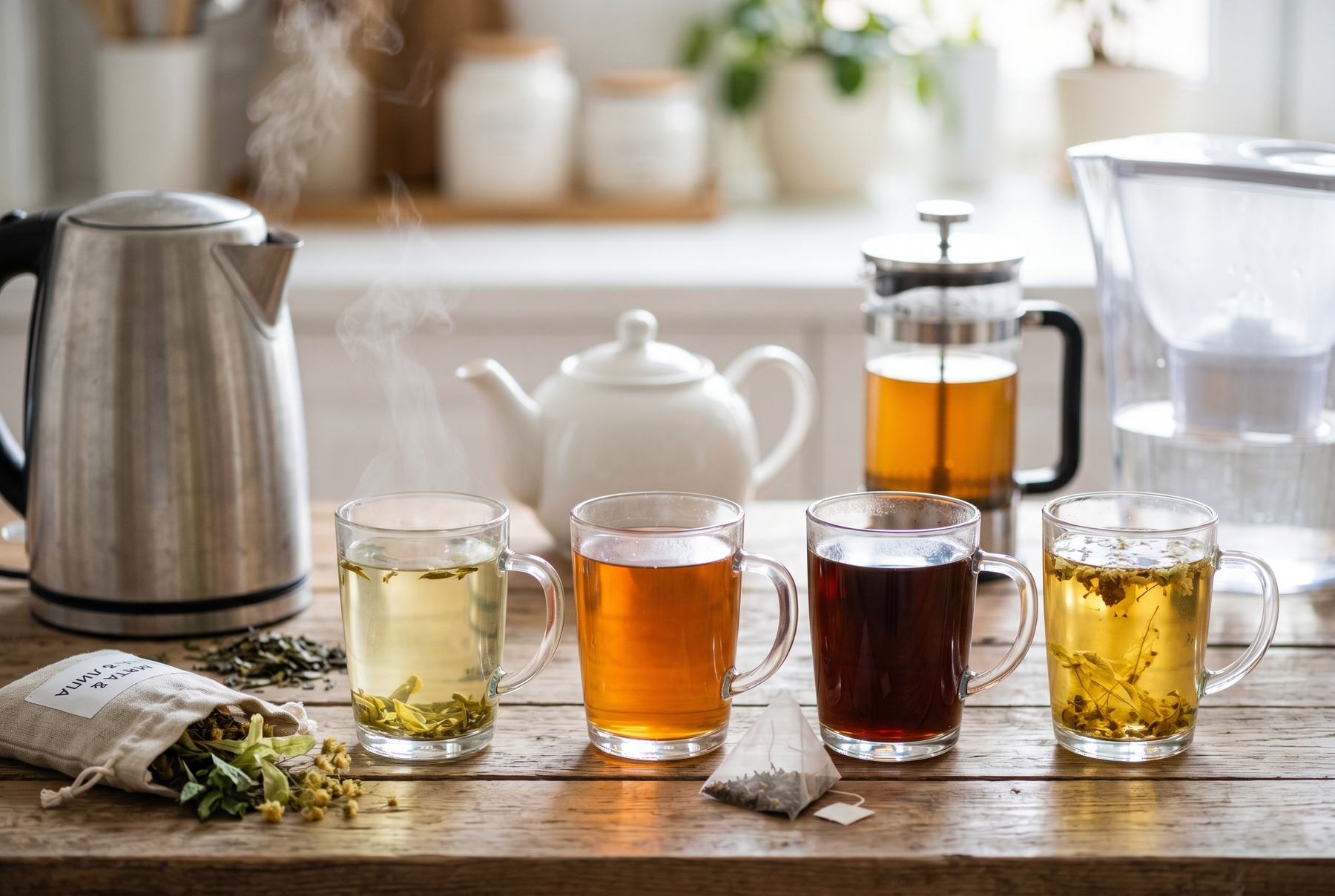
Proper brewing unlocks the true flavor of every variety, from delicate green tea to rich herbal blends.
Table of Contents
- Why One Tea Is Delicate and Aromatic While Another Becomes Bitter Brown Water
- What Water Extracts From the Tea Leaf
- Water, Teaware, and Dosage: Three Elements That Quietly Determine Half the Result
- At What Temperature to Brew Tea: A Flavor Map
- Herbs and Herbal Blends: Why Chamomile, Mint, and Rosehip Cannot Be Brewed the Same Way
- Fundamental Brewing Techniques
- How to Know if a Beverage Is Brewed Correctly
- Common Mistakes and How to Fix Them
- Tea and Herb Brewing Table: Temperature, Time, and Technique
- How to Brew Tea Without a Thermometer
- How to Build Your Perfect Ritual Without Tea Snobbery
Why One Tea Is Delicate and Aromatic While Another Becomes Bitter Brown Water
Most often, the issue is not the tea itself, but how it is brewed: the water used, the temperature, and the steeping time.
During brewing, water extracts flavor, color, aroma, and astringency from the leaf: essential oils, tannins, alkaloids, pigments, and organic acids. They do not enter the water all at once. Aroma and mild sweetness emerge first, followed by color, richness, and astringency. Finally, bitterness, a dry mouthfeel, and a heavy taste pull through, completely masking the aroma.
Water temperature, time, leaf size, dosage, and brewing vessels all affect the flavor. Boiling water extracts bitterness and sharp astringency from green tea within the first thirty seconds. Steeping for too long turns smooth white tea into a flat liquid that smells like wet paper. Hard tap water yields a cloudy sediment and dulls the aroma of even a high-quality variety.
Brewing tea correctly does not mean turning it into a strict ceremony. Understanding how temperature, time, and water affect the leaf is entirely sufficient.
What Water Extracts From the Tea Leaf
Why Flavor Emerges Gradually
A tea leaf contains many pores and cells; inside are essential oils, polyphenols, caffeine, amino acids, and pigments. Hot water softens the leaf and draws out its soluble compounds. A smaller leaf gives up its flavor and color to the water much faster.
Certain compounds dissolve into the water rapidly, while others require time and heat. Volatile aromatic compounds escape first, within 30 to 60 seconds. They deliver freshness, floral scents, and a light fruitiness. This freshness and aroma are exactly what distinguishes a fine tea from a merely strong brew.
Tannins follow shortly after. They introduce astringency to the palate, making the infusion feel heavier. Tannins dissolve into the water more slowly, and caffeine extracts at roughly the same pace.
After 3 to 5 minutes, the flavor of most teas stops improving. The infusion turns heavy, bitter, and astringent. A dry sensation lingers in the mouth, much like after eating an unripe persimmon. The delicate aroma vanishes, leaving only strength, bitterness, and dryness.
Assuming that steeping tea longer makes it richer is a common mistake. A rich tea and an oversteeped tea are entirely different things. An oversteeped infusion will never taste better.
Tea Brewing Temperature: How It Alters Flavor
Boiling water does not suit every variety. Some teas can withstand it, while for others, it is far too hot. Boiling water rapidly strips the leaf of its aroma, astringency, and bitterness. This is perfectly normal for dense, heavily oxidized, or fermented teas, such as Indian black tea, ripe Puerh (a fermented dark tea), and dark oolongs. The leaf in these teas has already been transformed through oxidation or post-fermentation. A high temperature does not immediately turn their flavor dry and bitter.
Delicate teas generally suffer from boiling water. Green tea, white tea, and light oolongs have not undergone deep oxidation. Their leaves are less processed, and their fragile aromas dissipate quickly. Boiling water rapidly draws out bitterness and astringency, while the delicate scent vanishes with the steam. Consequently, green tea often turns out sharp, grassy, and astringent.
A lower temperature allows the leaf to release its flavor more slowly, making it easier to stop the steeping process in time. At 70–80°C (158–176°F), the leaf first yields its aroma, light sweetness, and floral background. Tannins and bitterness emerge at a much slower pace. The infusion remains clearer, without unnecessary dryness.
Hotter water accelerates the extraction of both desirable and undesirable elements from the leaf. Cooler water gives the aroma and sweetness a much better chance to survive.
How Long to Steep Tea: Longer Is Not Always Better
A strong tea is not always a rich tea. Strength in this context comes from tannins, caffeine, a dark color, and an astringent mouthfeel. A truly rich tea delivers color and astringency alongside aroma, sweetness, and a pleasant aftertaste.
Obtaining a very strong tea that offers nothing but color, astringency, and bitterness is quite simple. One merely needs to oversteep the leaves in boiling water.
Black tea generally requires 3 to 5 minutes. Green tea often needs only 1 to 3 minutes, while white tea benefits from 3 to 7 minutes at a gentler temperature. Oolongs require anywhere from 20 seconds to 2 minutes, depending on the chosen method.
An oversteeped tea is visually apparent by its color and easily felt on the palate. The beverage becomes cloudy, dark, and highly astringent. The aroma disappears. A dryness remains in the mouth that does not wash away even after a sip of water. The flavor falls flat, and a lingering bitterness overshadows everything else.
The opposite problem also occurs. The infusion turns out pale, watery, and empty. It smells faint. The only sensation in the mouth is that of warm, lightly tinted water.
The perfect moment arrives when the aroma is already present, but the dry bitterness has not yet emerged.
Leaf Size, Tea Bags, and Granules
A smaller leaf has more exposed surface area, which means it steeps much faster. Tea bags usually contain small leaves, fannings, and dust left over from packaging loose-leaf tea. Sometimes, stems and tougher parts of the leaf end up there as well.
A tea bag typically requires only a minute or two. Steeping it longer invites sharpness, bitterness, and dry astringency. Fine tea dust releases its flavor much faster than a large leaf.
Granulated tea (CTC, typical for mass-market Indian and Ceylon production) consists of crushed, torn, and curled leaf particles. It brews exceptionally fast, producing a dark, astringent, and dense infusion. It works perfectly for tea with milk and a strong morning cup, but expecting a delicate aroma from it is unrealistic.
A large leaf needs space to unfurl, and sometimes a bit more time. For large-leaf black tea, this might take 3 to 5 minutes, while white tea requires longer steeping at a milder temperature. Green teas and light oolongs often reveal their character best through brief steepings or multiple short infusions.
Loose-leaf tea, especially tippy varieties containing buds, requires a gentler approach. Ruining it with boiling water and oversteeping is just as easy as ruining an expensive fish with extra minutes on the stove.
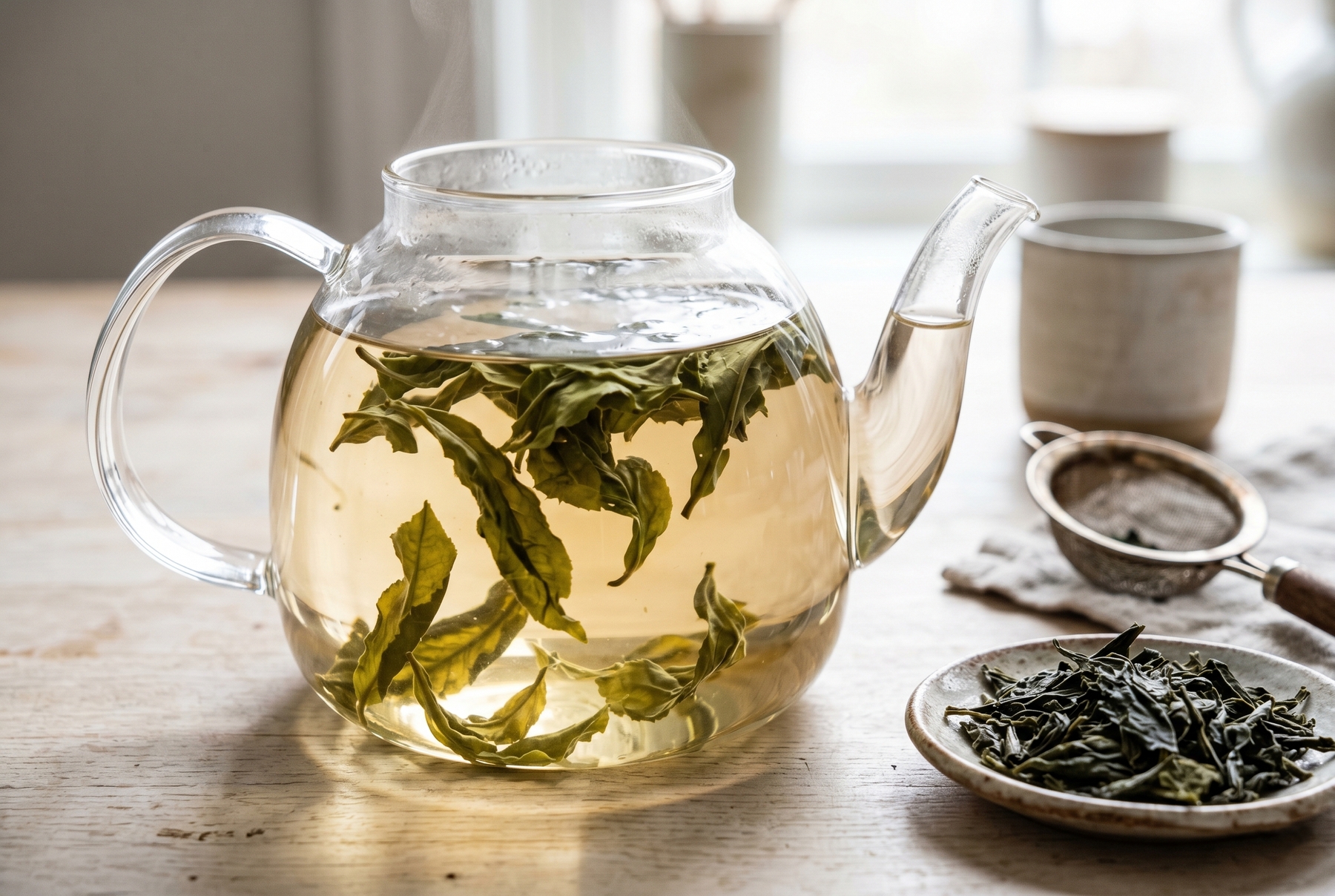
Large tea leaves require ample space to fully expand and release their complex aroma into the beverage.
Water, Teaware, and Dosage: Three Elements That Quietly Determine Half the Result
Which Water Is Suitable for Tea
Hard water makes tea cloudier and harsher on the palate. Calcium and magnesium salts bind with tea polyphenols, causing the infusion to turn murky and a film to form on the surface. The flavor becomes flat and metallic, while the aroma weakens.
Tap water occasionally smells of chlorine. This scent does not vanish during brewing; it mixes with the tea’s aroma and introduces a chemical aftertaste.
Repeatedly boiled water sometimes yields a flatter taste, as boiling reduces dissolved gases and slightly concentrates minerals. This is barely noticeable with soft water but becomes obvious with hard water. For high-quality tea, using freshly drawn water and avoiding keeping the kettle on a warming setting for hours is much more reliable.
At home, installing a pitcher filter or an under-sink filtration system is the easiest solution. Soft bottled water without a distinct mineral taste also works perfectly. The key is using freshly boiled water, rather than water from a kettle that has been boiled three times in a row.
Distilled water is equally unsuitable. Without any minerals, the flavor turns out entirely hollow. A balanced mineral content is essential.
Tasting the water separately before brewing is highly recommended. If it tastes unpleasant on its own, tea will not salvage the situation.
Why the Cup, Teapot, and Strainer Alter the Flavor
A tea leaf requires room to expand. When the leaf unfurls and absorbs water, the extraction process happens more evenly. In a tiny strainer, a brewing ball, or a cramped tea bag, the leaves clump together. One section barely touches the water, while another releases excessive bitterness.
A French press is highly convenient if the tea is poured out immediately. The leaves float freely, are then pressed down, and the infusion pours out clean, without any debris. However, pouring out the entire volume at once is crucial. Otherwise, the leaves will continue to steep, and within 10 minutes, the tea left in the beaker will turn intensely bitter.
A Kamjove or Gongfu teapot with a built-in strainer works well, provided the strainer is adequately large. In a tiny metal infuser the size of a spoon, the leaves generally lack space.
A Gaiwan is a traditional Chinese lidded bowl without a handle. It is designed for brewing via short infusions: pouring water, waiting 20 to 30 seconds, and decanting the tea through a narrow gap between the lid and the rim. This process is repeated several times. The method is highly precise, though beginners easily burn their fingers and spill half the infusion.
A glass teapot offers a great view of the process. Watching the leaves unfurl and the infusion darken minute by minute is quite satisfying. Glass cools down rapidly, so pre-warming the vessel with boiling water is advisable for hot tea.
Using a thermos demands caution. Rosehips, dense roots, and dried berries behave perfectly fine inside one. However, such prolonged heat usually ruins green tea, delicate blossoms, and aromatic oolongs. The leaves steep for hours, the water stays hot, and bitterness and astringency continuously extract. The resulting beverage ends up severely oversteeped, heavy, and bitter.
Brewing directly in a mug is the most common approach. This method works perfectly as long as the leaves are removed in time. A handled tea strainer or a brewing mug with an inner basket handles this job beautifully. A tea bag floating in a mug for half an hour almost guarantees a harsh flavor.
How Much Tea to Use: The Basic Dosage Formula
Starting with 2 to 3 grams (about 0.07–0.1 oz) of dry tea per 200–250 ml (6.7–8.4 fl oz) of water is an excellent baseline. This equals roughly a heaping teaspoon for large-leaf tea, or a level teaspoon for finer grades.
Herbal blends require a higher dosage: 1 to 2 tablespoons of dried herbs for the same volume of water. Fresh herbs demand even more volume, as they hold significant natural moisture and offer a milder flavor.
For pressed Puerh tea, 4 to 5 grams (0.14–0.17 oz) per 150 ml (5 fl oz) works beautifully for the short-steeping method. For Matcha (powdered green tea), 1 to 2 grams per 70–100 ml (2.3–3.3 fl oz) of water is standard.
If the tea turns out weak, increasing the dosage is a better strategy than extending the steeping time. If the tea ends up bitter, lowering the temperature or shortening the time is the right move, but reducing the leaves to a mere pinch guarantees a flavorless cup.
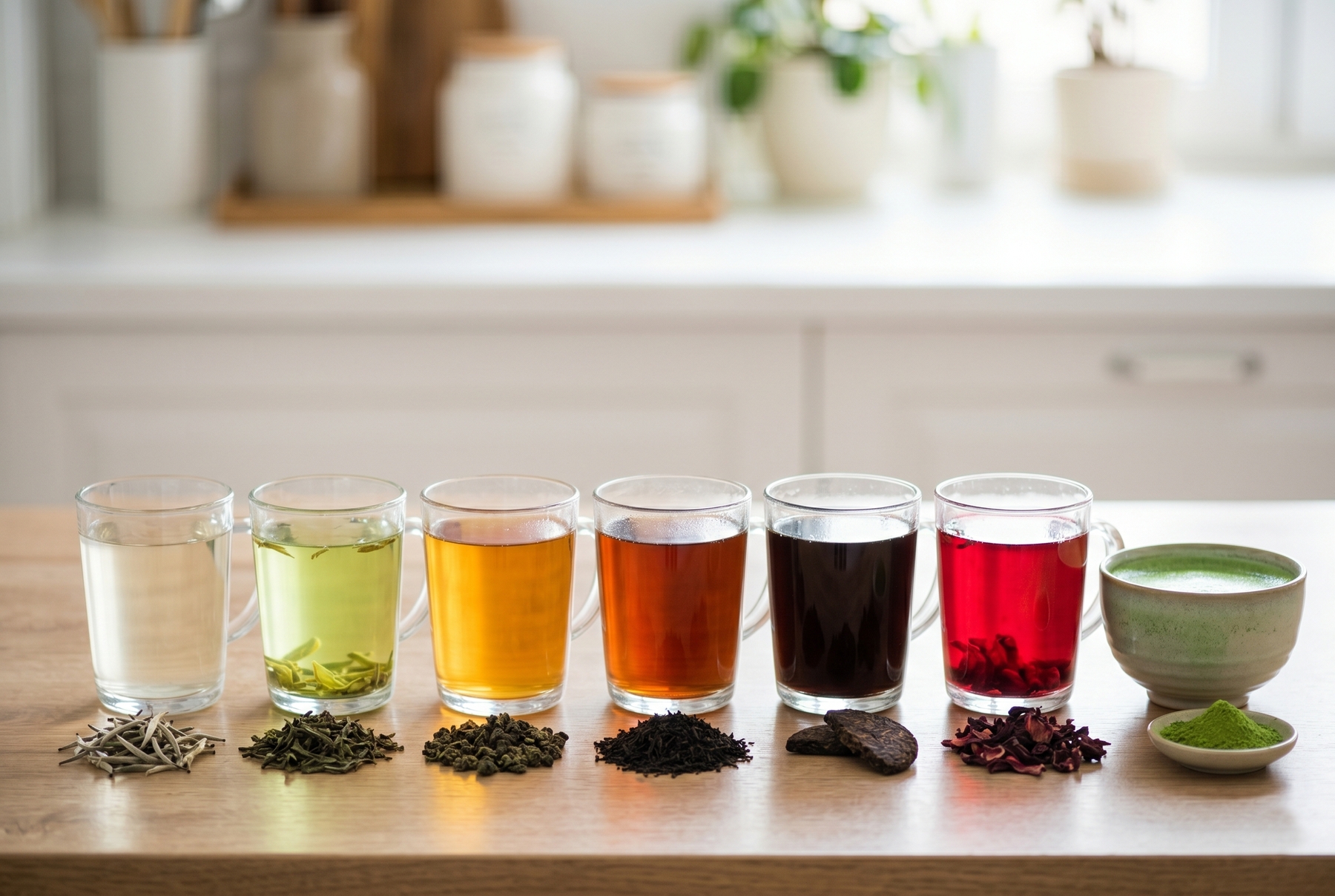
Every tea type, from delicate white to dense Puerh and Matcha, demands a specific water temperature and steeping time for perfect balance.
At What Temperature to Brew Tea: A Flavor Map
The numbers below serve as a starting point rather than a strict recipe. A specific tea might vary based on its variety, freshness, roasting level, and leaf size. A thermometer provides guidance, but checking the result in the cup remains essential.
Black Tea
- Temperature: 90–100°C (194–212°F). Most black teas handle this intense heat exceptionally well.
- Time: 3–5 minutes.
- Dosage: 2–3 grams per 200 ml (6.7 fl oz).
In traditional tea terminology, black teas and oolongs are often called fermented. From a processing standpoint, it is more accurate to call them oxidized. The leaf’s own enzymes oxidize its polyphenols. True microbial post-fermentation applies specifically to Puerhs and dark teas.
Robust Indian varieties like Assam, Ceylon, and certain regional teas unfold beautifully at high temperatures. The infusion turns out dense, often featuring notes of bread crust, malt, and occasionally caramel. Astringency is present, but it does not leave the tongue feeling overly tight.
Bagged tea brews much faster, usually in 2 to 3 minutes. Steeping it longer introduces an astringent bitterness without enriching the flavor profile.
Darjeeling and certain Chinese red teas (such as Dian Hong) are significantly gentler. They perform much better at 85–90°C (185–194°F), which highlights their delicate floral and honey notes.
A properly brewed black tea can present notes of warm bread, dried fruits, and sometimes flowers. The flavor is dense but never heavy. The astringency feels pleasant and never leaves the mouth dry.
Green Tea
- Temperature: 70–80°C (158–176°F).
- Time: 1–3 minutes.
- Dosage: 2–3 grams per 200 ml (6.7 fl oz).
Green tea undergoes almost no oxidation, making it incredibly easy to ruin with boiling water.
At 100°C (212°F), bitterness, grassy sharpness, and harsh tannins rapidly extract from the leaf. The aroma collapses entirely. The infusion turns cloudy, begins to pucker the mouth, and becomes unpleasant to drink.
At 70–80°C (158–176°F), the water draws out the flavor slowly and gently. Freshness, nutty notes, a mild sweetness, and floral or marine undertones (depending on the variety) have time to emerge. Bitterness is either entirely absent or barely noticeable.
Japanese green teas (like Sencha and Gyokuro) perform best closer to 60–70°C (140–158°F). They prominently feature umami and seaweed or grassy aromas, and excessive heat quickly makes their flavor excessively harsh.
Chinese green teas (like Longjing, Bi Luo Chun, and Mao Feng) favor 75–80°C (167–176°F). They more frequently display notes of nuts, light roasting, and floral scents.
A fine green tea looks transparent in the cup, boasting a light green or yellowish-green hue. Its aroma may carry hints of fresh grass, roasted nuts, flowers, or the sea (in the case of Japanese varieties). The flavor remains clean, free of coarse bitterness, and leaves no dry astringency after swallowing.
White Tea
- Temperature: 70–85°C (158–185°F).
- Time: 3–7 minutes.
- Dosage: 3–4 grams per 200 ml (6.7 fl oz), as white tea is highly voluminous.
White tea undergoes minimal processing. The leaf is simply withered and dried, with almost no oxidation. Its delicate flavor profile is easily destroyed by excessive heat.
It requires soft water, a spacious vessel, and slightly more time than green tea. It releases its flavor at a measured pace, gradually revealing light sweetness, floral aromas, dried fruits, honey, and hay notes.
Exposed to boiling water, white tea rapidly loses its fragile scent and begins to taste intensely bitter.
A quality white tea might express notes of hay, meadow flowers, ripe pear, and honey. Its color is a pale, almost transparent gold. The flavor feels soft and slightly sweet, while the floral aroma lingers pleasantly after a sip.
Oolong
- Temperature: 85–95°C (185–203°F). Light oolongs prefer temperatures closer to 85°C, while dark and heavily roasted ones thrive near 95°C.
- Time: 20–120 seconds using the short-steeping method, or 3–5 minutes for classic Western-style brewing.
- Dosage: 4–6 grams per 150 ml (5 fl oz) for short steeps, or 3 grams per 200 ml (6.7 fl oz) for classic brewing.
Oolongs are semi-oxidized teas, sitting comfortably between green and black teas. The degree of oxidation varies widely; one oolong might appear almost green, while another borders on black.
Light oolongs (like Tie Guan Yin and Milk Oolong or Nai Xiang Jin Xuan) are closer to green tea in their processing. They require a temperature of 80–85°C (176–185°F) and short steeps of 20 to 40 seconds. The cup usually delivers floral aromas and a light sweetness; pronounced milky notes are more common in artificially flavored oolongs.
Dark oolongs (like Da Hong Pao and Dan Cong) lean closer to black tea. Following their roasting process, their aromas often develop caramel, woody, and nutty notes. They easily handle 90–95°C (194–203°F) and can be brewed through one-minute short steeps or via the classic method.
During multiple short steeps, an oolong evolves gradually. It smells stronger at first, then grows denser and sweeter, with a lingering aftertaste. Steeping the same leaves 5 to 7 times is perfectly normal, and the flavor profile will shift slightly with every pour.
Puerh
Shou Puerh (Ripe, post-fermented tea):
- Temperature: 95–100°C (203–212°F).
- Time: 5–10 seconds for the first wash, followed by 20–40 seconds for subsequent steeps.
- Dosage: 5 grams per 150 ml (5 fl oz).
Shou Puerh undergoes wet piling, an accelerated fermentation process. The leaf turns dark, nearly black. The resulting infusion is thick and earthy, with aromas occasionally featuring aged wood, damp bark, rich soil, and sometimes hints of walnut and cocoa.
The first steep is always discarded; it rinses away dust and warms the pressed leaves. The leaves are then submerged in boiling water again, but only for a brief moment. Ripe Puerh comfortably tolerates boiling water, yet it can still be oversteeped. Leaving it for 5 minutes yields a heavy, murky infusion with an unpleasant, damp aftertaste.
Sheng Puerh (Raw, naturally fermented tea):
- Temperature: 85–95°C (185–203°F). Younger teas prefer 85°C, while aged ones favor 95°C.
- Time: 10–30 seconds using the short-steeping method.
- Dosage: 4–5 grams per 150 ml (5 fl oz).
Sheng Puerh is crafted from raw tea leaves (Maocha) and is frequently pressed into cakes. It continues to evolve during storage as slow oxidative and microbial processes take place. A young Sheng can resemble green tea in its sharpness and grassy notes, but it is not a traditional green tea.
Young Sheng Puerh (under 5 years old) is often quite sharp, carrying significant grassy, bitter, and astringent qualities. It requires a lower temperature, otherwise the bitterness and astringency will extract much too aggressively.
Aged Sheng Puerh (15+ years) becomes significantly smoother, developing notes of aged wood, dried fruits, and camphor. It usually handles boiling water exceptionally well.
Matcha
- Temperature: 70–80°C (158–176°F).
- Time: It is whisked, not steeped.
- Dosage: 1–2 grams of powder per 70–100 ml (2.3–3.3 fl oz) of water.
Matcha is a finely ground green tea powder. Instead of steeping it, one whisks it into a froth using a bamboo whisk (chasen).
Boiling water turns its flavor excessively bitter, grassy, and harsh. Sticking to the 70–80°C (158–176°F) range yields much better results.
Sifting the powder before use is crucial for preventing lumps. Placing it in a bowl, adding a small amount of water, and whisking rapidly in a W-shaped motion creates a smooth paste. Adding the remaining water and whisking until frothy completes the process.
A properly whisked Matcha boasts a bright green hue with a fine, dense foam. The flavor carries sweetness and umami, completely free of harsh bitterness. Lumps, a pale color, or a brownish-green tint indicate water that was too hot, poor-quality powder, or insufficient whisking.
Rooibos, Hibiscus, Yerba Mate, and Other ‘Not Quite Teas’
Strictly speaking, true tea comes exclusively from the Camellia sinensis plant. Rooibos, Hibiscus (Karkade), and Yerba Mate are more accurately classified as separate herbal infusions.
Rooibos:
- Temperature: 95–100°C (203–212°F).
- Time: 5–7 minutes.
- Dosage: 1 teaspoon per 200 ml (6.7 fl oz).
Rooibos is crafted from a South African shrub. It is entirely caffeine-free. The resulting cup carries a mild sweetness, smelling of wood, vanilla, and occasionally a hint of nuttiness. Boiling water does not harm it, and an extra couple of minutes rarely introduce any bitterness.
Hibiscus (Karkade):
- Temperature: 90–100°C (194–212°F).
- Time: 5–10 minutes.
- Dosage: 1 tablespoon of dried flowers per 250 ml (8.4 fl oz).
Hibiscus tea is brewed from dried hibiscus flowers. The infusion turns highly acidic and bright ruby red. This tartness comes from organic acids, including citric and malic acids. Prolonged steeping in boiling water renders it overwhelmingly sour, astringent, and puckering.
Cold brewing works exceptionally well for hibiscus. Submerging the flowers in cold water and refrigerating them for 6 to 8 hours produces a remarkably smooth flavor with a fruity aroma and absolutely no sharp acidity.
Yerba Mate:
- Temperature: 70–80°C (158–176°F).
- Time: Short steeps in a gourd, or 3–5 minutes in a teapot.
- Dosage: 1–2 tablespoons per 200 ml (6.7 fl oz).
Yerba Mate is prepared from the leaves of a South American holly species. The beverage contains caffeine (mateine is merely a marketing term for exactly the same caffeine molecule). Its flavor profile is distinctly grassy, carrying smoky notes and a slight bitterness.
Boiling water rapidly turns Mate harshly bitter. Traditionally, water at 70–80°C (158–176°F) is poured through a metal straw (bombilla) into a gourd vessel (calabash). Brewing it in a standard teapot is also perfectly fine, provided the temperature remains well below boiling.
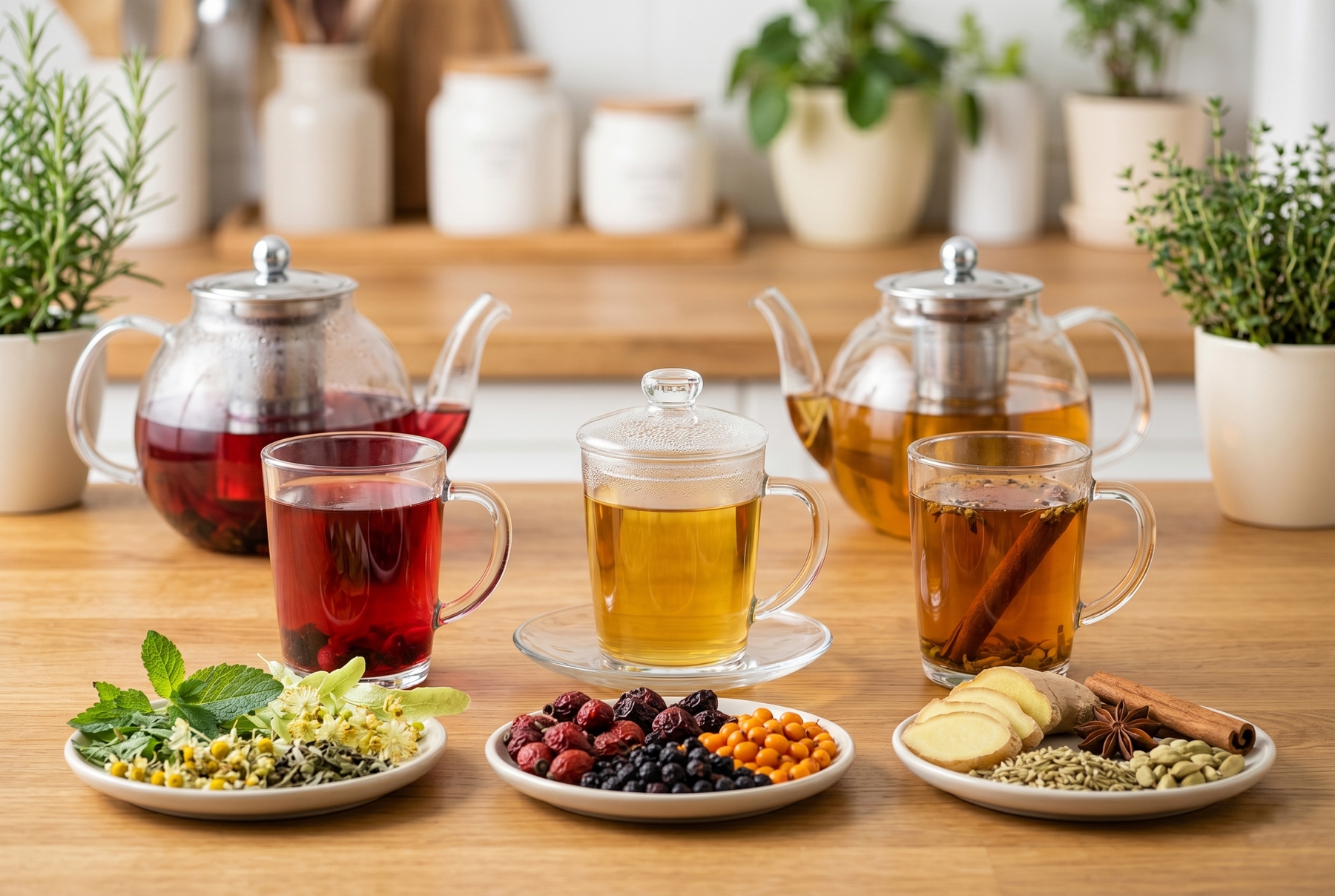
Herbs, berries, and roots brew quite differently from classic tea. They often require significantly higher temperatures and extended steeping.
Herbs and Herbal Blends: Why Chamomile, Mint, and Rosehip Cannot Be Brewed the Same Way
Delicate Leaves and Flowers
Mint, lemon balm, chamomile, lavender, and linden are incredibly rich in essential oils. Flooding them with rolling boiling water and leaving them uncovered allows the aroma to escape into the steam rapidly.
- Temperature: 80–90°C (176–194°F).
- Time: 5–7 minutes under a lid.
- Dosage: 1–2 tablespoons of dried herbs per 250 ml (8.4 fl oz).
Boiling water actively destroys a portion of these essential oils. The resulting infusion smells significantly weaker and completely loses its freshness. Using water that has rested for 2 to 3 minutes after boiling yields far superior results.
Using a lid here is absolutely mandatory. Without it, a noticeable portion of the aroma vanishes entirely with the steam.
Properly brewed mint smells vibrantly of menthol and delicate sweetness. Chamomile should deliver a honey-apple aroma, entirely free from any dusty staleness. Smelling like a dusty pharmacy box indicates that the raw material is either old or severely oversteeped.
Fruits, Berries, and Dense Plant Parts
Rosehip, hawthorn, dried berries (blackcurrant, raspberry, sea buckthorn), and citrus peels.
- Temperature: 95–100°C (203–212°F).
- Time: 10–15 minutes, perfectly suited for a thermos.
- Dosage: 1–2 tablespoons per 250 ml (8.4 fl oz).
Dense berries and fruits refuse to surrender their flavor quickly. Crushing rosehips slightly before brewing is highly recommended, as whole fruits release their flavor far too slowly.
A thermos handles rosehips and dense berries brilliantly. Pouring boiling water over them and leaving them for several hours works wonderfully. Leaving them for a full day, however, is a mistake. The infusion turns excessively acidic, terribly heavy, and develops an unpleasant aftertaste.
Citrus peels (lemon, orange) introduce both essential oils and a noticeable bitterness. Oversteeping them guarantees a highly bitter beverage. Ten minutes is more than sufficient.
Roots, Bark, and Seeds
Fresh and dried ginger, licorice, cinnamon, fennel, anise, and cardamom.
- Temperature: 100°C (212°F), occasionally benefiting from gentle simmering.
- Time: 10–20 minutes.
- Dosage: Strongly depends on the intensity of the aroma and flavor. Cinnamon and anise are immensely aromatic; a small piece or a tiny pinch of seeds is plenty. For ginger, 2 to 3 thin slices per cup work well.
Simmering roots and bark over low heat for 5 to 10 minutes after brewing is frequently beneficial. This technique allows the water to pull much more flavor from the dense fibers.
Licorice delivers significant sweetness without any sugar, but an overdose results in cloying sweetness and an overwhelmingly aggressive licorice flavor. A tiny pinch per teapot is the absolute maximum.
Ginger releases its spicy heat into boiling water very rapidly. Achieving a mild ginger tea requires using less root and keeping the steeping time short. Crafting a fiery, warming beverage demands thicker slices and significantly longer steeping.
Medicinal Herbs and Safety
Handling medicinal herbs requires a cautious approach, as several carry distinct contraindications.
St. John’s wort, sage, thyme, oregano, coltsfoot, calendula, elecampane, licorice, and many others contain highly active compounds capable of affecting the body. A single cup occasionally poses no problem, but a strong, daily herbal infusion exerts a real physiological effect.
Exercising extreme caution is crucial with the following herbs:
- St. John’s wort represents one of the most problematic herbs regarding drug interactions. It heavily reduces the efficacy of oral contraceptives, specific antidepressants, heart medications, anticoagulants, immunosuppressants, and other drugs. Combining it with medications affecting serotonin can trigger severe side effects.
- Licorice aggressively raises blood pressure, severely lowers potassium levels, and alters heart rhythms, particularly with regular consumption and among individuals with hypertension, heart conditions, or kidney disease.
- Sage is strictly not recommended during pregnancy and lactation.
- Coltsfoot frequently contains pyrrolizidine alkaloids, which pose a severe risk of liver toxicity. It serves as a terrible candidate for daily, long-term consumption at home.
Drinking concentrated herbal blends as daily ‘health courses’ without consulting a doctor is a dangerous practice. A single, occasional cup of chamomile differs drastically from a daily, potent infusion of medicinal herbs.
Children, pregnant women, nursing mothers, and individuals with chronic health conditions must select their herbal infusions with extraordinary care.
Returning to flavor and technique.
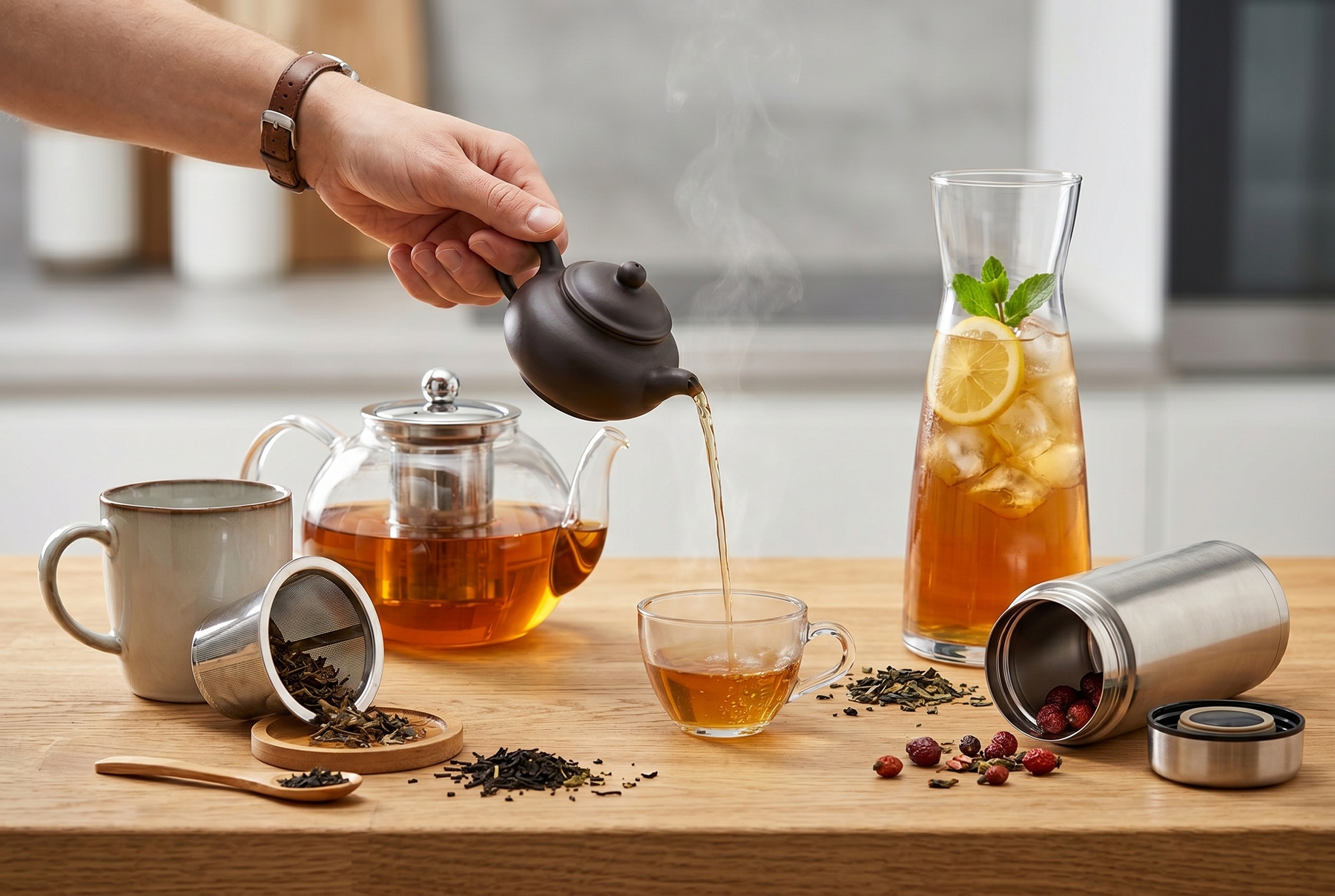
Using a thermos perfectly suits berries and roots, yet the prolonged heat easily ruins the flavor of delicate green tea.
Fundamental Brewing Techniques
Classic Teapot Steeping
This remains the foundational method for the vast majority of teas.
- Pre-warm the teapot with boiling water. Discard the water.
- Add tea leaves according to the desired dosage.
- Pour in water heated to the appropriate temperature.
- Cover the teapot securely with a lid.
- Wait for the required steeping time.
- Pour the entire infusion completely into cups.
The final step holds much more importance than it appears. Leaving tea sitting in the teapot guarantees it will continue to steep. Ten minutes later, the teapot will hold a dramatically darker and highly astringent infusion.
Short-Steeping Method (Gongfu Cha)
Short steeps perform exceptionally well with oolongs, Puerhs, and certain delicate green and white teas.
Brief contact with water extracts beautiful flavor entirely free from heavy bitterness.
- Place the tea leaves in a Gaiwan or a teapot equipped with a wide strainer.
- Pour in water heated to the correct temperature.
- Wait 10 to 30 seconds (the first steep is often much shorter).
- Pour out the infusion completely.
- Repeat the process 3 to 7 times, gradually extending the steeping time with each pour.
The tea evolves slightly with every single steep. It initially smells intensely aromatic, then gradually grows sweeter and denser, leaving a much longer-lasting finish on the palate.
How to Brew Tea Directly in a Mug
Brewing directly in a mug remains the most frequent practice at home, in the office, and while traveling.
Preventing tea in a mug from turning bitter requires a few simple rules:
- Use a large-volume strainer rather than a minuscule metal infuser ball.
- Set a timer on a smartphone.
- Cover the mug with a saucer acting as a lid.
- Remove the tea leaves exactly on time.
Squeezing a tea bag with a spoon down to the very last drop is heavily discouraged. This action forces far more bitterness into the mug than actual flavor.
Cold Brewing Tea and Herbs
Cold brewing offers incredible convenience, particularly during extreme heat.
Pouring cold water over the tea and placing it in the refrigerator for 6 to 12 hours yields fantastic results. The resulting flavor feels significantly smoother, completely lacking any sharp astringency, while the aroma becomes cooler and quieter. Cold water extracts almost no bitterness from the leaves.
This technique wonderfully suits green tea, white tea, oolongs, and select herbal blends.
Using impeccably clean teaware is mandatory. Keeping the infusion refrigerated and consuming it within 24 hours is strongly advised. Exercising high caution with fresh herbs and fruit additions is crucial due to the severe risk of bacterial growth.
Brewing in a Thermos
A thermos proves incredibly convenient for rosehips, dense herbal blends, and hot beverages on the road.
However, a thermos heavily ruins green tea, delicate blossoms, and aromatic oolongs. The leaf continues to steep for hours, the temperature remains excessively high, and it continuously releases intense bitterness and astringency into the water. The final infusion inevitably turns out severely oversteeped, bitter, and heavy.
Not everything capable of fitting into a thermos should actually spend the entire night inside one.
How to Know if a Beverage Is Brewed Correctly
Visual Cues
The color of the infusion heavily depends on the tea type and the duration it spent releasing compounds into the water.
Green tea: light green, yellowish-green, and highly transparent. A murky, grayish-green, or brown appearance confirms it is oversteeped.
White tea: pale golden and nearly transparent. A dark hue indicates water that was far too hot or a steeping time that was significantly too long.
Black tea: ranging from reddish-brown to deep dark amber. A transparent infusion typically serves as an excellent sign; cloudiness frequently arises from extremely hard water or severe oversteeping.
Hibiscus: a vibrant ruby-red and highly saturated. An almost black color signifies severe oversteeping, guaranteeing an overwhelmingly sour taste.
Chamomile: beautifully golden-yellow. A brown color confirms either stale raw material or massive oversteeping.
Sediment occurring in herbal infusions is perfectly normal. Tiny plant particles naturally settle at the bottom. In traditional tea, however, sediment frequently acts as a strong indicator of excessively hard water.
Aromatic Cues
Fresh green tea naturally smells of grass, nuts, roasted seeds, and the ocean (in Japanese varieties). It completely avoids smelling of dust, old hay, or staleness.
Black tea frequently presents aromas of bread, malt, dried fruits, and occasionally flowers or smoke. Mold, excessive acidity, and rancid scents serve as terrible indicators.
Mint absolutely must deliver bright menthol, fresh coolness, and a delicate sweetness. Smelling heavily of ‘pharmacy alcohol’ or ancient hay is entirely wrong.
Chamomile’s correct aroma leans closely toward apples, honey, and dried flowers. A stale, overwhelmingly dusty scent completely ruins the experience.
Rosehip smells distinctly sweet and sour, leaning heavily toward dried berries. Smelling intensely of mold or severe dampness is a disastrous sign.
Terrible aromas include deep staleness, heavy dust, active mold, a damp basement smell, intensely rancid oil, and sharp chemicals.
Mouthfeel
Astringency itself is perfectly normal. A mild puckering sensation that vanishes a few seconds after a sip is simply how tannins function, and they naturally exist in every single tea.
Intense dryness lingering in the mouth stands out as a terrible sign. If the tongue and palate feel severely tight, saliva practically disappears, and a strong urge to drink water arises, the tea has suffered from extreme oversteeping or excessively high water temperatures.
A very light bitterness occasionally fits perfectly, especially within green tea or Puerh. However, it must never aggressively overpower everything else. If a beverage tastes so intensely bitter that adding massive amounts of sugar or pouring it down the drain feels necessary, the brewing method urgently requires altering.
An exceptional tea leaves a highly pleasant sensation in the mouth. A delicate sweetness, refreshing coolness, exceptionally soft astringency, and an aroma that returns beautifully after a few seconds are all magnificent signs. A failed brew almost always leaves behind a severely dry tongue and an aggressive bitterness that refuses to fade.
Common Mistakes and How to Fix Them
Pouring Excessively Hot Water
Ruining a delicate green or white tea with boiling water leaves almost no room for correction. The intense bitterness and sharp harshness have already fully extracted into the infusion. Diluting it with cool water is possible, but the destroyed aroma will absolutely never return.
For the next attempt, letting the kettle rest for 2 to 3 minutes after boiling works perfectly. Alternatively, pouring boiling water into a completely cold cup heavily drops the temperature by 10 to 15 degrees Celsius. Mixing boiling water with a very small amount of cold, pre-boiled water also solves the problem brilliantly.
Oversteeping the Leaves
Adding water heavily dilutes the extreme strength, but it completely fails to restore the lost aroma. An excessively strong tea still possesses a few uses:
- Acting as a powerful base for iced tea (heavily diluting it, adding massive ice, and dropping in lemon).
- Transforming into a thick tea syrup (adding large amounts of sugar and aggressively boiling it down, provided this suits specific desserts).
- Functioning as a robust meat marinade (strictly in scenarios where aggressive tannins and heavy bitterness actively work as powerful tenderizers).
However, simply pouring it out and carefully brewing a fresh batch is usually much easier. An oversteeped infusion never magically becomes smooth.
Using Far Too Many Herbs
The herbal infusion suddenly turned aggressively bitter, resembling a harsh pharmacy mixture, and feels incredibly heavy.
Heavily diluting it with hot water occasionally saves the situation. Adding large amounts of honey and lemon also masks the issue beautifully, provided these additions do not violently clash with the base flavor.
For the next attempt, aggressively cutting the dosage completely in half is highly recommended. Overdoing it with herbs happens incredibly easily. A single dry spoonful violently expands in the cup, revealing far more intensity than it ever displayed while sitting in the jar.
Brewing Exceptional Tea in Terrible Water
The resulting flavor feels intensely flat and heavily metallic, while the murky infusion develops a disturbing surface film.
Switching to a high-quality water filter or utilizing lightly mineralized bottled water almost always resolves this issue completely.
Tasting the water completely on its own before brewing is highly recommended. If the water tastes inherently unpleasant, the finest tea leaves will absolutely fail to improve the situation.
Storing Tea Next to Spices, Coffee, and the Stove
Tea rapidly pulls in heavy moisture and aggressively absorbs foreign odors. Proper storage absolutely requires:
- Placing it securely in an airtight tin or a high-quality zip-lock bag.
- Keeping it completely away from pungent spices, aromatic coffee, and incredibly strong-smelling foods.
- Storing it safely in a completely dark, heavily dry location, strictly avoiding spaces directly above the stove or near a bright window.
If tea has successfully absorbed a heavy foreign odor, restoring its original, delicate flavor remains practically impossible.
Tea and Herb Brewing Table: Temperature, Time, and Technique
| Type | Temperature | Time | Dosage | Method | Primary Mistake |
|---|---|---|---|---|---|
| Black Tea | 90–100°C (194–212°F) | 3–5 min | 2–3 g / 200 ml | Classic Steeping | Oversteeping — Bitterness |
| Green Tea | 70–80°C (158–176°F) | 1–3 min | 2–3 g / 200 ml | Classic Steeping | Boiling Water — Harshness |
| White Tea | 70–85°C (158–185°F) | 3–7 min | 3–4 g / 200 ml | Classic Steeping | Excessively High Temperature |
| Light Oolong | 80–85°C (176–185°F) | 20–40 sec | 4–6 g / 150 ml | Short Steeps | Excessive Steeping Time |
| Dark Oolong | 90–95°C (194–203°F) | 30–60 sec | 4–6 g / 150 ml | Short Steeps | Insufficient Leaf Quantity |
| Shou Puerh | 95–100°C (203–212°F) | 20–40 sec | 5 g / 150 ml | Short Steeps | Failing to Wash the First Steep |
| Sheng Puerh | 85–95°C (185–203°F) | 10–30 sec | 4–5 g / 150 ml | Short Steeps | Boiling Water for Young Tea |
| Matcha | 70–80°C (158–176°F) | Whisking | 1–2 g / 70–100 ml | Bamboo Whisk | Boiling Water, Clumping |
| Rooibos | 95–100°C (203–212°F) | 5–7 min | 1 tsp / 200 ml | Classic Steeping | Extremely Difficult to Ruin |
| Hibiscus | 90–100°C (194–212°F) | 5–10 min | 1 tbsp / 250 ml | Classic Steeping | Excessive Time — Extreme Acidity |
| Yerba Mate | 70–80°C (158–176°F) | 3–5 min | 1–2 tbsp / 200 ml | Classic Steeping | Boiling Water — Severe Bitterness |
| Mint, Lemon Balm | 80–90°C (176–194°F) | 5–7 min | 1–2 tbsp / 250 ml | Under a Lid | No Lid — Aroma Escapes |
| Chamomile, Linden | 80–90°C (176–194°F) | 5–7 min | 1–2 tbsp / 250 ml | Under a Lid | Boiling Water — Sharpness |
| Rosehip, Berries | 95–100°C (203–212°F) | 10–15 min | 1–2 tbsp / 250 ml | Thermos | Excessively Long Time in Thermos |
| Roots, Bark | 100°C (212°F) | 10–20 min | To Taste | Simmering / Boiling | Insufficient Extraction Time |
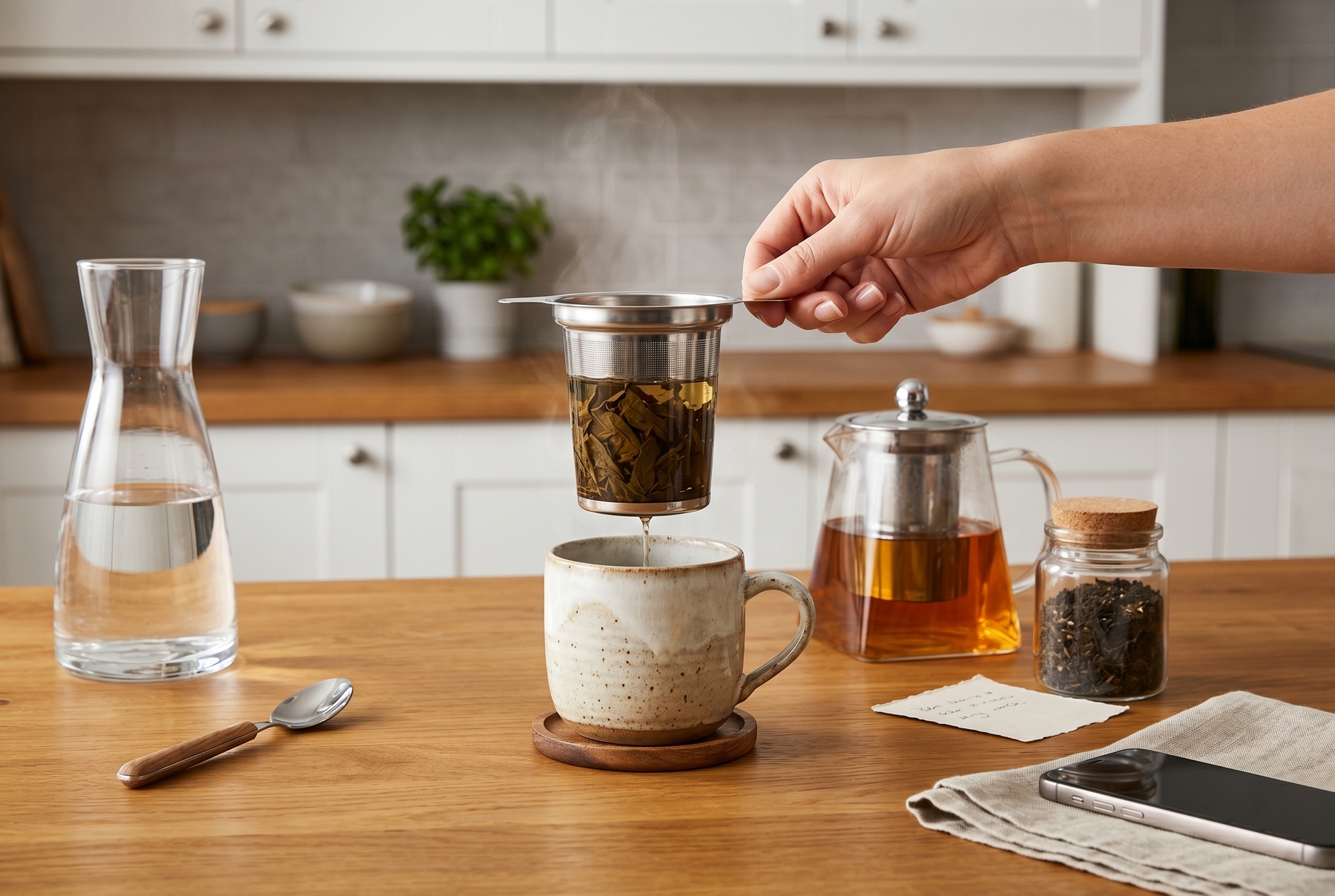
Removing the tea strainer on time halts extraction and prevents the mug of tea from turning bitter.
How to Brew Tea Without a Thermometer
An electric kettle featuring precise temperature control proves incredibly convenient, yet managing perfectly without one is entirely possible.
Practical household methods for estimating temperature:
Boiling water directly after bubbling hits exactly 100°C (212°F). This completely suits black tea, ripe Shou Puerh, heavy dark oolongs, Rooibos, dense rosehips, and exceptionally hard herbs.
Waiting 2 minutes after the kettle shuts off drops the temperature to approximately 90–95°C (194–203°F). This beautifully accommodates the vast majority of black teas, dark oolongs, and hibiscus.
Waiting 5 minutes after boiling lowers the heat to roughly 80–85°C (176–185°F). This temperature brilliantly serves green tea, delicate light oolongs, and fragile white tea.
Pouring boiling water between completely cold vessels actively drops the temperature by 5 to 10 degrees Celsius with every single pour. Pouring boiling water directly into a cold cup, and subsequently into a second cold cup, successfully achieves approximately 80–85°C (176–185°F).
Mixing heavily boiling water directly with cold, pre-boiled water also works perfectly. Adding 20–30% cold water to a boiling kettle forcefully drops the temperature to the 75–85°C (167–185°F) range.
These methods remain purely approximate. However, they drastically outperform blindly flooding every single tea leaf with intensely boiling water.
How to Build Your Perfect Ritual Without Tea Snobbery
Selecting two or three beverages consumed regularly represents an excellent starting point. Fine-tuning them to personal preferences is the ultimate goal.
Keeping a tiny observational log pays massive dividends. Casually noting the approximate temperature, exact time, precise dosage, and the final result heavily improves the process. Jotting this down in a phone note or on a tiny piece of paper taped strictly to the tea tin works wonders.
Brewing the very first cup exactly according to baseline recommendations sets the stage. If it tastes excessively bitter, aggressively lowering the temperature or drastically shortening the time is the proper solution. If the flavor feels severely weak, heavily increasing the dosage works perfectly. If the aroma is entirely absent, heavily scrutinizing the water quality and the tea’s exact expiration date becomes mandatory.
Finding that flawless sweet spot usually takes only three to five attempts. This completely lacks the rigid strictness of a formal tea ceremony. It simply guarantees immense predictability and massive enjoyment.
Crafting an exceptional cup of tea practically demands nothing more than a simple timer, decent water, and tea leaves that are completely removed precisely on time.
0 comments