
Food is widely regarded as a pleasure: friends gather, order a meal, and share conversations. However, for some individuals, a communal table—especially in a cafe, at a corporate event, or during a family dinner—feels entirely different. It resembles a large stage with blinding spotlights. The mouth goes dry before the menu even arrives, the jaw tightens, and a single swallow seems loud enough for the whole room to hear. A single thought races through the mind: “Everyone will notice.” The root of this issue rarely lies in the food itself or a personal flaw. The fear of judgment triggers a physical anxiety response, and the body faithfully executes it: appetite vanishes, the throat constricts, and the hands refuse to cooperate.
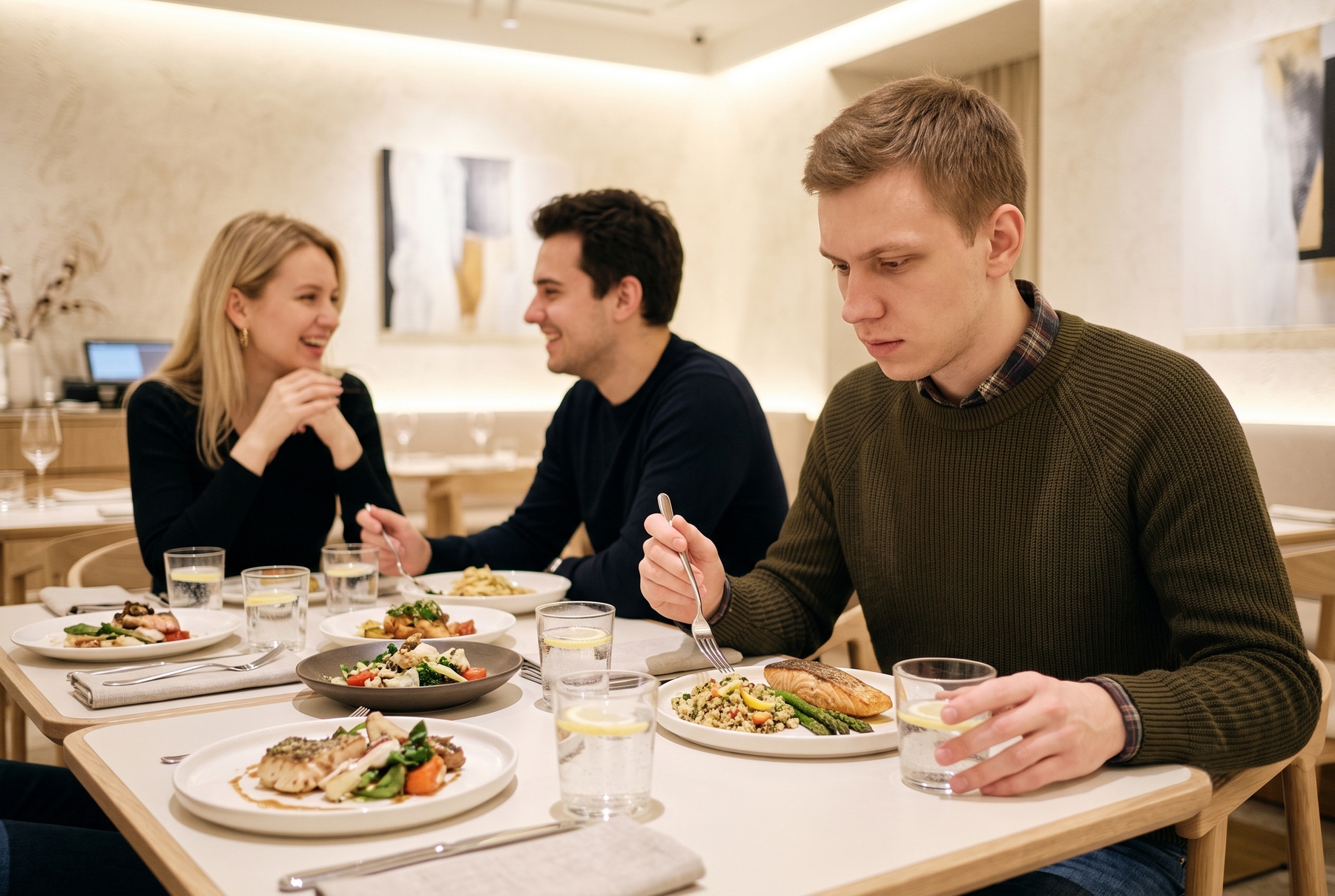
Experiencing social anxiety at the table often creates a sensation of being under intense scrutiny, even when those nearby are fully absorbed in their own conversations.
Table of Contents
- Why Dining With Others Can Be So Difficult
- The Origin of the Phrase "Hard to Swallow"
- Where the Boundary Lies Between Awkwardness and a Problem
- Why "Nobody Cares" Never Works as Advice
- What to Do When Eating in Public Causes Fear: Six Steps to Calmness at the Table
- What to Do Before, During, and After a Gathering When Dining Anxiety Strikes
- How Loved Ones Can Help Without Causing Harm
- Freedom at the Table: Dining Without an Inner Tribunal
Why Dining With Others Can Be So Difficult
Not an Oddity, but an Anxiety Script
The fear of eating in public or in the presence of others is frequently linked to social anxiety. Individuals fear appearing awkward: making a mess, chewing incorrectly, choking, blushing, or drawing unwanted attention. Clinical descriptions of this condition state it clearly: the apprehension stems from potential judgment, embarrassment, or humiliation in social situations. Eating and drinking in public are firmly on the typical list of situations a person either avoids or endures with severe distress. This article does not provide diagnoses; reading texts on the internet is never a substitute for a medical evaluation. However, understanding the underlying mechanism is highly beneficial, as comprehension instantly alleviates much of the associated shame.
The Gaze Is Scarier Than the Plate: Why Eating in Public Is Frightening
Thoughts at the table often sound like this: “People are watching me,” “I am eating unattractively,” “I chew too slowly,” “My hands are shaking,” or “Everyone can see how nervous I am.” Noticeably, not a single one of these thoughts is actually about the food. The brain mistakes assumptions for reality. Instead of a casual cafe where everyone is focused on their own pasta, it envisions a tribunal. Verifying this in the moment is difficult, and anxiety accepts the assumption as absolute fact.
This Happens to Sociable People, Too
The misconception that social anxiety always presents as total withdrawal is remarkably persistent. A person might confidently lead meetings, joke in group chats, and travel out of town with friends. Yet, when a corporate party, a date, or a shared lunch arises, a distinct, localized fear activates. Anxiety is highly selective: it does not attach itself to all social interactions, but rather targets specific formats involving plates, cutlery, and the eyes of others across the table.
The Origin of the Phrase “Hard to Swallow”
Threat Mode Instead of Dining Mode
During moments of anxiety, the body prepares to defend itself rather than to digest food. Blood redirects to the muscles, saliva production decreases, and the stomach receives a command to pause its operations. This biological response explains the dry mouth, the lump in the throat, nausea, trembling, racing heart, and tense abdomen. The body is not malfunctioning; it is simply defending itself the only way it knows how, albeit in the wrong situation. Recognizing this biological reality often brings a slight sense of relief.
Trying Harder to Eat “Normally” Only Makes It Worse
At this point, a loop of hyper-self-monitoring engages. The individual begins tracking every single gesture: how they hold the fork, how their lips move, or whether they are swallowing too loudly. Any action subjected to intense scrutiny instantly loses its natural automation. Focusing intently on the mechanics of walking down the stairs often results in stumbling. The exact same principle applies to eating. Occasionally, the biggest obstacle is not the person sitting across the table, but the internal observer critiquing every single bite.
Why Appetite Disappears During Anxiety
Anxiety possesses a remarkable ability to dampen pleasure. A dish might be exquisitely prepared, yet the sense of taste seems completely deactivated: one chews but feels almost nothing. Blaming oneself for being “ungrateful” is entirely pointless, and hearing the advice to “just relax” is about as effective as being told not to think of a white bear.
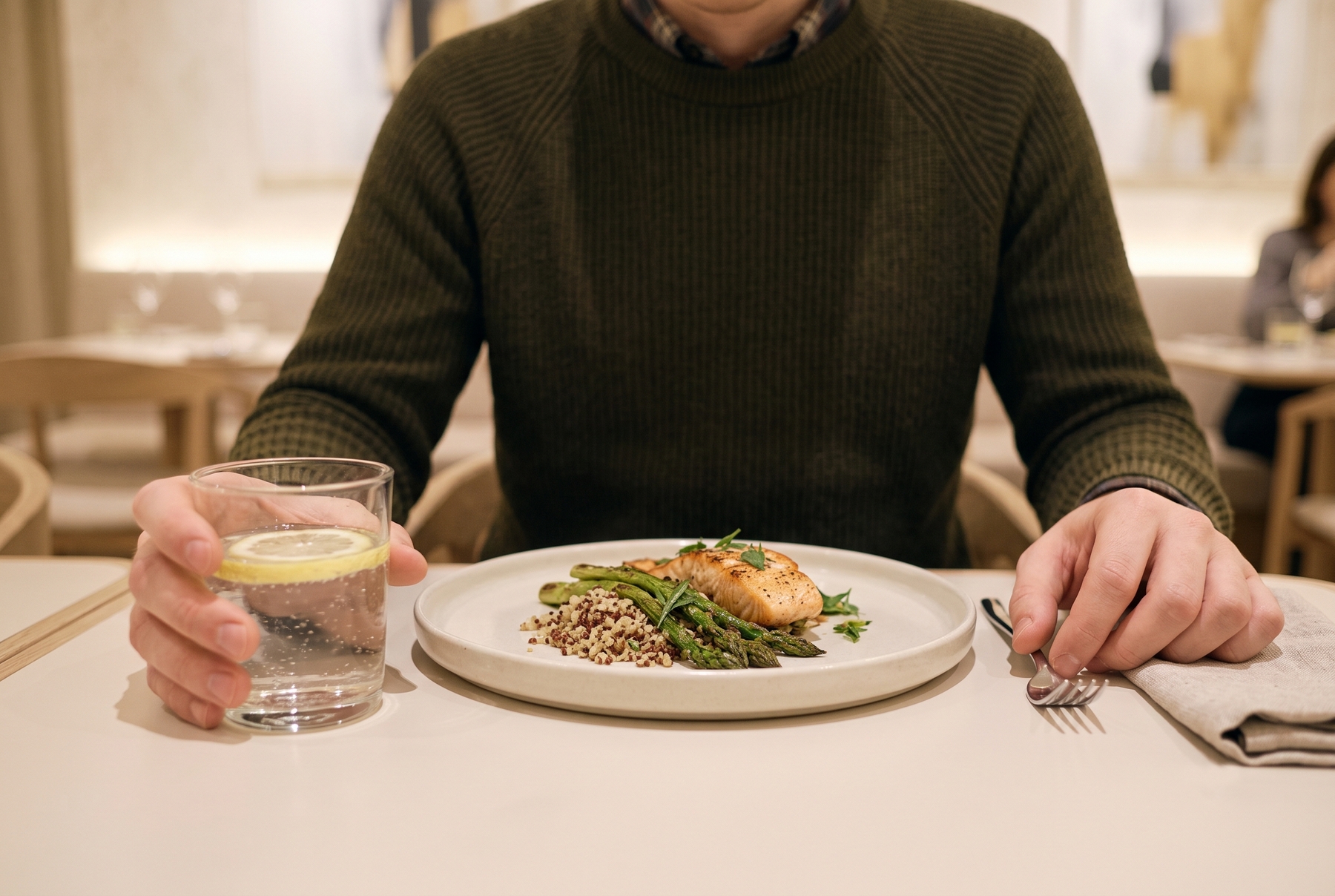
Attempting to control every gesture at the table strips the process of its natural automation, causing hands to feel disobedient and utensils unnecessarily heavy.
Where the Boundary Lies Between Awkwardness and a Problem
Experiencing Embarrassment Is Normal
Feeling awkward while eating on a first date is a common experience. Being nervous in a new work environment is natural. Opting for a dish at an important meeting that will not splatter across a crisp shirt is simply basic human caution, rather than necessarily indicating an underlying issue.
Seven Signs That Fear Has Begun to Control Your Life
- Regularly avoiding cafes, corporate events, dates, or family dinners.
- Inventing excuses in advance to avoid attending gatherings.
- Eating before a meeting or enduring hunger just to avoid eating in front of others.
- Selecting only “safe” dishes that are guaranteed not to cause embarrassment.
- Experiencing anticipatory anxiety days before a scheduled event.
- Endlessly replaying the lunch in your mind afterward, worrying about how you looked.
- Planning routes, vacations, and business meetings specifically to avoid sitting at a communal table.
Recognizing a few of these points does not constitute a diagnosis or prove the presence of a disorder. It does, however, serve as a reason to pay closer attention to your well-being and perhaps discuss these experiences with a professional.
How This Differs From Eating Disorders
The fear of eating in public can intersect with anxieties about appearance and food control, but these are distinct conditions. If rigid dietary restrictions, noticeable weight loss, binge eating episodes, or an obsessive fear of gaining weight emerge, consulting a specialist who works with eating disorders becomes essential. Eating disorders are serious conditions that cannot be resolved by reading a single article online.
Why “Nobody Cares” Never Works as Advice
Logic Agrees, But Anxiety Does Not
Intellectually, a person understands the situation: the people around them are preoccupied with themselves and their own salads. Yet, the anxiety system reacts much faster than rational arguments and refuses to submit to them directly. Consequently, dismissive remarks like “Nobody cares enough to watch you” often intensify shame rather than alleviating fear.
Telling Someone to “Just Eat” Only Amplifies the Anxiety
Comments regarding appetite, pacing, or facial expressions strike directly at the core of the fear: the belief that someone is indeed watching. For those sitting next to someone grappling with this fear, the guideline is simple: refraining from commenting on the quantity of food, the speed of eating, or the choice of dish is the best approach.
What Helps Instead of Persuasion
Gradual exposure is far more effective than applying pressure. The body requires time to relearn that sitting at a table can be a safe experience. While this approach takes longer, it provides the body with positive experiences to rely on in the future.
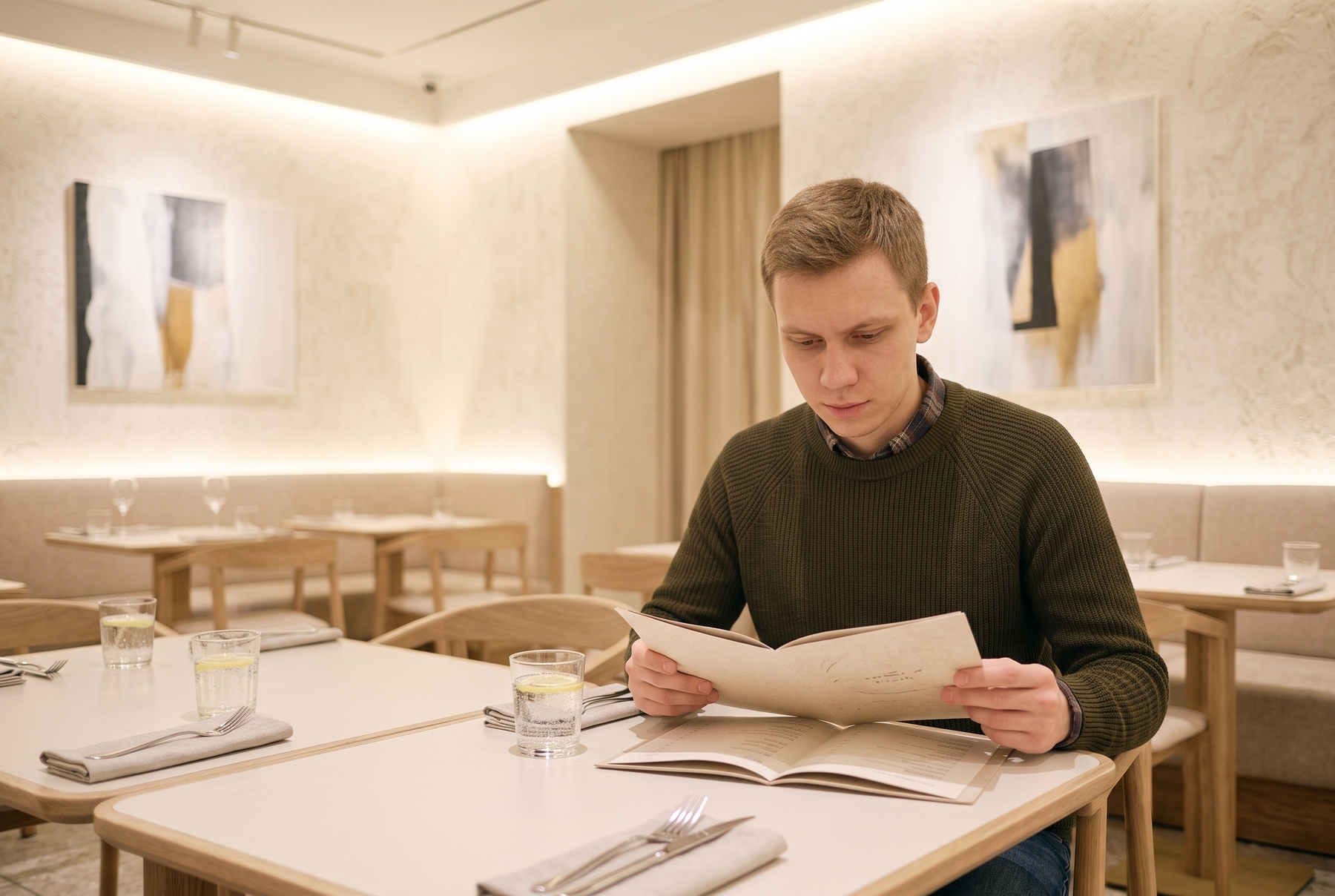
Reviewing the menu in advance and selecting simple, safe dishes significantly reduces stress levels and fosters confidence before the meal begins.
What to Do When Eating in Public Causes Fear: Six Steps to Calmness at the Table
Step 1. Naming the Fear Specifically
Rather than a vague “I am afraid to eat,” identifying the exact concern is crucial: “I fear people will notice my hands shaking,” “I am terrified of making a mess,” or “I dread the silence in the conversation while I chew.” Once the fear is precisely named, it becomes much easier to manage: instead of an overwhelming sense of terror, a specific task emerges.
Step 2. Mapping the Situations
Writing down situations ranging from the most relaxed to the most challenging is highly effective: a home-cooked dinner with a loved one, grabbing coffee on a walk, visiting a small cafe during off-peak hours, sharing a snack with one friend, having lunch with colleagues, dining at a restaurant on a date, or attending a banquet. This creates a standard, everyday anxiety map rather than a clinical diagnosis or protocol. If the fear is severe, building this hierarchy alongside a psychologist is highly recommended.
Step 3. Starting Small Instead of Facing the Biggest Fear
Beginning with a corporate party involving toasts and a pristine white shirt is rarely a good idea. Opting for situations that allow for an easy exit, where taking a break and ordering simple food is manageable, builds confidence. Consistent repetition holds far more value than attempting a heroic leap.
Step 4. Shifting Focus From the Self to Grounding Anchors
When anxiety pulls the mind toward thoughts of “how do I look,” gently redirecting attention back to reality makes a significant difference: feeling the feet on the floor, noticing the coolness of the glass in the hand, taking a slow exhale before the first bite, focusing on the taste and texture of the food, or actively listening to the companion’s voice. While mindfulness is not a magical cure-all, relying on these sensory details provides crucial support during moments of heightened anxiety.
Step 5. Choosing Food That Does Not Add Stress
In the early stages, ordering food that is easy to manage is a wise strategy: short pasta like penne, a rice bowl, an omelet, a pureed soup, syrniki (farmer’s cheese pancakes), or a salad with pre-chopped ingredients. Avoiding anything that requires complex cutting, battling with a shell, or navigating a drippy sauce prevents unnecessary stress. The diet does not need to be permanently restricted; the goal is simply to make the initial attempts feel achievable.
Step 6. Preparing Neutral Phrases in Advance
Having a few calm phrases ready significantly reduces tension: “I will start with a drink,” “I am going to grab something light,” “I am a slow eater today,” or “I just need a couple of minutes with the menu.” A steady, relaxed tone typically prevents any unnecessary questions.
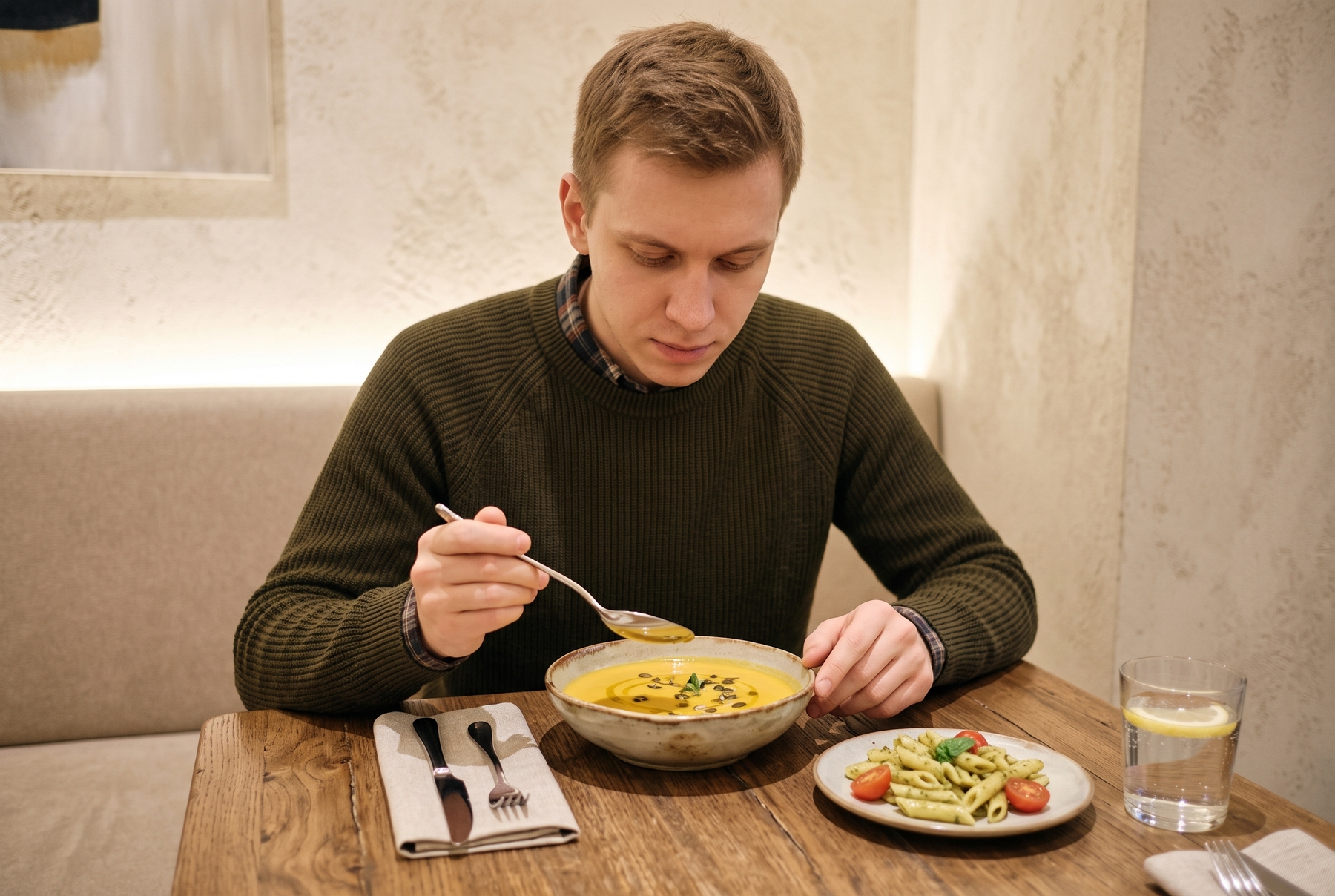
Selecting simple and easy-to-eat dishes, such as pureed soups or short pasta, prevents unnecessary awkwardness and allows focus on the dining experience.
What to Do Before, During, and After a Gathering When Dining Anxiety Strikes
Before
Arriving completely ravenous is generally unhelpful, as hunger and anxiety combined tend to amplify trembling and nausea. Reviewing the menu in advance and selecting one or two neutral options provides a sense of control. Arriving slightly early to secure a more secluded seat—perhaps against a wall rather than in the center of the dining room—also establishes a calmer environment.
In the Moment
The sequence remains brief and manageable: an exhale, a sip of water, a small bite, a pause, and a return of attention to the conversation. The anxiety might not dissipate immediately. The objective is much more modest: remaining at the table and enduring the experience with slightly more composure than the previous time.
After
Conducting a harsh post-gathering debriefing is rarely beneficial. Instead of thinking, “I sat there like a statue again,” gathering objective facts is much more productive: noting what worked well, identifying moments when the anxiety quieted down, and figuring out what to simplify for the next outing. The brain reinforces new skills through gentle repetition, not punishment. Scolding oneself in the evening only serves to attach more fear to the next lunch.
How Loved Ones Can Help Without Causing Harm
Avoiding the Stare at the Plate
Uttering phrases like “You are barely eating,” “Why are you picking at your food?” or “Just eat normally” instantly turns a simple lunch into a theatrical performance. The individual is already convinced they are being watched, and such remarks merely serve as confirmation.
Normalizing the Experience
The most effective support is remarkably unremarkable: maintaining conversation on unrelated topics, eating at a normal pace, and avoiding discussions about anxiety at the table unless the person initiates them. Lunch should remain just a lunch, not a special rescue operation.
When the Fear of Eating in Public Requires Professional Support
Certain situations demand more than just a friend’s empathy. When the fear significantly restricts life, when a person routinely avoids dining out, or when anxiety is accompanied by panic symptoms, noticeable weight loss, obsessive control over food or the body, depression, or a decline in academic, professional, or relationship quality, professional intervention becomes necessary. Seeking guidance from a psychologist, psychotherapist, or medical doctor is crucial in these instances. Addressing the issue early prevents the fear from taking deeper root.
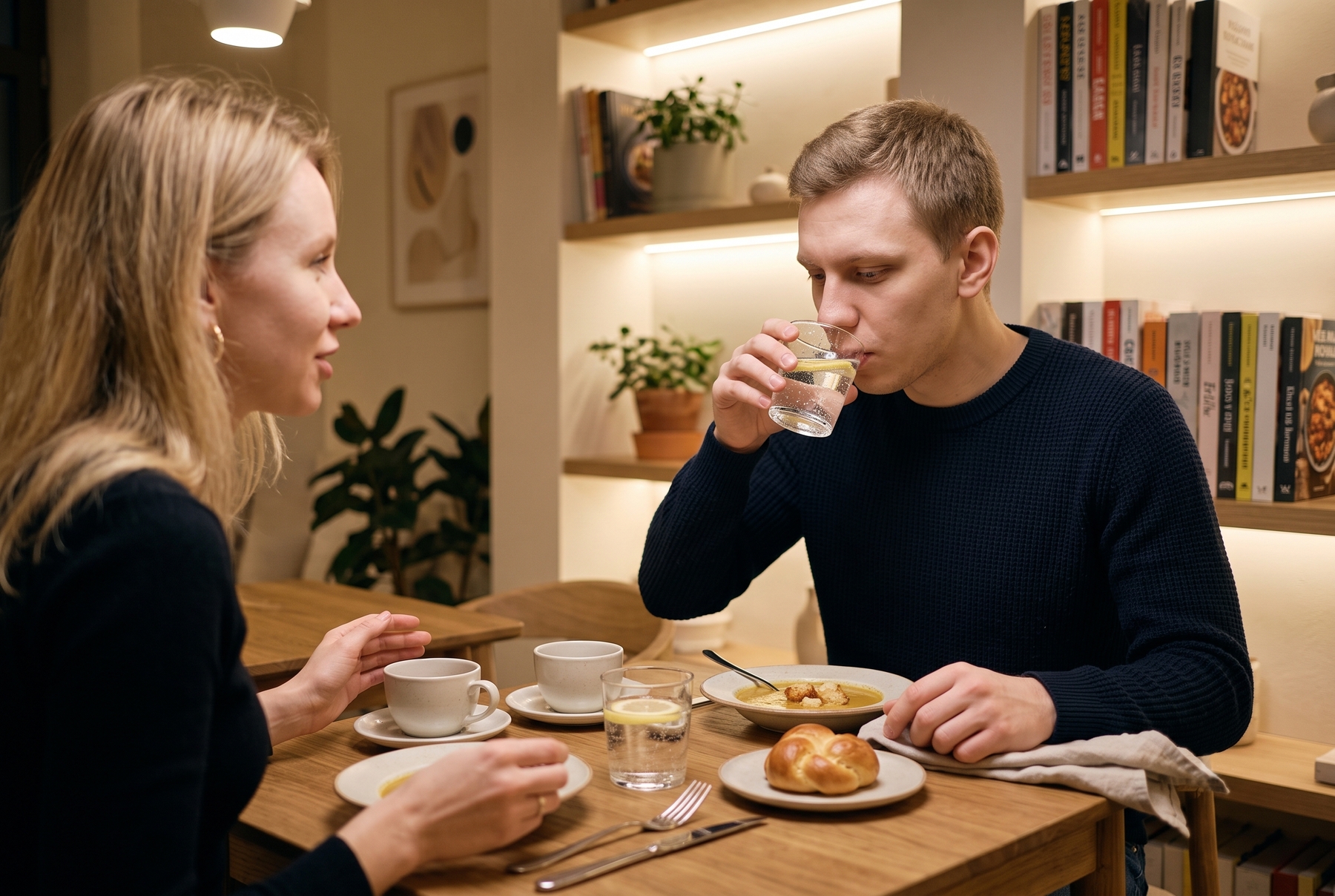
Engaging in calm conversations on neutral topics and avoiding excessive attention to the plate helps individuals with social anxiety relax and feel secure.
Freedom at the Table: Dining Without an Inner Tribunal
Loving Banquets Is Not Mandatory
The ultimate goal of this gradual process is far more modest than it might appear. There is no requirement to become the life of the party or to eat under the gaze of others with the exaggerated delight of a television host. In this context, freedom simply means holding the ability to grab coffee with a friend, enjoy a meal while traveling, eat in public peacefully, or attend a business dinner without feeling as though an examination on normalcy is taking place.
Small Progress Fully Counts
Sometimes, a profound victory looks incredibly simple: staying at the table for ten extra minutes. Managing one calm sip of soup. Choosing not to cancel a morning meeting and refusing to engage in self-criticism by evening. Anxiety constricted life gradually, and reclaiming that space requires a similarly gradual approach. Yesterday, sitting in a noisy coffee shop only allowed for a plain coffee. Today, a croissant was added to the order: flaky crumbs dusted the table, yet the hands remained entirely steady.
0 comments