
Spending forty minutes on dough requires patience. After honest kneading, resting, rolling, and shaping pelmeni (Russian meat dumplings) perfectly, the anticipation builds. Dropping them into boiling water only to find a disaster two minutes later—burst dough, floating filling, and white shreds drifting like jellyfish in the shallows—is heartbreaking.
Another scenario involves spending the entire evening baking bread. Preparing the preferment, gently deflating, proofing, and placing the dough in a preheated oven take time. Pulling out a loaf with a beautiful crust and solid appearance feels triumphant. Yet, tapping the bottom yields a dull thud, and slicing reveals a dense, moist crumb without a hint of air.
Experiencing this firsthand is a rite of passage. Students in culinary school face the same struggles. Honestly, early in my career, understanding why some batches of dough turned out perfectly while others failed remained a mystery. During my first internship, an elderly French baker explained a fundamental truth that I now pass on to all my apprentices: flour is not just white powder. It forms the living framework of the dough. If this framework is weak, nothing else matters.
Doing everything right is not enough if the wrong bag of flour is chosen.
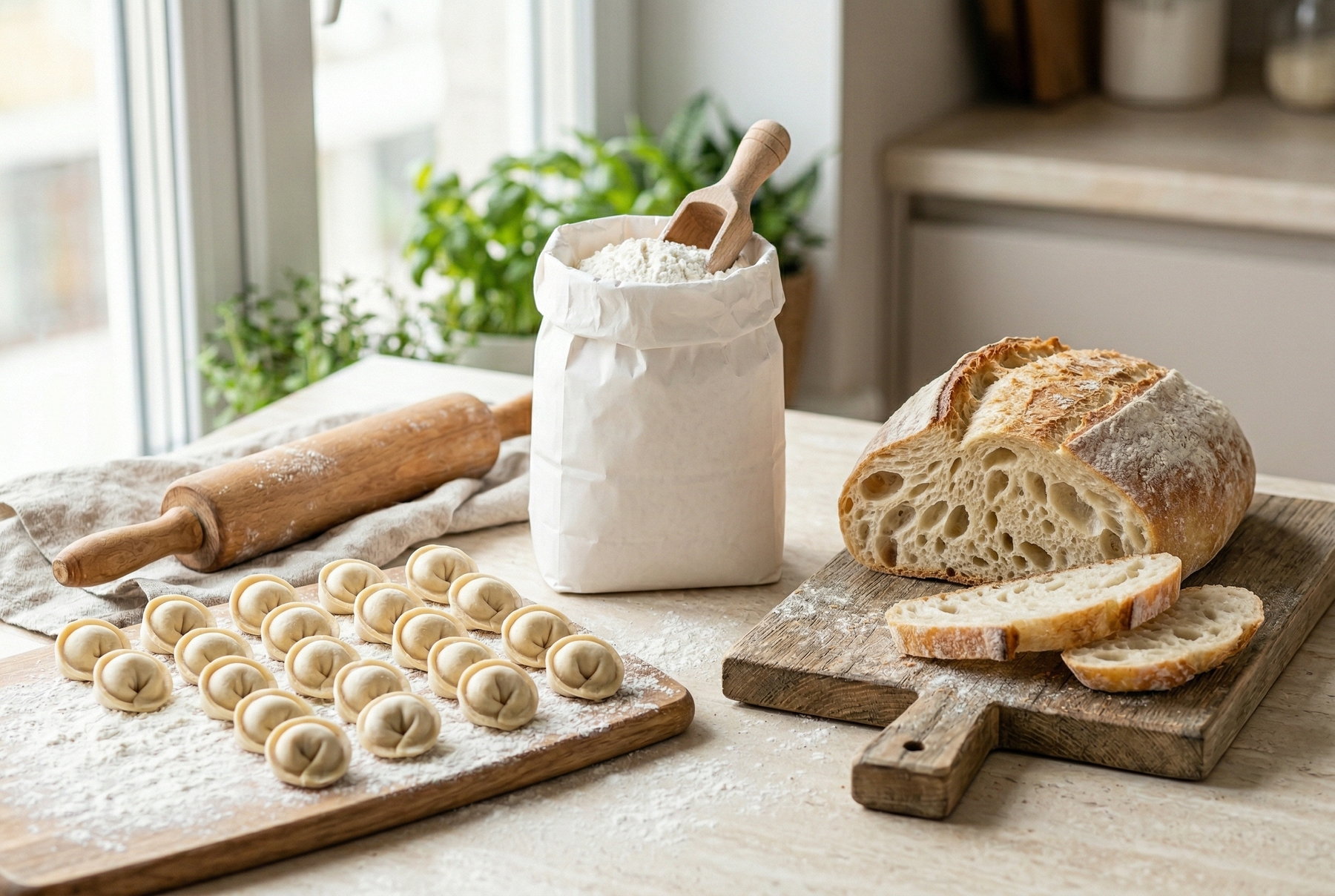
Choosing the right flour dictates the result, ensuring bread rises perfectly and dumplings stay intact.
Table of Contents
The Magic of Protein, or Why ‘Premium Grade’ Is Not a Compliment
Dispelling the primary myth is crucial. Buyers spend years selecting highly refined white flour (often labeled as “premium” or “extra” grade) because the word ‘premium’ sounds convincing. It seems logical that a premium grade surpasses first and second grades.
Reality tells a different story. ‘Premium grade’ describes the milling degree and purity: how finely the grain is ground, and how thoroughly the bran and germ are removed. It indicates color, texture, and the absence of impurities. However, it does not indicate protein content. Protein is what truly matters for dough.
Mixing flour with water and kneading causes two proteins inside the grain—glutenin and gliadin—to combine and form gluten. This creates a literal molecular network that permeates the entire dough. Higher protein content yields a denser, stronger network.
Visualizing a rubber mesh bag helps. In bread dough, yeast pumps carbon dioxide into this bag, inflating the cells. The dough rises, the gas expands further during baking, and a fluffy, airy crumb develops. This only works if the bag is strong enough. Low protein means a weak network, escaping bubbles, and collapsing dough, resulting in a dense brick.
Pelmeni dough requires a different approach. The network must be elastic enough to prevent tearing in boiling water, but not so stiff that the dumpling is as chewy as a bicycle tire. Weak gluten causes pelmeni to burst. Strong gluten makes the dough rubbery and unappetizing. Finding the golden mean is essential.
This explains the difference in dough behavior. It stems from the protein percentage in the flour, not moon phases, moods, or yeast brands.
Reading Labels Like a Pro
Flipping a bag of flour to check the nutrition label for the ‘Protein’ line (usually per 100 grams) is the first step. Finding a number like 9.5 g, 10.3 g, or 13.2 g reveals the key parameter.
The protein percentage is the same number in a different format. Having 10.3 g of protein per 100 g (3.5 oz) of flour equals roughly 10.3% protein. This number dictates what is possible with that flour.
A rarely discussed nuance exists: the number on the packaging represents an average for the batch. Actual protein content in a specific bag can fluctuate slightly depending on the grain harvest. This variation is especially noticeable in budget brands. Finding a flour that behaves predictably means sticking with it and avoiding unnecessary experiments.
Some packages display ‘flour strength,’ denoted by the letter W with a number (W260, W350). This professional Italian standard appears increasingly often. A high W signifies high protein and strong gluten. Relying on protein grams remains practical where this marking is scarce in local stores.
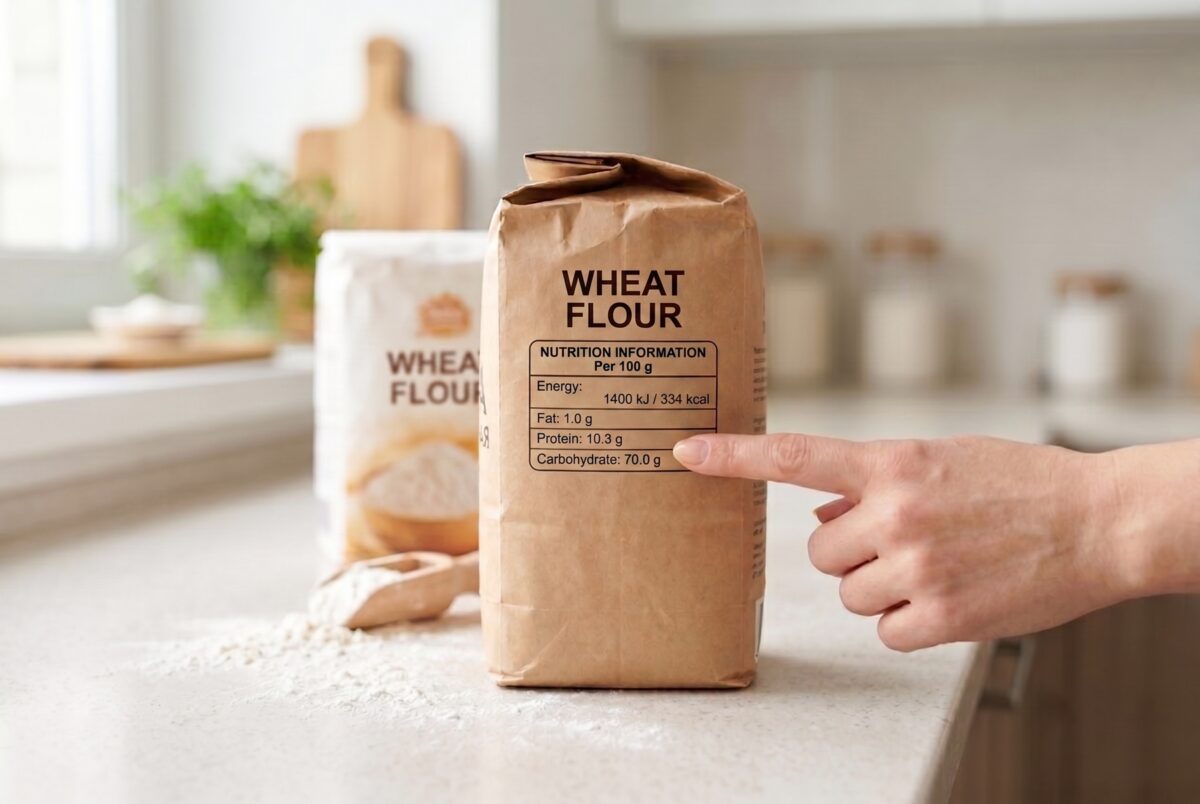
Checking the protein amount on the label before purchasing is the ultimate professional secret.
Which Flour You Need for What
Bread Flour: For Crunch and Airiness
Excellent homemade bread features a crumb with large, irregular holes, bouncing back with moisture inside, and a crust that breaks with a distinct crunch. Strong flour with a protein content of 12 to 14 grams per 100 grams (3.5 oz) guarantees this result.
Internally, a strong gluten network traps carbon dioxide bubbles produced by yeast during fermentation. A stronger network accommodates larger bubbles without tearing. This gives bread made with strong flour an airy crumb, unlike a dense pound cake.
In practice: Seeking flour labeled with 12 g of protein or higher is ideal. Stores often sell this as ‘bread flour,’ ‘baker’s flour,’ or simply feature a high number in the nutrition table. Italian and Finnish bread flours rated W330-W380 perform excellently, though they carry a higher price tag.
Visual marker of ready dough: Stretching well-kneaded dough made with strong flour forms a thin, transparent film without tearing. Bakers call this the ‘windowpane test.’ Tearing immediately indicates either under-kneading or weak flour.
Baking basic wheat bread requires baking at 220-240°C (430-465°F) for the first 15 minutes (with steam, if possible), and then lowering the temperature to 200°C (390°F) until done. The internal temperature of finished bread reaches 94-96°C (201-205°F). Investing in a cheap probe thermometer significantly improves home baking.
Flour for Pelmeni and Vareniki: Keeping Them Intact
Dumpling dough survives harsh conditions. Rolling it thin, shaping it by hand, boiling it for several minutes, and waiting before serving stresses the dough. Adequate protein ensures it stays intact in the pot while remaining tender.
The optimal range is 10-12 grams of protein per 100 grams (3.5 oz) of flour.
What this means in practice: The dough rolls out well, resists tearing during shaping, and holds its form in boiling water. It avoids turning into tough rubber, yielding easily to the bite.
Using flour weaker than 10% protein creates a tender but fragile dough. Pelmeni will require careful handling, and some will still burst. Using bread flour with 13-14% protein yields overly elastic dough that shrinks back during rolling and ends up tough.
Replacing about 30-40% of the total liquid with boiling water partially gelatinizes the starch, making the dough more pliable. Uyghur and Central Asian cuisines use this technique effectively.
Marker of ready dough: It should be matte, slightly warm to the touch, and completely smooth. A dimpled surface requires more kneading. The ball should slowly regain its shape after pressing with a finger.
Cheat Sheet: How Much Protein Your Dough Needs
Photographing this guide and keeping it on a phone helps immensely when choosing between two bags of flour in the store.
Sponge cake, muffins, shortbread, Medovik (Russian honey cake), Sachertorte, Ptichye Moloko (soufflé cake): 7-9 g of protein. Minimal gluten is necessary here. The dough should be crumbly and tender, lacking chewiness. Special pastry flour or ‘cake flour’ fits perfectly.
Blini (crepes), oladyi (thick pancakes), syrniki (quark pancakes): 9-10 g of protein. Liquid batters form weak gluten due to high water content. Regular ‘premium grade’ all-purpose flour often falls into this range, making it suitable for pancakes.
Pelmeni, vareniki, manti, khinkali (various regional dumplings), homemade pasta, chebureki (fried turnovers): 10-12 g of protein. This represents the golden mean described earlier.
Pizza: 11-13 g of protein. Pizza involves thinly rolled bread dough, requiring moderately strong flour. It needs enough strength to puff the crust and hold structure, but not so much that it constantly shrinks back during rolling.
Bread (any yeast bread), baguettes, focaccia, ciabatta, samsa, pirozhki (baked or fried buns): 12-14 g of protein. This requires the strongest flour for home cooking.
Bubliki (ring-shaped bread rolls), pretzels, New York-style pizza: 14 g and above. Special high-gluten bread flour, sometimes with added vital wheat gluten, is necessary. Knowing this helps, even if it remains a niche endeavor for home kitchens.
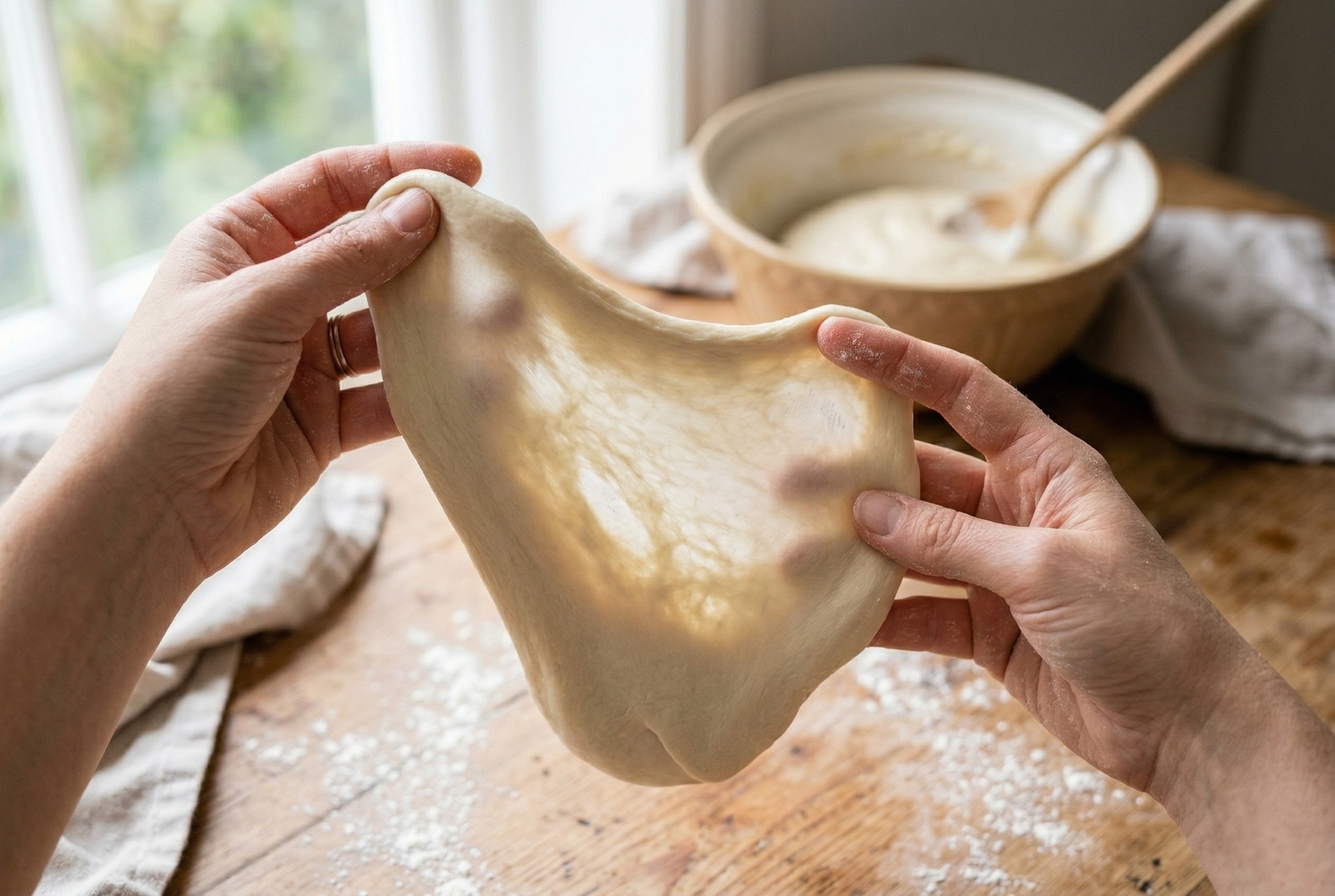
Strong flour allows dough to stretch into a thin film without tearing, guaranteeing a fluffy crumb.
Rescuing Failures and Being Lazily Delicious
Having only a bag with 10.2 g of protein while craving bread is manageable.
Avoiding panic is key. Failures always offer alternate routes.
When the Flour is Weak, but You Crave Bread
Long cold fermentation provides the first solution. Time can reinforce a weak gluten network. Slow cold fermentation in the refrigerator (12-18 hours at 4-6°C / 39-43°F) gradually builds gluten. Dough made with weak flour behaves significantly better after a night in the fridge compared to resting for two hours at room temperature.
In practice: knead the dough, let it rest for 30 minutes at room temperature, fold it a couple of times, and place it in the fridge in a bowl covered with plastic wrap. In the morning, let it warm up for an hour, shape it, proof it, and bake. The bread will have a proper crumb and lively aroma, even if slightly less airy than a strong flour loaf.
Adding vital wheat gluten (available in health food stores or online) offers a second method. One or two teaspoons per 500 grams (1.1 lb) of flour adds the missing 1-2% protein. The dough becomes noticeably more elastic.
Accepting the situation and baking a denser, rustic bread serves as the third option. Avoiding ciabatta and making a compact white bread with a tight crumb works best. Adding an egg and some butter creates an enriched dough. The egg provides a protein structure, and the butter tenderizes the crumb. Such dough does not require strong gluten.
Burst Pelmeni and What to Do With Them
Embracing a culinary disaster as an artistic vision makes for a great story.
Dropping carefully shaped pelmeni into a pot only to watch them open triggers panic, then anger. Quickly changing the plan saves the meal.
Carefully fishing out the contents with a slotted spoon leaves dough pieces of various sizes and partially cooked filling. The broth becomes rich and meaty.
Adding some water or prepared broth and bringing it to a boil transforms the disaster. The dough pieces become ‘rustic homemade dumplings,’ and the filling acts as a meat garnish. A few drops of good oil, fresh herbs, and black pepper complete the dish. Serving it as ‘broth with homemade dumplings’ with absolute confidence works wonders.
Families praise the ‘rich flavor’ without suspecting a thing.
This technique is genuine. Chefs have famously turned burst ravioli into a deconstructed pasta with ricotta sauce, prompting guests to ask for the recipe.
When Craving Pizza with Weak Flour
Pizza forgives weak flour slightly better than bread, especially thin crusts. However, dough with 10% protein will tear when stretched.
Three techniques help salvage the situation.
First, rolling with a pin instead of stretching by hand mechanically distributes the dough evenly, preventing stress concentration in one spot.
Second, allowing the dough to rest extensively before rolling is crucial. Resting for 20 minutes after dividing is the minimum; 40 minutes is better. Relaxed gluten yields more easily.
Third, increasing hydration by adding 5-10% more water than the recipe calls for makes the dough stretchier.
The result leans toward a thin Roman-style pizza rather than a Neapolitan pie with puffy edges. It remains delicious, just a different style.
A Brief Note on Storage
Protein degrades over time. Flour stored for a year in an open bag in a humid kitchen performs worse than fresh flour from a newly opened package. Proteins denature, fats oxidize, and gluten forms poorly.
Transferring flour to an airtight container immediately after purchase extends its life. Storing it in a dry place away from the stove is vital. Smelling flour older than six months reveals its condition: fresh flour smells neutral or slightly sweet, while stale flour develops a faint rancid or cardboard odor. Nothing fixes spoiled flour, not even long fermentation or vital wheat gluten.
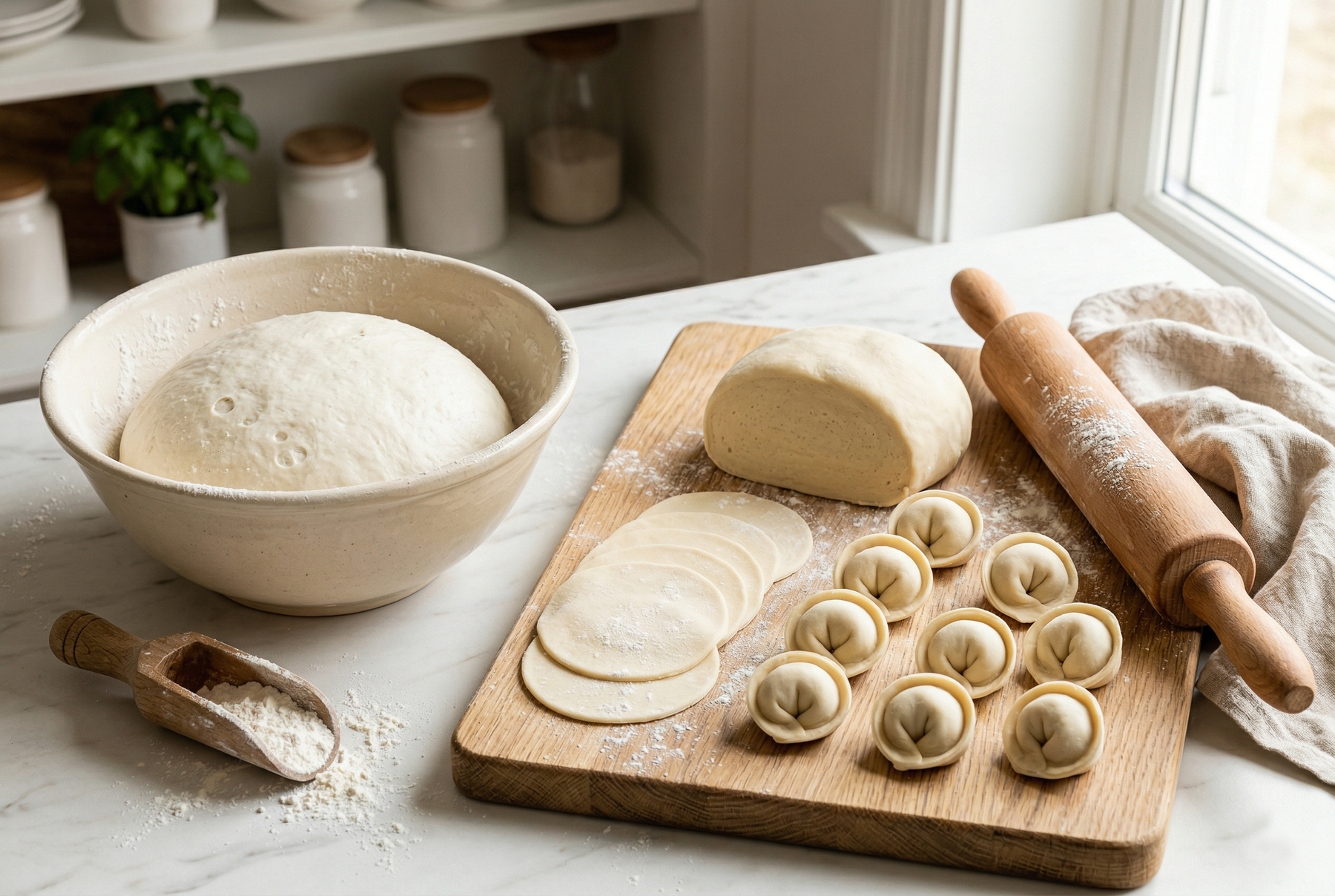
Selecting flour with 10-12 grams of protein guarantees strong yet tender homemade dumplings.
The Minimum Plan for Your Kitchen
Buying flour with six different protein levels and maintaining six containers is excessive and tedious. Pragmatism wins.
Keeping two types suffices for a start.
One ‘medium’ flour with 10-11 g of protein covers batters, pancakes, cakes, and anything not requiring strong gluten. Standard all-purpose or premium grade flour generally fits this category.
A second ‘strong’ flour with 12-14 g of protein specifically serves bread and pizza. Trying it once reveals a noticeable difference in the dough. Returning to the habit of grabbing random bags becomes impossible.
The price difference remains minimal, yet the difference in results is massive.
Checking the pantry to find the protein number on the current bag of flour takes thirty seconds.
Bon appétit.
0 comments