
Kitchen appliances regularly promise to change our lives. The air fryer is exactly one of those. It is sold with phrases like “fries without oil” and “replaces the oven.” These claims are a good place to start: both are inaccurate.
The principle of an air fryer is simple. Inside a small, closed chamber sits a powerful fan that circulates scorching air. The chamber is small, the heating is rapid, and the air is constantly moving. In reality, we are looking at a compact and highly aggressive convection oven. The airflow blasts the food from all sides, quickly drying the surface and creating a crust.
There is no deep frying here. In true deep frying, the food is submerged in oil at a temperature of 160–190 °C (320–375 °F). The oil rapidly seals the surface, creating the crunch and characteristic richness of fried food. Hot air behaves differently: it dries the surface but does not provide that dense oily texture. The result is similar, but not identical. Otherwise, you might expect French fries and end up with an entirely different texture.
An air fryer heats up quickly, yields a crust without copious amounts of oil, and is convenient for small portions. It excels at cooking chicken, vegetables, potatoes, fish, and frozen convenience foods. It also does a fine job reheating prepared meals. These are its strong points.
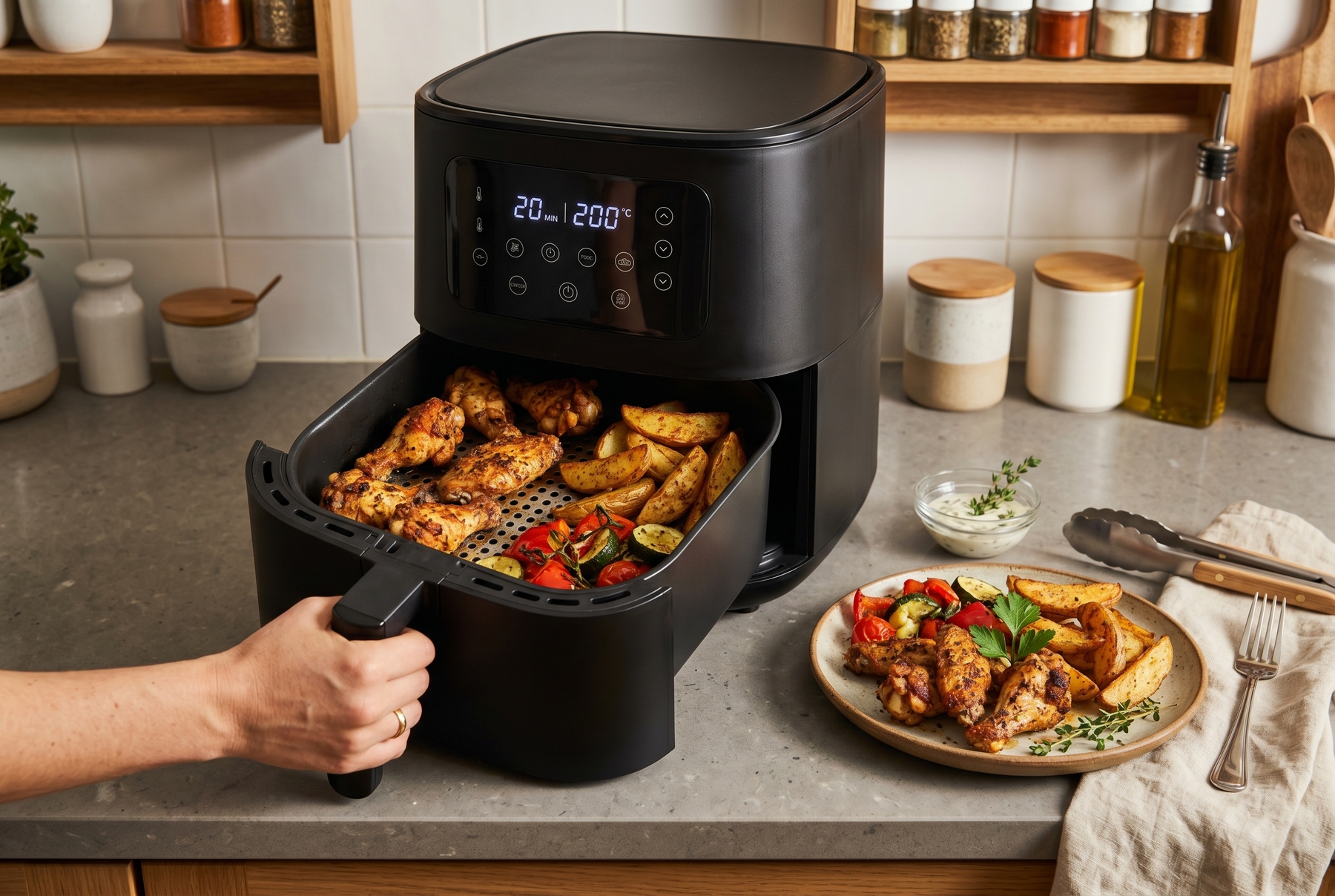
The air fryer produces an appetizing, crispy crust on chicken and vegetables through intense hot air convection.
Table of Contents
- How to Know if You Need an Air Fryer
- 7 Air Fryer Pros
- 6 Air Fryer Cons That Are Rarely Discussed
- What to Cook in an Air Fryer: The Foods That Turn Out Best
- What Not to Expect From an Air Fryer
- How to Choose an Air Fryer for the Home Without the Hype
- Who Should Buy an Air Fryer, and Who Should Not
- The Main Mistakes When Using an Air Fryer
- Not Everyone Needs an Air Fryer, But It Helps Some
How to Know if You Need an Air Fryer
You Cook for One to Three People
Heating an oven to 200 °C (400 °F) for two chicken thighs is akin to running a dishwasher for three plates. It is possible, but it makes little sense. An air fryer reaches its working temperature in three to five minutes; a standard oven takes ten to twenty. On a weeknight, those fifteen minutes are noticeable.
You Love the “Dry Outside, Juicy Inside” Texture
This texture develops when the surface of the food manages to dry out and heat up before the center does. The hot air actively pulls moisture from the surface and prevents it from pooling. Chicken skin becomes thin and crispy. Potatoes develop a crust the color of old copper. This texture is precisely why people buy an air fryer.
You Value Results Without Constant Hovering
The standard scenario involves setting the temperature, arranging the pieces, and doing something else. Chicken thighs, chunks of squash, frozen nuggets, or yesterday’s hand pies cook easily on a “set it and forget it” basis, requiring at most a shake of the basket halfway through.
Your Oven is Weak, or Turning It On Doesn’t Make Sense
In smaller or older kitchens, this is often more important than the numbers on the box. A compact kitchen, a rented apartment with a basic stove, a vacation cabin, or an old oven that heats unevenly and takes an hour to warm up. In such environments, an air fryer looks like a rational solution rather than a trendy gadget.
7 Air Fryer Pros
1. Quick Start
Preheating takes a few minutes, not a quarter of an hour. The small chamber heats up fast, which is palpable on weekdays: between work and dinner, no one wants to wait an extra half hour.
2. A Crust Without a Liter of Oil
Oil is still sometimes necessary. A teaspoon of olive oil per portion of potatoes or a light coating on chicken works better than a completely dry surface. But the difference in oil volume compared to deep frying or pan-frying is substantial. The resulting crust is dry and distinct: not greasy, not soft, and not steamed.
3. Reheating That Restores Texture
After the microwave, yesterday’s pizza often turns into damp dough with rubbery cheese. In an air fryer, the edges crunch again in four to five minutes, while the center heats up and melts. Cutlets, hand pies, khachapuri (Georgian cheese bread), croissants, and baked chicken hold their crust after this kind of reheating and do not turn soggy, as they do in the microwave.
4. Frozen Foods With Minimal Effort
French fries, fish sticks, nuggets, frozen syrniki (cottage cheese pancakes), and ready-made puff pastries are highly suitable for the air fryer. They cook without excess oil and yield predictable results: it is easy to see where the crust is and where it is still pale. It is best to check the package instructions, avoid overfilling the basket, and verify the doneness of meat, fish, and chicken products, as some are sold partially cooked. It is not haute cuisine, but in everyday life, this predictability is useful.
5. Less Odor and Splatter Than an Open Pan
The basket is closed, meaning fat does not fly all over the stove. This is especially noticeable with bacon, fatty chicken, and marinated meat. There will still be an odor, particularly from fish or pungent marinades. The filter will not catch everything, but the kitchen smells less intense than after using an open skillet. There is no splatter on the adjacent burner, the wall, or your clothing.
6. Chicken, Vegetables, and Small Cuts of Meat
The appliance handles these foods best. Pieces should be arranged loosely, in a single layer, without piling. Moist foods are better patted dry with a paper towel before entering the basket. Large cuts, especially meat, require checking with a thermometer: the outside may be browned while the inside remains undercooked.
7. Predictability
This is why the appliance is valuable. Finding a point of control in any process—temperature, time, thickness of the cut, evenness of loading—is essential. The air fryer excels here. One layer of food, a clear temperature, a timer. Afterward, the result is easier to replicate. Without these details, one batch comes out dry, and the next pale.
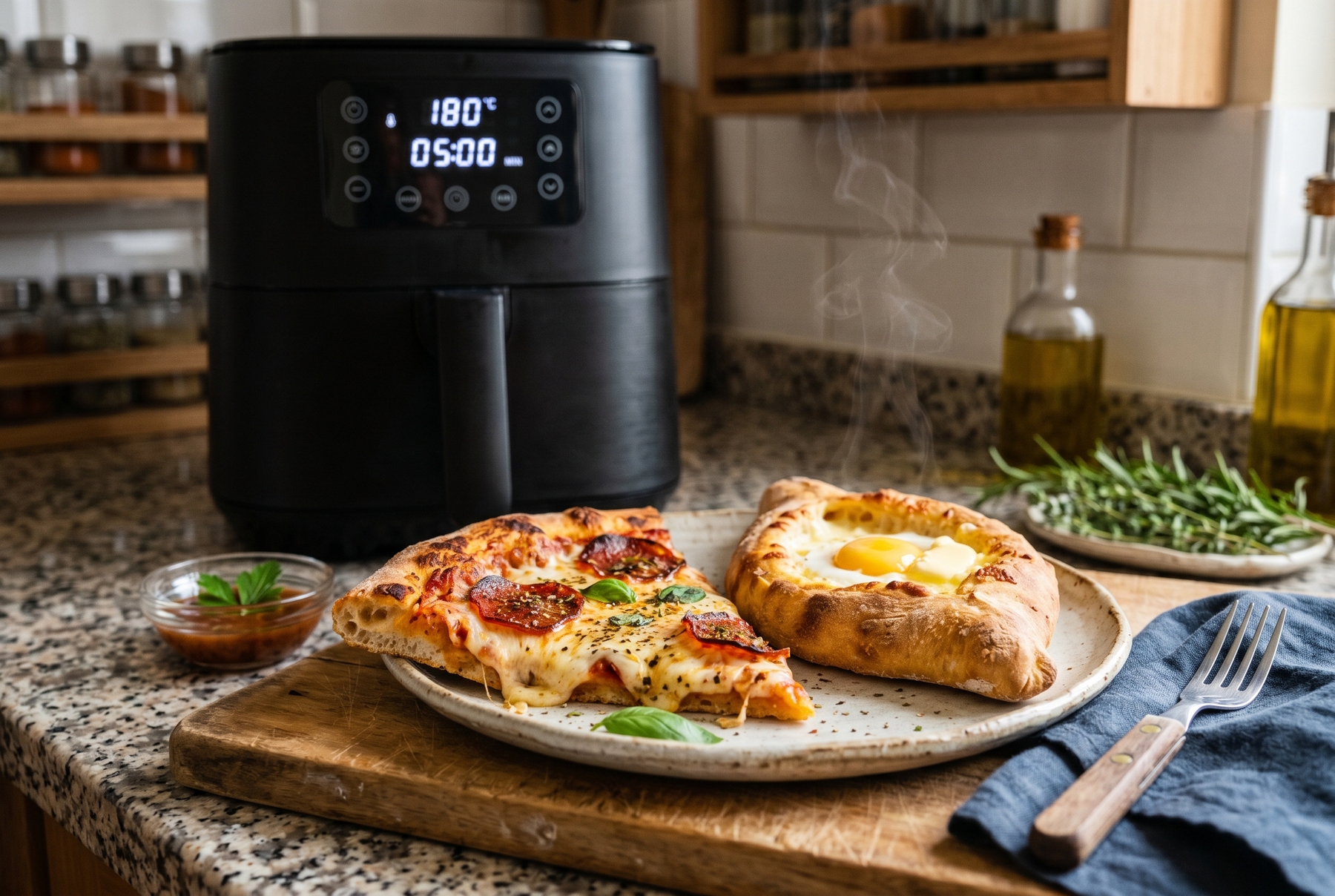
Reheating in an air fryer restores the crispy texture of leftover baked goods and pizza, unlike a microwave oven.
6 Air Fryer Cons That Are Rarely Discussed
1. The Actual Volume is Smaller Than the Specs State
The box usually lists the volume of the entire chamber. The surface area of the basket, where food can be arranged in a single layer, is always smaller. A 5-liter air fryer typically fits one generous portion or two smaller ones. The diameter and depth of the basket matter more than the total volume.
2. An Overloaded Basket Produces Steam, Not a Crust
If food is piled into a mound or arranged in two layers, the hot air stops functioning as intended. The pieces heat each other, moisture remains trapped inside the pile, and the surface cannot dry out. The output will be pale, damp pieces: cooked in some spots, raw in others. A single layer is not for aesthetics; without it, air cannot pass between the pieces.
3. Some Foods Turn Out Dry
Skinless chicken breast, lean white fish, thin patties, and finely chopped zucchini easily dry out in an air fryer. The hot air rapidly extracts moisture, and lean foods have nothing to compensate with. A marinade, a thin coat of oil, or breading helps retain moisture. A thermometer also helps. You can pull the food a couple of degrees early, but only if the residual heat will carry it to a safe internal temperature. With poultry and ground meat, hitting a safe internal temperature comes first, before worrying about juiciness.
4. It is Not an Oven Replacement
A large casserole, a loaf of bread, a whole duck, a 26 cm pie, or dishes in tall clay pots either will not fit in an air fryer or will turn out worse than in an oven. A family dinner for five in a single batch is also impossible. The appliance is great for small portions. When a large quantity of food is needed, its advantages vanish.
5. Cleaning Requires Patience
Grease bakes into the grate, the basket, and sometimes reaches the heating element. After fish or a spicy marinade, the smell lingers. The parts are usually dishwasher safe, but crevices, attachments, and corners still require manual scrubbing. It is not terrible, but if you dislike cleaning grates, crevices, and corners, it is better to know in advance.
6. A Cheap Air Fryer Can Disappoint
Without naming brands, but keeping it factual: a weak heating element fails to recover temperature quickly after loading cold food, stretching the cooking time and ruining the crust. Uneven heating results in one burnt edge and one raw one. A flimsy basket with a thin coating begins to peel at the edges after a few months. Look at the construction, not just the price.
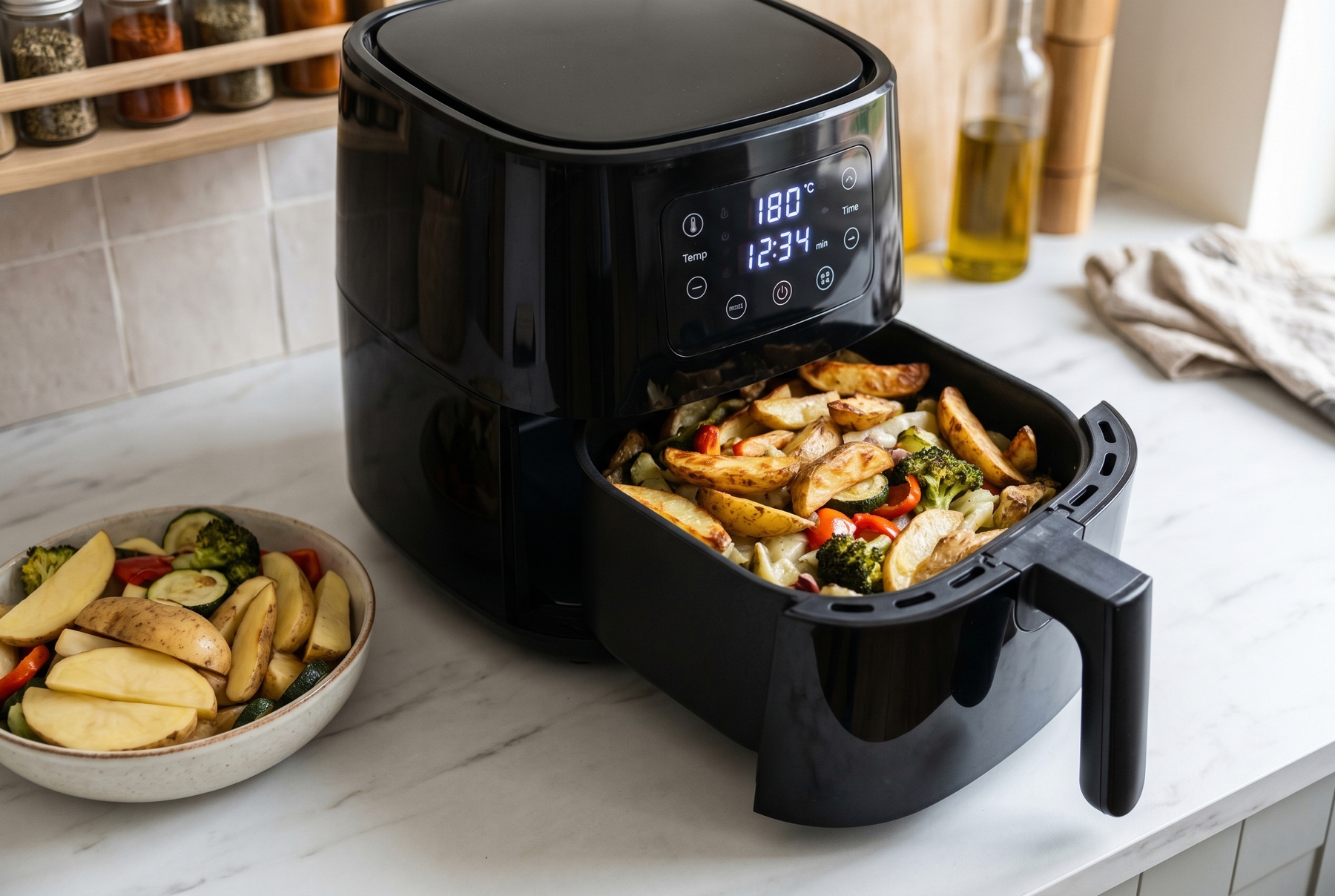
For an even roast, avoiding an overloaded basket and arranging the food in a single layer is crucial.
What to Cook in an Air Fryer: The Foods That Turn Out Best
Potatoes and Root Vegetables
Potato wedges or cubes, carrots, beets, and parsnips perform exceptionally well. The procedure is simple: dry them, add a little oil, arrange in a single layer, and shake halfway through cooking. The crust turns out dense and golden, with a soft center. It does not rival deep-fried potatoes, as it has less fat and less crunch. For a quick dinner, the difference is negligible.
Chicken Wings, Thighs, and Drumsticks
The skin tightens and browns in the hot air, while excess fat renders and drips down. Wings emerge with a crispy exterior and juicy meat, especially if dried and cooked in an uncrowded basket.
Vegetables for Quick Dinners
Broccoli, cauliflower, zucchini, eggplant, bell peppers, and carrots. A medium chop is required. Small pieces burn on the outside before softening inside, while large ones take too long and heat unevenly. A touch of oil and a little salt right before loading. After 12–15 minutes, the edges are roasted, and the center is tender.
Reheating Baked Goods and Prepared Meals
Hand pies, khachapuri, samsa (Central Asian meat pastries), croissants, pizza, and cutlets. The air fryer restores a semblance of a fresh crust to these dishes: it becomes crisp again, and the dough turns dry rather than wet. For baked goods, pizza, and similar items, three to four minutes at 160–170 °C (320–340 °F) is usually enough. For cutlets, poultry, casseroles, and dense meat leftovers, thoroughly heating the center to a safe temperature is crucial, which may require more time.
Small Baked Goods
Muffins, puff pastries, mini-casseroles, and syrniki. This works with caveats: the pan must fit with room to spare, air must circulate all around, and the evenness depends on the model. Bread and large pies do not belong here.
What Not to Expect From an Air Fryer
True Deep Frying Without Oil
The difference lies first in the physics of the process, and then in the taste. In an oil bath, the food is heated from all sides simultaneously; the oil quickly heats and dehydrates the surface, helping form a crust while the inside typically remains juicy. Hot air operates more slowly and less aggressively. The texture is similar but distinct: the surface is drier, the crunch is weaker, and there is almost no oil flavor. If you are expecting McDonald’s-style fries, the air fryer will disappoint.
The Perfect Steak
For a serious crust, a steak requires direct contact with a very hot surface, such as a cast-iron skillet or a grill. The Maillard reaction on metal at 220–250 °C (430–480 °F) behaves differently than in hot air at the same temperatures. An air fryer can play a role—for example, bringing a steak to the desired internal temperature after a quick sear—but as the primary tool for steak, it loses to the skillet.
Soups, Sauces, and Liquid Dishes
The basket is unsuitable for liquid meals. If a menu features many stews and boiled dishes, the air fryer will only cover a small fraction of the tasks.
A Large Family Dinner in One Go
Cooking in batches is possible, but it does not save time linearly. While one batch is in the appliance, the second is waiting. For a family of five or six, a conventional oven is more logical: load a baking sheet, wait, and take it all out at once.
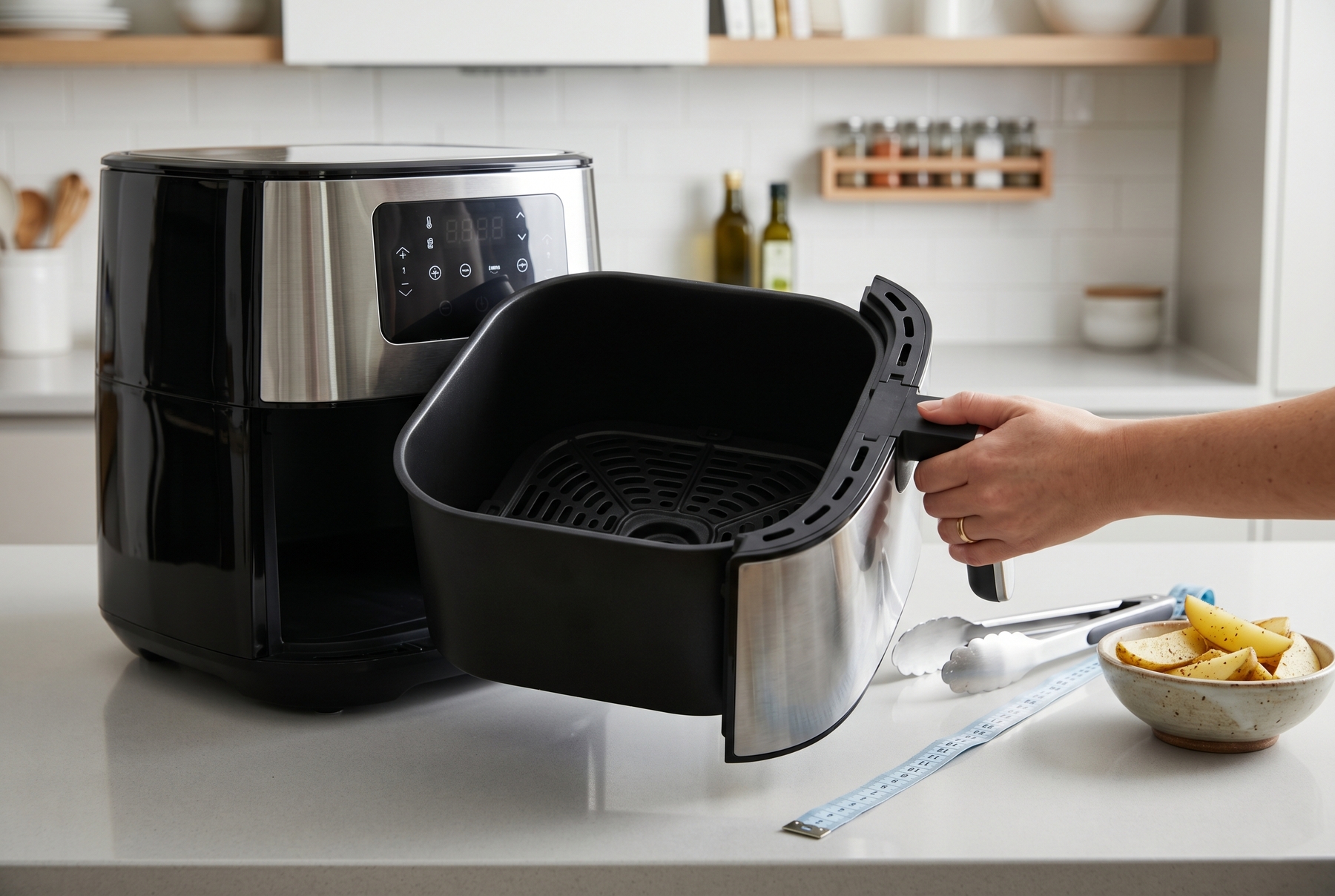
When choosing an air fryer, assessing the usable bottom surface area of the basket is more important than the total chamber volume.
How to Choose an Air Fryer for the Home Without the Hype
Look at the Basket Surface Area, Not Just the Liters
A wide, flat basket is more convenient than a deep, narrow one: more food fits in a single layer, with fewer dead zones around the edges. If the specifications provide the basket diameter or its dimensions in centimeters, look at those first.
Power and Temperature Range
High power is important not just for speed, but for temperature recovery: when you load cold food, the chamber cools down, and the appliance must quickly restore the required setting. A weak heater lags, stretching the time and ruining the crust. A range from 80 to 200–220 °C (175 to 400–430 °F) covers most tasks: the lower limit for delicate reheating, the upper for an aggressive crust.
The Basket, Grate, and Coating
Hold it in your hands if possible. The basket should slide in and out easily, the handle should not wobble, and the grate should not bend under pressure. The non-stick coating must be free of cracks and peeling corners. Narrow crevices between structural elements mean future misery during cleaning.
Controls and Programs
Automatic programs are handy as a guide, but manual adjustment of temperature and time is more important. Different foods, different sizes, different moisture levels—no auto-program can account for that. If the appliance allows you to freely set 175 °C (350 °F) and 12 minutes, it is already better than a model offering only “chicken” and “potatoes.”
Size and Storage Space
An appliance on the top shelf quickly vanishes from kitchen life. It is best to figure out in advance where it will sit, how much counter space it will occupy, and whether it will end up back in the cupboard after three uses.
Who Should Buy an Air Fryer, and Who Should Not
You Should Buy It If:
- You cook for one to three people;
- You frequently need a quick dinner without standing long at the stove;
- You love a crispy exterior with a juicy interior;
- You regularly reheat prepared food and want to retain its texture;
- Your oven is weak, old, or you lack the desire to turn it on for one portion;
- You often cook chicken, vegetables, potatoes, and frozen convenience foods.
You Should Not Buy It If:
- You have a family of five or six and need to cook a lot at once;
- You already own a good convection oven;
- There is almost no space in your kitchen;
- The foundation of your menu consists of soups, stews, porridges, and saucy dishes;
- You have no desire to wash yet another contraption with grates and corners.
If You Are in Doubt
Look at your menu from the past two weeks. Not the ideal menu you want to start cooking after the purchase, but what you are actually cooking now. If there is plenty of chicken, potatoes, vegetables, frozen foods, and reheating, an air fryer will fit right in. If there is borscht, cutlets for five people, and baking in large pans, the utility will fall short of expectations.
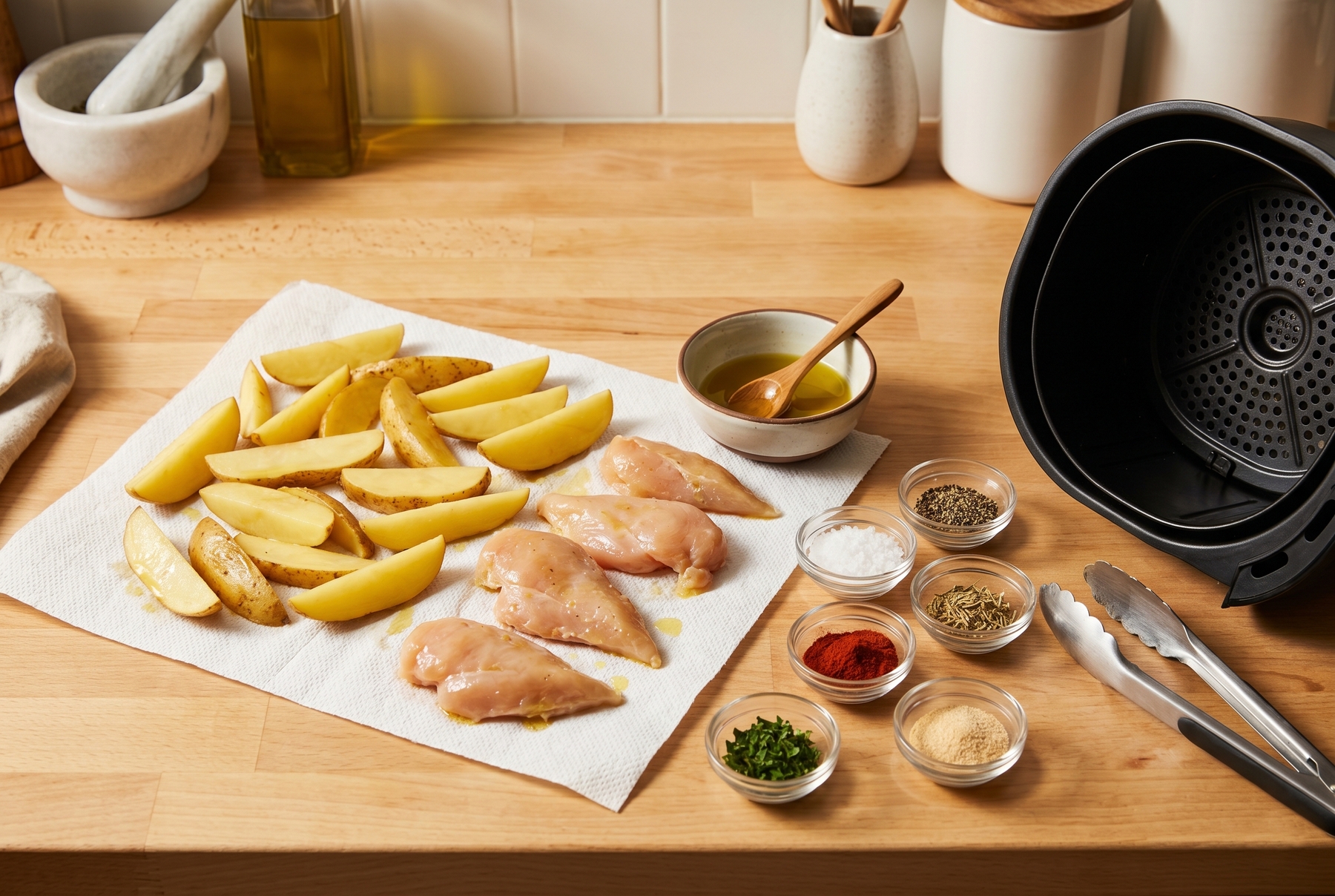
Drying the ingredients prior to cooking is essential for achieving a high-quality crust without a boiled effect.
The Main Mistakes When Using an Air Fryer
Overloading the Basket
It looks like this: piling up a heap of potatoes, turning it on, and pulling out pale, damp, partially raw pieces. The hot air cannot penetrate the mound of food; the top pieces steam the bottom ones, and the moisture cannot escape. Without a single layer, the hot air simply fails to reach all the pieces.
Not Drying the Food
As long as there is water on the surface, there will be no crust. While the surface evaporates water, the temperature in that zone does not rise above 100 °C (212 °F), preventing any browning. Using a paper towel before loading takes ten seconds.
Skipping Oil Entirely
Advertising has convinced many that an air fryer perfectly manages without oil, but the result is usually worse. A thin coating of oil aids heat transfer, provides color and flavor, and protects against drying out. A teaspoon per portion does not turn the dish into fried food, but it helps the crust set.
Not Shaking or Flipping
Typically, the hot air comes from above. The side resting on the grate heats through contact with the metal and convection from below, but the intensity differs. Shaking the basket or flipping the pieces halfway through ensures an even crust on all sides.
Blindly Trusting Recipe Times
A recipe is written for a specific model, a specific cut size, and a specific load. If you have a different appliance, a slightly larger cut, or three portions instead of one, the time and temperature will vary. With meat, the easiest approach is to skip the guesswork and check with a thermometer. For everything else, look at the color, texture, and aroma.
Not Everyone Needs an Air Fryer, But It Helps Some
An air fryer is not a universal appliance. It will not oust the oven, replace the skillet, or pave your way to a restaurant-quality steak. But in its niche, it works honestly: rapid reheating, a predictable crust, and convenient cooking of small portions with minimal effort.
I purchase kitchen tools only when I understand the specific problem they solve better than what I already have. For me, its purpose is clear: chicken wings on a weeknight, potatoes in twenty minutes, and reheating baked goods without losing texture. Not every day, but regularly—and without the feeling that the appliance is gathering dust on the shelf.
0 comments