
In many households, the “proper kids’ breakfast” comes with a ready-made mental image: a steaming bowl of porridge, a spoon, and a child dutifully finishing every bite. Everything else seems to carry an unspoken label of “well, only if nothing else works.” Consequently, parents usually ask how to replace morning porridge when a child refuses to eat it. That question is flawed from the start. Focusing on what a child actually gets in the morning and how that meal fits into the rest of their day matters far more than the name of the dish.
I have three kids: my oldest is 14, my middle child is nine, and my youngest is six. The exact same breakfast never works the same way even within our own kitchen. My youngest will happily eat anything at seven in the morning, my middle child only wakes up hungry around ten, and my oldest has spent the last three years eating breakfast standing up, a minute before walking out the door. A one-size-fits-all morning bowl simply does not exist here.
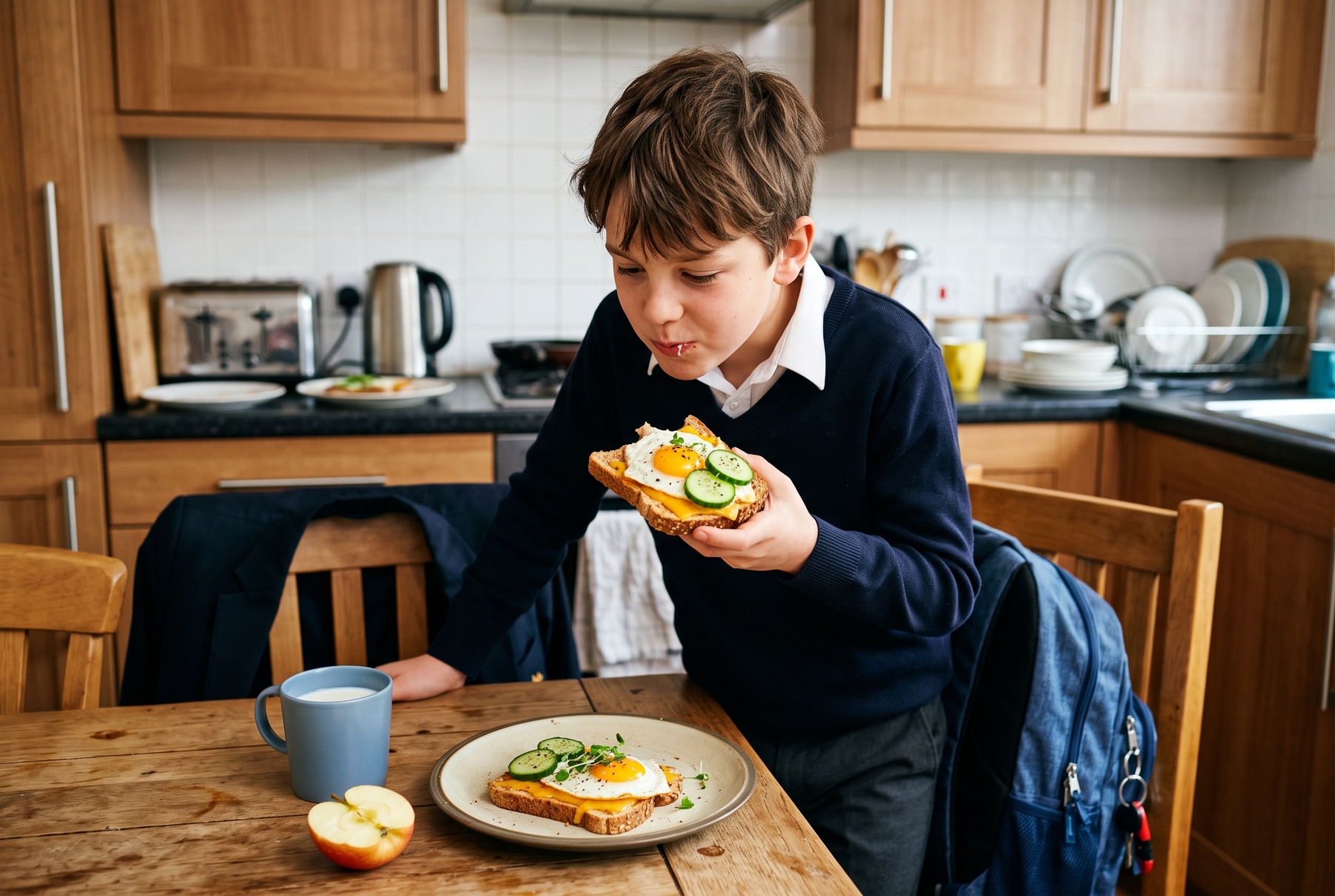
A balanced kids' breakfast does not have to be porridge: toast with an egg and fresh vegetables keeps children full and energized before school.
Table of Contents
- Why a Bowl of Porridge Became the Symbol of a Good Morning
- What Actually Matters at Breakfast
- Smart Alternatives to Morning Porridge
- When a Child Refuses to Eat in the Morning
- When the Issue Is the Meal Structure, Not the Porridge
- Why Bargaining for "Just Three More Bites" Backfires
- A Quick Pre-Breakfast Checklist
Why a Bowl of Porridge Became the Symbol of a Good Morning
The reasons behind this habit are more practical than scientific. Grains are inexpensive, sit in the pantry for months, and cook with minimal human intervention: you put the pot on the stove, go help the youngest get dressed, and come back to a finished meal. The varieties are endless (oats, buckwheat, rice, millet, cornmeal), toppings can be swapped infinitely, and you can rotate options all week with almost no repeats.
Historically, the Soviet public dining system reinforced this with its rigid meal schedules, where mornings in kindergartens and schools meant hot cereal almost by default. The habit took root and passed down through generations without anyone questioning why.
Grains provide complex carbohydrates and fiber; oatmeal satisfies hunger well, and buckwheat keeps kids full longer than semolina porridge (known as *manka*). Yet none of this makes porridge mandatory at eight in the morning. Hot cereal is great at any time of day, which is precisely why it does not have to be strictly a morning food.
What Actually Matters at Breakfast
Breakfast is simply the first meal of the day, not the most important one. According to traditional Eastern European public health standards (SanPiN) used to plan kindergarten menus, breakfast accounts for about 20% of daily energy and nutrient needs, while lunch covers around 35%. Morning meals represent roughly a fifth of daily intake. A child gets the rest throughout the day, meaning parents should evaluate the entire daily diet rather than obsessing over a single bowl.
People talk a lot about the benefits of breakfast for school performance, though the reality requires a bit more nuance. Researchers gathering data on children and adolescents reach a measured conclusion: eating in the morning is better than going to class on an empty stomach, the noticeable benefits apply to that specific morning and particular tasks like attention and memory, and the effect shows up most strongly in undernourished children. However, it neither guarantees an “energy boost until evening” nor produces an automatic jump in grades.
Looking at the building blocks of a balanced morning meal makes daily planning much simpler. A nourishing breakfast usually brings together four core elements:
- A hearty base: bread, grains, potatoes, pasta
- A protein source: eggs, farmer’s cheese (*tvorog*, a traditional Eastern European curd cheese), regular cheese, meat, fish, legumes
- Fats: butter, vegetable oil, cheese, nuts, avocado
- Something fresh: vegetables, fruit, berries
Porridge cooked with milk and butter offers a hearty base, protein, and fat. Pairing egg toast with a sliced cucumber easily checks the boxes. Farmer’s cheese with a banana also makes a complete morning meal. Every single breakfast does not need to contain all four elements at once, provided the overall daily diet remains varied.
What to Serve Kids for Breakfast Instead of Oatmeal
Parents frequently search for an exact “oatmeal equivalent”—something equally warm, equally filling, and looking just like a bowl of cereal. Replicating the exact form of oatmeal is unnecessary. Any balanced meal that matches the child’s appetite, family routines, and the rest of their daily nutrition works just fine. Taking this approach immediately opens up a world of options.
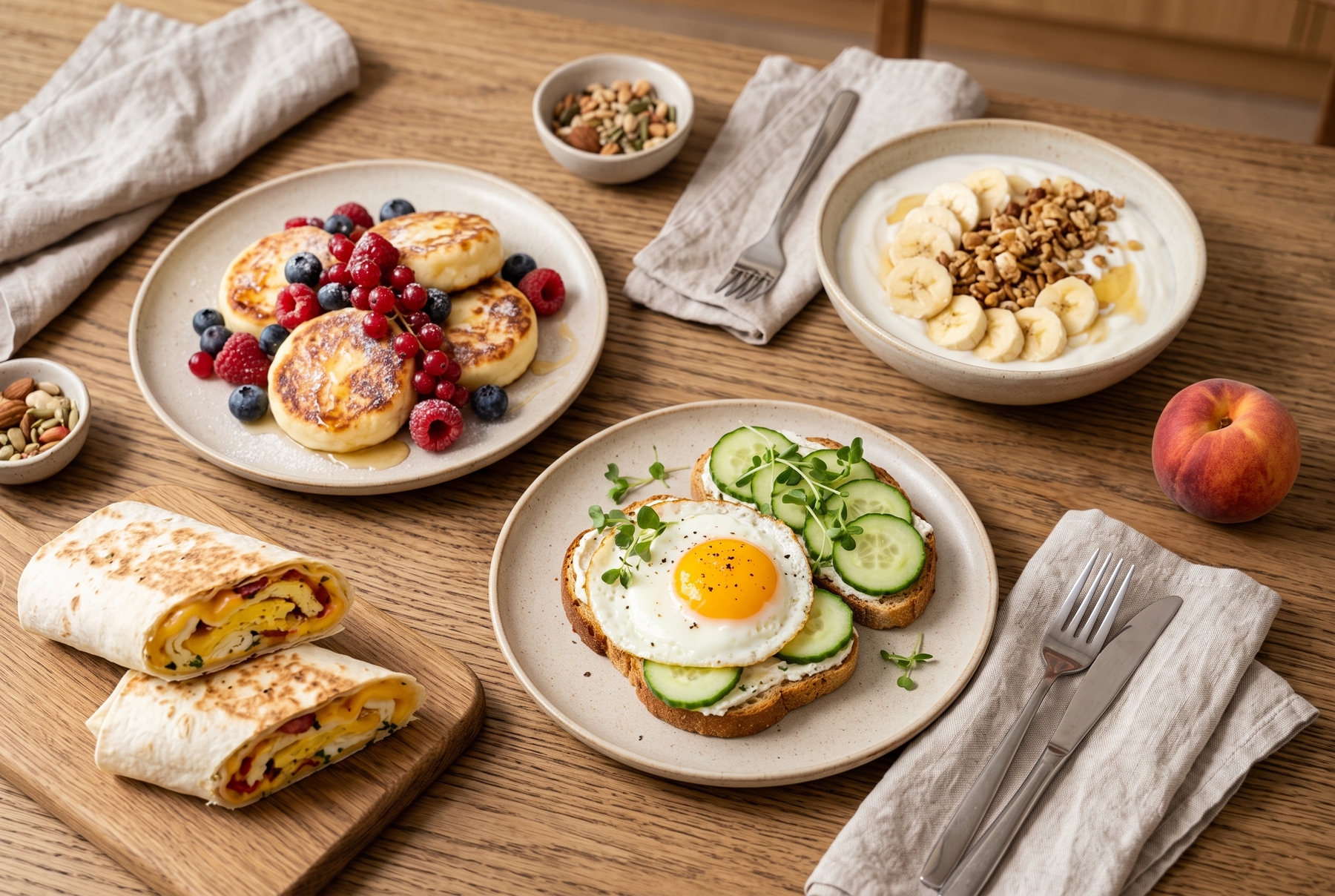
The formula for a healthy morning meal relies on balancing a hearty base, protein, healthy fats, and fresh berries or vegetables.
Smart Alternatives to Morning Porridge
Think of these as flexible formulas rather than strict recipes. Within each one, you can swap ingredients based on whatever happens to be in the fridge.
- Bread or flatbread (such as unleavened *lavash*) plus a protein filling (egg, farmer’s cheese, sliced cheese, cooked meat) plus a vegetable or fruit
- Plain yogurt or farmer’s cheese plus berries or fruit plus a grain topping like rolled oats or granola
- Eggs cooked the way your child likes them (soft-boiled, omelet, sunny-side up) plus bread plus something fresh
- *Syrniki* (pan-fried farmer’s cheese pancakes), a lightly sweetened farmer’s cheese bake (*zapekanka*), or *lenivye vareniki* (quick-boiled cheese dumplings)
- A savory sandwich or wrap that packs easily for the road
- Leftovers from last night’s homemade dinner, if your child enjoys eating “non-breakfast” food in the morning
Foods traditionally reserved for lunch or dinner usually raise the most eyebrows. Yet some children find savory meals much easier to stomach early in the day. Braised chicken with rice at eight in the morning is no worse than the exact same chicken at two in the afternoon. My middle child ate soup for breakfast for an entire year, and that was the most peaceful year in the history of our family mornings.
One caveat applies to curd cheese breakfasts. *Syrniki* and cheese bakes easily cross the line into dessert territory: sugar in the batter, sugar in the sour cream, and jam on top. When serving farmer’s cheese pancakes or bakes for breakfast, adding just a pinch of sugar to the batter and serving fresh fruit or berries on the side keeps things balanced. Unsweetened batter also cooks more evenly and resists burning around the edges during those same 3 minutes over medium heat.
These options are naturally not universal for every age. A six-year-old and a teenager require different portion sizes, and a doctor should always guide the diet of a child with specific nutritional needs or restrictions. The point of these formulas is simple: you no longer have to stand in front of the open fridge at dawn trying to invent a meal from scratch.
When a Child Refuses to Eat in the Morning
Morning appetites vary wildly among children; one wakes up ravenous immediately, while another needs an hour after getting out of bed to feel hungry. Pressure backfires completely here: the harder you push, the more firmly the child associates mornings with stressful negotiations.
Starting with smaller portions makes a big difference in practice. Scaling back the serving helps because half a piece of toast actually eaten nourishes a child far better than a full plate they only pick at for two bites. Making food physically easy to handle also encourages eating; finger foods disappear much faster than something requiring a fork and a deep bowl. Checking wake-up times matters, too. A child who rolls out of bed 15 minutes before walking out the door is not avoiding food—they are simply still asleep.
Packing breakfast to go often solves the problem: a banana and a cheese pancake in a lunchbox, eaten on the way to school or during first recess, beat an empty stomach until lunchtime. Everything depends on the school rules and family schedule, so no single right answer exists.
Our mornings look like this: my youngest eats first and has a full meal, while my middle child sits next to her drinking warm cocoa and takes his actual food to go. I spent a long time trying to force both of them to eat from the same kind of bowl at the same time. Mornings became noticeably calmer the moment I stopped.
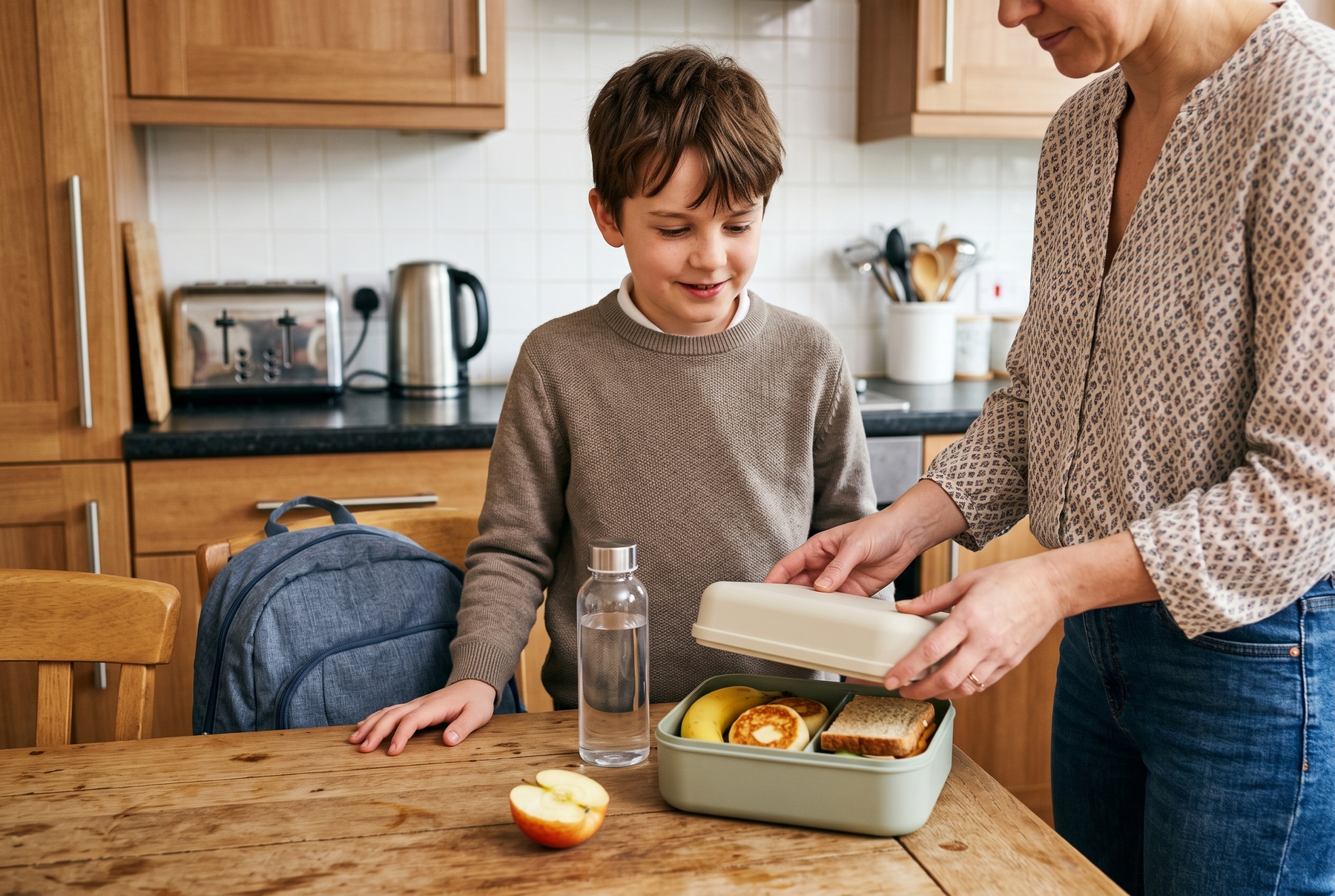
When a child has no appetite early in the morning, a hearty snack packed in a lunchbox saves the day during first recess.
When the Issue Is the Meal Structure, Not the Porridge
Sometimes swapping dishes changes nothing because the underlying issue lies in the composition of the meal itself.
For instance, a breakfast might consist almost entirely of a sugary drink or a dessert item. Sweet cocoa with cookies, flavored yogurt with sugary mix-ins, or a *glazirovanny syrok* (a popular chocolate-glazed sweet curd bar) are common culprits. Such meals end up heavy on sugar and light on lasting fullness. The WHO recommends keeping free sugars below 10% of total daily energy intake, noting that reducing them to 5% (roughly 25 g / 0.9 oz per day for a standard adult diet) provides additional health benefits, especially for dental health. Even a single sweetened yogurt in the morning can use up a significant fraction of that daily limit.
Another common trap happens when sweets replace real food rather than following it. A child refuses breakfast, gets a piece of candy “just so they have something in their stomach,” and the habit quickly cements itself.
Sometimes the portion is simply so tiny that the child gets hungry again 40 minutes later and fills up on random snacks. The telltale sign is straightforward: if you constantly have to buy snacks or negotiate treats before lunch, the morning meal failed to do its job.
Occasionally the opposite problem occurs: the meal is far too heavy. A full plate of rich fried food at seven in the morning regularly goes unfinished, leaving the child to face scolding on top of it.
Observing what happens after breakfast offers the best clues: how quickly the child asks for food again, whether they finish what is served, and whether the morning routine feels peaceful overall.
Why Bargaining for “Just Three More Bites” Backfires
Parental anxiety around food is completely understandable: it feels like a child will fall behind nutritionally unless someone micromanages every bite. In reality, counting spoonfuls usually turns the morning table into a daily exam where both parent and child feel like they are failing.
American dietitian and family therapist Ellyn Satter developed a widely respected framework known as the Division of Responsibility in feeding. The adult decides what food is offered, as well as when and where the meal takes place. The child decides whether to eat and how much. Nutrition educators rely heavily on this approach, though it remains a practical framework for family meals rather than medical advice; issues with weight, growth, or persistent food refusal always require a pediatrician.
Putting this into practice looks remarkably simple: you set a boiled egg, bread, and half a pear on the table, and then you step back from negotiating. You avoid swapping rejected food for cookies, stop counting spoonfuls, and never use a clean plate as a bargaining chip for screen time.
Adopting this dynamic feels unfamiliar at first, but it gradually removes the exhausting daily tug-of-war from the breakfast table.
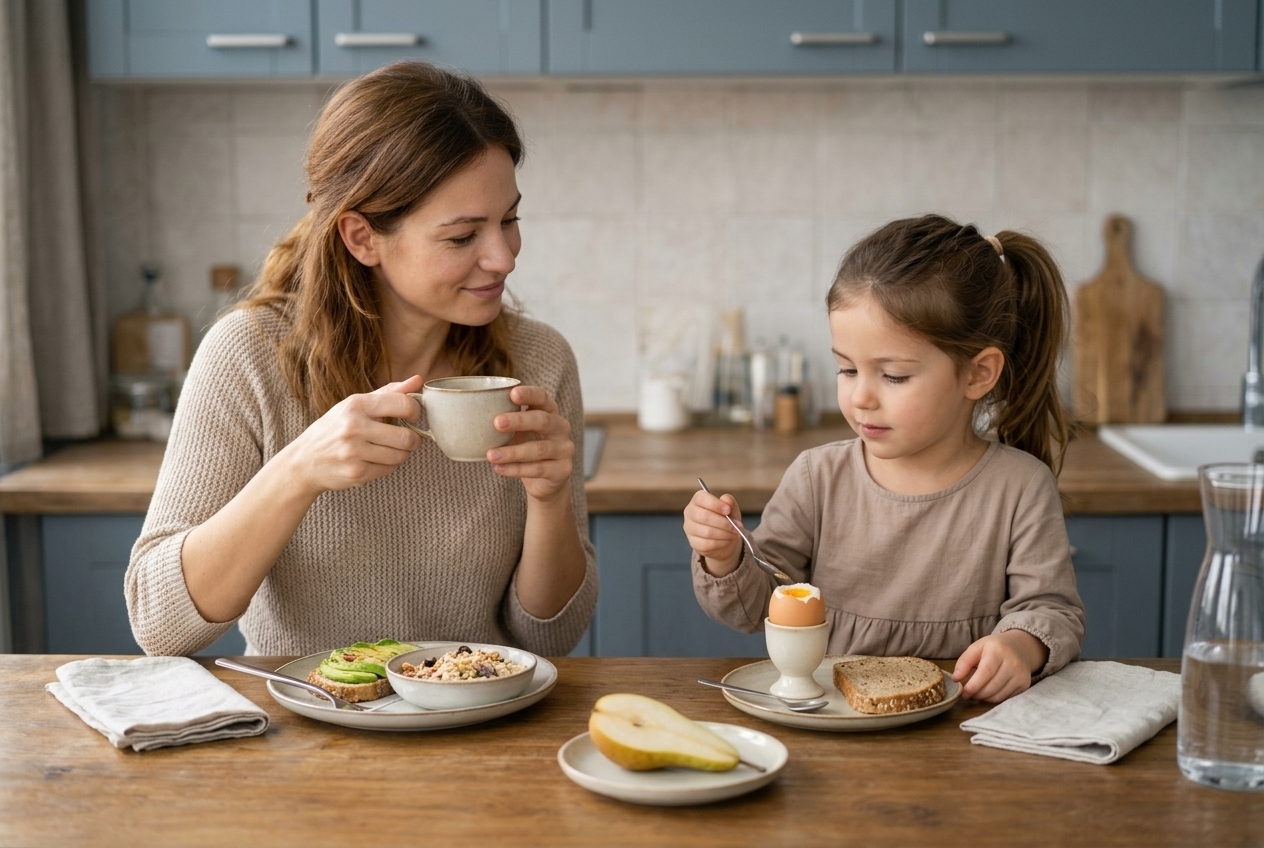
Letting go of spoon-counting and table pressure helps maintain a calm, pleasant atmosphere during morning meals.
A Quick Pre-Breakfast Checklist
Evaluating a few simple factors the night before—or right in front of the open fridge—takes the guesswork out of morning cooking. Consider what your child will genuinely eat, whether the meal includes a filling base, and how you might add a source of protein. Check for a piece of fruit, some berries, or a vegetable. The final question is the most practical of all: can you realistically pull this together on a normal weekday morning?
7 Five-Minute Breakfasts for Kids
- Toast topped with cream cheese, cucumber slices, and half a hard-boiled egg
- Unsweetened plain yogurt with a sliced banana and a tablespoon of rolled oats
- Flatbread (*lavash*) rolled up with cheese and cooked egg, toasted briefly in a dry skillet
- A two-egg omelet tossed with a handful of thawed green peas
- Freshly pan-fried farmer’s cheese pancakes (*syrniki*) made from batter mixed the night before
- A sandwich layered with sliced boiled chicken, crisp lettuce, and a tiny dab of mild mustard
- Farmer’s cheese (*tvorog*) mixed with grated apple and cinnamon, served without added sugar
None of these ideas require setting an earlier alarm. Five out of the seven can be prepped halfway the evening before.
Eliminating oatmeal entirely makes no sense. Grains are budget-friendly, filling, and versatile, and a warm bowl on a cold December morning is sometimes far more comforting than calculating protein ratios. Porridge easily earns its place on the menu, as long as it is not treated as mandatory every single day.
Rotating morning meals keeps things effortless. Serving oatmeal with berries today, an egg with toast and cucumber tomorrow, farmer’s cheese with fruit the day after, and leftover buckwheat with chicken on Thursday builds natural variety. Covering different nutritional bases across a week is much easier than spending seven mornings in a row begging a child to eat the exact same bowl.
For the record, my family still eats oatmeal. My middle child likes his with cinnamon and zero sugar, leaving half the bowl behind if it is made any other way. My oldest has not touched porridge since she turned 11 and eats a cheese sandwich every morning, standing by the windowsill with her backpack slung over one shoulder.
0 comments