
You have just butchered a chicken breast, wiped the board with a damp cloth, placed cucumbers on top, and started slicing. Everything looks normal. The board is clean. At least, it appears to be. The problem lies exactly between ‘looks clean’ and ‘safe for cucumbers.’
Cutting boards have memory. They retain the smell of garlic, the juice of raw chicken, and the scars from your chef’s knife. While a stainless steel pot makes things obvious with visible stains or lingering smells, a board presents a different reality. The surface might appear pristine, but deep cuts harbor residues that a simple damp cloth will never reach.
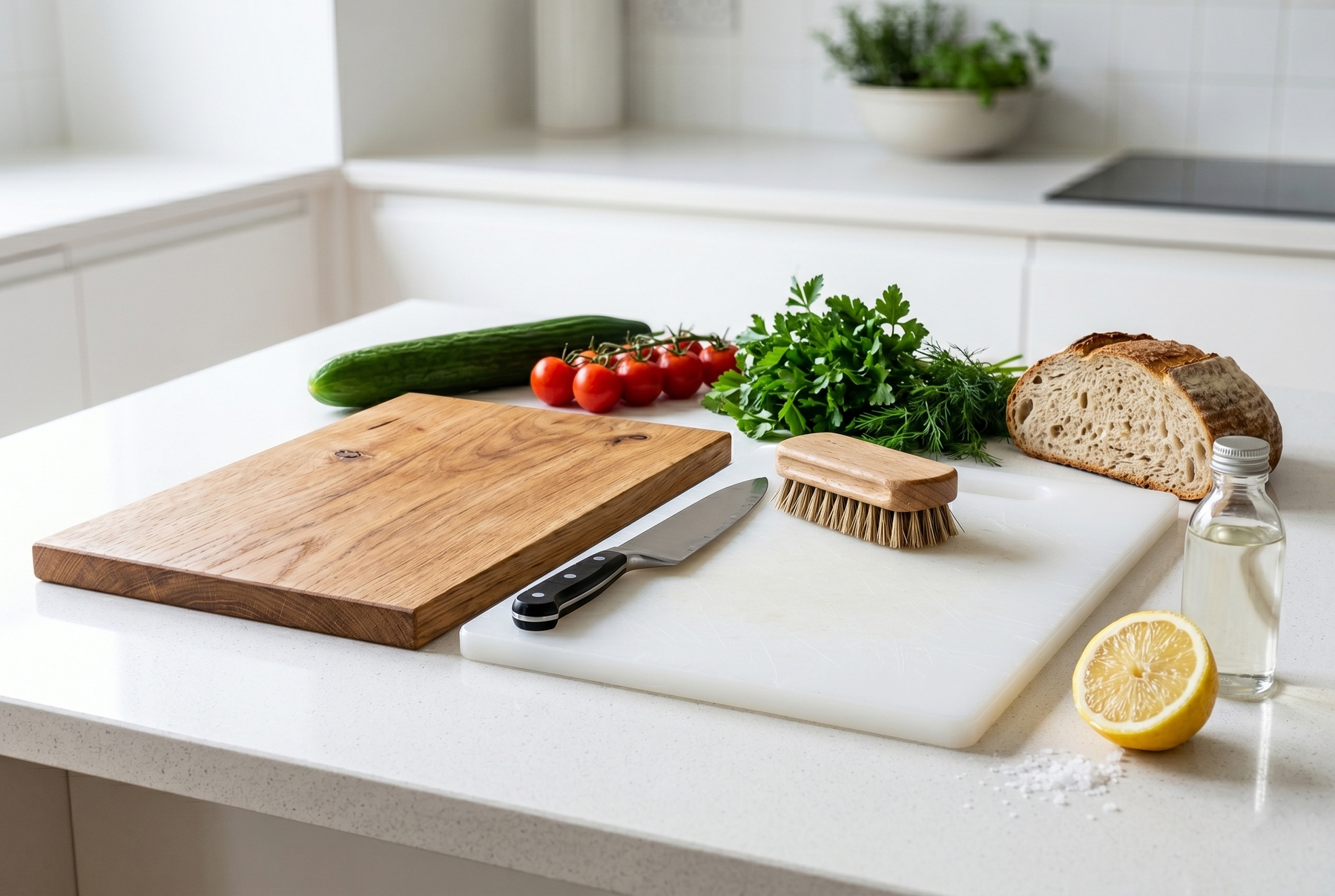
Choosing between a wooden and a plastic board often comes down to hygiene and durability. Both materials have their pros and cons when cared for properly.
Table of Contents
- Wood vs. Plastic: What the Research Shows
- Why Scratched Plastic Cutting Boards Are Harder to Clean
- Are Wooden Cutting Boards Hygienic?
- How to Wash a Cutting Board Correctly
- Caring for a Wooden Cutting Board: Why and How to Oil It
- Myths About Indestructible Plastic
- Separate Boards for Different Foods: Making It Work in a Small Kitchen
- Storage Is Just as Important as Washing
Wood vs. Plastic: What the Research Shows
Wood was long considered unsuitable for a sanitary kitchen. Conventional wisdom favored plastic for being smooth, washable, and visibly non-porous. This assumption became entrenched in health regulations, leading many professional kitchens to ban wooden boards entirely.
The reality of a home kitchen operates quite differently.
In the 1990s, researchers at the University of California, Davis, led by Dean Cliver, conducted experiments that yielded unexpected results. They intentionally contaminated both wooden and plastic boards with bacteria, waited a few minutes, and then tested the surfaces for surviving microbes. On plastic boards, the bacteria remained on the surface and thrived. On dry wooden boards, surface survival rates plummeted. The microbes retreated deeper into the wood fibers, where reproduction became exceptionally difficult. While this process does not render the board sterile, as washing remains essential, the difference is striking.
Scientists have not fully established the underlying mechanism. Certain wood species, including oak, beech, and acacia, demonstrate additional antibacterial properties linked to their tannin content. This is not a marketing gimmick but a proven matter of surface physics and rigorous testing.
This does not mean you can skip washing your board. These beneficial properties only manifest in dry wood. Tossing a wet board into a closed cabinet completely negates any natural antibacterial advantages.
Why Scratched Plastic Cutting Boards Are Harder to Clean
Bacteria on a plastic board stay exactly where they landed. They remain on the surface. At first glance, this seems convenient because the surface is fully accessible for washing. The problem begins with the inevitable knife cuts.
Every strike of a knife leaves a mark on a plastic board. These scores start out barely visible and gradually deepen. The issue goes far beyond aesthetics. Moisture gets trapped in these grooves, and a standard kitchen brush rarely reaches the bottom. Routine washing becomes ineffective inside deep scratches. Brushes struggle to penetrate, dish soap washes away too quickly, and a tenacious biofilm slowly forms within these microscopic trenches. Eradicating a biofilm is significantly more difficult than washing away isolated bacteria on a smooth surface.
Inspect the knife scores carefully. If they have darkened and resist scrubbing, the board is nearly impossible to clean properly. A faint, slightly sour odor emanating from a supposedly clean board serves as another alarming indicator.
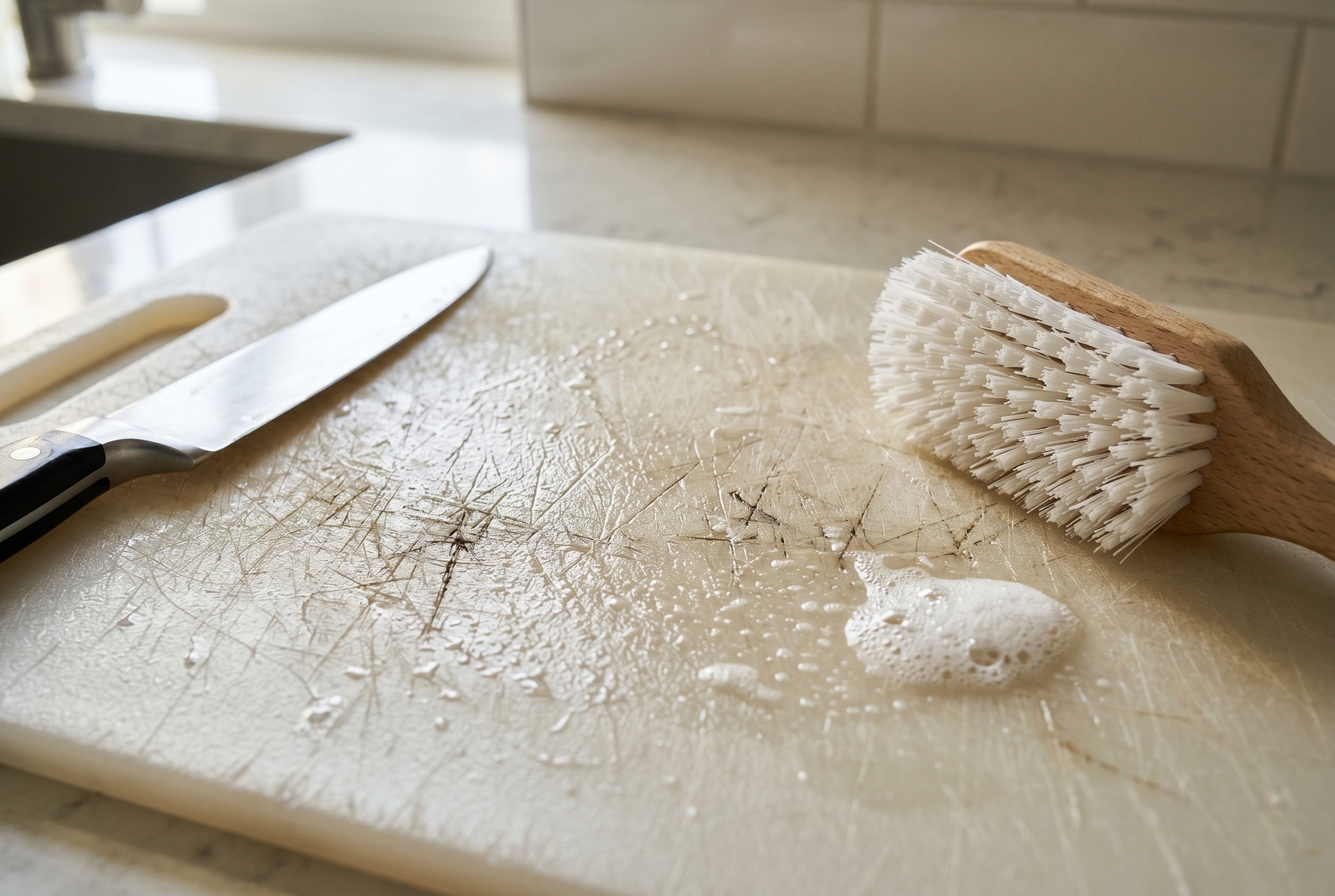
Plastic boards seem highly hygienic when brand new. Over time, knife cuts develop biofilms that are incredibly difficult to wash away.
Are Wooden Cutting Boards Hygienic?
The answer depends entirely on how you treat the board. In practice, it all comes down to drying. Wood is perfectly acceptable for raw meat and fish, provided the board dries quickly and receives regular maintenance. If you tend to abandon wet boards flat on the countertop, plastic is the better choice, as you can simply run it through the dishwasher.
The most reliable principle for a safe kitchen involves dedicating one board exclusively to raw animal products and another to fresh produce and cooked food. The material you choose for each becomes a secondary concern.
What a Damp Cloth Actually Does
Wiping a contaminated board with a damp cloth merely spreads the bacteria into a thin, even layer across the entire surface.
A kitchen sponge or cloth easily spreads bacteria, particularly if it remains perpetually damp and crumpled by the sink.
True sanitation relies on technique rather than scrubbing force. Genuine disinfection requires temperatures around 70°C (158°F) for more than just a few seconds. A standard home faucet rarely reaches this temperature. Water that hot burns the hands, yet it remains insufficient for true sterilization. Hot water effectively melts fat and dislodges food residue, which is crucial, but it does not equal disinfection.
How to Wash a Cutting Board Correctly
You must remove food residues immediately before they dry. If proteins bond to a wooden board, a bench scraper becomes necessary.
The next step involves washing the board with warm water, dish soap, and a stiff brush. Sponges are inadequate. A sponge glides over the surface, whereas a brush reaches down into the cuts. When cleaning wood, brushing along the grain rather than across it yields better results. Allowing the soap to sit and work for thirty seconds before rinsing makes a noticeable difference.
Finally, you must rinse the board and dry it quickly. Wooden boards should stand vertically to dry, rather than lying flat on a wet countertop.
The rule for dishwashers is straightforward. They generally sanitize plastic effectively but destroy wood. The steam in a dishwasher causes wood fibers to swell rapidly, followed by a harsh cooling cycle. Wood cannot handle these extreme temperature shifts. The board will warp, the end grain will develop cracks, and the entire block will eventually split or delaminate.
What Actually Works for Disinfecting a Cutting Board
Common household remedies like vinegar, hydrogen peroxide, and lemon yield varying results.
White vinegar (5%) acts as a helpful supplementary agent. Its acidic environment inhibits the reproduction of certain bacteria, but it does not replace a heavy-duty sanitizer.
Hydrogen peroxide (3%) delivers a stronger impact. You apply it to a freshly washed surface, let it sit for five to ten minutes, and then rinse it away. This treatment is highly appropriate for plastic boards after processing raw meat.
Coarse salt and lemon serve as an abrasive cleaner rather than a disinfectant. The friction does most of the heavy lifting here.
Chlorine bleach represents the most aggressive household option. For plastic boards, a mixture of about half a teaspoon of bleach per liter (33.8 fl oz) of water works well when left for a few minutes and thoroughly rinsed. Checking the label for exact dilution ratios is always recommended. Wood boards can only tolerate a very weak solution with minimal contact time; otherwise, the harsh chemicals will degrade the fibers.
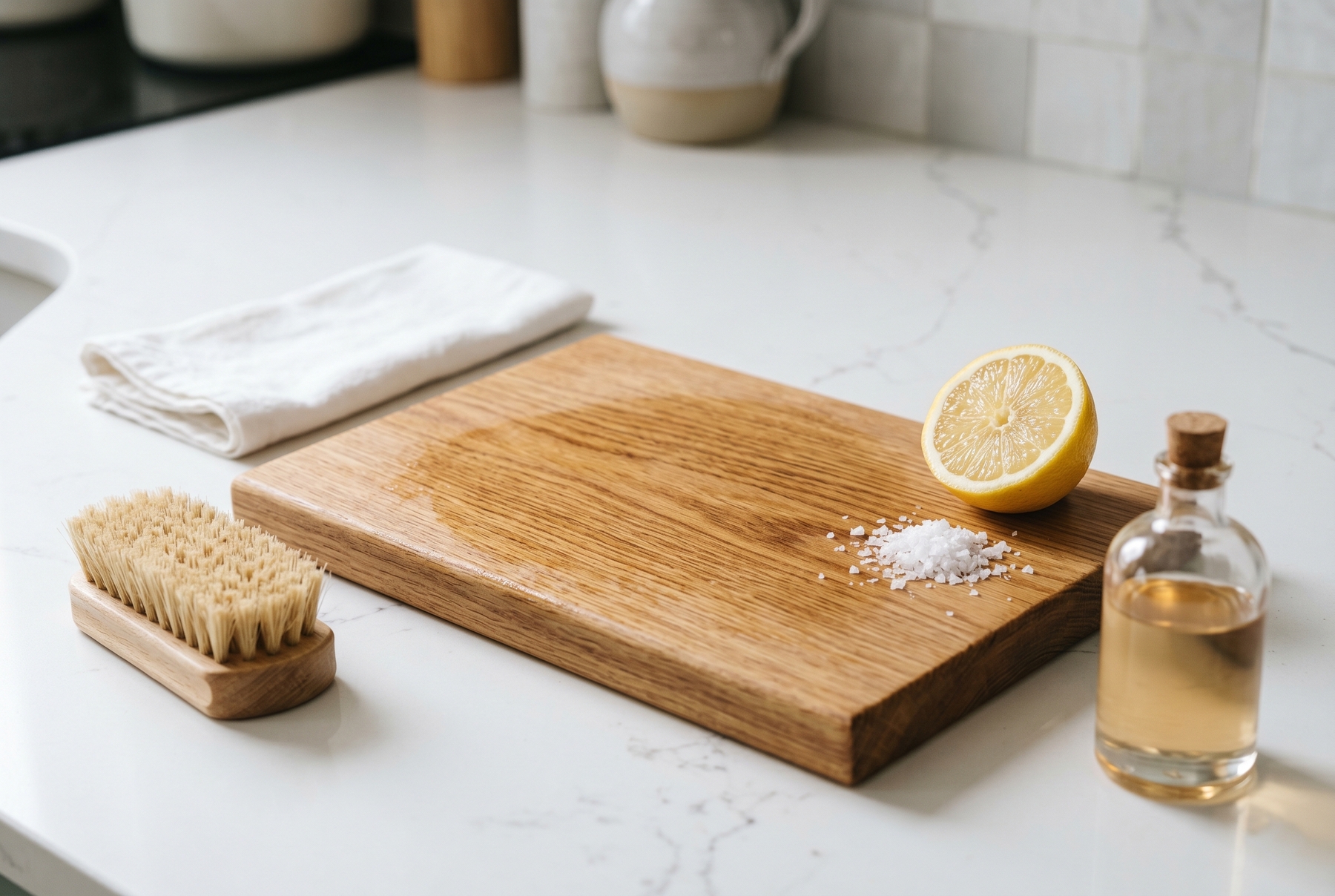
Coarse salt and lemon work effectively to scrub and refresh a wooden board. This method removes stains and prepares the surface for oiling.
Caring for a Wooden Cutting Board: Why and How to Oil It
Without proper maintenance, wood rapidly warps, splits at the ends, and absorbs lingering odors. Dry, unprotected wood fibers become as brittle as old paper.
Oiling the board solves this problem entirely. The oil saturates the fibers, creating a barrier that prevents water and meat juices from seeping inside. A well-oiled board is remarkably easier to wash and boasts a significantly longer lifespan.
Food-grade mineral oil remains the superior choice. It is odorless, will never go rancid, and is perfectly safe for food contact.
Linseed oil also performs well, as it hardens within the wood fibers over time. However, it takes quite a while to dry, and sourcing a purely food-grade version is essential.
Olive, sunflower, and coconut oils are strictly off-limits. Olive oil will turn rancid inside the wood within a month, leaving your cutting board reeking of spoiled fat.
Boards generally require oiling once a month, or whenever the wood appears dry and noticeably lighter in color.
How to Revive a Worn-Out Cutting Board
You can often restore a battered board, provided it lacks deep structural cracks.
Begin by scrubbing the surface vigorously with coarse salt and half a lemon. The salt strips away the top layer along with embedded grime, while the acidity helps bleach out stubborn stains. If the surface feels rough, smooth it down with medium-grit sandpaper (120 to 180 grit). Always sand strictly parallel to the grain.
Afterward, generously saturate the board with oil in two or three separate applications.
Myths About Indestructible Plastic
While plastic boards never require oiling, they demand much harsher scrubbing and frequent replacement.
Dishwashers generally benefit plastic boards. The high water temperatures significantly reduce the bacterial load. Chlorine bleaching also helps, provided you respect the proper concentration and contact time. Bleach lifts stains and neutralizes bacteria trapped deep within the score marks.
Ultimately, plastic boards must be replaced. Home cooks frequently ignore this crucial rule.
When to Throw Away a Cutting Board
Plastic boards display clear warning signs. Deep gouges, permanent dark staining inside the cuts, and persistent odors signal the end of their lifespan.
For wooden boards, watch out for separating fibers, deep structural cracks, severe warping, and stubborn smells that survive a thorough sanding.
Do not hesitate to discard an old board. A new cutting board costs far less than enduring a few days of food poisoning.
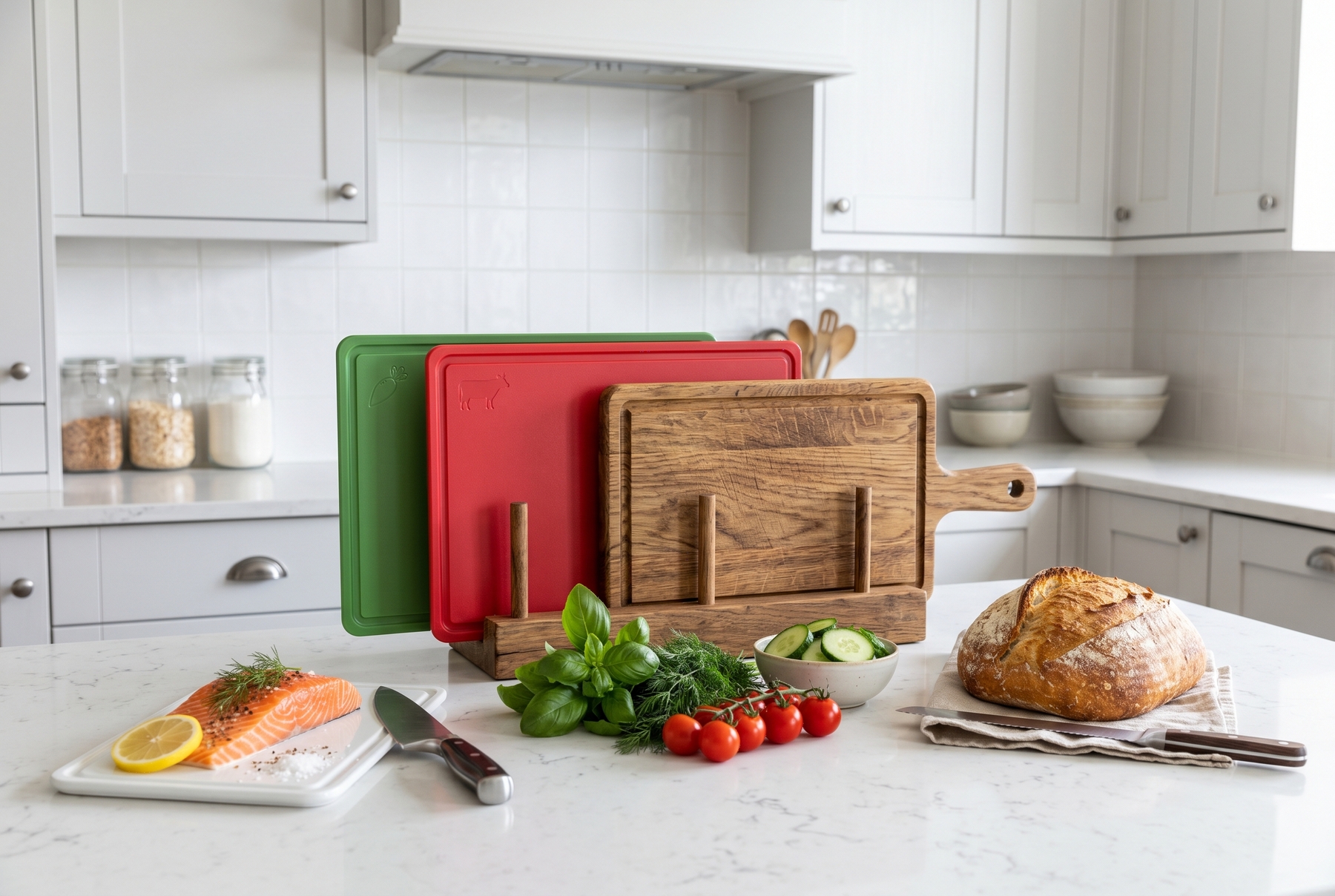
Using dedicated boards for different types of food prevents cross-contamination. Store them vertically to ensure optimal air circulation.
Separate Boards for Different Foods: Making It Work in a Small Kitchen
Using multiple boards is not about mere organization; it prevents transferring Salmonella from raw chicken to fresh heirloom tomatoes.
The absolute minimum setup for a home kitchen requires two boards. Dedicate one exclusively to raw meat and seafood, and use the other for everything else.
Color coding simplifies the process. A red board for meat and a green one for vegetables drastically reduce the chances of mixing them up.
Bread requires separate consideration. Crumbs and soft dough create a perfect breeding ground for mold. Ideally, your bread board should remain distinct and completely dry.
Storage Is Just as Important as Washing
A wooden board left lying flat on a wet countertop absorbs moisture from below while failing to dry on top. This is a direct path to mold. Storing the board vertically allows air to circulate freely on both sides.
Horizontal storage on a wet surface is equally undesirable for plastic. Water pools underneath and stagnates there for hours.
Tossing a wet board into a dark cabinet is a guaranteed way to cultivate fungus. Deprived of light and ventilation, wood will start blooming with mold in a matter of days. Leave the board upright on the counter against the wall to ensure proper airflow across all surfaces.
0 comments