
A holiday cake, a cream cheese frosting recipe from a trusted blog, and everything measured down to the gram. Yet, the frosting acts strangely: it either clumps up in the bowl, melts across the cake layers, feels excessively greasy, or refuses to hold a peak on a cupcake. In such moments, it is easy to blame oneself, the mixer, or the store-bought cheese. However, the problem often lies not in the execution, but in choosing the wrong base.
The term ‘cream cheese frosting’ encompasses several different variations. They behave differently in the bowl, on the cake, and in the refrigerator. The primary difference lies in the fat base: butter or heavy cream. Initially, the distinction seems minor: simply using butter instead of cream. In reality, these are two distinct bases meant for entirely different tasks. One provides stability and structure, while the other offers delicacy and lightness. One is ideal for cake architecture, and the other for pure flavor. Without understanding this difference, bakers can struggle endlessly with frosting a cake smoothly, using a cream that simply was not designed for the job.
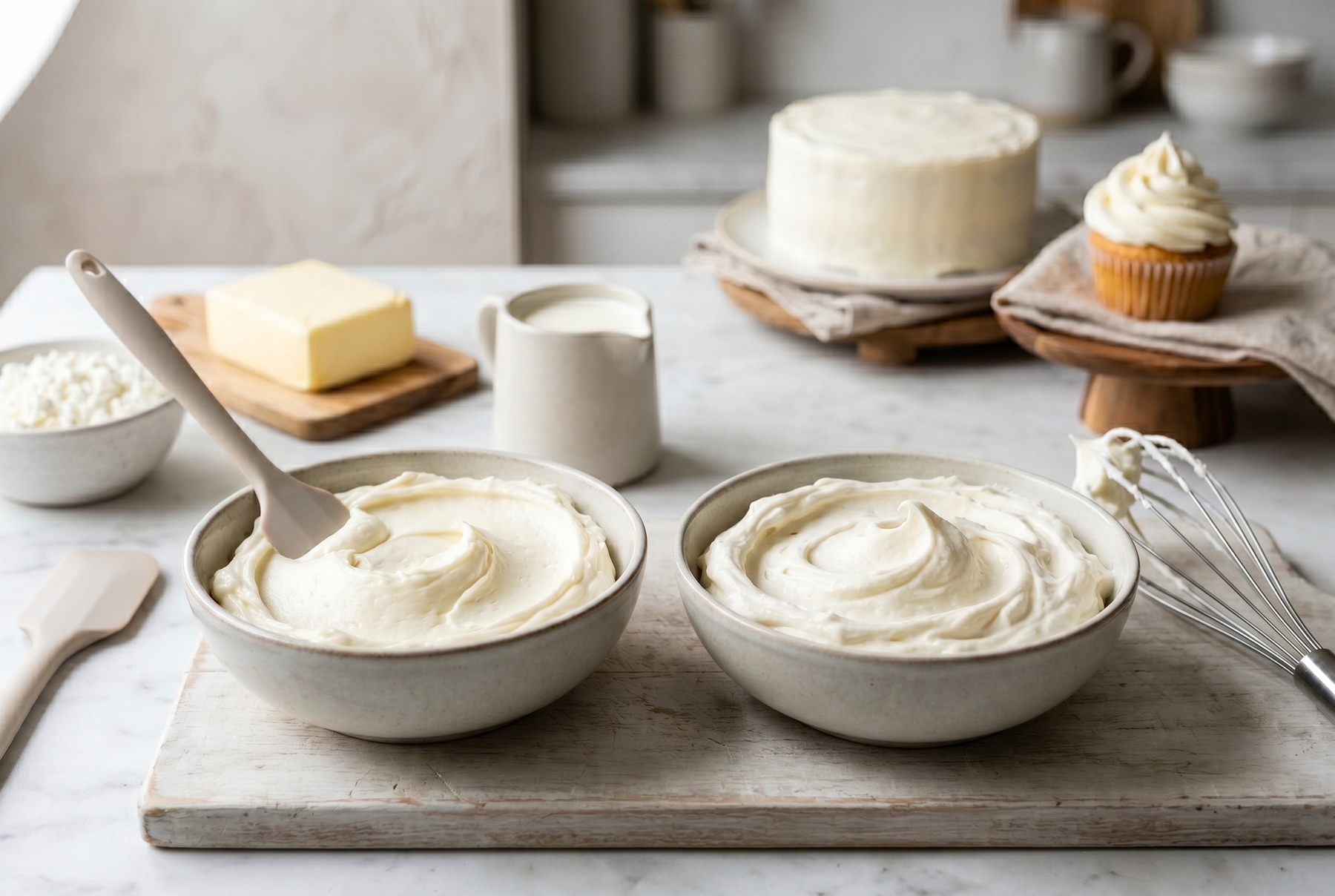
Butter-based vs. heavy cream cream cheese frosting: a visual breakdown of the bases for crafting the perfect dessert.
Table of Contents
- What Exactly Qualifies as Cream Cheese Frosting in Home Baking
- Butter-Based Cream Cheese Frosting: When Structure and Sharp Edges Matter
- Heavy Cream Cream Cheese Frosting: For Soft Fillings and Light Decorations
- Key Differences in Application: Choosing the Right Tool for the Job
- Side-by-Side Comparison
- Proportions: Why Results Vary Wildly
- Common Mistakes and How to Fix Them
- Choosing the Right Frosting for Your Specific Task
- Can You Mix Butter and Heavy Cream Together?
- Pre-Bake Checklist
- Proper Storage for Frosting and Finished Desserts
- The Final Logic: Which Frosting to Choose
What Exactly Qualifies as Cream Cheese Frosting in Home Baking
The Base: Cream Cheese Plus Fat and Sugar
In home baking recipes, cream cheese frosting typically refers to a mixture based on soft, spreadable cream cheese combined with a fat base: either butter or whipped heavy cream. The terminology can be confusing: ‘cream cheese’ can refer to both the product itself and the finished dessert frosting. The focus here is strictly on the finished frosting.
Professional pastry kitchens utilize dozens of variations and strict classifications. In a home kitchen, the approach is simpler: plain cream cheese, powdered sugar, and a fat base—either butter or heavy cream. From there, the outcome depends entirely on the temperature of the ingredients and the fat content of the base.
The Roles of Cheese, Butter, and Cream
The primary density and signature tang come from the cream cheese: it provides a cultured dairy flavor, a subtle salty note, and the necessary balance for the sugar. Without the cheese, the result would merely be standard buttercream or whipped cream.
Butter and heavy cream dictate the density, airiness, and how reliably the frosting holds its shape. Using 82.5% butter firms up the frosting, helping it hold its shape better than heavy cream versions at room temperature. Heavy whipping cream (33–35% fat) adds volume and softness but requires cold temperatures and brief whipping. The choice depends entirely on the task: achieving sharp edges on a cake, holding a tall swirl, or creating a soft, luscious filling.
Butter-Based Cream Cheese Frosting: When Structure and Sharp Edges Matter
How the Butter Base Works
In the refrigerator, butter firms up and sets the frosting. In warmer environments, it softens, but a butter-based frosting loses its shape much more slowly than a cream-based one. As a result, butter-based cream cheese frosting holds its form durably and predictably. It is ideal for masking cakes, creating piped decorations, topping cupcakes, and finishing desserts that will sit on a display table or travel in a car.
The goal in the mixing bowl is to form an emulsion: butter, cheese, and a bit of moisture from the cheese blend into a smooth, homogenous mass. When the ingredients are at roughly the same temperature, the frosting comes together seamlessly. If the butter is cold while the cheese is warm, the mixture may split or become lumpy.
Basic Proportions for 500–600 g (1.1–1.3 lb) of Frosting:
- Cream cheese — 300 g (10.5 oz)
- Butter (82.5% fat) — 120 g (4.2 oz)
- Powdered sugar — 80–100 g (2.8–3.5 oz)
These proportions yield a medium-density frosting that holds well on a spatula without sliding off. For tall cakes or intricate piping work, the butter content can be increased to 150 g (5.3 oz). To achieve a slightly lighter texture, it can be reduced to 100 g (3.5 oz), though the frosting will become much softer.
Flavor and Texture: Dense, Silky, and Rich
A properly emulsified butter-based frosting is smooth, pliable, and free of graininess. It holds its shape perfectly on a spatula, does not drip, and maintains crisp lines from piping tips. The butter is more prominent on the palate, and the overall texture feels significantly denser than the heavy cream alternative. If too much butter is used, the frosting mimics heavy commercial fillings: smooth and sweet, but with a heavy, greasy aftertaste. It lacks airiness, though it never quite reaches the density of a ganache. It glides smoothly under an offset spatula, but the sheer density is immediately apparent.
Graininess occurs when the butter is insufficiently softened, when granulated sugar is used instead of powdered sugar, or due to over-mixing. If the frosting tastes overly greasy, the butter ratio might be too high, or the frosting layer on the cake could simply be too thick.
Where Butter-Based Frosting is Indispensable
Under a bench scraper, it behaves much more predictably than standard buttercream: it applies more evenly and slumps much more slowly. For tall cakes requiring sharp edges, this remains the most reliable option for home bakers.
It also excels for beautifully piped cupcake swirls. The frosting easily maintains the shape of a piped rose or star in a moderately cool room.
In carrot cakes, red velvet creations, and dense chocolate sponges, butter-based frosting refuses to collapse under the heavy weight of the cake layers.
For takeout desserts and cakes that need to withstand several hours on a display table, the butter-based version is the superior choice.
Where Butter-Based Frosting Falls Short
It can feel overwhelmingly heavy when paired with delicate sponge cakes or light berry desserts. A thick layer of butter easily overpowers the nuanced flavors of fresh berries, citrus, or a tender genoise sponge.
Temperature plays a critical role with butter-based frosting: cold butter refuses to whip properly, while overheated butter results in a soupy mess. Allowing the butter to soften naturally at room temperature is crucial; placing it on a radiator or microwaving it leads to poor results.
If a cake covered in this frosting is left in a hot environment, it eventually softens and loses shape, albeit not as rapidly as a cream-based frosting. Straight out of the refrigerator, the frosting turns excessively hard: allowing it to rest briefly at room temperature helps the butter soften for a better eating experience.
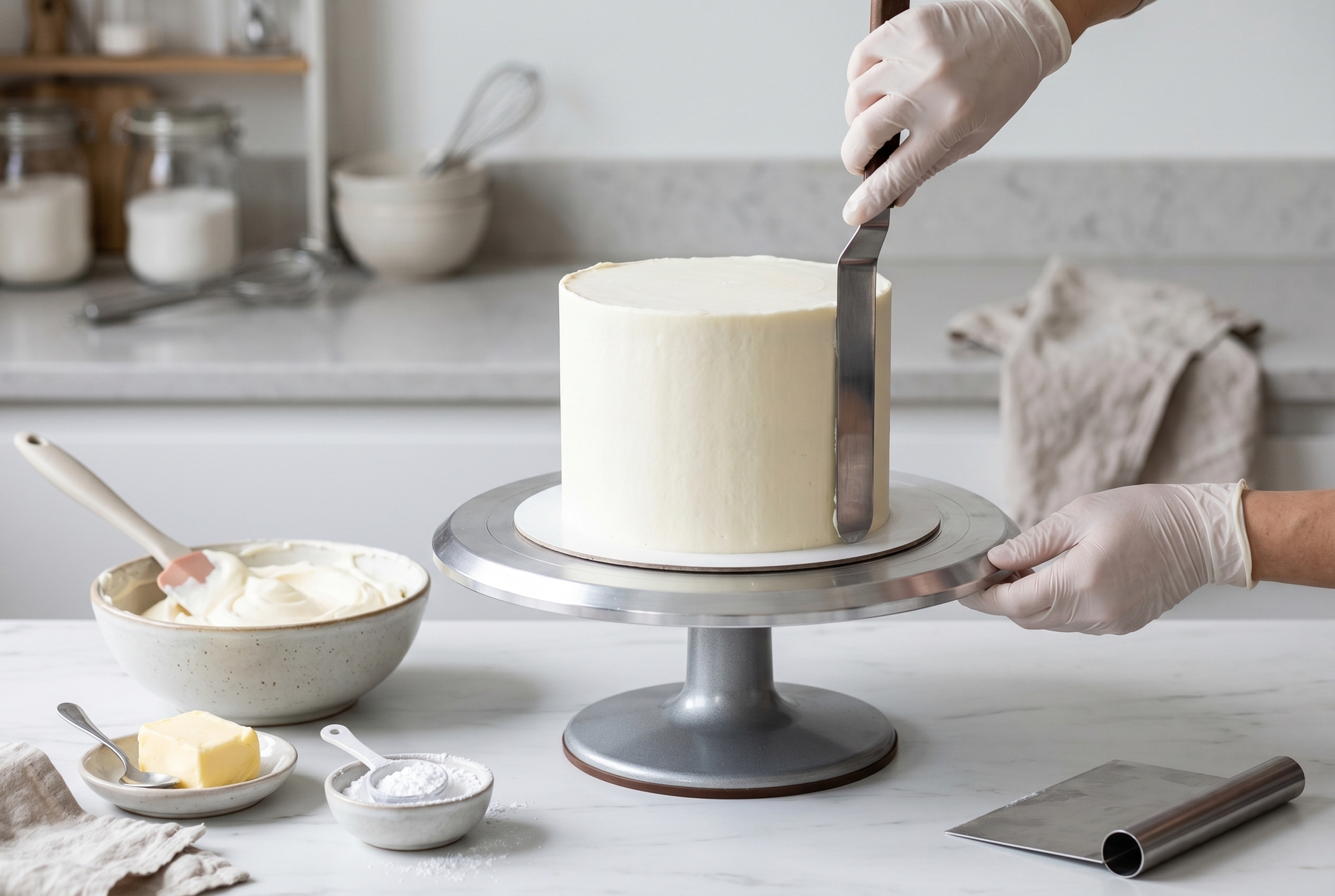
Butter-based cream cheese frosting remains the ultimate choice for masking cakes, as it perfectly holds its shape and creates razor-sharp edges.
Heavy Cream Cream Cheese Frosting: For Soft Fillings and Light Decorations
How Heavy Cream Works
Heavy cream whips into a foam, trapping air and fat together. When combined with cream cheese, it creates a much softer and more voluminous frosting. It is considerably more delicate than the butter variation: it deflates faster in warm environments and struggles to hold sharp edges. However, it maintains its integrity perfectly in the refrigerator, provided the cream has high fat content and the cheese is dense. For cake fillings, trifles, cake rolls, and soft, rustic decorations, this level of stability is more than sufficient.
Fat content and temperature are crucial when working with heavy cream. Heavy whipping cream containing 33–35% fat is the best choice, as this fat ratio holds the foam structure noticeably better. Cream with 30–32% fat may whip up, but the resulting frosting will be softer and less stable. Anything below 30% fat is generally unsuitable for this type of frosting. Cold cream whips rapidly and stably, whereas warm cream frequently turns into a runny mess. The cheese must also be thoroughly chilled. Timing is equally important: over-whipped cream introduces a grainy texture, while under-whipped cream fails to hold its shape.
Basic Proportions for 500–600 g (1.1–1.3 lb) of Frosting:
-
- Cream cheese — 250 g (8.8 oz)
- Heavy whipping cream (33–35%) — 250 ml (8.5 fl oz)
- Powdered sugar — 80–100 g (2.8–3.5 oz)
Equal parts of cheese and cream yield a medium-density frosting—stable enough for filling cakes, but noticeably softer than a butter base. To achieve a firmer frosting (for instance, for cupcakes), the cheese can be increased to 300 g (10.5 oz) and the cream reduced to 200 ml (6.8 fl oz). For an incredibly light trifle layer, using 300 ml (10 fl oz) of cream works beautifully, though the frosting will become quite delicate.
Flavor and Texture: Softer, Creamier, and Lighter
Heavy cream-based frosting spreads effortlessly across cake layers and provides a delicate mouthfeel. It lacks any greasy sensation, leaning instead toward a pure, milky creaminess. It pairs exquisitely with fresh berries, honey, citrus fruits, and airy sponge cakes. The flavors of the cake layers and fillings shine through beautifully.
It holds a soft peak and stays reliably on a spatula, yet remains incredibly pliable. Piped onto a cupcake, it will not yield the crisp, defined lines of a butter rose, but the resulting swirl feels delightfully soft.
Where Heavy Cream Frosting Shines
It excels in classic Medovik (Russian honey cake), berry sponge cakes, and ‘Molochnaya Devochka’ (Milk Girl cake): desserts where softness and moisture matter far more than rigid architectural structure.
It works beautifully for cupcakes intended for immediate serving: it settles into a soft, inviting swirl, though it will not survive long in a warm room.
It is perfectly at home in dessert cups, trifles, cake rolls, and éclairs, where a soft, luscious filling is prioritized over defined piping.
It also suits rustic cakes lacking complex decorations, where flawless edge-masking is unnecessary or applied in a ‘naked cake’ style, with the bulk of the frosting remaining safely tucked between the layers.
Where Cream-Based Frosting Can Fail
In a warm room or on a summer dining table, this frosting softens very rapidly. It will not melt instantly, but the crisp edges will begin to slump.
It remains a risky choice for extended transportation or long waiting periods. If a cake must travel in a warm car for an hour, the butter-based version is the smarter alternative.
If over-mixed, the heavy cream begins to churn into butter, causing the frosting to become grainy and lose its smooth appeal.
Using cream with less than 30% fat or an overly watery cheese prevents the frosting from whipping properly, leaving it unworkably soft.
Masking a tall cake with a thick layer of this soft frosting is inadvisable: the layer will stretch behind the bench scraper and eventually slide down.
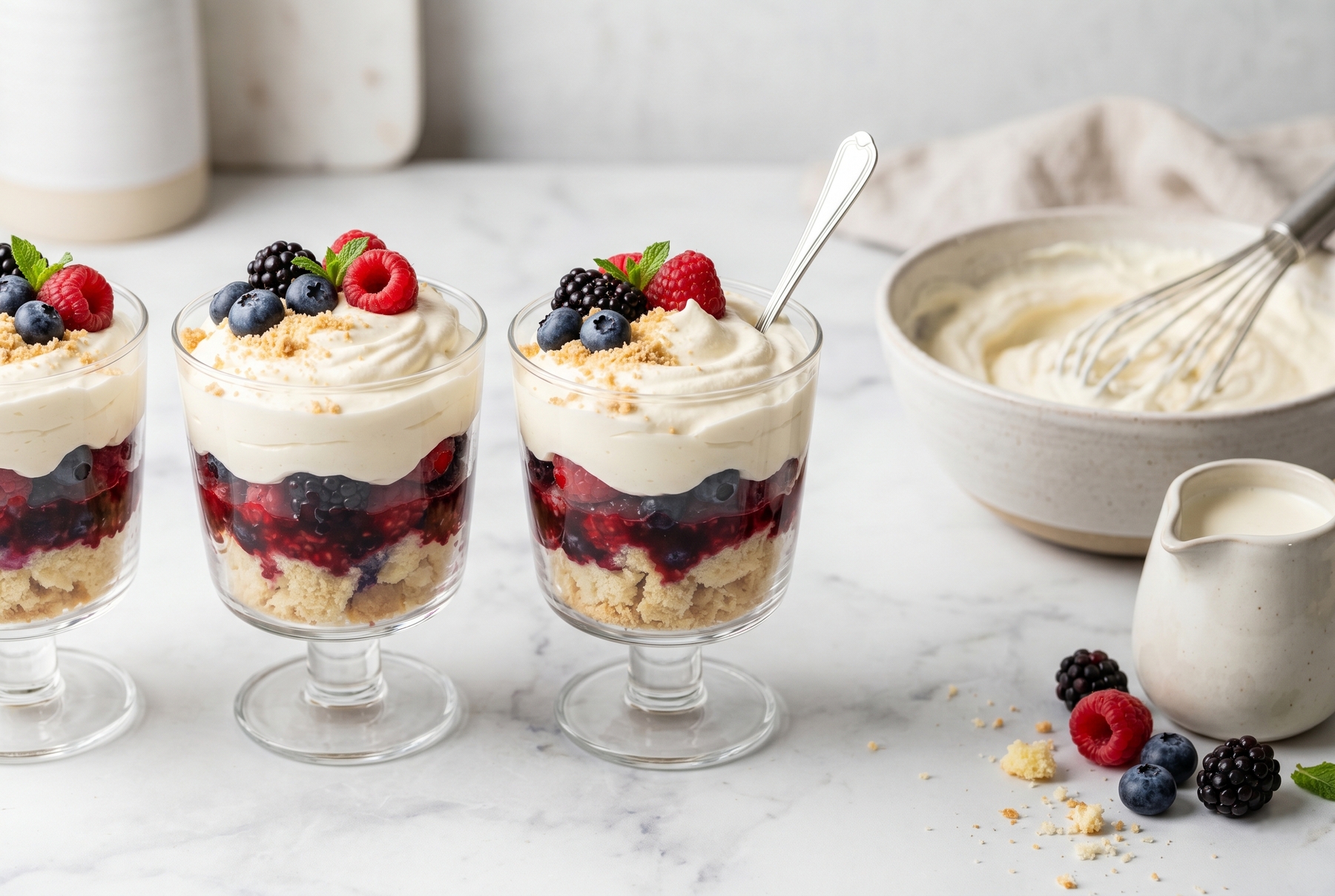
For delicate desserts like trifles, heavy cream cream cheese frosting is absolutely ideal due to its airy lightness and melting texture.
Key Differences in Application: Choosing the Right Tool for the Job
Stability and Resting Time
Butter-based frosting holds its structure significantly longer and more reliably. It easily survives cake assembly, intricate decorating, and several hours on a display table without noticeable slumping. Absolute invincibility, however, does not exist: ambient temperature, ingredient quality, and precise ratios ultimately dictate success.
Heavy cream frosting is much more sensitive to heat and time. It maintains its shape flawlessly in the refrigerator but softens much faster at room temperature.
Lightness and Mouthfeel
Cream-based frosting feels inherently lighter on the palate, despite containing a substantial amount of fat. The trapped air within the whipped cream provides volume and softness. Butter-based frosting is considerably denser and leaves a richer, lingering aftertaste.
Caloric content is not the primary deciding factor here. The focus is entirely on how the frosting feels within the finished cake. In a Medovik (honey cake), the cream-based frosting imparts moisture and softness, while the butter version provides dense, striking contrast.
Pliability and Ease of Use
Butter-based frosting glides more seamlessly under an offset spatula: it applies evenly and yields a flawlessly smooth finish with minimal effort.
Cream-based frosting acts less like a sculpting medium. It is much more pleasant to spread between cake layers with a spoon or a spatula, but using it to achieve sharp, flawless edges on a tall cake is a task reserved for seasoned pastry chefs, rather than beginners.
Pairing Frosting Types with Desserts
Butter-based: dense sponges, carrot cakes, red velvet, rich chocolate layers, and robustly structured cupcakes.
Heavy cream-based: Medovik (honey cake), delicate chiffon sponges, fresh berry fillings, trifles, ‘Molochnaya Devochka’, and Swiss rolls.
Strict rules do not apply here, but the logic remains straightforward: identify the task first, then select the frosting base. Understanding the desired effect is crucial—whether the priority is rigid structure or melting tenderness, steadfast stability or airy lightness.
Side-by-Side Comparison
| Criteria | Butter-Based | Heavy Cream-Based |
|---|---|---|
| Flavor | Rich, buttery, and dense | Light, milky, and less rich |
| Density | Dense, pliable, holds shape perfectly | Soft, airy, holds piping lines poorly |
| Stability | High, withstands warmth and time better | Moderate, requires refrigeration and quick serving |
| Decorating | Excellent for sharp piping, roses, and smooth masking | Best for rustic finishes, unsuitable for sharp designs |
| Filling Layers | Dense, stable, prevents layers from shifting | Delicate, moist, spreads effortlessly |
| Cake Masking (Smoothing) | Convenient and highly predictable | Difficult, requires advanced skill |
| Heat & Transport | Handles challenges well | Highly risky |
| Preparation Difficulty | Requires exact butter temperatures | Requires precise, careful whipping of cream |
| Common Errors | Splitting, graininess, excessive greasiness | Over-whipping into butter, excessive softness, instability |
| Best Applications | Masking, cupcakes, detailed piping, transportation | Fillings, delicate desserts, trifles, immediate serving |
Proportions: Why Results Vary Wildly
Balancing Fat and Cheese
More butter results in a denser frosting with superior stability, though the flavor profile becomes heavier and richer. Less butter yields a lighter mouthfeel but risks compromising structural integrity.
Increasing the heavy cream introduces more air, but compromises the frosting’s ability to hold a shape. Decreasing the cream makes the mixture denser, completely defeating the purpose of choosing a light cream base in the first place.
A single definitive recipe does not exist. The process relies heavily on a logic of balance: flawless cake masking requires a higher ratio of butter, while a light, airy filling demands more heavy cream and slightly less cheese. The recipe merely serves as a starting point, completely adaptable to the task at hand.
Butter-Based Variations by Task:
For Flawless Masking and Intricate Piping:
- Cream cheese — 300 g (10.5 oz)
- Butter — 150 g (5.3 oz)
- Powdered sugar — 100 g (3.5 oz)
For Fillings and Moderate Stability:
- Cream cheese — 300 g (10.5 oz)
- Butter — 120 g (4.2 oz)
- Powdered sugar — 80 g (2.8 oz)
For a Lighter Flavor Profile:
- Cream cheese — 300 g (10.5 oz)
- Butter — 100 g (3.5 oz)
- Powdered sugar — 80 g (2.8 oz)
Heavy Cream Variations by Task:
For Stable Cupcakes and Dense Fillings:
- Cream cheese — 300 g (10.5 oz)
- Heavy whipping cream (33–35%) — 200 ml (6.8 fl oz)
- Powdered sugar — 100 g (3.5 oz)
For Fillings Without Complex Decor:
- Cream cheese — 250 g (8.8 oz)
- Heavy whipping cream (33–35%) — 250 ml (8.5 fl oz)
- Powdered sugar — 80 g (2.8 oz)
For Light Desserts and Trifles:
- Cream cheese — 200 g (7 oz)
- Heavy whipping cream (33–35%) — 300 ml (10 fl oz)
- Powdered sugar — 80 g (2.8 oz)
The Role of Powdered Sugar
Powdered sugar significantly impacts flavor, smoothness, and, to a lesser extent, texture. Adding too much turns the frosting cloyingly sweet, completely masking the signature tang of the cheese. Using too little leaves it tasting decidedly bland. Granulated sugar is strictly forbidden here: it fails to dissolve completely, resulting in an unpleasant, gritty texture.
Gradually folding in the powdered sugar while tasting frequently is the best approach. Stopping the moment the sweetness balances out, rather than overpowers, the sharp tang of the cream cheese is key.
Why Temperature and Fat Content Matter
For butter-based frosting, the butter must be softened to room temperature but never melted. The cream cheese should ideally be cool or only briefly rested outside the refrigerator: it should not feel like an icy block, nor should it reach room temperature. The critical factors are using a dense cream cheese entirely free of separated whey, and keeping the whipping time short once the cheese is incorporated.
For heavy cream frosting, both the cheese and the cream must be extremely cold. The cream must contain 33–35% fat, otherwise, a stable foam will simply fail to form. Warm cream refuses to whip, instantly turning into a loose, unstable mess.
Fat content is always stated on the packaging. Creams labeled ‘for whipping’ or ‘heavy whipping cream’ generally fall into the 33–36% range. Anything falling below 30% fat is strictly unsuitable for this type of frosting.
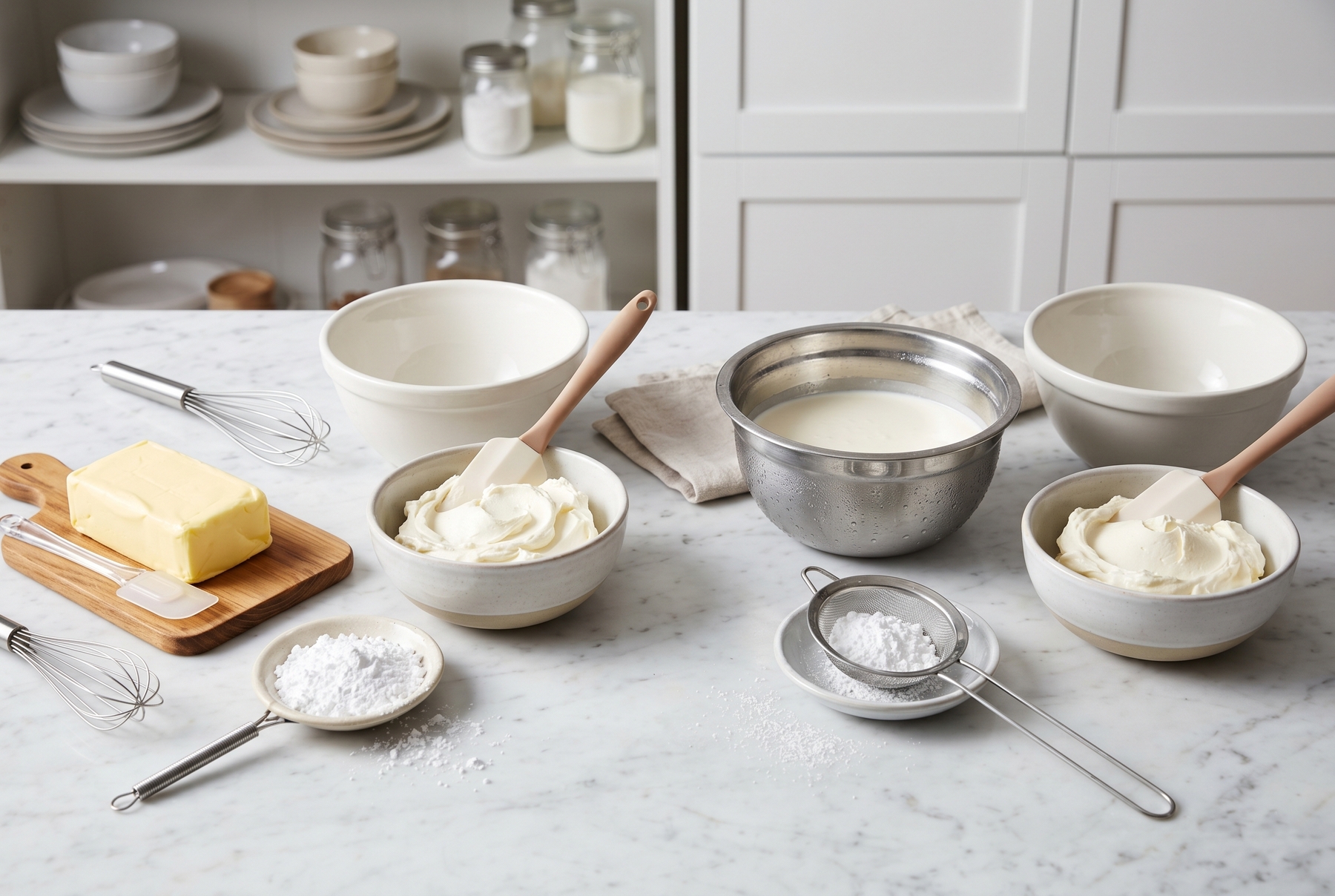
The quality and precise temperature of the ingredients directly dictate the stability and flavor profile of the finished cream cheese frosting.
Common Mistakes and How to Fix Them
The Frosting Separated
Causes: Mixing ingredients of varying temperatures, combining components too quickly, over-mixing, using excessively watery cheese, or working in a hot kitchen.
For Butter-Based Frosting: Warming the mixing bowl very briefly over a double boiler for a few seconds, vigorously whipping the mixture, and then chilling it often works. If this fails, repurposing the frosting as an internal cake filling is best; it is no longer suitable for exterior masking.
For Heavy Cream Frosting: Chilling the mixing bowl and carefully continuing to whip with a cold whisk is the best approach. If the mixture has completely disintegrated, the heavy cream has likely churned into butter, and the frosting is practically impossible to salvage.
The Frosting Turned Out Runny
Causes: The heavy cream lacked sufficient fat or was too warm, the ingredients were improperly chilled, an excess of liquid flavorings (juice or purees) was added, or the cream cheese had a high moisture content.
What to Do: Chilling the frosting in the refrigerator for 20–30 minutes, then carefully whipping it again helps. If it remains loose, utilizing the frosting for trifles, internal cake fillings, or cup desserts is wise, strictly avoiding it for masking.
The Frosting is Grainy or Gritty
Causes: Using granulated sugar instead of powdered sugar, incorporating cold butter, over-whipping heavy cream, or failing to establish a proper emulsion.
What to Do: If the grit stems from granulated sugar, fixing the texture completely is impossible—relegating this frosting to internal cake layers is best. If unsifted powdered sugar caused lumps, letting the frosting rest briefly before gently mixing can help. If cold butter formed clumps, slightly warming the bowl and whipping again resolves the issue. If the heavy cream was over-whipped, starting over is the only solution.
The Frosting Tastes Excessively Greasy
What to Do: Applying a thinner layer of frosting to the cake, incorporating a tart berry compote between the layers, opting for lighter sponge cakes, introducing an acidic element (like lemon juice or fruit puree) to cut the richness, and definitively reducing the butter ratio for the next batch are all effective strategies.
Choosing the Right Frosting for Your Specific Task
For Masking and Smoothing a Cake
Butter-based cream cheese frosting acts predictably. A thick layer is unnecessary: a thin coating easily traps crumbs and achieves a flawless, sharp edge. Utilizing a bench scraper and ensuring the cake is properly chilled between coats yields professional results. Attempting to mask a tall cake with soft, heavy cream-based frosting is an exercise in futility: the soft frosting will pull behind the scraper and eventually slump.
For Filling Cake Layers
Both variations work splendidly. The butter base provides density, stability, and crucial support for heavy layers. The heavy cream base adds delicacy, lightness, and essential moisture. The decision depends entirely on the cake sponge: dense cakes demand a butter frosting, while delicate Medoviks (honey cakes) pair beautifully with a heavy cream filling.
For Cupcakes
When a towering, sharply defined swirl needs to withstand hours on a display table, choosing the butter base is optimal. When serving immediately and prioritizing mouthfeel, the heavy cream base works wonderfully. In hot environments without refrigeration, the butter base remains the only reliable choice.
For Berry Desserts and Trifles
Heavy cream frosting easily wins here. It beautifully complements rather than overpowers fresh berries, provides a luscious milky base, and looks visually stunning layered inside transparent dessert cups.
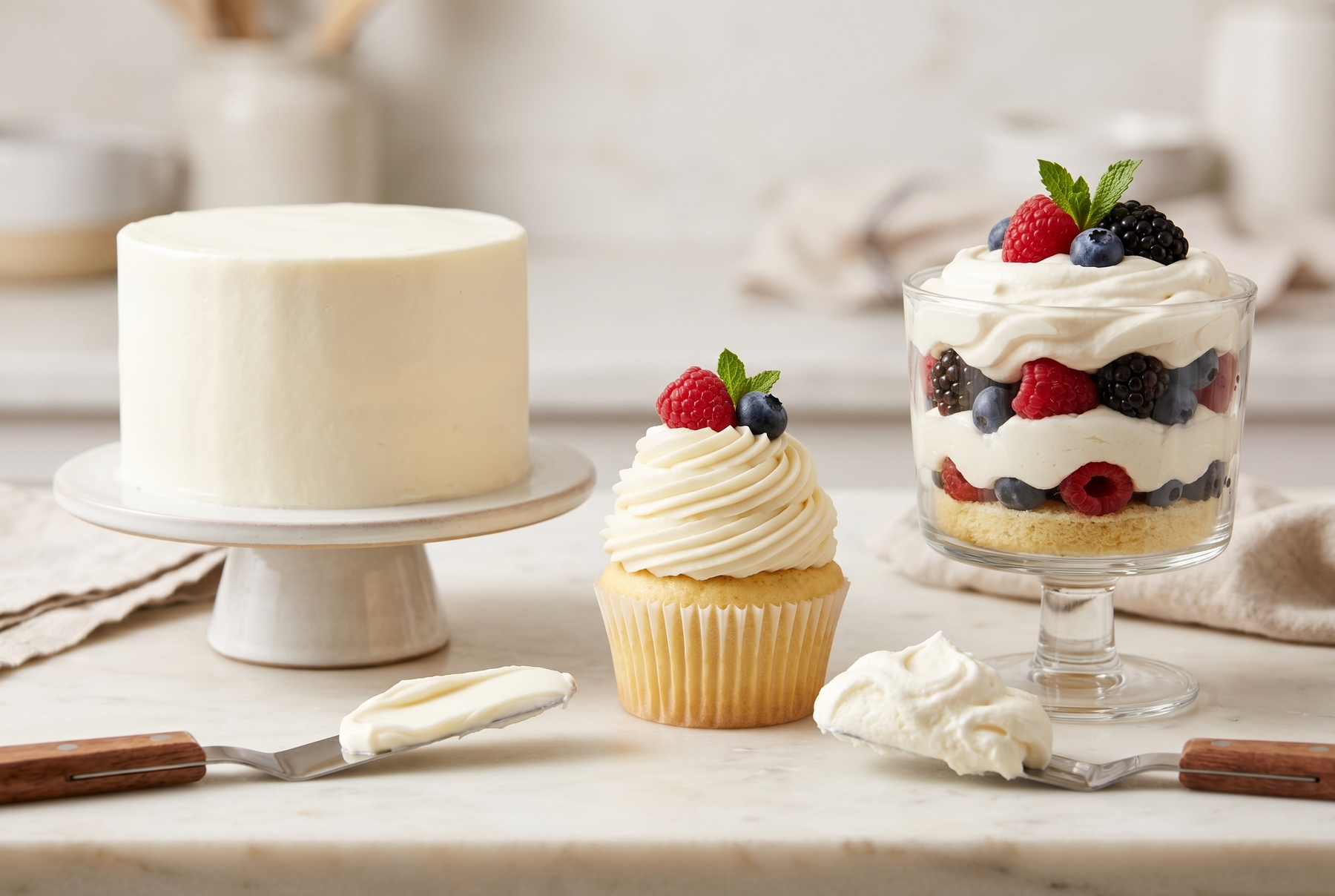
Choosing between butter and heavy cream depends entirely on the dessert type: cupcakes demand rigid stability, whereas trifles require melting softness.
Can You Mix Butter and Heavy Cream Together?
Why Create a Hybrid?
Hybrid recipes incorporate butter for structural integrity and heavy cream for a softer, more delicate texture. In theory, this works brilliantly: a portion of butter dictates the shape, while a splash of cream introduces lightness. Practically, it demands absolute precision regarding the order of incorporation, temperature, and specific ratios. Mistakes happen easily: the frosting often splits due to temperature shock or excessive whipping.
When a Hybrid Makes Sense
A hybrid is justified when a medium-density frosting is required: something not quite as rigid as a pure butter base, yet significantly more stable than a pure cream one. It works exceptionally well as a filling for cakes requiring a few hours of display time.
A Hybrid Variation:
- Cream cheese — 300 g (10.5 oz)
- Butter — 80 g (2.8 oz)
- Heavy whipping cream (33–35%) — 150 ml (5 fl oz)
- Powdered sugar — 100 g (3.5 oz)
Beginning by creaming the butter and sugar together, incorporating the cream cheese, and finally, gently folding in the heavy cream, which must be whipped separately, ensures the best texture.
When It Is Better Not to Overcomplicate
When a flawlessly stable exterior is the goal, abandoning the pursuit of airiness and sticking to a pure butter base is wise. When a feather-light dessert is desired, avoiding butter entirely and opting for pure heavy cream is best. Sometimes the best ‘hybrid’ is not a mixed frosting at all, but simply making an honest, decisive choice based on the dessert’s exact needs.
Pre-Bake Checklist
Ingredients:
- Plain cream cheese: Ensure it is dense, completely free of separated whey, and not watery. (If a label specifies 60–70% fat, this usually denotes fat in dry matter; nutritionally, this translates to roughly 20–30 g (0.7–1 oz) of fat per 100 g (3.5 oz) portion).
- Butter (82.5% fat), softened to room temperature but never melted (strictly for butter-based frosting).
- Heavy whipping cream (33–35% fat), thoroughly chilled (strictly for cream-based frosting).
- Powdered sugar, carefully sifted and entirely free of lumps.
Equipment:
- A hand mixer fitted with whisk attachments or a stand mixer.
- A chilled metal or glass mixing bowl (essential for heavy cream frosting).
- A sturdy silicone spatula for checking consistency.
The Process:
- Whipping at a moderate speed ensures the frosting never overheats.
- Halting the mixing process the exact moment the frosting holds its shape firmly on a spatula without dripping is critical.
- For butter-based: Creaming the butter and sugar first, then gradually incorporating the chilled cream cheese in small batches yields the best results.
- For cream-based: Whipping the cold heavy cream to soft peaks, introducing the cream cheese and sugar, and whipping briefly until reliably stable creates perfect consistency.
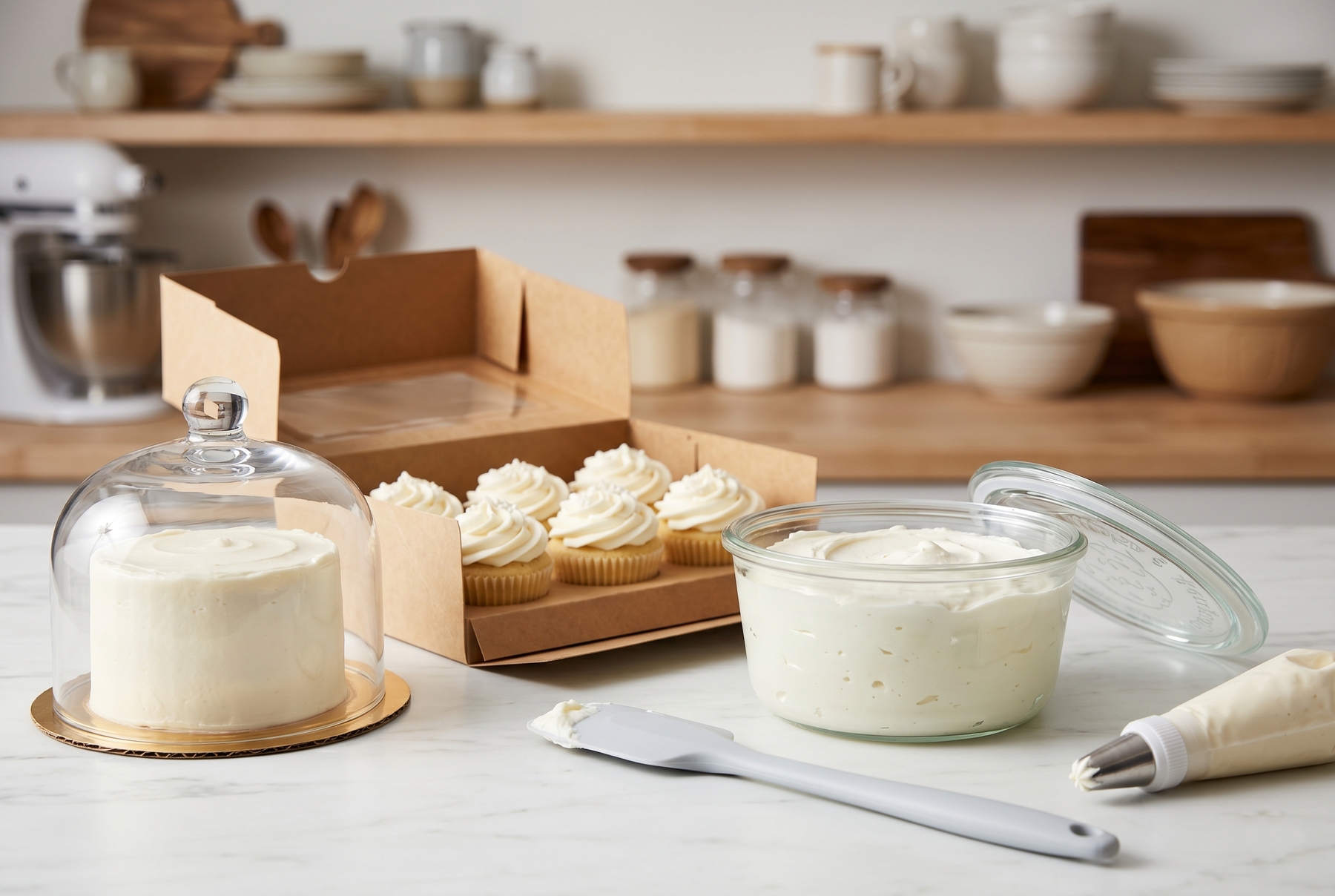
Finished desserts topped with cream cheese frosting require strict refrigeration to maintain both freshness and structural integrity.
Proper Storage for Frosting and Finished Desserts
Whether based on butter or heavy cream, cream cheese frosting remains a perishable dairy product requiring strict refrigeration. Stored in an airtight container in the refrigerator, the frosting safely lasts 2 to 3 days. A finished, frosted cake must also be refrigerated and ideally consumed within 2 days.
High ambient temperatures, prolonged periods on a display table, and unsterilized tools severely diminish shelf life. Discarding any leftovers if the frosting has sat out in a warm room for several hours is much safer than risking foodborne illness.
Freezing cream cheese frosting is highly discouraged: the thawing process irrevocably alters the delicate texture, frequently causing the emulsion to split entirely.
The Final Logic: Which Frosting to Choose
Opting for the butter base is best when prioritizing structure, flawless stability, sharp geometric edges, intricate piping, masking, transportation, or long display periods.
Selecting the heavy cream base is ideal when prioritizing melting tenderness, airy lightness, soft internal layers, pairings with fresh berries, immediate serving, and when pure flavor effortlessly trumps structural rigidity.
Determining the primary task first—whether the frosting needs to hold a razor-sharp edge under a bench scraper, or simply melt luxuriously between tender cake layers—makes the decision obvious.
0 comments