
Food does not carry a passport. Yet diners gladly issue one: simply printing “Singaporean,” “Hawaiian,” “German,” or “Californian” on a menu immediately pins a dish to a mental map. Sometimes that pin lands in the right spot. Other times, it misses by thousands of kilometers (miles). Occasionally, the question “where was this invented?” fails entirely because the dish migrated alongside people, adapting to new ingredients, different palates, and an evolving biography.
A salad bearing an Italian name originated in a Mexican border town just south of the United States. Pineapple-topped pizza emerged in Ontario. Stir-fried rice vermicelli billed as “Singapore noodles” owes its fame to Cantonese chefs rather than Singapore. And in German chocolate cake, the name refers to a baker’s surname rather than a European nation.
A single dish can trace its conceptual roots to one homeland, its modern form to a second, and its mainstream popularity to a third—which is why the origin of famous foods rarely boils down to a single dot on a map.
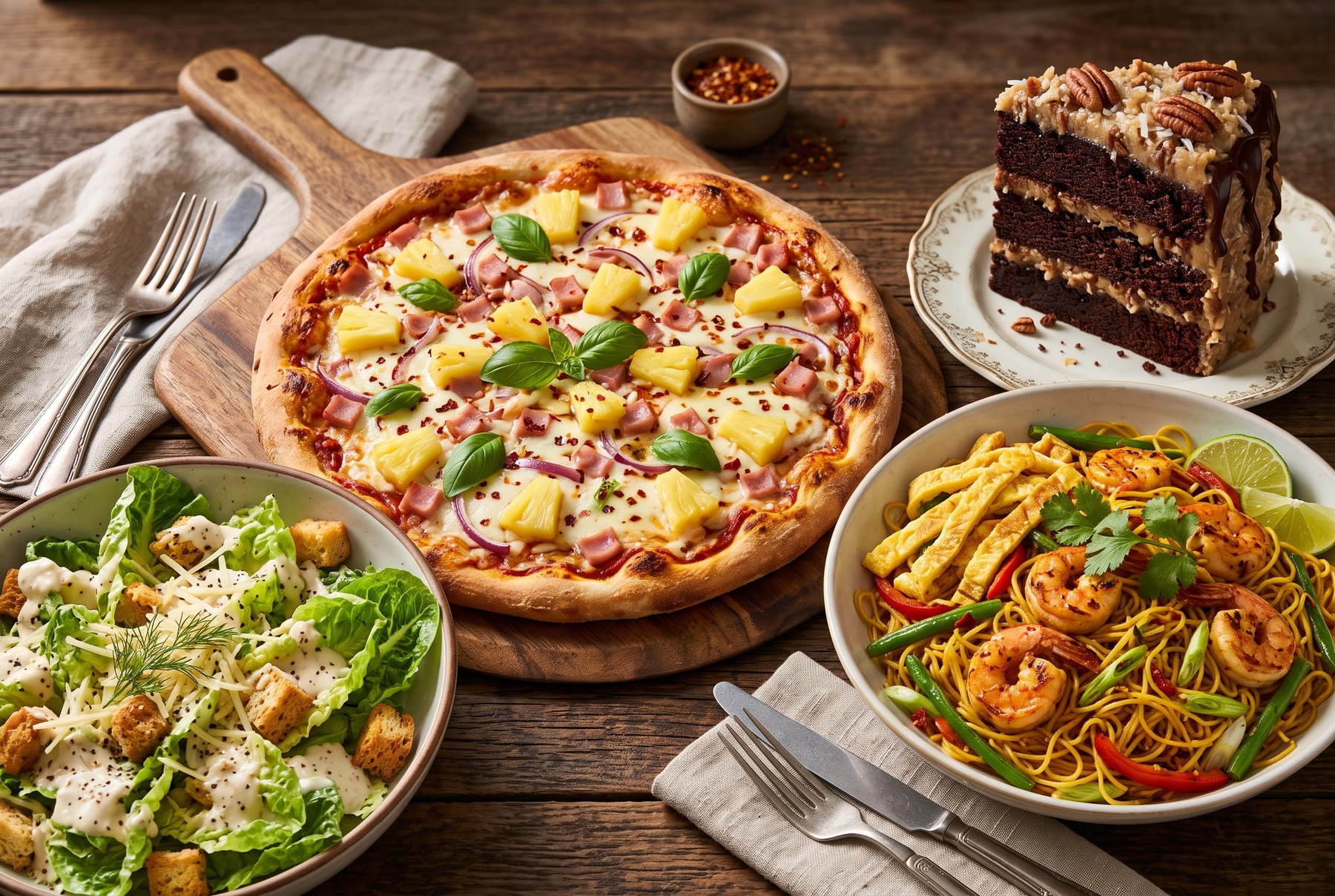
Popular dishes whose actual origins rarely match their familiar geographical names.
Table of Contents
- First, Let’s Define What Constitutes the Origin and Homeland of a Dish
- Part 1. Geography on the Marquee: When a Name Sends a Dish to the Wrong Place
- Part 2. Immigrant Kitchens: When a National Tradition Is Born Abroad
- Part 3. The China That Doesn't Exist in China
- Part 4. When the Audience's Palate Shifts, a Dish Changes Citizenship
- Part 5. National Icons With Foreign Relatives
- Part 6. When Culinary History Collides With Empires and Identity
- Part 7. Why Asking "What Nationality Is This Dish?" Is the Wrong Question
- Cheat Sheet: The True Trajectories of 20 Famous Dishes
First, Let’s Define What Constitutes the Origin and Homeland of a Dish
Four distinct questions usually get tangled into one.
Where the predecessor emerged. Many dishes have an older relative featuring a different technique, shape, or name. Yet a similar recipe did not necessarily inspire the later version. Resemblance alone proves nothing: cooks in entirely separate regions could independently bread and fry a thin cutlet of meat.
Where the modern version took shape. This marks the place where a recipe acquired the defining traits that make it recognizable today. Sometimes this transformation happens a century after the predecessor appeared, and in an entirely different country.
Where the dish achieved mass popularity. An immigrant community or a foreign restaurant industry often makes a recipe famous rather than its homeland. That adoptive home frequently cements the dish’s new national reputation.
Which country the name promises. This remains the least reliable compass. A culinary name might stem from a surname, an ingredient, a street, a restaurant, or a marketing push to sell exoticism. It almost never serves as a historical document.
Part 1. Geography on the Marquee: When a Name Sends a Dish to the Wrong Place
Hawaiian Pizza: Canada, Pineapple, and No Hawaii in Sight
In 1962, Sam Panopoulos, a Greek immigrant who ran the Satellite Restaurant with his brothers in Chatham, Ontario, scattered canned pineapple over a pizza. Polynesia had nothing to do with it; Panopoulos simply wanted to pair sweet fruit with savory ham. He later explained in interviews that the experiment grew out of simple curiosity and a desire to stand out from neighboring diners.
The name came straight off the tin. The canned pineapple brand was called “Hawaiian,” and the label migrated onto the menu alongside the fruit. Simple psychology handled the rest: “Hawaiian” sounds like geography rather than a trademark. Diners rarely questioned the island connection because Western imagination had long linked pineapples with the tropics. That association alone prompted people to take the name literally.
Today, almost no one debates whether the pie is Hawaiian or Canadian. Instead, diners argue over whether pineapple belongs on pizza at all. The president of Iceland once joked about banning the topping and sparked an international media storm. Nowadays, the dish’s origin takes a backseat to the fierce debate over fruit on flatbread.
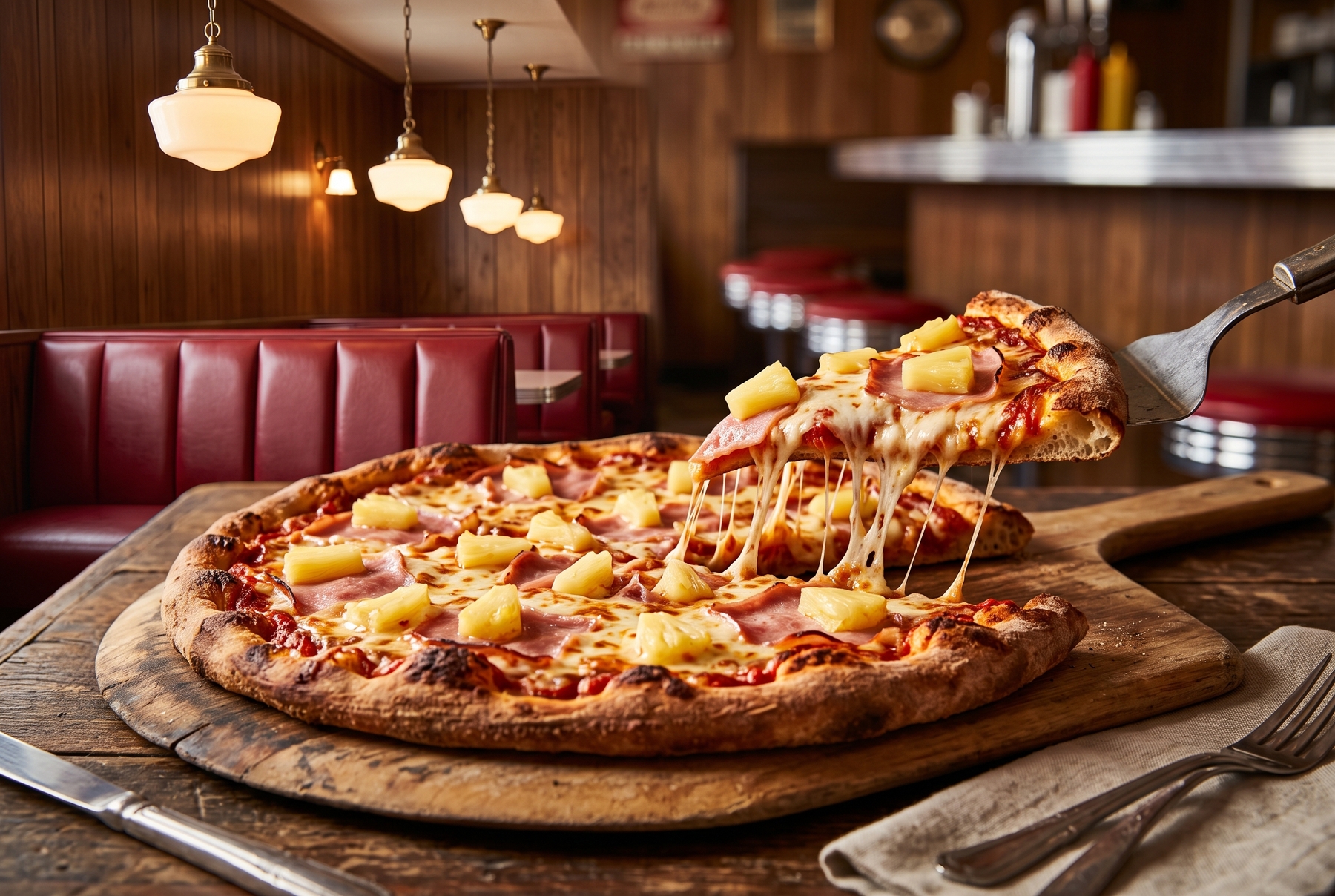
Hawaiian pizza topped with pineapple chunks and ham was invented in Ontario, Canada, in 1962.
Singapore Noodles: A Dish That Singapore Discovered Late
Thin rice vermicelli stir-fried with yellow curry powder, shrimp, ribbons of omelet, and crisp julienned vegetables frequently appears on menus as “Singaporean.” Yet travelers who visit a local hawker center (an open-air food court) in Singapore either cannot find the dish at all or spot it solely on tourist-oriented menus.
This vermicelli dish belongs primarily to Cantonese restaurant culture, specifically in Hong Kong, where British colonial trade introduced curry powder that local cooks married with high-heat wok techniques. From Hong Kong, Singapore-style vermicelli spread to Chinese restaurants across Britain, Canada, the United States, and Australia.
In this context, the word “Singapore” evoked an exoticized Southeast Asia for Western diners rather than pointing to a literal birthplace. Over time, restaurant-goers mistook a catchy menu title for a certificate of origin.
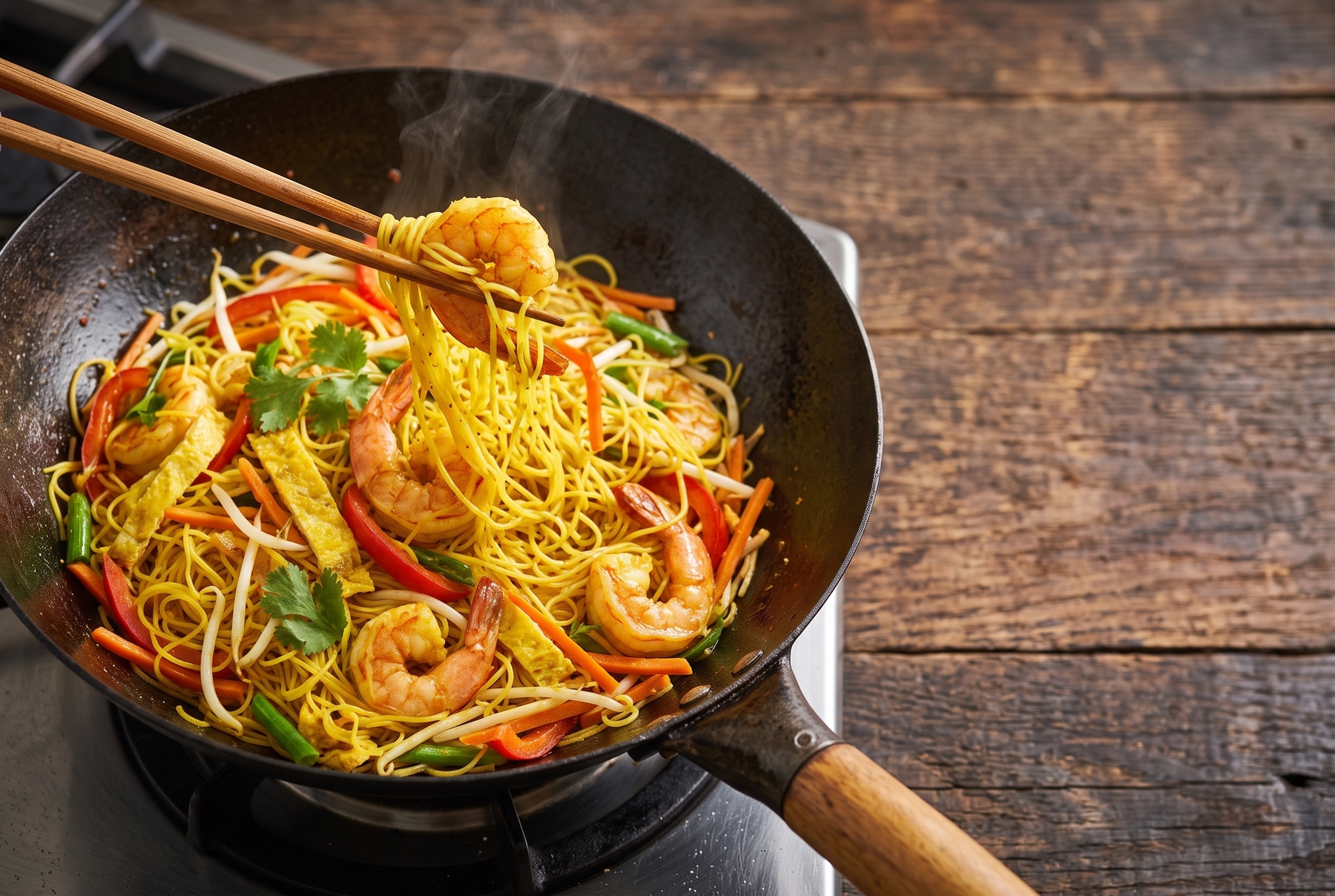
Curry-spiced rice vermicelli stir-fried with shrimp gained fame through Hong Kong chefs.
German Chocolate Cake: A Nationality Born From a Lost Apostrophe
In the mid-19th century, an American baker named Samuel German developed a dark baking chocolate bar for the Baker’s Chocolate Company. The company named the product “Baker’s German’s Sweet Chocolate” in his honor.
In 1957, a Dallas newspaper published a recipe for a layered cake using this specific chocolate, topped with a coconut-pecan frosting under the title “German’s Chocolate Cake.” As the recipe swept across the country, typographers and home cooks dropped the possessive apostrophe: “German’s” became “German.” That minor punctuation loss convinced generations of Americans that the dessert hailed from Germany.
Locals in Germany scarcely recognize it; a rich frosting packed with coconut and pecans bears no relation to traditional German pastry arts. The entire geographic mix-up rests on a missing apostrophe in a baker’s surname.
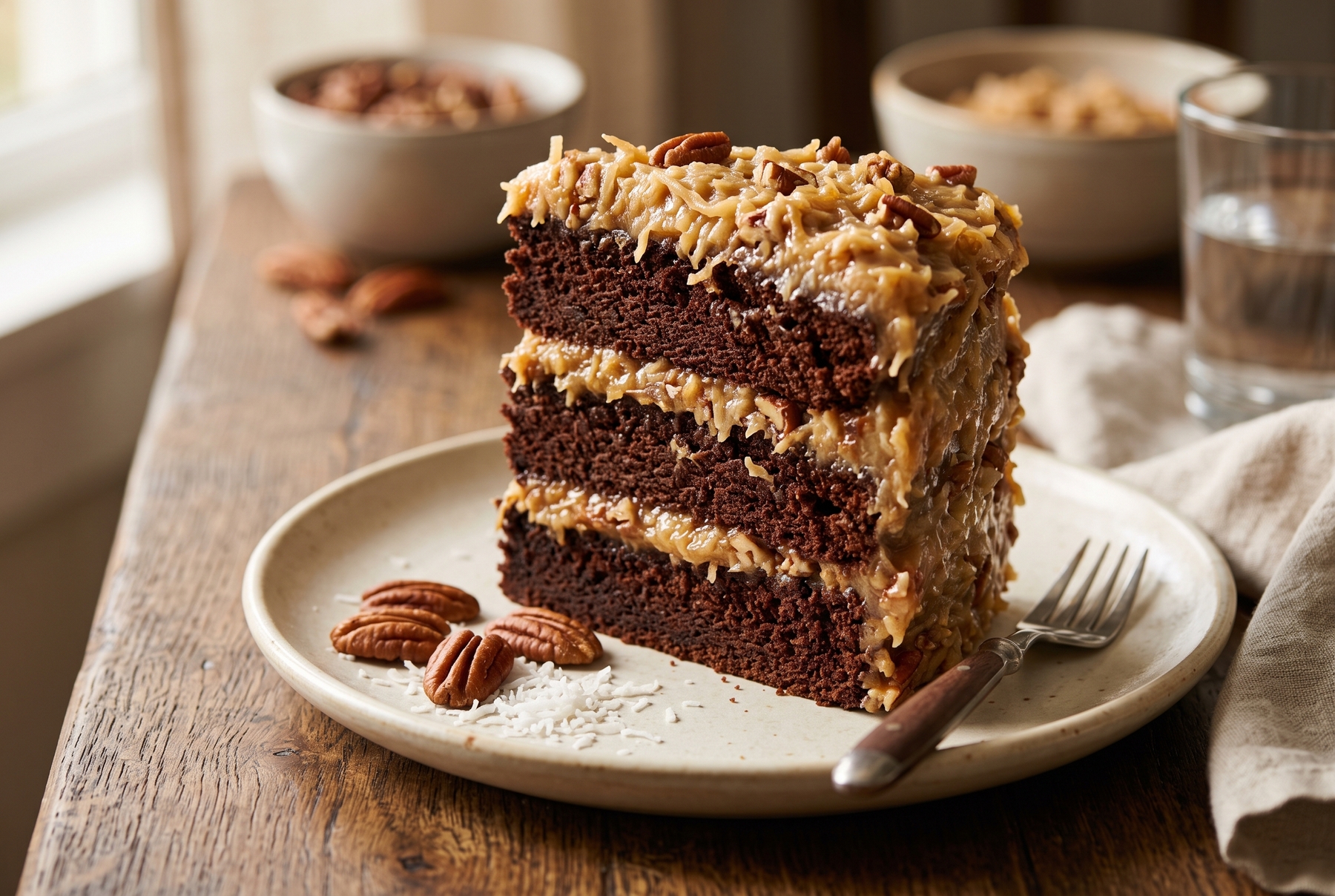
German chocolate cake takes its name from chocolatier Samuel German rather than the European country.
Scotch Egg: Scottish by Name, Contested in Every Other Way
A hard-boiled egg—or soft-boiled, in the hands of a skilled cook—wrapped in seasoned sausage meat, rolled in breadcrumbs, and deep-fried until crisp. Breaking the shell of golden crust reveals a vibrant, jammy orange yolk when timed right.
Competing theories surround its birth. The upscale London department store Fortnum & Mason claims to have invented the snack in 1738 as a portable meal for coach travelers heading out of the city. A crucial caveat applies here: this narrative comes from the store’s own corporate lore rather than an independently verified period document. The earliest confirmed print recipes for such eggs actually date to the early 19th century.
Another culinary theory points toward South Asian nargisi kofta—boiled eggs encased in spiced minced meat or legumes—which returning veterans and merchants may have brought to Britain through colonial trade routes. A third hypothesis suggests that “scotch” does not refer to Scotland at all, deriving instead from an old culinary verb meaning “to mince” or “to score” meat.
No single theory wins decisively. Nineteenth-century British cookbooks confirm that the dish was well established by that era, without clarifying how it arrived. Calling it an ancient Scottish specialty lacks historical grounding; aside from the title, almost nothing ties it to Scotland.
While the true origin story faded into history, the persuasive name endured. Diners simply began treating the label as proof of nationality.
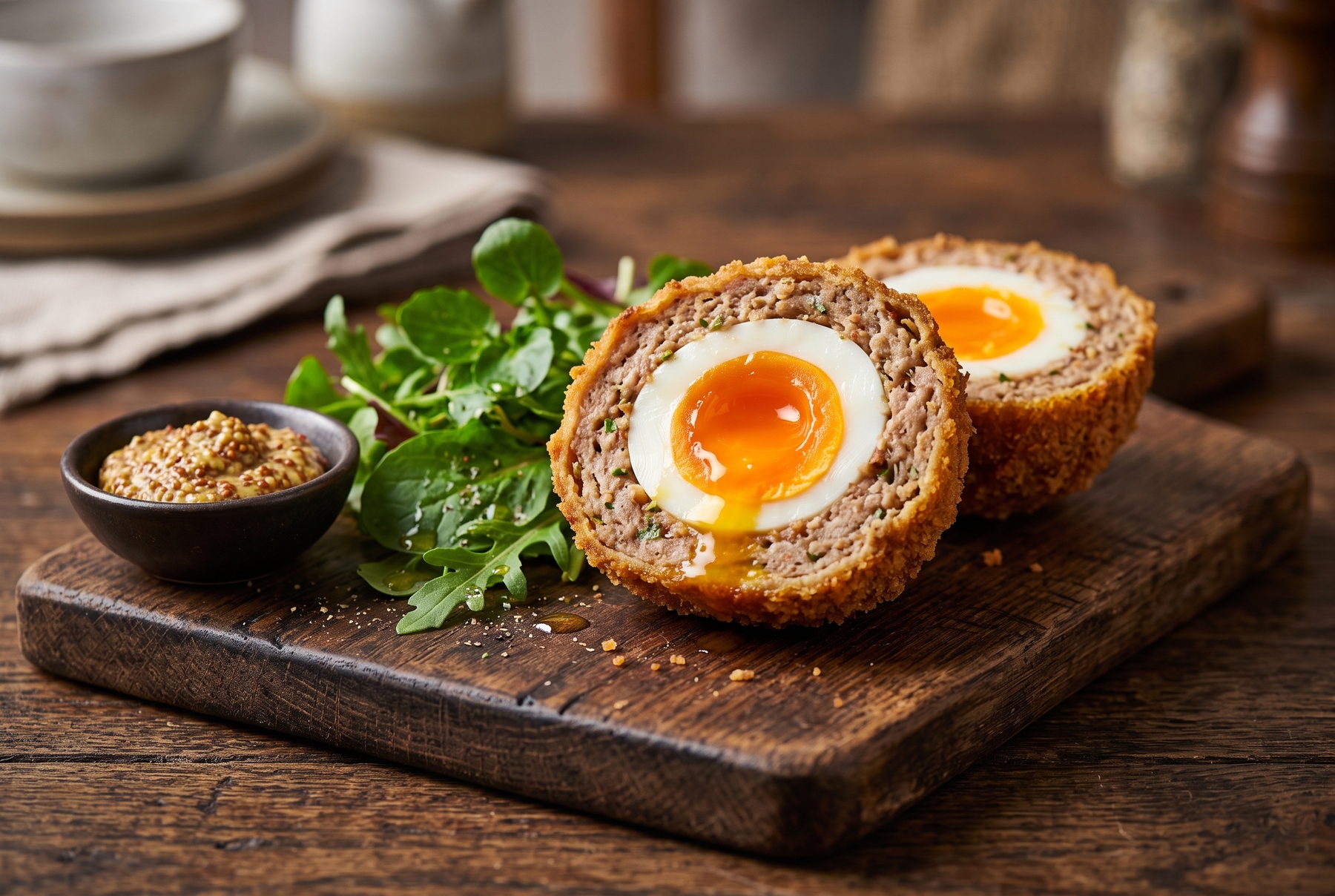
A Scotch egg encased in crispy breaded sausage meat with a jammy yolk inside.
Baked Alaska: Dessert First, Geography Later
Hard ice cream set on a slice of sponge cake, sealed entirely under a thick dome of meringue, and browned rapidly in a blazing hot oven. Simple physics makes the magic work: whipped egg whites trap tiny air pockets, and because air conducts heat poorly, the meringue exterior caramelizes before the frozen center can melt.
The technique itself had clear predecessors. Pastry chefs experimented with insulating ice cream inside pastry crusts or whipped egg whites throughout the 19th century, and French restaurants served a near-identical creation called omelette norvégienne (Norwegian omelet). Consequently, there is no single eureka moment of invention here.
The specific name “Baked Alaska” took hold within American fine dining, routinely credited to Delmonico’s restaurant in New York City, where chef Charles Ranhofer reportedly served a version in 1867 to commemorate the United States’ purchase of Alaska from Russia. It makes for a charming anecdote, though historians urge caution: given the dessert’s European precursors, crediting the entire concept to one Manhattan kitchen on one celebratory evening erases half of its culinary evolution.
The geographical moniker arrived well after the culinary technique, tying the dessert to Alaska retroactively.
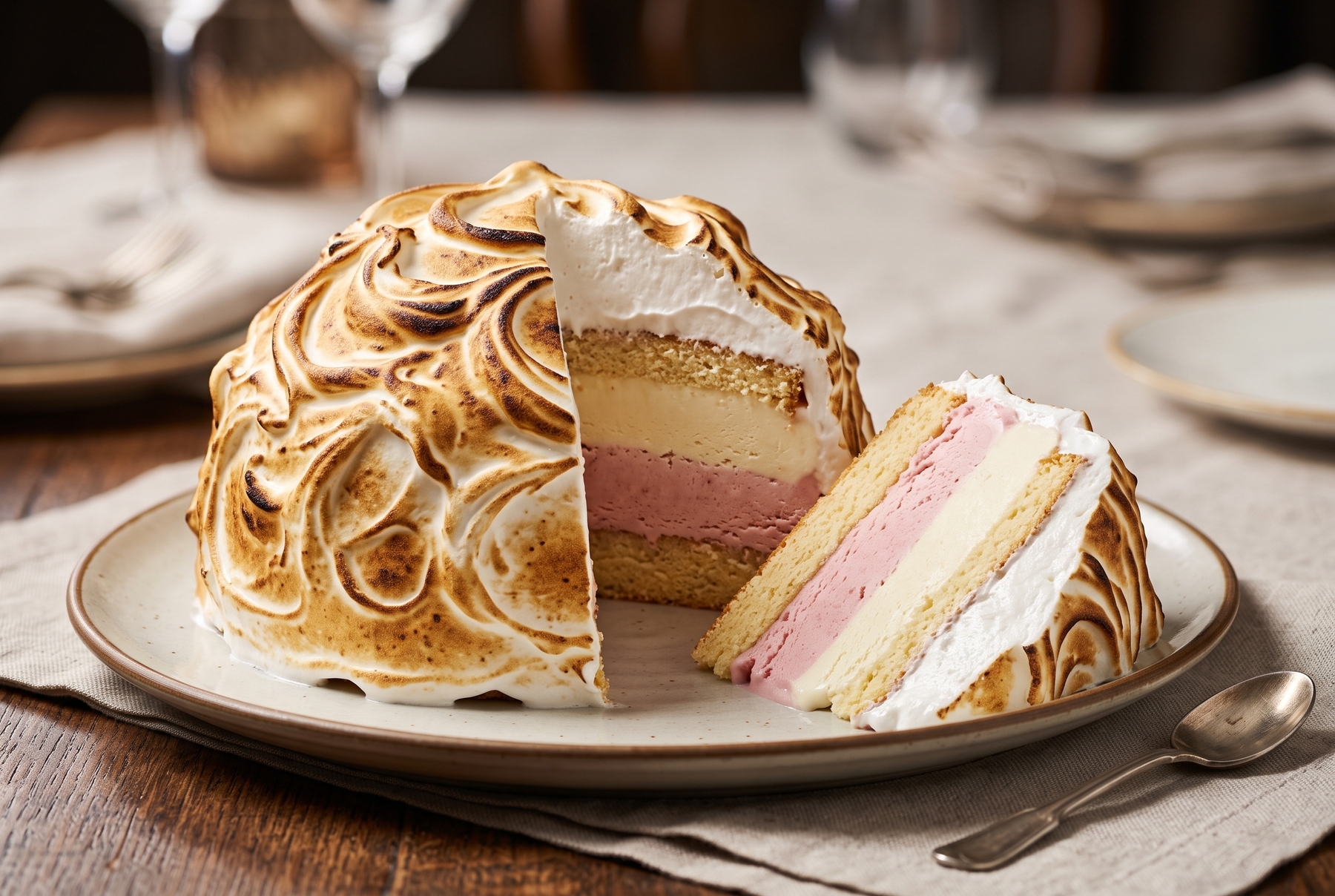
Baked Alaska layers ice cream and sponge cake beneath an insulating dome of torched meringue.
Part 2. Immigrant Kitchens: When a National Tradition Is Born Abroad
Italian-American cuisine grew directly out of what happened to rustic regional recipes when millions of Italians relocated to a country with a vastly different grocery economy, restaurant culture, and dining public.
Spaghetti and Meatballs: Italy Reimagined in America
Italy certainly makes its own polpette (meatballs). Cooks serve them on their own, simmered in light sauce, or alongside crusty bread, usually rolled no larger than a walnut or a small plum. Certain Italian regions do pair tiny meatballs with baked pasta dishes. Claiming that meat and pasta never share a plate in Italy is an exaggeration.
The American canon looks strikingly different: a towering mound of spaghetti drenched in thick marinara sauce, crowned with three or four beef meatballs the size of tennis balls. This iconic pairing took shape inside Italian-American neighborhoods during the early 20th century for thoroughly practical reasons.
Meat was far cheaper and more abundant in the United States than in the impoverished southern Italian provinces that most emigrants had left behind. Families who previously reserved meat for religious feast days suddenly found themselves able to afford ground beef several times a week. Portions of meat expanded rapidly. Meanwhile, canned California tomatoes offered an affordable, year-round pantry staple of consistent quality. American dining habits also pressured immigrant restaurateurs to combine starch and protein onto a single hearty plate rather than serving pasta as a separate first course (primo) followed by meat (secondo), as remains customary in Italy.
Out of these economic shifts emerged a distinct Italian-American culinary tradition governed by its own rules, sauces, and aesthetic of abundance.
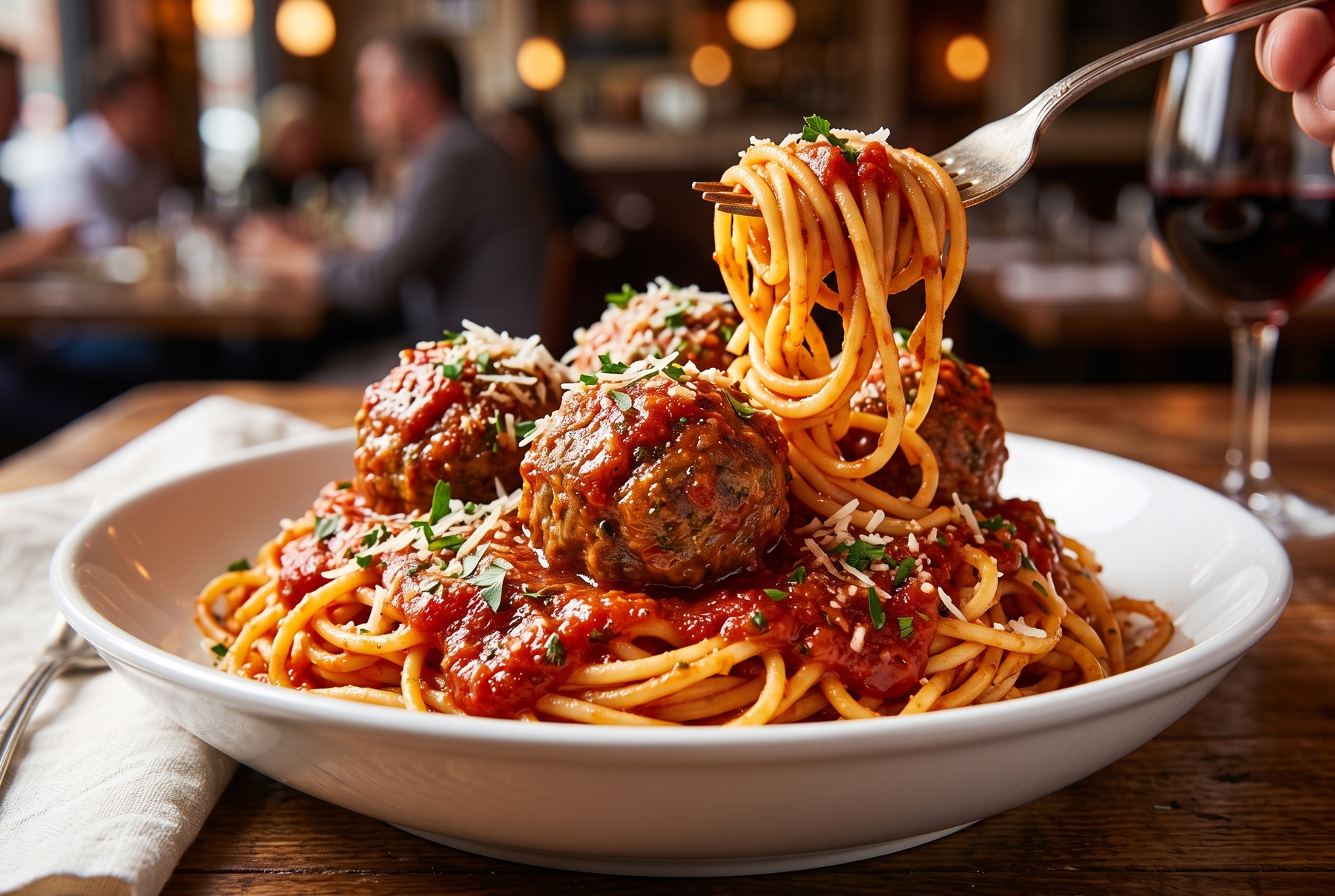
Spaghetti and meatballs stands as the quintessential canon of Italian-American immigrant cuisine.
Chicken Parmesan: How an Eggplant Crossed the Ocean and Became Poultry
The blueprint for this dish lies in southern Italy’s parmigiana di melanzane: shallow-fried slices of eggplant layered with tomato sauce and cheese, then baked until bubbling. It contains no chicken, and usually no meat whatsoever.
In Italian-American kitchens, the assembly technique stayed intact while the centerpiece ingredient changed. Cooks pounded a chicken breast thin, coated it in breadcrumbs, pan-fried it in oil, and baked it under a blanket of marinara and melted mozzarella. Before long, chicken parm found its way into crusty hero sandwiches, eventually becoming a staple of school cafeterias and casual dining chains.
The logic behind the swap mirrors the story of spaghetti and meatballs: in an American market where poultry was cheap and diners expected a substantial cut of meat at the center of the plate, a traditional vegetable casserole naturally evolved into a hearty meat entree.
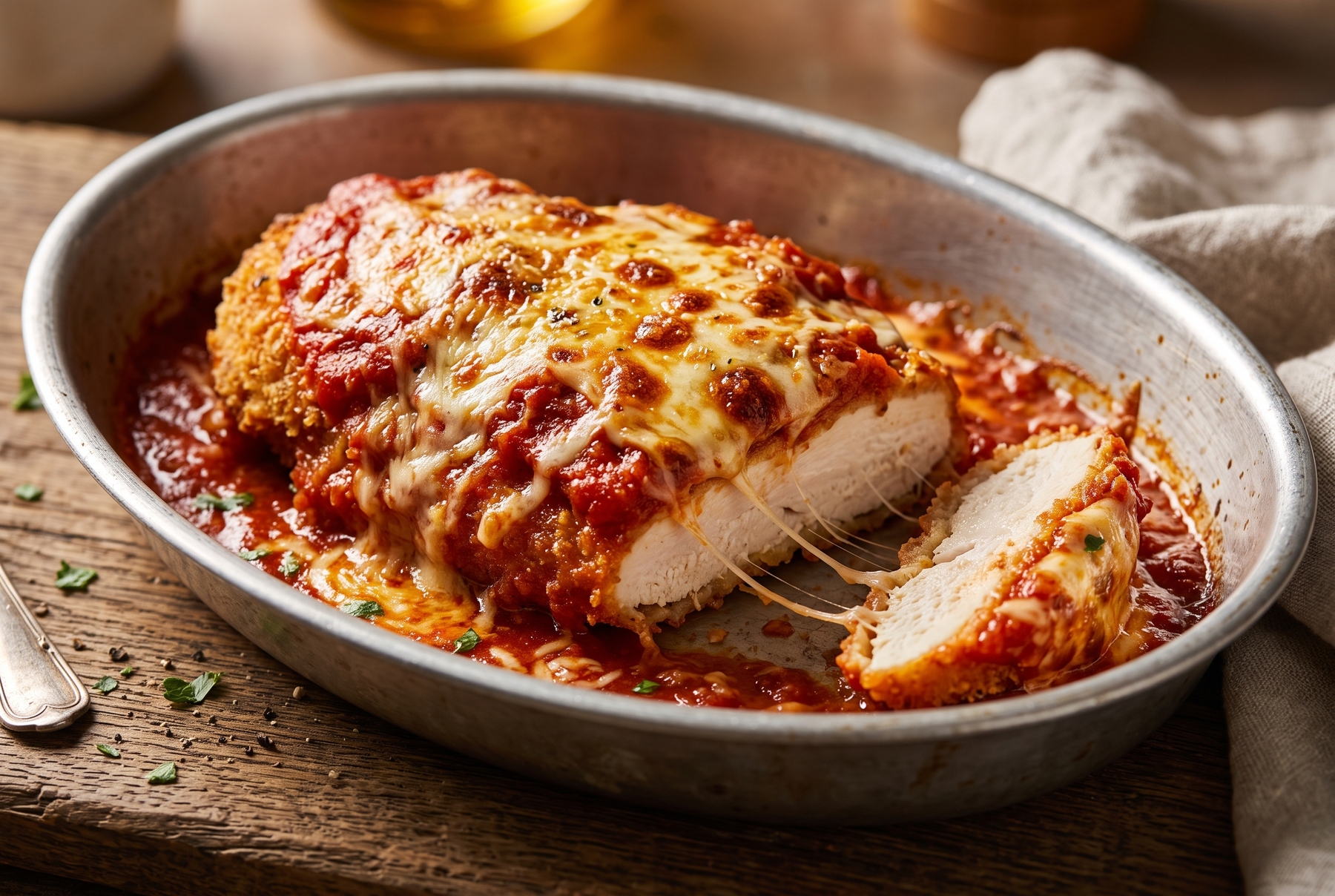
Chicken parmesan emerged in America as a meat-centric adaptation of southern Italian eggplant parmigiana.
Fra Diavolo: An Italian Name With an American Restaurant Biography
A fiery, chili-spiked tomato sauce tossed with seafood—most famously lobster, shrimp, or mussels—and served over long strands of pasta. The name translates to “Brother Devil,” carrying an unmistakably Italian ring.
Yet food historians link this exact seafood-and-pasta combination primarily to early 20th-century Italian-American restaurants rather than any specific regional tradition in Italy. The earliest print citations appear in American dining guides, and Lobster Fra Diavolo rose to fame specifically on New York City menus.
Where the devilish title originated remains open to debate. Some accounts connect it to Michele Pezza, an early 19th-century Neapolitan guerrilla leader nicknamed Fra Diavolo (later immortalized in an opera), while others point simply to the sauce’s diabolical heat. Regardless, an authentic-sounding Italian name does not make this New York restaurant classic a traditional dish of the old country.
Given enough decades, immigrant cooking establishes its own canon, legendary chefs, and fierce debates over authenticity. It matures into an independent culinary tradition.
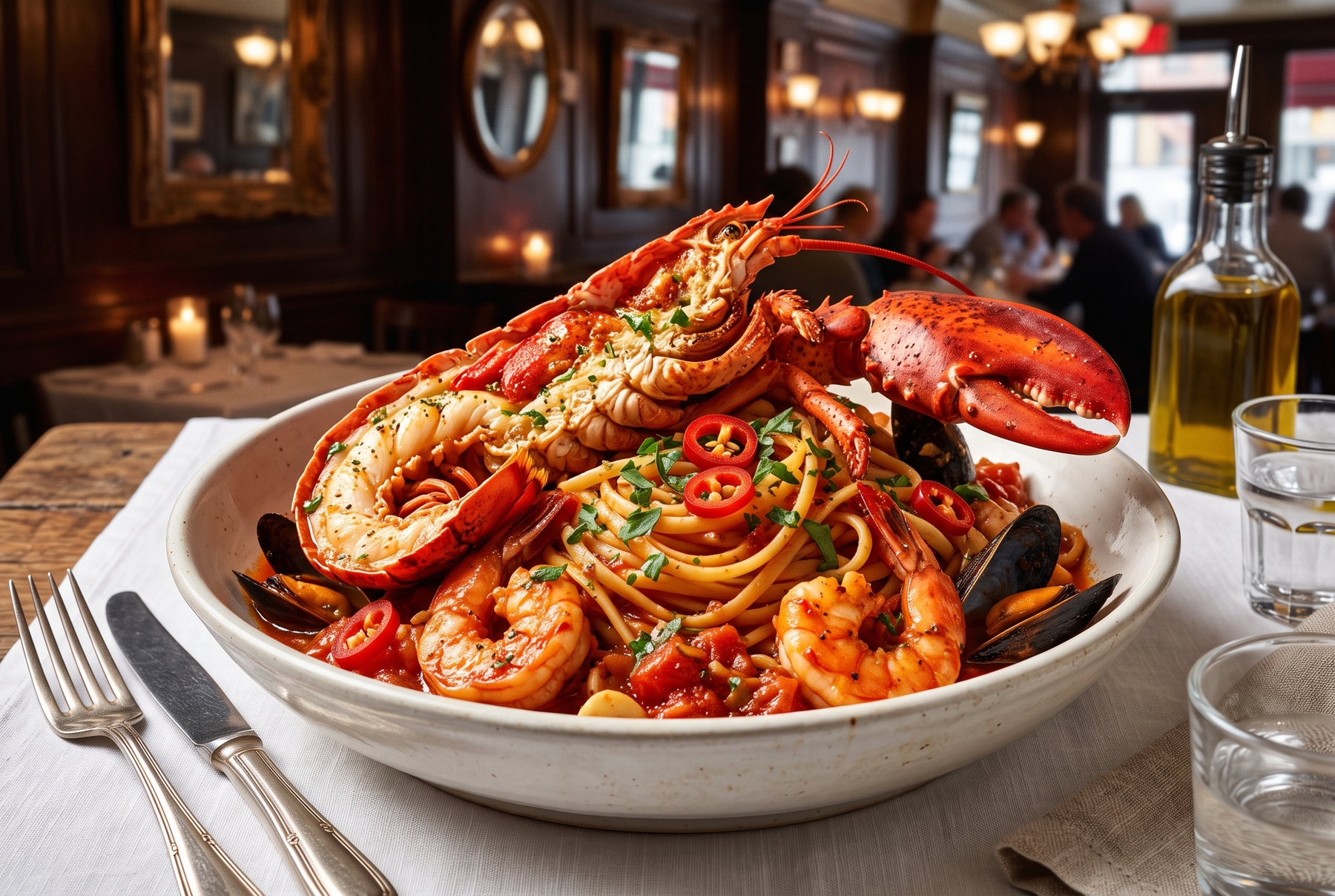
Spicy seafood pasta fra diavolo rose to fame in early 20th-century New York City restaurants.
Part 3. The China That Doesn’t Exist in China
For millions of Westerners, their introduction to “Chinese food” happened not in Beijing or Guangzhou, but inside diaspora restaurants in San Francisco, Liverpool, Lima, Vancouver, or Moscow. Those immigrant kitchens operated under tight constraints: unfamiliar local diners, limited native ingredients, and the economic pressure to turn tables quickly with approachable flavors. Those pressures forged an entirely new repertoire of dishes and dining rituals that Western customers eventually mistook for ancient Chinese tradition.
Fortune Cookies: A Japanese Past, Chinese Restaurant Fame
A crisp, vanilla-scented wafer snaps open with a dry crack, revealing a slip of paper printed with a vague aphorism or lucky numbers. This small ritual concludes meals in Chinese restaurants across the globe—everywhere, that is, except in China.
The historical trail leads directly to Japan. Bakeries around Kyoto have long produced traditional crackers known as tsujiura senbei: slightly larger, darker crescents flavored with sesame and miso, holding a paper fortune pinched into the fold. Japanese artisans baked these treats long before the American version appeared, with illustrations of the process showing up in 19th-century Japanese woodblock prints.
The cookies crossed the Pacific via Japanese confectioners and tea gardens along the American West Coast. How they migrated into Chinese restaurants remains a subject of lively dispute, with both Japanese and Chinese immigrant entrepreneurs claiming credit—a rivalry that once culminated in a tongue-in-cheek “court trial” in San Francisco’s mock Court of Historical Review.
The broader historical shift, however, is well documented. During World War II, the forced internment of Japanese Americans shuttered Japanese bakeries across California, allowing Chinese-American manufacturers to take over production of the cookies. Restaurant habit cemented the transition: the sweet, crisp wafer became the expected finale to a Chinese-American dinner, and ultimately its most recognizable Pop Art symbol.
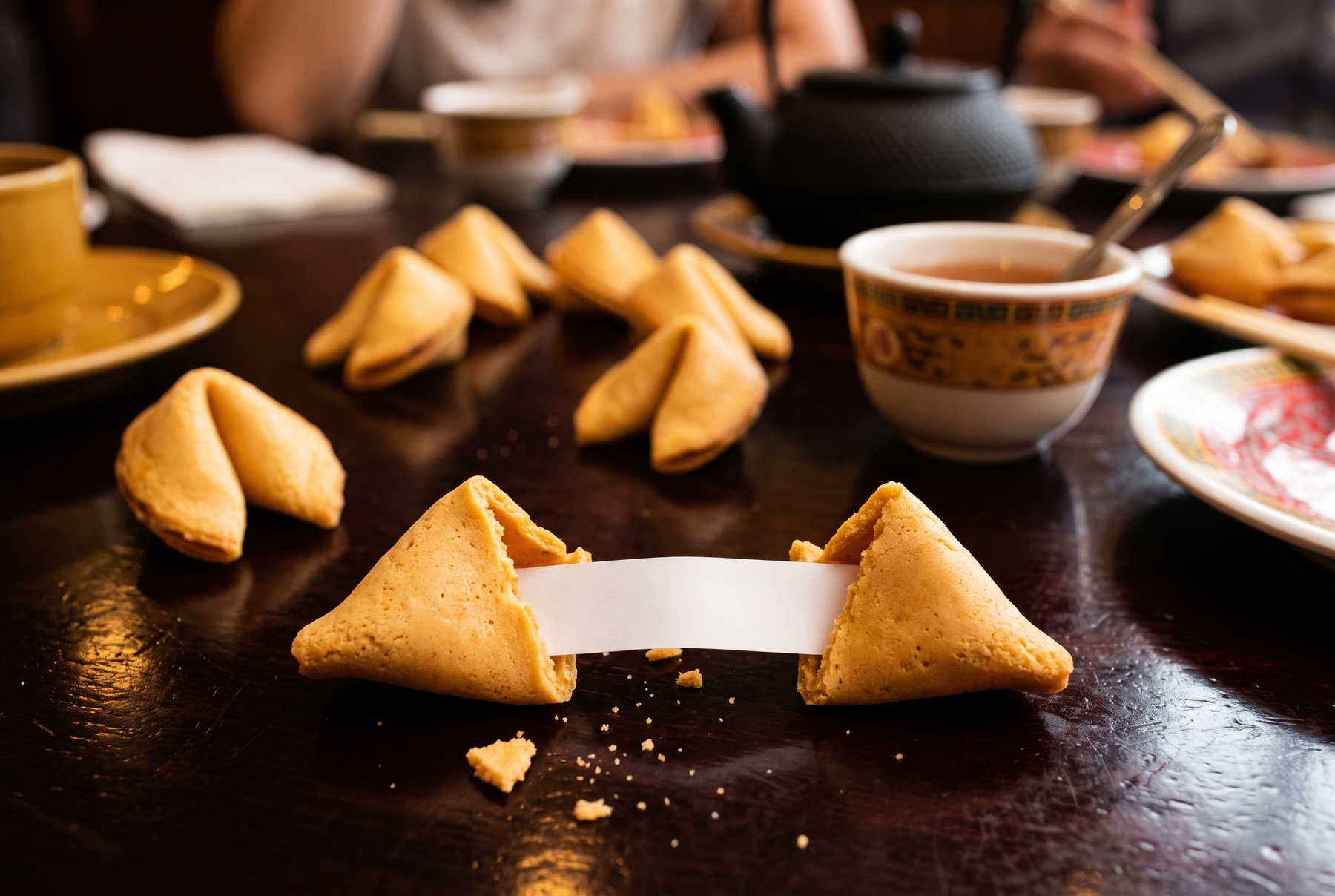
The crisp fortune cookie traces its roots to Japanese crackers before achieving fame in American Chinese restaurants.
Chop Suey: The Dish That Became a National Stereotype
Wok-seared vegetables tossed with sliced meat, bean sprouts, and a glossy, starch-thickened sauce. While restaurants in China do not serve American-style chop suey, the term itself has authentic southern Chinese roots: in Cantonese and specifically Taishanese dialects—spoken by the majority of early Chinese immigrants to the U.S.—phrases like shap sui or tsap seui translate roughly to “miscellaneous scraps” or “assorted bits.”
How directly the American menu staple evolved from village home cooking remains debated among historians. Even so, classic Cantonese culinary principles shine through clearly: high-heat stir-frying, resourceful use of whatever seasonal produce is on hand, and flexible ingredient pairings.
Colorful myths surround its birth. The most persistent legend credits the chef of Chinese statesman Li Hongzhang, who allegedly improvised the dish during Li’s 1896 diplomatic tour of the United States to appease American palates. Culinary historians dismiss this tale; print mentions of chop suey appear in American newspapers and menus well before 1896, making the diplomat story a classic piece of retroactive publicity.
In reality, early Chinatown kitchens needed to feed working-class American patrons quickly, cheaply, and using ingredients sourced from American grocers. A cook could toss varied vegetables and modest strips of pork or chicken into a hot wok, bind them with a savory gravy, and plate a satisfying meal without relying on hard-to-find imports. By the early 20th century, chop suey had become a coast-to-coast sensation in the United States, turning into shorthand for Chinese food in American popular culture.
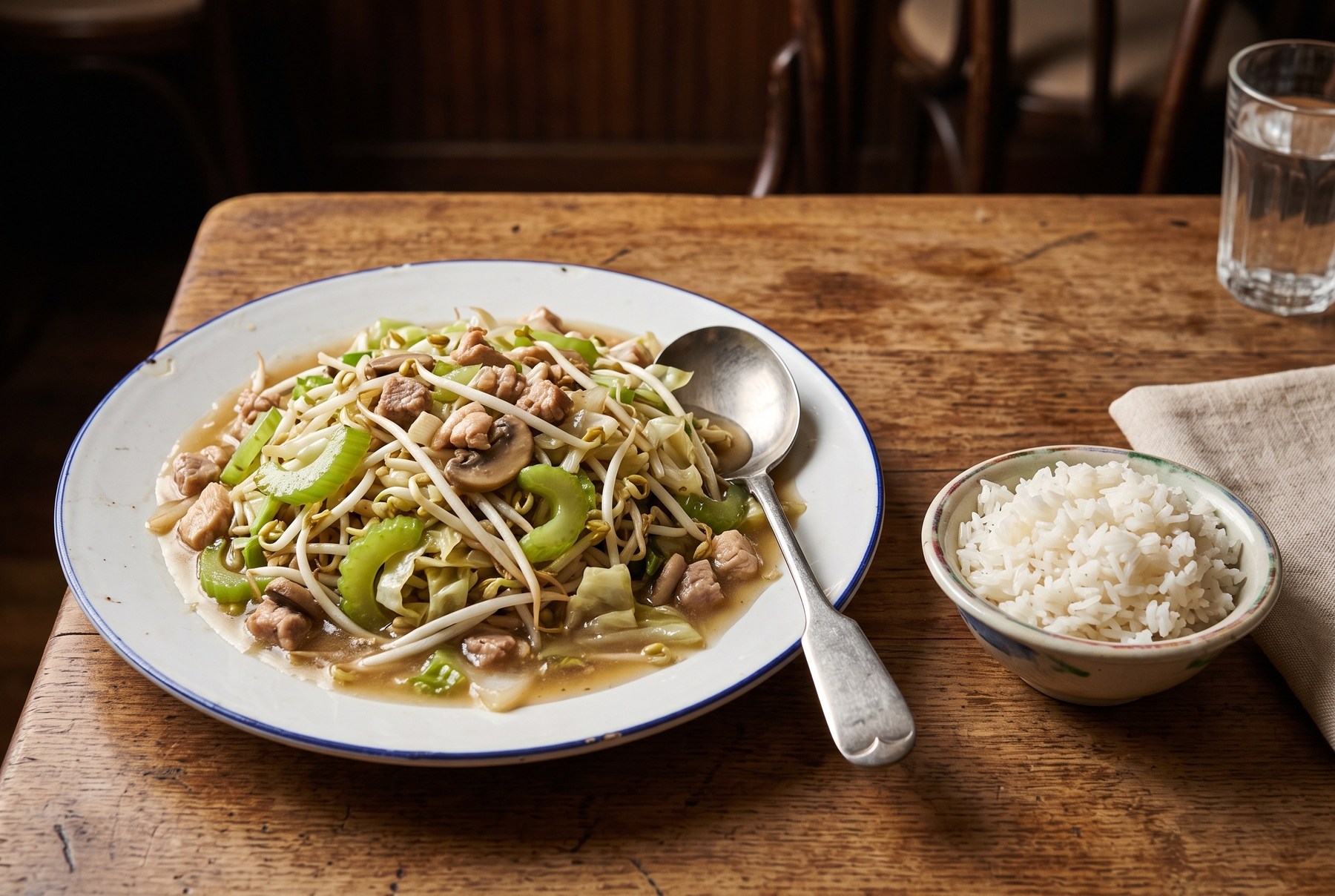
Chop suey became the defining culinary emblem of early 20th-century Chinese-American restaurant culture.
General Tso’s Chicken: A Winding Route to a Sweet Finish
The evolutionary path of this dish twists across borders, making it far too complex to dismiss merely as “fake American food.”
The title honors Zuo Zongtang (romanized as Tso Tsung-t’ang), a 19th-century military leader from Hunan province who never actually tasted the dish. Culinary records trace the recipe to Peng Chang-kuei, a banquet chef trained in the Hunanese tradition who fled to Taiwan after 1949. In Taipei, Peng created a dish built around Hunan flavor profiles: sour, salty, fiercely hot, and savory, without a hint of sugar.
From Taiwan, the itinerary splits. In the early 1970s, chefs brought the dish to New York City’s burgeoning Hunanese restaurant scene. There, chefs like T. T. Wang—working independently of Peng—adapted the recipe for American diners by crisping the batter and adding sugar to the glaze. When Peng himself opened a restaurant in Manhattan shortly afterward, he served his original, uncompromisingly savory version.
American diners overwhelmingly voted for the sweeter adaptation: bite-sized nuggets of dark meat chicken fried in a craggy batter that stays crunchy for several minutes under a glossy, garlicky, sweet-and-spicy sauce. According to accounts, when Peng later encountered what his creation had morphed into across America, he was less than thrilled.
Ultimately, the dish weaves together a mainland Chinese historical name, a Taiwanese banquet invention, and a sweet New York restaurant makeover.
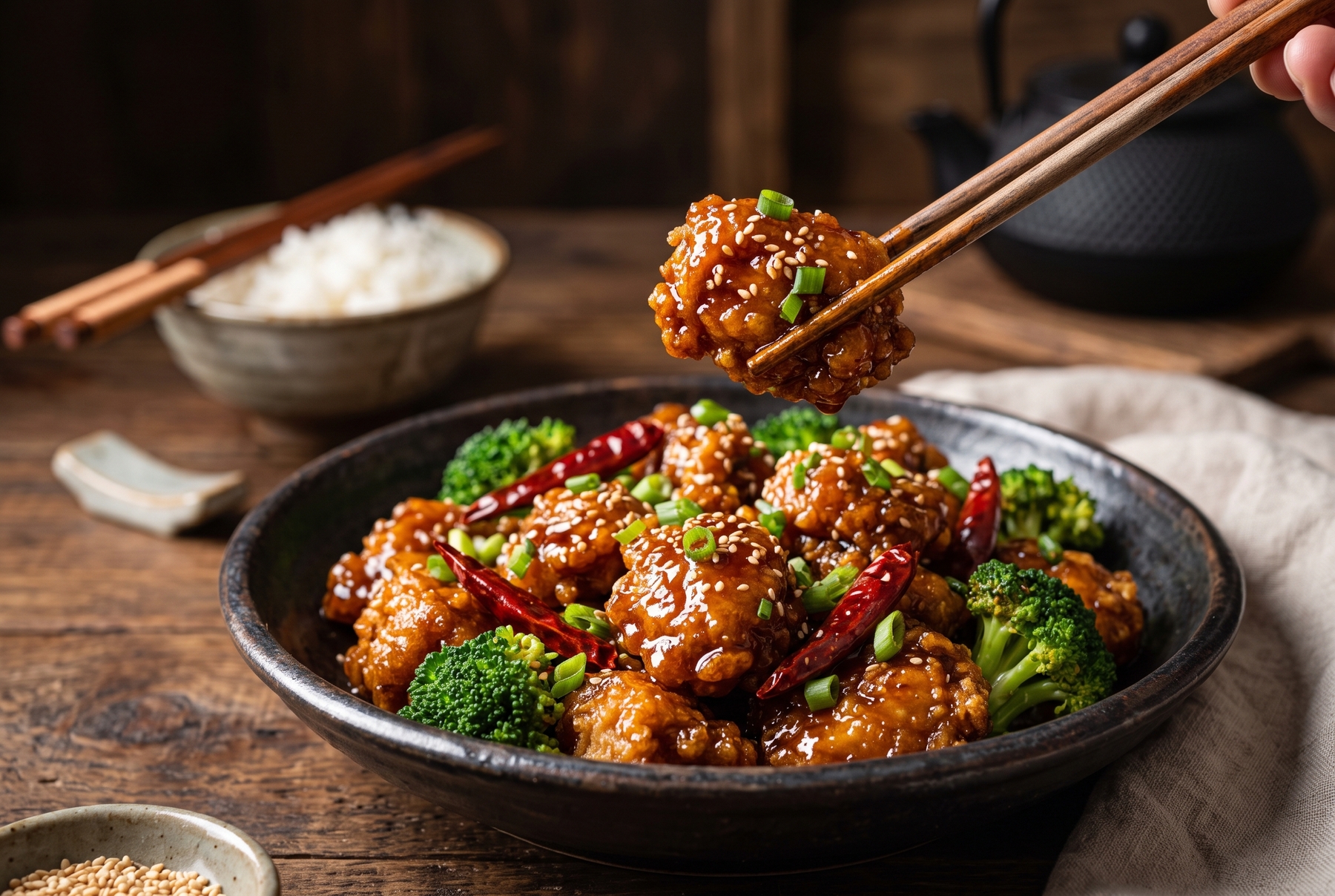
General Tso’s chicken traveled from a savory Hunanese dish in Taiwan to a sweet-and-crispy favorite in New York.
Part 4. When the Audience’s Palate Shifts, a Dish Changes Citizenship
California Roll: A Japanese Concept That Learned to Speak North American
A sushi roll filled with ripe avocado, cucumber, and crab meat—or surimi (imitation crab)—constructed inside-out with seasoned rice on the exterior and the sheet of nori (dried seaweed) hidden inside. Its exact parentage and the reasoning behind its reversed structure survive through competing chef memoirs rather than ironclad archival records.
One prominent lineage points to Los Angeles sushi bars in the late 1960s and early 1970s, where Japanese-trained chefs worked to win over hesitant American diners. In this narrative, ingredient substitution drove the invention: chefs swapped in creamy Hass avocado to mimic the rich, buttery mouthfeel of fatty toro (bluefin tuna belly), which was difficult to source reliably year-round.
A rival claim leads north to Vancouver in the early 1970s, where chef Hidekazu Tojo asserts he created a similar inside-out roll. Both lines of lore offer the same practical explanation for the inside-out (uramaki) build: North American guests disliked seeing and chewing the dark, papery seaweed wrapper, so chefs tucked the nori inside and rolled the sticky rice exterior in toasted sesame seeds or bright orange tobiko (flying fish roe).
Both accounts make complete culinary sense, though no contemporary document exists to crown a single undisputed inventor.
The cultural impact matters far more than the patent. A roll designed as training wheels for raw-fish skeptics became a global phenomenon, eventually traveling back to Japan as an accepted modern sushi style.
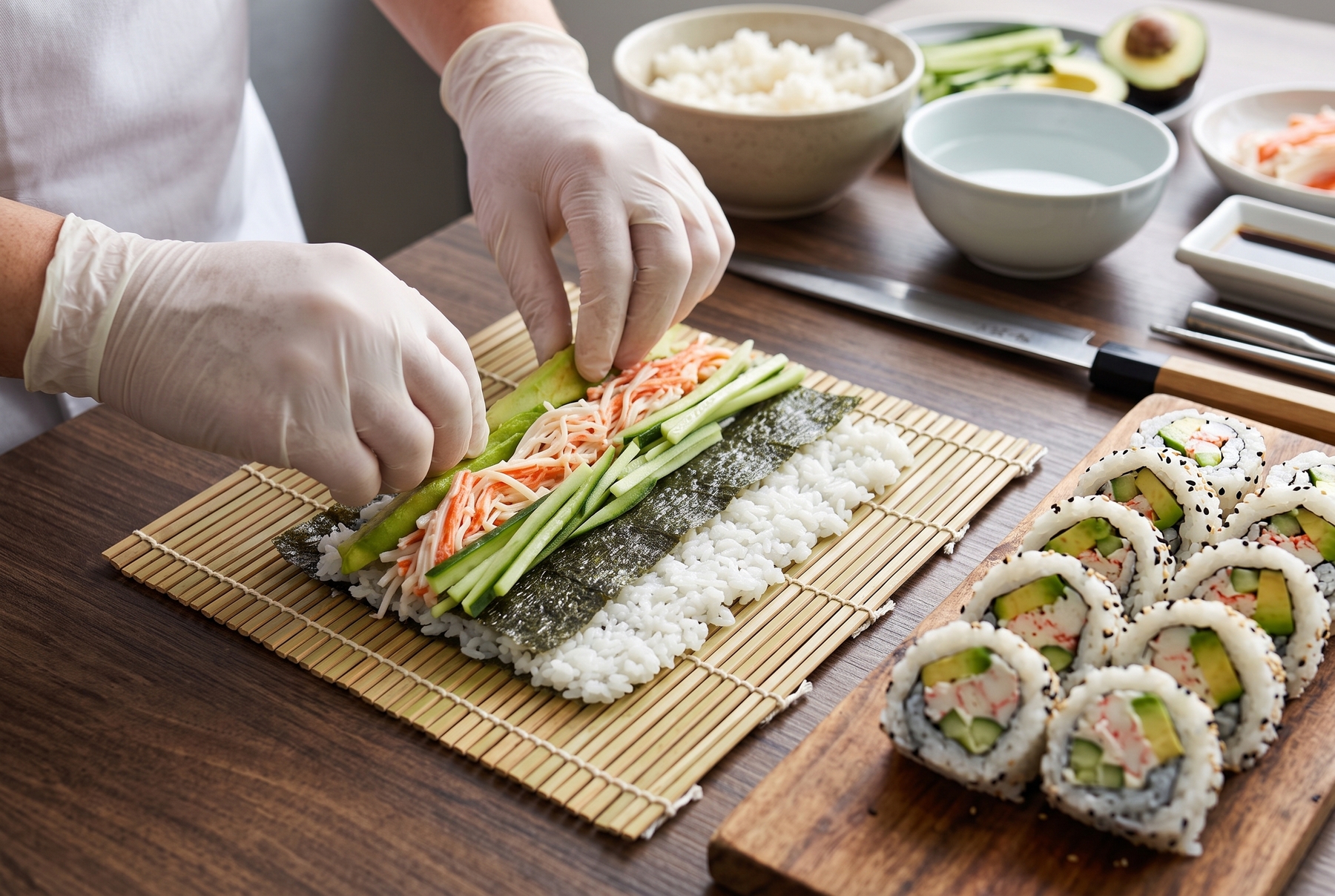
The inside-out California roll with avocado and crab was engineered to win over North American diners.
Chicken Tikka Masala: Suspended Between South Asia and Britain
Pinpointing a single birthplace for chicken tikka masala is famously tricky.
Its culinary foundation is unmistakably South Asian: chicken tikka—boneless chunks of poultry marinated in yogurt and warm spices, then blistered in a clay tandoor oven—has existed on the Indian subcontinent for centuries. The debate centers entirely on when and where cooks began simmering those charred chicken pieces in a vibrant, spiced tomato-and-cream gravy to create a standalone restaurant curry.
The most popular folklore places the birth inside a Glasgow curry house in the 1970s, where chef Ali Ahmed Aslam reportedly improvised a sauce from canned tomato soup, cream, and spices to placate a patron who complained his chicken tikka was too dry. While the anecdote is charming, hard historical evidence remains thin, leaving food historians skeptical.
A second school of thought points out the dish’s striking similarity to Punjabi murgh makhani (butter chicken), viewing the British curry house staple as a direct adaptation of existing North Indian Mughlai gravies. A third perspective suggests the dish evolved simultaneously across dozens of South Asian immigrant kitchens in postwar Britain without a single auteur.
One fact stands beyond dispute: the dish achieved superstardom inside Britain’s curry house culture, an industry built largely by migrants from South Asia, particularly Sylheti chefs from Bangladesh. It integrated so thoroughly into daily British life that in 2001, Foreign Secretary Robin Cook famously declared chicken tikka masala “a true British national dish.”
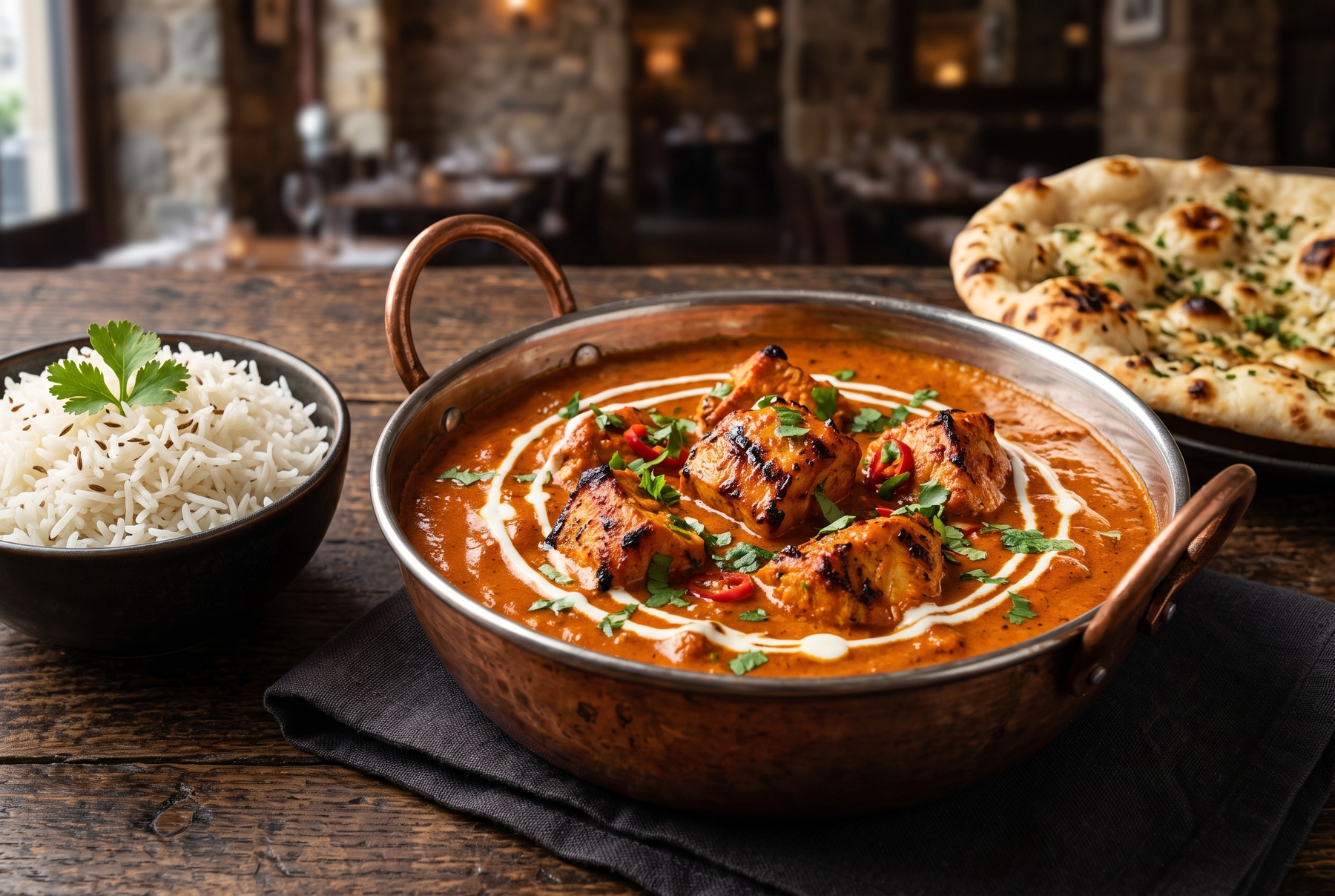
Chicken tikka masala marries South Asian tandoori techniques with a rich British curry house tomato-cream sauce.
Nachos: A Mexican Invention Routinely Mistaken for American
Unlike most bar snacks, nachos boast a remarkably clear paper trail. In the early 1940s, Ignacio “Nacho” Anaya worked as a maître d’ at the Victory Club in Piedras Negras, a Mexican border town sitting directly across the Rio Grande from Eagle Pass, Texas. One afternoon, a group of U.S. military wives from a nearby base arrived looking for a snack after the kitchen staff had gone home. Thinking on his feet, Anaya ducked into the kitchen and assembled what was available: fried corn tortilla triangles topped with shredded Wisconsin cheddar cheese and sliced pickled jalapeños, heated briefly until the cheese melted. He called them “Nacho’s Especiales,” and his nickname stuck.
The borderlands setting played a decisive role. Although born on Mexican soil, the dish emerged in a zone of constant cross-border commerce where Mexican hospitality catered directly to American tourists and American dollars.
Decades later, the American concession-stand industry radically altered the formula: pump-dispenser processed cheese sauce replaced real melted cheddar, and cardboard stadium trays overflowed with ground beef, sour cream, and olives. Anaya’s original creation was a study in restraint: crisp corn, real cheese, and sharp chili heat.
Consumers worldwide often lump nachos into American fast food, forgetting that they originated south of the border in Piedras Negras.
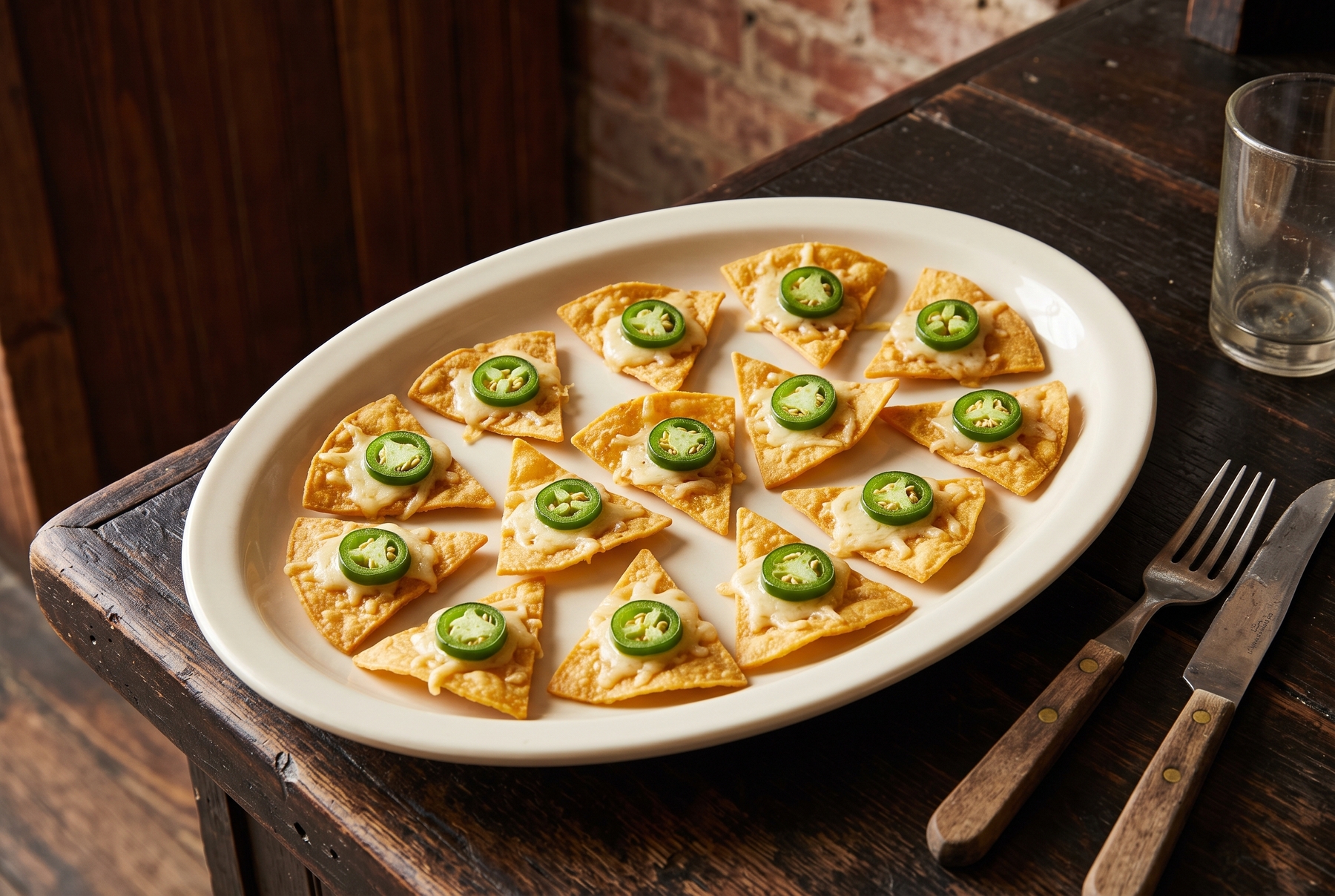
The original Mexican nachos from Piedras Negras consisted simply of crisp tortilla chips, melted cheese, and sliced jalapeños.
Caesar Salad: Italian Name, Mexican Address, American Fame
Perhaps no dish illustrates geographic confusion better than the Caesar salad.
Caesar Cardini, an Italian immigrant, operated a restaurant and hotel in Tijuana, Mexico, during the roaring 1920s. Tijuana was booming: Prohibition had outlawed alcohol in the United States, sending thirsty Americans, including Hollywood stars, streaming across the border for legal cocktails, nightlife, and fine dining. According to Cardini family lore, the salad was born during an overwhelmingly busy Fourth of July weekend in 1924 when the kitchen’s pantry was running dangerously low.
Cardini’s original tableside assembly was far more disciplined than modern cafe versions: whole inner leaves of crisp romaine lettuce—meant to be lifted by the stem and eaten with the fingers—tossed with garlic-infused olive oil, a coddled egg (simmered in boiling water for just one minute), Worcestershire sauce, fresh lime or lemon juice, freshly grated Parmigiano-Reggiano, and crisp croutons. Grilled chicken was nowhere near the bowl.
Even anchovies were initially a point of contention: Caesar relied solely on Worcestershire sauce for a subtle, fermented fish umami, whereas his brother Alex later added whole anchovy fillets to his own “Aviator’s Salad.” Sliced chicken breast, grilled shrimp, bacon bits, and thick, bottled mayonnaise dressings are all later American additions layered onto the dish as it became a coast-to-coast steakhouse staple.
Because of the creator’s Italian name, the shower of Parmesan cheese, and its ubiquity on American menus, diners naturally assume the Caesar salad hails from Rome or New York. Mexico routinely gets erased from the story, despite Tijuana being its undisputed birthplace.
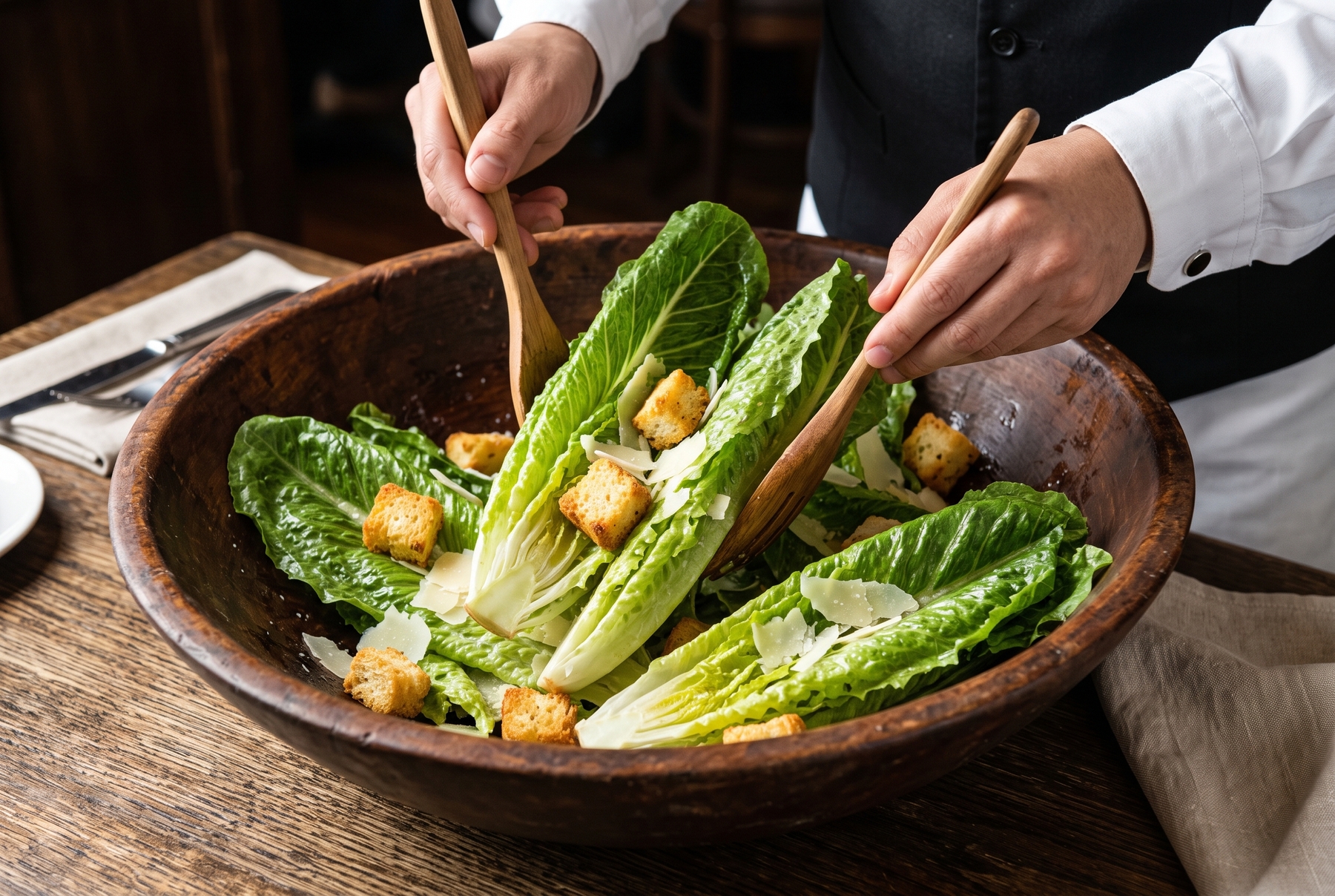
Caesar Cardini tossed the first Caesar salad tableside in Tijuana, Mexico, during the 1920s.
Part 5. National Icons With Foreign Relatives
This category requires a finer lens. No one can claim these dishes do not belong to their adoptive countries; they have anchored local culinary identity for generations. Their family trees simply happen to cross international borders.
Danish Pastry: Known in Denmark as Viennese Bread
Yeast-leavened dough laminated with generous layers of butter—rolled out, folded repeatedly, and chilled—before being shaped around fillings of vanilla custard, marzipan, or fruit jam. Bite into one, and paper-thin, flaky layers shatter beneath a shiny sugar glaze.
In Danish baking history, this pastry dates back to 1850, when a wage strike among Danish bakery workers prompted master bakers in Copenhagen to hire replacement pastry chefs from Austria. The visiting Austrians brought along the Viennese technique of laminating yeast-raised dough (known today in culinary French as viennoiserie). Once the strike ended, Danish bakers kept the foreign technique and adapted it to Scandinavian tastes, increasing the ratio of butter and eggs while developing distinct folding shapes and sweet fillings.
The resulting linguistic paradox is delightful. Around the English-speaking world, the treat is universally known as a “Danish.” Yet walk into a bakery in Copenhagen, and locals order wienerbrød—literally “Viennese bread.”
Both labels tell the truth from different angles: the lamination mechanics came from Vienna, while the rich, decadent final form was perfected in Denmark.
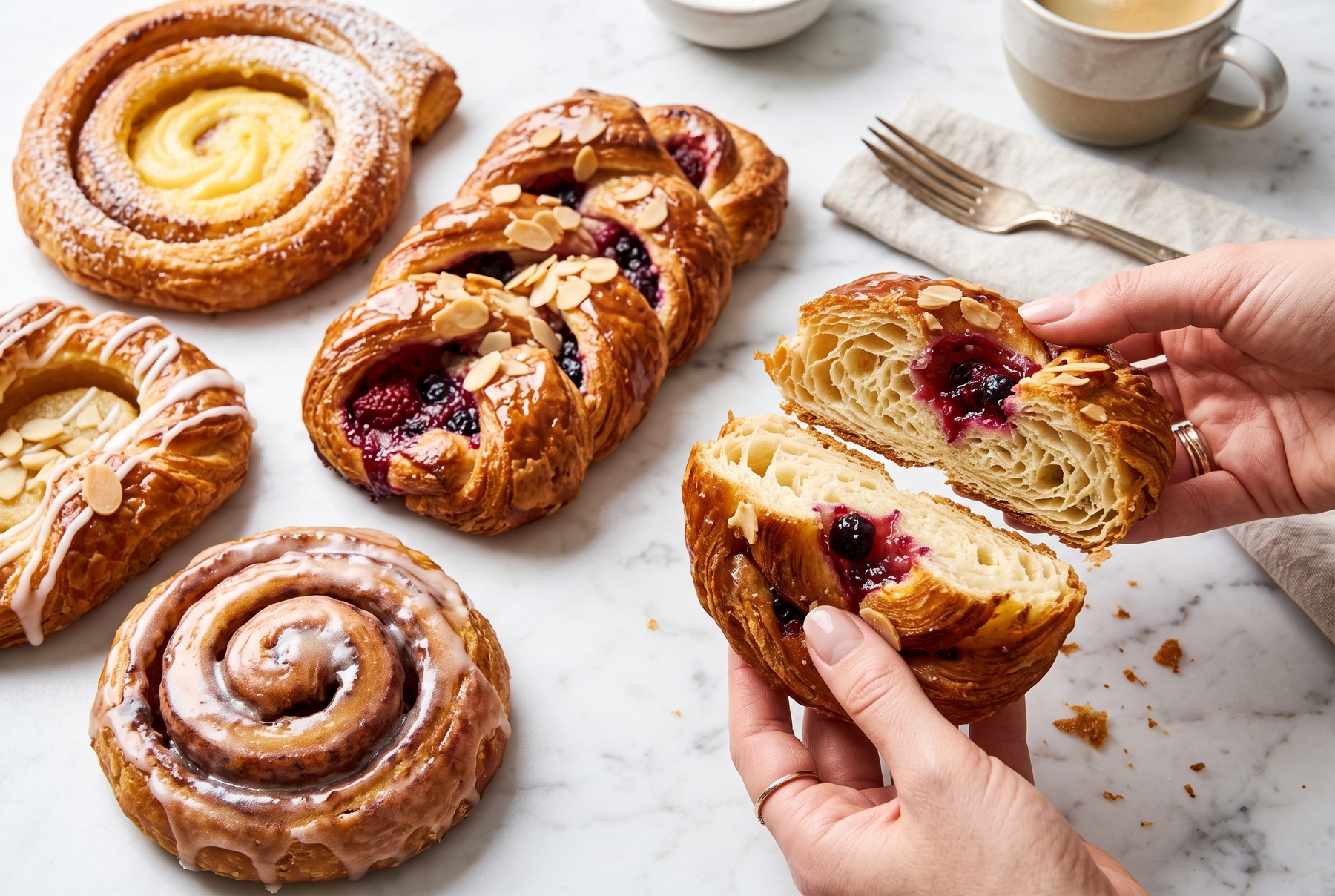
Danish pastry—known in Denmark as Viennese bread—combines Austrian lamination techniques with Scandinavian recipes.
Wiener Schnitzel: Austria’s Culinary Emblem With a Contested Pedigree
A thin escalope of veal, pounded nearly translucent, dredged in flour, egg, and fine breadcrumbs, and pan-fried in generous quantities of clarified butter or lard until the coating puffs up into airy, golden blisters. Properly executed, the crust stays dry to the touch and light gold without a trace of grease. It stands as the undisputed symbol of Austrian gastronomy.
Arguments over its ancestry almost always pit Vienna against Milan’s cotoletta alla milanese, a bone-in breaded veal chop. A popular 19th-century anecdote claims that Austrian Field Marshal Joseph Radetzky tasted the dish while stationed in Lombardy and sent a dispatch praising the recipe back to Emperor Franz Joseph’s court in Vienna.
Modern culinary historians view the Radetzky tale as apocryphal: no such military report has ever been found in Austrian archives, and the story only surfaced in print decades after the Field Marshal died.
Separating the technique from the dish clears up the confusion. Did the practice of breading and frying thin cuts of meat exist before 19th-century Vienna? Certainly—and not just in Milan; recipes for crumbed, fried meats appear across European cookbooks centuries earlier. Where did the specific dish recognized today as Wiener Schnitzel—defined by boneless veal, specific breadcrumb texture, and the signature souffléed crust achieved by swirling hot fat over the meat—crystallize into law? In the restaurant kitchens of Vienna.
Relying solely on the oldest surviving cookbook creates a trap: a better-preserved archive in one city does not prove a simple cooking technique never occurred to anyone else.
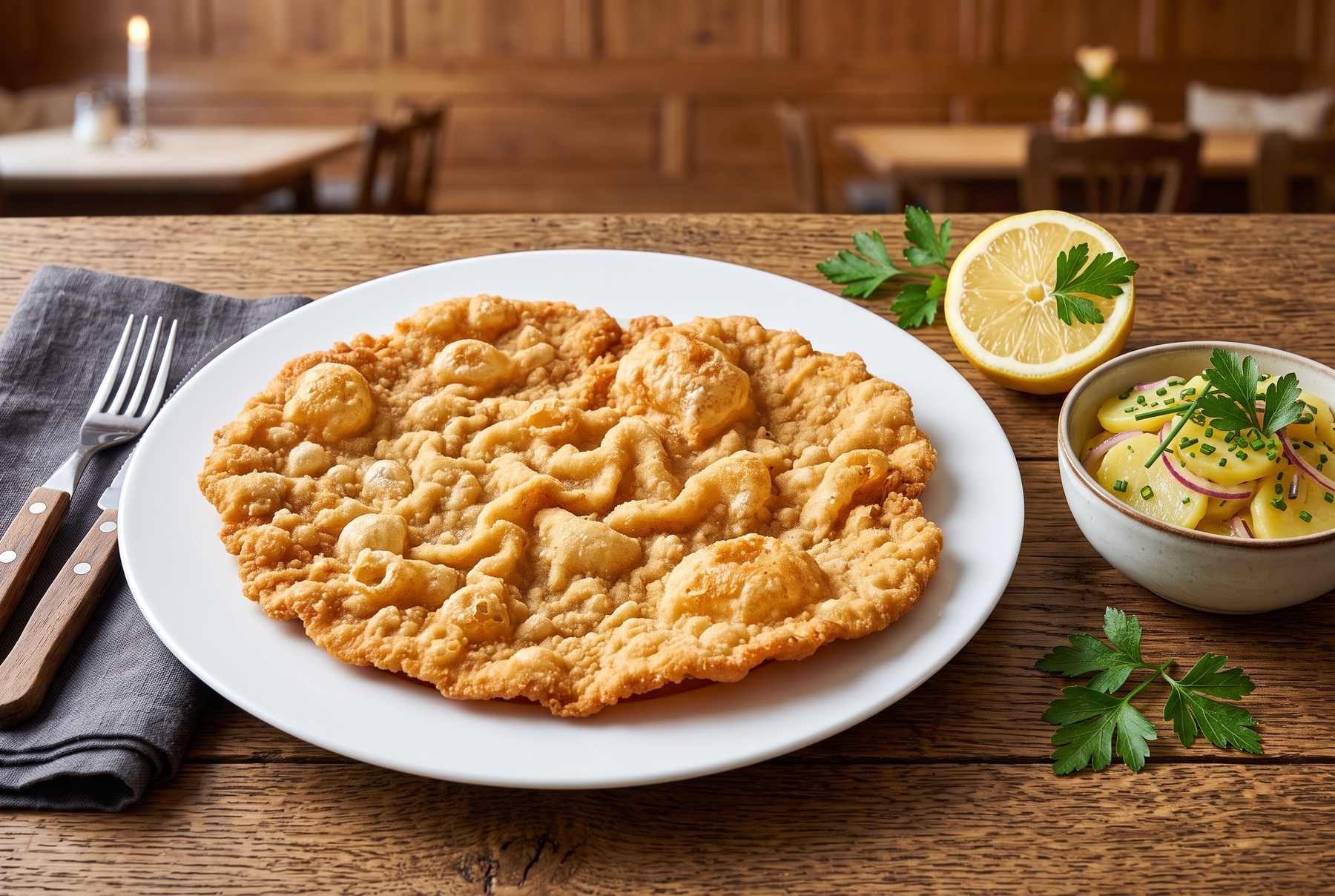
Paper-thin veal Wiener schnitzel with a blistered, golden breadcrumb crust is Austria's culinary icon.
French Fries: Gallic Potatoes or Belgian National Heritage?
Here, the most honest historical answer sounds anticlimactic: we cannot be entirely sure who fried the first baton of potato, though the surrounding lore is full of holes.
Belgium’s cherished national narrative claims that late 17th-century villagers along the Meuse River near Namur routinely caught and fried tiny river fish; during harsh winters when the river froze solid, they supposedly sliced potatoes into fish-sized strips and fried them instead. While charming, the story lacks contemporary archival proof, and given how scarce potatoes and cooking fat were among 17th-century European peasants, historians find the timeline highly improbable.
The French counterargument points to Parisian street vendors selling fried potato slices (pommes Pont-Neuf) on the bridges of Paris in the late 18th and early 19th centuries. Print records from Paris are far stronger here, though early recipes often described round slices or chunks rather than uniform sticks.
As for the English phrase “French fries,” the popular myth about American World War I doughboys tasting Belgian fries and calling them “French” simply because the local Belgian army spoke French falls apart under scrutiny. The term “French fried potatoes” appears in American cookbooks and newspapers as early as the 1850s—more than half a century before World War I.
In 19th-century English culinary terminology, “French” often referred to the preparation style—either deep-frying in immersed fat (the French method) or the culinary verb “to french,” meaning to julienne ingredients into long, thin strips. Neither explanation requires a trip to the Western Front.
Yet another truth remains beyond debate: Belgium elevated the fried potato into a national secular religion. With dedicated street-side fritkots, mandatory double-frying at two distinct temperatures, traditional rendering in beef tallow (blanc de bœuf), paper cones, and dozens of specialized sauces, Belgium owns the culture of the fry regardless of who held the knife first.
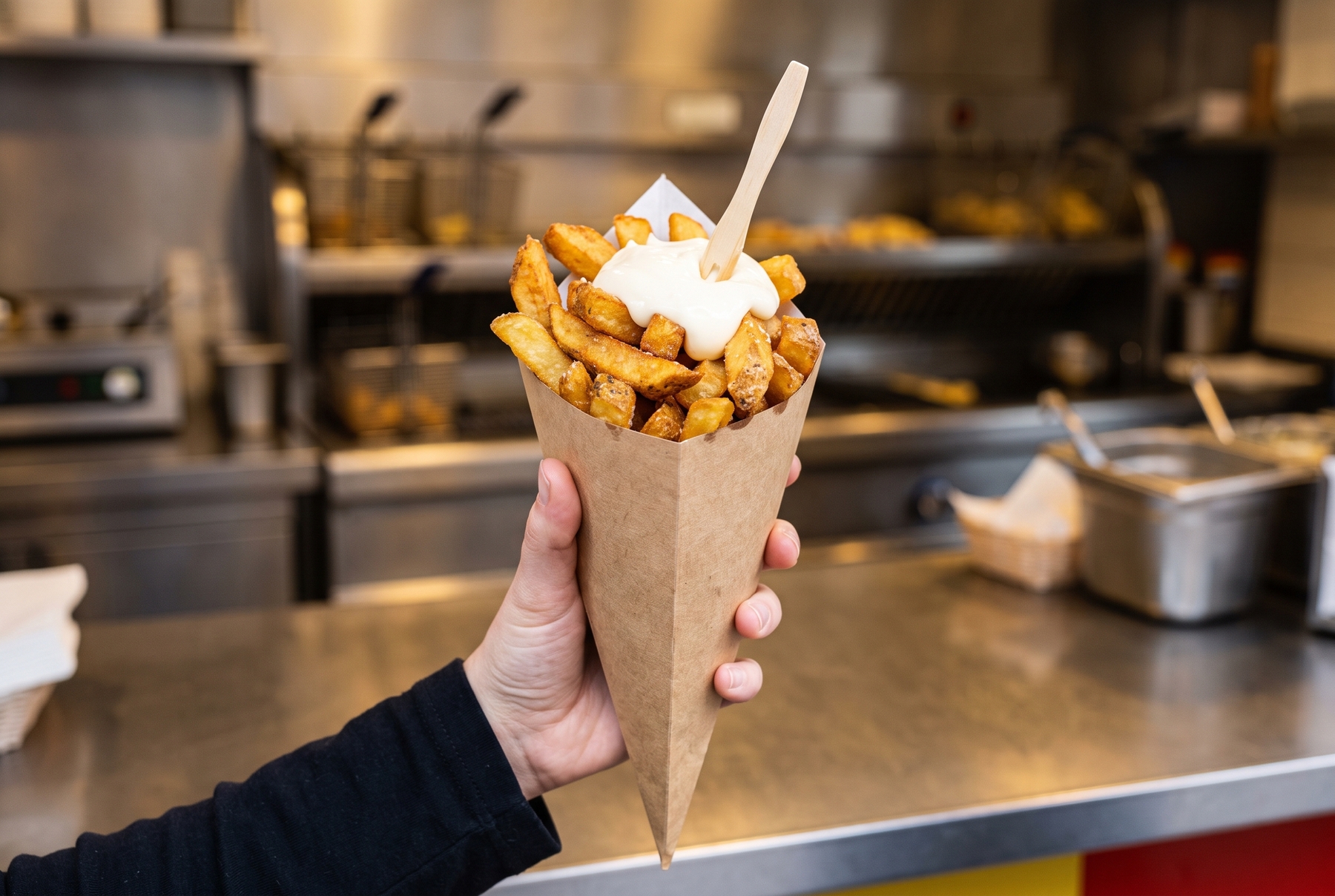
The tradition of double-frying potatoes in beef tallow turned frites into a cornerstone of Belgian culture.
Russian Salad: A Name Older Than Its Most Famous Recipe
The standard textbook summary goes like this: a French chef named Lucien Olivier invented Russian salad in Moscow during the 1860s. That summary runs into an awkward chronological snag.
Recipes titled salade russe (Russian salad) appear in French and English culinary manuals—including works by Antonin Carême and Charles Elmé Francatelli—decades before Lucien Olivier opened his Moscow kitchen. Those mid-19th-century European dishes featured chilled, finely diced cooked vegetables bound with mayonnaise or aspic, frequently garnished with capers, anchovies, lobster, or cured meats.
Why Western chefs dubbed this chilled vegetable medley “Russian” remains fuzzy; it likely stemmed from the fashionable service à la russe dining style or the broader craze for Russian aristocratic aesthetics in Parisian haute cuisine.
The Moscow storyline represents a distinct branch. In the 1860s, Lucien Olivier helmed the prestigious Hermitage restaurant in Moscow, where his signature game-and-seafood dish became the talk of high society. Olivier guarded his formula fiercely and took the exact recipe to his grave in 1883. Reconstructions published later from diners’ memories describe an opulent platter of grouse, crayfish tails, calf’s tongue, caviar, capers, and gherkins dressed in a secret Provençal sauce.
In the 20th century, the dish underwent a dramatic proletarian reinvention. Soviet home cooks preserved the visual geometry—uniformly diced ingredients bound in mayonnaise and served cold—while swapping luxury proteins for affordable state-store staples: boiled potatoes, carrots, canned green peas, pickled cucumbers, hard-boiled eggs, and boiled bologna-style “Doctor’s sausage” or chicken. Inside the former USSR, this beloved New Year’s Eve staple is universally called Salat Olivye; cross the border into Europe or Latin America, and menus call it “Russian salad.”
Meanwhile, the older European lineage kept evolving along the Mediterranean coast. In Spain, nearly every tapas bar serves ice-cold ensaladilla rusa enriched with canned tuna, roasted peppers, and olives. In Italy, insalata russa remains a holiday antipasto of diced vegetables folded into stiff mayonnaise. Across the Balkans, ruska salata anchors winter feasts.
Treating Parisian salade russe, Tsarist Hermitage game salad, Soviet Olivye, and Spanish ensaladilla as a single linear recipe misses the point. Rather than a mislabeled dish like Hawaiian pizza, “Russian salad” acts as an umbrella surname under which an entire extended family of diced mayonnaise salads has gathered over 150 years.
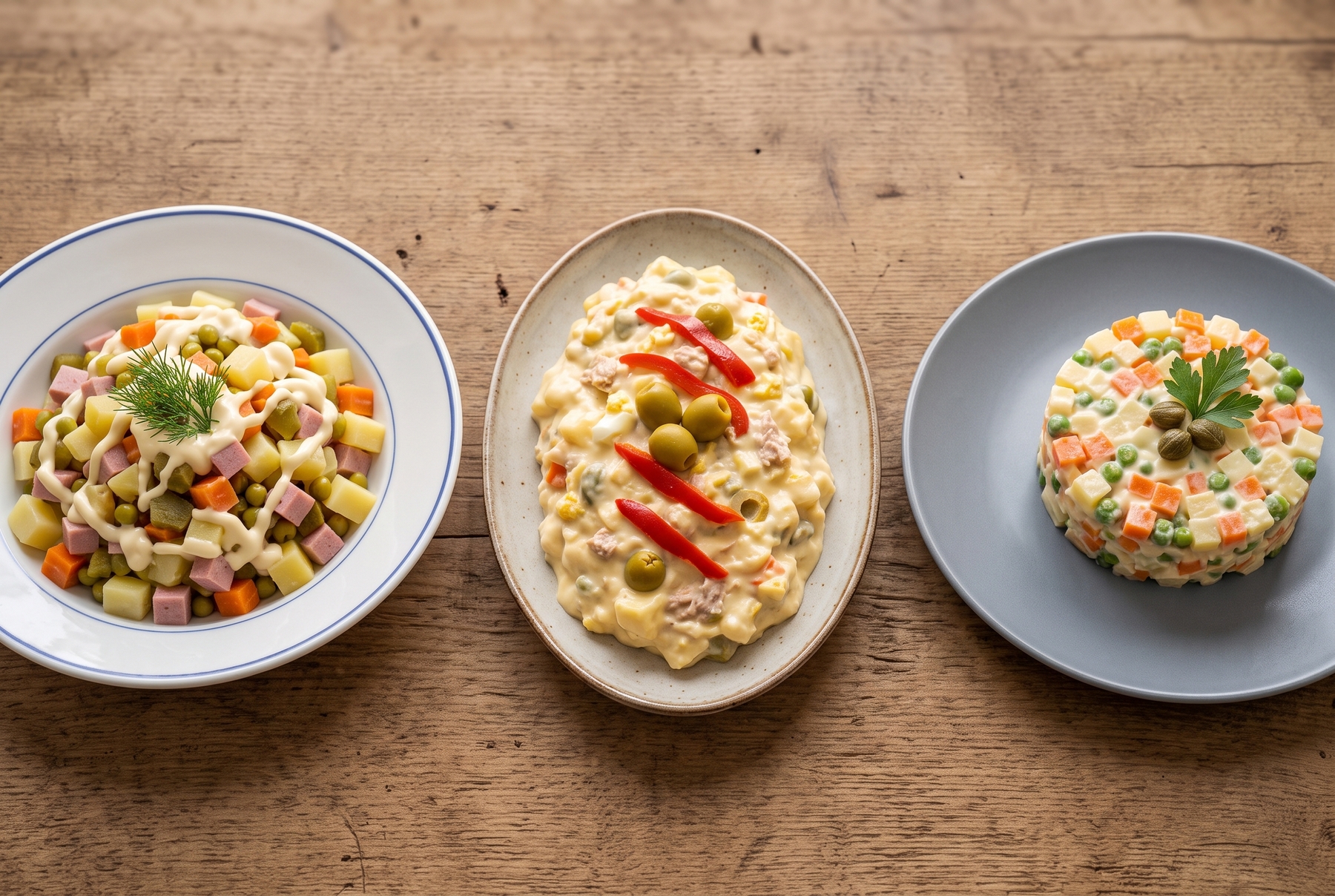
Three branches of the "Russian salad" family tree, ranging from Soviet Olivye to Spanish ensaladilla rusa.
Part 6. When Culinary History Collides With Empires and Identity
Chicken Kyiv: A City Name Doesn’t Settle a Complex Pedigree
Tracing the history of Chicken Kyiv (historically spelled Kiev in English) demands careful precision, as discussions around its origin today carry cultural and political weight alongside culinary interest.
The dish itself is a marvel of culinary engineering: a skinless chicken breast pounded thin, rolled tightly around a chilled log of herb-infused butter, breaded, and fried golden. When prepared correctly, the cold butter core melts into a pressurized reservoir of fragrant liquid that spurts out the moment a diner’s fork pierces the crust.
Unpacking its history requires separating several distinct chronological layers.
Technical predecessors. Nineteenth-century aristocratic kitchens across the Russian Empire operated under heavy French culinary influence: estates hired French chefs, menus were printed in French, and local cooks trained on French techniques for deboning poultry and breading cutlets. Within that repertoire sat the broad category of côtelettes de volaille (poultry cutlets). However, 19th-century stuffed poultry cutlets typically held complex forcemeats, mushroom ragouts, or thick béchamel-based sauces rather than a solid core of raw, chilled butter.
No archival document draws a straight, unbroken line from a specific Parisian recipe to modern Chicken Kyiv; while the French technical toolkit is undeniable, the exact genesis remains debated.
Early printed recipes. Turn-of-the-century Russian-language cookbooks from the late 1800s and early 1900s do feature minced or pounded poultry cutlets enclosing butter fillings under various names (such as Novo-Mikhailovsky cutlets). Even here, historians caution against assuming a neat, single-author invention, as parallel variations existed across major imperial cities.
Emergence of the Kyiv name. The geographic title appears in print earlier than many popular accounts suggest. References to “Kyiv-style cutlets” (kotlety po-kievski) show up in culinary publications and restaurant records by the 1910s, and appear again in early Soviet catering manuals during the 1920s.
What varied during those early decades was the exact structural build—some early recipes used minced poultry rather than a whole pounded supreme breast filet—meaning the name existed before the recipe was permanently standardized.
Global standardization and mass fame. The iconic version known worldwide today—a whole breast filet with the wing bone often left attached, rolled around parsley-garlic butter—was codified inside mid-20th-century Soviet hotel restaurants (most notably the Intourist network that catered to foreign visitors). From there, the dish leaped into Western grocery aisles. In 1979, British retailer Marks & Spencer introduced chilled, ready-to-bake Chicken Kiev to UK supermarkets, transforming a high-maintenance restaurant showpiece into a wildly popular convenience dinner.
Cultural symbol. Today, the dish stands as a proud culinary emblem of Kyiv and Ukraine globally. In recent years, international food media, restaurants, and major retailers across the English-speaking world have officially updated their spelling from the Russian-derived “Kiev” to the Ukrainian transliteration “Kyiv.”
Attempting to force a 19th- and early 20th-century culinary evolution—which unfolded across transnational imperial kitchens, restaurant guilds, and shifting borders—into a simplistic modern patent dispute distorts history. When historical archives show a gradual, multi-city evolution, the most honest approach is to lay out every layer of the record.
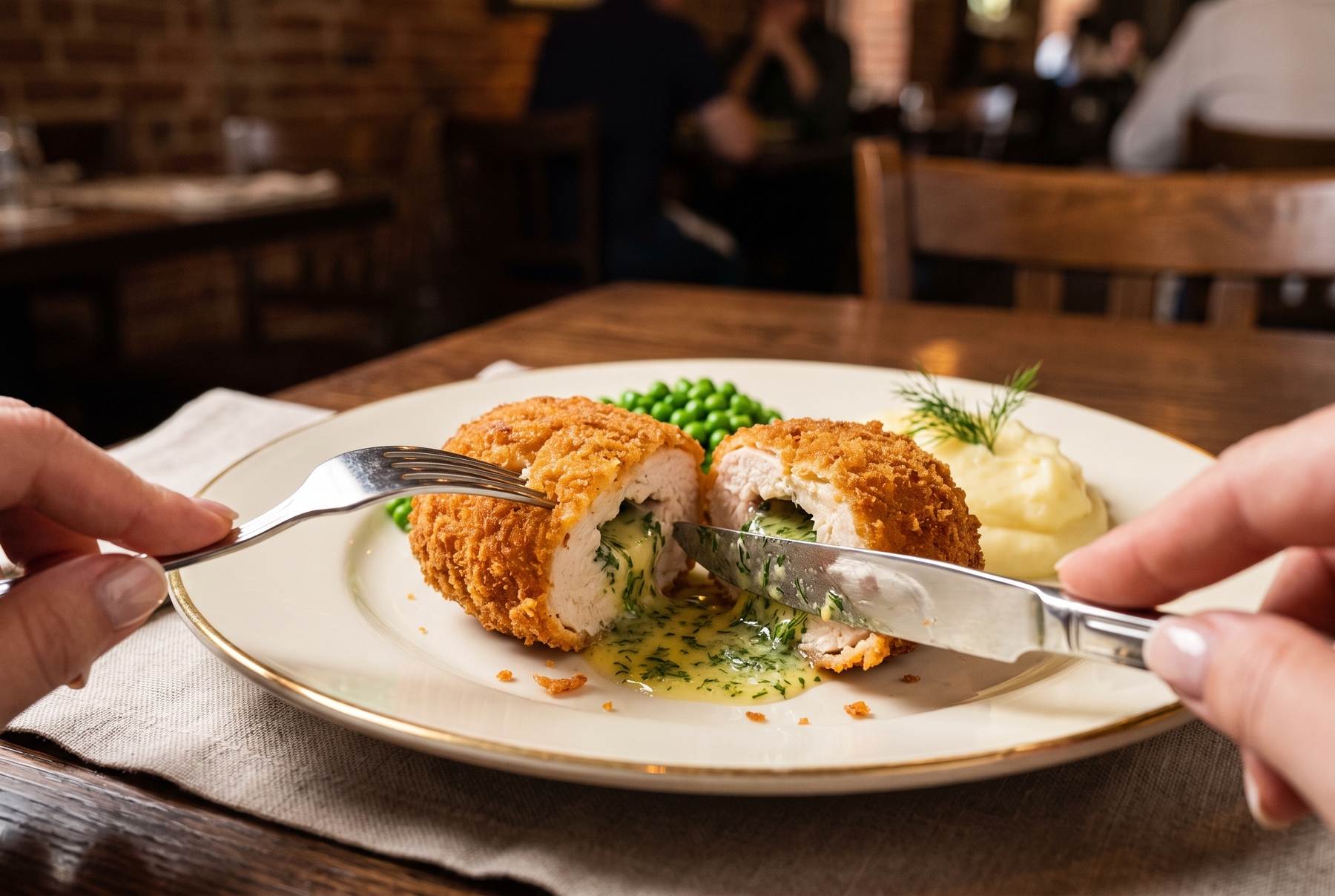
Chicken Kyiv wraps a pounded chicken breast around a chilled core of garlic-and-herb butter.
Part 7. Why Asking “What Nationality Is This Dish?” Is the Wrong Question
A single dish can legitimately hold multiple geographic identities at once without contradiction:
- the homeland of its technical predecessor;
- the place where its modern recipe crystallized;
- the immigrant community that adapted and championed it;
- the commercial hub that broadcast it to the rest of the world;
- the national culture with which diners associate it today.
Consider the pattern: Danish pastry borrowed its lamination technique from Vienna, yet perfected its sweet, buttery identity in Copenhagen. Chicken tikka masala rests on South Asian tandoori foundations, yet owes its restaurant formatting and global fame to Bangladeshi and Indian chefs working in Britain. The California roll relies on Japanese sushi craft, yet was engineered in North America before being exported back to Tokyo. Spaghetti and meatballs draws from Italian culinary DNA, yet its canonical big-portion form is unmistakably American.
Asking “what country does this food come from?” flattens a three-dimensional journey into a single point. Technique, modern assembly, popularization, and cultural ownership frequently point to four different compass headings.
How to Fact-Check a Romantic Food Origin Story
You do not need a university archive pass to spot culinary mythology. Raise a skeptical eyebrow whenever a food origin story:
- claims to know the exact afternoon a dish was born two centuries ago;
- stars a famous monarch, a battlefield general, a war, or a furious aristocrat;
- hinges on the trope that “the chef ran out of food and threw leftover scraps into a pot”;
- assigns exclusive copyright to a single modern nation-state for a dish that evolved inside a multi-ethnic empire or porous borderland;
- uses the dish’s name as its sole piece of historical evidence;
- insists that “nobody in Country X ever eats this”—which often just reveals the speaker’s unfamiliarity with regional or diaspora variations;
- gets repeated word-for-word across hundreds of blogs without citing a single period menu, newspaper, or cookbook.
To trace how a dish truly evolved, look instead to dated print cookbooks, digitized newspaper archives, historical restaurant menu collections, immigration history, and peer-reviewed culinary scholarship. Tracking how a recipe’s title shifted over fifty years—and comparing the earliest printed ingredient list against what lands on the plate today—almost always tells a richer story than any legend.
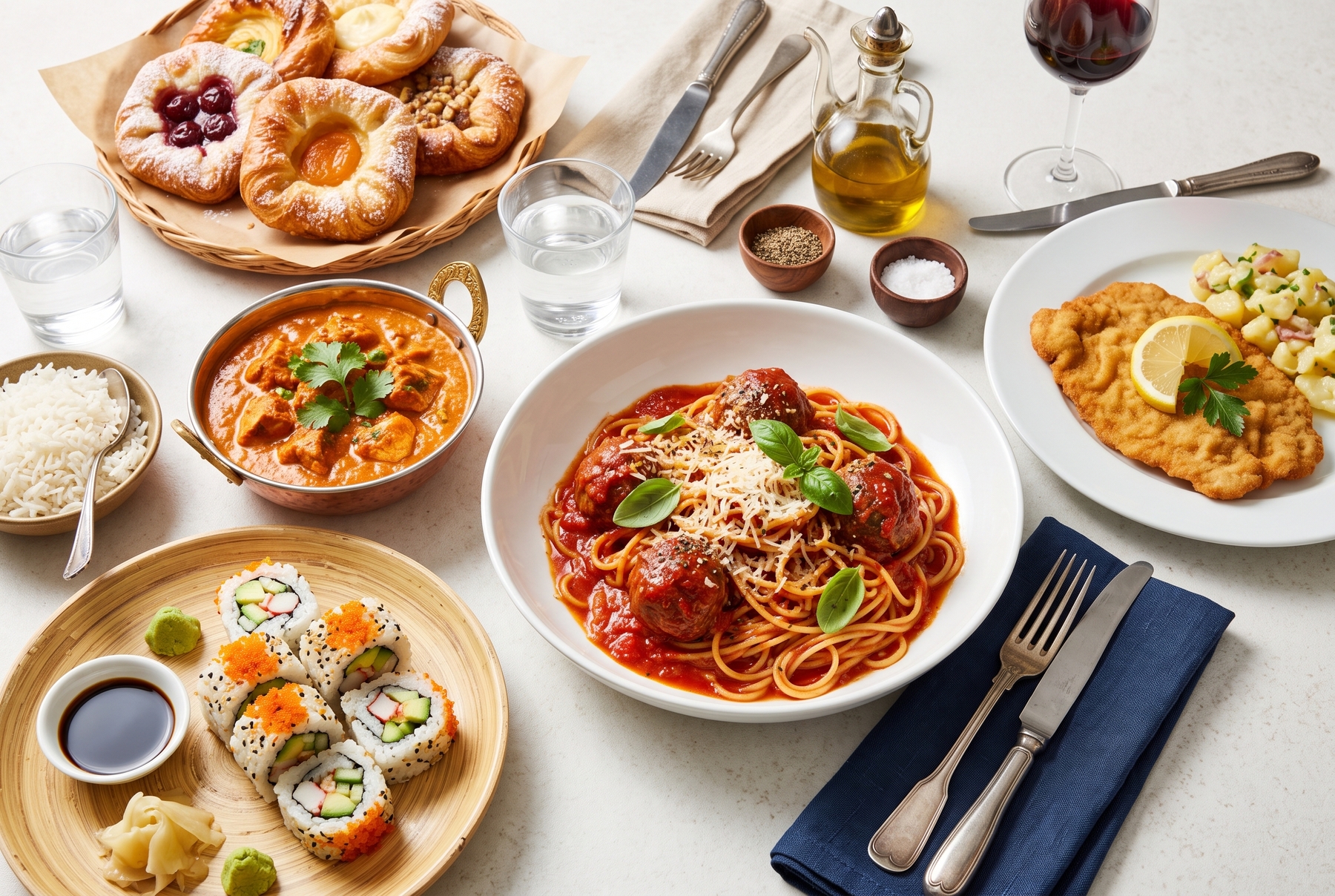
A map of traveling recipes: how dishes transform as they cross cultural borders.
Cheat Sheet: The True Trajectories of 20 Famous Dishes
| Dish | Popular Assumption | Historical Reality |
|---|---|---|
| Caesar Salad | Italy or the United States | Invented in Tijuana, Mexico (1920s) by Italian immigrant restaurateur Caesar Cardini |
| Hawaiian Pizza | Hawaii (USA) | Created in Chatham, Ontario, Canada (1962); named after a brand of canned pineapple |
| Singapore Noodles | Singapore | A Cantonese and Hong Kong restaurant creation using British-introduced curry powder |
| Danish Pastry | Denmark | Lamination technique brought by Austrian bakers in 1850; known in Denmark as wienerbrød (Viennese bread) |
| Fortune Cookies | China | Evolved from Japanese tsujiura senbei crackers; popularized by Chinese-American restaurants during WWII |
| Chop Suey | China | Forged in Chinese-American kitchens; linked to Taishanese home cooking concepts, though exact lineage is debated |
| General Tso’s Chicken | Mainland China | Hunanese general’s name; created as a savory dish in Taiwan, then sweetened in 1970s New York City |
| Spaghetti and Meatballs | Italy | Shaped by Italian-American immigrants adapting to cheap American beef and canned tomatoes |
| Chicken Parmesan | Italy | Italian-American poultry adaptation of southern Italy’s meatless eggplant parmigiana |
| Fra Diavolo | Italy | Italian literary/historical name attached to an early 20th-century New York Italian-American seafood pasta |
| German Chocolate Cake | Germany | Named after American chocolate maker Samuel German; 1957 Texas recipe lost its possessive apostrophe |
| Scotch Egg | Scotland | English origins; Fortnum & Mason claims 1738, print records start in early 1800s, possible South Asian kofta influence |
| Baked Alaska | United States (Alaska) | European culinary predecessors (including French omelette norvégienne); named in New York after the 1867 Alaska Purchase |
| Wiener Schnitzel | Austria | Codified in Vienna; broader European breaded-meat roots; the Field Marshal Radetzky Milanese legend lacks proof |
| Chicken Tikka Masala | India | South Asian tandoori chicken base married to a spiced tomato-cream gravy inside British curry houses |
| Chicken Kyiv | Ukraine | French-influenced imperial roots; Kyiv name printed by 1910s; modern butter-core filet standardized in the mid-20th century |
| French Fries | France or Belgium | Early frying origins disputed between Paris and the Meuse valley; Belgium perfected the double-fried culture |
| Nachos | United States | Invented in Piedras Negras, Mexico (1940s) by Ignacio “Nacho” Anaya for visiting Texas shoppers |
| California Roll | Japan | North American inside-out sushi adaptation from the 1960s/70s; claimed by chefs in both Los Angeles and Vancouver |
| Russian Salad | Russia | Term appeared in Western Europe before Moscow’s 1860s Olivier salad; evolved into a diverse global family of mayonnaise salads |
Plotting these twenty dishes onto a world map produces migration routes rather than static pins: from Vienna to Copenhagen, from South Asia to Britain, from Kyoto to California, from southern Italy to New York tenements, from Guangdong and Taipei to Western Chinatowns, and from Mexican border towns straight into global pop culture.
And despite originating in an Ontario diner, Hawaiian pizza kept its tropical name anyway.
0 comments