
Imagine standing at the fish counter. A sea bream lies on crushed ice, staring at you with silent reproach. The price tag looks like a monthly gym membership. Nearby, an octopus costs about as much as a weekend getaway. You sigh, drop discounted chicken thighs into your basket, and walk home with a quiet realization that Mediterranean longevity is a privilege reserved for those with a different passport and a thicker wallet.
I understand this feeling. My parents moved from Russia to Italy when I was three. I grew up between two cuisines: Bolognese, where olive oil flowed like water, and domestic, where on Sundays they cooked borscht and salted salo (cured pork fatback). And you know what I realized after twenty years as a nutritionist? Neither borscht nor salo was the problem. The problem was the myth that healthy eating must speak with an Italian accent. Let us drop this narrative—you do not need a Schengen visa for the Mediterranean diet.
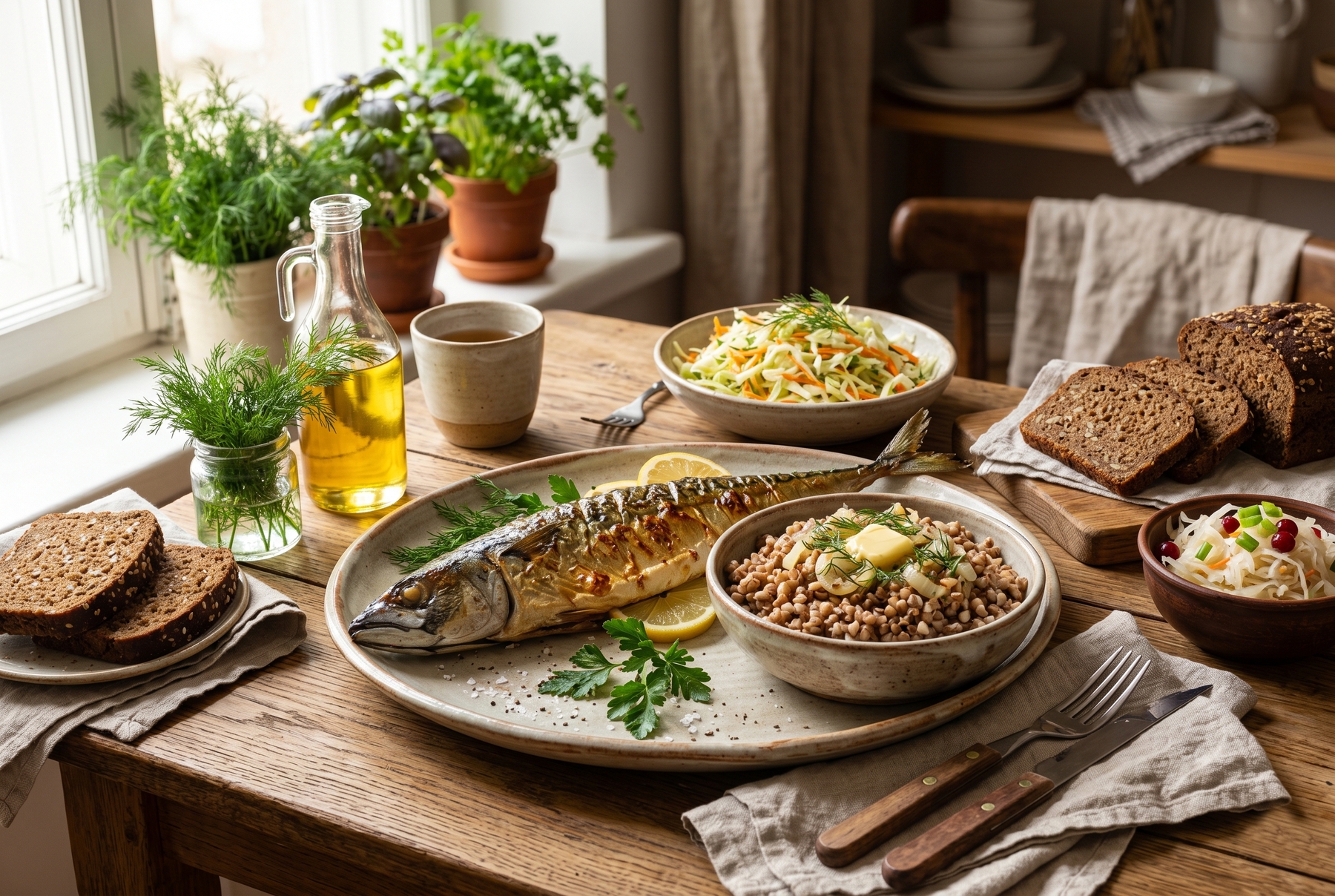
An example of an ideally balanced lunch: baked mackerel, fluffy buckwheat, and a fresh cabbage salad.
Table of Contents
Geography Does Not Matter, Chemistry Does
The Mediterranean diet is not a grocery list. It is not dorado, quinoa, artichokes, or even that olive oil in a beautiful tin can with an olive branch. All of this is merely a local adaptation of general rules.
When scientists in the 1950s began studying why residents of Mediterranean villages lived long and rarely suffered from cardiovascular diseases, they found no magic ingredient. The secret turned out to be yawn-inducing: it is all about proportions. A high ratio of omega-3 to omega-6 fatty acids. A large amount of fiber from vegetables, legumes, and whole grains. Sufficient protein, primarily from fish and poultry. Moderate consumption of red meat. Minimal sugar and industrial processing. And finally, shared meals without rushing.
None of these principles are tied to a specific sea.
Omega-3 is not about dorado. It is about EPA and DHA fatty acids, which reduce systemic inflammation, support vascular health, and boost brain function. A fascinating fact is that ordinary Atlantic mackerel contains about 2.5 grams (0.09 oz) of omega-3 per 100 grams (3.5 oz)—this is one and a half to two times more than dorado. Baltic herring offers roughly 1.5 to 2 grams (0.05 to 0.07 oz). Canned sprats in tomato sauce have significantly less, but they are still in the game. Meanwhile, a fresh dorado that flew on an airplane and sat on ice for three days has already lost some of its valuable fats due to air exposure.
This does not mean dorado is bad. It means mackerel is just as good, and it costs eight times less.
The same goes for oil. Cold-pressed olive oil is wonderful exactly because it is unrefined and rich in monounsaturated fatty acids and polyphenols. However, unrefined cold-pressed sunflower oil—the dark one with a bright, nutty seed aroma—is also rich in vitamin E and linoleic acid. Flaxseed oil yields a record amount of ALA, a plant-based omega-3 precursor to EPA and DHA. And camelina oil (which was highly respected in Russia long before the olive oil trend) offers an omega-3 to omega-6 balance that is a true gift for our bodies.
There is no culinary magic here. It is just basic biochemistry that works exactly the same in Naples and Novosibirsk.
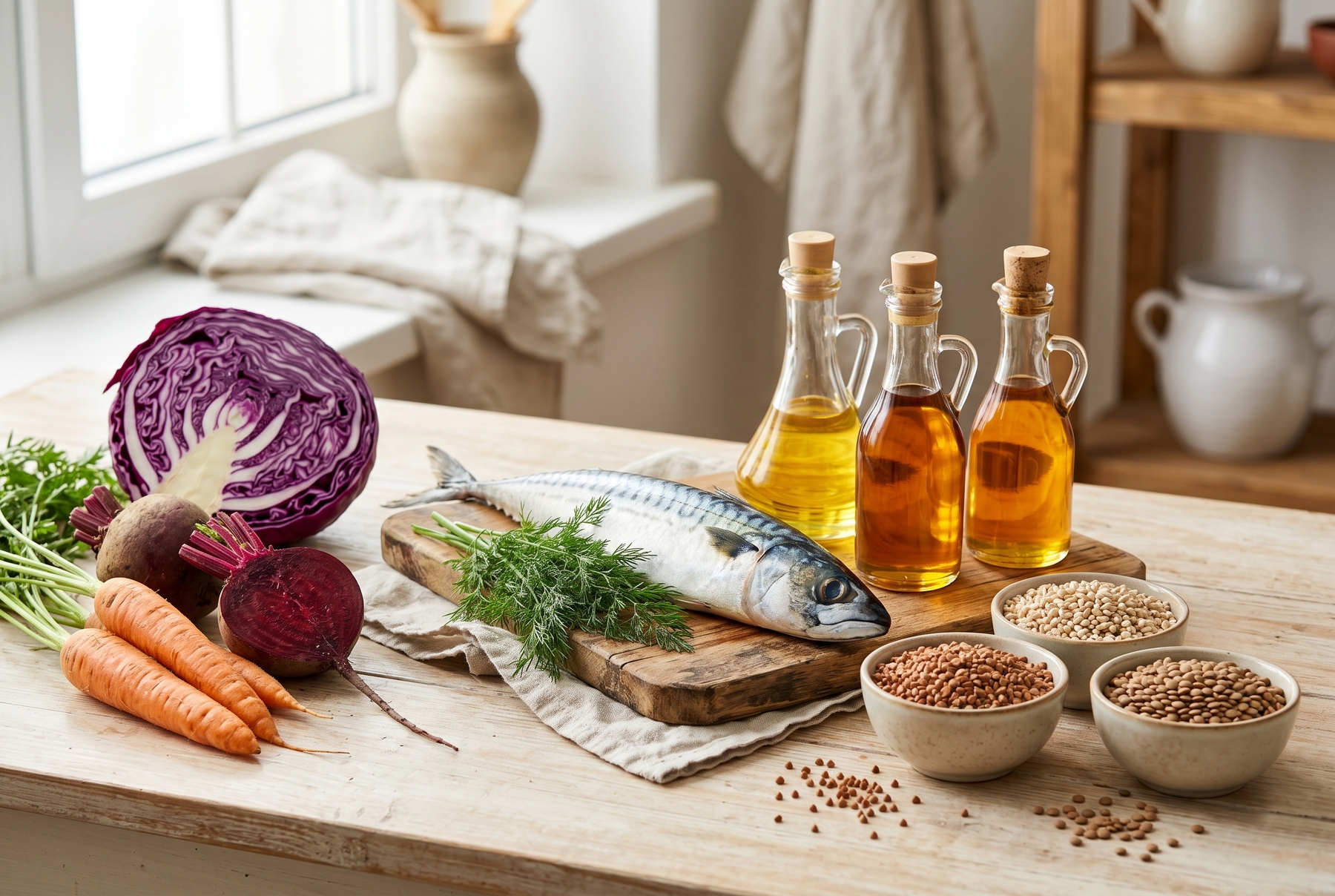
Simple and accessible foods—mackerel, root vegetables, and unrefined oils—form the foundation of a healthy diet.
Substitution Table: A Cheat Sheet For Your Refrigerator
I give this cheat sheet to clients so they stop blowing half their income in supermarkets. Print it, hang it on your refrigerator, and let us end this food snobbery once and for all.
Fats And Oils
Instead of olive oil for salad dressings, use unrefined cold-pressed sunflower, flaxseed (only for cold dishes, never heat it), camelina, or mustard oil. For frying, high-oleic refined sunflower oil or clarified butter (ghee) works perfectly, as both have a high smoke point, do not burn easily, and offer better oxidative stability when heated.
Fish And Seafood
Instead of dorado, sea bass, and tuna, opt for mackerel (fresh-frozen or hot-smoked, though be careful with salt), lightly salted herring, sprats, capelin, or pollock. Pollock deserves a special mention: it is an absolutely underrated fish with excellent protein, near-zero fat, and a price that does not cause an existential crisis. Canned tuna in water also works well if not overused; due to potential mercury content, it is best eaten no more than twice a week.
Vegetables
Instead of artichokes and zucchini—or rather, not “instead of,” because they are magnificent—embrace cabbage of all kinds: white, red, broccoli, cauliflower, and Brussels sprouts. Beets offer fantastic betaine and antioxidants. Carrots, pumpkins, and squashes are also great choices; they are widely available locally, but we tend to underestimate them. Kvashenaya kapusta (traditional Russian sauerkraut fermented without vinegar) in winter is a whole different story that we will return to later.
Grains And Cereals
Instead of quinoa and bulgur, choose buckwheat (grechka). As a nutritionist, I can confidently say that buckwheat is one of the best pseudocereals in the world. It boasts a complete amino acid profile, plenty of magnesium, rutin for vascular health, and zero gluten. Pearl barley is an unfairly forgotten grain with a high content of beta-glucans, the very compounds for which oatmeal is so highly praised. Brown rice and whole-grain sourdough bread—provided you find a real loaf, not a caramel-dyed one—are also excellent.
Legumes
You do not need to substitute anything here. Lentils, chickpeas, beans, and peas are equally good everywhere. Just eat them more often. Mediterranean people consume legumes four to five times a week, while most of us barely manage once. This is the simplest step toward a healthy diet.
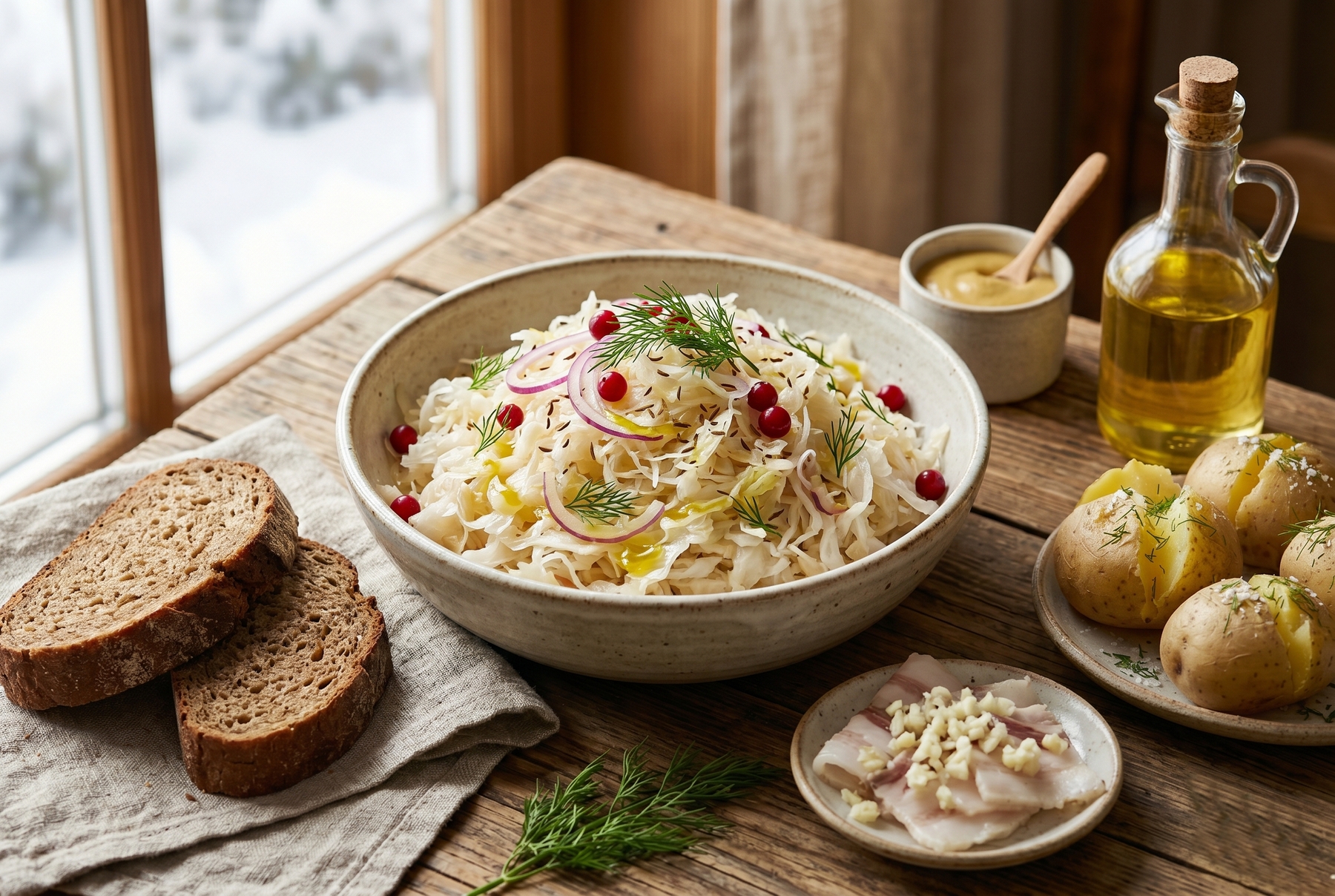
Traditional kvashenaya kapusta is a powerful fermented superfood that supports immunity and digestion.
The Lazy Mediterranean: Life Hacks For The Exhausted
I work with people who have children, deadlines, mortgages, and at best, twenty minutes for lunch. Therefore, you will find no meditative cherry tomato chopping and no three-day eggplant marinating here.
The Formula For Laziness: How To Save Boring Buckwheat In 3 Minutes
You cooked some buckwheat. Good. Did you find boiled carrots or leftover braised cabbage nearby? Excellent. Now we add three things that will turn this into a restaurant-quality bowl:
- A touch of acidity—a drop of lemon juice, apple cider vinegar, or white wine vinegar. Acidity instantly elevates the flavor and makes the dish feel vibrant rather than institutional.
- Something crunchy—a handful of sunflower, pumpkin, or sesame seeds, or walnuts. Textural contrast separates food you want to eat from food you have to eat.
- A spoonful of good oil—unrefined sunflower or flaxseed. This goes in at the very end, never into a hot pan.
That is it. Your lunch is assembled from whatever you had on hand, but it features a perfect nutritional profile.
Saving A Culinary Disaster: A Fish Pâté Out Of Catastrophe
You bought a frozen fillet of white fish, like pollock, hake, or cod. You thawed it, placed it in a pan, and it predictably fell apart into a sad, watery mush. Take a deep breath, put down the spatula you unsuccessfully tried to flip it with, and do the following.
Mash whatever is left with a fork. Mix in finely chopped dill or parsley, a clove of pressed garlic, a drop of unrefined oil, a pinch of salt, and, if available, a teaspoon of mustard. Stir it well. Spread it on a toasted slice of dark rye bread.
Congratulations. You just prepared what Scandinavian restaurants serve as “fish rillettes” and confidently charge a premium for. Yours will taste better because gentle cooking and fresh herbs provide an honest flavor profile, while the dark bread with its rye tang completes the dish.
Kvashenaya Kapusta As A Mediterranean Superfood
This is not a joke. Fermented foods—such as kvashenaya kapusta (sauerkraut), kefir (a fermented milk drink), and natural yogurt without additives—contain live bacterial cultures that support the gut microbiome. A healthy microbiome is currently at the center of evidence-based medicine, dictating immunity, mood, and metabolism. Traditional Mediterranean cuisine is rich in fermented foods like olives, cheeses, and yogurt. Our cuisine is rich in fermented cabbage, pickles, and kefir. It is simply not inferior.
During winter, kvashenaya kapusta is absolutely indispensable. It retains vitamin C, which is catastrophically lacking during this season, along with lactic acid bacteria and fiber. If the Mediterranean diet had been invented in Siberia, fermented cabbage would sit at the very center of the food pyramid.
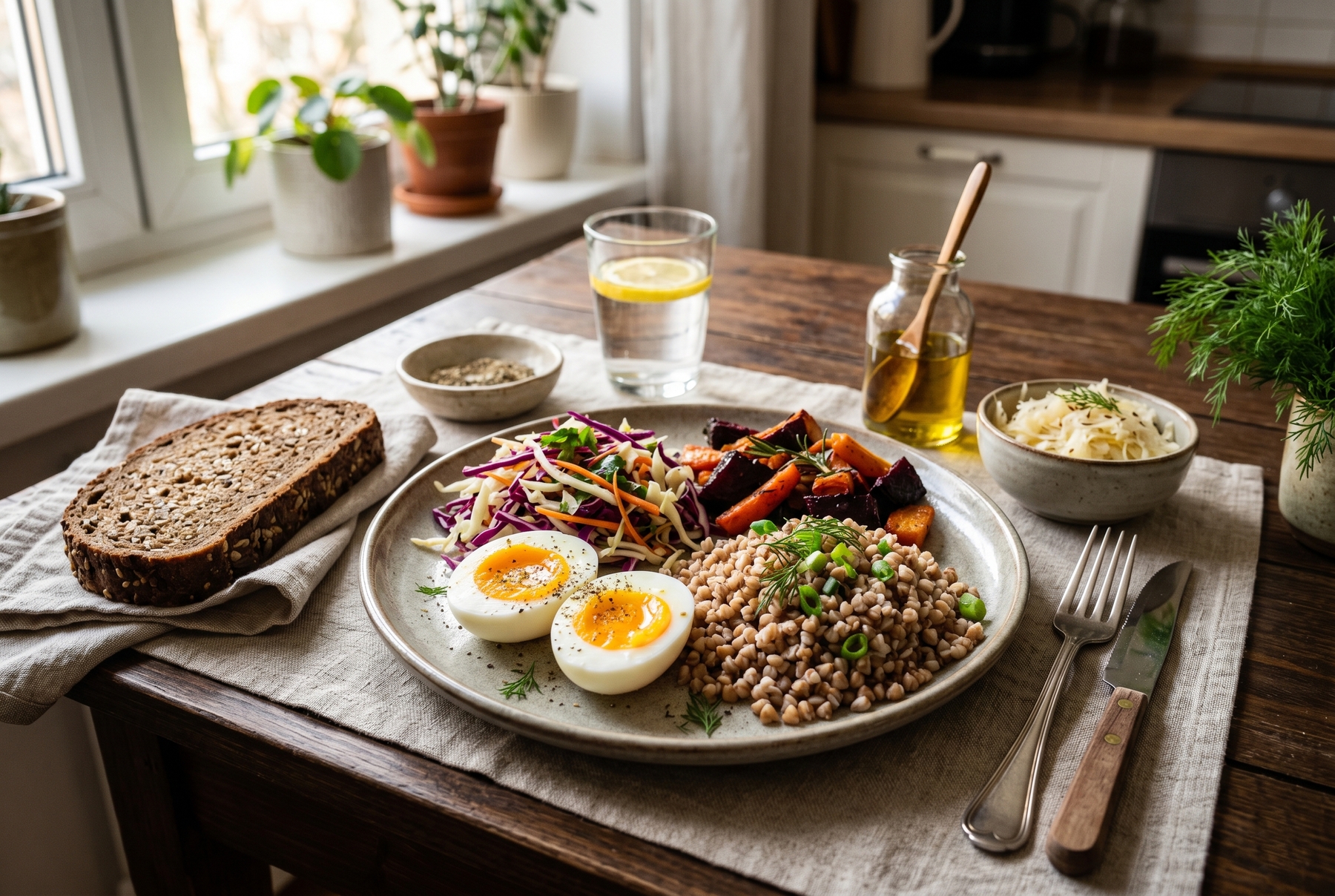
Visualizing the healthy plate rule: 50% vegetables, 25% protein, and 25% complex carbohydrates for longevity.
Assembling The Plate: A Simple Constructor For Every Day
Forget about calorie counting if it exhausts you. Instead, rely on a simple visual model that applies to any dish in any context.
Half The Plate – Vegetables And Greens. You can use any kind, any color, in any form. Fresh, boiled, braised, or fermented. In winter, enjoy braised pumpkin with thyme, baked beets, or cabbage salad with carrots. In summer, eat whatever is at the market. Different colors mean a different set of phytonutrients—that is pure science.
A Quarter Of The Plate – Grains Or Legumes. Buckwheat, pearl barley, lentils, or chickpeas provide slow carbohydrates, satiety, and fiber. This slow energy ensures your blood sugar remains stable, preventing a frantic run to the refrigerator an hour later.
A Quarter Of The Plate – Protein. Fish (that same mackerel or pollock), eggs, poultry, or legumes if they are not already occupying the other quarter. Two or three times a week, you might incorporate low-fat cottage cheese (tvorog) or kefir as a separate snack.
A Spoonful Of High-Quality Fat—oil in your salad, a handful of nuts, or a few slices of avocado if the season and your wallet allow. Fat is not an enemy. Fat ensures the absorption of fat-soluble vitamins A, D, E, and K, bringing both satiety and flavor.
That is the entire diet. It requires no exhausting detox marathons, fainting from hunger, or self-flagellation over a piece of birthday cake. It is just normal, healthy food.
Your Dacha Is Your Mediterranean
When I visit my parents and see my mother cutting dill straight from the garden bed and dropping it into freshly boiled potatoes, I think this is exactly it. This is the essence. Fresh, seasonal food, grown nearby, eaten with pleasure and without anxiety.
The Mediterranean diet became a symbol of healthy eating not because Greeks and Italians discovered a secret ingredient. They simply lived a long time in harmony with what grew around them. People ate fish because the sea was near. They poured olive oil because olive trees covered every hillside. They crafted cheese from whatever milk was available. And they gathered around the table because food is a ritual of connection, not mere fuel.
You have your own sea, and that is not a metaphor. You possess fermentation traditions that dietitians worldwide envy. You have buckwheat, which would easily defeat quinoa in a fair nutritional fight. You have kvashenaya kapusta, which will outlive any trendy superfood. And, if you are lucky enough to have a country house (dacha) or even a balcony, you have dill that stubbornly grows on its own, even if you forgot to water it all summer.
0 comments