
It is tempting to rank bread on a simple hierarchy. White bread sits at the bottom, whole grain occupies the middle, and tangy, blistered-crust sourdough claims the very top. The scale looks neat, yet it fails in practice. Two loaves bearing the exact same buzzword on the wrapper can differ more drastically than a white baguette and a dark rye: one lists whole wheat flour as the primary ingredient, while the other buries it in eighth place, trailing behind sugar, malt, and vegetable oil.
Consequently, the question of whether white, whole grain, or sourdough bread is healthier has no universal answer. A far less glamorous but much more practical approach examines what actually goes into a specific loaf and what role it plays at your table. Examining the ingredient list comes first, followed by a closer look at whole grains and sourdough fermentation, before returning to the classic white baguette.
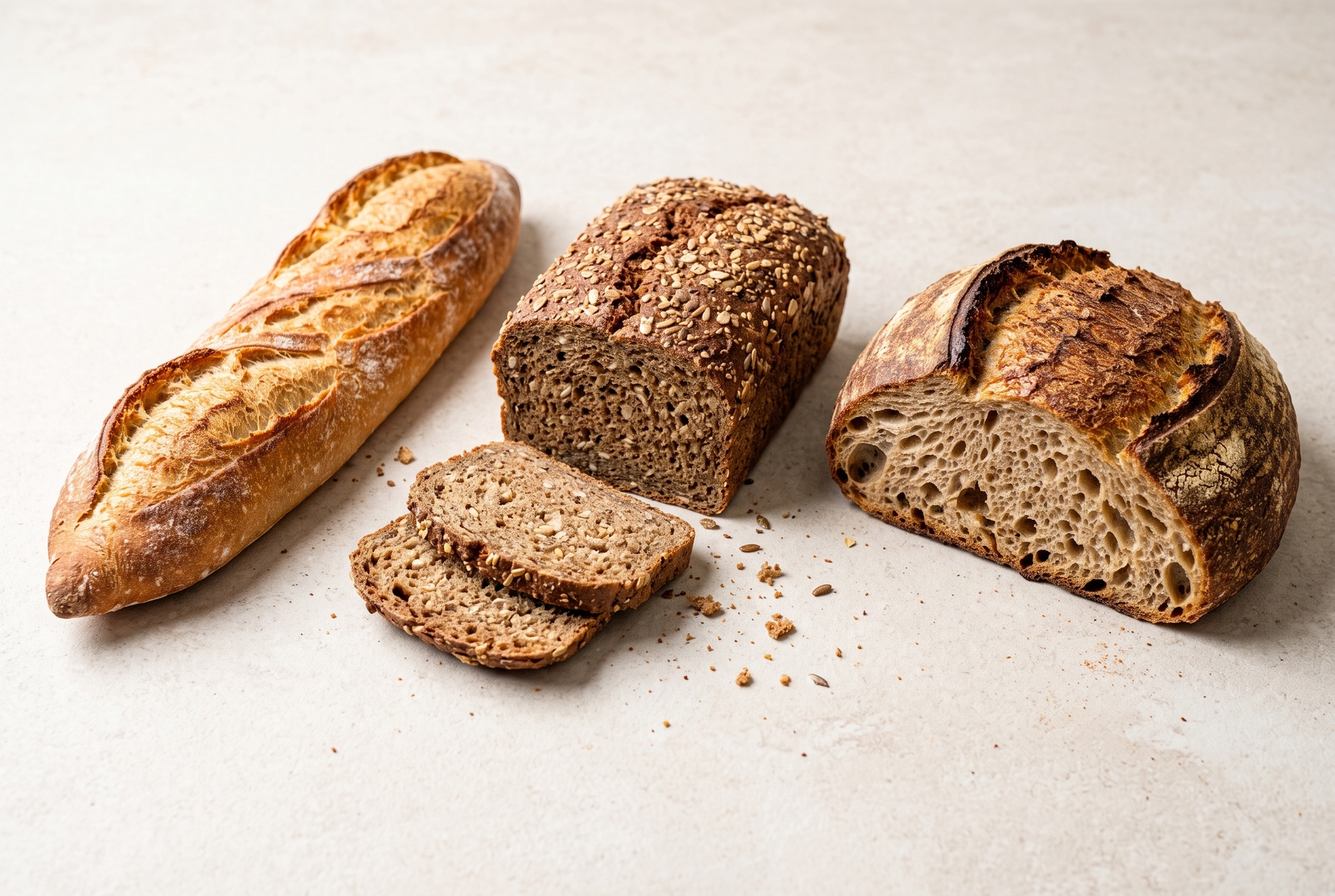
A white baguette, a dense seeded whole grain loaf, and an airy sourdough bread shown in cross-section.
Table of Contents
- How to Choose Bread by Its Ingredients: Why Crumb Color and Front-Label Claims Matter Less Than You Think
- What the Grain Loses on Its Way to Becoming White Flour
- How Whole Grain Bread Truly Differs
- Sourdough Bread: What Fermentation Changes, and What It Leaves Untouched
- Is Whole Grain Bread Always Healthier Than White?
- How to Choose Bread at the Grocery Store: 5 Things to Check on the Label
- How to Build a Sandwich So the Bread Type Stops Being the Main Question
How to Choose Bread by Its Ingredients: Why Crumb Color and Front-Label Claims Matter Less Than You Think
A dark crumb proves nothing on its own. That deep hue can come from rye flour, fermented rye malt, molasses, or occasionally plain caramel coloring. A loaf with a smooth brown crust and an even, grayish-brown interior often consists of refined white flour tinted and scented with malt. It smells wonderful, yet that aroma has no connection to the actual whole grain content.
The word “sourdough” tells a different story with a similar outcome. Sourdough indicates the fermentation method, meaning lactic acid bacteria and wild yeasts leavened the dough. That single term reveals neither the flour grade nor the nutritional value of the bread. Furthermore, it does not rule out commercial baker’s yeast: industrial bakeries frequently spike sourdough with standard yeast for a predictable rise, and the package still legally calls the product sourdough bread. Refined white flour fermented with a starter remains refined white flour.
Evaluating a loaf requires looking at several factors simultaneously: the type of flour, the true proportion of whole grain, the dietary fiber content, the sodium level, and the amount of bread a person eats in a typical day. None of these metrics paints the full picture in isolation.
What the Grain Loses on Its Way to Becoming White Flour
A wheat kernel consists of three distinct parts: the outer layers (which become bran after milling), the tiny nutrient-rich germ, and the large, starchy endosperm inside. Milling refined white flour (known in Eastern European grading systems as “highest grade” flour) strips away the bran and the germ, leaving almost pure endosperm. This process creates the bright white color, silky texture, and neutral flavor.
Removing the outer layers strips away the vast majority of dietary fiber, while discarding the germ eliminates a significant portion of B vitamins, magnesium, vitamin E, and natural oils. Because the lipid-rich germ turns rancid quickly, whole grain flour has a noticeably shorter shelf life than white flour. Refined white flour sits stably in a sack for months and bakes with reliable predictability.
Even so, white bread is neither “empty” nor “toxic.” It provides starch, a modest amount of protein, and serves as a normal component of an everyday diet. When a person’s meals regularly include vegetables, legumes, whole grains, nuts, and fruit, pairing a slice of baguette with a bowl of lentil soup does not degrade the overall quality of their nutrition. Dietary quality depends on the entire plate, not a single slice of bread.
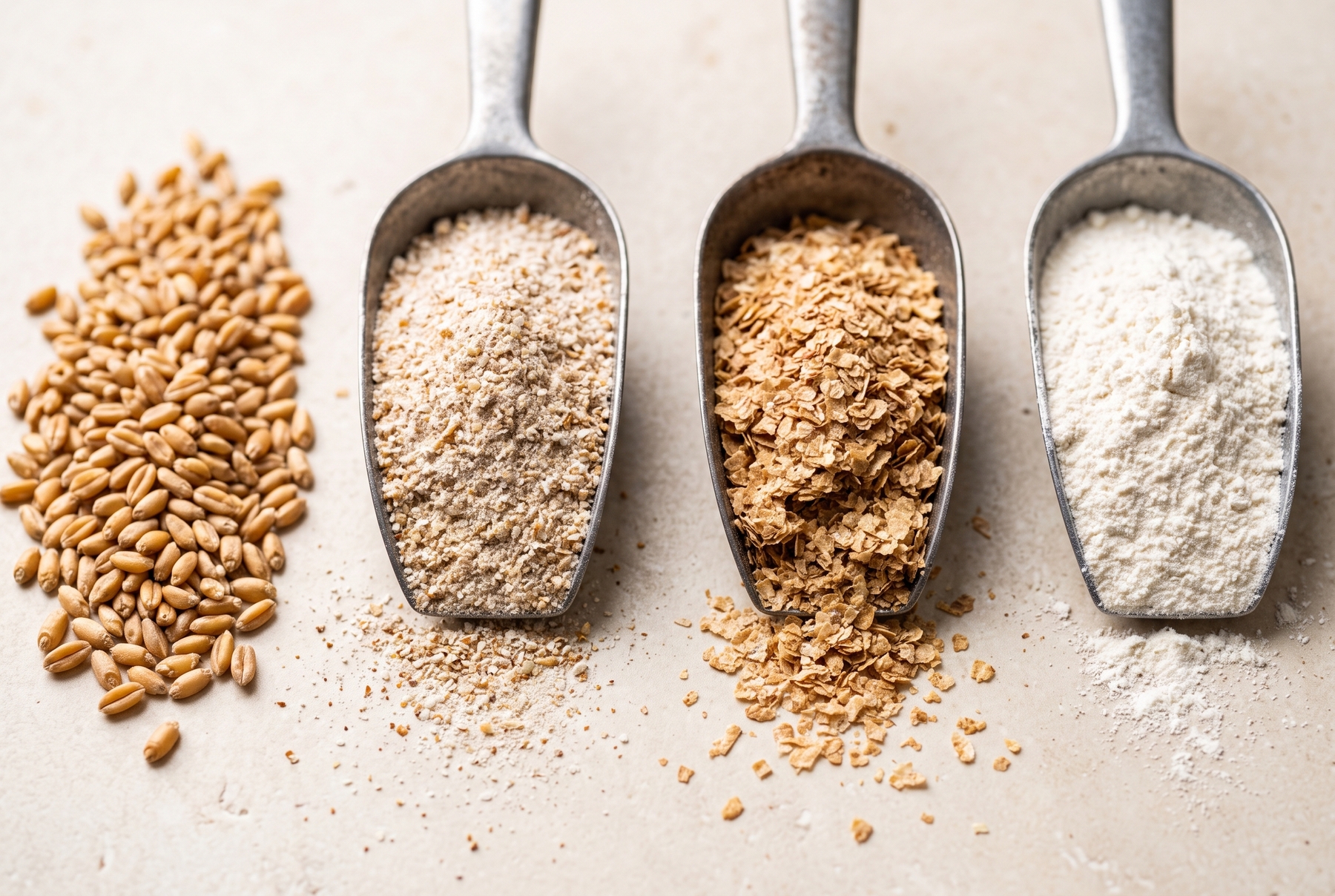
Wheat kernels and their milled counterparts: whole wheat flour, bran with germ, and refined white flour.
How Whole Grain Bread Truly Differs
Whole grain flour retains nearly the entire kernel, keeping the bran and germ intact. This preservation yields significantly more dietary fiber, minerals, and B vitamins. A simple, everyday physical difference also emerges: whole grain bread is denser, demands more chewing, and slows down the pace of eating.
By comparison, standard white bread made from refined wheat flour typically contains about 2–3 g (0.07–0.11 oz) of dietary fiber per 100 g (3.5 oz), whereas a loaf made with a high proportion of whole grain flour frequently delivers 6–7 g (0.21–0.25 oz). Across a single sandwich, the gap looks modest. Over the course of a week, however, the difference adds up noticeably, especially when a diet lacks abundant vegetables. The World Health Organization (WHO) recommends that adults consume at least 25 g (0.88 oz) of naturally occurring dietary fiber daily and build the carbohydrate portion of their diet primarily around whole grains, vegetables, fruits, and legumes.
Discussing long-term health outcomes requires caution, as the scientific evidence relies heavily on observational data. In a major meta-analysis of prospective studies, higher whole grain consumption—around 90 g (3.2 oz) per day, or roughly three servings—correlated with a lower risk of coronary heart disease and cardiovascular disease overall. This association held true for whole grain bread specifically, while refined grain intake showed virtually no such benefit. Correlation and proven causation are not identical: people who eat more whole grains typically maintain other health-conscious habits as well. Promising a specific health outcome to an individual simply for swapping loaves would be misleading.
Satiety offers a more straightforward discussion. Dietary fiber adds bulk to food, slows gastric emptying, and requires real work from the jaws. Many people notice that two slices of whole grain bread topped with cream cheese carry them comfortably to lunch, whereas three slices of white toast leave them hungry mid-morning. Satiety remains individual, but anyone can test this effect over a week of breakfasts.
How to Distinguish True Whole Grain Bread from Loaves with a “Healthy” Appearance
The front of the package sells the loaf, while the ingredient list tells the truth. Under standard food labeling regulations (including FDA rules and Eurasian Economic Union technical standards), manufacturers must list ingredients in descending order by weight at the time of manufacture, making this the single most useful line on the label.
Key details warrant close attention on the back label:
Checking the very first ingredient is the best starting point. When “refined wheat flour” or “enriched wheat flour” opens the list and whole wheat flour appears fifth, the product is predominantly white bread with a minor whole grain addition.
Examining the exact terminology for the flour comes next. The clearest designations are “whole wheat flour,” “whole grain wheat flour,” or “whole rye flour.” On Russian and Eastern European labels, the traditional milling term “oboynaya” (referring to unbolted coarse wholemeal flour) often confuses shoppers, even though it refers directly to a single-pass grind that retains all the outer bran layers. Rolled flakes, cracked grains, and multigrain seed mixes scattered through the crumb do not make a bread whole grain on their own.
Added bran listed as a separate ingredient boosts the fiber count, yet white flour fortified with isolated bran does not replicate the nutritional matrix of flour milled from the intact whole grain.
Comparing loaves becomes much easier when the nutrition facts panel lists dietary fiber. While regulations in some regions make fiber labeling optional unless a specific health claim is made, seeing the number printed is generally a positive sign: bakeries gladly highlight fiber when the count is respectable.
A specific note applies to the Russian regulatory context. Previously, foundational industry standards lacked formal definitions for terms like “whole grain,” “grain,” and “multigrain.” That gap closes on June 1, 2026, with the introduction of national standard GOST 32677-2025. This regulation defines whole grain (or coarse wholemeal) bakery products as items containing at least 50% whole grain and/or unbolted wholemeal flour in the recipe, explicitly classifying “oboynaya” flour as whole grain based on its milling method. While the GOST standard unifies terminology, general technical regulations still govern package labeling, meaning manufacturers are not legally required to print the exact percentage of whole grain flour. Verifying front-of-pack claims against the ingredient list on the back remains essential.
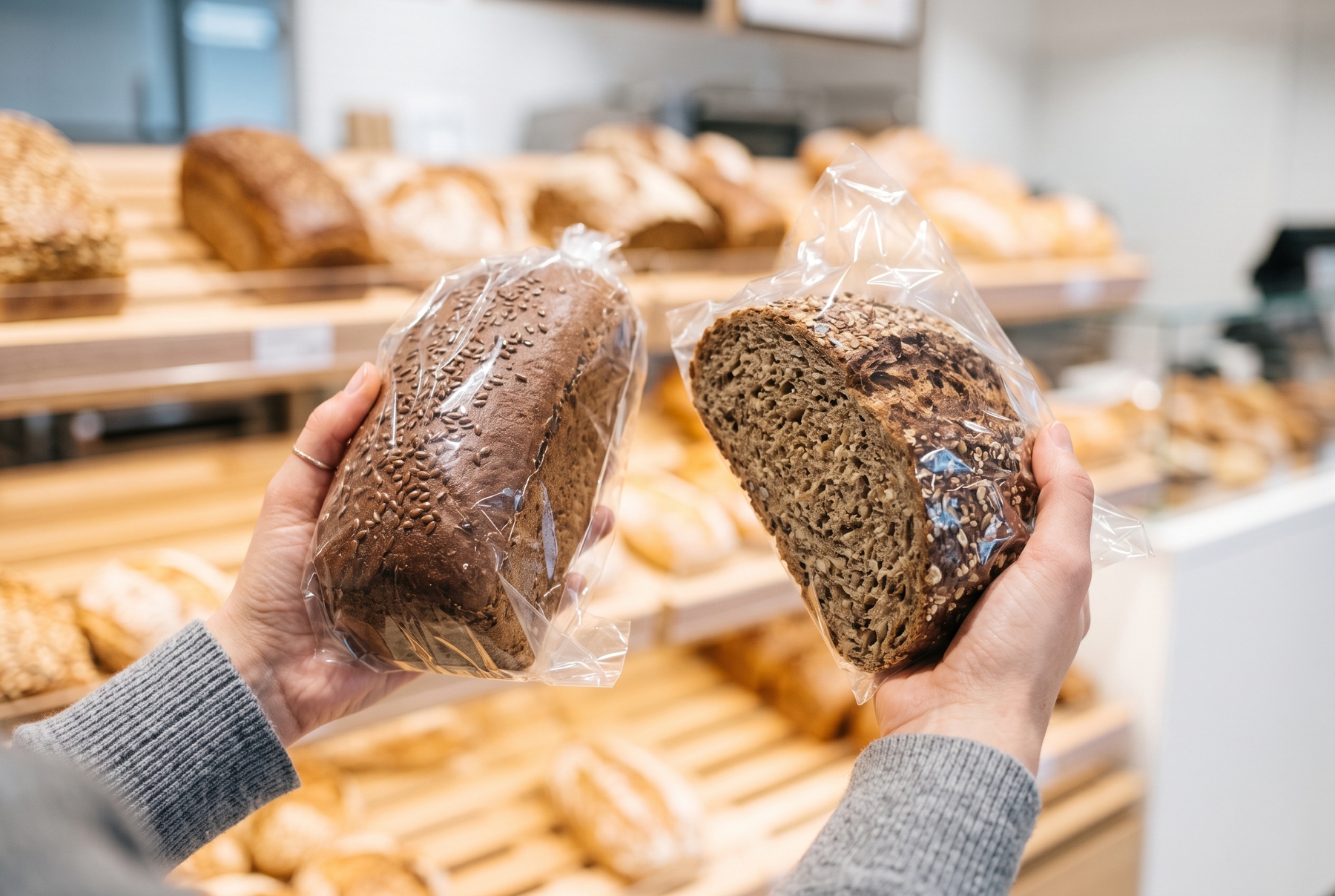
When choosing bread at the store, checking the ingredient list on the back matters much more than reading front-of-pack claims.
Sourdough Bread: What Fermentation Changes, and What It Leaves Untouched
A sourdough starter leavens dough through a symbiotic culture of lactic acid bacteria and wild yeasts. As the dough acidifies and the pH drops below 5, the flour’s endogenous enzymes become significantly more active. This biochemical shift produces the unmistakable tangy aroma, the chewy crumb with irregular gas pockets, and the thick crust that crackles under a knife and scatters crisp shards across the cutting board. Sourdough bread also stales much more slowly.
Sorting through the health claims surrounding sourdough requires more nuance, typically centering on three areas.
Glycemic response. Several studies demonstrate a gentler rise in blood glucose after eating long-fermented sourdough bread compared to fast-risen commercial yeast bread. However, the outcome depends heavily on the flour type, the specific microbial strains, the fermentation duration, and the foods eaten alongside the bread. Applying this benefit universally to every supermarket loaf bearing a “sourdough” sticker is unwarranted.
Phytates and minerals. Phytic acid naturally present in grain hulls binds to iron, zinc, and magnesium, inhibiting their absorption. Long, acidic fermentation breaks down phytates far more effectively than rapid yeast leavening. Actual mineral absorption in the human body proves more complex, with iron offering the clearest research picture. Lower phytate levels in bread can increase the short-term bioavailability of non-heme iron, yet a 2026 systematic review of human intervention studies called the broader evidence inconclusive: convincing data showing that sourdough consumption improves long-term iron status or outperforms regular yeast bread in this regard remains insufficient.
Digestion. Extended fermentation reduces the levels of fructans (fermentable carbohydrates that can trigger gastrointestinal distress), allowing some people with sensitive guts to tolerate sourdough more comfortably. This effect represents a helpful observation rather than a medical treatment. For individuals with celiac disease, sourdough fermentation does not make wheat bread safe: gluten remains present, and a standard wheat sourdough loaf is just as off-limits as any conventional bread. Managing a diagnosed condition or suspected intolerance requires consulting a physician rather than experimenting in the bakery aisle.
One final practical distinction matters: fermentation method and flour type are independent variables. Bakers make whole grain bread with either sourdough starters or commercial yeast, and plenty of artisan sourdough loaves consist entirely of refined white flour. Furthermore, industrial bakeries often add a small amount of inactive or active sourdough purely for flavor alongside commercial yeast, while the front label boasts “sourdough” just as proudly.
Is Whole Grain Bread Always Healthier Than White?
Bread almost always functions as part of a larger dish, performing a specific structural job. A mozzarella and tomato panini requires a resilient white crumb that holds the filling and absorbs juices without disintegrating. Bruschetta demands a sturdy crust that scrapes audibly against a fork and a clove of garlic. When making fresh breadcrumbs for a delicate coating, whole grain bread can introduce a bitter note that overwhelms the dish.
Digestive tolerance varies widely as well. A sudden influx of coarse bran causes heaviness and bloating for some people, especially after an abrupt dietary shift—switching overnight from white toast to a dense, brick-like whole grain loaf at every meal. Increasing dietary fiber works best gradually, accompanied by adequate water intake. For individuals managing irritable bowel syndrome (IBS), diabetes, or any other medical diagnosis, a healthcare specialist tailors the nutrition plan, while general culinary advice provides only a broad framework.
Household habits play a major role, too. A nutritious loaf that nobody enjoys eating delivers zero health benefits: it simply dries out on the counter and ends up ground into breadcrumbs.
Growing up, our family table simultaneously accommodated thin, saltless Tuscan bread, my grandmother’s dense homemade dark rye, and Sunday focaccia drenched in olive oil until nearly translucent. None of those loaves was the single “correct” choice. Nutritional balance came from what surrounded the bread basket: a bowl of stewed beans, a platter of braised vegetables, a wedge of cheese, and a modest portion of meat on holidays.
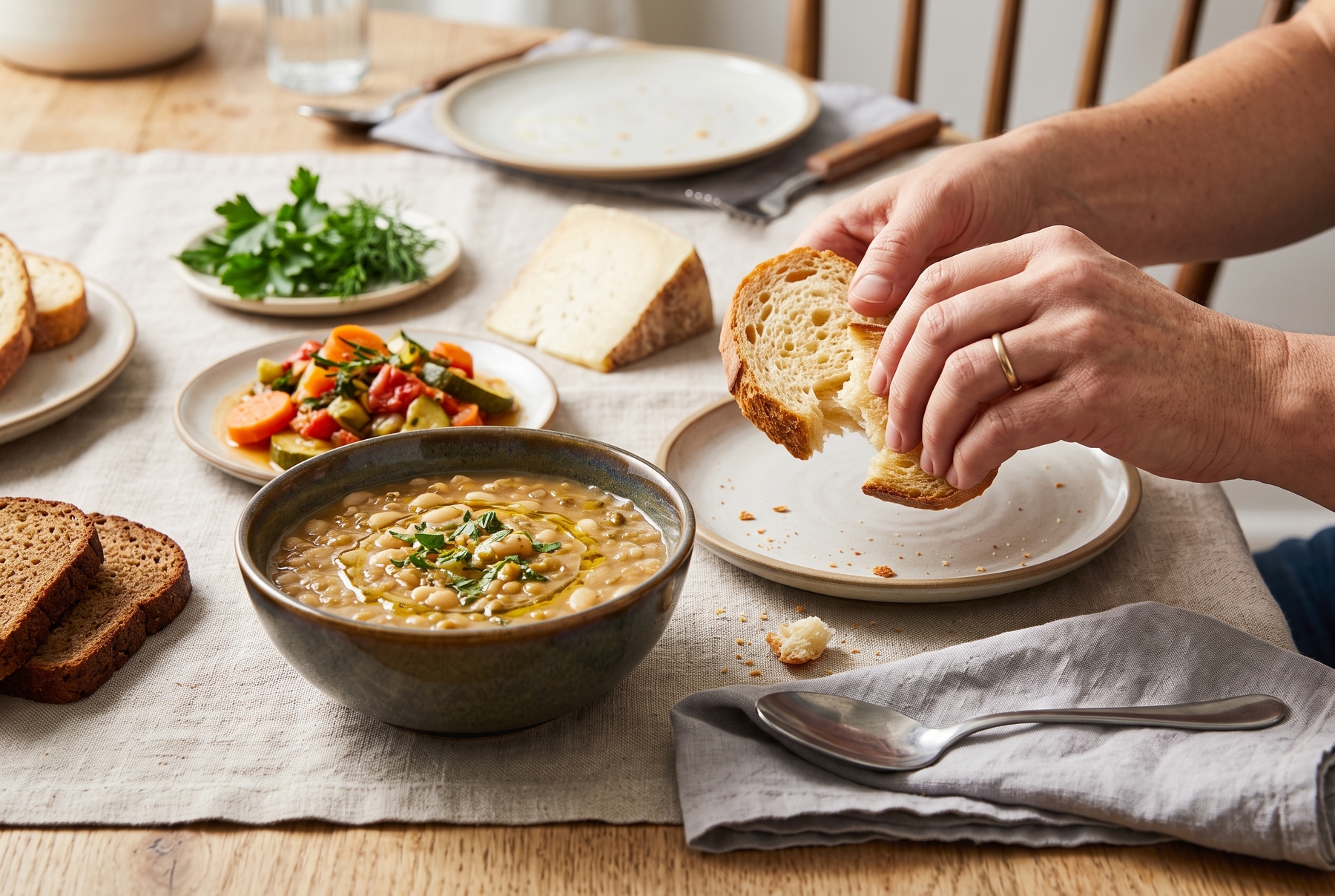
Bread naturally complements a nutritious diet when served alongside legumes, fresh vegetables, and cheese.
How to Choose Bread at the Grocery Store: 5 Things to Check on the Label
- The first ingredient and flour type. The leading ingredient defines the character of the loaf, while everything following it merely adjusts the details.
- The actual presence of whole grain. Look specifically for whole wheat, whole rye, or coarse wholemeal flour, and note its position in the ingredient list. Cracked grains, rolled oats, and seed mixes add appealing texture and visual interest, but they do not guarantee a high proportion of whole grain flour.
- Dietary fiber, when listed. As a reliable benchmark, a bread containing 5–6 g (0.18–0.21 oz) of fiber per 100 g (3.5 oz) makes a meaningful contribution toward the daily 25 g (0.88 oz) goal.
- Sodium content. Standard loaves typically contain around 1 g (0.04 oz) of salt per 100 g (3.5 oz) of bread, though certain commercial recipes run higher. Given the WHO recommendation to keep daily salt intake under 5 g (0.18 oz), eating a customary 150–200 g (5.3–7 oz) of bread accounts for a substantial share of the daily limit.
- Ingredient list length relative to component function. A short ingredient list does not automatically equal a superior loaf, nor does a longer one signal junk food. Malt provides color and aroma; seeds contribute healthy fats and fiber; sugar accelerates fermentation and browns the crust, even though yeast does not strictly need added sugar because flour enzymes naturally convert starch into fermentable sugars. The critical factor is not the mere presence of sugar or oil, but its quantity and rank in the lineup.
Comparing three real-world ingredient lists illustrates how these rules play out on the store shelf.
First label: refined wheat flour, water, sugar, fermented rye malt, yeast, salt. The front package promises a “hearth grain” loaf. In reality, this is brown-tinted white bread. It pairs nicely with soup, but contributes minimal dietary fiber.
Second label: whole wheat flour, water, sunflower seeds, flaxseeds, salt, yeast. Whole grain leads the list, added sugar is absent, and seeds outweigh the salt. Calculating the exact percentage of seeds remains impossible from the text alone: the order only indicates relative proportions, and food regulations allow ingredients comprising 2% or less of the formula to appear at the end in any sequence.
Third label: unbleached wheat flour (first grade, a slightly less refined white flour), water, wholemeal rye flour, rye sourdough starter, salt. This represents a balanced hybrid: it includes a portion of whole grain and relies on genuine sourdough fermentation, though refined wheat flour still forms the base. Such a loaf suits shoppers who find 100% dense whole grain bread too heavy.
How to Build a Sandwich So the Bread Type Stops Being the Main Question
The grade of flour matters far less than the toppings piled onto the slice. A piece of white toast topped with a poached egg, a spoonful of Greek yogurt, and a handful of spinach delivers protein, healthy fats, and a bit of fiber, keeping hunger at bay until lunch. Eating a slice of plain whole grain bread by itself supplies fiber, yet leaves the snack entirely devoid of protein and vegetables.
Thoughtful pairings effortlessly balance the plate. Dense rye or whole grain bread welcomes a smear of whipped cream cheese, thinly sliced radishes, and flaky sea salt. A slice of toasted sourdough shines underneath a soft-boiled egg and the crushed flesh of a ripe tomato. White baguette works naturally alongside a thick bean or lentil stew, while whole grain toast pairs brilliantly with oil-packed sardines, lemon zest, and thinly shaved red onion.
Because every one of these combinations surrounds the bread with protein, vegetables, or healthy fats, the specific milling grade of the flour stops being the decisive nutritional factor.
When the primary goal is boosting whole grain and fiber intake, the winning loaf is almost always the one listing whole wheat or whole rye flour first rather than tenth. When flavor, aroma, and an open, chewy crumb take priority, long-fermented sourdough is the ideal choice—while still glancing at the flour type, since sourdough fermentation and whole grains complement rather than replace each other. The exact same logic applies to white bread: portion size, frequency, and the foods sharing the plate matter most.
0 comments