
Rolled oats crunch in a bowl alongside almond halves, sunflower seeds, and three dried berries, all topped with a dollop of yogurt. It looks like an illustration straight out of a textbook on healthy eating—an impression that forms well before we read a single line on the packaging.
Now for the unpleasant part. Two bags of granola sitting side by side on the supermarket shelf, sporting similar nuts on the front and equally soothing, muted designs, can differ severalfold in added sugar and vary noticeably in fiber. Nutritionally, they are entirely different products, even though they look like twins in a bowl.
That is why I consider the question “Is granola healthy to eat for breakfast?” far too broad. A much more useful question is: what exactly is in your bowl, and what are you pairing it with?
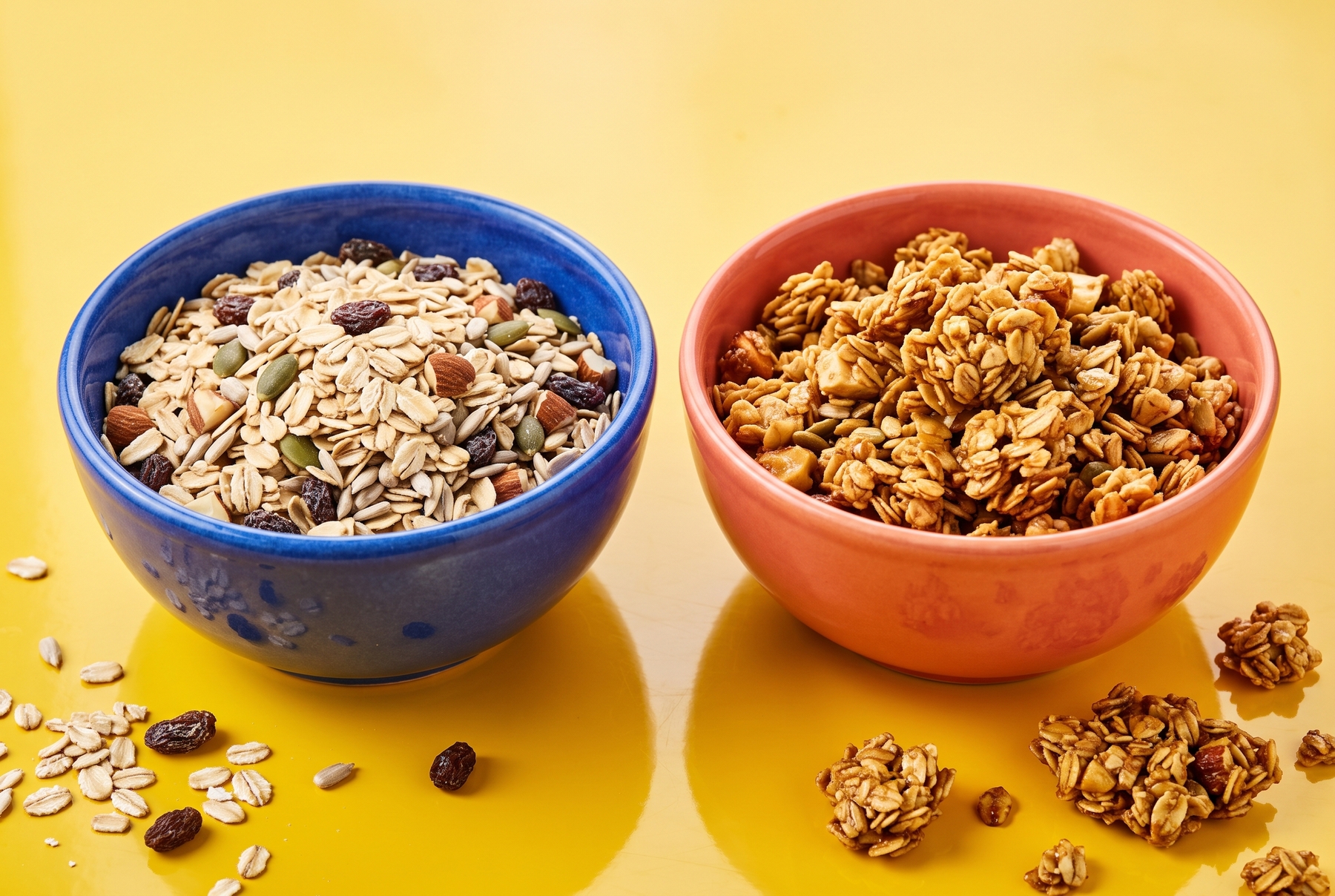
Muesli consists of raw rolled grains and nuts, whereas granola is baked with syrup and oil into crunchy clusters.
Table of Contents
- How Granola and Muesli Differ in Structure
- How Granola Earned Its Reputation as a Flawless Breakfast
- What Grains, Nuts, and Dried Fruit Bring to the Bowl
- Where Breakfast Quietly Turns into Dessert
- How to Vet Granola or Muesli by the Label in One Minute
- Why a Bowl of Granola Sometimes Fails to Keep You Full Until Lunch
- What to Pair with Granola or Muesli for Breakfast
- Does Baking Granola at Home Make Sense?
- Granola vs. Muesli: Which Is Healthier and Which to Choose
- When General Advice Falls Short
How Granola and Muesli Differ in Structure
People often use the words “granola” and “muesli” interchangeably, even though their ingredients and preparation methods are fundamentally different. Granola requires a baking sheet; muesli does not.
How Muesli Comes Together
Muesli typically combines rolled grains (most often oats, and less frequently wheat, rye, barley, or a blend) with dried fruit, nuts, and seeds. Producers sometimes toss in bran, puffed grains, shredded coconut, or chocolate chips. Because the mixture is never baked in oil and syrup, it remains loose and free-flowing rather than sticking to your spoon.
This method shapes its flavor profile: dry, distinctly grain-forward, and devoid of caramelized sweetness. Eating muesli dry requires serious chewing and can feel almost like eating sawdust. It was originally designed for soaking—in milk, kefir (a tangy fermented milk drink), yogurt, or simply water, either for ten minutes or overnight.
Where Granola Gets Its Crunch
Granola is baked. Producers coat the rolled grains in syrup or honey and oil, spread them across a sheet pan, and toast them in the oven until the mixture dries out and binds into clusters. Heating thickens the syrup so it glues the oats together, while the oil delivers that signature crunch and an aroma of toasted oats that carries two rooms away.
You pay for that crunch with caloric density: an equal volume of granola typically packs more calories and added sugar than muesli. Visually, telling the two apart is effortless—granola forms clusters while muesli stays loose—but no one can guess the nutritional profile simply by looking at them.
How Granola Earned Its Reputation as a Flawless Breakfast
We always see the packaging before we read the ingredient list. Kraft paper, muted earth tones, hand-drawn wheat stalks, and buzzwords like “natural,” “fitness,” “protein,” “made with coconut oil,” or “no refined white sugar” set the stage. Each phrase sounds honest on its own, and together they create the illusion that the product carries an official stamp of nutritional approval.
Some of these terms lack strict legal definitions in food labeling regulations and rely purely on consumer associations—think “fitness,” “superfood,” or “energy.” Meanwhile, claims about “no added sugar” or “good source of fiber” are strictly regulated by labeling laws, though it is always wise to check the current standards in your region. Flipping the bag over to read the ingredient list is much simpler. Incidentally, “no refined white sugar” usually means the product relies on a different sweetener: cane sugar, syrup, or concentrated fruit juice.
There is also a purely logical trap at play. Oats are healthy. Almonds are healthy. Flaxseeds are healthy. Yet it does not follow that coating this mixture in four tablespoons of syrup automatically creates an optimal breakfast. The health benefits of individual ingredients do not simply add up to guarantee the healthfulness of the final dish.
I have noticed a telling pattern for years: the exact same sweet cereal blend in a brightly colored box reads as kids’ junk food, whereas placing it in a beige pouch with minimalist typography makes it look almost like a nutritionist’s prescription. The ingredient list on the back can be identical.
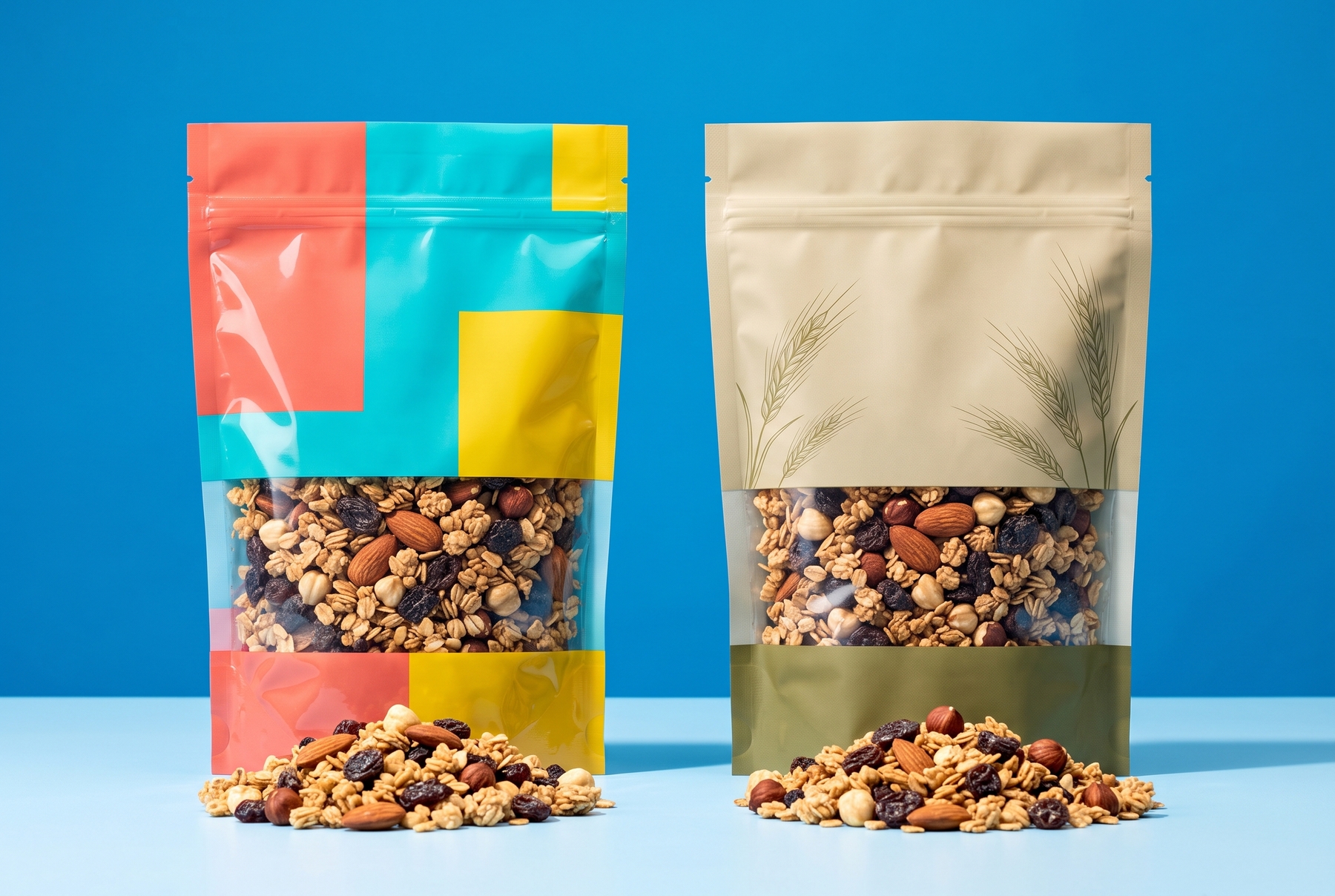
Packaging design can create a false impression of healthfulness, making the ingredient list the only reliable guide.
What Grains, Nuts, and Dried Fruit Bring to the Bowl
The Grain Base
Rolled oats provide complex carbohydrates and fiber. The exact amount in a specific bag depends entirely on the formula: the more dense rolled grains, bran, and seeds in the mix—and the fewer sweet, puffed rice balls—the more substantial the base. Instant oats, milled almost to a powder, behave quite differently from thick-cut rolled oats: they turn soggy faster and keep you full for a shorter time.
Nuts and Seeds
Almonds, cashews, walnuts, and sunflower, pumpkin, and flax seeds contribute unsaturated fats, plant protein, fiber, magnesium, and vitamin E. At the same time, nuts and seeds significantly increase the caloric density of the blend. Scattering an extra handful of nuts over an already rich granola easily increases the calorie count of your bowl by fifty percent. This is not an argument against nuts, but rather a reminder to check how many are already inside the bag.
Dried Fruit
Raisins, dried cranberries, apple pieces, and dates have had their water removed, which concentrates their natural sugars. A small handful of raisins packs a sugar content comparable to a much larger volume of fresh grapes, yet you chew through it twice as fast. This does not turn dried apricots into candy, but accounting for that sugar concentration is worthwhile. Furthermore, producers frequently sweeten tart berries before drying them, which introduces extra sugar or syrup into the ingredient list.
Where Breakfast Quietly Turns into Dessert
Consider a common morning trap: chocolate granola, fruit-on-the-bottom yogurt, a drizzle of honey, a sliced banana, and extra dried fruit. All five components individually pass as “healthy.” Yet when you add up the refined sugars from the granola, flavored yogurt, and honey, and combine them with the natural sugars of the banana and dried fruit, you end up with dessert on the breakfast table. In terms of sheer sweetness, this bowl sits much closer to a pastry than to a bowl of plain oatmeal. Nobody planned on eating cake for breakfast, but the sugar load in that bowl tells a different story.
Overeating granola is much easier than overeating cooked oatmeal for purely physical reasons. Granola is dry and contains almost no water—and water is what creates physical volume in the stomach. Granola is also easy to eat quickly, with your hand reaching for the next spoonful before you finish chewing the last. Because so many calories pack into a compact volume, a standard cereal bowl holds far more energy than you might think.
A universal ideal serving size does not exist, and I have no intention of inventing one. Weighing your bowl just once, however, is an eye-opening exercise. Manufacturers typically list a serving size around 40–50 g (1.4–1.8 oz), which serves as a baseline for nutrition facts rather than a medical recommendation. Pouring a typical portion into a bowl set on a kitchen scale surprises almost everyone who tries it in front of me.
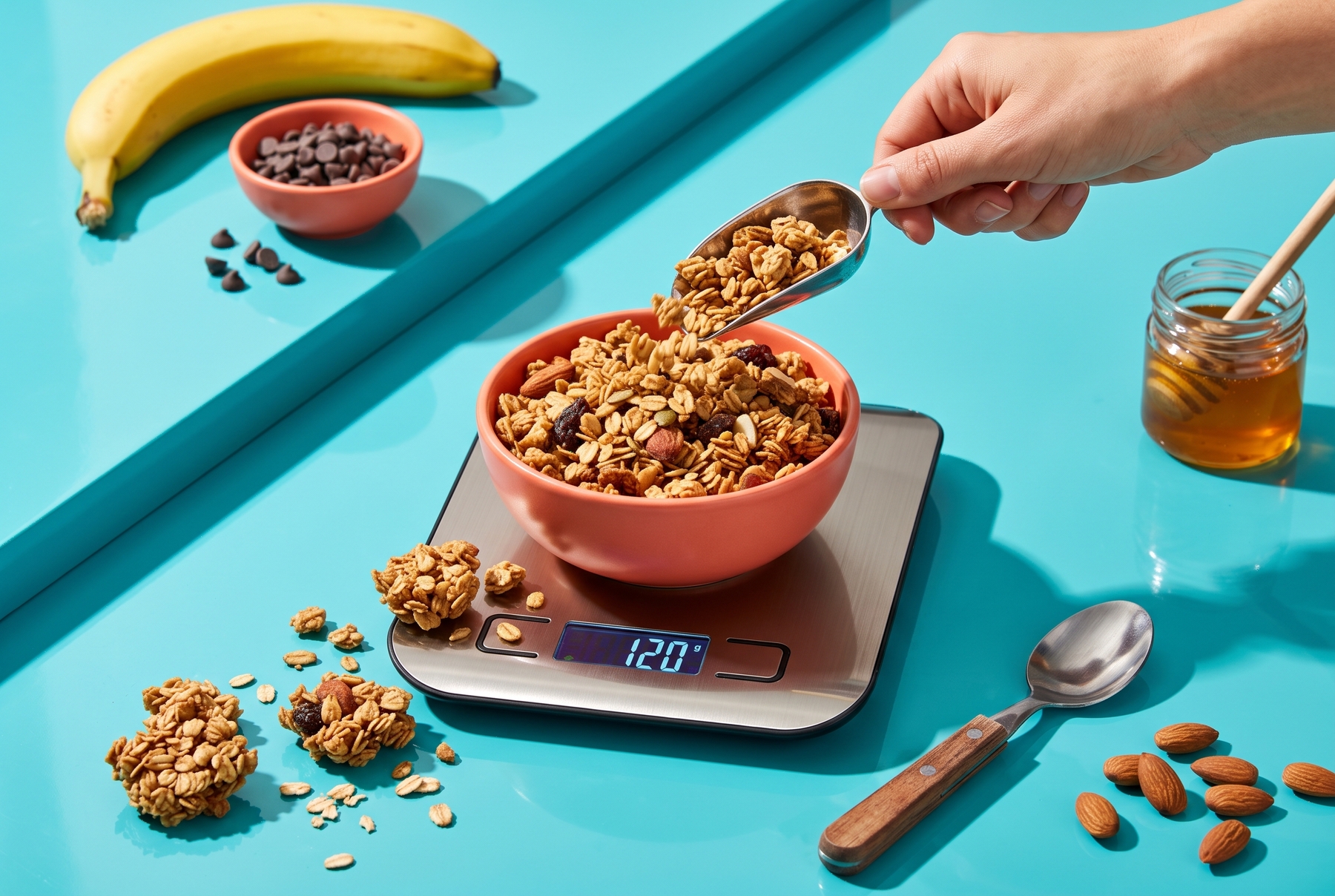
A typical free-poured bowl often far exceeds the manufacturer’s recommended 40–50 g (1.4–1.8 oz) serving size.
How to Vet Granola or Muesli by the Label in One Minute
Examining the first few ingredients is the best place to start. Food labeling laws require manufacturers to list ingredients in descending order by weight, with minor exceptions for things like spice blends and vitamin premixes. When the list begins with whole grains, nuts, and seeds, you are looking at a predominantly grain-based blend. Seeing sugar or syrup in the second slot shifts the nutritional profile considerably.
Next, scanning the label reveals all the sweetening agents: white sugar, cane sugar, glucose and high-fructose corn syrups, honey, maple syrup, agave nectar, and concentrated apple juice. Manufacturers often split sugar and various syrups into separate entries so they appear lower down the ingredient list. Checking the fiber content right alongside the sugar count offers helpful context: thick rolled oats, bran, nuts, and seeds push the fiber number up, while sweetened puffed grains do not.
A high protein number on a granola bag often points to added protein isolate or soy crisps, which by itself says nothing about the overall quality of the blend. Similarly, fats can come either from whole nuts or from the cooking oil used to bake the clusters, making the source of the fat just as important as the total grams. Comparing two packages is always easiest when looking at the 100 g (3.5 oz) column, since every brand invents its own serving size.
Why a Bowl of Granola Sometimes Fails to Keep You Full Until Lunch
A dry cereal blend consists mostly of grains, while fats and protein come primarily from a smaller proportion of nuts and seeds. True satiety relies on four pillars: protein, fats, fiber, and physical volume. Protein and fat slow down digestion and sustain fullness, while fiber and water create physical volume in the stomach, and carbohydrates deliver quicker energy. Stripping away the protein and volume while leaving only the carbohydrates guarantees that your breakfast wears off long before late morning.
I will not attempt to write a rigid mathematical formula here, nor will I promise that a specific bowl will keep you full until lunch. Satiety depends heavily on your daily routine, habitual meal size, sleep quality, and physical activity, varying wildly from person to person. In practice, pairing your cereal with a dedicated protein source and fresh fruit or berries is the simplest way to build a lasting meal.
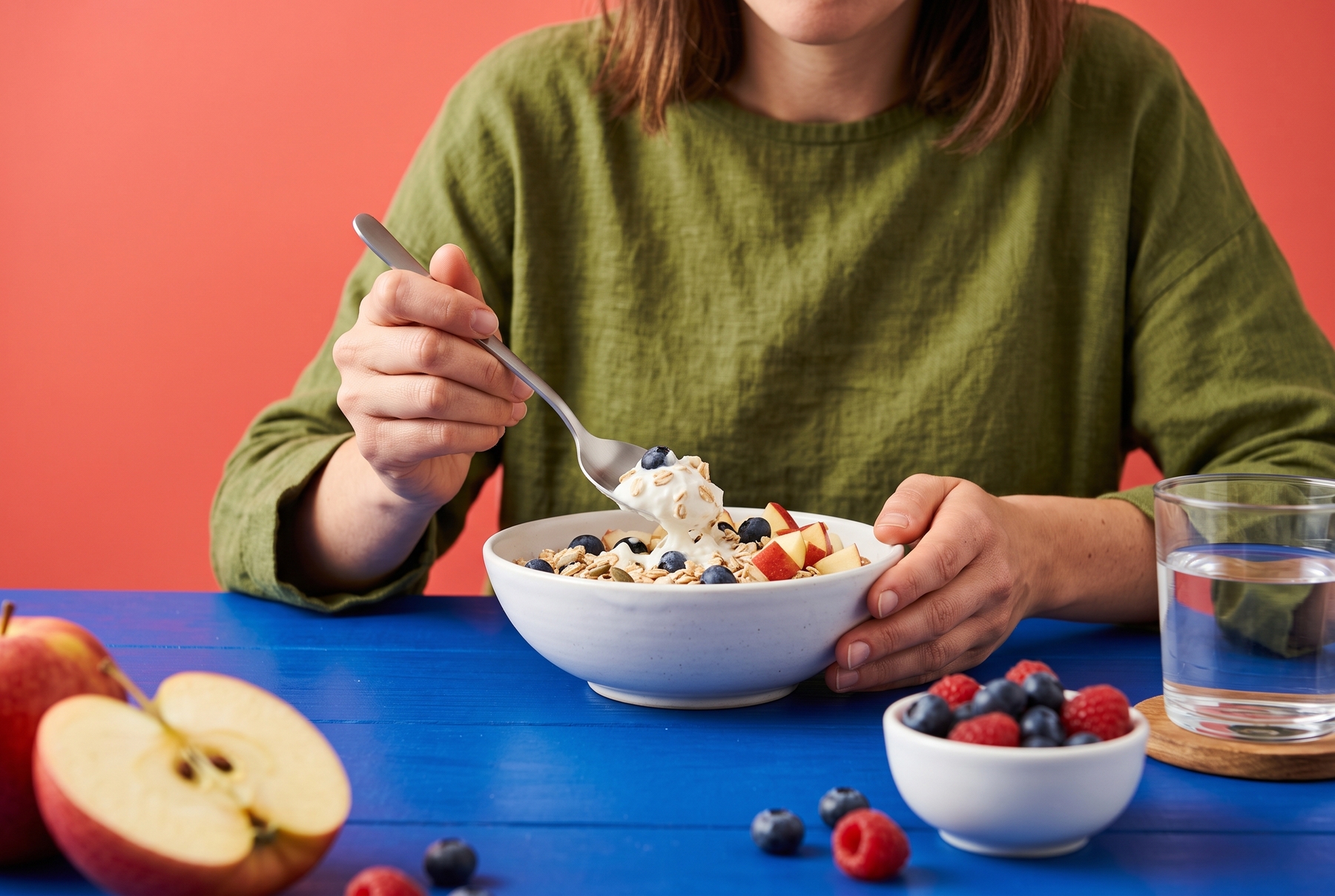
Pairing cereal with plain yogurt and fresh berries balances protein and fiber for lasting morning satiety.
What to Pair with Granola or Muesli for Breakfast
The Base. A portion of granola or muesli that you have weighed out at least once to understand its true volume. If the granola leans sweet, using a smaller amount and building up the bowl’s volume with yogurt and fresh fruit keeps the meal balanced.
The Protein Component. Plain unsweetened yogurt, Greek yogurt, quark, cottage cheese, farmer’s cheese, or Icelandic skyr. For those who avoid dairy, soy yogurt serves as the strongest plant-based option since it naturally contains more protein than almond or coconut varieties; alternatively, serving a boiled egg on the side solves the protein question effortlessly.
The Volume. Fresh fruits and berries. Gram for gram, they deliver water, bright acidity, and fiber with a much lower sugar concentration than dried fruit. Coarsely grating half a fresh apple into your muesli adds far more physical volume than a handful of raisins when the goal is genuine fullness rather than extra sweetness.
The Accent. Cinnamon, unsweetened cocoa powder, citrus zest, or a spoonful of flax or pumpkin seeds. Checking the granola’s ingredient list first is wise: if nuts and seeds already sit near the top, an extra handful sprinkled over the bowl is likely redundant.
Four Combinations for Different Mornings
- Weekday routine: 40 g (1.4 oz) muesli, 150 g (5.3 oz) plain yogurt, a handful of frozen berries (they thaw in ten minutes and release a tart juice), and a pinch of cinnamon;
- Extra filling: 30 g (1.1 oz) granola, 150 g (5.3 oz) cottage cheese or quark, half a diced pear, and a spoonful of pumpkin seeds;
- Overnight soak: 40 g (1.4 oz) muesli stirred into kefir in the evening, topped with grated fresh apple in the morning for a thick, pleasantly tangy bowl;
- For a sweet tooth: 30 g (1.1 oz) dark chocolate granola, 150 g (5.3 oz) Greek yogurt, sliced banana, and a teaspoon of unsweetened cocoa powder. The rich sweetness remains, but the total sugar stays significantly lower than in a bowl made with honey and sweetened fruit yogurt.
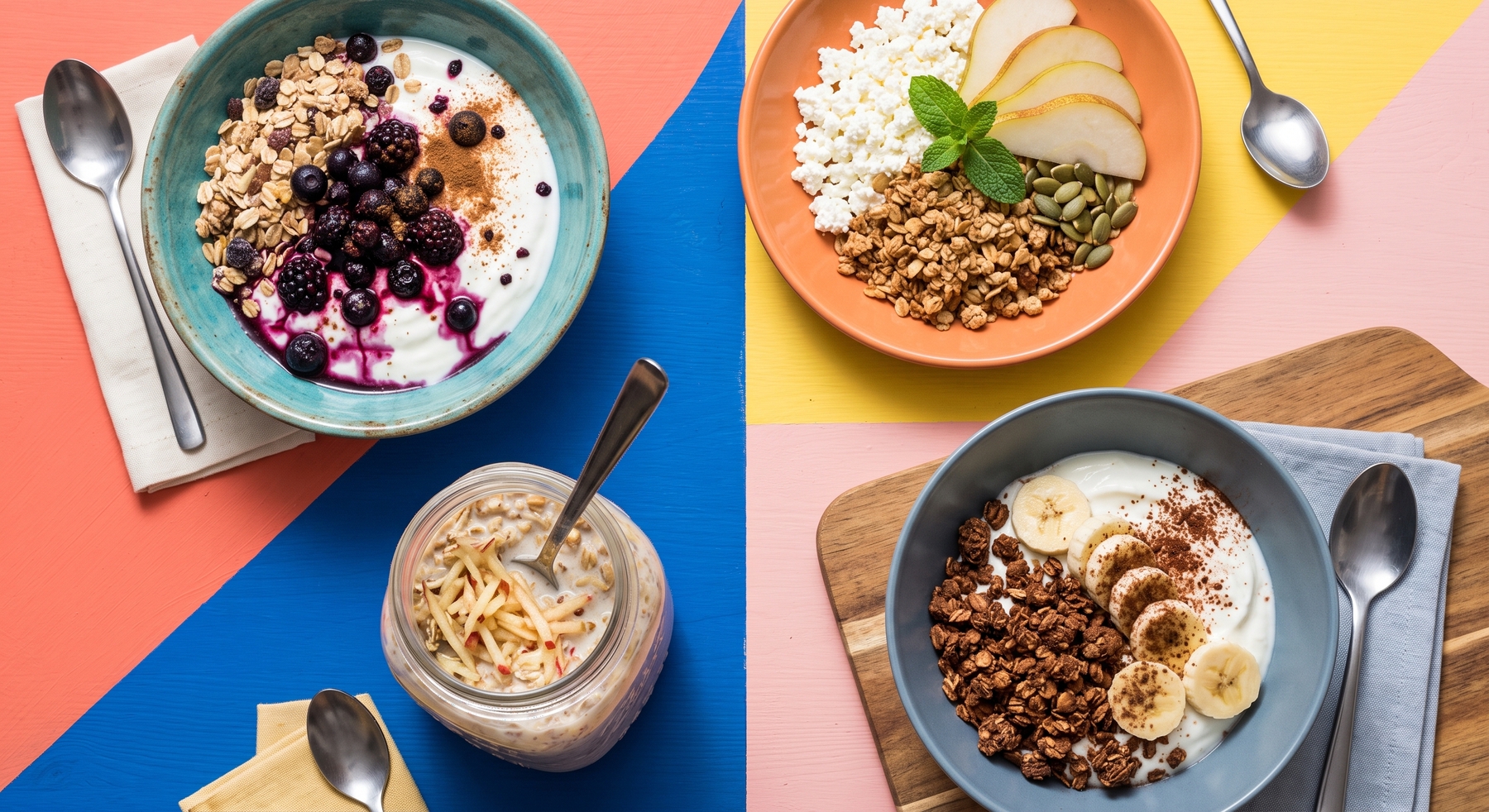
Four balanced morning bowls featuring fresh cheese, berries, kefir, and sliced fruit.
Does Baking Granola at Home Make Sense?
Baking your own granola makes complete sense for purely practical reasons. At home, you control exactly how much oil hits the sheet pan (I use noticeably less than most recipes call for and dry the mixture longer at 150 °C (300 °F)), which rolled grains form the base, how much syrup goes into the bowl, and whether you really need decorative freeze-dried berries that cost as much as saffron. You also skip paying the retail markup for fancy packaging.
Homemade granola does not magically become low-calorie just because it came out of your own oven. Honey, oil, chocolate, and nuts carry the exact same caloric density in a home kitchen as they do in an industrial bakery. The word “homemade” describes the location of the oven, not the nutritional profile of the food.
Getting crisp clusters requires leaving the granola completely undisturbed on the baking sheet as it cools. Stirring or breaking up the mixture while it is still hot causes it to crumble into loose flakes. Letting the pan cool completely to room temperature allows the syrup to set before you break the slab into clusters by hand.
Granola vs. Muesli: Which Is Healthier and Which to Choose
On average, muesli features a simpler ingredient list and contains far less added fat and sugar because it skips the oil-and-syrup baking process. Granola, on the other hand, delivers an undeniable crunch—and for anyone who finds soaked, softened oats boring, that texture alone is a valid reason to choose it.
Reading the specific package in your hand remains unavoidable. I have encountered chocolate-coated mueslis that packed more sugar than half the granola aisle, just as I have tasted sugar-free granolas bound with mashed banana whose primary flaw was their flavor rather than their nutrition facts.
The smartest choice is never the bag with the most virtuous-sounding name on the front, but rather the product whose ingredient list you understand, whose flavor you genuinely enjoy, and which fits into your morning routine without feeling like a punitive diet.
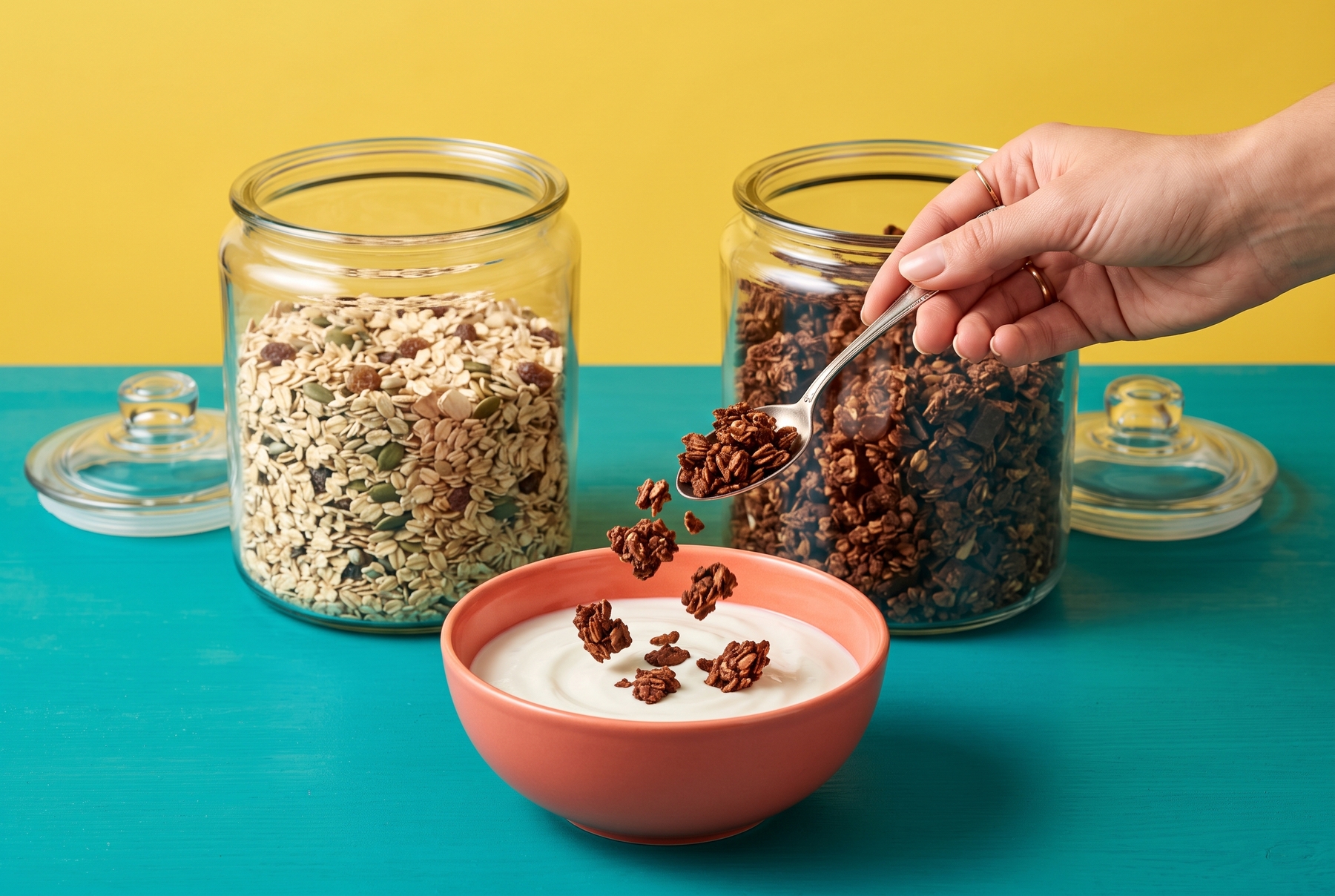
Simple unsweetened muesli works well as a daily staple, while crunchy granola serves best as a flavorful accent.
When General Advice Falls Short
Everything discussed above applies to a standard breakfast for a generally healthy person without specific dietary restrictions. Certain medical conditions require guidance from a healthcare professional rather than an online article.
Managing diabetes or other conditions that require strict carbohydrate control means tailoring breakfast alongside a physician or registered dietitian, where the exact gram count of carbohydrates per serving takes priority. Dealing with a nut allergy requires scanning not just the main ingredient list, but also the “may contain traces” advisory, since commercial cereals frequently share production lines.
Gluten warrants a separate mention. While pure oats are inherently gluten-free, commercial oat products frequently suffer from cross-contamination with wheat, rye, or barley during harvesting, transport, and milling. Consequently, anyone with celiac disease must look for certified “gluten-free” labeling. Furthermore, a subset of people with celiac disease reacts poorly even to certified pure oats (due to the protein avenin), making it unsafe to rely solely on front-of-pack claims. Personalized medical advice from a doctor always supersedes general culinary guidelines.
Standing in the cereal aisle, I always look at the first three ingredients, scan for hidden sugars and syrups, and compare the sugar-to-fiber ratio per 100 g (3.5 oz) across a few competing bags. After that, it simply comes down to checking the suggested serving size and deciding what else will join those grains in the bowl.
Pairing cereal with tangy quark or farmer’s cheese and fresh pear builds one kind of breakfast; drowning it in honey, sweetened yogurt, and banana creates something entirely different. I keep two glass jars in my own pantry: one holds plain unsweetened muesli for busy weekdays, and the other holds dark chocolate granola. On Saturday mornings, I spoon two tablespoons of the chocolate clusters over plain yogurt purely for the crunch.
0 comments