
“Drink two liters a day.” This advice seems to survive every passing diet trend, yet almost no one can explain where it actually came from.
People most often point to a 1945 recommendation from the U.S. National Research Council. It suggested about 1 ml of liquid for every kilocalorie consumed, which conveniently added up to about 2.5 liters for a standard diet. The same text contained a crucial caveat: a significant portion of this volume comes from food. Somewhere along the way, the caveat was lost, and the round number remained. Thus, a “norm” was born, one that we now plug into hydration reminder apps.
The rule has a second source: the classic English-language “eight eight-ounce glasses.” In 2002, physiologist Heinz Valtin tried to track down the research supporting this and found no convincing evidence.
In the house where I grew up, no one counted glasses. A glass pitcher sat on the table, and we poured as much as we wanted. My grandmother, from the Eastern side of the family, firmly believed that soup and kompot (a traditional fruit beverage) were also water. Her stance turned out to be much closer to current recommendations than the modern fear of under-hydrating.
Your body needs all liquids, including the water that arrives with your food. This completely changes the math.
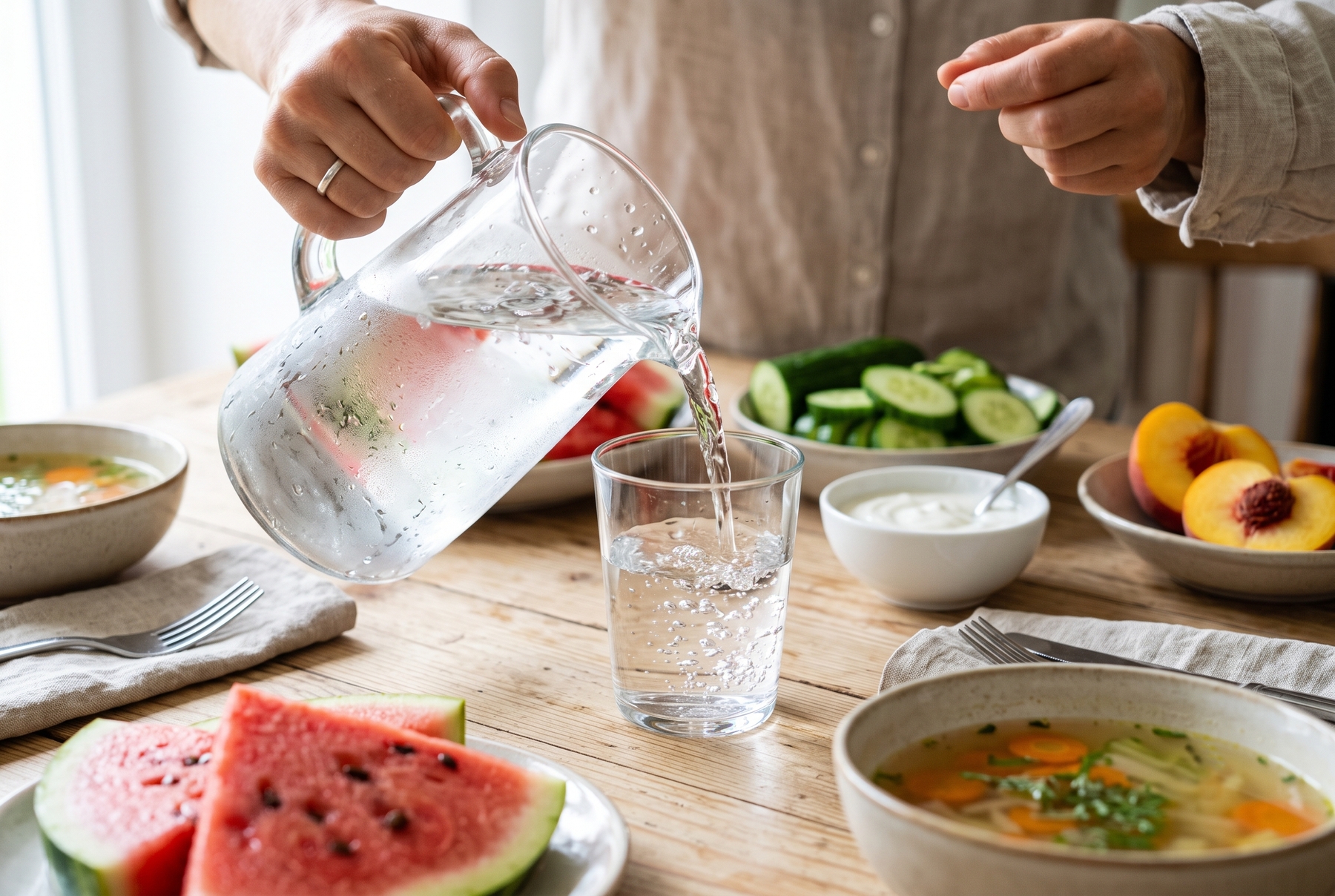
A significant portion of our daily fluid requirement enters the body along with our food, including soups, vegetables, and fruits.
Table of Contents
- Why A Single Hydration Norm Does Not Exist
- Should You Count The Glasses Of Water You Drink?
- Which Drinks Count And Which Do Not
- Can You Drink Water During Meals, And Does It Affect Digestion?
- Is It Possible To Drink Too Much Water?
- 6 Guidelines For Every Day
- Why The Number In The App Means Less Than It Seems
Why A Single Hydration Norm Does Not Exist
In 2010, the European Food Safety Authority proposed a baseline for adults in a temperate climate: about 2 liters of fluid per day for women and about 2.5 liters for men. American recommendations are higher, at 2.7 and 3.7 liters. In both cases, this accounts for all water, including what comes from food, which usually makes up one-fifth to one-third of the total volume.
If your diet is rich in vegetables, fruits, soups, and dairy products, you actually need to “drink” noticeably less than someone subsisting on bread, cheese, and cured meats.
What Determines Your Daily Fluid Needs
Body mass and age set the baseline. A larger person has more water in their body and loses more. Then movement intervenes. An hour of brisk walking in the heat and an hour on the couch cost the body completely different amounts of fluid.
Climate acts just as directly. Dry air, wind, high altitude, heat, and winter heating all increase invisible losses through the skin and breathing. In a sauna, you can see the sweat, but in the freezing cold, evaporation from your skin happens just as much, only silently.
Diet shifts your hydration needs more than anything else. Salt draws water to itself, and after a dinner of salty ham, olives, and parmesan, you will clearly feel thirsty. A high protein intake also requires water to excrete nitrogenous waste products. Watermelon, cucumbers, zucchini, kefir (a fermented milk drink), and a standard vegetable soup work in the opposite direction.
Health also plays a role. Fever, vomiting, diarrhea, certain kidney and heart conditions, pregnancy, breastfeeding, and the use of diuretics all affect your needs. Here, doctors set the norms, and general recommendations from articles simply do not apply.
Why Summer And Winter Numbers Differ
In the heat, fluid loss through sweat increases exponentially. During heavy physical labor in a hot factory or on a long run, losses are measured in liters per hour, not milliliters. You can easily spot this by the salt rings left on a T-shirt.
Winter is much more insidious. The cold dulls thirst, the air in heated apartments is dry, and breathing carries away water with every exhale. People drink less and often blame a heavy evening headache on the weather.
The human sensation of thirst usually kicks in late: by this point, you have already lost about 1–2% of your body weight. For a healthy person in a normal environment, this signal works perfectly fine. For someone digging garden beds for three hours in 30°C (86°F) heat, the signal arrives far too late.
Seeking one correct number is ultimately pointless. The body does not demand a standard quota; it demands compensation for what was lost during the day.
Should You Count The Glasses Of Water You Drink?
Counting makes sense for people who systematically forget to drink and those whose fluid volume has been prescribed by a doctor. Everything else quickly turns into unnecessary anxiety, and anxiety hinders us far more than a missing 200 ml.
When It Is Safe To Trust Your Thirst
For a healthy adult with functioning kidneys, this mechanism is entirely sufficient. The brain detects rising salt concentrations in the blood before problems begin and prompts you to pour another glass.
A bottle on your desk is useful, but not as an accounting tool. It works as a reminder: whatever is in plain sight gets drunk naturally. A pitcher of water with a few lemon slices on the kitchen table does the exact same thing, only with better flavor.
Who Truly Needs Fluid Control
Older adults, whose sense of thirst weakens with age and whose kidneys are less efficient at retaining water, need to pay attention. Many in this age group also consciously drink less to avoid getting up at night, achieving the opposite effect.
Next are those who work or train in the heat, especially if the exertion lasts longer than an hour. During a fever, vomiting, or an upset stomach, you lose not only water but also electrolytes, meaning plain water might not be enough.
For individuals prone to kidney stones, doctors often recommend drinking more than usual. Conversely, for certain heart and kidney conditions, fluid volume is restricted. Both recommendations are highly personal, and a reminder app cannot replace them.
Signs That Your Hydration Is Fine
- Thirst appears but is not agonizing.
- Urine is light, the color of pale straw.
- You use the restroom about four to seven times during the day.
- There is no unprovoked heaviness in your head by evening.
- Your lips and skin are not dry without frost or wind.
Signs of dehydration seem mundane, making them easy to miss: dry mouth, viscous saliva, darkened urine, headache, lethargy, and absent-mindedness by midday. Even mild dehydration noticeably hits concentration and mood. In older adults, a lack of water sometimes manifests as confusion, which is a reason to consult a doctor, not just pour a glass.
There is one important caveat regarding urine color. The morning portion is always darker, which is normal after a night’s sleep. Riboflavin from vitamin complexes turns it bright yellow, beets give it a pinkish hue, and some medications also alter the picture. If your urine is completely clear all day, you likely have more water in you than you need.
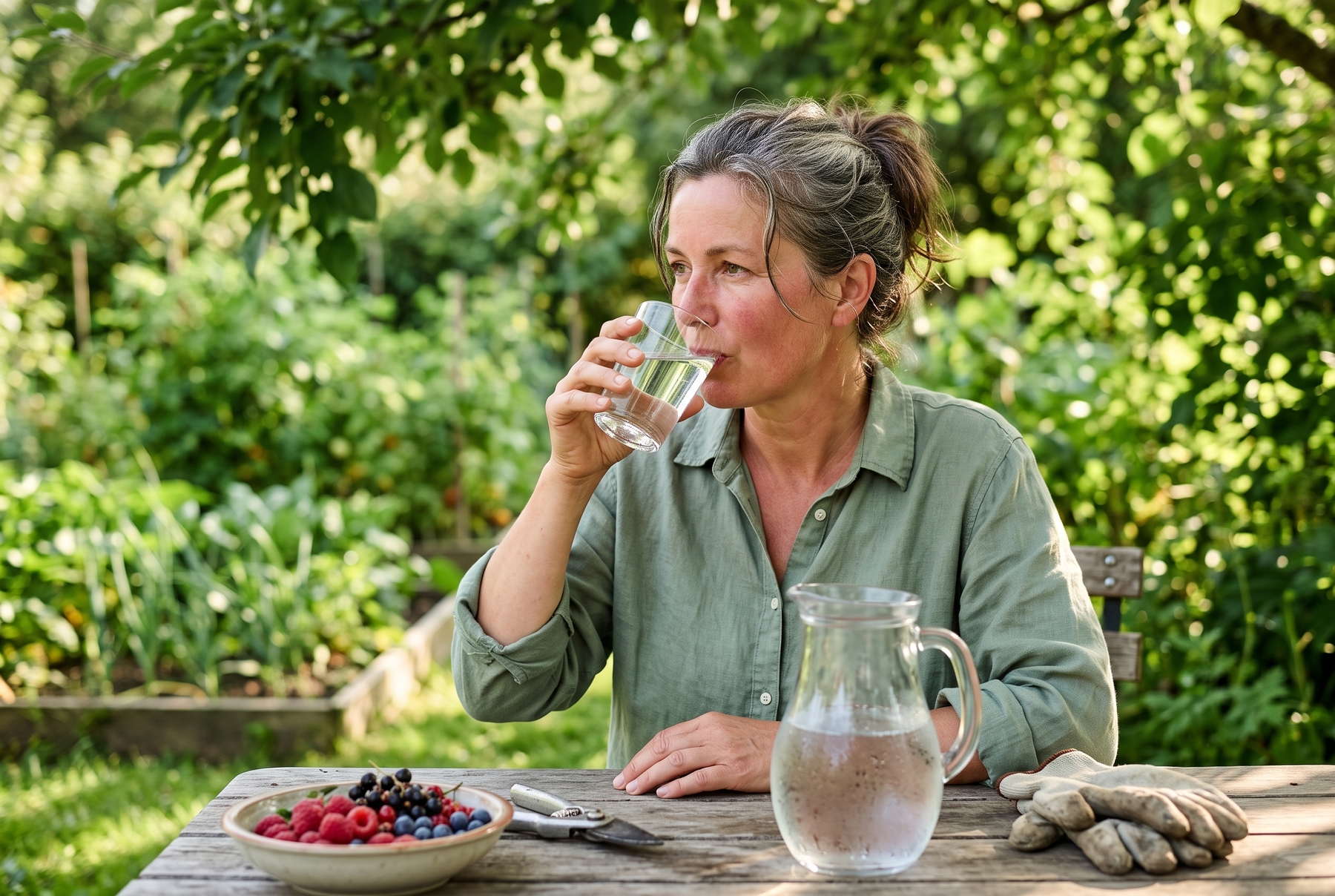
For a healthy person, relying on the natural sensation of thirst is entirely sufficient to maintain an optimal water balance.
Which Drinks Count And Which Do Not
Almost everything you drink counts. The only question is what comes along with the water: sugar, salt, caffeine, alcohol, or calories.
Plain Water
The baseline option, free of sugar, caffeine, and calories. Cold water is drunk faster and in larger portions, while room-temperature water goes down better with food. If you dislike the taste of tap water, a filter solves the issue far more cheaply than bottled water.
Mineral Water
Considered a full-fledged fluid source, but the composition of different bottles varies radically. Table waters with mineralization up to 1 g/L are suitable for daily drinking. Therapeutic-table waters (about 1–10 g/L) and therapeutic waters (above 10 g/L) are consumed in courses based on medical advice, rather than replacing your daily pitcher.
Check the label if you are watching your salt intake. Some mineral waters contain a fairly high amount of sodium. Carbonation itself is harmless, but if you experience reflux or bloating, it is best to let it go flat.
Tea
Essentially, it is just water with dissolved substances. A cup of tea contains less caffeine than coffee, and with a normal number of cups, it does not affect your fluid balance. The same applies to herbal infusions.
One practical detail: strong tea consumed directly during a meal reduces iron absorption from plant-based foods. If you are eating lentils or buckwheat as your primary iron source, it makes sense to shift your tea to an hour later.
Coffee
The myth that coffee dehydrates you turned out to be scarier than the facts. Caffeine does indeed drive water out, but only weakly. At habitual doses, the body adapts, and the loss does not negate the volume of the cup consumed. Studies show that for regular coffee drinkers, hydration levels after coffee and after water are comparable. A glass of water served with espresso in Italian bars is not there out of a fear of dehydration, but to cleanse the palate before the first sip.
For a healthy adult, up to 400 mg of caffeine per day is considered safe, equating to roughly three or four cups of strong coffee.
Milk
Milk is about 87% water, accompanied by protein, sodium, and potassium. Because of this, milk leaves the stomach more slowly and is retained in the body just as well as water. This makes it convenient after physical exertion. Kefir and ayran (a savory yogurt-based beverage) behave similarly, and in the heat, they go down easier than sweet soda.
Soups
A 300–400 ml bowl of soup counts toward your hydration practically in its entirety, plus the salt helps the water stay in your system. A cold summer vegetable soup solves both hydration and lunch at once. Those restricting sodium need to count the salt in the broth, not just the water.
Kompot, Mors, And Kissel
All of these traditional drinks count as well. Homemade kompot (fruit beverage) is easy to boil with minimal sugar. If you use sour plums or cherries, you hardly notice the difference.
Kissel (a viscous fruit drink thickened with starch) is denser and noticeably more filling, so you likely will not want to drink it by the liter. Mors made from cranberries or lingonberries is pleasantly tart and easier to keep relatively unsweetened.
Soda
Sweet soda provides water, but it brings about 50 grams of sugar per 0.5-liter bottle. The World Health Organization advises keeping free sugars below 10% of daily caloric intake, and one bottle consumes almost the entire limit. The sugar-free version is equivalent to regular carbonated water in terms of hydration.
Juices
A glass of juice counts as fluid, but its sugar counts as free sugar, even if freshly squeezed at home without additives. The fiber is almost entirely lost during juicing. A reasonable portion is about 150–200 ml per day.
Alcohol
Ethanol suppresses the production of the antidiuretic hormone, causing the kidneys to excrete more water. You cannot replenish fluids with alcohol, and the stronger the drink, the worse your balance becomes. It makes sense to alternate a glass of wine with water, especially in the heat.
| Beverage | Counts Toward Hydration | Characteristics | When Most Appropriate |
|---|---|---|---|
| Water | Yes | No sugar or calories | Any time of day |
| Mineral Water | Yes, Table Water | Mineralization and sodium vary | Table water daily, therapeutic per prescription |
| Tea | Yes | Moderate caffeine, tannins | Between meals |
| Coffee | Yes | Weak diuretic effect, up to 400 mg caffeine/day | First half of the day |
| Milk, Kefir | Yes | Retained in the body longer than water | After exercise, for breakfast |
| Soups | Yes | High in sodium | Lunch, heat (cold soups) |
| Kompot, Mors, Kissel | Yes | Sugar depends on the recipe | Homemade, minimal sugar |
| Sweet Soda | Yes, but | About 50 g sugar per 0.5 L | Occasionally, as a dessert |
| Juices | Yes, but | Free sugars, low fiber | 150–200 ml per day |
| Alcohol | No | Increases water excretion | Not as a fluid source |
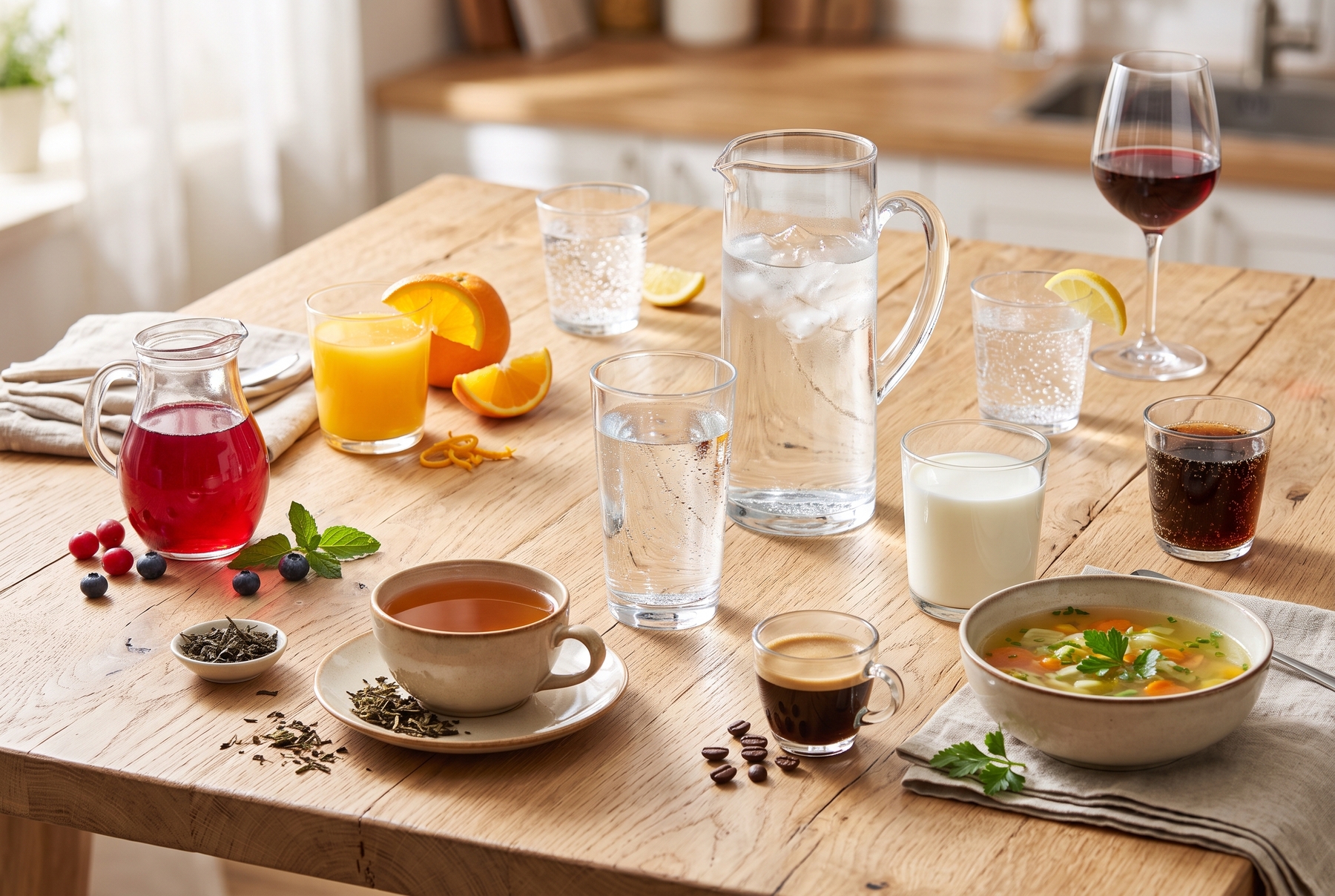
Your daily fluid balance includes not only plain water but also tea, coffee, soups, milk, juices, and homemade fruit beverages.
Can You Drink Water During Meals, And Does It Affect Digestion?
It is often said that water dilutes stomach acid and ruins digestion. This sounds logical, but physiology does not back it up. The stomach secretes acid constantly, adjusting the amount based on its contents, and water leaves the stomach for the small intestine in mere minutes.
Discomfort does occur, but for other reasons. A large volume of carbonated water stretches the stomach and exacerbates reflux. After stomach surgery or with certain conditions, fluid volume at the table is genuinely restricted, but that is a separate medical scenario.
There is also a downside: water makes it easy to wash down poorly chewed food, sending large chunks directly to the stomach.
With dry, fibrous, or salty foods (bread, cured meats, legumes), water at the table certainly helps.
If you feel better having a glass of water with your lunch, then drink up.
Is It Possible To Drink Too Much Water?
It is possible, though rare, and usually requires considerable effort. Kidneys can process roughly 0.7–1 liter of free water per hour. If you drink faster and in massive quantities, your blood sodium concentration drops. This condition is called hyponatremia, bringing headaches, nausea, weakness, and, in severe cases, confusion.
The classic risk group includes marathon runners and long-distance swimmers who consume only large amounts of plain water on the course. A secondary situation involves illnesses and medications, where the volume is determined by a physician.
Forcing yourself to finish a liter before bed just because your app shows a deficit is unnecessary. If you are running to the bathroom every half hour and waking up at night, you already have more water in you than you need.
6 Guidelines For Every Day
- Drink when you are thirsty and keep water within reach.
- Count tea, coffee, milk, soups, and kompot toward your total volume.
- Increase fluids in the heat, during exertion, with a fever, and during the winter heating season.
- Look at your urine color as a guideline, not a diagnosis.
- Consider sweet drinks and juices as sugar sources, not just hydration.
- Consult a doctor for constant thirst, dry mouth, swelling, or a sudden change in urine output.
Why The Number In The App Means Less Than It Seems
A completed progress bar in a tracker guarantees nothing. The body does its own calculations based on what you eat, how much you move, and the climate you live in. The very same person needs different amounts of water in February and July, and no universal norm accounts for this.
Water remains the best beverage. It has no sugar, no caffeine, no calories, and costs less than anything else on the list. However, it has never been our only source of hydration.
0 comments