
Many of my acquaintances keep a jar of collagen on their shelf. It features a pink lid, bold lettering promising ‘skin elasticity,’ and a price tag rivaling a nice dinner for two. Others believe that the collagen from a bowl of rich bone broth or a grandmother’s kholodets (a traditional Eastern European meat aspic) travels straight to their forehead wrinkles or aching knees.
This logic is ancient, almost primal. Eating skin supposedly fortifies one’s own skin. Consuming cartilage allegedly repairs joints. People reasoned similarly in the Middle Ages, when eating a lion’s heart was thought to bestow courage, and powdered horn served as a cure-all. The difference is that we have a high school biology education behind us. Yet, our hands still reach for that attractive jar. Drinking collagen simply sounds much more appealing than eating a diverse diet and waiting years for results.
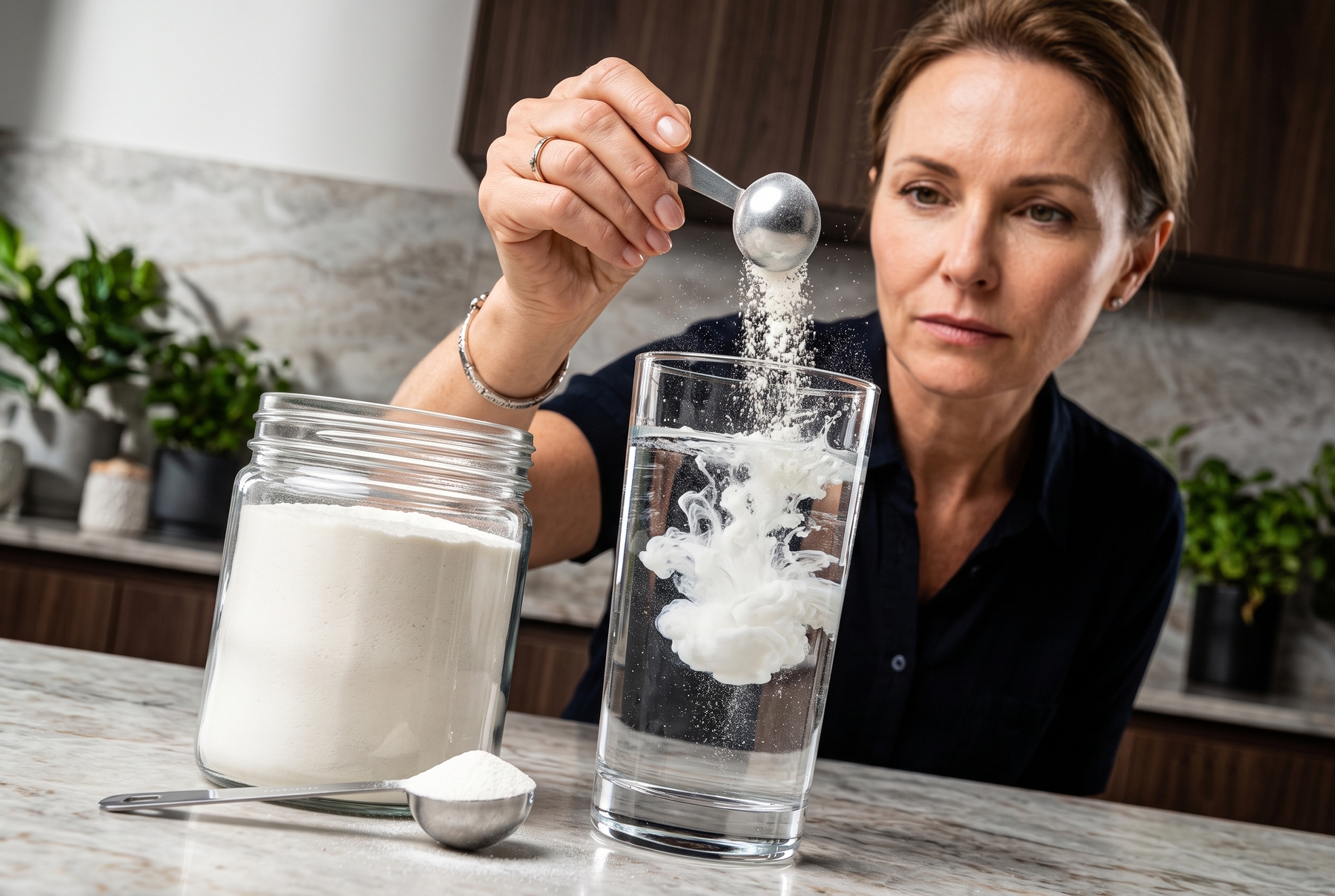
Popular drinkable supplements break down into simple amino acids in the stomach, losing their original structure.
Table of Contents
How The Body Absorbs And Processes Collagen
Collagen is not some promotional youth pollen, but rather an ordinary protein. It is quite large and twisted into a triple helix, much like three threads tightly braided together. Envision a castle built from toy building blocks, complete with towers, walls, and gates. It looks beautiful while intact.
Once this castle enters the stomach, the dismantling process begins. Hydrochloric acid and enzymes—pepsin in the stomach, followed by an entire crew in the small intestine—do not stop to admire the architecture. They break the protein into pieces. The process yields large fragments first, then shorter peptide chains, and ultimately leaves behind individual building blocks known as amino acids. Glycine, proline, and hydroxyproline formed the original castle, and they represent all that remains.
These blocks absorb into the bloodstream and drop into a shared pool. The body simply does not care where the glycine originated, whether it came from an expensive powder, a bowl of cottage cheese, or a chicken thigh. A glycine molecule remains identical across the board. It carries no label, holds no passport, and features no tag demanding delivery straight to the face.
Why We Trust An Attractive Label
Understanding why we fall for this marketing requires looking beyond mere gullibility. The brain eagerly grabs a ready-made solution rather than choosing the long journey involving mindful eating over many years. A jar labeled ‘collagen for skin’ provides a sense of control. Purchasing it makes individuals feel they are taking action and securing guaranteed results. A forehead wrinkle causes anxiety, and a daily morning spoonful of powder creates the illusion of erasing it.
Marketers understand this psychology perfectly and target it directly. Packaging highlights the exact words consumers want to read, such as ‘elasticity,’ ‘radiance,’ and ‘youth.’ Buyers latch onto these cues and mentally fill in the blanks. The phrase ‘for skin’ leads them to assume the product will travel directly there. At that moment, it becomes easy to forget that an entire digestive tract lies between the spoonful of powder and the face.
Price adds another layer to this illusion. Consumers automatically assume that expensive items perform better than cheaper alternatives. A high-priced powder in a stylish jar feels far more convincing than an inexpensive can of beans and a bunch of parsley, even though both contain the necessary amino acids. The image of a woman with flawless skin on the label seals the deal, implying the product worked wonders for her.
Attractive label promises create an illusion of instant rejuvenation, encouraging spontaneous purchases.
Who Decides Where The Amino Acids Go
Once those building blocks enter the bloodstream, the body takes charge. It operates according to its own logic rather than catering to a desire to smooth out the crease between the eyebrows.
Amino acids travel to active construction sites within the body. Healing a cut on a finger redirects a portion of these resources. Muscles recovering from a workout claim their share. The intestines, liver, and immune cells constantly require fresh material as well. All these processes run in parallel, drawing from the same general reserve. The skin pulls from the exact same pool as all other tissues. The body simply has no strict queue where the skin gets priority access.
A consumed amino acid carries no specific delivery address pointing to a facial wrinkle. Routing glycine to a precise spot on the face proves just as impossible as directing a glass of water exclusively to the left kidney. The body manages distribution independently. Consequently, biology simply cannot fulfill the promise that a particular collagen product targets the facial oval. Even in studies showing a mild effect from collagen supplements, the consumed protein never reaches the skin intact. Digestion breaks it down into individual blocks, making any potential result rather modest.
How The Body Produces Collagen: Three Essential Conditions
The good news is that the body produces its own collagen continuously and for free. It merely requires the right materials and a few nutritional assistants.
Complete Protein. The amino acids needed for collagen synthesis come from ordinary dietary protein. Meat, fish, eggs, cottage cheese, and legumes provide glycine, proline, and the rest of the required set. Enjoying a bowl of lentils or a couple of eggs for breakfast delivers the amino acids necessary for natural collagen synthesis. These foods also offer benefits missing from a supplement jar, such as fiber, vitamins, and lasting satiety. Consuming enough daily protein ensures the skin receives ample material without any additional powders.
Vitamin C. Construction literally halts without this crucial element. The body physically cannot assemble a mature collagen thread without vitamin C. Enzymes require it to refine individual amino acids and help the protein fold into a stable triple helix. Historically, sailors on long voyages without fresh greens experienced decaying gums and the reopening of old wounds precisely for this reason. Scurvy represents nothing more than collagen failing to complete its structure. Finding vitamin C does not require an extensive search:
- bell peppers, especially red ones
- citrus fruits and kiwi
- blackcurrants, sea buckthorn, and rose hips
- cabbage, broccoli, and fresh herbs
Copper and Zinc. These two inconspicuous assistants each perform specific tasks. Copper supports the enzyme responsible for binding finished collagen threads together, and its absence leads to weak structural links. While zinc does not directly influence this binding process, protein synthesis and general tissue repair stall without it. Deficiencies in either mineral remain rare for anyone maintaining a normal diet, but knowing their dietary sources proves useful. Liver, seafood, nuts, seeds, and buckwheat provide excellent copper. Sourcing zinc involves eating meat, shellfish, pumpkin seeds, legumes, and whole grains.

Natural collagen synthesis requires complete protein, vitamin C, copper, and zinc sourced from a balanced diet.
Do Kholodets And Bone Broth Offer Any Benefit?
This raises the question of whether grandmother’s kholodets belongs in the trash, or if the stockpot should remain hidden in the back cabinet. The answer is absolutely not.
Growing up, my life spanned two distinct culinary worlds. In Bologna, my Italian grandmother spent half the day simmering ragù. Meanwhile, my Eastern European grandmother served kholodets (a savory meat jelly) at every holiday. It arrived cloudy, trembling on the plate, heavily seasoned with garlic and bay leaf, and dense enough to hold its shape for hours. She viewed it as a piece of home rather than just food. In her own way, she was correct, as such a concentrated broth truly provides significant nourishment.
However, its nutritional value does not serve as an anti-aging remedy. Bone broth contains protein—typically 6 to 10 grams (about 0.2 to 0.35 oz) per cup—alongside glycine, bone-derived minerals, and a comforting warmth that relaxes tense winter shoulders. Yet, its collagen content relies heavily on chance. The final amount depends entirely on the bones used, the cooking time, and the spoonful of vinegar added early on to extract more nutrients. Independent testing of store-bought broths often reveals minuscule collagen levels. This remains perfectly acceptable for food. After all, nobody expects a bowl of borscht to function as medicine.
Cooking broth makes perfect sense for those who enjoy its rich flavor and the aroma of slow-cooked root vegetables filling the apartment. Serving kholodets for New Year’s Eve honors tradition and completes the holiday table. Doing so simply requires dropping the expectation of a cosmetic miracle. The money saved from skipping trendy supplement jars easily covers quality fish, a handful of nuts, and an extra bell pepper for a salad.
Meanwhile, the collagen in the face builds itself. The body handles this process slowly and independently, utilizing yesterday’s scrambled eggs and that very same red bell pepper.
0 comments