
A customer orders avocado toast. Charred-edged ciabatta, green creamy flesh, a poached egg with a yolk ready to run at the first touch of a fork, a pinch of red chili flakes. The scent of toasted bread and a light lemony tang linger in the air as the waiter steps away. Yet, a few days later, this breakfast suddenly turns out to be not a meal, but a political statement.
In 2017, Australian property developer Tim Gurner said something along these lines: young people cannot afford to buy a home because they spend their money on twenty-dollar avocado toasts instead of saving. The phrase spread rapidly. The internet exploded. The toast turned into a meme—first as a mockery of out-of-touch millionaires, then as a battle cry for millennials, and finally simply as part of the cultural vocabulary used by everyone, regardless of their position in the debate. Today, if someone mentions the word “avocado” near the topic of personal finance, that entire conversation hovers invisibly in the air: discussions about money, housing, generations, and the right to live life exactly as one chooses.
Today, avocado toast is simultaneously a dish, a lifestyle, an economic argument, an environmental issue, and a marketing phenomenon. Eating it purely for what it is, devoid of context, is no longer an option.
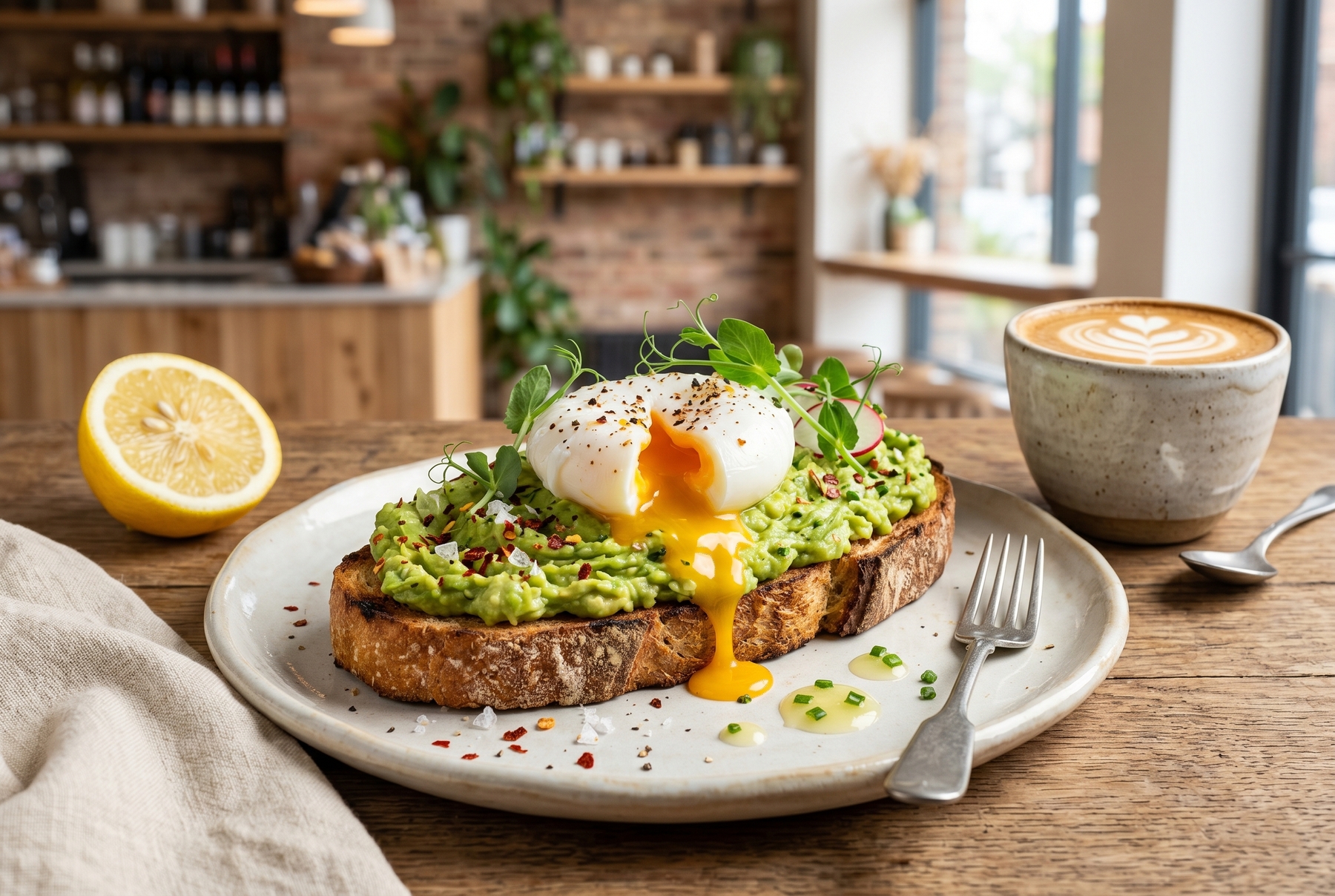
The perfect breakfast: toasted bread, creamy avocado, and a poached egg. This dish has become the symbol of an entire generation and modern breakfast culture.
Table of Contents
- How to Make Avocado Toast: The Formula for Perfect Flavor
- Why Avocado Makes All the Difference
- Breakfast as a Global Business
- Why Green Is Not Always Eco-Friendly
- Why Buying Avocados in Cold Climates Remains a Lottery
- A Well-Forgotten Old Sandwich
- Avocado Toast Recipes for Home: Simple Variations
- So, What Did Avocado Toast Actually Change?
How to Make Avocado Toast: The Formula for Perfect Flavor
Stripping the cultural noise away from avocado toast leaves a simple, almost dull foundation. Good bread. A rich, creamy base. Acidity. Salt. Crunch. Optional protein.
The avocado serves as the fat base here, a substitute for butter or cream cheese. Many wonder why avocado can taste bland. The problem is that without acidity and salt, it feels flat, almost soapy: not unpleasant, but entirely uninteresting—much like eating a rich, neutral cream. Adding lemon juice and a generous pinch of sea salt brings the flavor to life, providing brightness and contrast. Incorporating crispy bread and a spicy element introduces a textural interplay, establishing the sensation of a true breakfast rather than merely consuming a green paste on a plate.
Online recipes often present avocado toast as something highly specific, demanding ciabatta from a particular bakery, a perfectly timed poached egg, and chili flakes from a very specific tin. In practice, the formula thrives with any good bread: dense rye, hearth bread, or whole wheat. The crucial element is ensuring it is toasted to a genuine crunch; the crust must hold its shape under a moist topping and not turn soggy a minute after assembly.
A poached egg is wonderful, but a standard soft-boiled egg performs just as well and saves a significant amount of stress. Lime can be seamlessly replaced with lemon. Chili flakes easily swap for black pepper, smoked paprika, scallions, or dill. There are no strict rules, only one underlying principle: richness without acidity and salt is almost always boring. This is a critical point that most basic recipes either mention only in passing or fail to explain altogether.
Avocado toast did not invent a new breakfast formula. It repackaged an old one—and did so beautifully.
Why Avocado Makes All the Difference
Avocados are visually stunning. Green, creamy, and possessing an almost glossy surface once sliced. Sitting on dark bread alongside a vibrant orange yolk and red pepper flakes, it looks as though the portion was assembled explicitly for a photoshoot. The colors are highly contrasting, the composition is straightforward, and it catches the light beautifully. Slicing it open, adding salt, and finishing with a spritz of lemon makes it instantly ready for publication.
Mindful eating acts as a status marker today, much like a pair of high-end sneakers. The avocado fit into this dynamic flawlessly. It appeared as a designer’s choice: not merely sustenance, but a clear signal of who the consumer aspires to be.
In a café kitchen, avocado toast is an absolute dream. Assembly is incredibly fast, taking a mere three to four minutes. Equipment requirements are minimal, needing only a toaster and a sharp knife. The dish looks expensive and high-status, even though its base cost is pennies. It offers endless variations without altering the foundation: salmon, radishes, sesame seeds, truffle oil, or ricotta. A menu can be refreshed without revamping the kitchen operations. Furthermore, photos posted online by satisfied customers served as free advertising, eagerly produced by the patrons themselves.
Payment service Square recorded striking data in 2017: avocado toast sales on their platform reached roughly 900 thousand dollars a month, compared to just 17 thousand dollars in 2014. That signifies three years, a single dish, and a fifty-fold increase. This is far beyond a passing culinary trend. Avocado toast is essentially what happens when a sandwich dons a linen apron, moves into a café featuring concrete walls and bare wooden tables, and triples its check size. As it turned out, people are more than willing to pay.
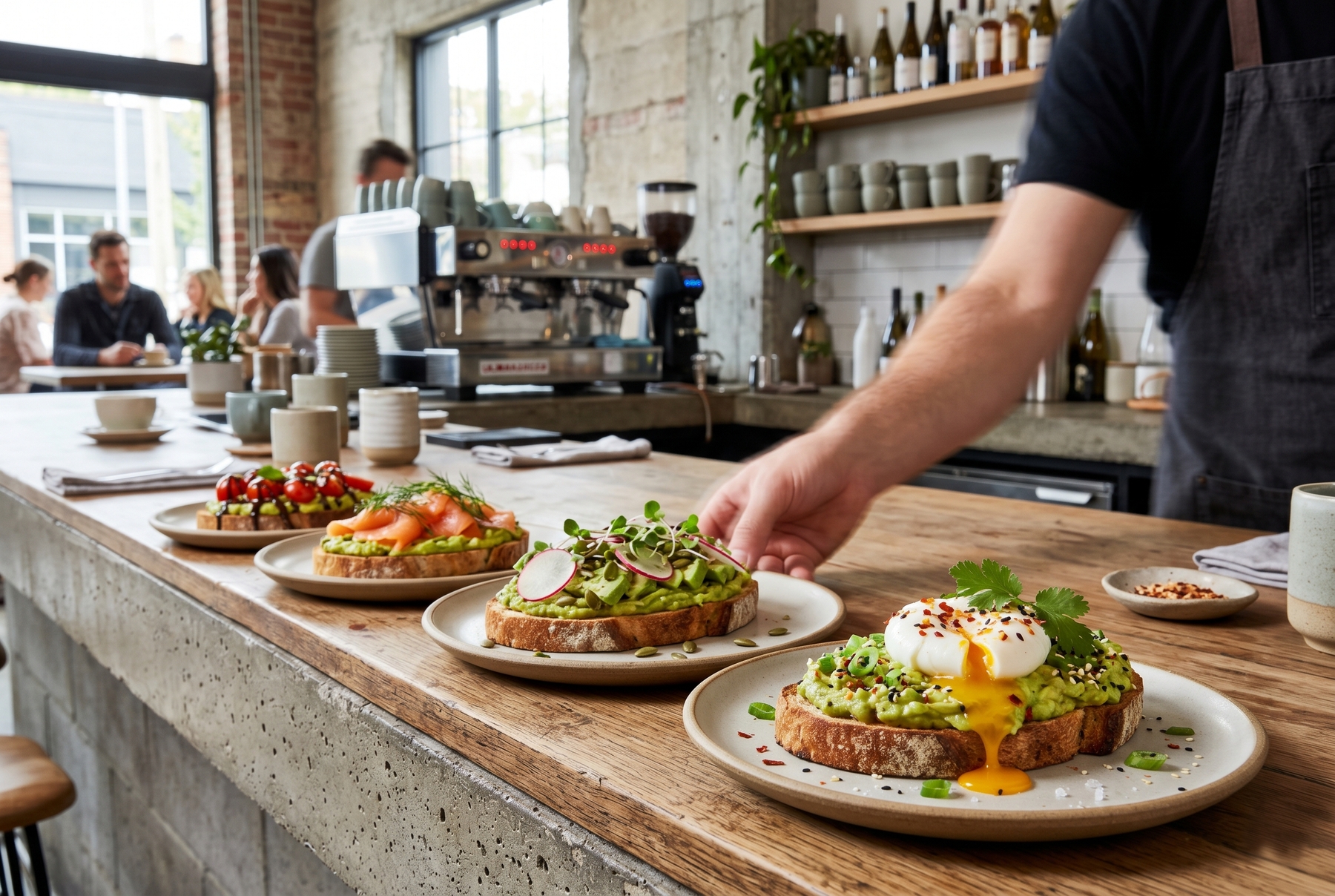
For cafes, avocado toast became the perfect product: high profit margins, endless variations with salmon, radish, or fresh herbs, and guaranteed photogenic appeal.
Breakfast as a Global Business
Prior to the avocado toast era, dining out for breakfast was often utilitarian: a coffee with a pastry, fried eggs, or syrniki (traditional Eastern European quark pancakes)—something eaten hastily before work. It served a function rather than being an event. Avocado toast demonstrated that breakfast could be marketed differently: as a small, highly aesthetic ritual, offering a sense of mindful choice and an unspoken promise of a better quality of life. “I am starting my day beautifully” was roughly the message decoded right off the plate.
Cafés eagerly adopted this format. Menus underwent visual transformations, price tags climbed, and the competition for serving the most photogenic dishes evolved into an entirely separate kitchen discipline. Breakfasts in major metropolises shifted: London, New York, Sydney, and Berlin witnessed the rise of an entire segment of establishments operating strictly until noon and making highly respectable profits doing so.
Consequently, the underlying economics of the product shifted. The surge in demand transformed the avocado from an exotic farmers’ market fruit into a mass-produced global commodity. By 2025, Mexico was growing 2.75 million metric tons of avocados and exporting half of that yield. Behind these figures lay not small family farms, but industrial-scale plantations, multi-year trade contracts, cross-ocean refrigerated logistics, and seasonal price fluctuations. These operations are now directly tethered to the breakfast sales at European and North American cafés from the previous week.
The European market built its own supply chain: Peru, Colombia, Kenya, Morocco, and Israel. According to CBI data, Peru emerged as the dominant avocado supplier to Europe. An avocado toast served in a Moscow, Madrid, or Berlin café originates far away from the kitchen where it is plated. A single breakfast is now a profoundly global project.
Why Green Is Not Always Eco-Friendly
The avocado is no villain. However, it is not a completely “clean” ingredient straight out of a healthy-living blog, either. Being green and organic does not always equate to being beneficial for the planet.
Global demand steadily depletes water resources, regularly sparking conflicts in the Mexican state of Michoacán. These issues are actively monitored by local journalists and international funds. A single fruit requires an average of 70 to 320 liters (roughly 18 to 85 gallons) of water, depending on the calculation method and the region—a substantial amount for areas historically plagued by water scarcity.
The true eco-friendliness of a toast stems from a collection of minor choices: the frequency of purchase, the origin of a specific batch, the level of ripeness when bought, and the ultimate amount wasted due to poor selection. Buying a rock-hard avocado, letting it sit by the window for a week, and then discovering it has turned completely brown inside represents a doubly wasted resource. Furthermore, it means money thrown directly down the drain.
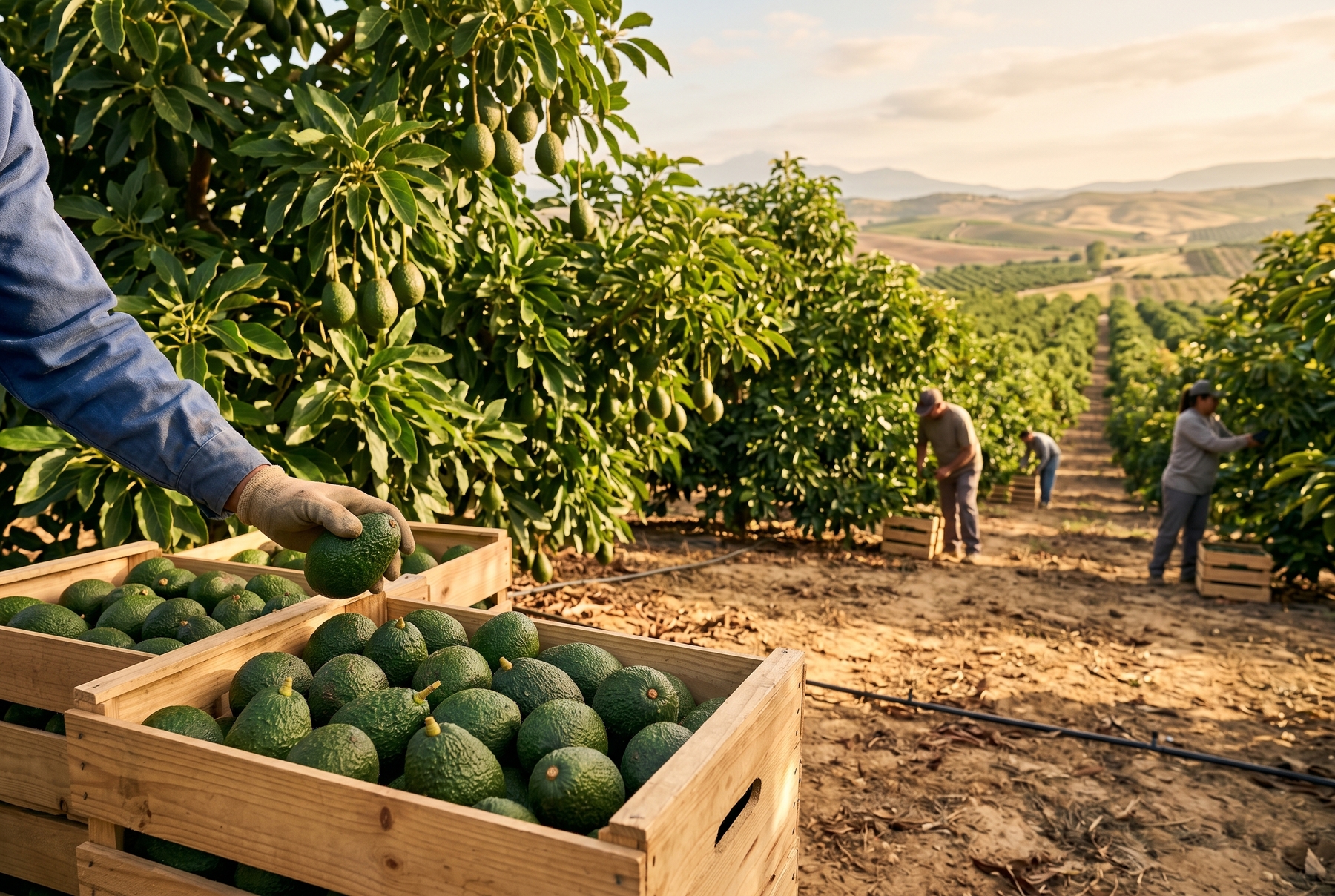
A massive industry stands behind this popular dish. Cultivating a single avocado requires dozens of liters of water, turning its eco-friendliness into a subject of serious debate.
Why Buying Avocados in Cold Climates Remains a Lottery
The context in colder climates, such as Russia, is fundamentally different. While in warmer regions one can pick a ripe avocado right off the produce stand, imported ones frequently arrive rock-hard and undergo ripening in unpredictable transit conditions. Therefore, the essential skill for crafting a proper toast in these areas involves accurately identifying a ripe fruit and maintaining composure when an attempt fails. The precise methods for doing this—and the tricks for making a stubborn, woody fruit ripen properly—are detailed comprehensively in our separate guide.
A Well-Forgotten Old Sandwich
The classic avocado sandwich did not pioneer the concept of a bread-based breakfast. Toast paired with an egg, quark (a fresh dairy curd), cured salmon, smoked sprats, squash spread, or a roasted eggplant spread—all functioned on the exact same formula: a rich base combined with acidity or freshness, grounded by the crunch of toasted bread. Spreading a layer of cream cheese topped with cucumber and dill over dense Borodinsky rye bread provides the exact same textural balance, simply without the surrounding hype. A sandwich featuring smoked sprats and a squeeze of lemon on toasted white bread offers fatty fish, a sharp acid, and a crispy foundation. The underlying principles remain identical; only the ingredients differ.
Avocado toast did not win the culinary race based solely on flavor. It triumphed through its vibrant color, its curated image, and timing: the marketing of a healthy lifestyle, the globalization of café culture, and the era of food photography converged flawlessly at a single point—with the avocado stepping up as the main protagonist. A sandwich backed by exceptional marketing simply defeated the sandwich without it.
Avocado Toast Recipes for Home: Simple Variations
The formula is singular: avocado plus salt plus acid plus heat plus crunch. Toasting the bread to a genuine crunch rather than merely warming it is mandatory. Incorporating the salt and acid immediately after adding the avocado, rather than waiting until the end, makes all the difference.
Variations That Work Flawlessly:
- Lemon + salt + chili flakes — the foundational version, exceptionally clean and straightforward. Combining this with a poached egg yields the “café” version, looking exactly like something served in a minimalist establishment.
- Lemon + dill + soft-boiled egg — dill pairs far better with avocado than one might initially expect.
- Cream cheese + avocado + lightly salted cured fish + lemon — a dense, highly satisfying option that shines on dark rye bread. It makes a remarkable dinner choice, despite officially holding breakfast status.
- Toasted Borodinsky rye + avocado + lightly salted cured fish + lemon + scallions — sounding a bit bold, yet functioning perfectly. The Borodinsky bread (a dark, coriander-spiced sourdough) introduces an acidity and malty depth that a standard ciabatta simply cannot provide.
- Any good toast + half an avocado + salt + a few drops of lemon juice + a touch of heat — best eaten standing directly over the plate, assigning it no formal name whatsoever.
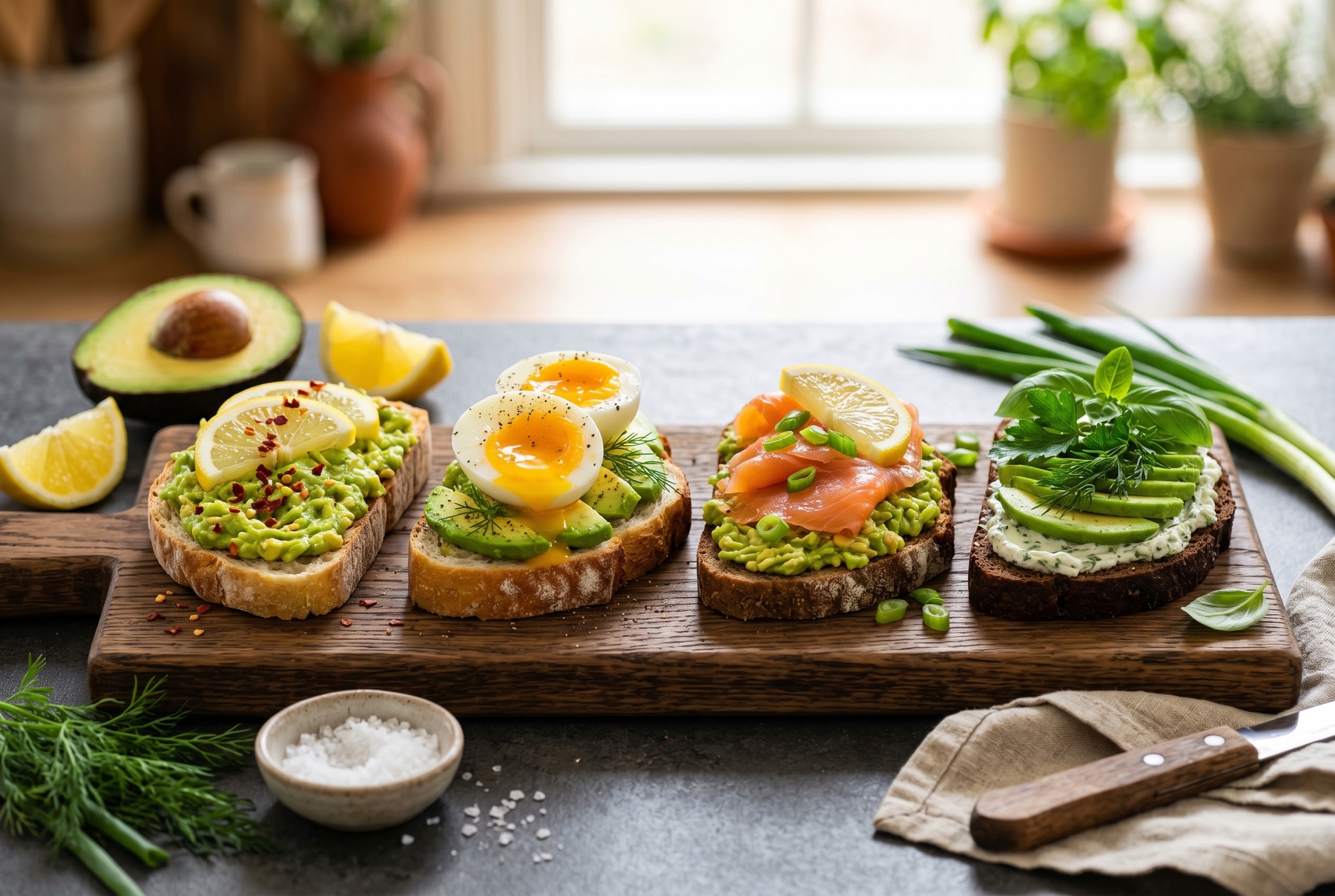
Home experiments: from the classic lemon and chili variation to hearty options featuring cured fish and cream cheese on dark rye bread.
So, What Did Avocado Toast Actually Change?
The housing market? Absolutely not. That was merely a successful provocation that struck a nerve, precisely because it spoke not of avocados, but of something vastly larger: the rising cost of living, a massive generational divide, and the reality that simply affording a normal life had become both more expensive and significantly more complicated. Finding a scapegoat in something tangible and visible is always convenient. The toast simply served as an easy target.
Avocado toast evolved into the perfect symbol for a new era of urban dining: fast, highly photogenic, completely global in its ingredient origins, slightly expensive, and delivering a promise of both health and status on a single plate. One simple piece of toast revealed that modern cafés are no longer selling food; they are dealing in lifestyles—boasting excellent margins and free marketing generated by the customers themselves.
Through an ordinary open-faced sandwich, our deepest anxieties suddenly surfaced: worries about money, social status, and the fundamental right to live beautifully, even if only during breakfast.
0 comments