
Yesterday, your shortbread turned out exactly right: it had neat edges, a clean snap when broken, and held its shape perfectly. Today, it spread across the baking sheet into uneven puddles, the dough stretched behind the rolling pin and stuck to your hands, and incorporating extra flour only made it tougher.
Before overanalyzing what went wrong, looking at the butter wrapper reveals the likely culprit. Most people grab butter from the shelf without a second thought, reaching for a familiar brand or recognizable golden foil. However, if a block of 72.5% butter ended up in the refrigerator instead of the usual 82.5%, excess water has infiltrated the dough. While not a catastrophic amount, it remains enough to alter the dough’s behavior: gluten develops more actively, the structure softens, and the shape ultimately yields.
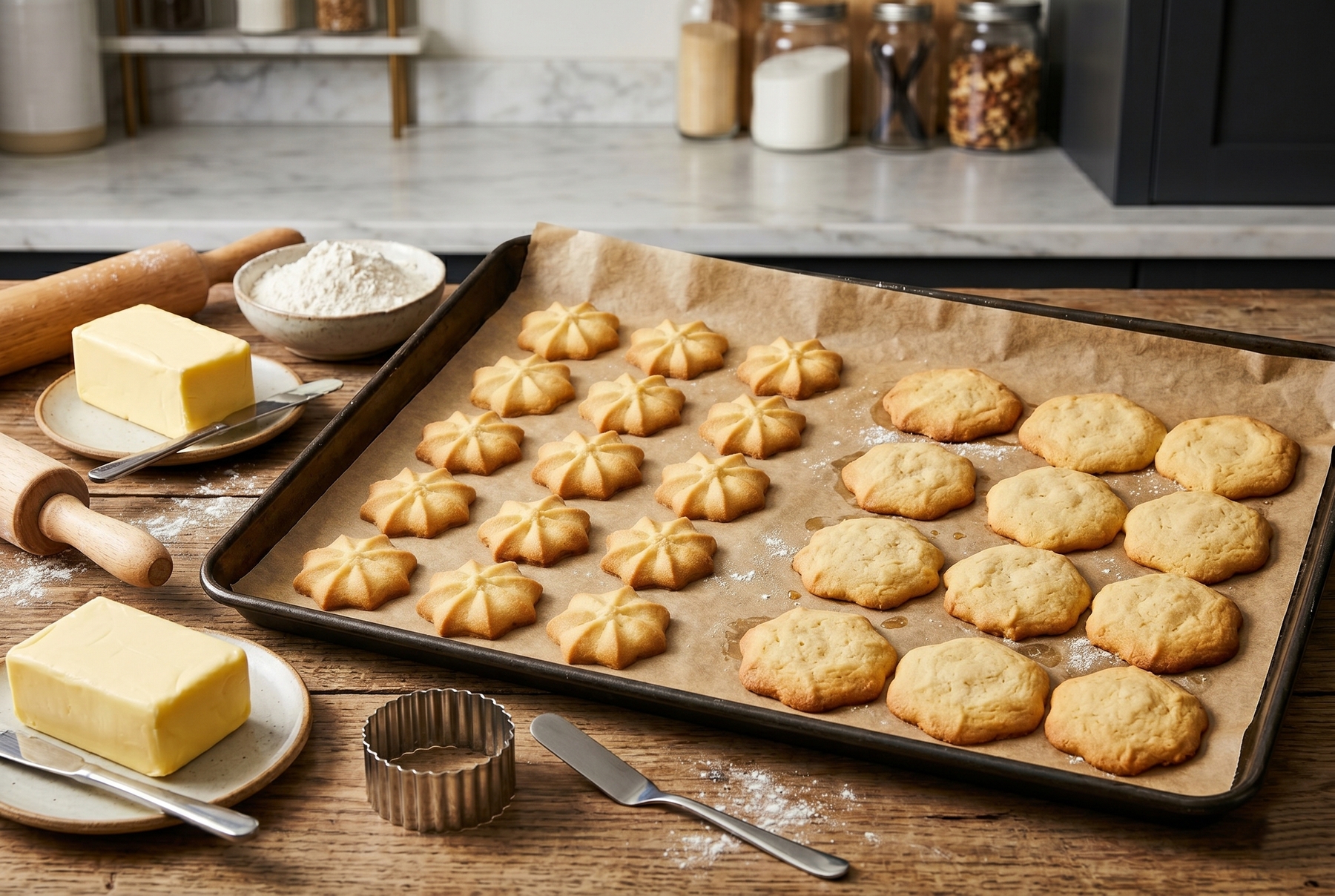
A visual comparison: on the left, the cookie baked with 82.5% butter maintained its sharp shape, while on the right, the 72.5% butter caused spreading due to excess moisture.
On the grocery shelf, these two blocks sit side by side and look equally promising. In the dough, they behave entirely differently. Using the former allows for process control, while relying on the latter leaves the outcome to pure luck.
Table of Contents
- What Is the Real Difference Between 72.5% and 82.5% Butter
- The Role of Butter in Baking
- Where 82.5% Butter Truly Alters the Result
- Where 72.5% Butter Usually Works Perfectly Fine
- Can You Substitute 82.5% Butter With 72.5% and How to Execute It
- How to Decipher the Butter Label
- Cheat Sheet: Which Butter to Choose
What Is the Real Difference Between 72.5% and 82.5% Butter
It Is Not About Good or Bad, But About Balance
The percentage on the wrapper indicates the mass fraction of milk fat. Butter with 82.5% contains more fat and less water, whereas 72.5% offers the exact opposite. According to historical Eastern European GOST standards, common categories appear as follows: “Peasant” (Krestyanskoye) at 72.5%, “Amateur” (Lyubitelskoye) at 80%, and “Traditional” (Traditsionnoye) at 82.5%. In practical baking, this difference boils down to a single question: what happens to the dough when the water content increases?
The moisture difference might seem minor, but it can reach up to 9 percentage points. For a delicate dough, this discrepancy is highly noticeable.
Higher fat and lower moisture content make butter behave more predictably in doughs where structure and crumbliness are paramount. Excess water hydrates the flour, activating gluten more aggressively, which renders the dough softer and less stable. During baking, this moisture turns into steam: while this is an essential part of the process for puff pastry, it can make other baked goods gummy and heavy.
Why Simply Adding More Butter Is Not Always the Solution
It seems straightforward: if 72.5% butter contains less fat, incorporating more butter should fix it. This might work in a simple loaf cake, but it completely fails in shortcrust pastry. Along with the extra fat, you introduce even more water. The dough softens, spreads, and loses its structural integrity. Cookies melt into puddles, and tart shells collapse.
In rustic baking, this margin of error often goes unnoticed. However, contemplating whether 82.5% butter can be substituted with 72.5% in precise recipes typically yields a firm “no.”
The Role of Butter in Baking
Choosing the Best Butter for Shortcrust Pastry: The Function of Fat
Fat literally coats the flour particles. It creates a physical barrier between the flour and water, preventing gluten from overdeveloping. This explains why an excellent shortcrust pastry crumbles upon breaking—it does not turn to dust but offers a short, clean snap. Similarly, a tart shell should never chew like rubber. The higher the fat and the lower the moisture, the more tender and crumbly the pastry becomes.
Water Generates Steam But Can Ruin the Structure
As it heats, the water trapped within the butter turns into steam. In puff pastry, this acts as a crucial technological step: the steam inflates the dough and forces it to separate into flaky layers. Yet, if the moisture is excessive or misdirected, the dough becomes sticky, unstable, and struggles to hold its shape, resulting in a denser bake than intended.
Butter Temperature Is Sometimes More Crucial Than Percentage
Even premium 82.5% butter can be ruined by improper temperature management.
Cold butter, diced straight from the refrigerator, is essential for flaky pie crusts and puff pastry. Soft, pliable butter that yields to a gentle finger press without resistance is destined for whipping, buttercream, and classic shortbread. Melted butter shines in muffins, simple loaf cakes, and batter-based pies.
Attempting to cream nearly liquid butter with sugar proves futile: the emulsion fails to form, the frosting refuses to gain volume, and the fat distributes unevenly throughout the dough. The cookies will not just spread—they will entirely melt. The difference is profoundly noticeable.
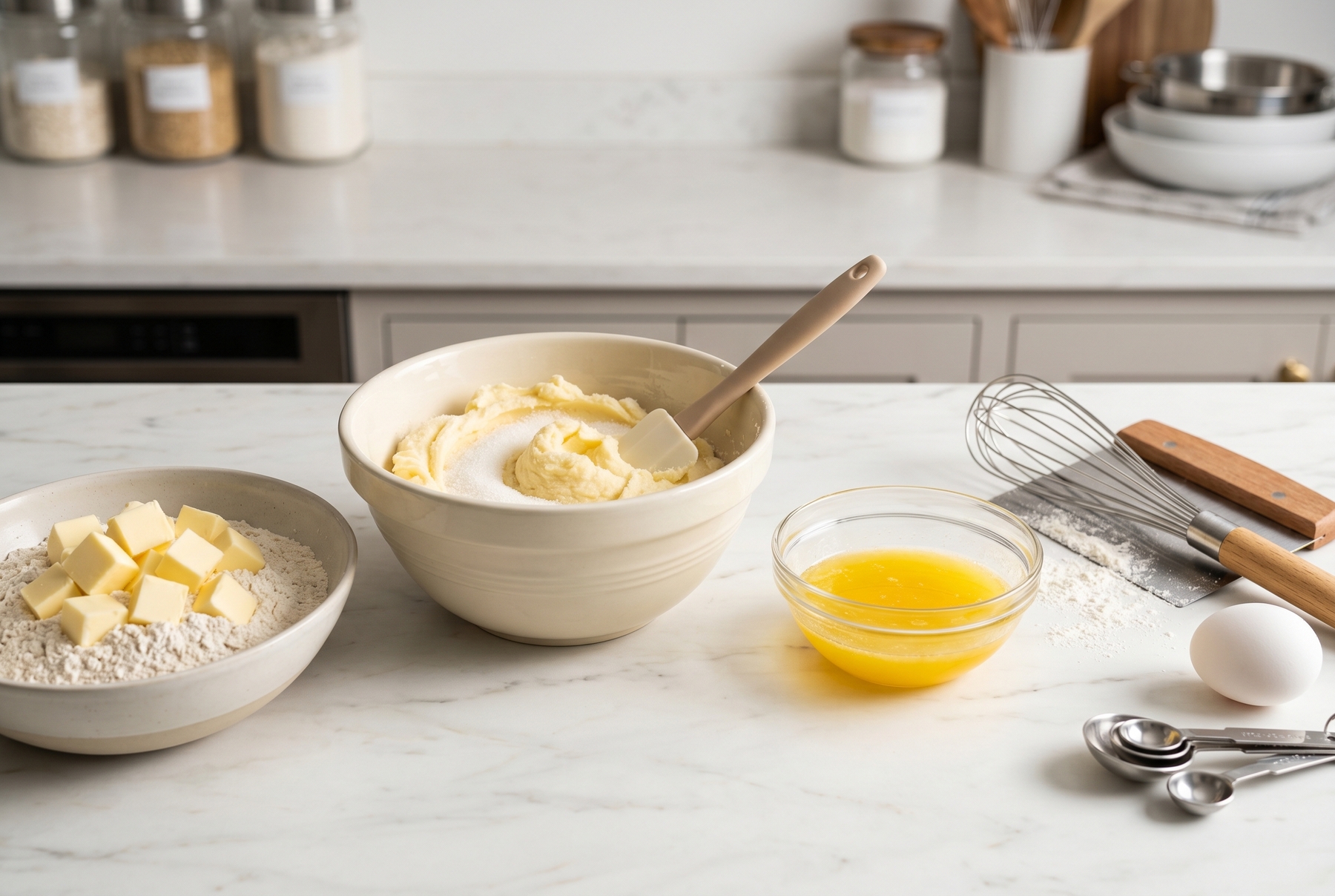
Proper butter preparation: cold cubes for flaky pie crust, softened for creaming, and melted for loaf cakes.
Where 82.5% Butter Truly Alters the Result
Shortcrust Pastry, Tarts, and Sablé
Classic French sablé relies on approximately 250 g (8.8 oz) of flour, 125 g (4.4 oz) of butter, an egg yolk, and sugar. This dough entirely depends on the delicate balance of fat and gluten development. Here, every extra gram of water poses a severe risk. Using 82.5% butter guarantees fragility, a pure dairy flavor, and a predictable shape. Tartlet shells maintain their crisp edges, and cookies emerge with sharp contours rather than melted outlines.
Puff Pastry and Flaky Pie Dough
In laminated doughs, the butter must roll out seamlessly with the dough without tearing or leaking. It needs to remain firm enough to keep the layers from sticking together, yet sufficiently pliable to avoid crumbling under the rolling pin.
This is precisely where the fat percentage of butter for puff pastry becomes critical: 72.5% frequently behaves less predictably. With lower fat and a higher water ratio, it struggles to maintain an even sheet, loses stability rapidly during rolling, and yields less defined flaky layers.
Buttercream Frostings
When deciding between 72.5% or 82.5% butter for a frosting, keeping in mind that buttercream is an emulsion changes the perspective. The butter gets whipped with powdered sugar, incorporated into a custard base, or emulsified with Italian meringue. Fat content directly impacts texture: 82.5% butter delivers a silky, resilient frosting with an unadulterated sweet cream taste. Using 72.5% butter might result in a looser, sometimes split structure—not always a total disaster, but hardly what is expected for a celebration cake destined to sit out for several hours.
Cut-Out Cookies and Stamped Doughs
Gingerbread, roll-out cookies, stamped designs, and intricate shapes demand precision. Any baked good that must emerge from the oven looking exactly as it did going in—just baked—requires stability. In these scenarios, 82.5% is not a luxury, but a fundamental tool.
Where 72.5% Butter Usually Works Perfectly Fine
A slight difference might exist, but in rustic home baking, it rarely compromises the entire recipe.
Simple Loaf Cakes and Muffins
When a recipe calls for melting the butter and mixing it with liquid ingredients like milk, eggs, or kefir, the variation goes almost unnoticed. A muffin baked with 72.5% butter might present a slightly different crumb, perhaps a fraction more moist, but the recipe easily withstands it.
Yeast Doughs
Soft rolls, hand pies, enriched doughs, and simplified homemade brioche rely on flour, liquid, kneading, and fermentation. Yeast dough proves resilient enough to forgive a touch of excess moisture. Opting for 72.5% here remains a highly viable choice. While 82.5% provides a richer dairy note, the bake succeeds beautifully without it.
Cozy Home Baking
Rustic apple pies, farmer’s cheese bakes, quick batter pies, and that raisin loaf from a treasured family recipe book that calls for “one stick of butter” rather than precise grams. For these comforting classics, 72.5% stands as a perfectly normal household choice.
72.5% butter is not inherently bad. It simply behaves differently, and pastries sensitive to dough hydration immediately register that shift.
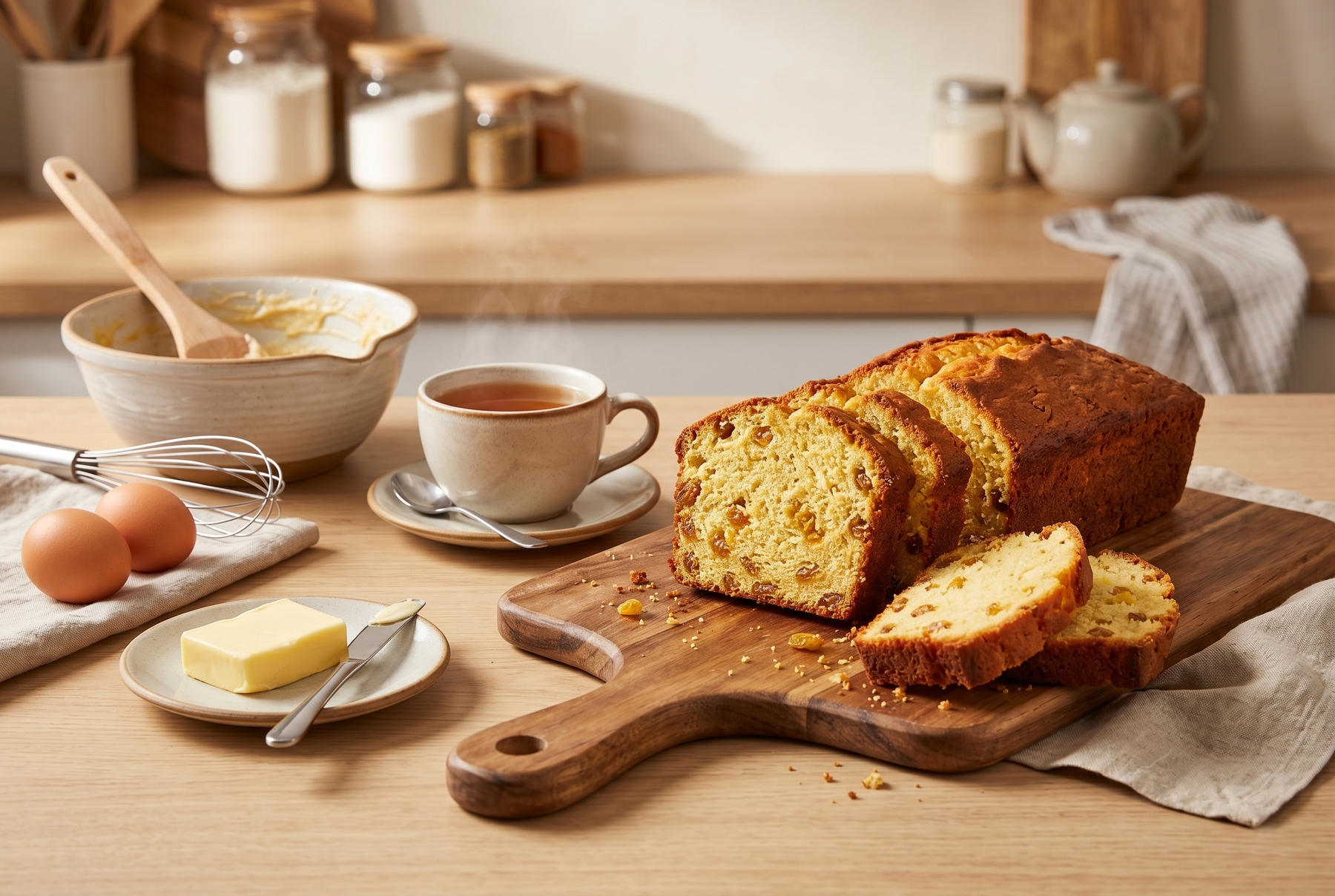
For simple loaf cakes and muffins, 72.5% fat butter works perfectly well, as the structural difference remains minimal.
Can You Substitute 82.5% Butter With 72.5% and How to Execute It
Substitutions Fail in Precision Recipes
Shortcrust, sablé, puff pastry, tarts, and buttercreams demand exactness. If the recipe heavily relies on precise ratios and moisture control, purchasing the correct butter prevents agonizing over a collapsed crust later. Calculating the ratios remains theoretically possible, but introducing extra fat inevitably drags unwanted excess water into the mix.
In Forgiving Batters, Reduce the Other Liquids
When working with a tolerant recipe like a loaf cake, muffins, or yeast dough, slightly reducing the other liquids—such as milk, water, or buttermilk—often solves the problem. A radical cut is unnecessary. Subtracting roughly 1 to 2 teaspoons of liquid per 100 g (3.5 oz) of butter effectively compensates for the extra moisture.
Rescuing Soft Dough: Cold Always Wins Over Extra Flour
Should the dough turn out softer than intended, the refrigerator serves as the ultimate rescue tool. Chilling the dough for 20 to 40 minutes at 4°C (39°F) achieves far better results than dusting in extra flour. Flour never actually eliminates moisture; it merely binds it while simultaneously altering the delicate structure, making the resulting pastry coarse and heavy.
How to Decipher the Butter Label
Reading Beyond the Marketing Names
Supermarket shelves display butter at 72.5%, 80%, 82%, 82.5%, and occasionally 84%. Relying strictly on the marketing name invites unnecessary risk. Checking the ingredients list and the exact fat percentage provides the only reliable metric.
The Ingredients List: Cream Is Excellent, Vegetable Oils Mean a Different Product
Classic baking demands a product made solely of sweet cream and occasionally salt—nothing more. The presence of vegetable oils immediately identifies the product as margarine or a blended spread. While functional in certain household scenarios, spreads employ an entirely different technology, behave differently under heat, and lack authentic dairy flavor.
Salted Butter: Adjusting the Seasoning
Most professional baking recipes default to unsalted sweet cream butter. If a block of salted butter accidentally makes it into the cart, proportionally reducing the added salt in the recipe restores balance. This adjustment becomes incredibly prominent in buttercreams and delicate pastries, where salt functions merely as a subtle flavor enhancer.
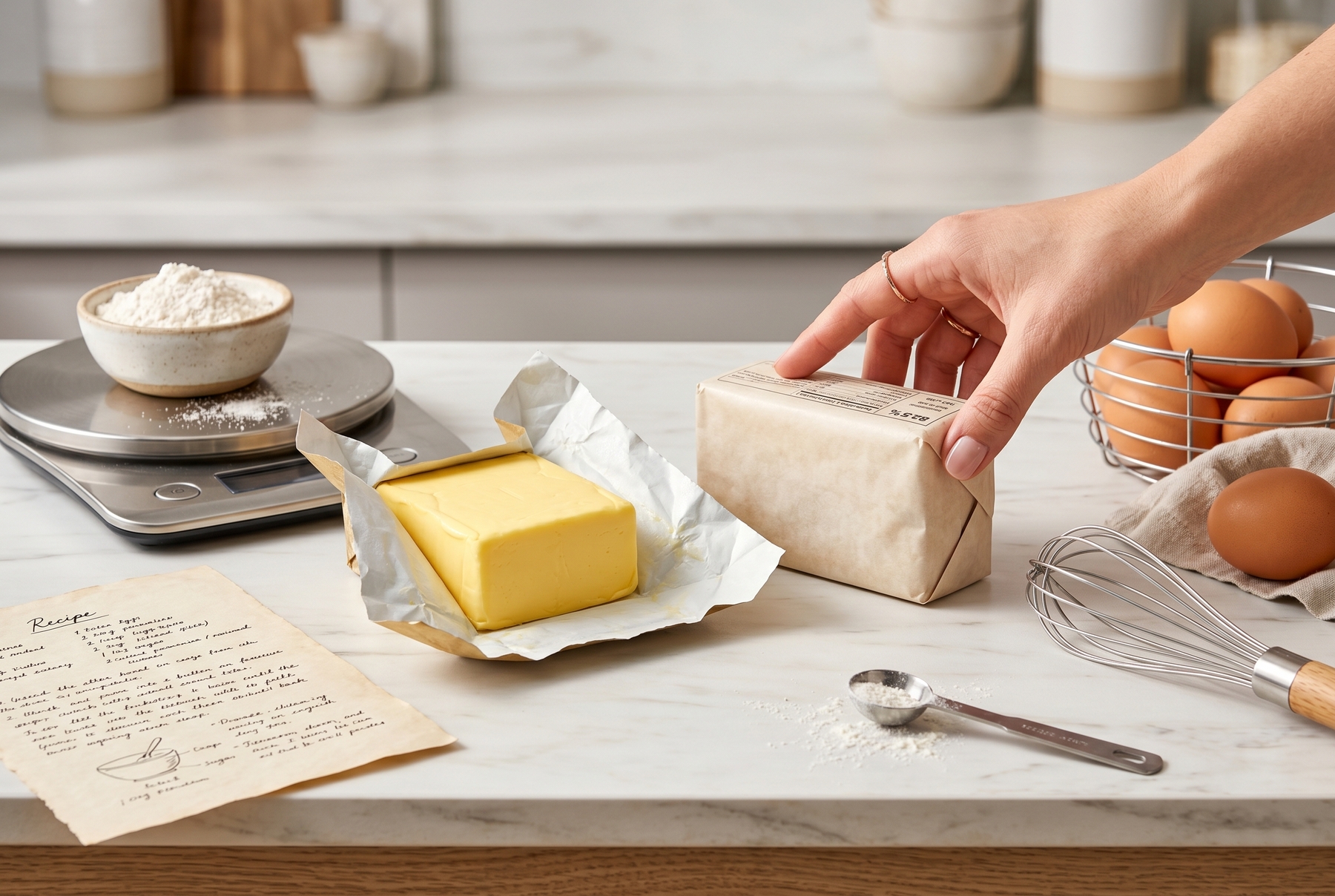
Always inspect the fat percentage and ingredient list on the wrapper: professional results demand butter starting at 82.5%.
Cheat Sheet: Which Butter to Choose
82.5% Butter:
- Shortcrust pastry, tarts, and French sablé
- Puff pastry, flaky pie dough, and croissants
- Buttercream frostings
- Cookies requiring sharp shapes, stamps, or intricate designs
- Any recipe where structural integrity and crumbliness matter
72.5% Butter — Usually Handles the Job:
- Loaf cakes, muffins, and rustic fruit pies
- Yeast rolls and savory hand pies
- Comforting home baking without strict requirements for shape and flakiness
Using 82.5% butter serves as an insurance policy against culinary surprises. In delicate shortcrust, laminated doughs, sablé, and silky buttercream—where form and texture are non-negotiable—excess water in the butter becomes an unwanted variable requiring constant management.
Meanwhile, 72.5% butter comfortably holds its rightful place: spread over morning toast, stirred into oatmeal, or folded into an apple pie for Sunday afternoon tea. Baking projects that do not demand absolute, jewelry-level precision handle it without the slightest issue.
0 comments