
A cast-iron skillet sits in the sink from the night before. Frying potatoes left you exhausted, so you told yourself ‘I will do it later’ and went to bed. In the morning, rust spots cover the surface, a rancid smell lingers, and you stare at it with the heavy heart of someone who ruined a family heirloom overnight.
The skillet is not ruined. However, the logic of cast iron is worth understanding once and for all, because most problems with this cookware stem from a single misstep: leaving it wet.
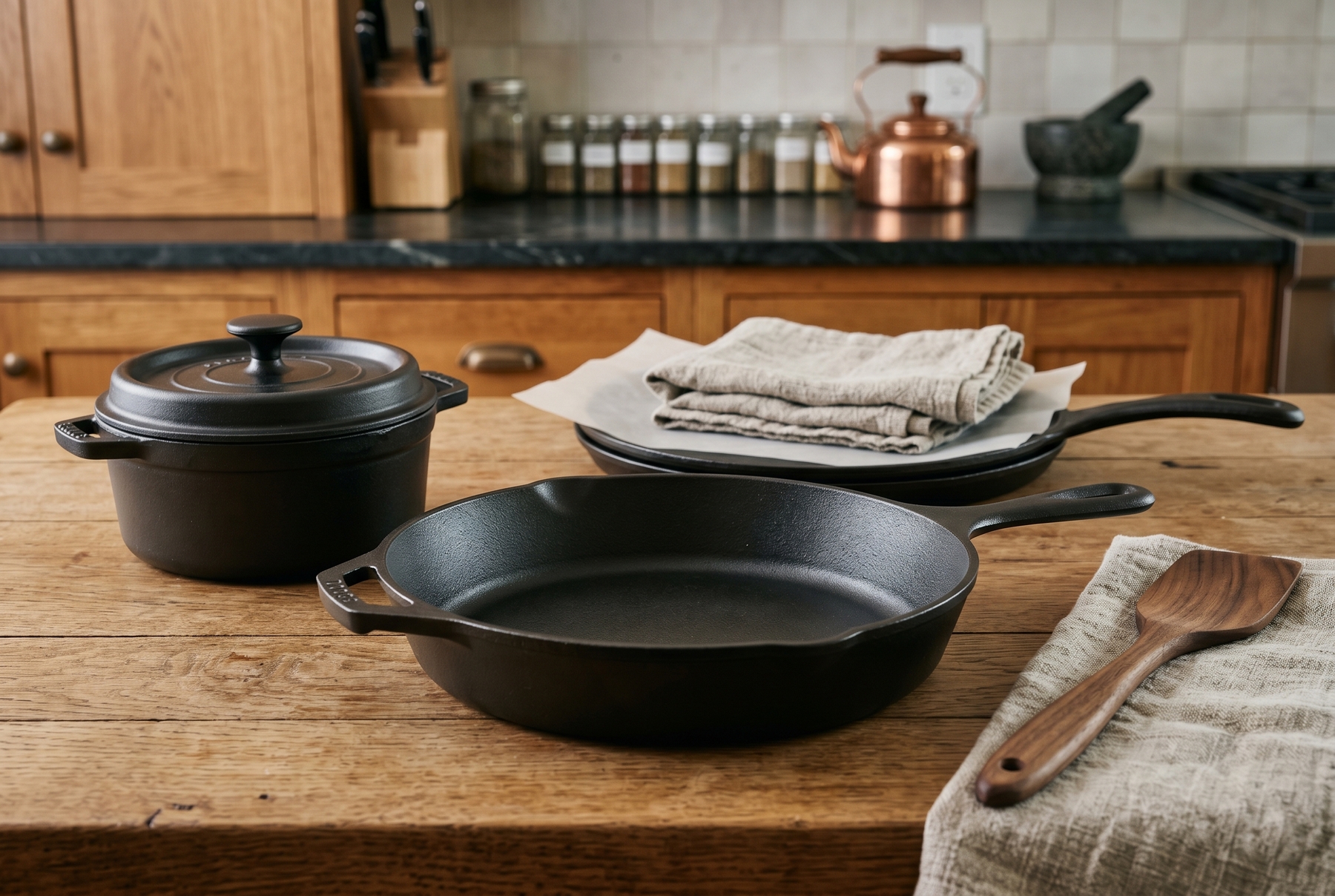
High-quality cast iron serves as an investment for decades. The golden rule: never leave it wet.
Table of Contents
- When People Say Cast-Iron Cookware Requires Special Care
- Where So Many Superstitions Came From
- The Issue Is Not Water, But Improper Drying
- How to Properly Wash a Cast-Iron Skillet: Three Main Scenarios
- Staying Calm About Dish Soap
- Why Storing Food in Cast-Iron Cookware Is a Mistake
- Drying: A Towel Is Not Enough
- Which Oil Your Cast-Iron Skillet Needs: How Much and Why
- Storage: Keep It Dry and Airy
- What to Do If Rust Appears on Cast Iron: Do Not Panic
- What You Should Avoid Doing
- Your Everyday Checklist
When People Say Cast-Iron Cookware Requires Special Care
Typically, this refers to a specific type of cookware: uncoated, non-enameled cast iron. An old Soviet skillet darkened by time. A thick-walled kazan (a traditional Central Asian cooking pot for pilaf). A roasting pan, a crêpe pan, or a heavy modern skillet lacking a non-stick coating.
Enameled cast iron, bright and colorful, operates under different rules. Seasoning it with oil is unnecessary, washing it with dish soap is perfectly fine, and most of the advice in this article does not apply to it. If an oval roaster features a white or blue enamel interior, washing it like a regular pot is the best approach.
The following applies solely to bare cast iron.
Where So Many Superstitions Came From
Cast iron has survived communal kitchens, country stoves, grandmother’s ladles, and cross-generational moves. Yet, culinary myths surrounding it have accumulated more than around perhaps any other cookware.
‘Cast iron cannot be washed with water.’ It absolutely can be. Leaving it wet is the actual problem.
‘Soap kills the skillet.’ The outcome depends entirely on the method. Soaking it in a bubble bath for three hours will certainly ruin the seasoning. A drop of dish soap and a quick rinse, however, cause no harm.
‘If rust appears, it is time to throw it away.’ This is false. Rust on cast iron usually requires just twenty minutes and a little patience to remove.
‘Proper care means only salt and no water.’ While salt serves as a useful mild abrasive, it does not replace washing and fails to make the skillet sanitary.
‘The greasier the surface, the better the protection.’ This remains the most harmful superstition. A thick layer of oil offers no protection; instead, it becomes sticky, gathers dust, turns rancid, and ultimately smells worse than an unseasoned pan.
These myths stem partly from real, albeit overly simplified, experiences. Cast iron behaves differently than stainless steel or Teflon, prompting people to explain its nature through prohibitions rather than logic. The logic, however, is quite simple.
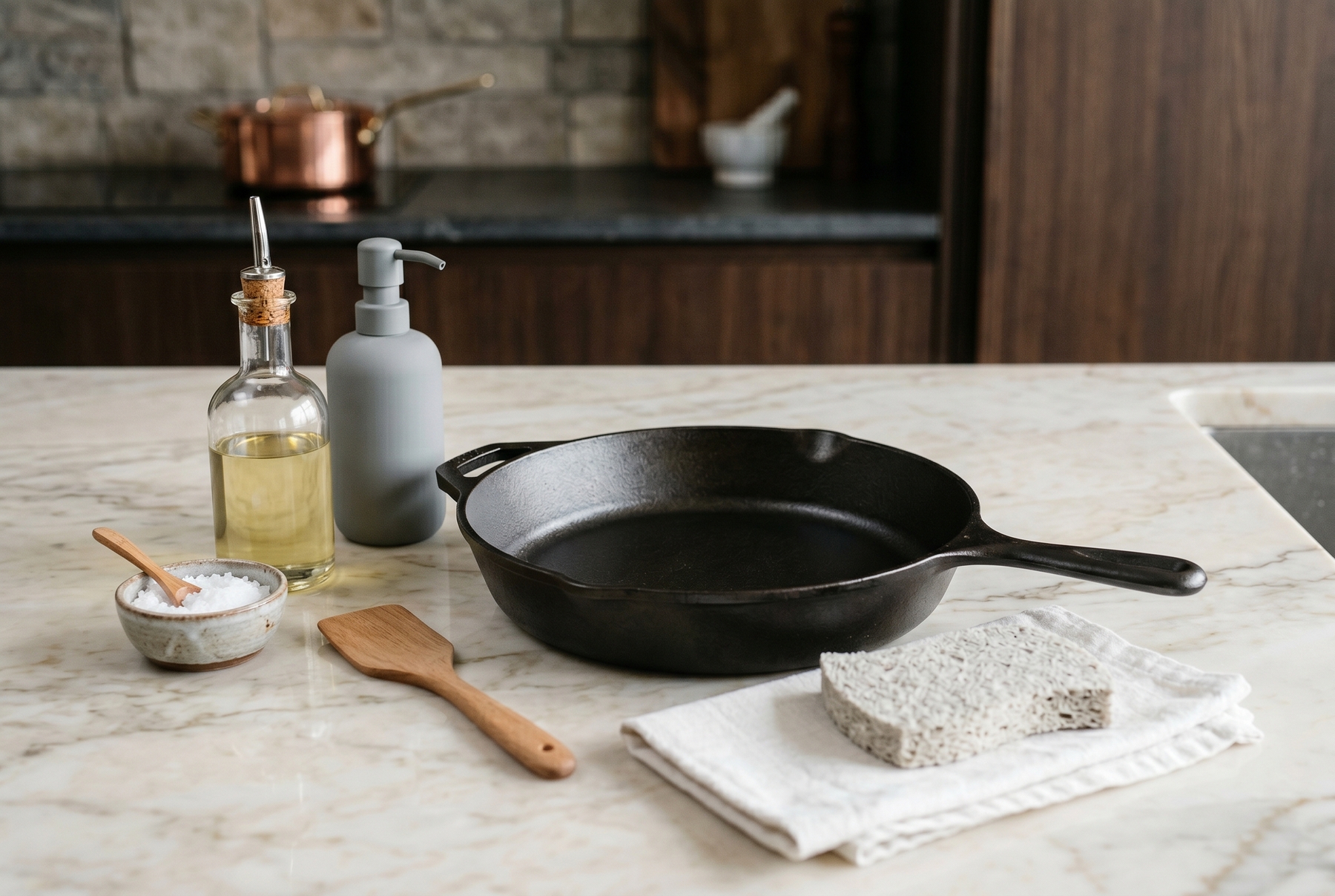
Basic supplies are enough for proper care: vegetable oil, coarse salt, and a soft sponge.
The Issue Is Not Water, But Improper Drying
Cast iron contains iron. Iron rusts upon contact with water and oxygen: this is basic chemistry, and nothing unexpected happens here. Therefore, the problem lies not in washing the skillet, but in leaving it damp afterward.
Washing, wiping dry, and heating the pan on the stove provides all the necessary care.
Over time, a thin layer of polymerized oil develops on the cooking surface of well-maintained cast iron. Intense heat literally bakes the fat into the pores of the metal, creating a protective film. This exact layer prevents eggs from sticking and gives the surface a dark, almost satin-like finish. This coating is not dirt, so scrubbing it down to the gray metal is a mistake. On the other hand, passing off actual grime as ‘proper patina’ is equally wrong. Leftover fish from yesterday and rancid fat have nothing to do with a well-seasoned surface.
How to Properly Wash a Cast-Iron Skillet: Three Main Scenarios
The skillet is mostly clean. Allowing the pan to cool until warm is essential (pouring cold water over a scorching-hot skillet can cause the metal to warp). Wiping away food debris with a paper towel or spatula prepares it for washing. Rinsing with warm water, using a drop of dish soap if necessary, along with a brush or a soft sponge, does the job. Wiping it completely dry immediately is the final step.
The surface needs to be clean, free of stuck bits and sticky grease. Getting it squeaky clean like glass is not the goal and will not happen.
Food is stuck. Pouring a little water into the skillet and placing it over medium heat for a minute and a half helps immensely. The stuck bits loosen almost on their own. Assisting the process with a wooden or silicone spatula is highly effective. If stubborn spots remain, sprinkling coarse salt and scrubbing with a brush works perfectly: salt acts as a gentle abrasive, removing burnt food without scratching the metal. Following up with warm water, wiping, and drying finishes the process.
Reaching for a steel wool pad right away is unnecessary. It strips everything, including the seasoning that needs to stay.
After cooking fish, garlic, or pungent spices. Cast iron holds onto odors, especially if the protective layer is uneven or thin. Using dish soap confidently in this scenario is fine: a normal amount, not half the bottle. Washing thoroughly, drying, and heating the pan ensures the smell disappears.
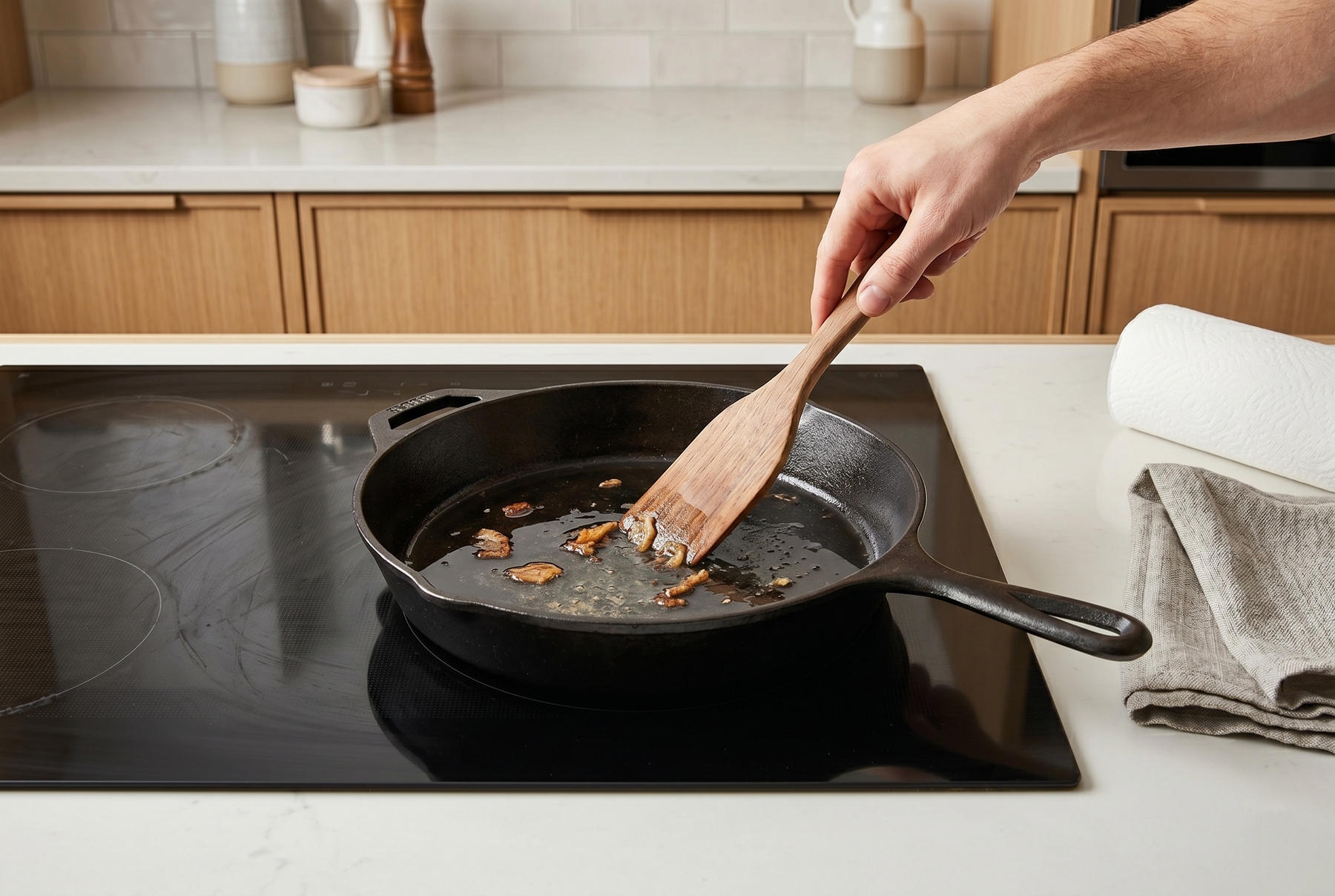
Removing stuck food is easy by heating the skillet with a small amount of water and using a spatula.
Staying Calm About Dish Soap
Dish soap does not destroy cast iron. What truly ruins it is hours of soaking, the dishwasher, and aggressive degreasers meant to strip a greasy buildup in a single wash.
A soft sponge, a brush, warm water, and a drop of soap provide perfectly adequate maintenance. Thus, using a drop of detergent after cooking fish, a rich sauce, or a sweet glaze is perfectly acceptable.
Certain actions must be avoided: soaking the pan for an hour, running it through the dishwasher (a long cycle in hot water with aggressive chemicals creates ideal conditions for rust), and scrubbing the metal back to gray after every use, as if it just arrived from the store.
Why Storing Food in Cast-Iron Cookware Is a Mistake
This topic is not entirely obvious, yet it is the most common reason for ruined cookware.
Many people leave leftover pilaf in the kazan, braised cabbage in the roaster, or a stew in the skillet. Keeping it there until tomorrow’s lunch seems harmless at first glance. In reality, food swimming in sauce interacts with the metal for hours; salt and acids from vegetables and spices slowly break down the protective layer. The dish can develop a metallic taste, the pan surface stains, and the risk of rust forming right where the food touches the metal increases significantly.
Acidic and salty dishes require special attention. Tomato sauce, braised cabbage, and dishes containing vinegar, wine, lemon juice, or strong marinades interact actively with the metal. Pilaf loaded with spices and onions left in a kazan overnight, fish, or salty broth pose similar risks. A kazan makes an excellent vessel for cooking pilaf, but it was never designed to be a storage container.
The workflow is straightforward: cooking, serving, letting it cool slightly, and transferring the leftovers into a regular container or glass bowl. Emptying the kazan immediately, washing it, and drying it is the best practice. While guests are still at the table or the dish serves as a centerpiece, leaving the food in the pan is perfectly fine. Leaving a saucy roast or anything acidic or salty in it overnight, however, develops into a bad habit that eventually damages the cookware.
If the interior boasts intact enamel without chips, storing food is safe. Nevertheless, fitting a four-liter (4-quart) enameled pot into the refrigerator is rarely convenient. Transferring the food is simply easier.
Drying: A Towel Is Not Enough
This is the step most people overlook. Wiping with a towel creates the illusion of a dry pan. However, microscopic moisture remains trapped in the pores and fine scratches of the metal. This exact invisible moisture eventually produces rust spots.
Proper drying involves wiping the pan with a towel, placing it over low or medium heat for two to three minutes, and allowing all residual moisture to evaporate. Turning off the heat completes the process.
Heating an empty skillet until it smokes white is completely unnecessary. The goal is modest: eliminating residual moisture, not running a metallurgical workshop. The skillet is perfectly dry when a paper towel wiped across the surface comes away completely dry. The walls, handle, and bottom also need careful drying: rust happily develops underneath the pan where no one expects it.
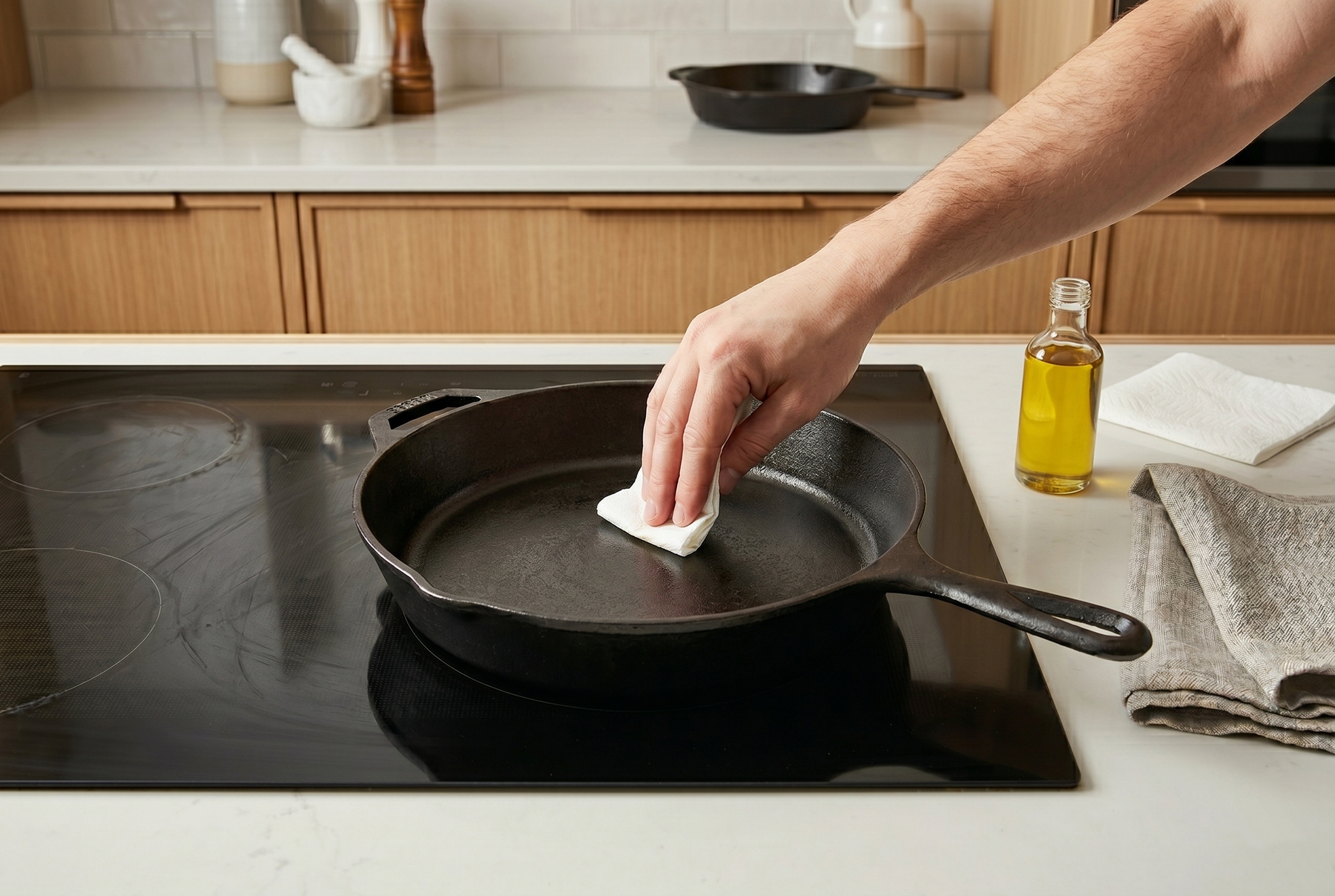
After drying, applying just a few drops of oil and rubbing it to a matte finish protects against corrosion.
Which Oil Your Cast-Iron Skillet Needs: How Much and Why
Applying just a few drops onto a paper towel is all it takes. Spreading a thin layer across the entire surface, followed by taking a clean towel and wiping it almost entirely dry, achieves the right finish. The skillet should look slightly lustrous, almost matte, rather than greasy and slick.
If the surface looks slathered in lotion, too much oil has been used. This provides no protection; instead, it promises future trouble. Excess oil fails to polymerize correctly, turns sticky, and eventually goes rancid.
Neutral, refined oils perform best: sunflower, canola, or grapeseed oil. Unrefined aromatic oils, butter, and the ‘good old pork fat from grandmother’s jar’ serve this purpose poorly, as they introduce odors and create an uneven coating.
Storage: Keep It Dry and Airy
Cast iron despises enclosed, humid spaces. Storing a kazan in a cabinet, sealing it tightly with a lid, and discovering rust a month later is a classic scenario.
Keeping the lid slightly ajar, rather than sealed tight, is the better approach. Putting a damp skillet away in the cupboard is an absolute mistake. If nesting skillets is unavoidable due to lack of space, placing a paper towel, a sheet of parchment, or a thin cloth napkin between them is highly recommended. This shields the surface from scratches and prevents condensation from building up between the metal layers.
The oven serves as a suitable storage spot only if it remains genuinely dry, rather than functioning as a ‘garage’ right after a long roasting session full of steam. A summer house kitchen works only if the environment is dry and the cookware is put away in proper condition.
What to Do If Rust Appears on Cast Iron: Do Not Panic
Orange spots on cast iron rarely signify a disaster; instead, they represent a thirty-minute chore.
Grabbing a brush or coarse salt and removing the rust mechanically is the first step. Fine sandpaper or a dedicated wire brush works beautifully for deeper spots. Washing the pan, drying it completely (first with a towel, then on the stove), applying a thin layer of oil, and heating it restores the surface. For severe cases, repeating the process two or three times yields great results.
This method works. Cast iron recovers remarkably well.
Knowing when to stop and avoid heroics is crucial. If the rust runs deep, the surface literally flakes off, the cookware comes from an unknown origin, or it smells of rancid fat even after several scrubbings, a different approach is necessary. In these instances, a full restoration and re-seasoning process is required, or the skillet temporarily shifts away from culinary use.
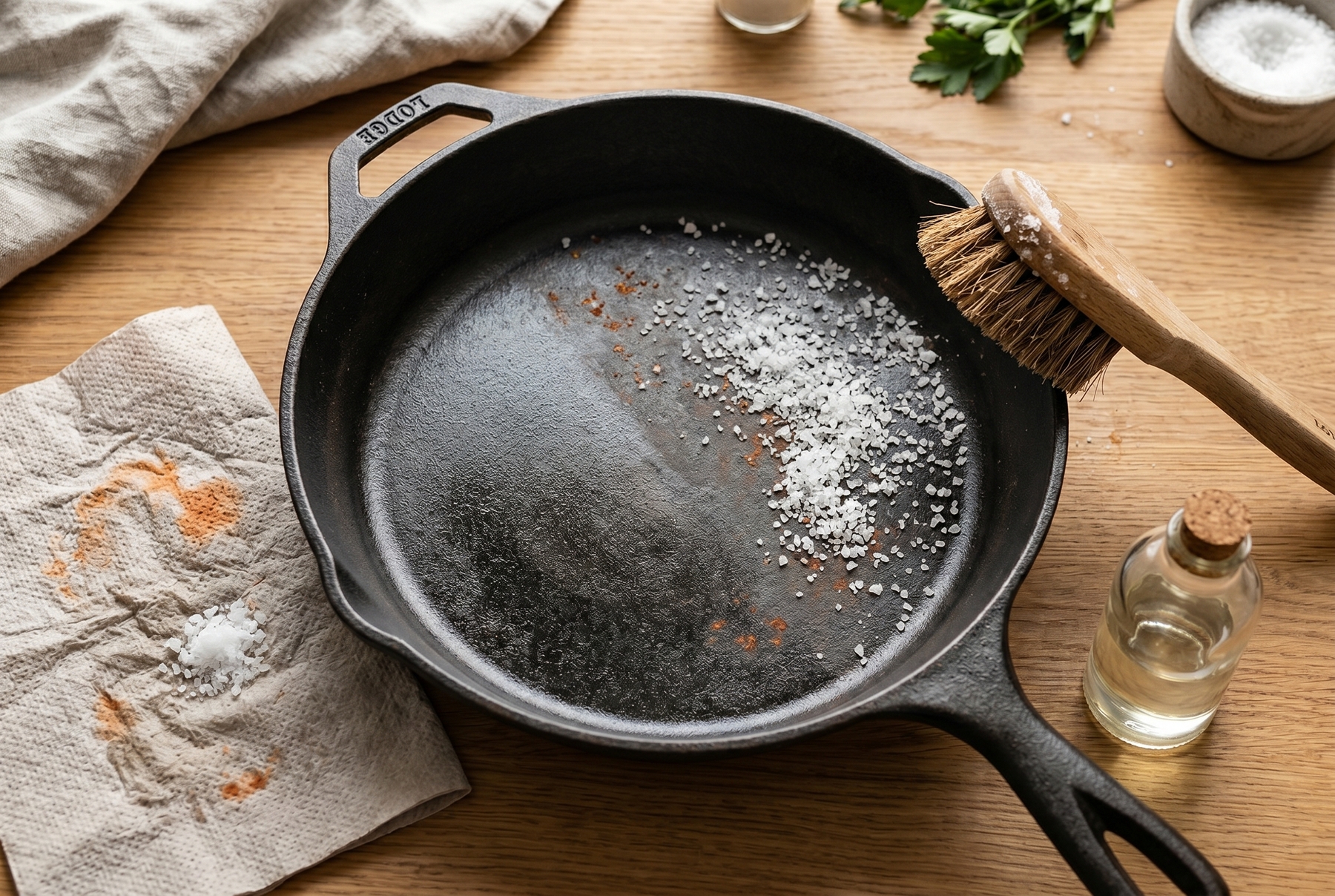
Rust is no reason to throw away cookware. Mechanical cleaning with salt and subsequent oiling brings it right back to life.
What You Should Avoid Doing
Leaving the pan in the sink until morning ranks as the most frequent and predictable scenario. Water, leftover food, and a few hours take care of the rest.
Storing prepared food in cast iron. Braised, acidic, and salty dishes cause particular harm. A kazan functions as a cooking pot, not a storage container.
Soaking the kazan after making pilaf ‘so it cleans easier.’ A post-pilaf kazan benefits from sitting with hot water on the stove for five minutes, rather than spending the night acting as a submarine.
Washing it in the dishwasher. An hour and a half in boiling water with alkaline tablets guarantees the death of the protective oil layer. Following such a wash, the skillet quickly develops a rusty bloom.
Applying excessive oil for ‘better protection.’ Extra oil fails to protect the skillet, turning instead into a sticky film that attracts dust.
Fearing a proper wash. A dirty cast-iron pan holding yesterday’s fish remnants is not boasting a ‘well-aged patina.’ Leftover food and rancid fat fail to make burgers more aromatic; they only make them worse.
Your Everyday Checklist
Following cooking: transferring food from the cast iron into a container or onto a plate. Removing the remnants. Washing with warm water, using a drop of soap if necessary. Wiping dry. Finishing the drying process on the stove for two to three minutes over low heat. Applying a micro-layer of neutral oil, then wiping it almost completely dry. Storing in a dry place with the lid slightly ajar.
Overall, the rules remain simple: avoiding soaking the skillet, never storing food in it, and keeping the metal dry. At the same time, embracing water and detergents when genuinely needed, and confidently scrubbing burnt bits with salt, is the right way. Caring for cast iron takes a mere three minutes, quickly turning into second nature.
Cast iron appears demanding only when surrounded by prohibitions and superstitions. Removing the food, washing, drying, and lightly protecting it with oil solves everything. As the surface darkens and strengthens, eggs stop sticking, and burger patties slide right off the spatula with zero effort.
0 comments