
You take a sharlotka (traditional Eastern European apple sponge cake) recipe that has worked dozens of times: five eggs, a cup of flour, a cup of sugar. You remove the sugar, pouring in a couple of spoons of sweetener from a green packet with little flowers instead. Forty minutes later, something pale, dense, and springy under the finger emerges from the oven, carrying an aftertaste you want to wash down immediately.
People usually blame the oven at this point. However, the problem lies elsewhere. Sugar in baking works not just as a sweetener—it is responsible for structure, moisture, and a golden crust. Swapping it out one-to-one almost never yields the desired result.
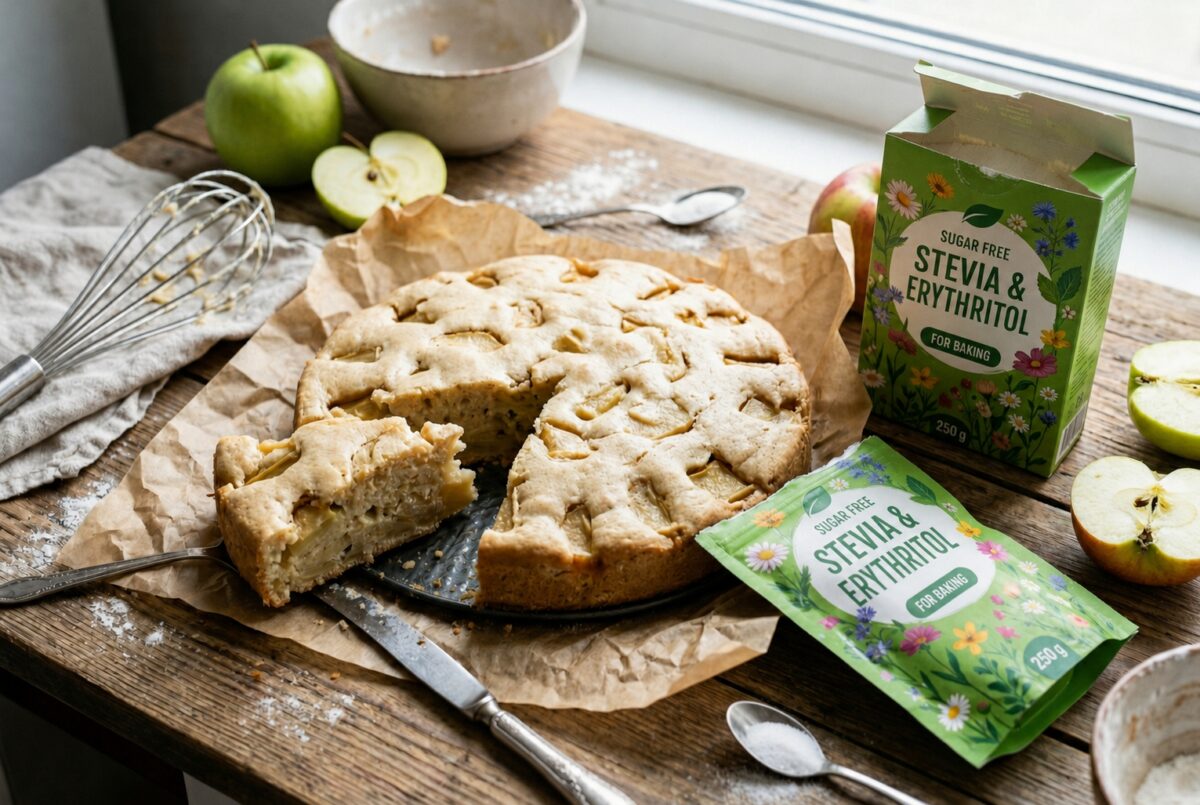
Sweetener-based baking succeeds when bakers understand that the absence of sugar impacts both texture and crust color.
Table of Contents
Sugar in the Dough Is Not Just About Sweetness
In any recipe, sugar stands on the same level as flour and eggs. Sweetness is secondary here. It performs three parallel functions, and each profoundly affects the outcome.
Hygroscopicity. Sugar binds water. In a finished sponge cake, this very property ensures the layer remains moist on the second day. Removing 150 grams (5.3 oz) of sugar and adding 10 grams (0.35 oz) of stevia causes the dough to lose its ability to retain moisture. By the evening of the same day, the change becomes obvious: a cake that seemed fine in the morning feels like slightly bland rubber by dinner.
Volume. During whipping, sugar helps retain air in the batter, affects dough viscosity, and slows down the setting of proteins and starches in the oven. This explains why baked goods with sugar rise evenly and hold their shape. Pure intensive sweeteners fail to take on this role; they possess a different density and exhibit different behavior upon contact with fat and eggs. Without additional recipe adjustments, a sweetener-based sharlotka will turn out flatter and denser.
Crust. That familiar brown, crispy crust smelling of caramel results from two simultaneous processes: the Maillard reaction between amino acids and sugars, and the caramelization of the sugars themselves during heating. Removing sugar eliminates both. Erythritol does not trigger the Maillard reaction, yielding less color and a weaker caramel profile under high heat. Stevia participates in neither process. The sharlotka comes out pale not because the oven is bad, but simply because there is no material for browning.
Remembering that a “replace 1-to-1” label on the packaging is pure marketing, rather than food science, saves a lot of frustration.
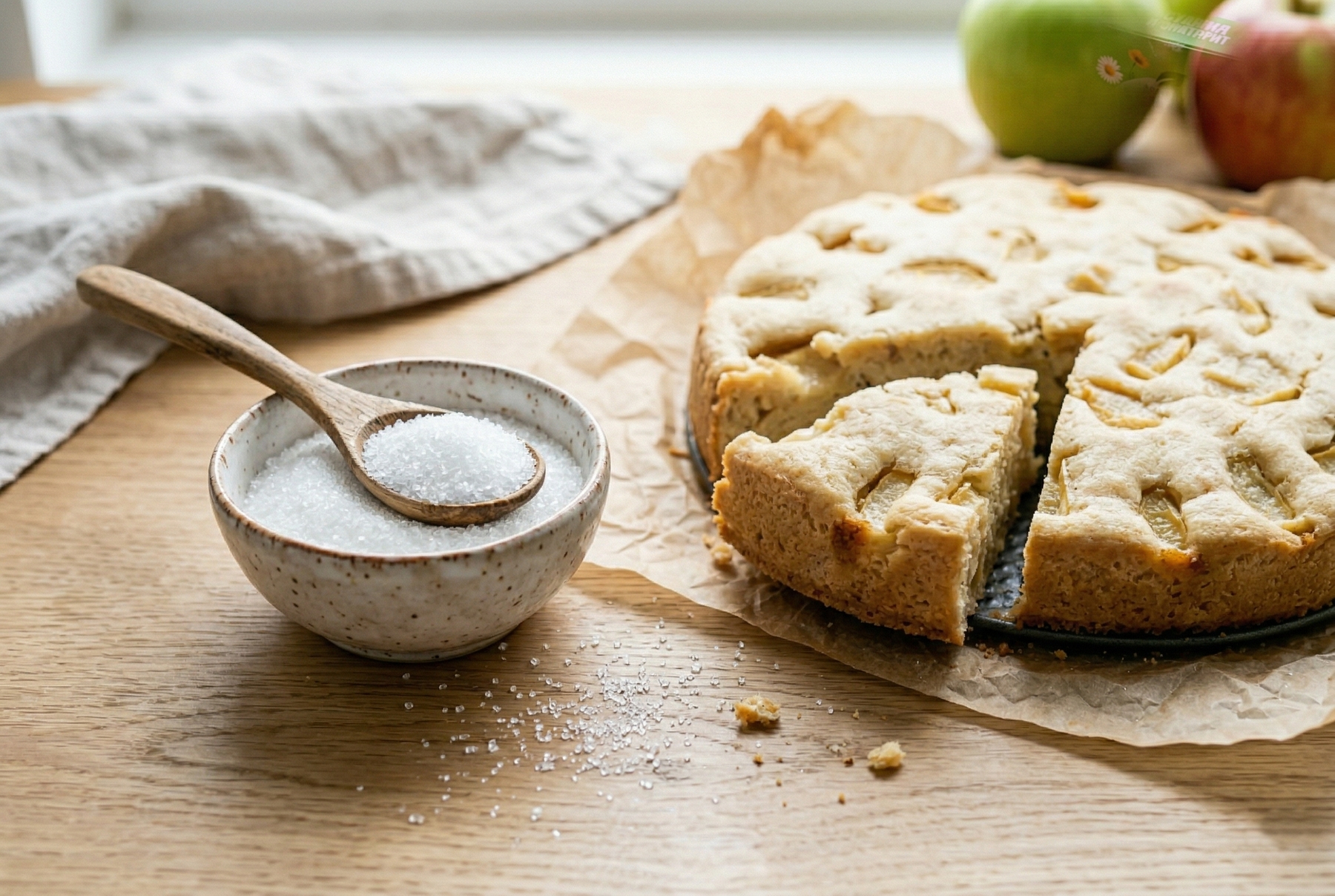
Replacing sugar one-to-one is often a marketing trick. In reality, the dough loses volume and its ability to caramelize.
Which Sweetener to Choose
The market is vast today. It ranges from saccharin, which appears increasingly rarely in baking but often in tablet sweeteners and drink mixes, to trendy monk fruit blends. I will analyze what home bakers actually encounter.
Erythritol
This sugar alcohol boasts a glycemic index close to zero. The body barely absorbs it: about 90% is excreted unchanged. In terms of safety, it remains one of the most thoroughly studied substitutes.
Erythritol carries a specific trait that annoys almost everyone: a cooling effect in the mouth. As it dissolves, erythritol crystals absorb heat from the mucous membrane, making the mouth feel slightly colder. In a hot sharlotka straight from the oven, this effect is barely noticeable. However, in a cold dessert or in syrniki (Eastern European quark cheese pancakes) that have cooled on the plate, it feels very distinct: a light chill on the tongue, reminiscent of menthol chewing gum.
Erythritol remains stable when heated up to 160°C (320°F). Under higher heat, it behaves differently from sugar, providing less color and a weaker caramel profile. In the oven at a standard 180°C (350°F), it behaves predictably but simply fails to develop a crust.
Stevia
This extract originates from the leaves of the Stevia rebaudiana plant. Its active compounds are 200 to 400 times sweeter than sucrose by weight. In terms of volume, this translates to literally a few grams per standard recipe. This explains the structural gap in the dough: removing a cup of sugar and pouring in one and a half teaspoons of powder creates a void. Volume, structure, and moisture retention evaporate alongside the sugar, and stevia fails to step in as a replacement.
The bitter licorice aftertaste that everyone notices does not stem solely from poor purification, although that plays a role. Stevia molecules are structured to trigger the same receptors on the tongue as caffeine. The issue lies within the substance’s structure rather than manufacturing quality. The finest extracts deliver a cleaner taste, but completely eliminating the aftertaste proves impossible.
Stevia suits regular home baking in terms of thermal stability, but it does not replace the structure of the dish, much like any other sweetener.
Incidentally, a panic swept the internet in 2024 regarding stevia being banned. In reality, the concerns applied to unpurified forms, while highly purified steviol glycosides (E960) never left the shelves. Many popular sweeteners sold under the stevia brand are based precisely on these, often blended with erythritol or other fillers.
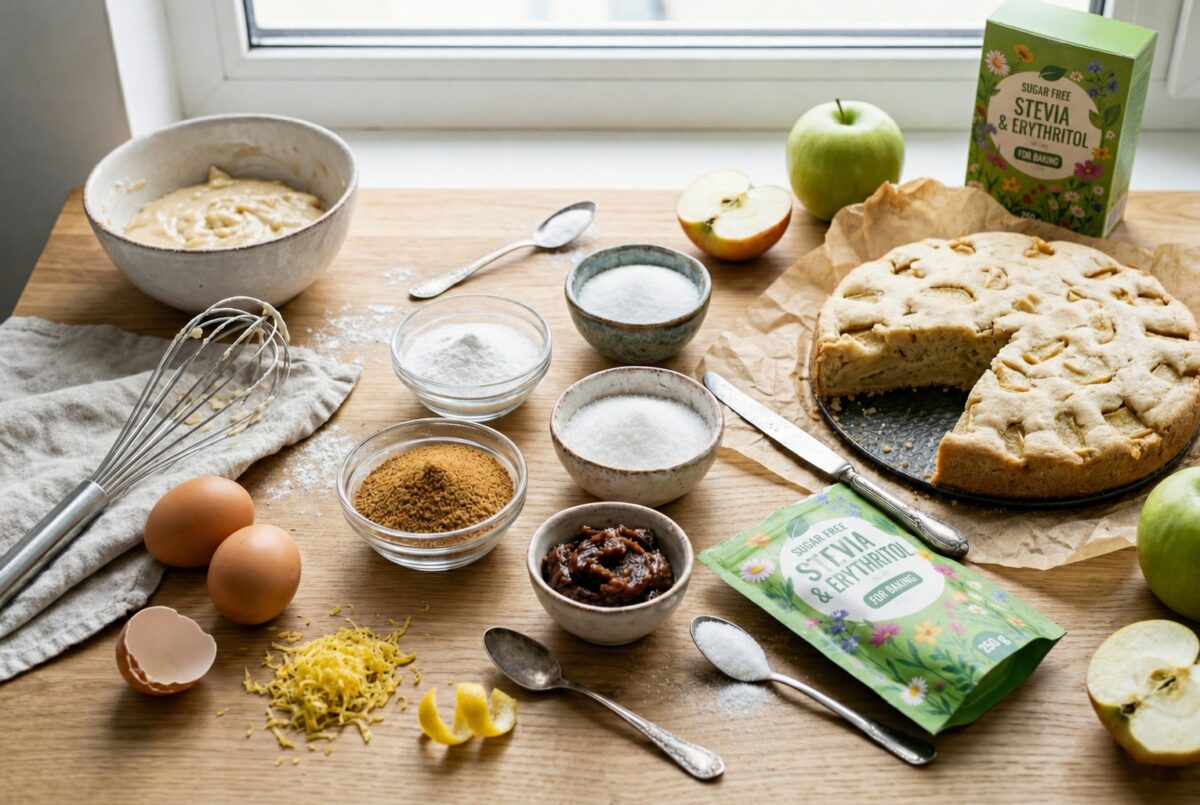
Achieving perfect results requires understanding the properties of each substitute, from the cooling effect of erythritol to the bitterness of stevia.
Sucralose
Anxiety often arises here: people worry that it is too chemical. Sucralose is produced by chlorinating regular sucrose. The word chlorine in food ingredients frightens many, although it remains an absolutely normal element in our kitchens, serving as the foundation of common table salt (sodium chloride).
Within established daily intake limits, the WHO and other global regulators recognize sucralose as completely safe. However, scientists do not currently recommend adding it to baked goods. In 2025 and 2026, European food safety agencies warned that heating sucralose above 120°C (250°F) might release toxic chlorine-containing compounds. While toxicologists continue to study this process and assess the risks, home bakers should opt for heat-stable erythritol and stevia for hot baking. Pure sucralose is better reserved for cold desserts and beverages.
Monk Fruit (Luo Han Guo)
This extract comes from the Chinese Siraitia grosvenorii fruit. It offers almost no bitterness and barely any cooling effect. While infrequent in regular offline retail, it sells noticeably well on marketplaces, most often blended with erythritol or allulose. It boasts a solid safety reputation, though its long-term evidence base is more modest than that of erythritol. In baking, its behavior closely resembles stevia: it is thermally stable but fails to trigger the Maillard reaction or caramelization.
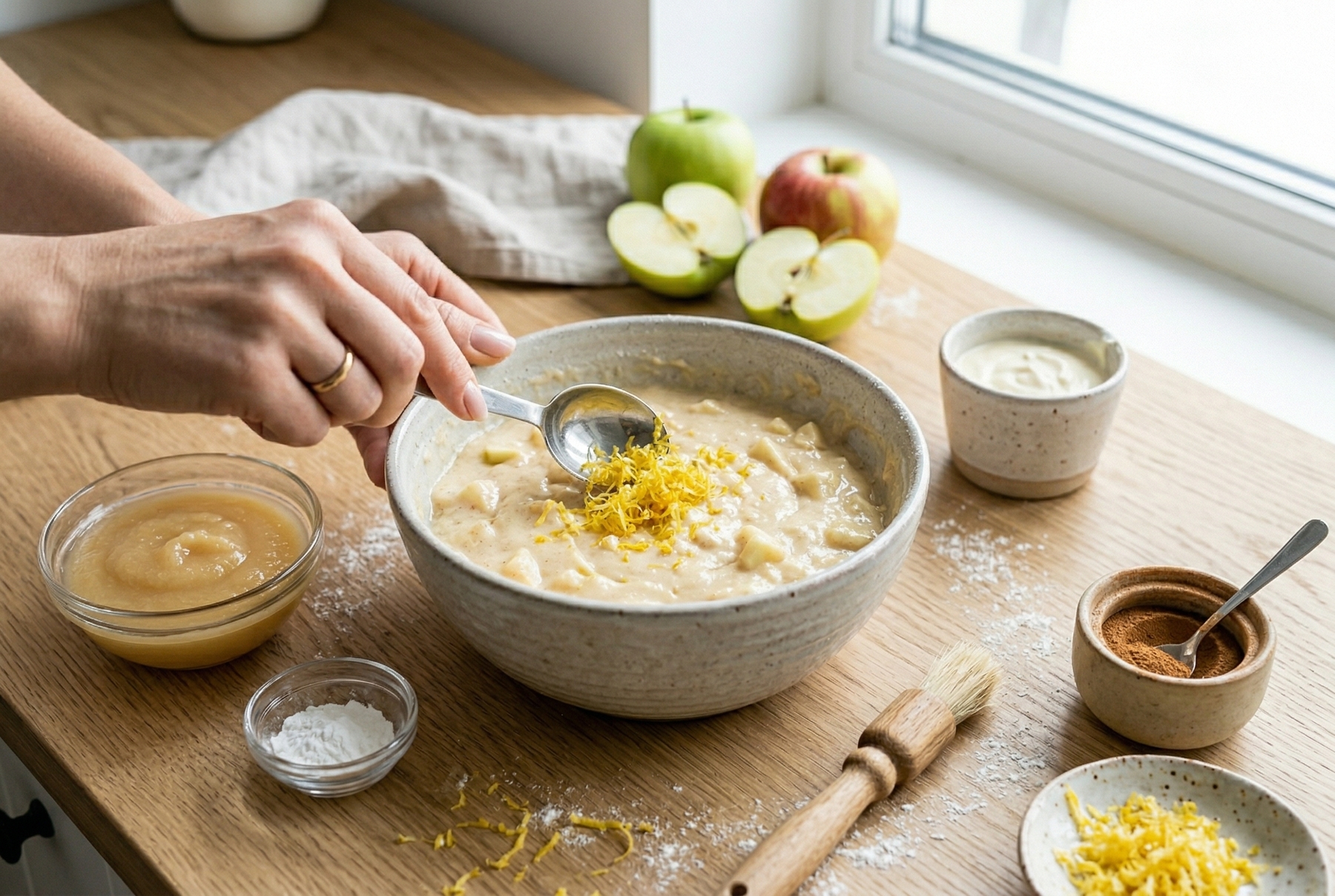
Lemon zest and applesauce act as excellent helpers, restoring moisture and a rich aroma to sugar-free baked goods.
How to Make It Work: Moisture, Volume, and Crust
The main issue with most online healthy lifestyle recipes is their abstract advice. Authors suggest adding a little more liquid. How much? Which liquid? Under what conditions?
How to Restore Moisture and Volume
Without sugar, dough generally retains moisture poorly. Full-fat kefir or sour cream (15 to 20 percent fat) adds both moisture and lactic acid. Combined with baking powder, this acid boosts gas production and provides an extra lift. This approach works beautifully for sharlotka and syrniki; simply adding 2 to 3 tablespoons beyond the recipe’s norm yields excellent results. Unsweetened applesauce contributes moisture and pectin, which partially assumes the job of holding the structure: adding 50 to 70 grams (1.7 to 2.5 oz) to a standard sharlotka recipe feels organic and remains undetectable as an additive.
Baking powder also occasionally helps increase volume slightly, but moderation is key: an excess quickly introduces a soapy aftertaste and causes the cake’s center to collapse.
A Separate Note on Syrniki. Syrniki demand special attention. Sugar binds the moisture from the quark cheese (tvorog), and without it, the mixture often melts right in the pan. Frankly, this is the most temperamental scenario of all. Adding a tablespoon of starch beyond the norm, or using slightly less egg than the recipe requires, saves the day. Frying requires a more moderate heat and more time; sweetener-based syrniki set slower, and rushing causes them to spread.
How to Achieve a Crust
Bakers can partially restore the color and top crust by introducing a small amount of honey or fructose. Honey (1 to 2 teaspoons per recipe) initiates browning with a minimal caloric footprint. Fructose activates at a lower temperature: a few grams in the dough deliver color at just 160°C (320°F). For a completely sugar-free approach, brushing the dough surface with milk before baking works nicely. Lactose participates in the Maillard reaction, ensuring a crust forms, albeit paler than usual.
Aftertaste and Bitterness
Stevia turns more bitter at high concentrations. Using 15 to 20 percent less sweetener than the recipe requires makes the aftertaste less noticeable and prevents the pastry from becoming cloying. Aromatic additions function as competitors rather than masks: cinnamon, lemon zest, or strong espresso introduce multiple potent signals simultaneously, pushing the bitterness to the periphery of perception. A pinch of salt unifies the sweetness and slightly dampens the bitter notes; this principle holds true for both baked goods and beverages.
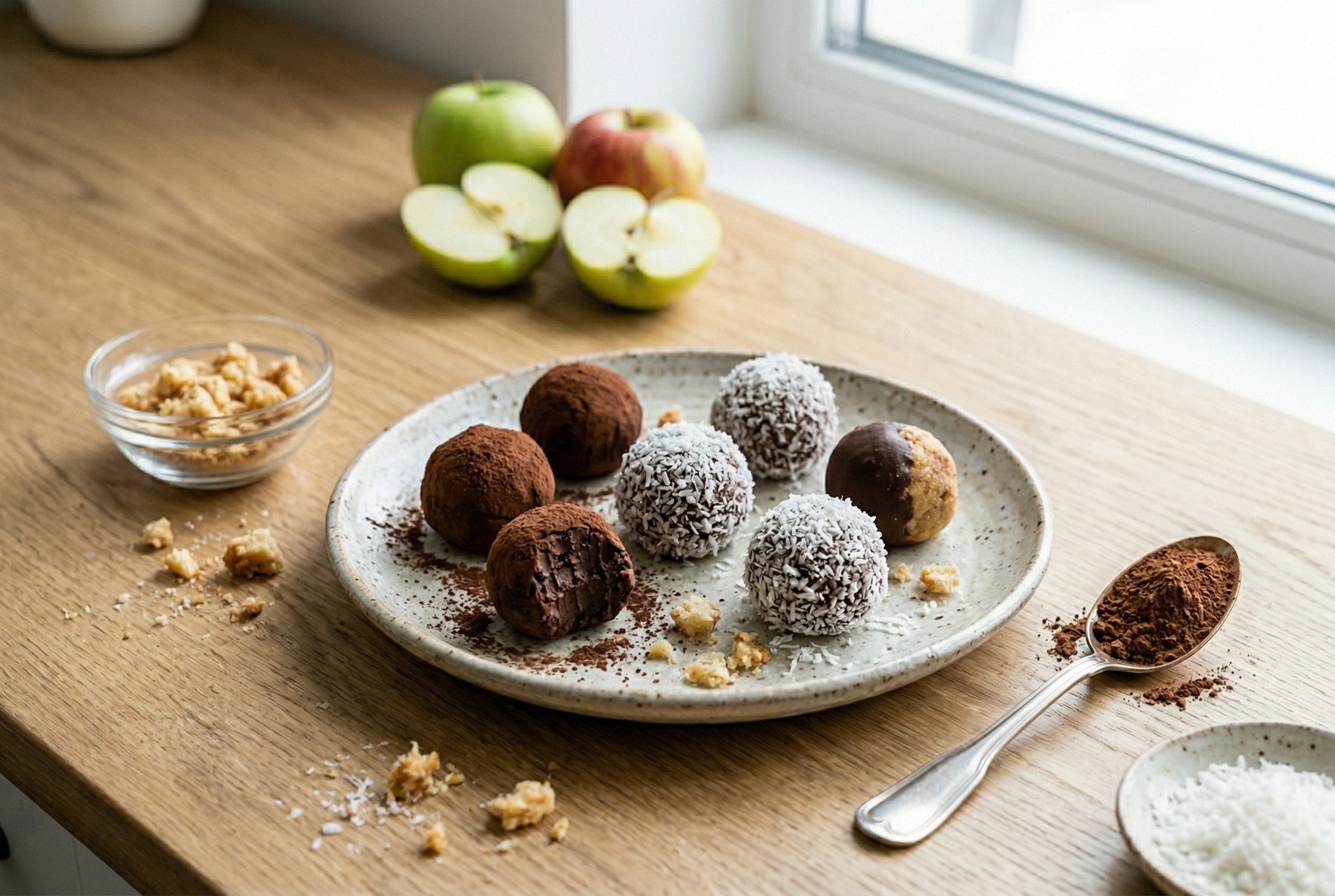
Turning a dense sweetener-based sponge cake into healthy truffle treats requires only cocoa powder and butter.
What to Do When It Is Already Too Late
The sponge cake emerged dense, rubbery, and carrying an odd aftertaste. The pan sits on the table, and throwing it away feels wrong.
The First Method: The Lazy Route. Cutting the cake into 2 to 3 centimeter (1 inch) cubes and leaving them exposed in the refrigerator for an hour or so helps. A slightly dried-out, dense sponge cake absorbs liquid perfectly. The next steps require glass tumblers and layers of cake cubes, Greek yogurt, and any berries. The aftertaste virtually disappears against the backdrop of the tart yogurt. The texture ceases to be an issue because the soaking transforms its role: it now serves as firm layers rather than a heavy cake base. Covering the glasses with plastic wrap and refrigerating them for an hour completes the dessert.
The Second Method: A Healthy Take on Kartoshka. Kartoshka is a classic Russian truffle-like pastry traditionally made from cake scraps. Tossing the entire cake into a blender starts the process. Adding 50 grams (1.7 oz) of room-temperature butter, 2 tablespoons of cocoa powder, and a pinch of salt follows. Pulsing the mixture until smooth yields a firm, pliable mass that smells intensely of chocolate. If the mixture crumbles, adding a teaspoon of full-fat sour cream fixes it. Rolling the mixture into balls and coating them in shredded coconut or more cocoa powder finishes the job. A 30-minute chill in the refrigerator delivers a genuinely delicious outcome.
The bitterness of stevia proves harder to eliminate in a finished product than in raw dough. If the aftertaste stands out, applying a few drops of vanilla extract or a sprinkle of cinnamon directly to the surface works even better than mixing them into the dough. The aroma captures attention before the bitterness registers on the taste receptors.
Storing such baked goods in an airtight container is crucial. The staling rate accelerates without sugar: by the end of the second day, the texture deteriorates noticeably.
0 comments