
Someone you know—a colleague, a relative, a person at a corporate party—finds out you decided to order Chinese noodles, and with the look of a savior, informs you: “There is MSG everywhere in them.” A pause. Then they add, a bit quieter, as if it is obvious to all normal people: “I generally do not eat Asian food for this reason.”
The conversation is closed. The tone does not invite clarifying questions.
I have heard this phrase in various forms enough times to stop being surprised. Monosodium glutamate is perhaps the most demonized food additive in history. Scientists have found no evidence of harm, but the panic lives on and thrives: passed by word of mouth with the certainty of a witness, even though no one has seen anything.
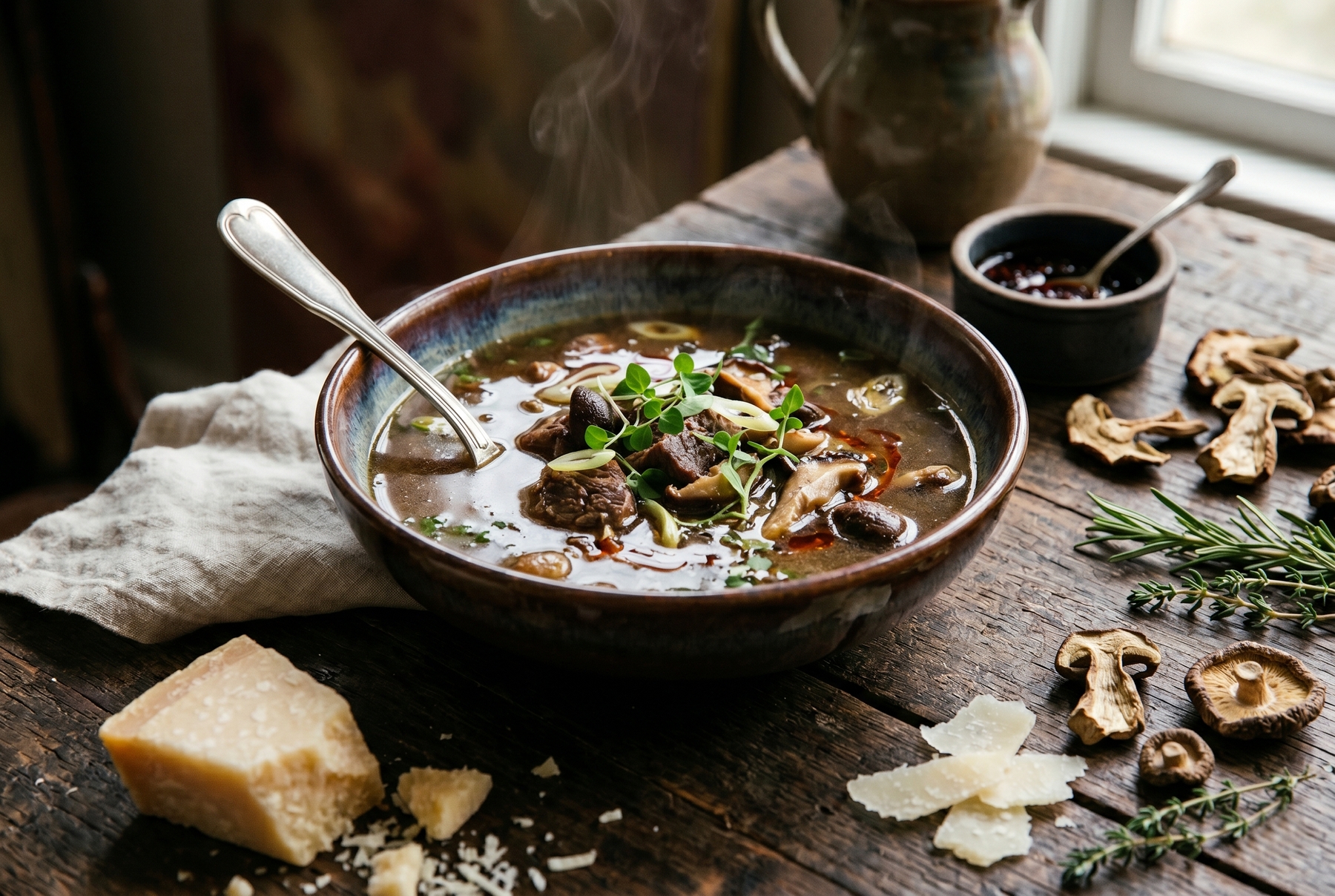
The rich taste of this dish comes from the natural presence of glutamates in meat, mushrooms, and vegetables.
Table of Contents
How Umami Began
1908. Tokyo Imperial University. Chemist Kikunae Ikeda sits over a bowl of dashi broth and thinks about what all respectable scientists think about when faced with something inexplicably good: why is this so delicious? Cooks brew dashi from kombu seaweed and dried bonito flakes. The taste is deep and enveloping—you cannot confuse it with sweet or salty. Ikeda decided to figure it out.
He evaporated several liters of broth, isolated a crystalline substance, and identified it: glutamic acid. An amino acid. One of the twenty standard ones from which every protein on the planet is built—in your body, in beef, in wheat, in soybeans. Ikeda christened the discovery “umami” (literally: “delicious taste”), patented the technology, and founded the Ajinomoto company.
Every person has specialized taste receptors sensitive specifically to glutamate. Glutamate in food signals the presence of protein and the nutritional value of the meal. The ability to recognize it became fixed evolutionarily: organisms that sensed protein-rich food well had an obvious advantage.
Breast milk contains glutamic acid in a free form. The first umami taste a human experiences in life is not restaurant food or a bouillon cube. It is mother’s milk.
Simply put: the love for glutamate is hardwired into us. This is not a “chemical” from a packet, but the taste of life itself, which we recognize before we learn to walk.
The History Of A Myth
1968. American doctor Robert Ho Man Kwok publishes a short letter in the New England Journal of Medicine. Not a study, not clinical data. A letter. He describes symptoms he personally experienced after eating in Chinese restaurants: weakness, numbness in the back of the head, palpitations. He suggests that monosodium glutamate is to blame.
No control group. No double-blind protocol. No methodology at all.
The media picked it up. “Chinese restaurant syndrome” became a real phenomenon in the mass consciousness. The truth emerged later when high-quality, evidence-based studies appeared: the connection between the symptoms and MSG reproduced poorly and inconsistently. For some participants, symptoms also arose on a placebo. Generally, it looked more like autosuggestion than real symptoms.
The position of regulators around the world today is roughly the same. The US Food and Drug Administration officially recognizes monosodium glutamate as safe. The Joint FAO/WHO Expert Committee on Food Additives went even further: they did not even establish an acceptable daily intake limit for this substance, considering it unnecessary with a normal diet. The European Food Safety Authority took a more conservative approach in 2017 and still set a guideline: 30 mg per kilogram of body weight per day for added glutamates. For a person weighing 70 kg (154 lb), this is more than two grams a day—a figure that is quite difficult to reach from seasonings and sauces alone.
According to food researchers, an average adult receives about 13 g of glutamate a day from dietary proteins—this is a natural component of any food containing protein. People consume about 0.55 g a day from added seasonings and convenience foods.
Science has closed this question. Glutamate is safe.
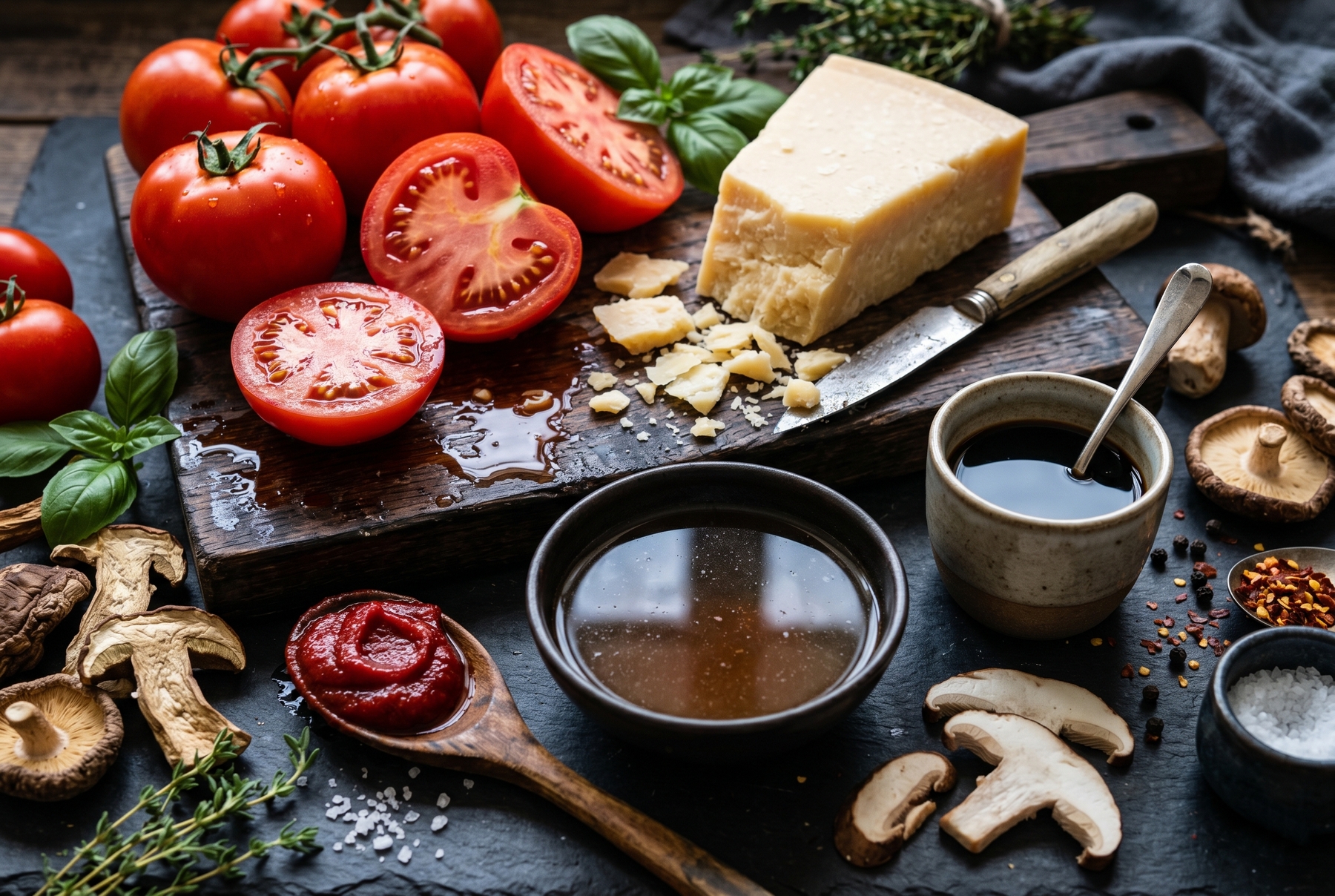
Many familiar foods contain glutamic acid in a free form, providing that very ‘fifth taste’.
Where To Find E621 If It Is Not On The Ingredient List
It is ironic that those who avoid E621 on the label calmly eat it every day. They just consume it under different names.
A Ripe Tomato. Not a greenhouse pale-pink one with an apple crunch, but a field-grown, heavy one with a crack near the stem. The content of free glutamic acid in it is noticeably higher than in an unripe one: it is on the order of tenths of a gram per 100 g (3.5 oz). This is exactly why tomato sauce, boiled down to a thick consistency, tastes better than any ketchup: the excess water evaporates, leaving pure, dense umami.
Parmesan and other aged cheeses are a separate story. While the cheese matures, enzymes break down the protein, and glutamic acid comes to the forefront. The longer the aging, the brighter and more powerful the taste. The white crystals crunching on your teeth in aged Parmesan are tyrosine, another amino acid. Unlike glutamate, tyrosine dissolves poorly, so during long aging it precipitates, forming those very hard grains. In essence, this acts as a “certificate of quality” for the cheese: if it crunches, it means the enzymes worked long and honestly. Tyrosine itself is almost tasteless, as it governs the texture, but the invisible glutamate next to it causes such addiction that it is physically difficult to stop eating the cheese.
Dried Mushrooms. Porcini mushrooms, which your grandmother strung on a thread and hung by the window, act as a literal concentrate of umami. Mushroom broth from dried ones turns out more powerful than from fresh ones not because of the “aroma”, but due to a colossal dose of glutamic acid.
Soy Sauce. Traditional, naturally fermented soy sauce stands among the record holders for the content of free glutamic acid. Producers age it for months: a special mold slowly breaks down the soy protein, and glutamic acid accumulates—exactly the same way as in aged cheese.
Stewed Meat. Long simmering at a moderate temperature makes the flavor rich through a variety of processes: water-soluble substances are extracted from the meat, collagen turns into gelatin, aromatic compounds emerge, and if the cook seared the meat beforehand, a crust contributes everything that has accumulated within it. Glutamate works here in a team with other substances.
For those who need more than tomatoes and Parmesan, here are a few more products with a high content of natural glutamate, which people discuss less often:
- Anchovies. The secret weapon of chefs. A small salty fish completely dissolves in a sauce or dressing—leaving no fishy aftertaste, only a sharp rise in everything else. This explains why a real Caesar salad without anchovies tastes elusively wrong.
- Cured Meat: jamón, prosciutto, salami. During long aging, proteins break down just like in aged cheese. White dots on good sausage consist not only of salt but also free amino acids, including glutamic acid.
- Fish Sauce. Thai or Vietnamese. The smell in its pure form poses a test. A couple of drops in a soup or marinade provide such depth that soy sauce struggles to match: the concentration of glutamate there is fundamentally higher.
- Green Peas And Corn. Children are ready to eat them endlessly, and this happens for a reason. Both vegetables contain a noticeable amount of free glutamate, and the body responds to it predictably.
- Walnuts. That dense astringency that distinguishes them from hazelnuts or almonds comes partly from the work of free glutamic acid. It is not the only factor, but it is a tangible one.
- Green Tea, especially matcha. The herbaceous, slightly brothy taste of expensive tea delivers pure umami. It contains theanine, an amino acid with a structure close to glutamic acid, which activates the same receptors. Japanese tea masters have long worked with this property consciously—hence the tradition of serving matcha with something neutral, to avoid overpowering the taste.
How To Save A Flat Broth
It happens. The broth stands on the stove, smells right, but you taste it—and it delivers nothing. It tastes flat, without depth.
Option One: a Parmesan rind. You need not a piece, but exactly the dried crust—usually people just throw it away. You drop it into the broth half an hour before the end. It remains solid and preserves the transparency, but it releases glutamate and a little fat. The taste comes together perfectly.
Option Two: tomato paste. You fry one or two tablespoons separately with onions until they reach a dark brick color—not burnt, but until the moment when the paste begins to stick to the bottom and change shade. During frying, moisture evaporates, the taste concentrates, and caramelization adds that very right aroma. This explains why the classic sauté for borscht works better than just adding tomato juice.
Option Three works for those who do not want to change the profile of the dish. Sometimes you do not need excess fat from Parmesan or the sourness of tomato paste—for example, in a clear chicken broth they feel simply inappropriate. In such cases, cooks use a “pure cheat”: crystalline monosodium glutamate.
A pinch on the tip of a knife into minced meat or soup works like a filter in a photo editor: it carries no smell or taste of its own, but all other notes become sharper, as if someone turned up the brightness. This offers the ideal way to save a dish without turning it into something else. Moderation is key: if you pour too much, a specific “soapy” stickiness appears in the mouth. The working range spans only 0.1–0.3% of the mass of the dish.
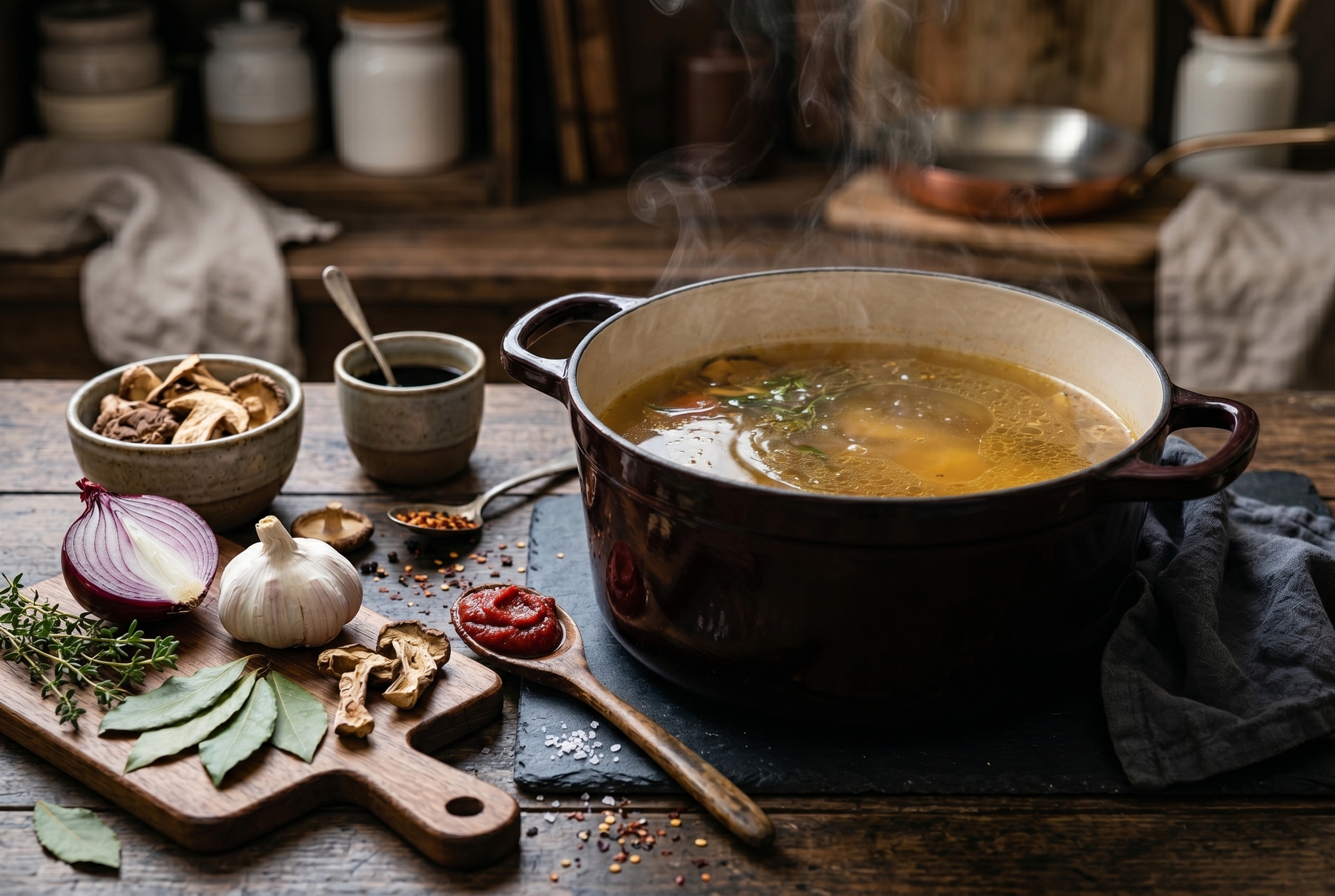
Adding umami-rich ingredients, such as tomato paste or mushrooms, helps make the taste of the dish complete.
Instead Of A Conclusion: Why You Need MSG On The Shelf
Monosodium glutamate will not pull umami out of products that lack it. It will not turn watery greenhouse strawberries into aromatic ones and will not make stale fish decent. It acts as an enhancer, not a creator: it simply brings to the surface what nature laid down.
Salt, acid, umami—three tools determine the balance of any dish. Most people add umami unconsciously: through tomatoes, mushrooms, aged cheese. Adding it in its pure form simply provides a short path to the same result.
A packet of dried Parmesan rind in the freezer works exactly the same way. And no one panics yet.
0 comments