
You might think onions are simple. They are the cheapest, most familiar, and most “background” ingredient in the kitchen. People chop them on autopilot, toss them into a pan, and walk away to check their phones. Then they wonder why their sauce tastes bitter or their soup is bland.
Onions stand at the beginning of half of all recipes. Ruining them means ruining the entire dish before it even becomes a dish. This does not require talent. It requires concrete markers: color, sound, and time. Knowing what to look for eliminates the guesswork.
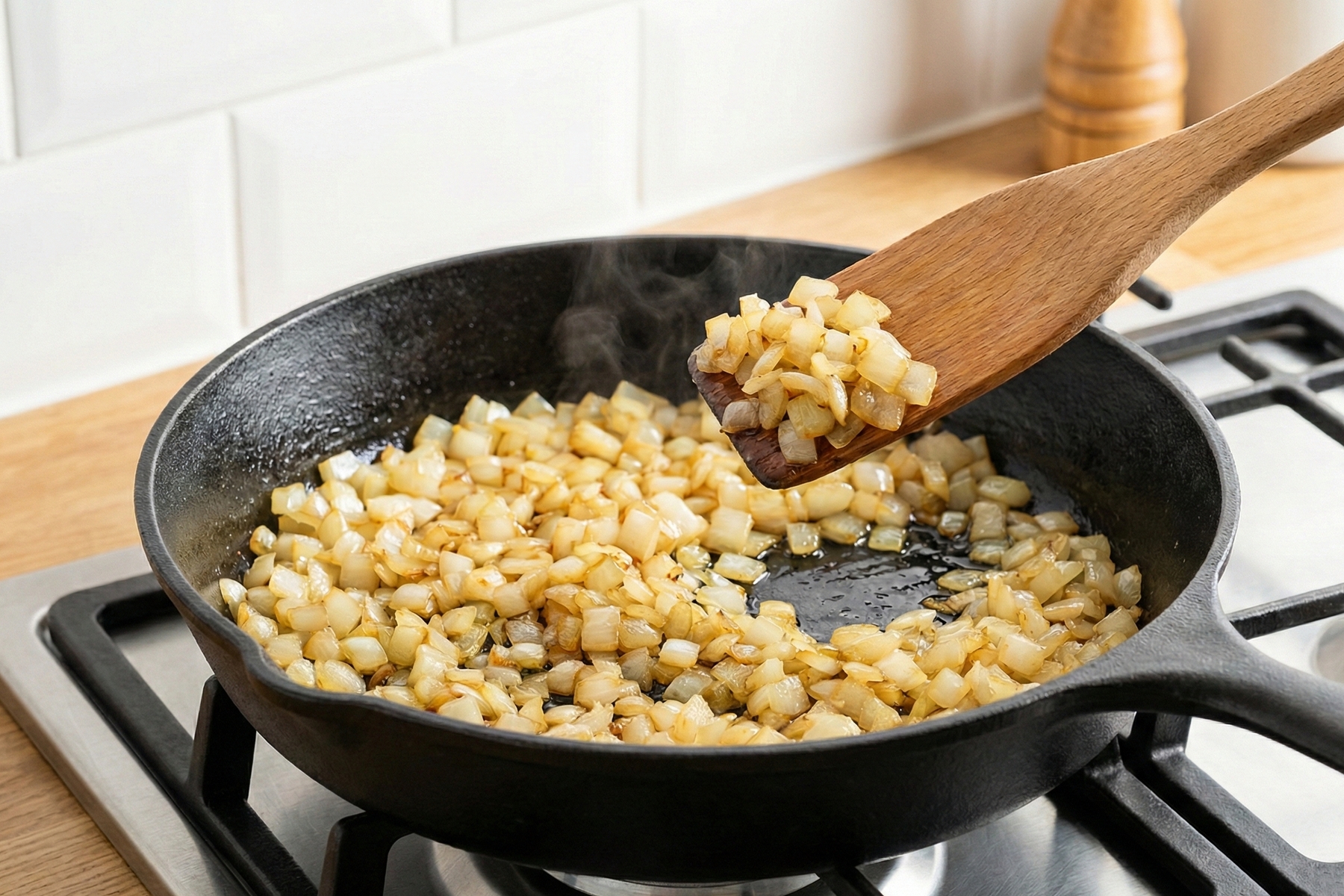
Proper onion sautéing requires temperature control and a high-quality, heavy-bottomed pan for even heating.
From Tears to Gold: Why “Just Frying” Does Not Work
When a knife slices into an onion, cell sap mixes with enzymes that were neatly separated into different compartments within the whole bulb. Your eyes sting for a reason—the chemistry is already in motion. Finer cuts expose more cells, resulting in a more intense final aroma. Direction matters too: slicing across the fibers makes the onion release moisture faster and soften quickly—perfect for sauces; slicing along the grain (from root to stem) helps it hold its shape—ideal for side dishes and savory pies.
Let us address why onions stay pale for so long and then suddenly darken. While they release steam on a hot surface, the temperature does not rise above 100°C (212°F): evaporating water absorbs all the heat.
True gold appears exactly when the last drop of moisture vanishes and the surface heats up beyond 120°C (248°F). This is when natural sugars and amino acids begin to react, darkening the onion and filling the kitchen with the scent of burnt sugar and sweet onion. Hence the classic mistake: cranking up the heat to speed up the process. The outside burns, the inside remains raw, and bitterness is guaranteed.
The Pan, the Fat, the Heat
A thin-bottomed pan forgives no mistakes because it distributes heat unevenly: the temperature is higher directly over the burner and lower around the edges. Onions burn in the center and steam on the periphery. Grabbing something heavy-bottomed is essential: cast iron, multi-clad stainless steel, or high-quality aluminum. This is not culinary snobbery; it is simply physics. Onions should fill about half the pan’s volume by height; they will shrink to a third or a quarter as they cook, which is perfectly normal.
Choosing the right cooking fat is simpler than it seems. Refined sunflower or vegetable oil provides a reliable base: it is neutral, tolerates heat well, and does not distract from the onion’s flavor. A mixture of oil and butter adds aroma, but it is important to understand that this does not raise the butter’s smoke point. Milk proteins will still begin to burn at around 150°C (300°F); the oil merely dilutes their concentration, making the burning less noticeable. Saving extra virgin olive oil for salads or gentle sweating over low heat is a wise choice: under high heat, it loses everything that makes it expensive. The quantity is straightforward—about one tablespoon per 200 g (7 oz) of onions, enough to coat the bottom without drowning the vegetables.
Speaking of terms. Sweating or softening (often related to the French culinary term suer, meaning “to sweat”) implies cooking a vegetable in hot fat so it becomes soft and aromatic without browning, whereas sautéing comes from sauter, meaning “to jump”. It is neither frying nor stewing, but rather holding the ingredient between those two states. In classical French cuisine, sautéing or sweating is the foundation, the very first step of almost any sauce or soup. The Russian culinary school adopted both the term and the technique, but somewhere along the way, they merged into a vague “fry the onions,” which everyone interprets differently. This is where all the problems begin.
Playing tricks with the heat is unnecessary; keeping it at medium allows you to control the process rather than fight it. Medium heat maintains a working range of 120–150°C (248–300°F), where onions darken evenly, do not burn around the edges, and do not stew in their own juices.
If a thermometer is unavailable, checking the temperature with a drop of water works perfectly: if it evaporates slowly, keep heating; if it hisses and vanishes instantly, the temperature is ideal; if it bounces around like a bead, the pan is too hot, and you must lower the heat.
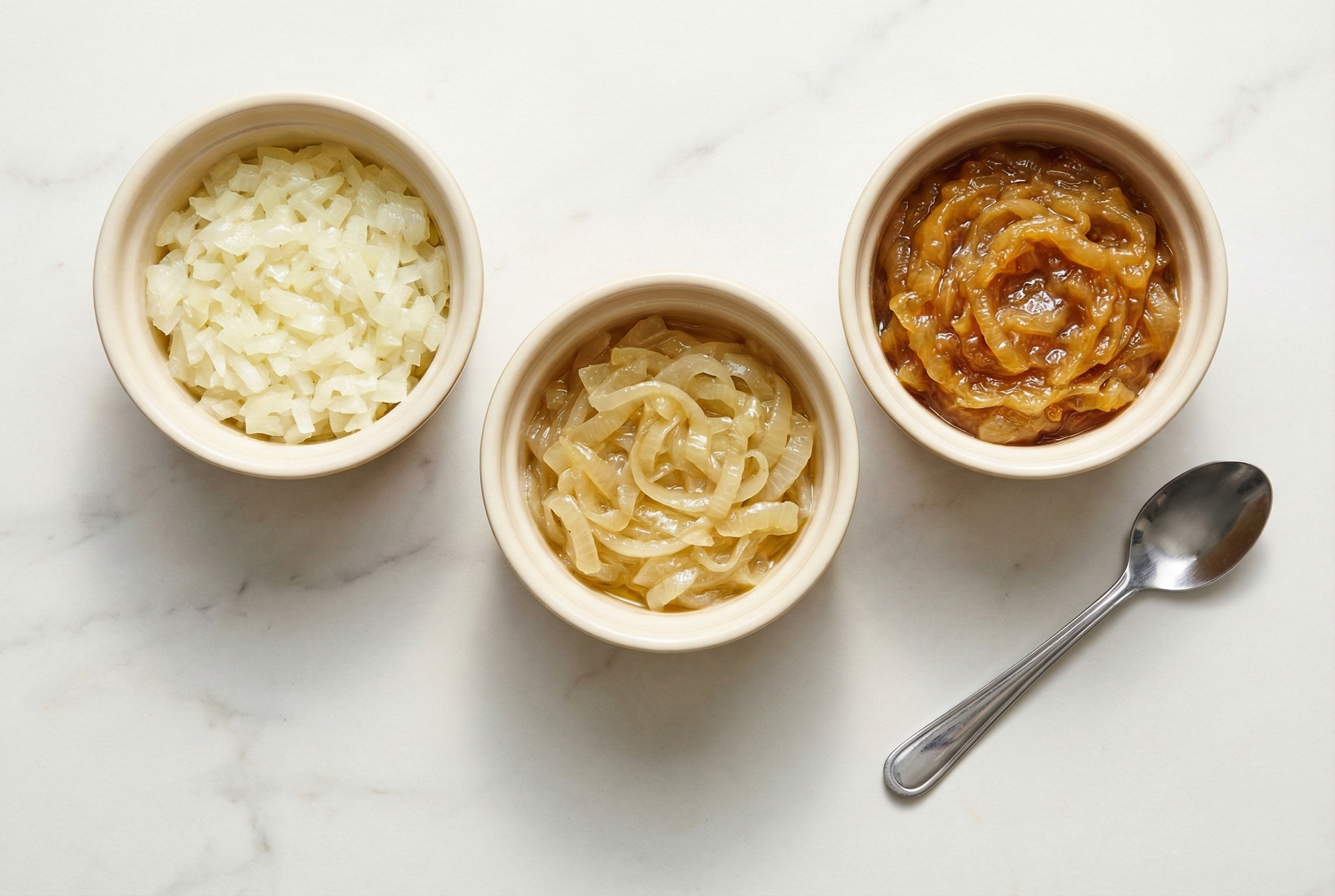
From translucent to a deep jammy color: each stage of doneness serves different culinary purposes.
Stages of Doneness: From Translucent to Jammy
Onions do not simply fry; they pass through several entirely distinct states, each suited for a specific task. Confusing them comes at a high culinary cost.
For the first three to five minutes, the onions sweat: they release active steam and soften while remaining almost white. This is the safest stage, as moisture protects against burning. Using this stage for puréed soups and stews ensures a clean onion flavor without the slightest hint of searing.
Around the seven to ten-minute mark, onions turn a translucent golden hue and begin to truly smell wonderful. The sharp raw scent dissipates, replaced by something sweet and mellow. This is the sweated or gently sautéed onion that 90% of recipes mean when they say “sauté the onions.” This is where you will stop most often.
Continuing to the twelve to eighteen-minute mark yields an even golden color and a slight crispness around the edges. The aroma of toasted sugar becomes more pronounced. This is an onion with a voice, perfect for dishes where it needs to sing rather than fade into the background: savory pies, pâtés, and roasted meats.
Caramelized onions are a different story entirely, one that demands patience. Twenty-five to forty minutes over low or medium-low heat requires periodic stirring and absolute acceptance that you cannot rush the process. However, the result is practically a jam: deep golden, profoundly sweet, with a depth of flavor that is difficult to achieve otherwise. When the onions start sticking to the bottom, adding a couple of tablespoons of water or white wine deglazes the pan. Exercising caution is key: keeping your hand back and your spatula ready prevents hot oil splatters from reaching you. Scraping the bottom immediately captures all that incredible flavor.
How to Sauté in Practice
Heating the pan over medium heat for a minute or two before adding the oil, then waiting another half-minute, sets the stage. The oil should be hot and shimmering, but not smoking. Pouring in the onions and spreading them evenly requires leaving them untouched for the first two minutes, allowing the bottom layer direct contact with the hot surface. Listening closely reveals a lot: an active, wet hiss initially gives way to a drier, quieter sound as the moisture cooks off.
After the first stir, checking the color underneath is crucial. A light golden tint means everything is progressing correctly. From there, stirring every minute and a half to two minutes keeps the cooking even. If one section darkens faster, it indicates a hot spot; stirring more frequently or lowering the heat slightly solves this.
Adding salt depends on the objective: early on, it draws out moisture and accelerates the entire process; later, it yields a more restrained result. Watching the color, rather than the clock, is the best strategy. The clock is a guide, but color is the absolute truth.
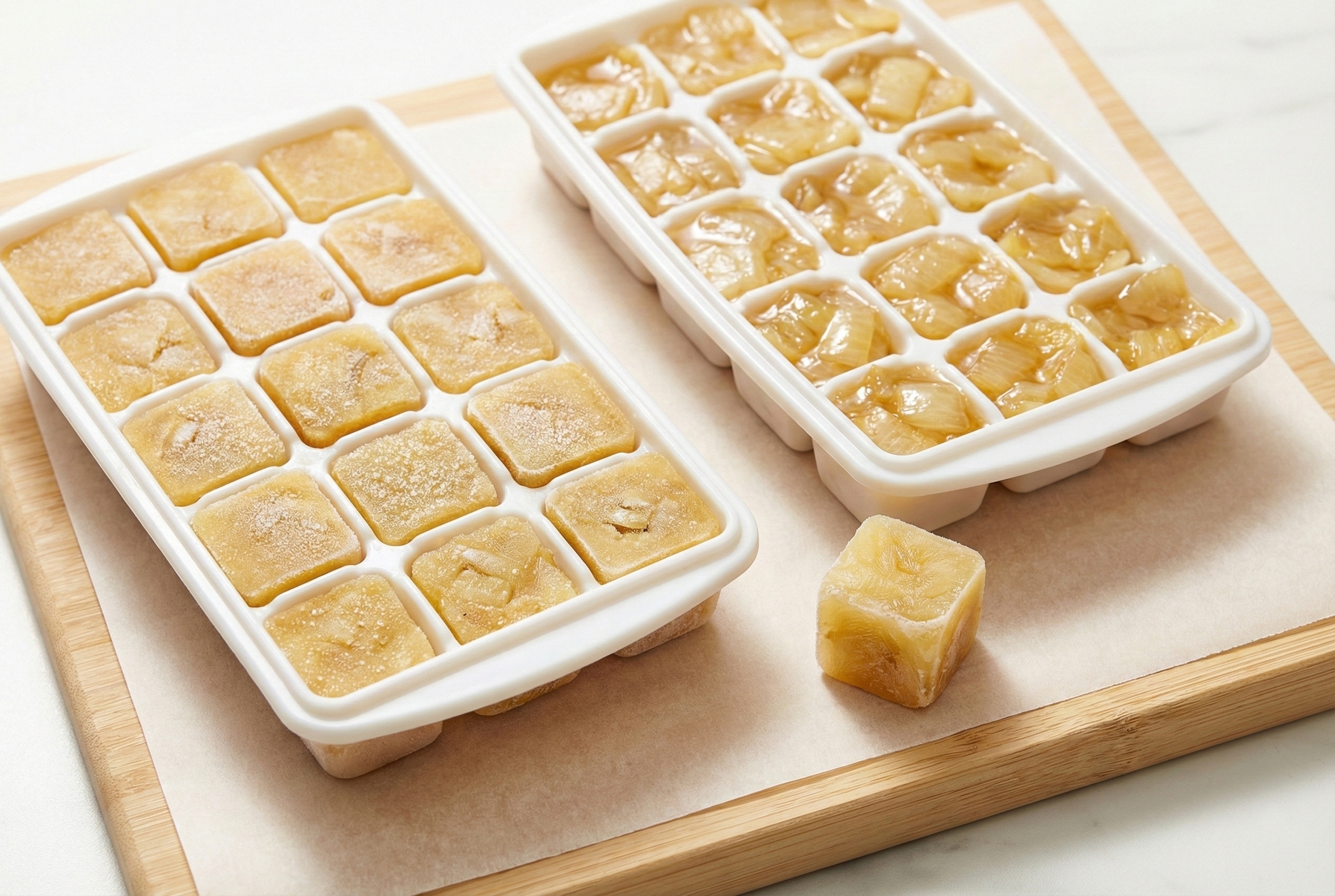
Freezing sautéed onions in portioned molds is an excellent way to save time when preparing soups and sauces.
Prepping for the Week
Sautéing onions in small batches every single time is inefficient; the process demands the same amount of attention regardless of volume. Preparing a kilogram (2.2 lbs) at once makes much more sense.
A kilogram of onions cooks down into 200–250 grams (7–8.8 oz) of thick, sweet concentrate after caramelizing. Portioning it into ice cube trays, roughly 30–40 g (1–1.4 oz) each, and freezing them is a game-changer. These cubes last up to three months and go straight from the freezer into a hot pan or soup, saving 15–20 minutes every time. Freezing at the golden stage is optimal: it recovers its texture after thawing much better than fully caramelized onions.
In the refrigerator, sautéed onions keep for up to five days in an airtight container, while caramelized ones last up to seven days, as the high sugar content acts as a natural preservative.
Sautéing vs. Frying: Understanding the Difference
Sautéing or sweating is a slow process at 110–130°C (230–266°F) with minimal color change. The onion transforms into a soft, delicate foundation that enhances other ingredients without overpowering them. This is the secret to a great risotto, a vibrant tomato sauce, or any filling where the onion must melt into the overall flavor profile.
Frying with caramelization happens at 140–160°C (284–320°F), requires less stirring, and produces a distinctly sweet character. French onion soup, a toast with caramelized onions and goat cheese, or beef with onion jam—these are the dishes where this technique truly shines.
The choice depends on the dish, not on your mood. Understanding the difference turns recipes into gentle suggestions rather than strict manuals. The rest happens right in the pan: guided by color, aroma, and the sound of the hiss, which grows quieter and softer as the onion stops being raw and starts becoming delicious.
0 comments