
Five minutes ago, it was a perfect apple, but now it looks like an archaeological find. A schoolchild will not touch it. Party guests will politely ignore it. We all know the feeling: turning away from the cutting board for just a moment is enough to lose the pristine color.
The apple itself remains perfectly fine. It is delicious, safe, and entirely edible. A literal chemical war is simply unfolding on its surface, and the knife served as the declaration of hostilities.
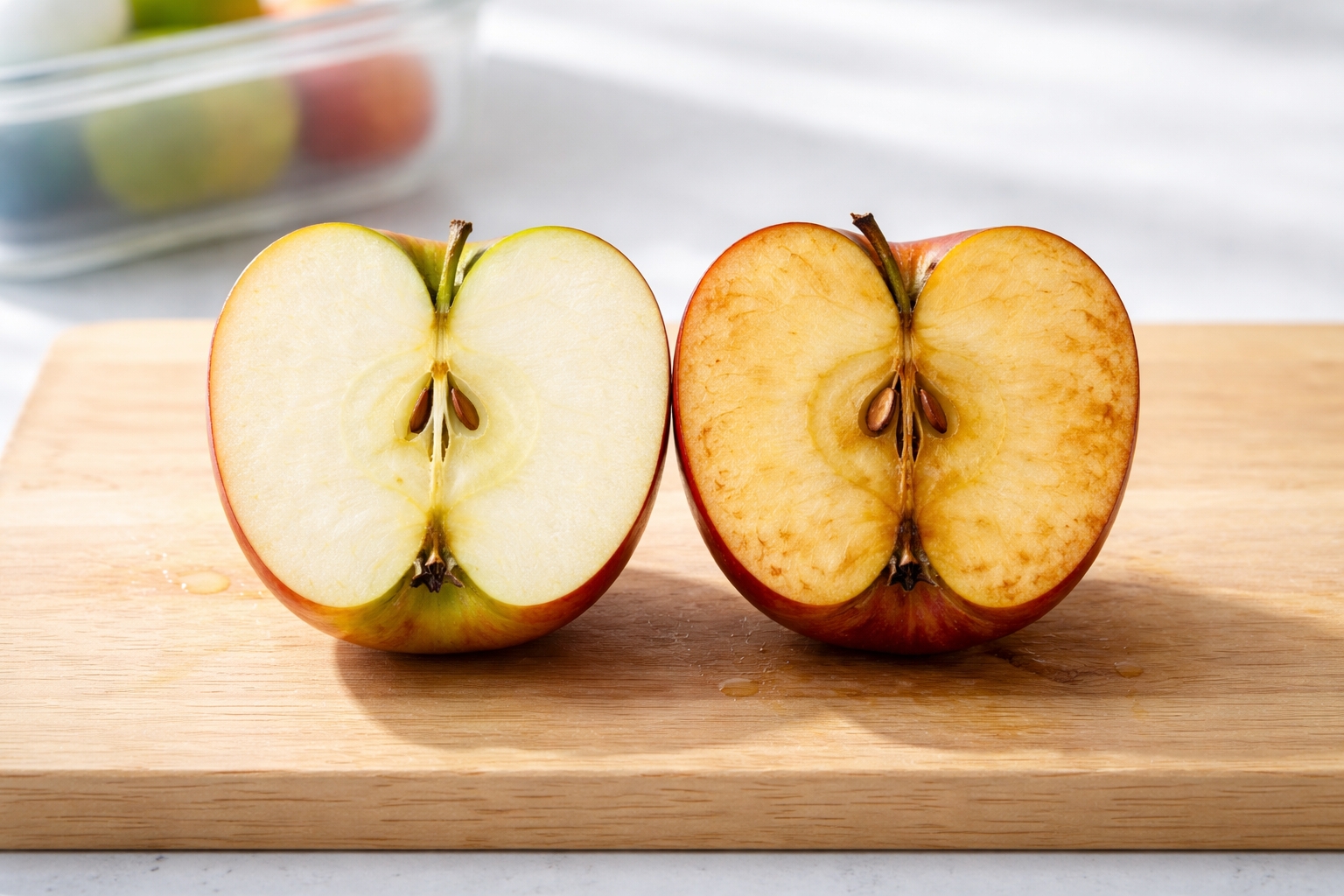
Enzymatic browning begins immediately after the flesh contacts oxygen: the apple is edible, but the cut quickly ‘rusts’.
The Chemistry of ‘Rust’: Why an Apple Acts Like an Old Nail
While the apple remains intact, two substances coexist peacefully: polyphenols, which are responsible for flavor and aroma, and an enzyme capable of destroying them. The knife forces them together. Oxygen from the air gives the signal, and the chaos begins. The enzyme attacks the polyphenols, producing melanin—the same brown pigment that colors human skin in the sun. The apple experiences the exact same process, just at an incredibly inconvenient time. This enzyme is scientifically known as polyphenol oxidase, but for the sake of simplicity, referring to it as “that enzyme” works just fine.
The brown hue appears alarming, though there is nothing to fear; the apple is not spoiled. It does, however, lose something in the process. As the reaction progresses, antioxidants are depleted. Vitamin C burns away first, intercepting oxygen before it reaches the enzyme and sacrificing itself to buy time. The loss is not critical, but it happens.
The speed of the reaction depends heavily on the variety. Cultivars like Antonovka (a tart Eastern European heirloom variety), Melba, and Golden Delicious brown almost instantly due to their naturally high enzyme activity. Varieties like Granny Smith and Renet Simirenko (a crisp, green heirloom apple popular in Eastern Europe) resist browning noticeably longer. Ultimately, all apples brown; it is merely a question of when. Slowing down the process is entirely possible, as there are four distinct levers to pull: temperature, acidity, oxygen access, and contact time. The five methods detailed below target these exact vulnerabilities.
Before exploring the solutions, clearing up a common misconception is essential. The brown crust on baked or pan-fried apples looks similar to a freshly cut brown slice, but they are entirely different phenomena. The crust forms when heated above 140°C (285°F), triggering the Maillard reaction between sugars and amino acids to create entirely new flavor molecules. This generates that mouthwatering aroma and represents a desirable culinary outcome. A fresh slice experiences no heat and develops no new flavors, undergoing only a quiet, cold oxidation. Brown can be a culinary friend, just not in this specific case.
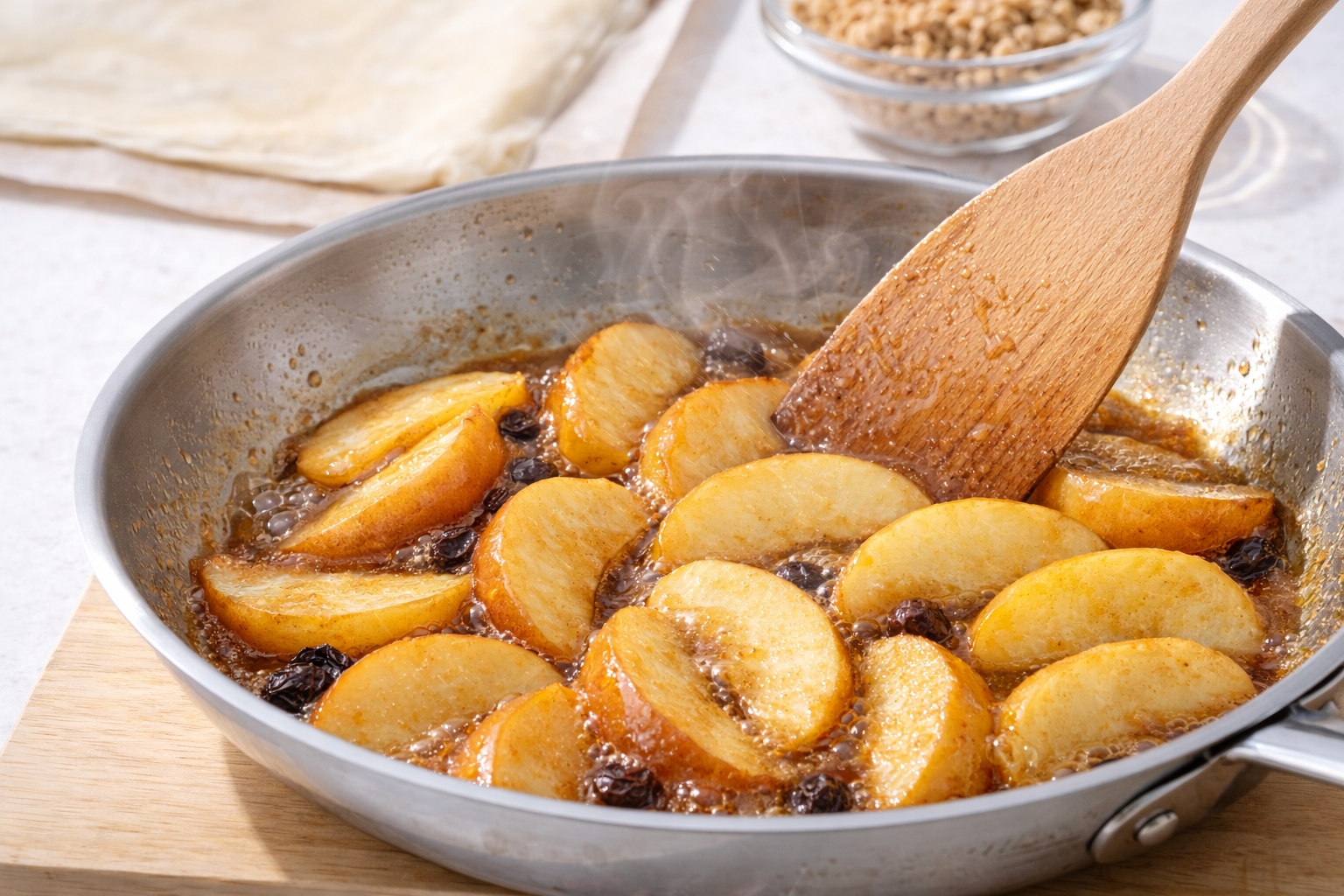
The golden color during cooking comes from caramelization and thermal reactions, not ‘rust’ on a fresh cut: in strudel filling, browning becomes flavor.
Five Ways to Trick Nature: From Lemon to Vacuum
Lemon: The Classic That Actually Works
Lemon juice is the internet’s first suggestion, and for good reason. The issue lies in the fact that most people simply squeeze it on randomly without understanding the mechanism, which leads to unpredictable results.
That specific enzyme thrives in a neutral environment. Dropping the acidity below pH 3.0, roughly the level of lemon juice, alters the electrical charge of its active center, causing it to essentially lose sight of the polyphenols. The reaction slows down. As a bonus, the natural ascorbic acid in the juice intercepts the oxygen before it reaches the enzyme, creating an effective double block.
The ratio is straightforward: mixing 1 to 2 grams (about 0.03 to 0.07 oz) of citric acid or a couple of tablespoons of lemon juice into a glass of water creates the perfect bath. Submerging the slices for 2 to 3 minutes ensures an even coating, signaled by a uniformly wet surface. Drying the slices allows for normal use afterward. This method preserves the color for up to 6 hours at room temperature and up to 12 hours in the refrigerator.
There is a slight downside: a faint tartness lingers. It remains nearly imperceptible at minimal concentrations, but for a delicate, sweet dessert or mousse, finding another option might be best. The citrus aroma of natural juice proves wonderfully appropriate for a cheese board, but it occasionally clashes elsewhere.
Salt: A Sturdy Option for Those Willing to Rinse
A saline solution offers a perfect path for anyone willing to take an extra step to achieve a completely neutral flavor. Chloride ions literally embed themselves into the enzyme’s active center, blocking oxygen binding. Without oxygen, the reaction starves, and the browning halts entirely.
Precision is key here: using a quarter teaspoon of salt per glass of water is the absolute limit. Using less means the enzyme will not notice the difference. Using more results in a salty apple, and no amount of rinsing will fully correct that mistake. Keeping the slices in the solution for 3 to 5 minutes, followed by a thorough rinse with cold water and gentle drying, makes this method universally viable, even for sweet dishes. Careful rinsing leaves the flavor perfectly neutral.
Salt offers slightly less protection time than lemon, roughly 3 to 5 hours, but this remains more than sufficient for a lunchbox or transport in a sealed container.
Honey Water: It Works, But Not How People Think
Using honey to protect apples is not merely folk wisdom; it provides a very real effect, though the mechanism is more complex than commonly believed. The flavonoids and polyphenols inherent in honey compete with the apple’s polyphenols for the enzyme’s attention, absorbing part of the impact. Additionally, the thick sugars create a microscopic film on the surface, cutting off a portion of the oxygen supply. While honey’s glucose oxidase is occasionally credited as the key player, its presence is minimal. The heavy lifting is done primarily through isolation and polyphenol competition.
The primary requirement is using real, raw honey rather than industrial syrup. Temperatures above 40°C (104°F) destroy the active compounds, leaving behind nothing but sweet water. Dissolving 2 tablespoons of honey into a glass of warm water and dipping the slices for 30 seconds works perfectly.
This method maintains color for 3 to 4 hours. While slightly weaker than lemon, it leaves behind a delicate honey aroma. For a fruit platter featuring cheese or a sweet dessert, this often acts as an unexpectedly fitting bonus rather than a compromise.
Vacuum: Maximum Results Without Compromise
Prepping apples the night before for a two-day span demands a more radical approach, and the vacuum seal remains the only unconditional method. The logic here is beautifully straightforward: no oxygen means no reaction. It becomes physically impossible.
A vacuum sealer, whether a countertop appliance or a manual pump, is required. Properly sealed slices stay pristine in the refrigerator for 24 to 48 hours without losing color or flavor. The only caveat is that the moment the bag is opened, oxygen rushes back in, and the countdown restarts. This approach is intended for prep work and sealed transport rather than immediate table presentation straight from the bag.
Blanching: When You Need a Filling, Not a Snack
The most extreme temperature-based method comes last. Like all proteins, that troublesome enzyme permanently loses its shape and stops working when heated above 85–90°C (185–194°F). Commercial facilities rely heavily on this exact principle when processing apples for freezing.
Bringing water to a boil, letting it cool slightly to the target temperature, submerging the slices for 10 to 30 seconds, and immediately transferring them to an ice bath halts the thermal cooking process. The slices must retain their firmness; if they begin to turn mushy, they have been overexposed and will turn into purée. A properly blanched slice looks slightly less matte but avoids appearing watery. With the enzymes deactivated, there is nothing left to trigger browning, allowing the slices to last for a day or longer.
The downside is a noticeable change in texture. The crisp snap disappears completely. For pies, strudels, compotes, and baked fillings, this poses absolutely no issue. For fresh table slices, it is undeniably a dealbreaker.
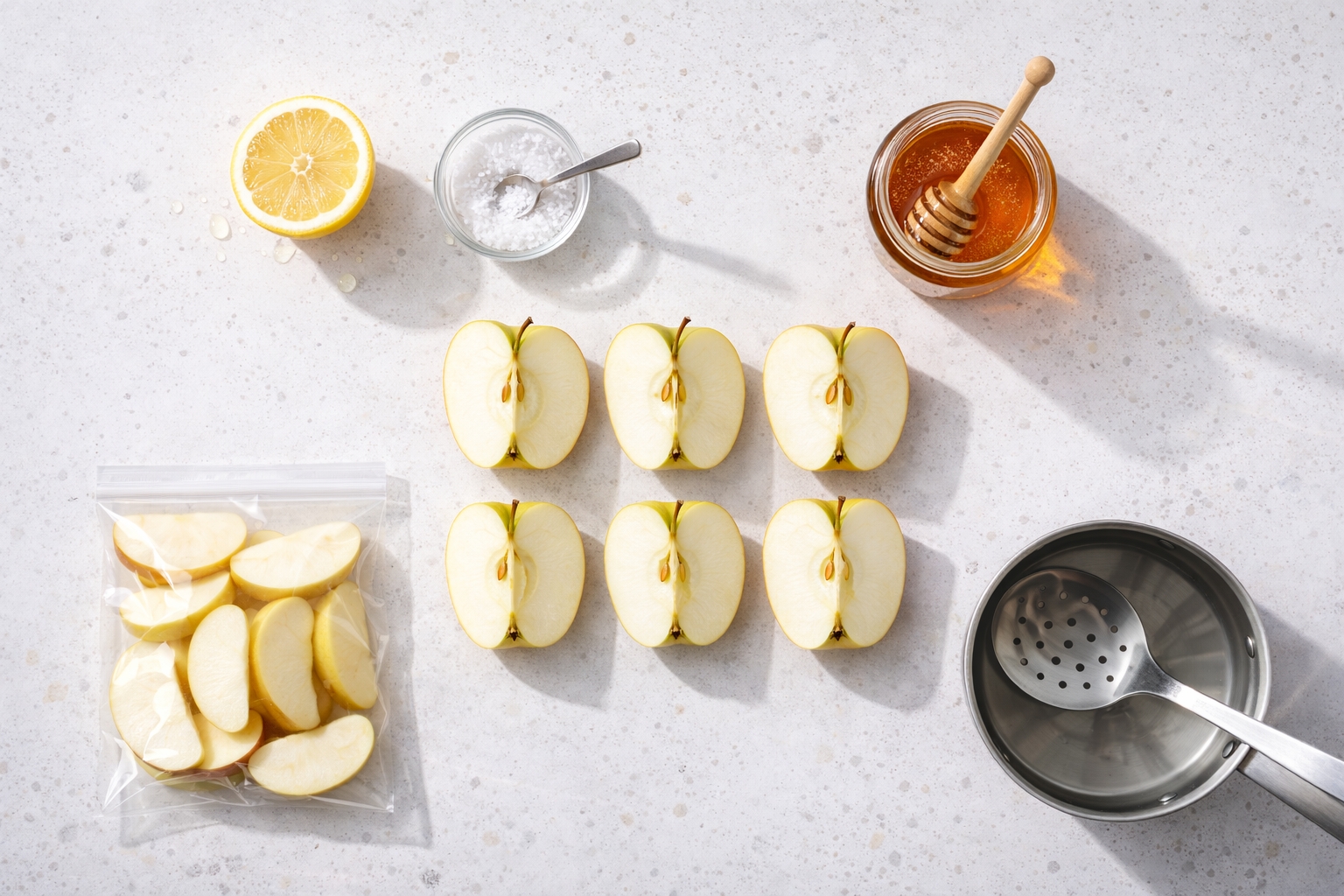
Acid, salt, honey water, vacuum sealing, and blanching operate through different levers: pH, oxygen access, and temperature.
What to Choose: A 30-Second Guide
Deciding is simple with these everyday scenarios.
Prepping a fruit platter for guests arriving in an hour? Citric acid is the answer: soak the slices in 1 to 2 grams (0.03 to 0.07 oz) of citric acid per glass of water for three minutes. Drying them off allows you to move on to other tasks.
Packing a morning lunchbox for a child? The rubber band method, paired with a few drops of lemon juice, guarantees six to eight hours of pristine color. More on this technique follows below.
Needing a neutral flavor and having five minutes to spare for a rinse? A saline solution using a quarter teaspoon per glass of water works beautifully.
Crafting a dessert or a cheese board? Honey water adds a fantastic complementary aroma.
Prepping pie apples for tomorrow? A vacuum sealer is ideal. Without one, blanching is the way to go.
Requiring pre-cut slices to last two days with zero flavor alteration? Only a vacuum seal will suffice.
The Rubber Band Trick: An Engineering Approach to Snacking
The scene is all too familiar: slicing an apple in the morning, packing it neatly into a container, only for a child to open it at noon and discover unappetizing brown wedges. The lunchbox returns home completely untouched, leading to a ten-minute lecture about how “it is perfectly fine to eat.” It is a classic struggle.
A brilliant solution exists for this exact scenario, requiring neither acid nor salt—only a simple rubber band. Slicing the apple into wedges or rings, reassembling them back into the shape of a whole apple exactly as they were before cutting, and tightly securing them with a standard office or silicone rubber band completely changes the game. Slipping it into a container finishes the prep.
The secret lies entirely in the tight seal. Pressed tightly against one another, the cut surfaces avoid contact with the air. Oxygen cannot penetrate, leaving the enzyme effectively unemployed. By lunchtime, the apple remains impressively bright without a single extra chemical step. Adding a few drops of lemon juice to the cut sides before reassembly stretches that guarantee to six or eight hours, even inside a warm backpack.
One absolute condition exists for this trick to succeed: the slices must fit together flush. Any gaps provide a pathway for air, allowing the oxidation reaction to march forward.
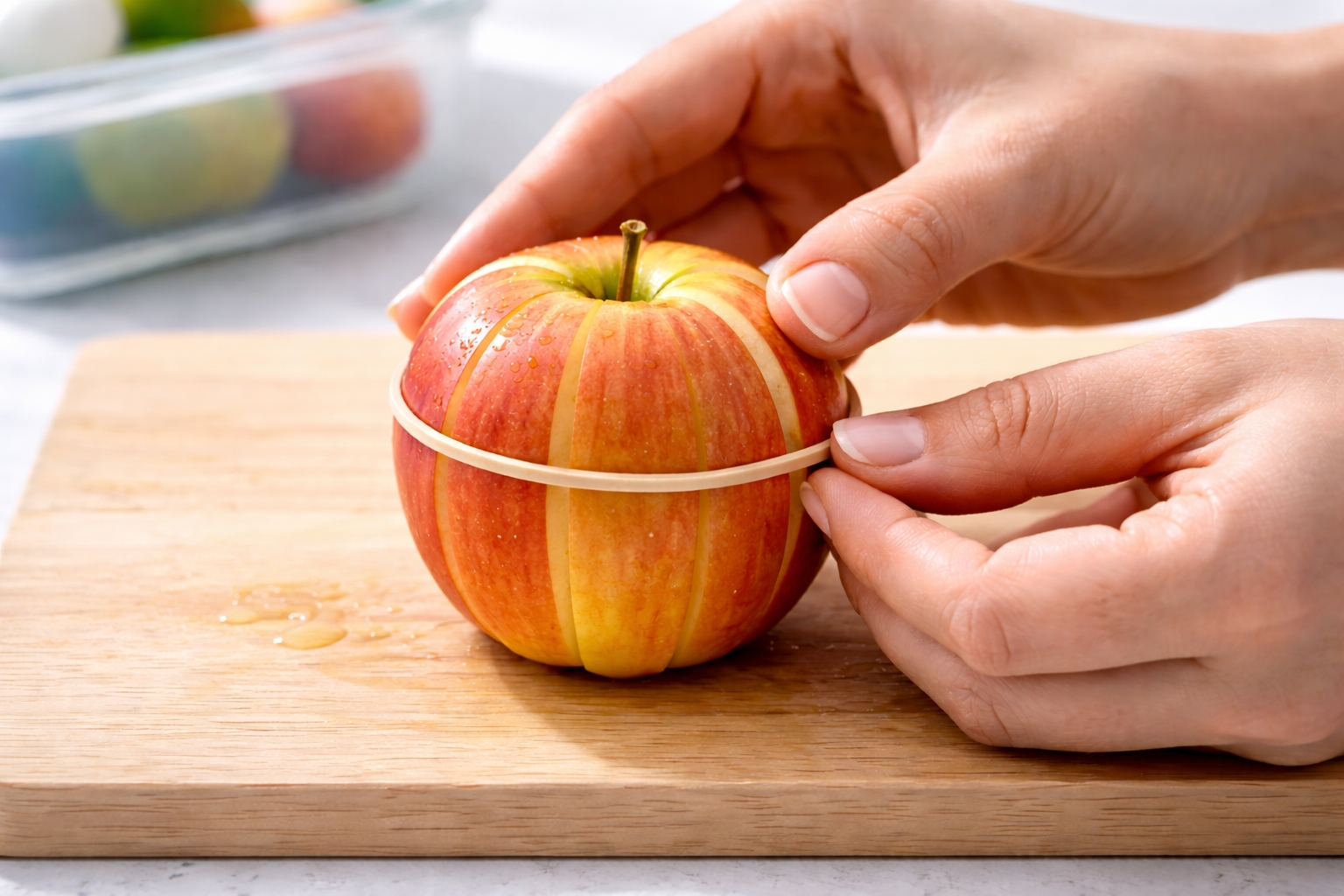
Reassembling the slices and securing them tightly with a rubber band minimizes air contact, keeping the apple bright in a lunchbox.
A Second Life for ‘Tired’ Slices: From Meat Sauce to Amber Fruit Leather
Throwing away those brown, oxidized pieces is a mistake. Truly.
A browned apple is far from spoiled. It has merely undergone surface oxidation, while the interior remains exactly as it was: flavorful, aromatic, and entirely viable. “Tired” slices have several brilliant applications that transform an unpresentable appearance into a stellar ingredient.
The most intriguing option is a fermented apple sauce. Grating or finely chopping the slices and mixing in 2% salt by total weight (roughly 10 grams or 0.35 oz per 500 grams or 1.1 lb of apple) creates the perfect environment. Using less salt is risky, as this specific concentration allows beneficial lactic acid bacteria to thrive while suppressing undesirable ones. Packing the mixture tightly into a clean jar and pressing down until the apples release their juices and are fully submerged sets the stage. Covering the jar with cheesecloth or a loose lid allows fermentation gases to escape. Leaving it at room temperature for 3 to 5 days yields a tart, deeply complex sauce with surprising umami notes that pairs exceptionally well with roast pork, burgers, or a cheese board.
For those unenthused by savory sauces, crafting an amber fruit leather (pastila) is a phenomenal alternative. Roasting the browned apples at 180°C (350°F) for 25 to 30 minutes, blending them into a smooth purée with sugar to taste and a pinch of vanilla, and spreading the mixture in a thin 3–5 mm (0.1–0.2 inch) layer on parchment paper prepares it for drying. Baking in the oven at 70–80°C (160–175°F) with the door slightly ajar for six to eight hours produces magic. The brown starting material vanishes completely. The fruit leather emerges a stunning golden-amber color, thanks to the Maillard reaction during roasting. In this context, brown shifts from a disappointment to a highly desired guest.
When time is incredibly tight, tossing them into a smoothie is the fastest route. Blending them with a banana, a handful of spinach, and some berries ensures no one will ever know. The flavor remains unchanged; only the appearance was compromised, and the blender erases that evidence entirely. Accumulating a large surplus of browned slices makes them perfect for portioned freezing. Tucking them away for future pies or strudels works brilliantly, as baking inevitably alters their color anyway, making the starting shade completely irrelevant.
Lemon juice works by dropping the pH below the enzyme’s activity threshold. Salt works by allowing chloride to block the active center. The rubber band works by starving the reaction of oxygen. Understanding the underlying reasons, rather than just memorizing rules, changes everything. The next time an apple and a knife meet on the cutting board, you will know exactly how to master the chemistry.
0 comments