
Opening the refrigerator to grab a yogurt for breakfast often ends in hesitation. Remembering when it was purchased becomes a guessing game. Perhaps it was two weeks ago, or maybe three. The lid has bloated, and the contents have separated. Taking a risk usually loses out to tossing it, meaning your money goes straight into the trash alongside the yogurt.
The issue lies in treating the refrigerator like a magical box that automatically extends the lifespan of food. Shoving items wherever they fit and hoping for the best usually leads to routine purges with garbage bags. It is no surprise when herbs turn into a slimy mess in three days, or cheese develops mold a week before its expiration date.
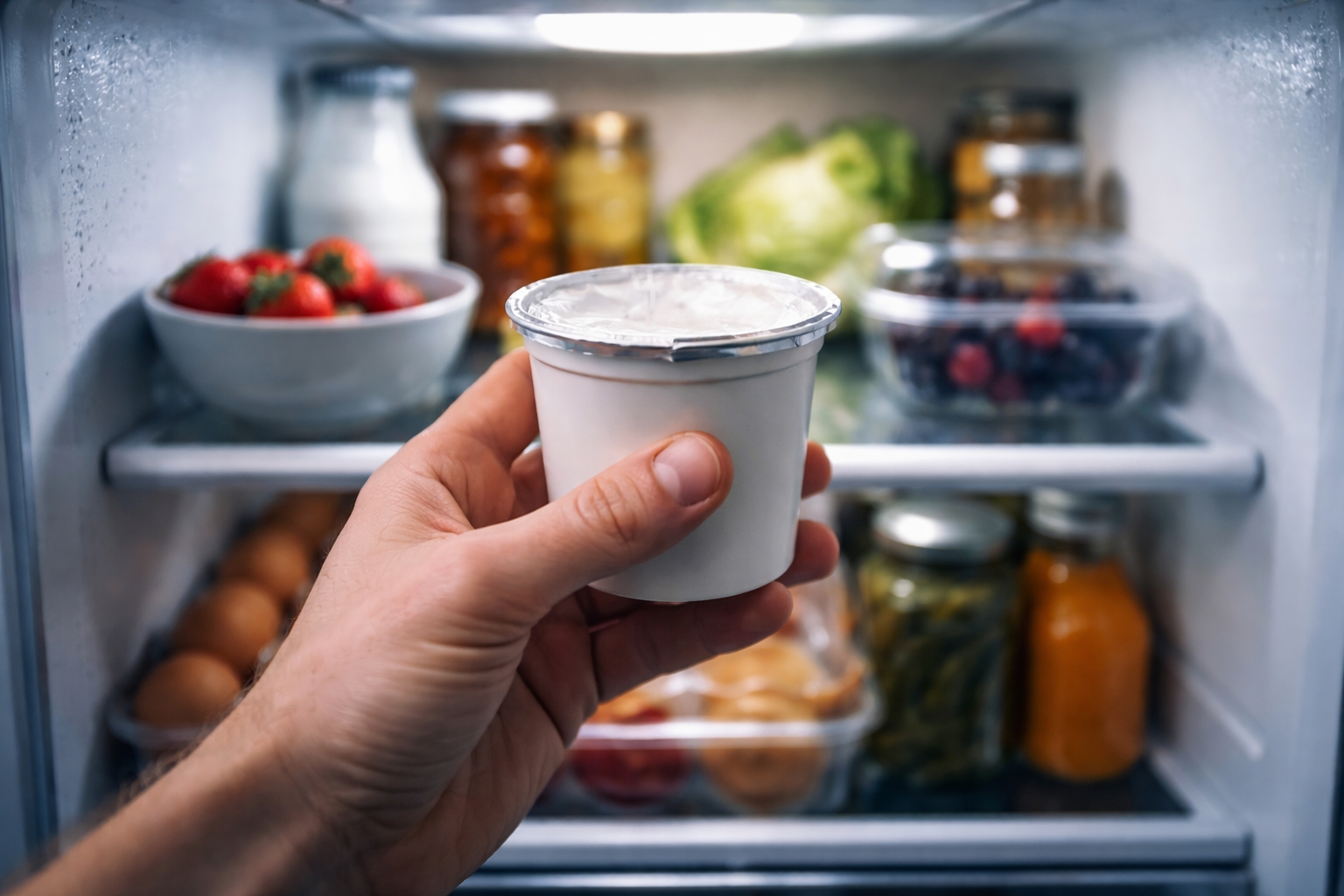
Questionable yogurt is a classic scenario when relying on the fridge as magic. Proper temperature and storage zones reduce food waste and save money.
This guide is not about memorizing expiration dates. It focuses on creating a self-sustaining system. It explains why some foods last for weeks while others spoil overnight, and it offers solutions to stop throwing away freshly bought groceries.
The Core Concept in 15 Seconds:
- Bottom shelf – raw meat and fish (on a tray)
- Middle shelf – dairy and eggs
- Top shelf – ready-to-eat meals, sauces, quick-consumption items
- Door – solely jarred sauces and beverages
- Herbs – moist but without condensation
- Fruits – separated from cucumbers and greens (they release spoilage-accelerating gases)
Table of Contents
- Why the Refrigerator Is Not a Magic Wand
- The Refrigerator Is a System of Zones, Not a Storage Unit
- Recognizing When the Spoilage Process Begins
- The Refrigerator Map: Zones and Storage Times
- Food Pairings to Keep in Mind
- What to Do With Ingredients That Are Getting Tired
- Life Hack: Checking Supermarket Storage Conditions
- Conclusion
Why the Refrigerator Is Not a Magic Wand
Placing milk in the fridge does not stop time. It merely slows it down. Bacteria continue to multiply, enzymes remain active, and fats still oxidize. The process simply shifts into slow motion.
At room temperature, microbiological processes run at full speed. Cooling a product to +4 °C (39 °F) drastically reduces this speed. This explains why milk sours in a few hours at +25 °C (77 °F) but lasts a week in the refrigerator.
Cold is selective, however. Most bacteria come to a near halt at temperatures below +4 °C (39 °F). Listeria remains a notable exception. This cold-loving pathogen continues to multiply slowly even at 0 to -1.5 °C (32 to 29 °F). Eating ready-made salads and deli meats within 48 hours is therefore essential.
Beyond temperature, humidity and ethylene play critical roles. While cold is widely understood, these two factors often remain overlooked.
Humidity. Foods consist of 60–90% water, which constantly tries to evaporate. In a dry refrigerator environment, lettuce leaves lose their crunch overnight, bread turns stale, and cheese develops a hard rind. Airtight packaging creates condensation, resulting in water droplets on the surface. This moisture provides an ideal breeding ground for bacteria and mold.
Fresh herbs require a delicate balance: a slightly damp paper towel at the bottom of the container and a loosely closed lid. Excess moisture evaporates, ensuring the leaves do not dry out.
Ethylene. Apples, pears, bananas, and tomatoes emit an invisible accelerator gas. Although unseen and unscented, it actively works. Placing an apple next to a salad causes the greens to yellow and wilt within a couple of days. Ethylene triggers the ripening of anything nearby, and overripening inevitably leads to spoilage.
Storing fruits and vegetables separately is therefore not for aesthetics, but for preservation.
The Refrigerator Is a System of Zones, Not a Storage Unit
Opening the refrigerator and placing a hand on the top shelf, followed by the bottom shelf, reveals a noticeable difference.
Internal temperatures are inconsistent. Cold air is heavier than warm air, meaning it sinks to the bottom. Top shelves typically hover around +6 to +8 °C (43 to 46 °F), while bottom shelves sit closer to +2 to +4 °C (36 to 39 °F). The door operates in its own climate, experiencing a temperature spike every time it opens.
A temperature of +3 to +4 °C (37 to 39 °F) is optimal for most foods. Bacteria multiply slowly, and the food neither freezes nor loses its texture. Achieving a uniform temperature throughout the entire volume is impossible, which is why distributing food into specific zones is highly effective. Keeping a thermometer on the middle shelf provides the real temperature rather than just relying on the display.
Top Shelves. The temperature here remains around +6 to +8 °C (43 to 46 °F), making it the warmest spot. Ready-to-eat and stable items belong here: yogurts, cottage cheese, hard cheeses, sauces, and beverages. These products have either undergone thermal processing, contain low moisture, or are preserved.
Middle Shelves. This is the golden mean, holding steady at +4 to +6 °C (39 to 43 °F). Milk, sour cream, butter, and eggs (kept off the door) thrive here. Anything requiring stable coolness without extreme conditions finds its place on the middle racks.
Bottom Shelves. As the coldest area, ranging from +2 to +4 °C (36 to 39 °F), this zone is meant for raw meat, fish, and poultry. Storing them on a separate tray prevents juices from dripping onto other foods. Salmonella and Campylobacter spread through contact, making the separation of raw and cooked items the foundation of food safety.
Vegetable Drawers. This zone offers higher humidity, which many modern refrigerators allow you to adjust.
High humidity benefits leafy greens, cucumbers, and bell peppers. Low humidity is better for fruits like apples, pears, and apricots. Separating them by drawer effectively eliminates the ethylene problem.
The Door. This is the most volatile area, with temperatures fluctuating upon every opening. Eggs, traditionally placed in built-in trays here, fare much better on an internal shelf. The door should be reserved solely for items that can survive temperature swings: jarred sauces, mustard, ketchup, and beverages.
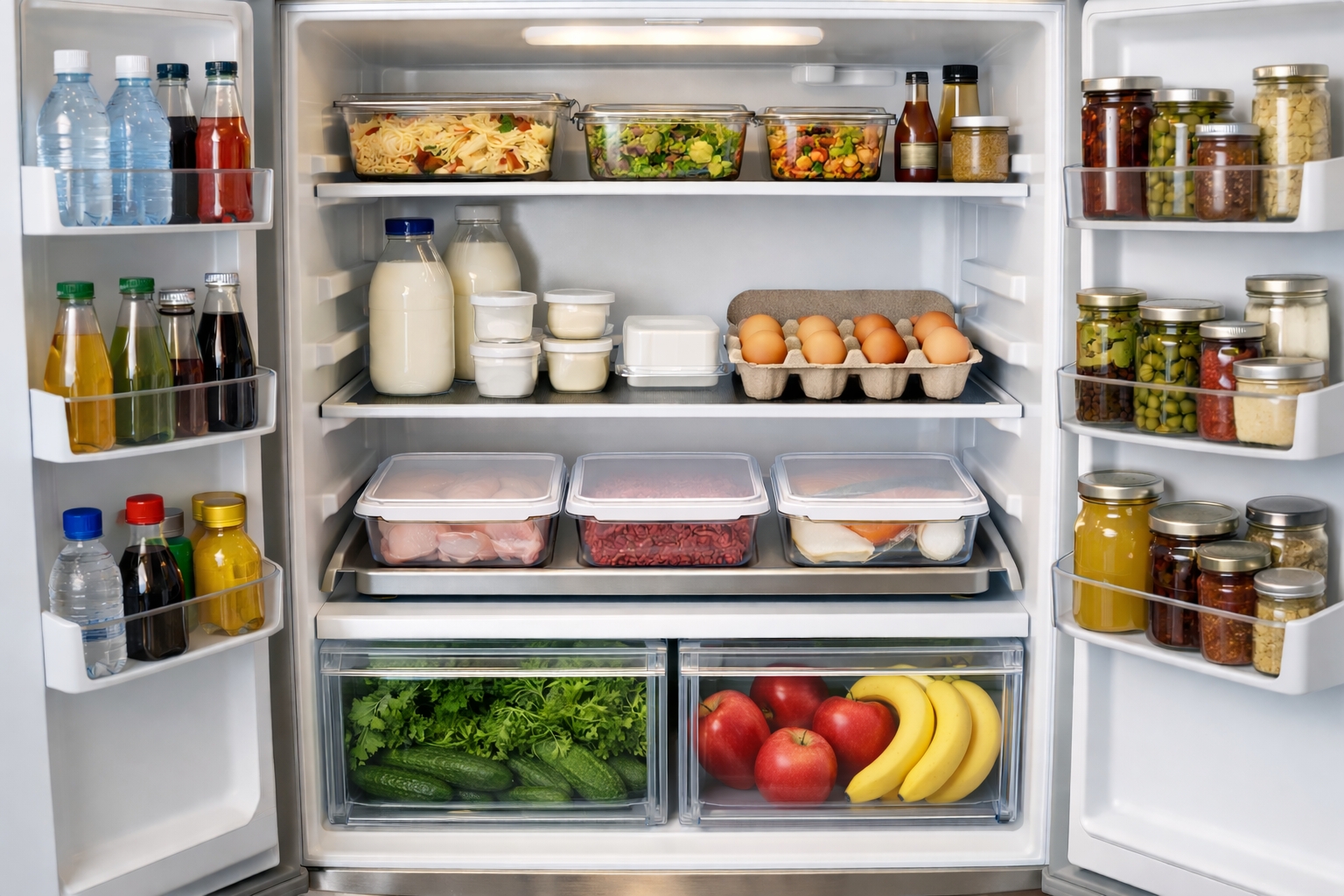
The refrigerator map in action: ready-to-eat meals and sauces on top, dairy and eggs in the middle, raw meat or fish on a bottom tray, with beverages and jarred sauces on the door.
Recognizing When the Spoilage Process Begins
Packaging dates serve as a guideline, not a strict verdict. They are calculated based on ideal conditions rarely found in real life. Bringing milk home in the heat and then placing it in a +8 °C (46 °F) fridge guarantees it will spoil prematurely. Conversely, storing it at +2 °C (36 °F) in an airtight container can extend its lifespan beyond the printed date.
Learning to Read the Product
Souring milk develops a slightly acidic scent and a thicker consistency. Spoiling meat becomes sticky to the touch, shifting in color from bright red to grayish-brown, and emits an unpleasant odor. Molding cheese first shows small dots before developing larger patches. Wilting vegetables see their leaves lose elasticity.
Noticing changes is important, but there is no need for paranoia. Separated yogurt that smells fine and is within its expiration date simply needs a stir. Slightly wilted herbs that have not blackened or turned slimy work perfectly in a soup or sauce. Mold on hard cheese can usually be cut away with a generous margin, whereas soft and curd cheeses should be discarded entirely.
Foods You Should Never Gamble With
Raw meat and fish carrying a suspicious odor belong in the trash. The same applies to ready-made salads and deli slices that have been open for over 48 hours. Items exhibiting visible mold—unless it is intentional, like in blue cheese—should be thrown away, as mold grows deep into the food, not just on the surface.
The Refrigerator Map: Zones and Storage Times
| Refrigerator Zone / Temperature | Ideal Items to Store | Storage Time (After Opening) |
|---|---|---|
| Top Shelf – +6 to +8 °C (43 to 46 °F) | Yogurts, cottage cheese, hard cheeses, ready sauces, beverages | Yogurt – 7–10 days, cottage cheese – 3–5 days, hard cheese – 3–4 weeks |
| Middle Shelf – +4 to +6 °C (39 to 43 °F) | Milk, sour cream, butter, soft cheeses, eggs | Milk – 3–5 days, sour cream – 7–10 days, butter – 2–3 weeks, eggs – 3–4 weeks |
| Bottom Shelf – +2 to +4 °C (36 to 39 °F) | Raw meat, fish, poultry (in separate packaging) | Ground meat – 1–2 days, meat cuts – 3–5 days, fish – 1–2 days |
| Vegetable Drawers (High Humidity) – +4 to +6 °C (39 to 43 °F) | Leafy greens, cucumbers, bell peppers, zucchini, green onions | Lettuce – 3–5 days, cucumbers – 7–10 days, bell peppers – 10–14 days |
| Vegetable Drawers (Low Humidity) – +4 to +6 °C (39 to 43 °F) | Apples, pears, citrus fruits, carrots, beets | Apples – 3–4 weeks, carrots – 2–3 weeks, beets – 2–3 weeks |
| Door – +8 to +10 °C (46 to 50 °F) | Jarred sauces, mustard, ketchup, beverages | Sauces after opening – 1–3 months, beverages – according to label |
Storage times are indicated for a temperature of +3 to +4 °C (37 to 39 °F) in airtight packaging. If the refrigerator is warmer or the door is opened frequently, these times are reduced.
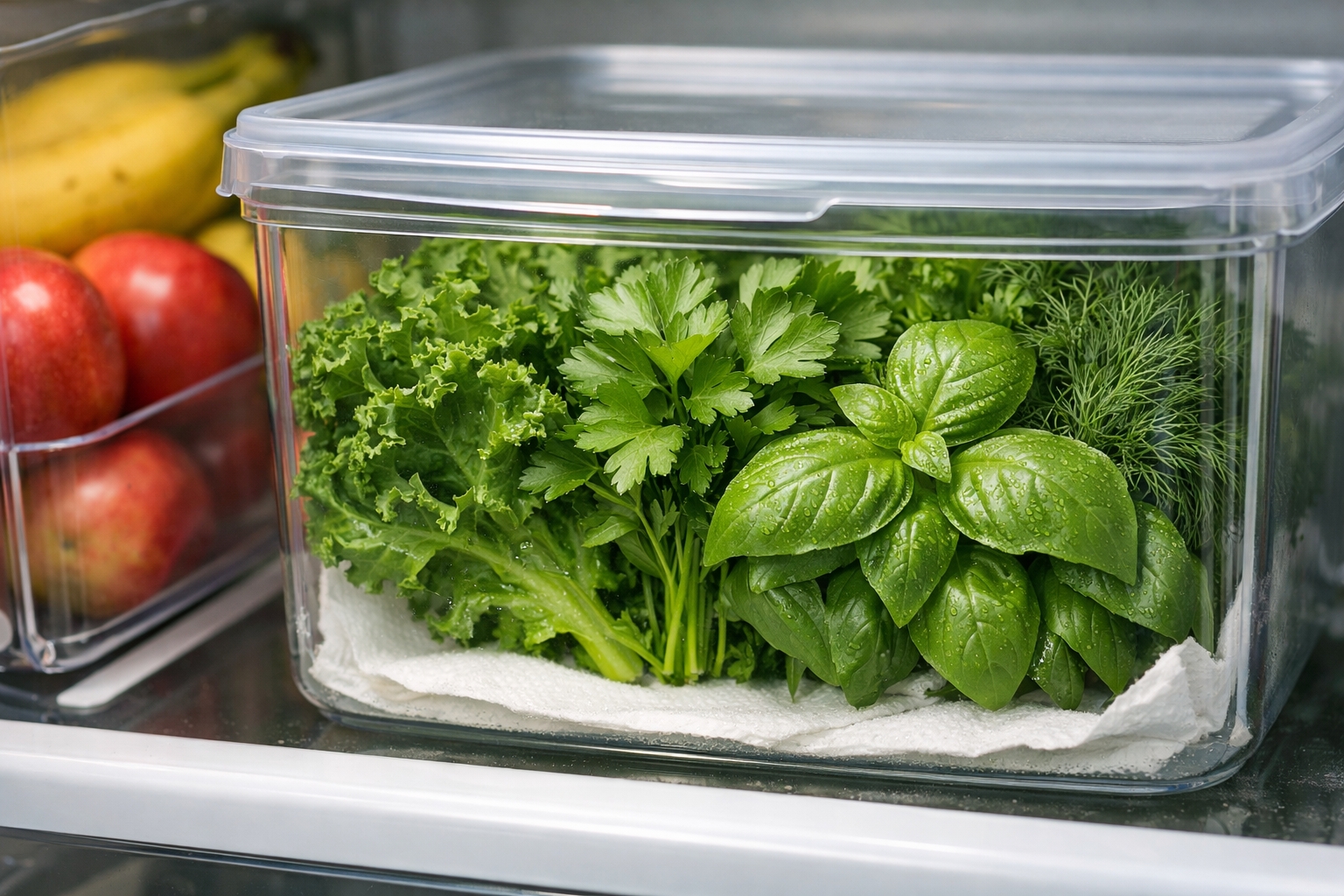
Fresh herbs require a moisture balance: a container paired with a slightly damp paper towel prevents slime and drying out. Keeping fruits separate is crucial, as ethylene accelerates the spoilage of greens and vegetables.
Food Pairings to Keep in Mind
Properly distributing items by zone is only part of the equation; understanding what sits next to what is equally important.
Keeping raw meat away from cooked foods is a well-known rule, but other pairings are less obvious.
Strongly scented items—like fish, smoked meats, pungent cheeses, or that opened jar of robust sauce—require airtight containers. Milk and butter easily absorb foreign aromas, and no one desires herring-flavored butter.
Apples, pears, bananas, and tomatoes accelerate the ripening of their neighbors. Isolating them from sensitive greens and cucumbers is crucial. Eggs, due to their porous shells, also absorb odors easily and should be kept in their original carton away from aromatic foods.
A deep dive into the nuances of food pairings deserves its own discussion. For now, the focus shifts to handling ingredients that are beginning to tire.
What to Do With Ingredients That Are Getting Tired
Purchasing a bunch of parsley, using three sprigs for soup, and letting the rest migrate from shelf to shelf is a familiar routine. Rather than waiting for the herbs to completely wilt, you can transform them into an infused oil as a brilliant alternative.
Blending the herbs with olive oil (at roughly a 1:2 ratio) and a pinch of salt creates a vibrant mixture. Pouring it into ice cube trays and freezing it provides instant flavor bombs for sauces, dressings, and marinades. These cubes last for months and melt in seconds.
Submerging slightly wilted, but not yet blackened, lettuce leaves in an ice bath for 10–15 minutes works wonders. The cells absorb the water, restoring their natural crispness just in time for a dinner salad.
Dicing stale bread, tossing it with olive oil and spices, and toasting it in the oven yields excellent croutons. Alternatively, pulsing it in a blender creates perfect homemade breadcrumbs.
Peeling, slicing, and freezing overripe, blackened bananas ensures they never go to waste. They are ideal for smoothies, pancakes, and banana bread. Frozen bananas naturally give smoothies a creamy texture without the need for ice.
Grating cheese that has dried out around the edges and freezing it makes it ready for future pizzas, pastas, or casseroles, where the texture difference goes completely unnoticed.
Taking proactive measures is the key. Intervening before an ingredient becomes unusable ensures it serves its purpose while still in good condition.
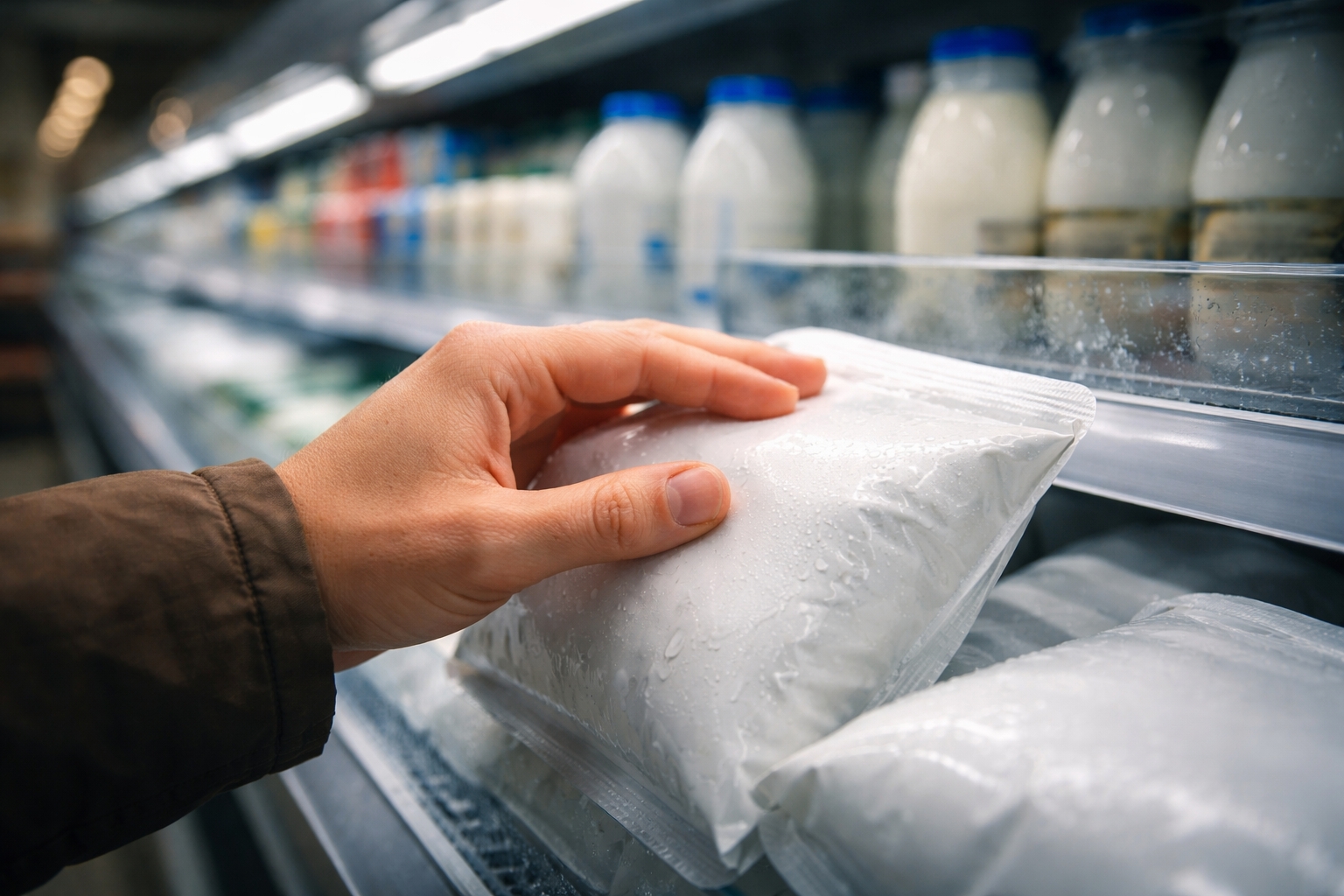
Checking the cold chain is essential: packaging should feel noticeably cold. A warm display case or excessive condensation frequently explains why food spoils ahead of schedule.
Life Hack: Checking Supermarket Storage Conditions
Sometimes the spoilage issue begins before the groceries even reach your home. Observing these details during a shopping trip makes a substantial difference:
Touching the packaging. Chilled meat and milk should feel cold to the touch, not just cool. Warm packaging indicates the product has spent time outside of a refrigerated environment.
Checking the display case level. Goods stacked above the rim of an open refrigerated case lack sufficient cooling. Cold air circulates below the rim, leaving anything exposed on top to warm up.
Looking for condensation. Water droplets on the inside of a package signal unstable temperature control within the store’s display.
Reviewing delivery receipts. Certain delivery services print the thermal bag’s temperature on the receipt. A reading of +10 °C (50 °F) or higher puts chilled groceries at risk.
Conclusion
Refrigerators operate on the laws of physics and chemistry, not magic. Stopping time is impossible, but slowing it down is entirely within reach.
Dividing foods into zones means controlling their exposure to temperature. Monitoring humidity extends the life of delicate greens. Isolating raw meat protects against harmful bacteria, and keeping fruits away from vegetables prevents premature ripening.
A storage system is not about achieving picture-perfect organization. Its true purpose is to stop the cycle of throwing away freshly bought food. It ensures that every ingredient retains its quality for as long as nature allows, rather than degrading by day three.
Memorizing every timeline and temperature is unnecessary. Understanding the basic logic is enough: cold slows things down, appropriate humidity preserves textures, and ethylene accelerates ripening. Everything else simply comes with practice.
1 comment