
Holding a whole onion right up to your face yields nothing more than the dry, papery scent of its skin. Even though all the tear-inducing compounds are already waiting inside, tucked away into separate cellular compartments, they simply haven’t met yet.
Then a knife slices into the bulb.
Within seconds of that first cut, a substance that didn’t exist in the intact onion materializes above the cutting board. Volatile and airborne, it rises directly toward your eyes, which are usually less than half a meter (about 20 inches) away. Seconds later, the stinging, burning, and involuntary tears begin—a reflex no amount of willpower can stop. This chemical ambush is the exact reason slicing onions makes your eyes water: the bulb synthesizes an irritant the very moment the blade breaches its cells, though a few links in this chain reaction can be manipulated right in your kitchen.
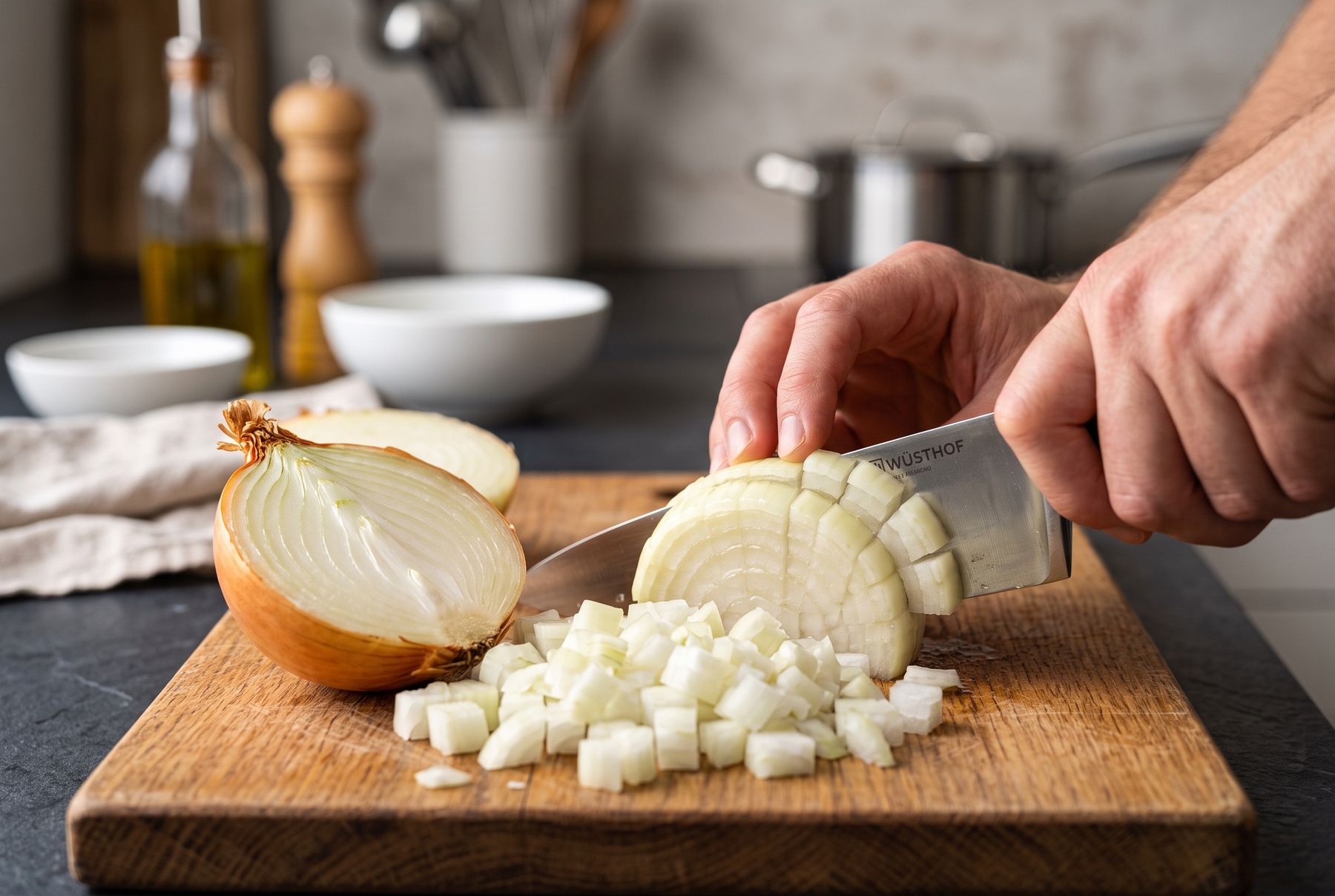
Slicing into an onion ruptures its cells, triggering an enzymatic reaction that produces the tear-inducing lachrymatory factor.
Table of Contents
- An Onion Assembles Its Tear-Inducing Compound in Seconds
- Why Onions Make Your Eyes Water: What Happens When the Molecule Hits
- Why One Onion Is Meaner Than Another
- How to Chop Onions Without Crying: 3 Methods With Clear Mechanics
- Water, Bread in the Mouth, and Other Kitchen Folklore
- Goggles: A Barrier That Actually Works
- Why Fried Onions Stop Stinging Your Eyes
- How to Cut Onions Without Crying: What Actually Works at the Board
An Onion Assembles Its Tear-Inducing Compound in Seconds
Inside a raw onion, two key reaction components sit completely isolated from one another. The first is a sulfur-containing precursor called isoalliin, which is entirely odorless and mild. The second is alliinase, the enzyme responsible for breaking it down. Stored in separate parts of the cell, they never make contact in an undamaged bulb.
Slicing the onion destroys the boundary between them.
Once the blade cuts through, the chemical reaction unfolds in two distinct steps. Alliinase breaks down the isoalliin, generating an unstable compound—sulfenic acid—that survives for mere fractions of a second. A second enzyme, lachrymatory factor synthase (LFS), then steps in to convert this fleeting acid into a volatile molecule known as syn-propanethial-S-oxide. That specific molecule is what stings your eyes.
For decades, scientists assumed that second step happened spontaneously. In 2002, however, Japanese researchers demonstrated that the tear-inducing compound cannot form at all without that dedicated second enzyme, forcing a rewrite of the textbook diagrams.
The unstable intermediate compound actually stands at a chemical crossroads with two possible pathways, each yielding different products. If LFS intercepts it in time, it becomes the lachrymatory factor. If not, the exact same chemical fragment converts into thiosulfinates—the compounds responsible for the pungent aroma of freshly cut alliums. Plant breeders are already exploiting this quirk: in onions bred to have suppressed LFS activity, the tear factor plummets while the flavor remains unmistakably oniony, albeit noticeably milder and less aggressively sharp.
Why the Reaction Starts Only After the Cut
An onion functions much like two-part epoxy stored in separate tubes. As long as the cellular chambers remain intact, the enzyme and substrate never physically touch, and nothing happens. Structural damage acts as the trigger.
This cellular architecture explains why finely dicing an onion stings far worse than slicing it into halves. Cutting a bulb in two leaves a relatively small area of damaged tissue. Dicing it into 3 mm (1/8-inch) cubes multiplies that exposed surface area several times over, with every pass of the knife rupturing millions of fresh cells. Consequently, a prolonged session of fine mincing reliably brings on a much fiercer burn than the first few rough chops.
Why Onions Make Your Eyes Water: What Happens When the Molecule Hits
Because the lachrymatory factor molecule is small and highly volatile, it readily evaporates from the cut surface at room temperature. When it reaches the cornea, it encounters a dense network of trigeminal nerve endings that are acutely sensitive to chemical irritation. Those nerves fire a distress signal to the brain, the lacrimal glands receive the command to flood the zone, and tears wash across the eye’s surface to flush the irritant away.
The popular internet theory claiming that onion gas turns into sulfuric acid in your eyes is an oversimplification. While the molecule is indeed reactive in an aqueous environment, the exact mechanism of irritation at the specific receptor level isn’t fully mapped out, and reducing it to “sulfuric acid” treats a tidy shorthand as established fact. For anyone standing at the cutting board, only the bottom line matters: a volatile irritant reaches the cornea and triggers an immediate tear reflex.
Gas isn’t the only delivery system; microdroplets of onion juice play a major role, too. In 2025, a research team at Cornell University analyzed the mechanics of onion slicing using high-speed cameras. They found that as a knife presses down on the outer layer, the tissue beneath the skin compresses; when the blade finally breaches the surface, that pent-up pressure blasts a cloud of microscopic droplets into the air at speeds ranging from 5 to 40 meters per second (16 to 130 feet per second). Those droplets shoot up to 60 cm (24 inches) high. In other words, a significant portion of the irritant reaches your eyes not as a diffusing gas, but as a literal aerosol spray of onion juice—and a cook’s face happens to hover right in the firing line.
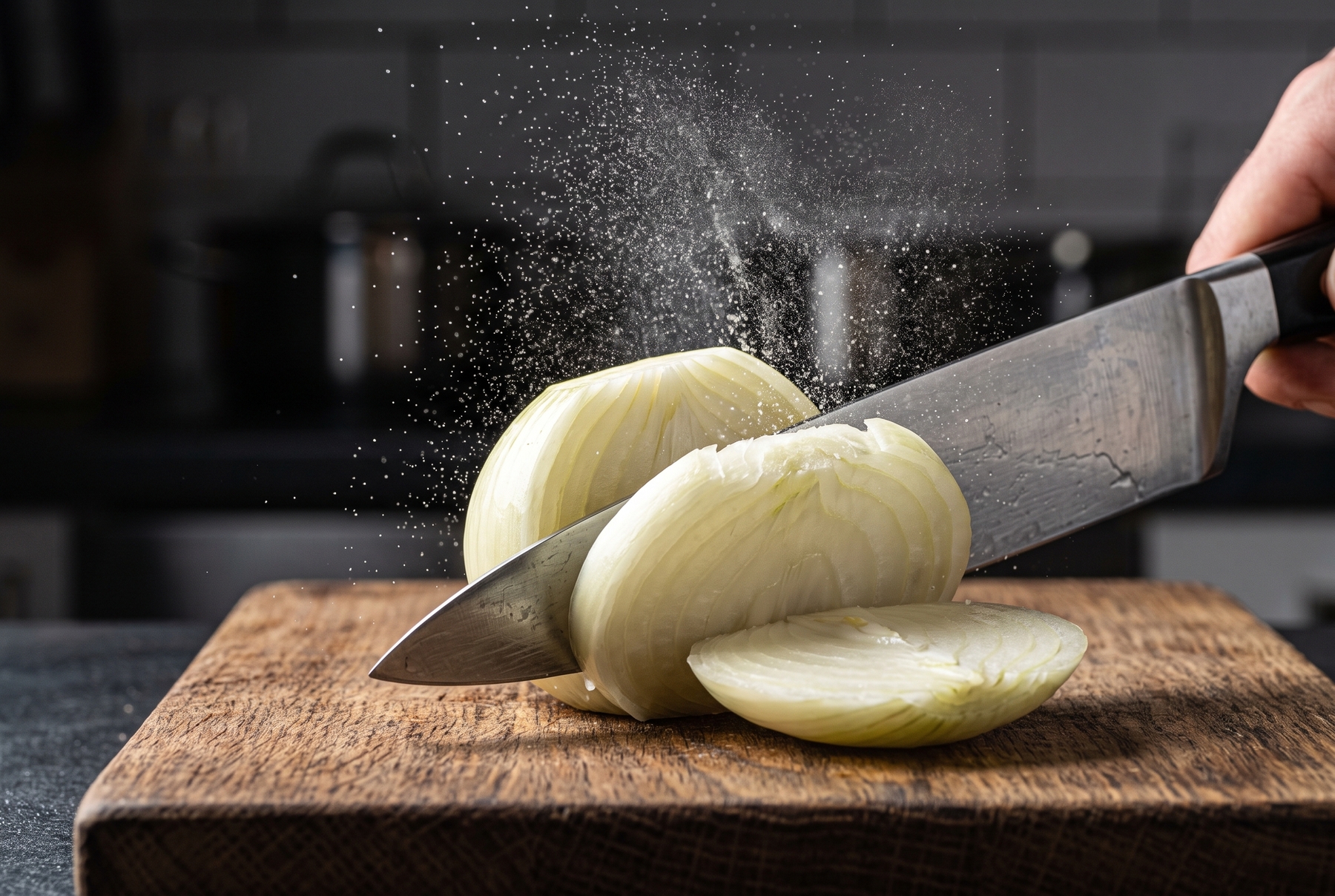
Irritants reach your eyes not only as a diffusing gas, but also as an airborne cloud of microscopic onion juice droplets.
Why One Onion Is Meaner Than Another
The tear-inducing potency varies dramatically from one bulb to the next. How much sulfur-containing precursor an onion packs depends heavily on both its specific cultivar and the availability of sulfur in the soil where it grew.
Sweet cultivars like Vidalia onions offer a classic example. Farmers grow them in low-sulfur sandy soils where sulfates easily leach away, resulting in a mild bulb. Sulfur-rich fertilizers, conversely, crank up the pungency. One agricultural study found that levels of the lachrymatory factor rose in direct proportion to fertilizer application rates, regardless of the onion variety. Pungency can even fluctuate within the exact same field due to subtle shifts in terrain and soil composition.
Judging an onion’s potential bite strictly by its color or variety is therefore unreliable; two batches of the exact same cultivar from different farms can behave completely differently on the cutting board.
The cook’s own habits and physiology also tip the scales. Prescription glasses provide a partial physical shield for some, while contact lenses alter the tear film for others. One person leans directly over the board while another maintains a safe posture further back, and baseline corneal sensitivity varies wildly from person to person. Drawing sweeping conclusions about an onion variety based on a casual home test of two bulbs is futile—there are simply too many variables in play.
How to Chop Onions Without Crying: 3 Methods With Clear Mechanics
The following techniques actually have a logical, traceable mechanism of action behind them.
A Razor-Sharp Blade
Using a sharp knife boasts the strongest scientific backing, validated by that recent high-speed camera research. When researchers built a custom guillotine fitted with blades of varying sharpness, they discovered that dull edges and fast, forceful chops launch significantly more liquid droplets into the air. A dull blade crushes and pinches the onion’s layers first, building up internal hydraulic pressure before finally tearing through the skin. A keen edge glides through the tissue before that excess pressure can accumulate.
Honing your knife on a steel before tackling a big pile of onions—and slicing with calm, deliberate strokes rather than frantic, TV-chef chopping—makes a measurable difference. A dull blade that forces you to saw through the bulb acts like an aerosol atomizer.
Keep in mind that a sharp knife doesn’t halt the underlying chemistry; alliinase goes to work regardless of the blade’s edge. A sharp knife minimizes the mechanical spray of juice, though the volatile gas will still evaporate from the cut surfaces.
A Thoroughly Chilled Bulb
The theory behind chilling onions is that cold temperatures slow down enzymatic reactions while reducing the volatility of the irritating gas. The chemistry sounds entirely plausible, even if rigorous peer-reviewed kitchen trials are scarce.
The National Onion Association in the United States recommends chilling bulbs in the refrigerator for 30 minutes prior to slicing. A standard fridge shelf at around 4 °C (39 °F) does the trick. Popping an onion into the freezer for 10 minutes also works, provided you don’t forget it there: freezing turns the flesh limp as ice crystals rupture the cell walls, leaving you with a mushy bulb that slips and slides under the knife.
To be completely candid, solid experimental data quantifying this trick is hard to find, and the “70% fewer tears” statistic floating around the internet lacks a credible citation. Still, chilling is a widespread practice that costs nothing and won’t harm the onion, even if its exact effectiveness in your kitchen remains unpredictable.
Strategic Airflow
Moving air won’t alter the chemistry inside the onion, but it reliably curbs crying by sweeping the irritant away before it can concentrate around your face.
Switching your range hood to medium speed and positioning your cutting board directly beneath the intake zone is the most straightforward approach. If a strong vent hood isn’t an option, setting a small fan on low speed to the side of the board works well, aiming the airflow across the work surface toward an open window. Avoid placing the fan behind the board facing you, which only blows the irritant straight into your eyes.
Maintaining a bit of posture distance from the board helps, too. Since microdroplets launch up to 60 cm (24 inches) into the air, hunching closely over your knife puts your eyes directly in the splash zone.

Running a kitchen range hood or directing airflow across the board lowers the concentration of tear-inducing irritants near your face.
Water, Bread in the Mouth, and Other Kitchen Folklore
Vetting any folk remedy in this category requires a simple test: identify which specific link in the chemical or physical chain reaction the trick disrupts. If a clear target exists, the method is worth discussing; if not, it’s just kitchen superstition.
Slicing underwater or wetting the bulb. A real mechanism exists here: the chemical precursors are partially water-soluble, so water rinses the juice from the blade and blocks evaporation. While it works chemically, the execution is clumsy. Wet onions turn slippery, the knife loses traction, blade control suffers, and some flavor washes down the drain. No formal studies back up the hassle.
Oiling the onion’s surface or blade. Though it sounds eccentric, this trick has a shred of physics behind it. In that same Cornell droplet study, coating the onion in oil reduced the aerosol spray, as the lipid film alters surface tension and how the skin ruptures. In practice, however, an oil-slicked onion is a hazard under a sharp chef’s knife, leaving the risk-reward calculation up to you.
Leaving the root end intact. Cooks repeat this advice constantly, usually claiming that sulfur compounds concentrate most heavily near the root. While that specific claim comes mostly from industry lore rather than strict botanical data, leaving the root intact serves a brilliant mechanical purpose: it anchors the layers together, preventing the half-bulb from collapsing and making neat, uniform dicing vastly easier and faster.
Holding bread or water in your mouth, sticking out your tongue, clenching a matchstick between your teeth, or laying a wet towel beside the board. Almost all of these quirky rituals focus on the mouth, despite the fact that the irritant targets the corneal nerves of the eyes. No plausible physiological mechanism connects moisture in your mouth to the concentration of volatile gas hitting your eyeballs. Lighting a candle near the board could theoretically incinerate trace amounts of gas passing directly through the flame, but the volume of air a tiny wick processes is negligible. A piece of advice doesn’t become scientifically valid just because three generations of cooks have repeated it.
Goggles: A Barrier That Actually Works
Tight-fitting eyewear stops the tear reflex cold by physically blocking the irritant from ever reaching the cornea.
Standard eyeglasses don’t quite seal the deal. Everyday frames leave wide gaps at the top and sides, allowing gas and microdroplets to drift freely behind the lenses; they offer mild relief, but not immunity. Snug laboratory safety goggles or dedicated foam-lined onion glasses seal off the entire perimeter of the eye socket, shutting out the irritant almost completely.
The drawbacks are purely practical: sealed lenses tend to fog up, and bulky frames restrict peripheral vision—a genuine annoyance when wielding a sharp knife.
Buying specialized goggles just to chop a couple of onions a week is overkill. Yet if stinging tears routinely blind you mid-chop, or if you’re facing down 5 kg (11 lbs) of onions for a massive batch of French onion soup or jam, sealed eyewear makes total sense. A snug pair of swimming goggles pulled from a closet drawer works just as well.
Why Fried Onions Stop Stinging Your Eyes
Both of the culprits behind the tear cascade—alliinase and lachrymatory factor synthase—are protein-based enzymes. High heat denatures their three-dimensional structure, shutting down the chemical factory permanently. Meanwhile, the lachrymatory factor itself is thermally unstable and volatile, meaning whatever gas formed during chopping quickly evaporates or breaks down in the pan.
As a result, a hot skillet only stings your eyes during the first minute or two, when freshly diced raw onions first hit the fat and residual compounds steam upward. Soon after, the aroma wafting from the pan transforms completely: the harsh, sulfurous bite vanishes, giving way to a mellow sweetness and, eventually, the rich, savory perfume of browned alliums.
That initial loss of sting shouldn’t be confused with browning, however. True sweetness and golden color develop much later in the cooking process: water evaporates, natural sugars concentrate, the Maillard reaction kicks off between sugars and amino acids, and prolonged slow cooking triggers caramelization. Those flavor-building reactions have nothing to do with the tear-inducing factor and only begin once the heat has already deactivated the enzymes.
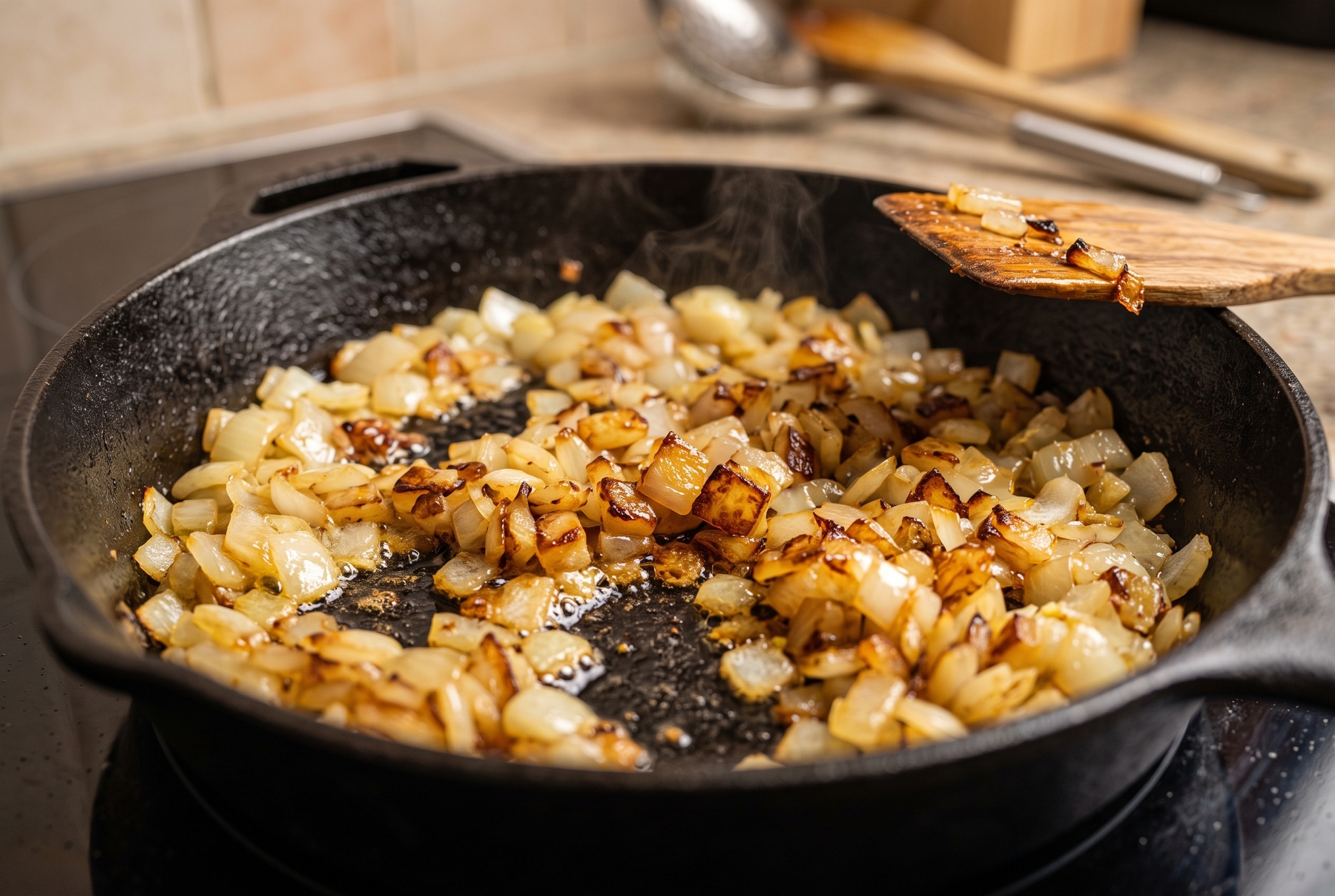
Heat denatures the active enzymes, which is why sautéed onions stop irritating your eyes.
How to Cut Onions Without Crying: What Actually Works at the Board
In day-to-day cooking, keeping tears to a minimum boils down to a few practical habits:
Honing your knife right before you start prevents crushing the cells. Chilling the onion in the refrigerator for 30 minutes beforehand may help, even if hard data on cooling is thin. Running the range hood on medium and sliding the cutting board directly under the intake pulls the gas away, while standing back slightly keeps your face out of the droplet splash zone. Making your large cuts first, saving the fine mincing for the very end, and never rubbing your eyes before washing your hands rounds out the defense.
Eliminating tears entirely isn’t always realistic, simply because halting the enzymatic reaction inside a sliced raw onion is impossible. The goal is merely reducing the dose of irritant that reaches your corneas. The blade ruptures the cells, the enzymes synthesize a volatile compound, air currents and microdroplets carry it upward, and your eyes flush themselves out in self-defense.
0 comments