
Standing in the baby food aisle, a parent can easily spend ten minutes comparing “4+ months” and “5+ months” purees, sounding out ingredient labels syllable by syllable, and agonizing over whether an infant cereal really needs that extra 1% of vegetable oil. All of this comes down to a single modern luxury: choosing what is healthiest and most optimal. A few centuries ago, the question was far more blunt: if a mother could not breastfeed, what could possibly keep her baby alive?
Long before the invention of the glass jar, people searched desperately for answers, experimenting with milk substitutes, makeshift feeding vessels, and improvised recipes. Some of these historical solutions look entirely reasonable today, others seem bizarre, and a few are harrowing enough to make anyone look at their refrigerator with profound gratitude.
To be clear from the start, what follows is culinary and medical history, not a parenting guide. None of these antique feeding methods should ever be tested on a modern infant.
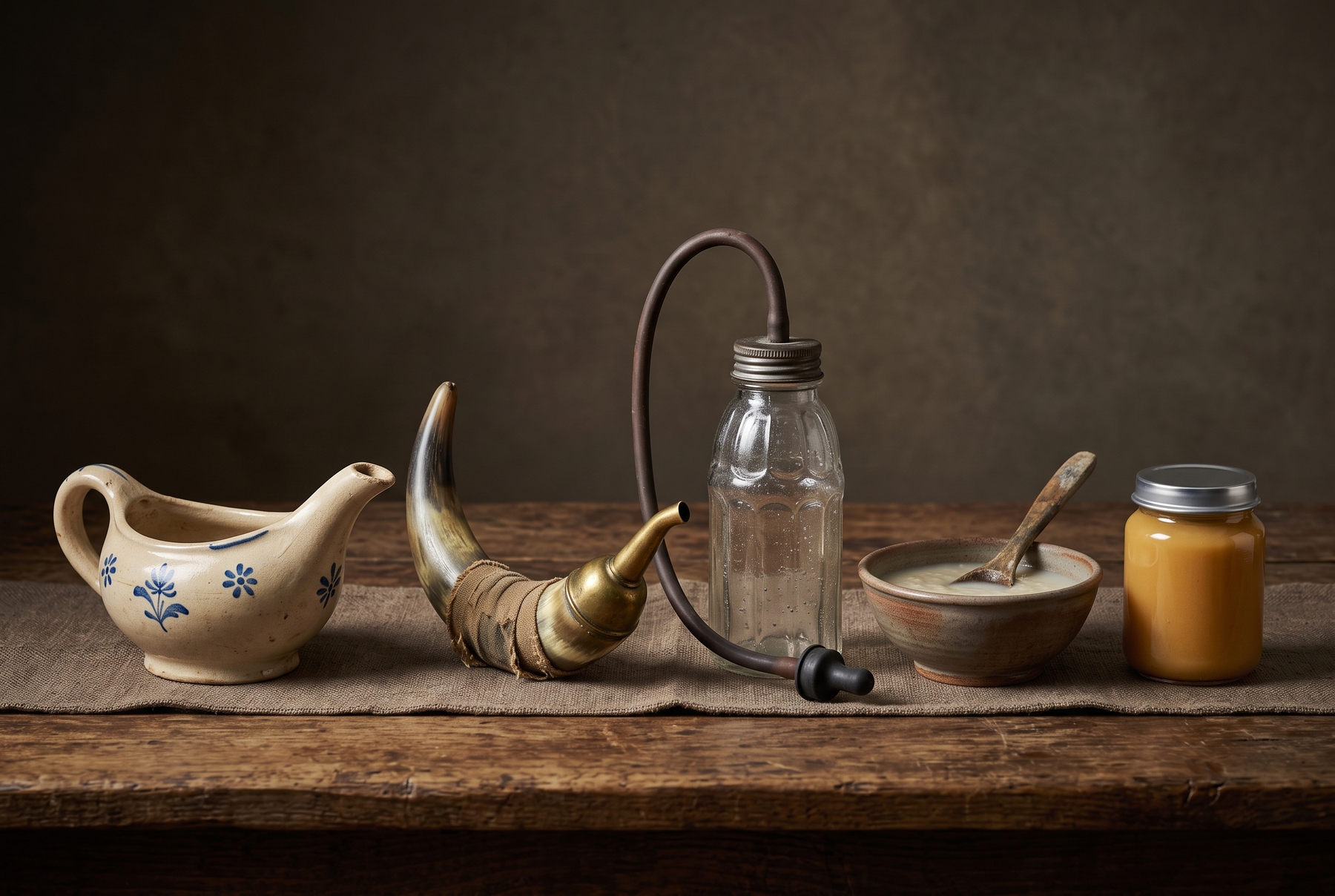
The evolution of infant feeding: from ancient clay spouts and cow horns to Victorian glass bottles and modern jarred purees.
Table of Contents
- First, the Biggest Misconception
- The Wet Nurse: History's Primary "Formula Substitute"
- When Human Milk Was Not an Option
- Beyond Milk: Infant Porridges Long Before the "No Added Sugar" Box
- Before the Modern Baby Bottle
- Why Historical "Homemade Formula" Was Deadlier Than It Looked on Paper
- Rich Babies and Poor Babies Ate Differently
- The Birth of Commercial Infant Formula
- When Jarred Baby Purees Arrived
- What Sounds Surprisingly Familiar Today
First, the Biggest Misconception
A persistent myth suggests that before commercial jars existed, families simply pulled babies up to the communal table and fed them whatever the adults were eating. That is untrue. For most of human history, human breast milk remained an infant’s primary nourishment. While commercial baby food arrived relatively late on the scene, caregivers were preparing dedicated meals for infants and toddlers centuries before the first factory opened.
In reality, historians look at three distinct scenarios: a mother nursing her own child, another woman nursing the child, or a complete absence or shortage of human milk.
The first scenario requires no explanation. In the second, wet nurses stepped in for centuries. The third scenario, however, gave rise to the most inventive, strange, and occasionally terrifying chapters in the history of infant nutrition.
The Wet Nurse: History’s Primary “Formula Substitute”
Today, the term “wet nurse” sounds like a character description from a costume drama. Once, it was a profession as commonplace as a nanny. For centuries, the survival of countless children rested entirely on wet nurses.
Why Wealthy Women Sent Their Babies Away to Nurse
In affluent families, having another woman breastfeed one’s child was the cultural norm rather than an emergency measure. The reasons were plentiful: lactation delayed the return of fertility (and wealthy families needed heirs), nursing clashed with rigid corsets and high-society obligations, and the act itself was widely viewed as physical labor best delegated to servants.
The practice became so widespread that in 18th-century France, a massive proportion of newborns passed through the hands of wet nurses—by several historical estimates, the majority of urban infants. Contemporaries called Paris a “city without babies” because parents routinely sent newborns into the countryside, leaving them there for months or even two to three years at a time.
Wet Nursing as Survival, Not Luxury
There was another side to this system, far less aristocratic. A mother died in childbirth. A mother fell gravely ill. Her milk failed to come in. Or a working-class woman had to return to her job immediately, lest her entire family starve. An urban factory worker at a loom could not take nursing breaks or bring an infant onto the shop floor, reducing her options to two stark choices: hire a cheap wet nurse or abandon the child to a foundling home.
Families recruited wet nurses from impoverished rural regions (such as the Morvan in Burgundy), where nursing paid better than local agricultural work. Demand grew so immense that in the second half of the 18th century, Parisian authorities consolidated private agencies into a municipal Bureau of Wet Nurses, which guaranteed women a minimum wage and monitored caretakers to ensure babies were not neglected for profit.
The Dark Side: Whose Baby Went Hungry?
Here lies the uncomfortable truth of the trade. Once a woman’s milk and time became paid commodities, her own biological infant frequently ended up last in line. While a rural mother nursed a wealthy stranger’s child for money, she often weaned her own baby onto diluted animal milk or handed the infant over to an even poorer wet nurse for a fraction of the fee.
Mortality rates among babies sent to country wet nurses were high, and the numbers inside foundling hospitals—institutions for abandoned infants—were downright catastrophic, with more than half of the wards dying before their first birthday. This does not mean mothers of the past were heartless. They operated within the rigid confines of poverty, poor sanitation, and social custom, where choices often came down to bad and worse.
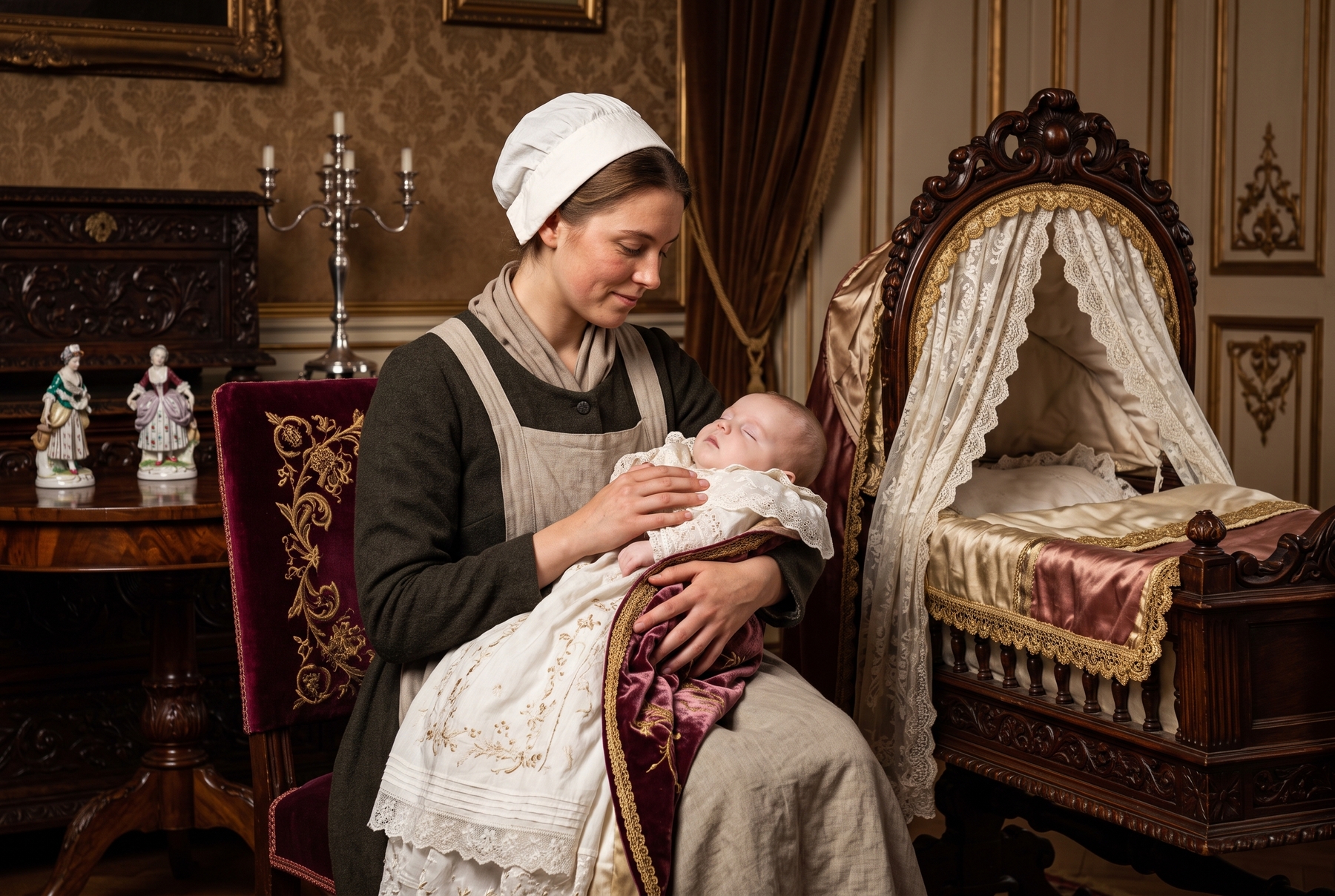
For centuries, wet nurses remained the primary alternative to a mother's milk in wealthy and urban European households.
When Human Milk Was Not an Option
Wet nurses were not always available or affordable. When human milk could not be found, caregivers began inventing breast milk substitutes long before modern chemistry existed.
Why Animal Milk Was a Poor Fit
Cow, goat, donkey, sheep: families used whatever livestock grazed nearby. Donkey milk was prized above all others because its nutritional profile is much closer to human milk than cow’s milk—a fact observant caretakers noticed centuries before laboratory analysis.
Yet a fundamental biological hurdle remained misunderstood for ages. Milk varies dramatically across species in its ratios of protein, fat, and sugar. What is ideal for a rapidly growing calf is far too heavy for a human newborn; straight cow’s milk severely overtaxes an infant’s immature kidneys. Then came the everyday logistical nightmare: getting milk into a baby before it spoiled, without refrigeration, sterilization, or proper dishwashing. In summer, fresh milk soured in transit, making a sour smell in a porous clay cup a routine hazard.
Diluting and “Improving” the Milk
Even without chemical analysis, caregivers noticed that whole cow’s milk sat heavily in a baby’s stomach. To fix this, they diluted it with water, sweetened it, and frequently mixed in grain broths or boiled bread to make the liquid thicker and more filling. By the logic of the era, it made sense: watering the milk down seemed to make it gentler on digestion, while bread or grain restored its heartiness. The tragedy was that nobody knew about vitamins, minerals, or true caloric density, meaning these “improved” concoctions were often simultaneously nutrient-poor and bacterially lethal.
Nursing Directly from the Udder
One historical method looks particularly startling to modern eyes: putting infants to nurse directly from animals. This was practiced especially in foundling hospitals, where wet nurses were in short supply and physicians harbored a deep fear of wet nurses transmitting syphilis—a disease they feared catching from a strange woman far more than anything a goat might carry.
In 1775, physician Alphonse Le Roy documented the system at a foundling hospital in Aix: goats walked straight into the ward, each animal locating its assigned infant, nudging the swaddling clothes aside with its horns, and standing straddled over the crib so the baby could suckle. In Madrid in 1799, a committee of noblewomen overseeing a local foundling home spent over a decade conducting meticulous trials with milk substitutes: goat’s milk, goat’s milk infused with fennel, and donkey’s milk nursed straight from the animal. They kept neat, detailed records. Almost all the infants died.

In foundling hospitals and poor households, infants were sometimes nursed directly from goats or donkeys in place of wet nurses.
Beyond Milk: Infant Porridges Long Before the “No Added Sugar” Box
Milk was rarely the only thing entering an infant’s mouth. Dedicated semi-solid foods for young babies have existed for centuries, though they looked very different from today’s purees.
Pap, Panada, and Gruel
Across Europe, these early mushy foods went by different names, even if the recipes blurred together. In Britain, caregivers relied on pap—bread or flour soaked or boiled in water or milk—alongside gruel, a thin porridge made from oats, barley, or other grains. In France, cooks prepared panade (panada), made by simmering bread for a long time in water or broth, sometimes enriched with milk, butter, or egg; similar bread soups under cognate names appeared across Italy and Spain.
In rural Russia, peasant families had their own variation: a baby was often given a soska or zhovka—a piece of rye bread pre-chewed by the mother, sometimes mixed with porridge, and tied inside a linen rag for the infant to suck on like a pacifier. Slightly older babies received thin grain porridges and cow’s milk, frequently fed through a hollowed-out cow’s horn fitted with a stitched leather teat.
Why Bread and Grain Dominated
Bread and grain were universal, shelf-stable, and cheap. They could be thinned to any consistency, required no teeth to swallow, and were easily whipped up from whatever already sat on the family table. The danger was timing: newborns were often given these starchy mixtures far too early, long before their digestive tracts produced the enzymes needed to break them down.
The age at which families introduced supplemental foods varied wildly: in some regions, babies tasted soft mush within days or weeks of birth, while in others, mothers waited nearly a year. History offers no single traditional timeline; everything depended on the century, country, family income, and whether a lactating woman was available.
Against this backdrop, the modern parenting debate over whether to start with rice or buckwheat cereal looks remarkably peaceful. Centuries ago, the culinary fork in the road was much starker: whether to soak stale bread in milk or plain water.
Before the Modern Baby Bottle
Another puzzle was mechanics: how to get liquid food into a baby. Infant feeding vessels are far older than most people realize. Archaeologists have unearthed spouted clay feeding cups from Neolithic sites, and ceramic “baby bottles” from the Bronze and Iron Ages—sometimes shaped like whimsical little animals with horns and tiny feet—appear across Europe.
In 2019, a team led by Julie Dunne at the University of Bristol published a landmark study in the journal Nature analyzing residue inside tiny spouted vessels found in infant graves in Bavaria. Chemical analysis revealed fatty acids from ruminant milk—meaning cow, goat, or sheep milk. The earliest similar vessels date back roughly 7,000 years. Researchers estimate that up to a third of children in Bronze Age Europe did not survive to adulthood, and the milk traces inside these clay cups show exactly how families tried to nourish them.
Later eras brought polished cow horns, pewter and glass flasks, and porcelain pap boats shaped like gravy boats. Then, in the 19th century, a new invention swept Britain and the United States: a glass bottle fitted with a long flexible rubber tube ending in a nipple. Manufacturers molded the glass into playful banjo or turtle shapes so the bottle would lie flat. The design was seductively convenient, allowing a baby to self-feed while a mother did housework. Unfortunately, that long tube proved almost impossible to clean.
The Deadliest Flaw Was Not the Recipe
The narrow rubber tubing could not be scrubbed out. Milk trapped inside soured, soaking deep into the porous rubber where no bristle brush could reach. Worse still, a popular domestic manual of the era advised mothers not to remove the nipple for two to three weeks at a time so the rubber wouldn’t tear, turning the tube into a warm incubator for lethal bacteria, especially in summer.
Physicians quickly connected these contraptions to deadly outbreaks of infant diarrhea, dubbing them “murder bottles” in the English-language press. In 1897, authorities in Buffalo, New York, became the first to ban long-tube feeders, yet they continued selling briskly until the 1920s. Contemporary observers claimed only two out of ten infants fed with these bottles survived to their second birthday, though modern historians note that poor water quality and unpasteurized milk shared much of the blame.
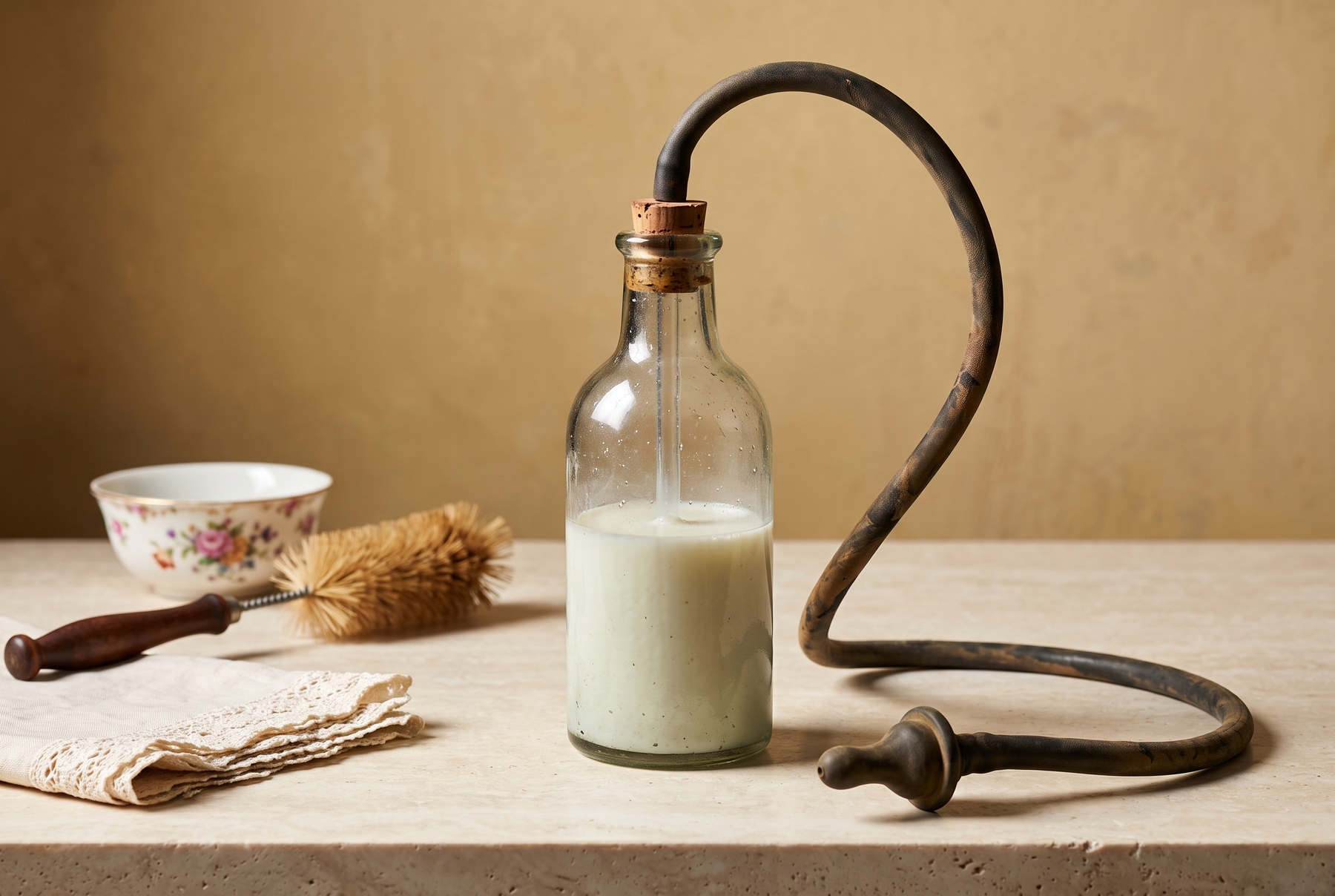
Bottles with long rubber tubes were nearly impossible to clean properly, earning them the grim nickname "murder bottles" from physicians.
Why Historical “Homemade Formula” Was Deadlier Than It Looked on Paper
The recipe itself was only half the hazard.
Without refrigeration, milk spoiled within hours, was frequently diluted with contaminated well or river water, and went into vessels that could not be properly sanitized. Solids began far too early, measurements changed by guesswork with every batch, and medical science knew almost nothing about an infant’s baseline needs for protein, fat, vitamins, or calories.
Parents could spend hours lovingly preparing a baby’s meal while remaining completely blind to microbial risks that are common knowledge today. Nutrition did not exist in a vacuum: infections, lack of sanitation, rudimentary medicine, overcrowded housing, and grinding poverty all compounded the danger. The exact same panada recipe prepared in a clean, wealthy kitchen and in a damp tenement cellar produced tragically different outcomes.
Rich Babies and Poor Babies Ate Differently
These daily details split infant survival into two vastly different worlds. A household with money had access to a live-in wet nurse, fresh milk from a nearby dairy, easy-to-clean porcelain dishes, and, later on, commercial formulas and a doctor’s advice. In a poor family, a mother had to rush back to work, food was scarce, and clean water or cold storage simply did not exist. The nutritional divide between these two babies opened during the very first weeks of life.
The Industrial City Changes the Rules
Rapid urbanization upended everything. When women entered factories in massive numbers, breastfeeding on demand became physically impossible, while the traditional village support network of grandmothers and neighbors was left behind in the countryside. The more women worked industrial shifts, the more desperate the need became for a shelf-stable milk substitute that could simply be bought at a shop.
The Birth of Commercial Infant Formula
By the mid-19th century, scientists made the first industrial attempts to engineer a breast milk substitute—the direct ancestor of modern infant formula. In 1865, German chemist Justus von Liebig developed and marketed the world’s first commercial formula: a liquid—and later powdered—mixture of wheat flour, malted barley flour, cow’s milk, and potassium bicarbonate. The malt was a stroke of biochemical genius; its enzymes broke heavy starches down into digestible sugars that an infant’s immature stomach could handle. By 1867, Liebig’s formula was an international success.
Almost immediately, in that same year of 1867, a Swiss pharmacist named Henri Nestlé in Vevey launched his Farine Lactée (Milk Flour), made from cow’s milk, toasted wheat flour, and sugar. Because it cost less than Liebig’s mix and required only water to prepare, it quickly gained a massive following. The true revolution lay not in the ingredients themselves, which echoed traditional pap, but in standardization: a uniform, shelf-stable factory product replacing unpredictable kitchen improvisation.
Condensed, Evaporated, and Powdered
At the same time, food technologists figured out how to preserve the most perishable ingredient of all: milk. Gail Borden patented sweetened condensed milk in 1856; doctors valued its bacterial safety, even though the massive sugar content made it nutritionally lopsided for babies. In the 1880s, unsweetened evaporated milk arrived, heat-sterilized inside sealed tin cans. By the 1920s and 1930s, evaporated milk mixed with water and corn syrup became the standard pediatric formula across North America, paired with daily doses of orange juice and cod liver oil to prevent scurvy and rickets.
The Bottle Grows Up
Although the vulcanized rubber nipple was patented back in 1845, safe bottle feeding required a convergence of breakthroughs: pasteurization (whose principles Louis Pasteur outlined in the 1860s), germ theory, and wide-necked glass bottles that could be fully disassembled, boiled, and scrubbed without any lethal tubing. Improved urban milk hygiene between 1875 and 1925 drove a dramatic drop in infant mortality. No single invention separated the dangerous past from the safe present overnight; the transition took decades.
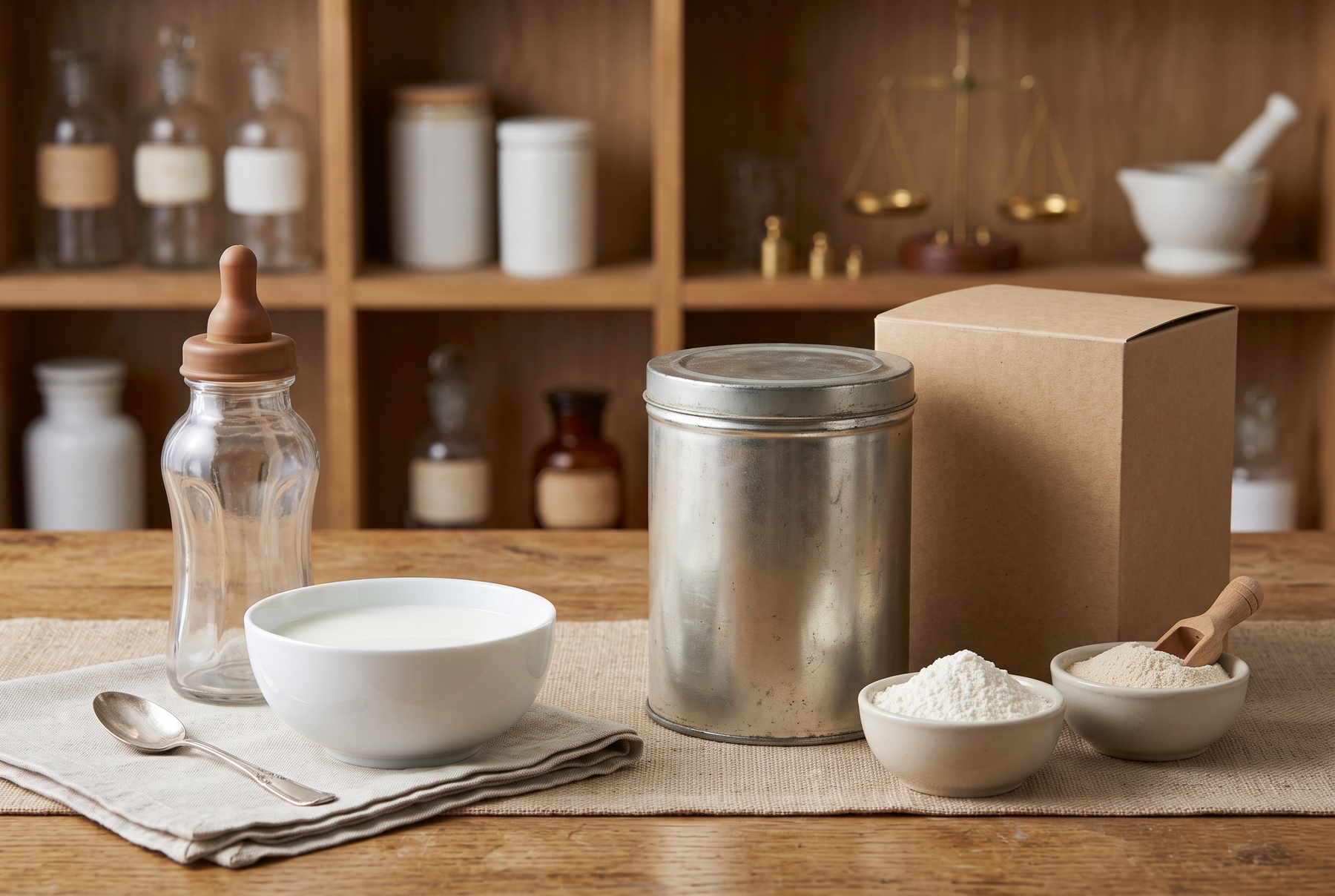
The arrival of Liebig's and Nestlé's powdered formulas in the 19th century ushered in the era of standardized, safer infant nutrition.
When Jarred Baby Purees Arrived
Ready-made baby puree in a glass jar—which feels like an eternal fixture of parenthood—is actually nearly 60 years younger than infant formula. In the early 1920s, a Rochester, New York, father named Harold Clapp brewed a restorative soup of broth, vegetables, and grains for his sick child, eventually selling strained foods through local pharmacies. Then, in 1927, Dorothy Gerber, exhausted from hand-straining peas for her seven-month-old daughter, suggested to her husband Dan that his family’s Michigan canning factory could do the job mechanically. By 1928, Gerber’s strained fruits and vegetables were on store shelves, and by the mid-1930s, families were buying millions of tins and jars a year.
Success came down to more than canning technology. Mass production, safe sterilization, standardized nutrition, growing trust in pediatricians, and the rise of the modern urban nuclear family all converged at once, replacing hours of kitchen straining with a uniform, labeled jar.
What Sounds Surprisingly Familiar Today
Strip away the historical horrors of unwashed rubber tubes and spoiled milk, and much of the old menu looks remarkably familiar. Thin grain gruel is the direct ancestor of modern boxed baby cereal; hand-mashed kitchen scraps gave way to jarred purees. Parents today are still searching for foods soft enough for toothless gums and wondering whether their baby is getting enough to eat.
Having made the journey from the first spoonful of puree to school lunchboxes three times myself—surviving the Great Broccoli Wars and phases where only plain pasta was deemed acceptable—I can confirm that this specific parental anxiety binds us to a Bronze Age mother holding a clay feeding cup far more tightly than we might think.
To bring the timeline fully into the present, modern consensus from global health authorities like the World Health Organization recommends exclusive breastfeeding for roughly the first six months of life followed by safe complementary foods—a luxury of medical knowledge and food safety that took millennia to achieve.
0 comments