
Different cultures transform the exact same cut of pork—subcutaneous fat—into remarkably distinct culinary creations.
At a market in a Ukrainian city, a slab of pork fat three fingers thick sits rubbed with coarse salt and garlic, releasing an aroma powerful enough to overwhelm the neighboring herb stall. In the village of Colonnata, perched above the marble quarries of Carrara, artisans pull a piece from the same part of the pig out of a marble basin after six months of aging, brush off the rosemary, and slice it until it turns nearly translucent; it commands the price of fine cheese. In Hungary, cooks skewer the fat and hold it over glowing embers until the rendering drops soak into a slice of onion-topped bread. Meanwhile, in an American can of baked beans, a pale cube floats solely as a seasoning, with no one intending to eat it on its own.
Can a single word truly capture all of these traditions?
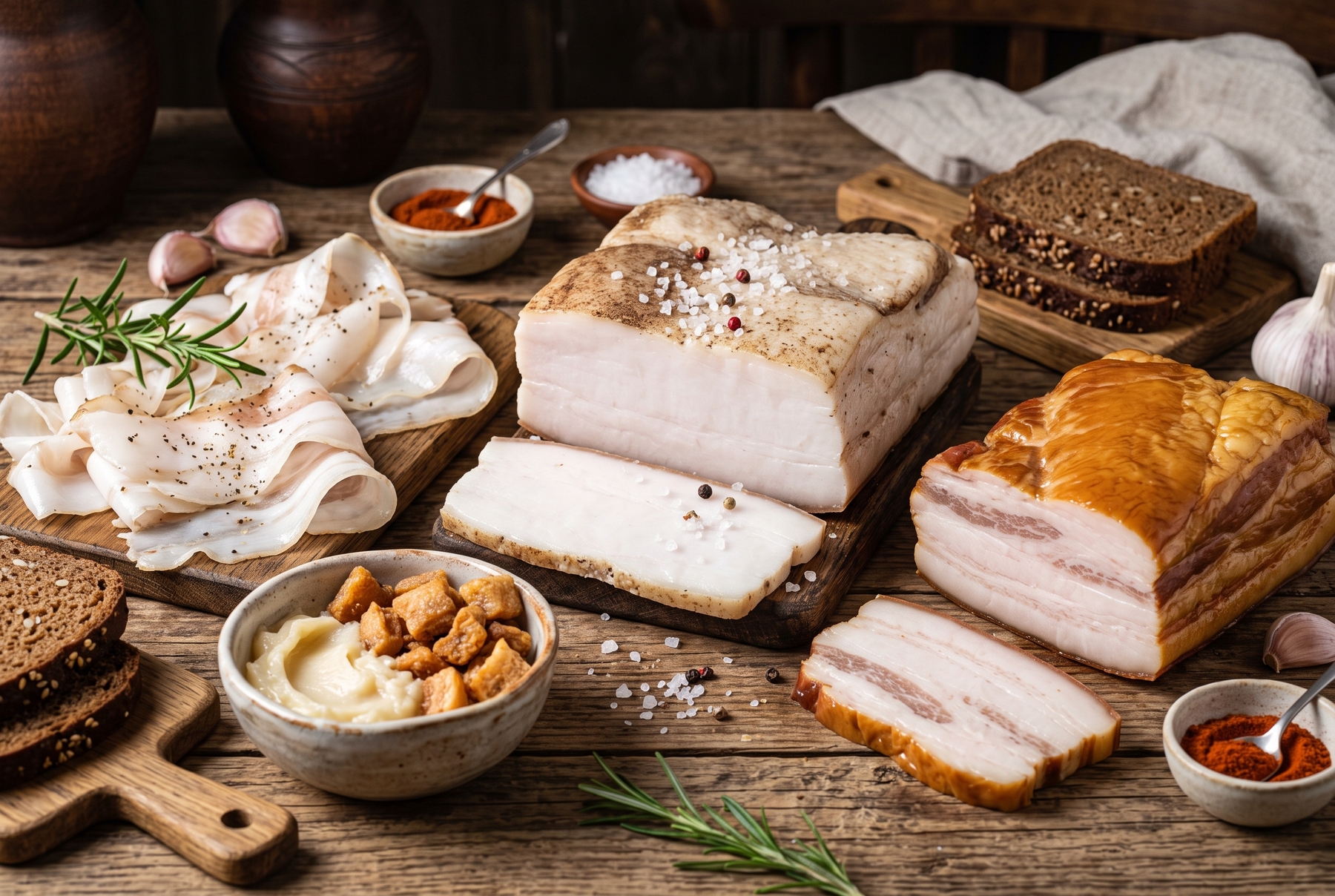
Pork fat across world cuisines: from classic salted salo and smoked belly to aged Italian lardo and rendered lard spreads.
Table of Contents
- What Is Salo and How Different Countries Define It
- Why Pork Fat Became a Strategic Staple
- Ukraine: Salo as a Standalone Dish
- Poland: Słonina and Smalec—Two Destinies for One Cut
- Hungary: Szalonna, Smoke, and Paprika
- The Balkans: One Word, a Dozen Products
- Italy: Lardo—When Pork Fat Becomes a Delicacy
- The Alps: Where Salo Ends and Speck Begins
- Spain: Tocino as a Kitchen Workhorse
- The United States: Fatback, Salt Pork, and Fat as Seasoning
- China: Fat as a Medium, Not a Dish
- How Salt, Smoke, and Time Transform Pork Fat
- How to Host a Comparative Tasting at Home
- How to Choose Quality Salo at the Market
- Salo and Nutrition: Separating Fact from Folklore
- A 4-Step Tasting Flight for the Curious
What Is Salo and How Different Countries Define It
In everyday Slavic usage, the word “salo” refers to three distinct concepts at once.
Anatomically, it describes dense subcutaneous pork fat: thick along the back, thinner down the sides, and streaked with muscle closer to the belly. Culinarily, it denotes a salt-cured product served cold. Colloquially, people often use the word to describe any pork fat at all, including rendered lard.
Once geography enters the picture, even dictionaries fall short.
Italian lardo indeed refers to back fat, yet it specifically describes a long-aged, spice-cured delicacy rather than a quick home cure. English fatback comes closest to the raw material: a plain slab of unprocessed back fat. Salt pork represents a finished product, most often cut from the belly. Polish słonina and Balkan slanina share a linguistic root, yet in Serbia, “slanina” can mean either nearly pure white fat or a heavily streaked slab of meaty belly. Hungarian szalonna acts as an umbrella term covering a dozen distinct products made through various techniques. Spanish tocino signifies a piece of stewing fat in one region and what English speakers call bacon in another. And German Speck should never be translated simply as “salo”—for reasons explained below.
Throughout this exploration, the same core forms appear repeatedly. Sometimes it takes the shape of raw whole fat or a meat-streaked cut; elsewhere, it transforms into a salted, aged, or smoked delicacy; and everywhere, cooks render it down into pure fat—known variously as Eastern European smalets, English lard, Serbian mast, Hungarian zsír, or French saindoux.
These foundational forms echo from country to country, yet each culture brings its own distinct priority to the forefront.
Why Pork Fat Became a Strategic Staple
Historically, everything came down to food preservation.
On a peasant farm, pigs grew quickly, ate almost anything, and yielded far too much meat at slaughter for a single family to consume fresh. Raw meat spoils within days. Fat removed from the carcass and buried in salt lasts for months. Pure rendered pork fat delivers roughly 902 kcal per 100 g (3.5 oz)—packing an immense amount of energy into a compact volume.
Local conditions shaped the next steps. In cold, damp climates, smoke and attic rafters aided preservation. In dry, windy regions, salt and a steady breeze sufficed. Where salt cost a fortune, people rationed it and compensated with heavy smoking. Where nearby seas provided cheap marine salt, cures grew generous. Divergent traditions emerged directly from these practical realities rather than from some romanticized, unified ancient history invented in hindsight.
Markets around the world consistently reveal a striking divide: pork fat products highlight the gap between a country’s tourist-facing cuisine and what locals actually eat at home. Restaurant menus hide the fat. Open-air markets display it proudly in prime counter space, sold by vendors who know their regular buyers by face.
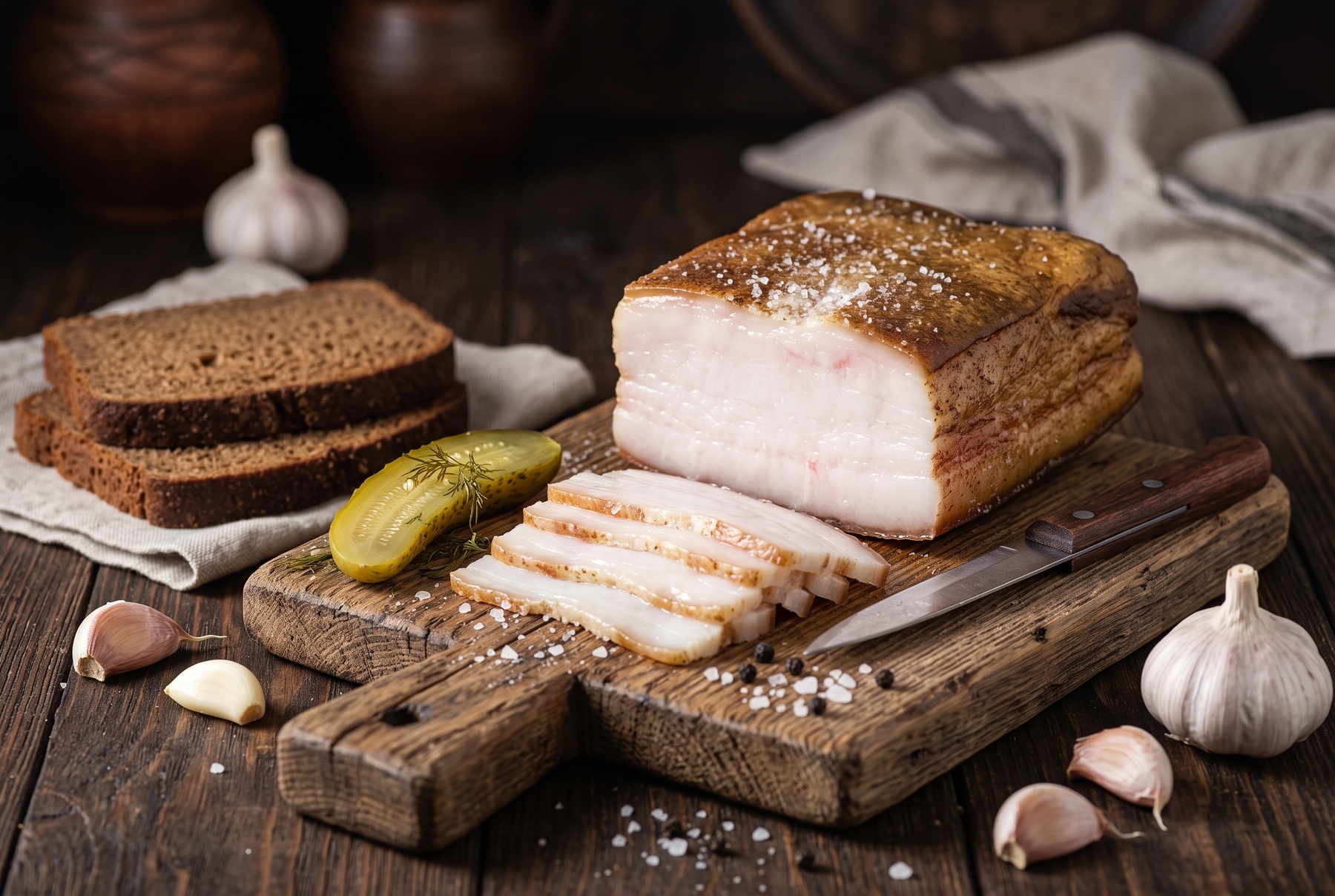
Classic dry-cured salo rubbed with garlic and black pepper, sliced thin and served alongside dark rye bread.
Ukraine: Salo as a Standalone Dish
The Ukrainian tradition stands apart primarily because of the status elevated upon the product itself.
In most culinary traditions, pork fat serves as a kitchen tool: cooks fry with it, lard lean roasts with it, or grind it into sausages. In Ukraine, it stepped out of a supporting role to become a centerpiece dish, served on its own and sliced at the table in front of guests. Salo has long stood alongside borscht and varenyky (stuffed dumplings) among the most recognizable Ukrainian foods, and since 2015, enthusiasts have even celebrated an unofficial Ukrainian Salo Day on August 27.
Technically, dry curing remains the most common method. Makers rub a slab of back or side fat generously with coarse salt: pure fat absorbs only as much salt as it needs, making it nearly impossible to oversalt in the traditional sense. Cooks press sliced garlic into slits cut into the fat or rub it over the surface as a paste, followed by coarsely ground black pepper, bay leaves, and occasionally coriander or paprika. After salting, the slab rests in a cool place for several days—with or without a pressing weight—before moving to the refrigerator or freezer.
Introducing smoke turns that exact same cut into a noticeably different product.
The distinction between pure white salo and a slab streaked with meat (often called pidcherevyna, from the belly) is fundamental. Pure fat feels softer and more pliable, melting on the tongue at body temperature. Meat streaks require chewing and contribute a savory, porky flavor, though they also introduce specific food safety considerations.
Even the traditional accompaniments for salo shift from household to household. Rye bread, raw garlic, onions, sour pickles, mustard, and horseradish form the classic lineup, yet each family assembles them differently, and swapping mustard for horseradish changes the entire experience. Some eat it alongside boiled potatoes, others pair it with sauerkraut, and many enjoy it completely plain.
Evaluating the quality of salo works best when the product is cold, for good reason. Chilled fat cannot hide flaws: the color (pure white or faintly blush-pink, completely free of yellowing), the resistance under the knife, and the aroma all reveal themselves immediately. Well-made salo smells of garlic, spices, and clean, fresh pork fat. Any hint of rancid nuts or stale oil means the fat has oxidized, and no amount of spice can salvage it.
Poland: Słonina and Smalec—Two Destinies for One Cut
Polish cuisine clearly illustrates how a single raw ingredient diverges along two distinct technological paths.
Słonina refers to whole subcutaneous fat, which cooks can salt and eat much like Ukrainian salo, or treat as a raw material for rendering. Smalec is the rendered result: finely diced fat slowly melted down over low heat.
The rendering process requires patience, taking 30 to 40 minutes over a gentle flame, sometimes starting with a couple of tablespoons of water in the pot to prevent scorching. As the fat melts, the solid bits shrink, turn golden, and crisp up into skwarki (cracklings). Next, chopped onions, grated tart apple, garlic, and marjoram join the pot. Timing matters immensely here: onions go in 10 to 15 minutes before the end, apple at the 5-to-7-minute mark, and garlic and marjoram at the very end or after removing the pot from the heat—otherwise the garlic turns bitter and the marjoram loses half its fragrance.
Many Polish recipes blend plain słonina with smoked bacon (boczek) or jowl fat: the pure back fat provides a smooth, spreadable base, while the smoked cuts contribute depth and character.
Placing both products side by side makes the contrast unmistakable. A slice of salted słonina feels cold and firm, resisting the bite for half a second before yielding. Smalec from the very same pig spreads softly across bread, leaves a matte trail on the knife, and smells richly of caramelized onion. A tart fermented pickle pairs effortlessly with both.
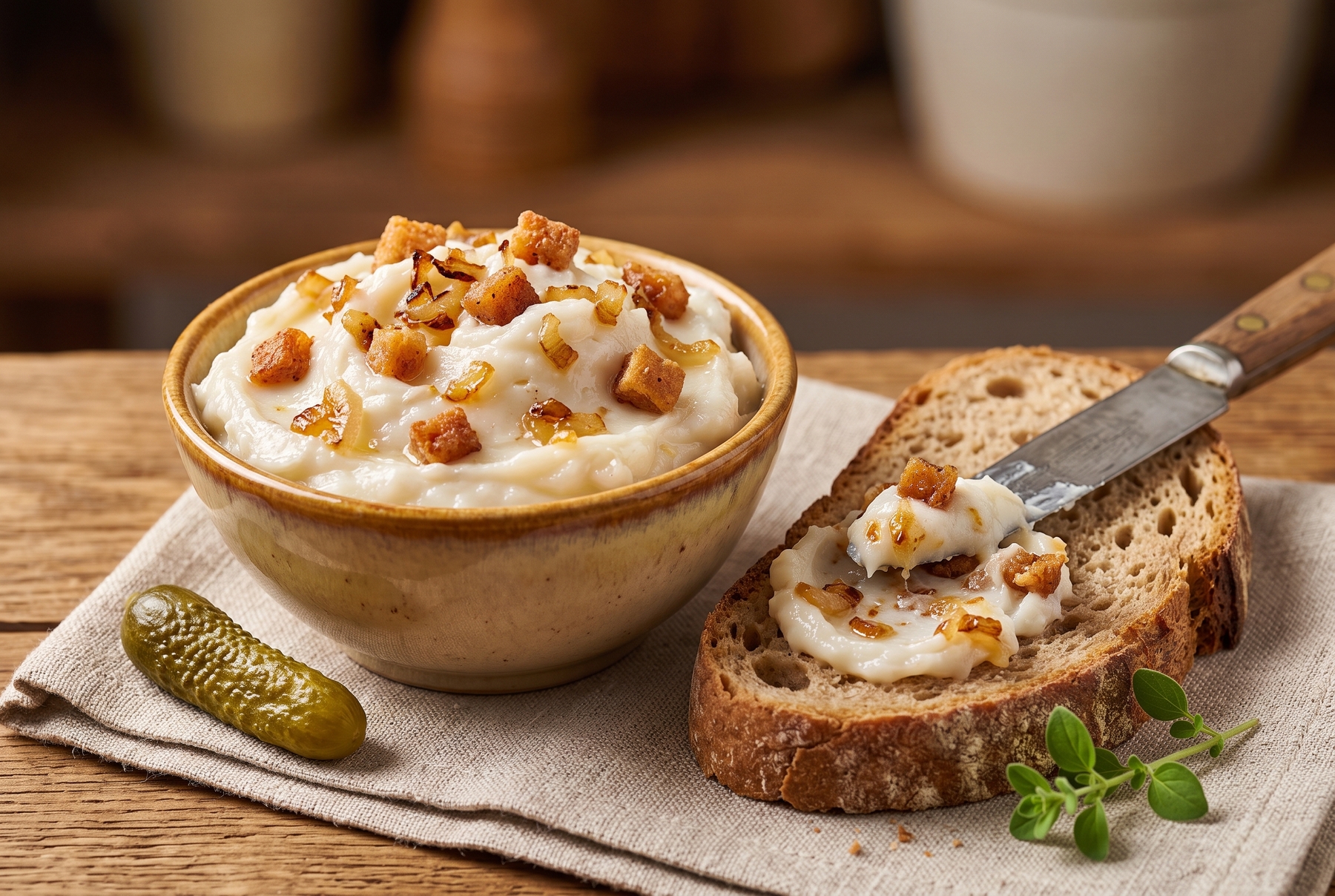
Slow-rendered smalec studded with crispy cracklings, caramelized onion, and marjoram—a classic Polish tavern spread.
Hungary: Szalonna, Smoke, and Paprika
The Hungarian word szalonna often confuses outsiders because it describes an entire family of cured pork fats rather than a single item.
The primary varieties of szalonna differ by anatomical cut and curing method. Kolozsvári szalonna comes from the meat-streaked side, salted and smoked. Abált szalonna simmers in salted water with garlic before getting rolled in sweet or hot paprika and served cold. Hátszalonna consists of dense, pure back fat, cured with salt and smoke.
Cooking over an open fire represents a distinct cultural ritual in Hungary, known as szalonnasütés. Participants score a chunk of fat in a crosshatch pattern, impale it on a long iron skewer, and hold it over glowing coals. As the fat bubbles, sizzles, and drips, diners catch the rendering drops on thick slices of white bread until the crumb soaks through. Rings of raw onion and fresh peppers go on top. Ultimately, the fat-soaked bread becomes the true star of the meal.
Smoking fundamentally transforms the ingredient here: identical slabs of back fat subjected to simple salting versus cold smoking diverge completely in both flavor and presentation. In the former Soviet food standards (GOST), the smoked, paprika-rubbed style even earned its own official designation as “Hungarian Shpik.”
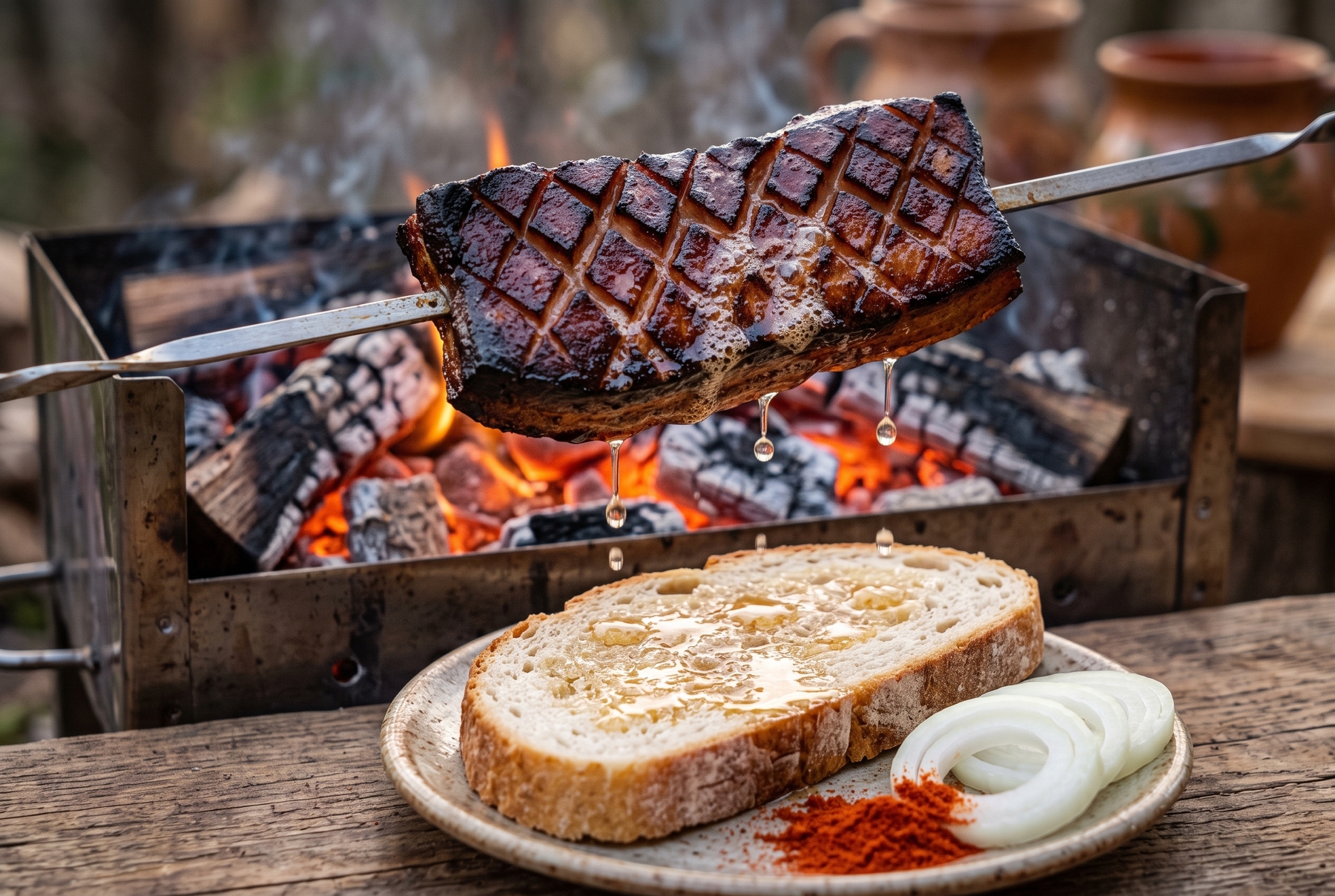
A traditional Hungarian campfire ritual: scoring szalonna and roasting it over glowing embers while catching the rendered fat on bread.
The Balkans: One Word, a Dozen Products
Serbia, Croatia, Slovenia, Bosnia, and Bulgaria share deep rural traditions, yet their specific curing techniques vary widely. One late-autumn ritual unites them all: the village pig slaughter, where families process nearly every part of the carcass and preserve the bounty for winter.
Balkan slanina appears smoked, paprika-crusted, meat-streaked, air-dried, or boiled. In Serbia’s Vojvodina province, makers salt Sremska slanina for an extended period before air-drying and cold-smoking it. Simultaneously, almost every household renders fat into mast (lard) and presses the crispy cracklings into čvarci.
In Slovenia, several regional specialties hold protected geographical status. Kraška panceta cures in sea salt before drying in the mineral-rich winds of the Karst plateau. For Prleška tünka, artisans pack cured pork loin into wooden tubs and seal it under layers of zaseka—minced, seasoned back fat that acts as both a flavorful spread and an airtight preservative.
Understanding the Balkan approach requires tasting just three items: a smoky Sremska slanina, a wind-dried Kraška panceta, and a rustic homemade spread based on minced or rendered fat. Three distinct culinary logics, all from a single pig.
Italy: Lardo—When Pork Fat Becomes a Delicacy
Italian lardo elevates the concept entirely: here, artisans market cured pork fat as a high-end charcuterie delicacy.
Lardo di Colonnata (which holds Protected Geographical Indication, or IGP, status) originates in the mountain village of Colonnata near Carrara, using fresh back fat. Producers layer the slabs into basins carved from local Carrara marble, rubbing them with sea salt, freshly cracked black pepper, rosemary, and garlic, plus spices like cinnamon, nutmeg, and cloves. Capped with a heavy marble slab, the fat cures for a minimum of six months. During this time, the salt draws out moisture to form a natural, aromatic brine inside the cool stone. The interplay of long aging, salt, herbs, and the unique microclimate of the marble basins defines the character of the finished product.
The Aosta Valley takes a different approach. Valle d’Aosta Lard d’Arnad (holding Protected Designation of Origin, or DOP, status) cures inside fitted chestnut or oak vats called doils, submerged in a boiled brine of salt, water, garlic, rosemary, bay leaf, and mountain herbs. The minimum aging period spans 90 days, though maturation often stretches much longer. Consequently, despite starting with similar raw back fat, the wooden vessels and liquid brine yield a noticeably different aroma and texture than Colonnata’s marble cure.
Fine lardo offers a sensory experience worlds apart from everyday salted salo. Sliced paper-thin until nearly translucent, it shines when served slightly warmed: draped over toasted bread, the edges begin to turn clear and melt, releasing waves of rosemary and warm spice. Served straight from the refrigerator, those volatile aromas remain locked away. After just a few slices, the palate coats with richness, making the subtlest herbal notes harder to detect.
This creates a fascinating visual paradox. On a photograph, a plate of lardo looks monastic in its simplicity: white fat, plain bread, nothing more. Yet in terms of aromatic complexity on a charcuterie board, it effortlessly outshines the neighbouring sausages, aged cheeses, and cured hams.
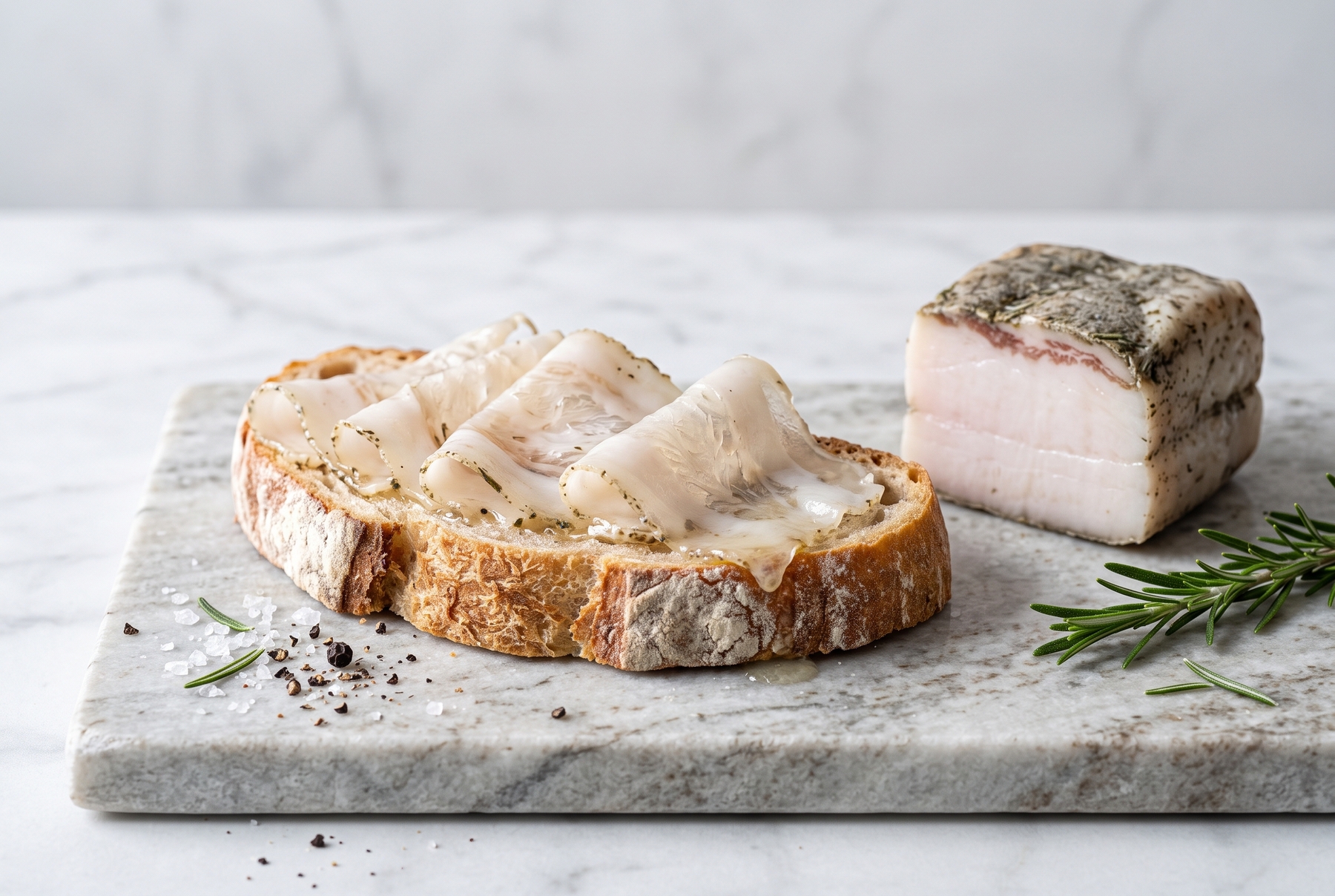
Lardo di Colonnata cures in marble basins with herbs and spices for at least six months, melting slightly over warm bread.
The Alps: Where Salo Ends and Speck Begins
The German and Alpine word Speck frequently trips up travelers from Eastern Europe: because it sounds identical to the Russian word shpik (cured back fat), visitors often order something entirely unexpected.
South Tyrolean Speck (Speck Alto Adige IGP) comes from the deboned hind leg of the pig—the ham—rather than subcutaneous back fat. Producers season the meat with juniper and herbs, lightly cold-smoke it, and age it in the mountain air for months. Ordering “speck” in Bolzano therefore brings a platter of ruby-red, dry-cured ham edged with a strip of fat, rather than white salo.
Pure pork fat certainly exists in the Alps, just under different names. In Austria, especially in Styria, cooks prepare Verhackertes: finely minced smoked back fat blended with garlic and spices, sometimes smoothed out with lard, and spread thickly onto dark rye bread. Austrian taverns also serve Grammelschmalz—rendered lard studded with crisp cracklings.
Keeping the terminology straight simply requires looking at the tissue structure. A solid muscle cut belongs to the ham family. Alternating layers of fat and meat point to the belly and bacon family. Only when the slab consists of nearly pure, uninterrupted white fat are we truly talking about salo.
Spain: Tocino as a Kitchen Workhorse
Approaching Spanish tocino requires attention to local context, as the term shifts meaning even within Spain’s borders.
Some Spanish butchers define tocino strictly as firm subcutaneous back fat, while others include the fatty lower flank of the belly. One trait unites them: the cut consists overwhelmingly of fat with minimal muscle, sold either fresh or heavily salted.
Across the Iberian Peninsula, tocino performs a foundational, utilitarian role. Cooks drop chunks of it into simmering pots of cocido (chickpea and meat stew) and potaje (hearty bean soup) to give the broth body, velvety mouthfeel, and rich depth; for this reason, it rarely appears alone on a tapas plate. The prized Ibérico pig adds another dimension: thanks to an acorn-rich diet, its fat contains a remarkably high concentration of oleic acid, making it softer on the cutting board and allowing Ibérico tocino to melt into stews far more luxuriously than fat from standard white pigs.
Travelers should keep two linguistic quirks in mind. In Mexico and much of Latin America, the word tocino refers simply to smoked streaky bacon. Meanwhile, the beloved Spanish dish tocino de cielo (“heavenly bacon”) contains no pork whatsoever: nuns in Andalusia created this rich, glossy caramel flan from egg yolks and sugar syrup, naming it purely for its dense, translucent resemblance to cured fat.
The United States: Fatback, Salt Pork, and Fat as Seasoning
The American culinary tradition stands out for having almost entirely abandoned the practice of eating cured pork fat cold on bread.
Fatback refers literally to the raw cut: an unadorned slab of hard back fat. American cooks render it into snowy lard for flaky pie crusts, slice it thin to bard lean roasts and game birds, or grind it into venison and pork sausages for juiciness.
Salt pork represents a preserved ingredient: fat cured aggressively in salt, most commonly cut from the lower, fattiest part of the belly, and less frequently from the back. The crucial distinction between salt pork and bacon lies in the smokehouse. Bacon undergoes curing and smoking; salt pork receives only a heavy salt cure, making it significantly saltier. Cooks often blanch salt pork in boiling water before using it to draw out excess salinity.
In the American kitchen, salt pork acts strictly as a flavor catalyst. A diced slab goes into the Dutch oven for Boston baked beans, simmers for hours in a pot of Southern collard greens, or renders at the base of a New England clam chowder. As the fat melts, it carries savory flavors throughout the dish, while any small streaks of meat season the cooking liquid. In the American South, a variation containing a wider ribbon of meat goes by the name streak o’ lean, which cooks slice thicker than bacon and fry crisp for breakfast.
Rigid definitions rarely apply here: commercial meatpacking labels and regional heirloom recipes overlap, meaning the exact same cut might wear three different names across three different states.
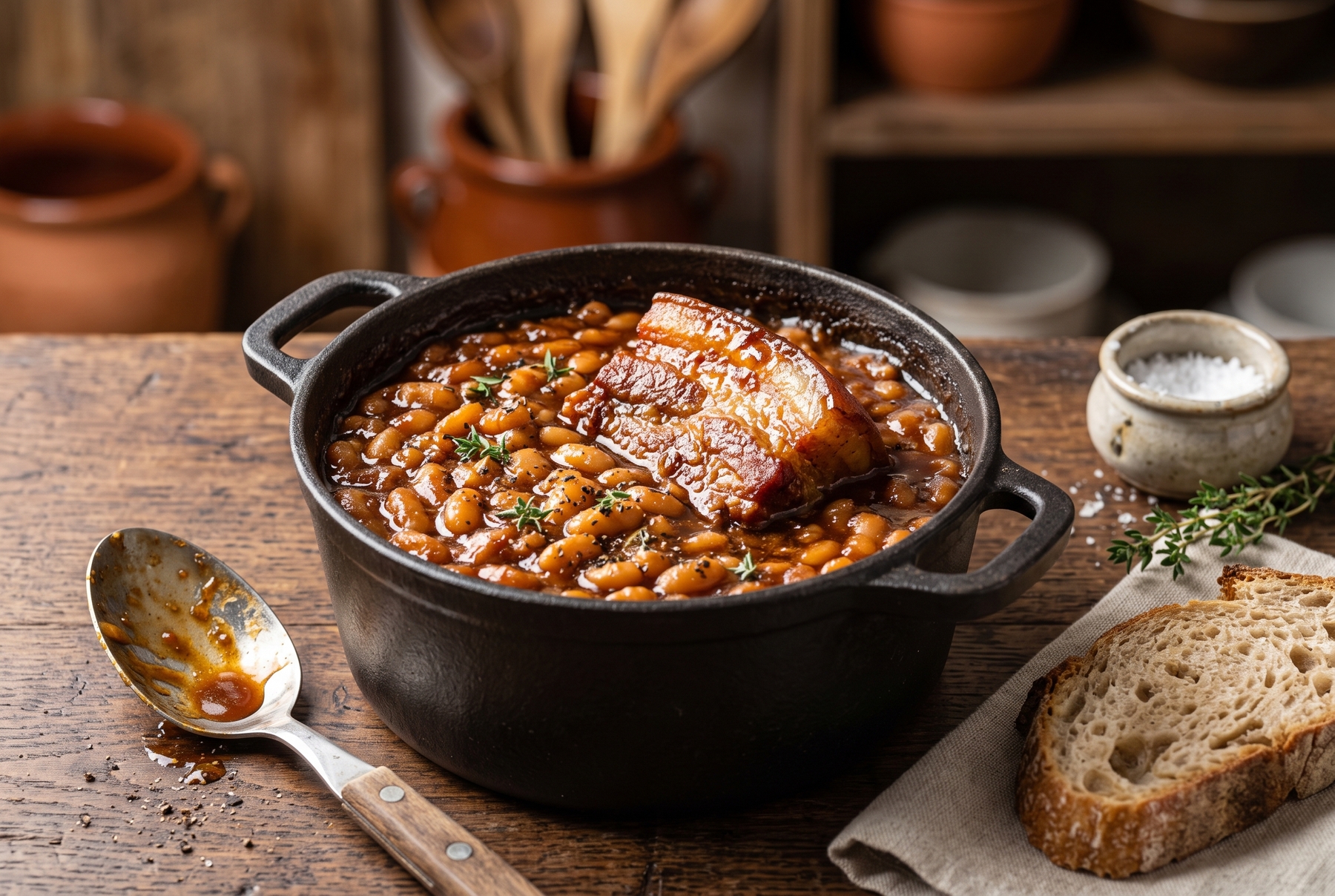
In American cooking, salt pork and fatback serve as a rich, savory seasoning base for braised beans and greens.
China: Fat as a Medium, Not a Dish
East Asian cuisines approach pork fat from a completely different angle.
While pork fat plays a monumental role in Chinese cooking, the concept of slicing cold, salted fat as an appetizer scarcely exists. Instead, the kitchen relies on zhūyóu (猪油)—rendered pork lard—which serves as an indispensable culinary medium.
Chinese cooks carefully distinguish between raw fat sources. Bǎnyóu (板油), the visceral leaf fat surrounding the kidneys, yields the purest, whitest, most neutral lard, prized for creating paper-thin, flaky layers in traditional pastries and mooncakes. Subcutaneous back and belly fat produce a more savory, aromatic lard suited for everyday stir-frying. Cooks typically render the fat using the water method: diced fat goes into a wok with a splash of cold water over low heat. As the water slowly simmers and evaporates, it gently draws out the fat without scorching or splattering, leaving behind crystal-clear oil that cools into a dense, porcelain-white paste.
Zhūyóu bàn fàn (猪油拌饭)—steaming hot rice mixed with a spoonful of lard and a splash of soy sauce—endures in cultural memory as the ultimate comfort food of leaner decades in Hong Kong, Taiwan, and southern China, when muscle meat was a luxury and fat was affordable. Today, restaurants serve it as a nostalgic delicacy: a bowl of fragrant rice topped with a melting dollop of white lard, dark soy sauce, scallions, and a scattering of crispy cracklings known as zhūyóu zhā (猪油渣).
Richly marbled pork belly in Chinese, Korean, or Japanese cooking remains pork belly—an ingredient meant for braising, roasting, or grilling—no matter how thick the fat cap grows. Similarly, seabura (背脂), the simmered pork back fat whisked or grated into rich Japanese ramen broths, serves as a textural soup enhancer. Ultimately, the exact same animal tissue evolved into a standalone cold cut in Europe while remaining a cooking medium and flavor carrier across Asia.
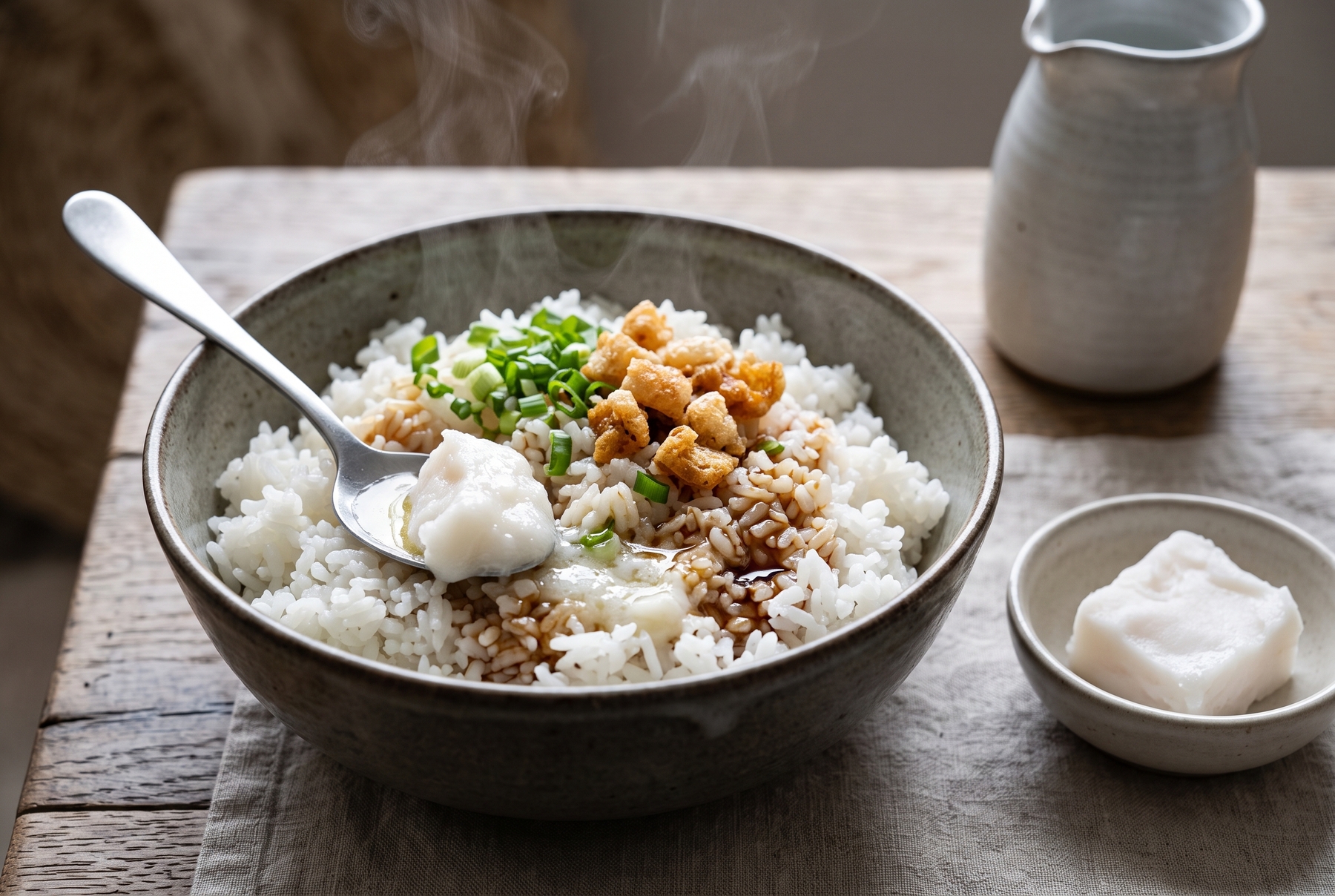
Zhuyou ban fan—a nostalgic East Asian dish of steaming rice topped with a spoonful of pork lard, soy sauce, and crispy cracklings.
How Salt, Smoke, and Time Transform Pork Fat
Dry salting draws out moisture through osmosis and compacts the cellular structure. The fat grows firmer under the knife, the flavor sharpens and cleans up, and any raw barnyard notes fade away. Thin slabs cure the fastest.
Aging introduces a dimension that simple salting cannot replicate: time for slow enzymatic breakdown and controlled lipid oxidation, which develop deep nutty, sweet, and faintly cheesy notes in long-matured fat. This biochemical evolution explains why six-month-old lardo from a marble basin smells entirely different from the same raw fat cured in a fridge for two weeks.
Smoking overhauls the aromatic profile while drying and sealing the exterior surface. Cold smoke (kept below 30 °C / 86 °F) infuses the fat gently without melting it, whereas hot smoke partially renders the outer layer, yielding a softer, more rustic texture.
Spices behave differently depending on their placement. Garlic rubbed across the exterior creates a sharp, pungent crust that hits the palate immediately. Slivers of garlic tucked deep into knife slits infuse the fat slowly and mellow out over time. A coating of paprika primarily colors the surface and leaves a sweet, earthy dust on the tongue.
Rendering destroys the cellular matrix completely: water evaporates, proteins crisp into cracklings, and the liquefied fat resets into a uniform, spreadable solid once cooled.
Melting points explain the dramatic differences in mouthfeel between cuts. Subcutaneous back fat melts between roughly 30 and 40 °C (86–104 °F), whereas visceral leaf fat melts at a significantly higher 43 to 48 °C (109–118 °F). Because the human mouth sits at about 37 °C (98.6 °F), a thin slice of back fat liquefies effortlessly on the tongue, while dense internal fat feels waxy and coats the palate.
Streaks of muscle meat introduce a critical food safety consideration. The microscopic larvae of Trichinella parasites encyst in muscle tissue rather than pure fat—meaning they hide in those exact savory ribbons of meat that make belly cuts so popular. Food safety authorities emphasize a vital rule: home salting, cold smoking, and standard domestic freezing do not reliably kill Trichinella larvae. Only thorough cooking (reaching an internal temperature of at least 71 °C / 160 °F) or rigorous veterinary inspection of the carcass guarantees safety. Practically speaking, pure white back fat carries minimal risk, whereas meat-streaked cuts intended for raw curing must come exclusively from inspected sources bearing an official veterinary stamp. Relying on sight, smell, or taste is useless, as infected meat shows no outward signs.
How to Host a Comparative Tasting at Home
The nuances separating these global traditions become unmistakable when tasted side by side. Setting up a comparative board at home requires little more than pulling the samples from the fridge in advance and slicing good bread.
- Bring the samples to the proper temperature before serving. Classic salted salo needs 10 to 15 minutes at room temperature to soften slightly; aged Italian lardo benefits from resting a bit longer or draping directly over warm toast. Smoked varieties handle cooler temperatures well, as woodsmoke aromatics register clearly even when chilled.
- Adjust your knife work to match the cut. Slice pure fat paper-thin, almost to the point of translucency. Cut meat-streaked slabs slightly thicker to give the teeth something to chew. Serve rendered spreads like smalec in a small bowl with a spreader.
- Provide a neutral foundation. Unsweetened rye bread, mild country sourdough, plain boiled potatoes, or simple flatbreads work best. Skip all condiments during the first tasting pass.
- Progress from delicate to intense: start with pure salted fat, move to garlic-and-herb-rubbed styles, follow with long-aged lardo, and finish with heavily smoked cuts. Pause between samples and cleanse the palate with plain water or unsweetened tea. Save the pickles, mustard, and horseradish for the second round, as their sharp acidity and heat quickly overwhelm subtle curing notes.
Serving cured fat straight from the freezer or refrigerator remains the most common mistake, often making an expensive artisanal product taste like nothing at all. Volatile aromatic compounds remain trapped inside rock-hard, chilled lipids and only release as the fat warms toward melting temperature.
When taking mental notes on texture, comparing the samples to everyday materials helps pinpoint the differences: notice whether a slice feels like cold candle wax, warmed modeling clay, or dense chilled butter.
How to Choose Quality Salo at the Market
Butcher counters and specialty markets often group vastly different pork fat products under a single generic label, making it worthwhile to know what to look for.
Raw fatback appears pure white, firm, and free of spice aromas, sold in thick slabs with the skin attached. Cooks buy this raw cut for rendering lard, larding roasts, or curing at home. Ready-to-eat salted salo smells distinctly of garlic and pepper, often wearing visible salt crystals on the surface. Smoked varieties display a golden-brown or mahogany rind and an unmistakable campfire aroma. Belly cuts reveal themselves through alternating ribbons of pink meat and white fat. Imported aged delicacies like lardo usually arrive vacuum-sealed, bearing official regional certification seals (DOP or IGP) and aging dates on the label.
When reading commercial packaging, look for specific anatomical terms and processing methods: “cured back fat,” “salted pork belly,” or “smoked fatback.” A high-quality product features a minimal ingredient list: pork fat, salt, whole spices, and occasionally curing salt (sodium nitrite) and a pinch of dextrose in meat-streaked cuts.
Walk away from any slab showing yellow discoloration on the cut face (a clear sign of lipid oxidation), a mushy or crumbly texture under pressure, a slimy surface, or odors reminiscent of old frying oil or ammonia. Keep in mind that an aggressive, thick crust of red pepper or garlic on a market slab sometimes serves to mask aging, oxidized fat underneath.
Marketing buzzwords like “farmhouse,” “traditional,” or “old-world recipe” carry no legal weight on their own. Instead, check the packaging date, verify that the display case maintains proper refrigeration, and look for official inspection stamps. When buying from an open-air market vendor, ask to see the veterinary inspection mark on the skin and check whether the cut contains raw muscle streaks.
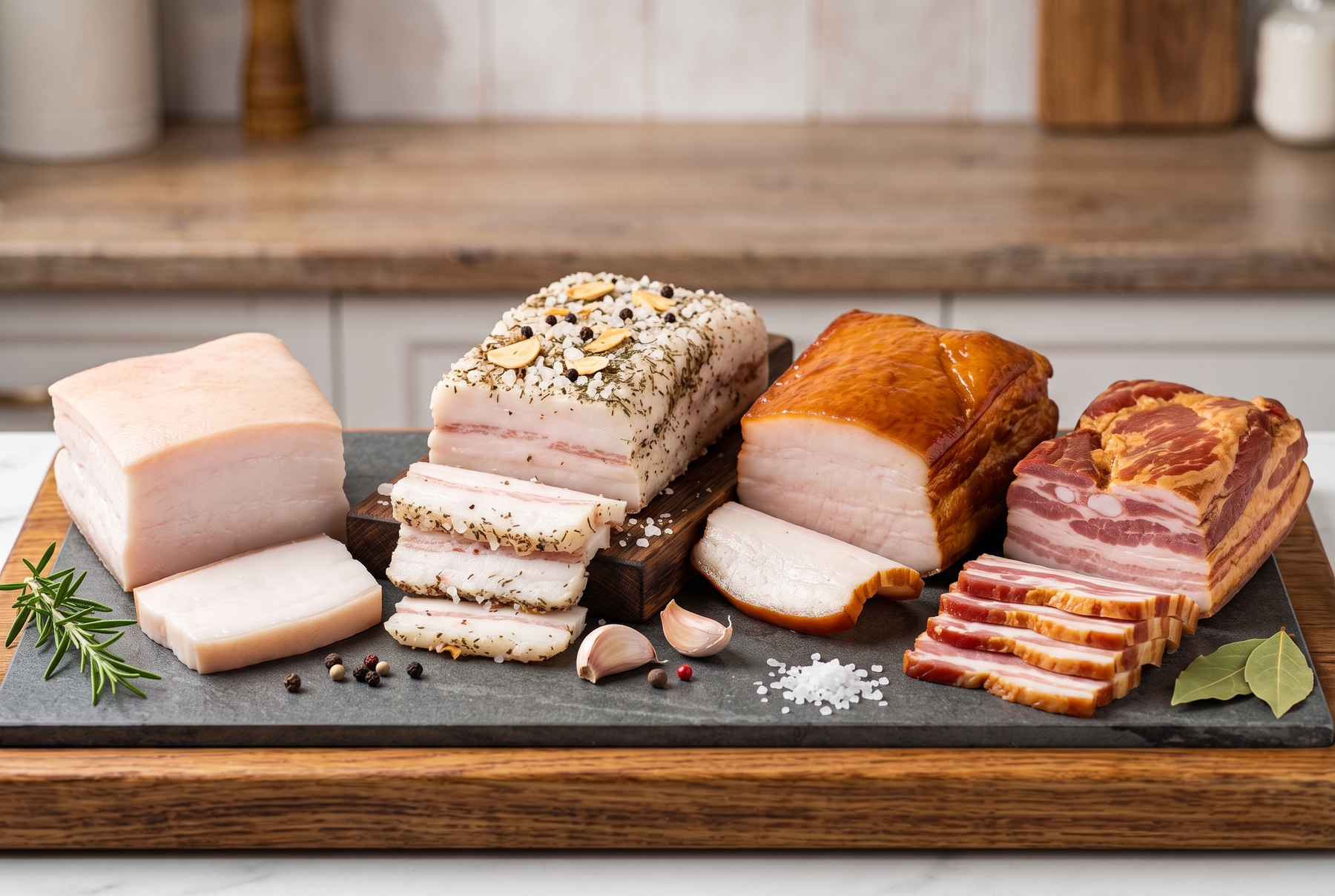
A butcher's selection of pork fat: fresh back fat, spice-rubbed salted salo, cold-smoked fatback, and meat-streaked belly.
Salo and Nutrition: Separating Fact from Folklore
Any serious discussion of animal fat eventually confronts the nutritional questions on every modern eater’s mind.
Pork fat is exceptionally calorie-dense, delivering roughly 902 kcal per 100 g (3.5 oz) in its pure rendered form. Yet its fatty acid profile is less saturated than many assume: 100 g contains approximately 39 g of saturated fat, 45 g of monounsaturated fat (predominantly oleic acid, the same fatty acid found in olive oil), and 11 g of polyunsaturated fat. In pasture-raised, acorn-fed Ibérico pigs, the proportion of monounsaturated oleic acid climbs higher still.
The World Health Organization (WHO) recommends keeping total fat intake below 30% of daily caloric energy and limiting saturated fats to less than 10%, favoring unsaturated sources whenever possible. Cured and smoked pork fats also contribute significant dietary sodium, while traditional wood smoking introduces trace polycyclic aromatic hydrocarbons. Ultimately, how salo fits into a healthy lifestyle depends on portion size, frequency, overall dietary patterns, and individual metabolic health—not the mere presence of pork fat on the table.
Cured pork fat possesses no magical medicinal properties. Popular folk claims—that eating salo “cleanses blood vessels,” holds a unique health halo among animal fats, or delivers transformative doses of selenium and arachidonic acid in a single sandwich slice—have no basis in nutritional science. Conversely, demonizing the ingredient makes little sense either: enjoying two paper-thin slices alongside a bowl of winter soup is worlds apart from consuming 200 g (7 oz) of salted fat with white bread every day. Moderation defines the difference.
Anyone managing cardiovascular conditions, hypertension, or specific dietary restrictions should tailor their intake with a physician or registered dietitian rather than relying on culinary folklore.
A 4-Step Tasting Flight for the Curious
Experiencing how geography and technique reshape this humble ingredient takes just four small plates arranged side by side.
Start with a classic Eastern European dry-salted salo free of meat streaks. Focus on the clean sweetness of the fat, the crunch of salt, the punch of raw garlic, and the speed at which a thin slice melts across the tongue.
Second, taste a Central European smoked variety—whether Hungarian, Polish, or Balkan. Notice how the woodsmoke and paprika transform the aromatic profile and firm up the exterior bite.
Third, drape a translucent ribbon of aged Italian lardo over a piece of warm toast. Look for the perfume of rosemary, nutmeg, and black pepper, followed by that deep, nutty richness that only months of curing can create.
Fourth, finish with a scoop of Polish smalec or Austrian Verhackertes, where rendering or mincing has completely broken down the tissue structure, leaving a lush, savory spread driven by caramelized onions, apples, and cracklings.
Seeing all four on the same table makes the larger story clear: behind a single anatomical cut lie vastly different climates, salt trade routes, rural farming economies, and cultural definitions of luxury. Searching for the single homeland of “true salo” misses the point entirely—the magic lies in the variations.
By the time you reach that fourth plate, by the way, keep a napkin handy: rendered smalec clings to the tasting knife far more stubbornly than the rest.
0 comments