
In a professional kitchen, pairing strawberries with black pepper or chocolate with olive oil is never considered strange. What chefs actually find strange is a dish where the cook cannot explain why an ingredient is on the plate. If someone asks what the smoked paprika is doing there, and the response is silence or a vague mention of an “interesting accent,” the dish is a failure.
Over many years on the line, I have seen countless menus where the boldest dishes relied on elementary-school arithmetic of balance: salt pulls out sweetness, acid cuts through fat, and bitterness provides depth. A diner reads “olive oil ice cream” and sees a wild experiment. Meanwhile, the chef is simply calculating fat content and serving temperature.
That is the exact boundary between a successful pairing and pointless novelty. Every ingredient on the plate needs a job to do.
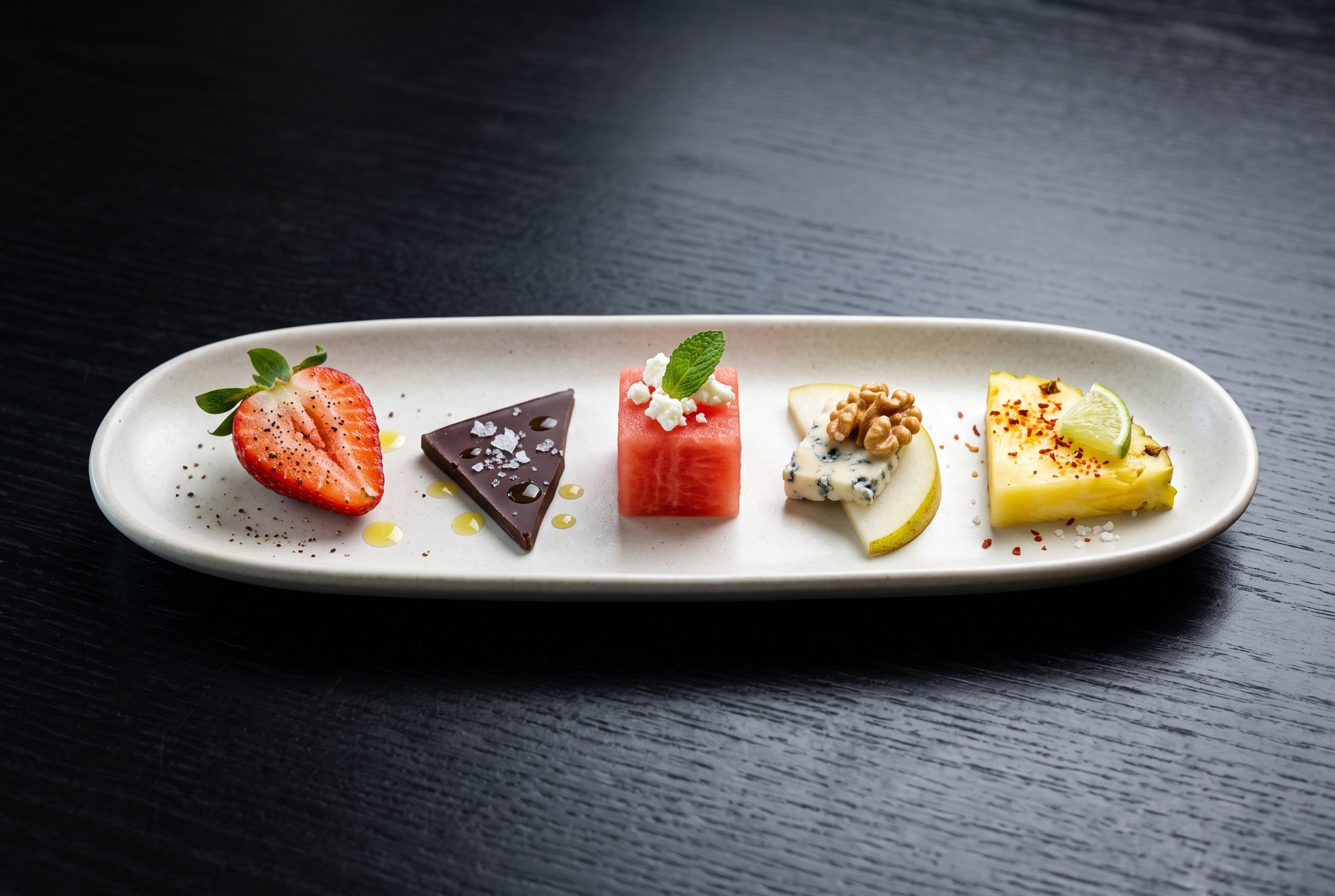
Examples of culinary contrasts on a single plate: strawberry with black pepper, dark chocolate with sea salt, watermelon with feta, pear with blue cheese, and pineapple with chili.
Table of Contents
What Actually Makes an Unusual Pairing Work
The mechanics of flavor pairing are fairly straightforward, and they require no background in molecular gastronomy. Understanding how flavors interact relies on three core concepts: how basic tastes alter one another, how aroma operates, and why texture often matters more than the ingredients themselves.
One Taste Amplifies Another
Salt and sweet form the most reliable partnership in cooking. A pinch of salt on ripe melon does not make the fruit salty; it makes it sweeter. The same principle applies to watermelon, pineapple, and tomatoes. Salt suppresses the perception of bitterness while simultaneously pushing sweet notes to the front of the palate.
Acid goes to work on fat. Rich food quickly fatigues the palate—after three spoonfuls of a heavy cream sauce, the mouth feels coated and dull. A drop of lemon juice or vinegar resets the palate, making the next bite compelling again. That is precisely why rich fish is traditionally served with lemon, and why pork pairs so naturally with pickled accompaniments.
Sweetness and heat take turns softening each other. Sweetness hits the tongue first, followed by a wave of heat, and then the sweetness returns. The sensation rolls across the palate like a wave rather than hitting as a flat, one-dimensional burn.
Creaminess and bitterness create a sense of volume. Think of dark chocolate in ice cream, coffee with heavy cream, or an aggressively peppery olive oil emulsified into a velvety sauce. Fat coats the tongue and stretches bitterness out over time, preventing it from striking a single harsh note.
A secondary ingredient does not need to announce its own distinct flavor. Often, its only job is to make the primary ingredient more expressive. Freshly cracked black pepper on strawberries is not there to make the dish taste like pepper.
Aroma Plays by Its Own Rules
The tongue only registers about five basic tastes. Aromas, however, number in the thousands, and they create the complex sensation we casually refer to as flavor. During chewing, volatile compounds travel up from the back of the throat into the nasal cavity, allowing the brain to assemble the full picture.
This explains why two ingredients that sound incompatible by name can align seamlessly by scent. Strawberries and black pepper share spicy, slightly woody notes—a ripe wild strawberry baking in the summer sun smells almost hot. Beets and cocoa both lean toward earthy, damp, and slightly mineral profiles.
The modern food pairing theory—which argues that ingredients work well together when they share key aromatic molecules—deserves a brief caveat. While the concept is fascinating and occasionally useful for brainstorming, strict scientific backing for it remains thin. Shared molecules do not guarantee a delicious plate of food, and plenty of iconic combinations (like watermelon and feta) share no molecular kinship whatsoever. Treat the theory as a source of hypotheses rather than an absolute law.
Texture Sometimes Matters More Than Ingredients
Putting two wonderful flavors together in the exact same soft format results in a boring dish. Pumpkin purée with goat cheese cream sounds lovely on paper, yet in the mouth it turns into a uniform paste that becomes tiresome by the third spoonful.
Juicy elements usually crave crunch, cold elements benefit from warmth, and creamy components need something coarse to push against. These physical collisions give a dish momentum, movement, and a reason to chew differently.
Consider a simple example: watermelon with feta on its own is good. That exact same watermelon and feta scattered with a handful of toasted pumpkin seeds becomes noticeably more engaging, even though the flavor profile barely shifts. The work required from the jaw changes everything.
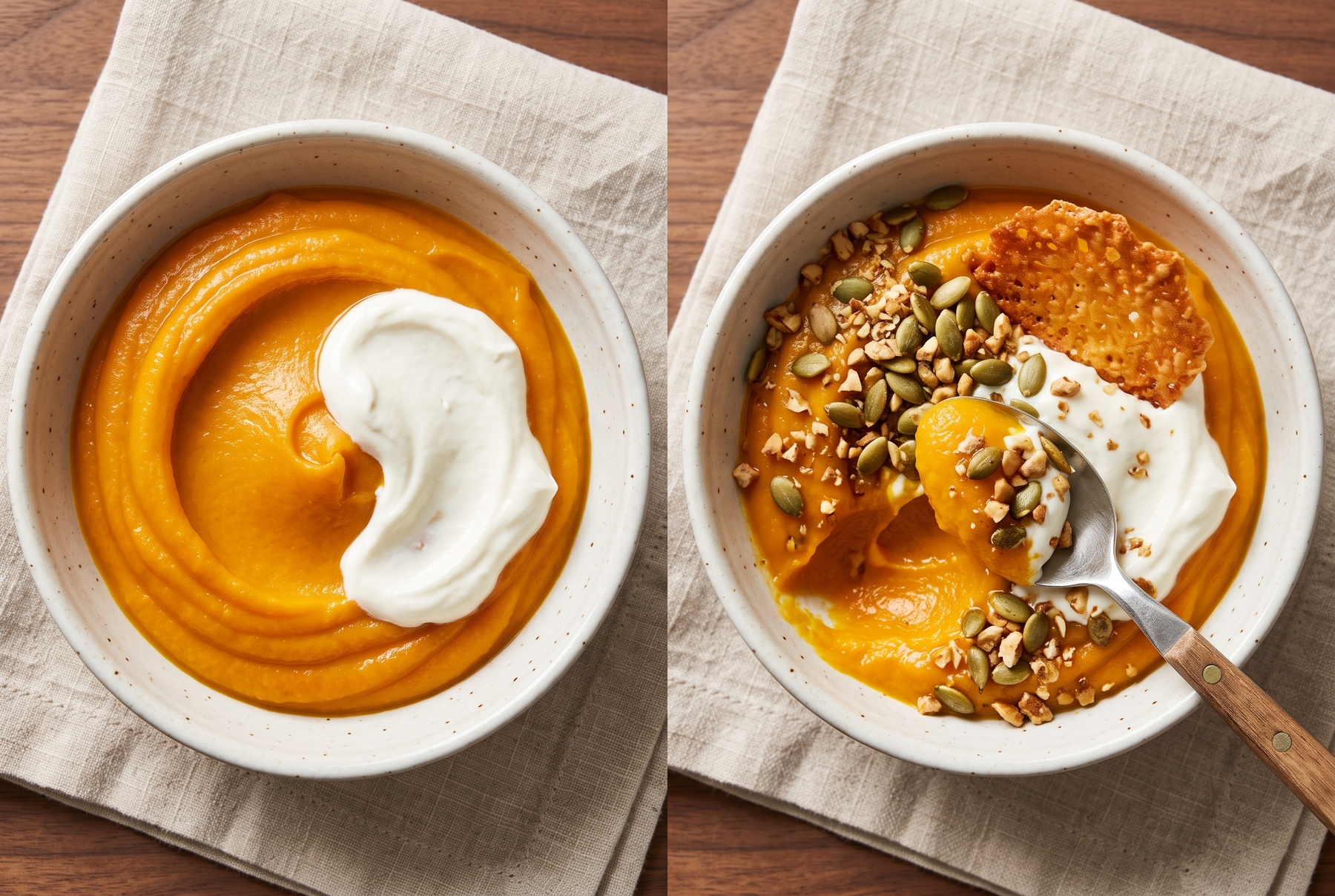
A smooth pumpkin purée becomes far more compelling with the addition of crunchy toasted pumpkin seeds and a crisp cheese tuile.
The Four-Point Rule: How to Approach Any Experiment
Before exploring the specific pairings, establishing a basic workflow helps. Any unusual flavor combination tested at home relies on four foundational elements.
A familiar base. Starting with an ingredient whose flavor is known by heart makes it easy to judge whether an addition improves or ruins it.
One primary contrast. Sticking to a single variable is essential. Rather than throwing salt, acid, and heat at a dish all at once, introducing just one deliberate contrast keeps the experiment clear.
A control point. Identifying a specific sensory marker confirms the proportions are right. Instead of aiming for a vague sense of “delicious,” look for concrete proof: the base ingredient still registers first on the palate, while the secondary aroma appears without taking over.
A single-bite test. Testing a new idea does not require tossing a four-person salad. Cutting off a small piece of the base ingredient, adding a microscopic amount of the secondary component, and tasting them together reveals the baseline. Repeating the process with a double dose makes the difference obvious within fifteen seconds.
Professional kitchens operate this way constantly: a small spoon, a single variable, and an immediate side-by-side comparison. That way, an entire batch of food never goes to waste.
15 Unusual Flavor Combinations
1. Strawberries and Freshly Cracked Black Pepper
Pepper works here through aroma rather than heat. Freshly cracked black pepper carries resinous, slightly citrusy, warm notes that latch onto similar compounds in ripe berries. The strawberry suddenly tastes riper and more fragrant, as if it spent an extra day ripening in the sun.
Running a home test takes about a minute. Halving two strawberries, leaving one plain, and giving the other one or two turns of a pepper mill sets up the comparison (using a mill rather than pre-ground pepper from a tin is crucial, as pre-ground powder has already lost its volatile aromatics). Tasting the plain berry first, followed by the peppered one, highlights the shift.
The control point: the pepper should act as a backdrop that registers only after the berry itself. If a sharp burn hits the tongue first, there is twice as much pepper as needed.
From there, the pairing easily expands with soft goat cheese, cold unsweetened whipped cream, or a few torn basil leaves. A thick, aged balsamic vinegar also fits well, though it is best reserved for berries that lack natural sweetness. Truly ripe strawberries need no help from vinegar.
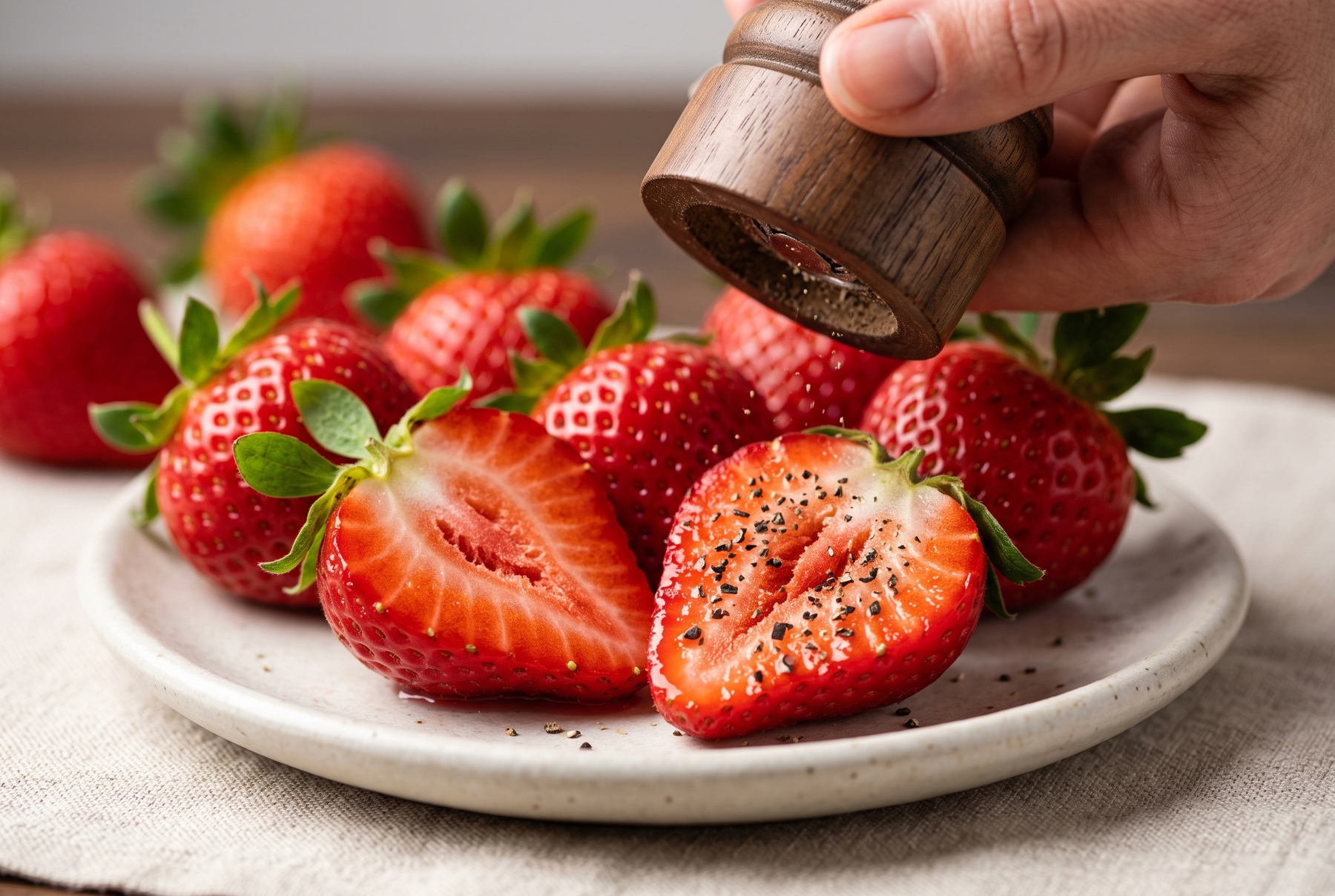
Freshly cracked black pepper highlights the natural sweetness and warm aromatic notes of ripe strawberries.
2. Watermelon and Feta
Four distinct forces collide here: the sweetness and water content of the melon against the salt and fat of the cheese. Because watermelon consists almost entirely of water, its flavor vanishes on the palate almost instantly. Salty, rich cheese gives the flavor something to cling to, while the salt pulls the melon’s sweetness forward.
Temperature is critical here. Warm watermelon smells distinctly like squash and tastes cloying, whereas cold watermelon stays crisp and vibrant. Keeping the melon refrigerated until the last possible second, cutting it right before serving, and using thoroughly chilled cheese ensures the cleanest flavor.
The most common mistake is heavy-handedness with the cheese. Overly salty feta from a cheap brine—or simply too much of it—overwhelms the delicate fruit, leaving behind nothing but salt and a muddy dairy aftertaste. Measuring proportions by eye works better than using a scale. Looking at a single bite, the volume of watermelon should outnumber the cheese by three or four to one: a walnut-sized cube of melon paired with a bean-sized crumble of feta.
Tossing in a few mint leaves and a couple of drops of olive oil rounds out the plate. Pumpkin seeds, lightly toasted in a dry skillet, introduce the crunch that soft melon and feta naturally lack.
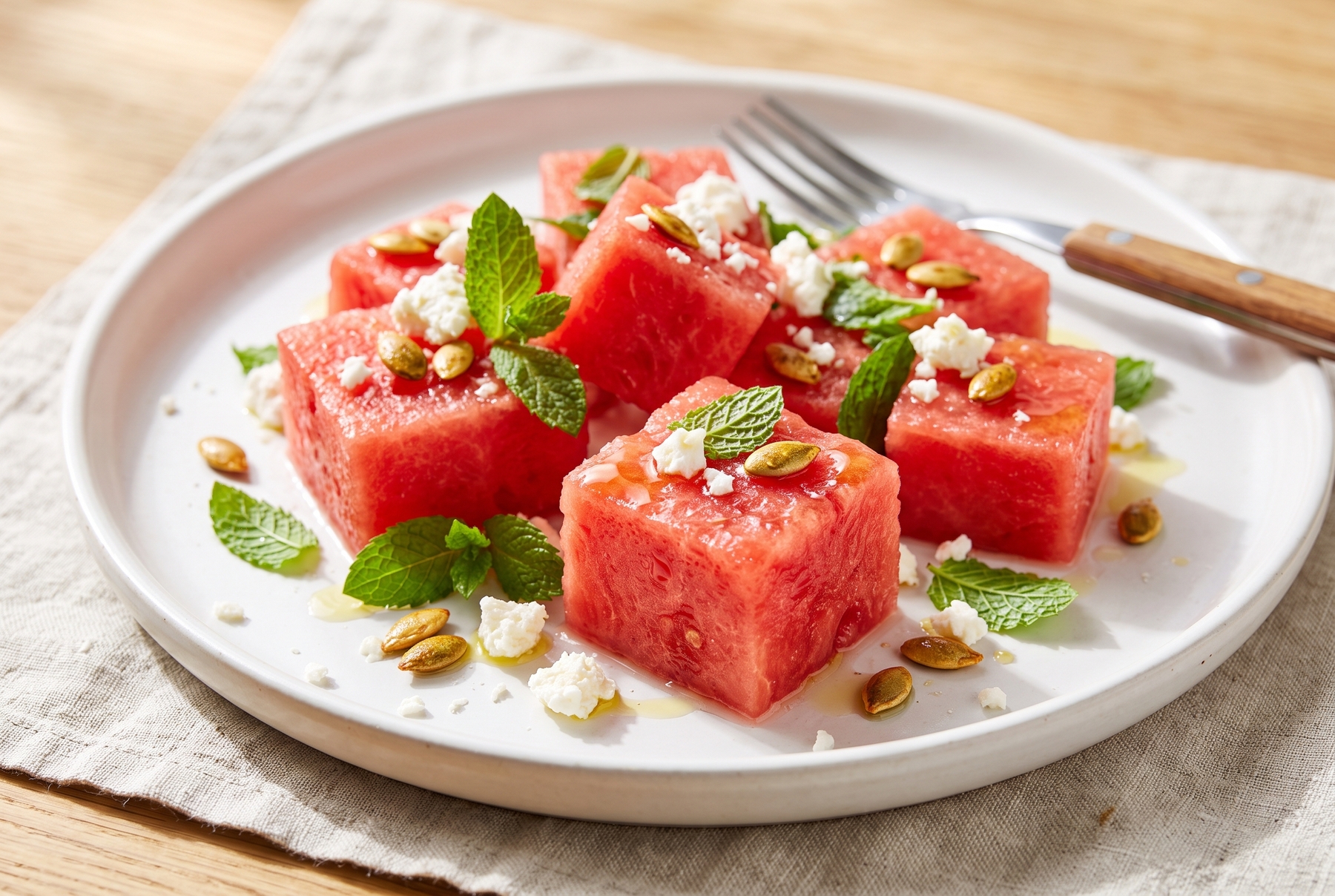
A bright contrast of sweet, juicy watermelon, salty feta, fresh mint, and toasted pumpkin seeds.
3. Dark Chocolate, Olive Oil, and Sea Salt
This restaurant classic relies on food physics rather than culinary bravado. Olive oil fundamentally alters how chocolate behaves in the mouth: cocoa butter melts at body temperature and leaves a relatively short finish, whereas liquid olive oil spreads across the palate and stretches the flavor out. The chocolate feels fuller, lingers longer, and loses its characteristic dryness.
Not just any bottle will do. Cheap refined oil only adds odorless fat, while an overly aggressive oil with a harsh, peppery throat-catch will fight the natural bitterness of the cacao. Tasting the oil straight from a teaspoon first helps: it should offer a grassy, slightly green note, a gentle bitterness, and a mild tickle at the back of the throat. If it leaves the impression of freshly cut grass and green olives, it is the right bottle.
Setting up a no-cook tasting is simple: a piece of 70% dark chocolate, a few drops of olive oil drizzled directly on top, and a couple of flakes of coarse sea salt. Letting it sit for thirty seconds allows the oil to warm and spread.
The control point: the chocolate should taste rounder and more persistent. If the bite suddenly reminds you of salad dressing, either too much oil was used or the bottle was too aggressive.
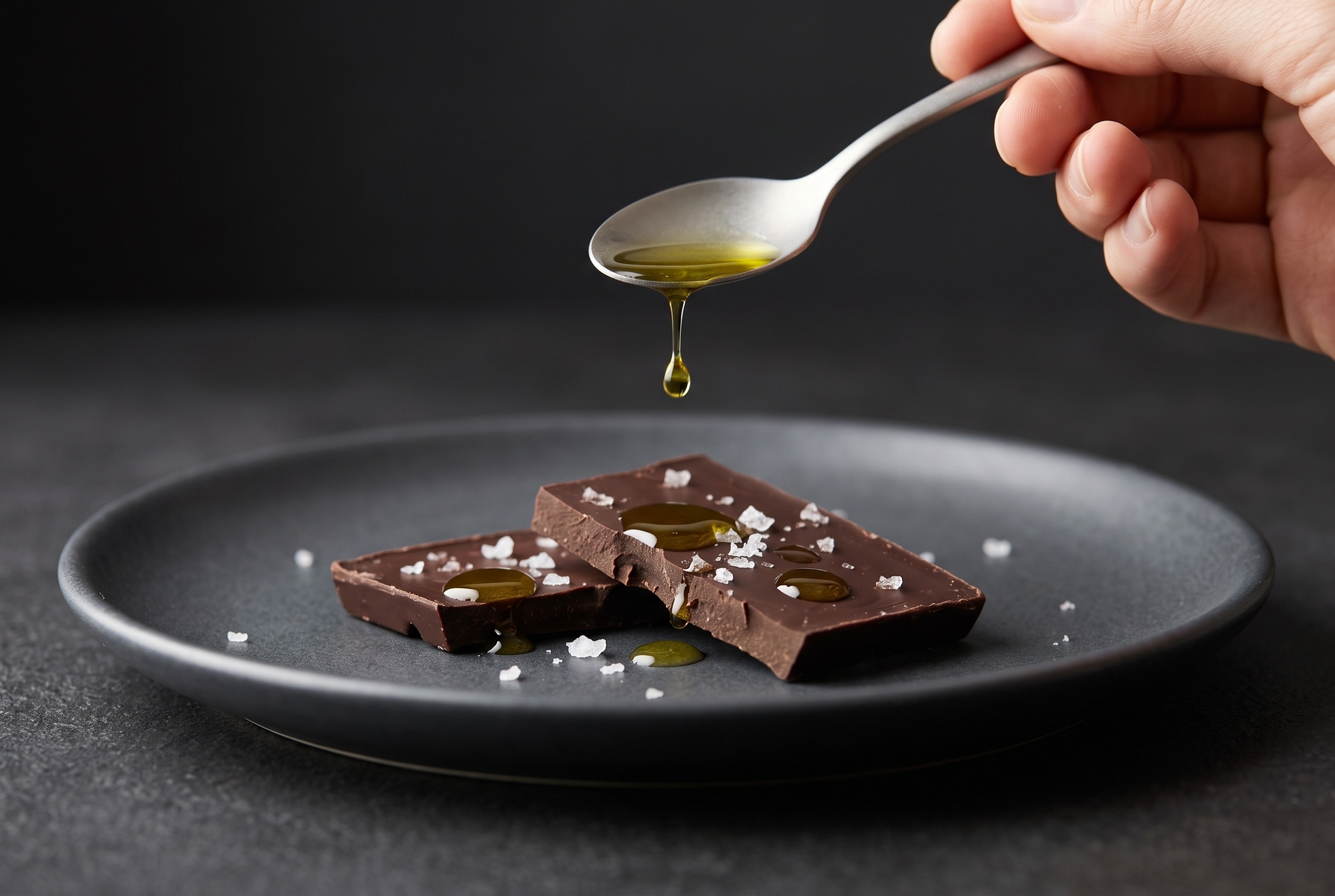
Extra-virgin olive oil and flaky sea salt unlock new dimensions of flavor in bitter dark chocolate.
4. Coffee and Citrus
Coffee beans—especially light-roast varieties from Africa—naturally harbor hidden citrus and berry notes. Orange highlights these characteristics, lending a bright freshness that strips away coffee’s underlying heaviness.
Different parts of the fruit behave in entirely different ways. Zest delivers pure aroma without acidity, making it nearly impossible to ruin the drink. A splash of juice introduces acidity along with some risk: coffee is already acidic, and excess acid turns the flavor sharp and metallic. Incorporating a full citrus component—like syrup, orange slices, or liqueur—requires rebuilding the entire drink from the ground up.
Starting with the most controllable option works best. Removing a strip of orange zest with a vegetable peeler—carefully avoiding the bitter white pith—and twisting it over a cup of espresso releases a fine mist of essential oils onto the crema. Rubbing the peel along the rim of the cup finishes the job. Smelling the espresso before and after reveals an immediate transformation.
The control point: the orange should register in the nose rather than on the tongue. The moment a distinctly sour taste appears in the coffee, a line has been crossed.
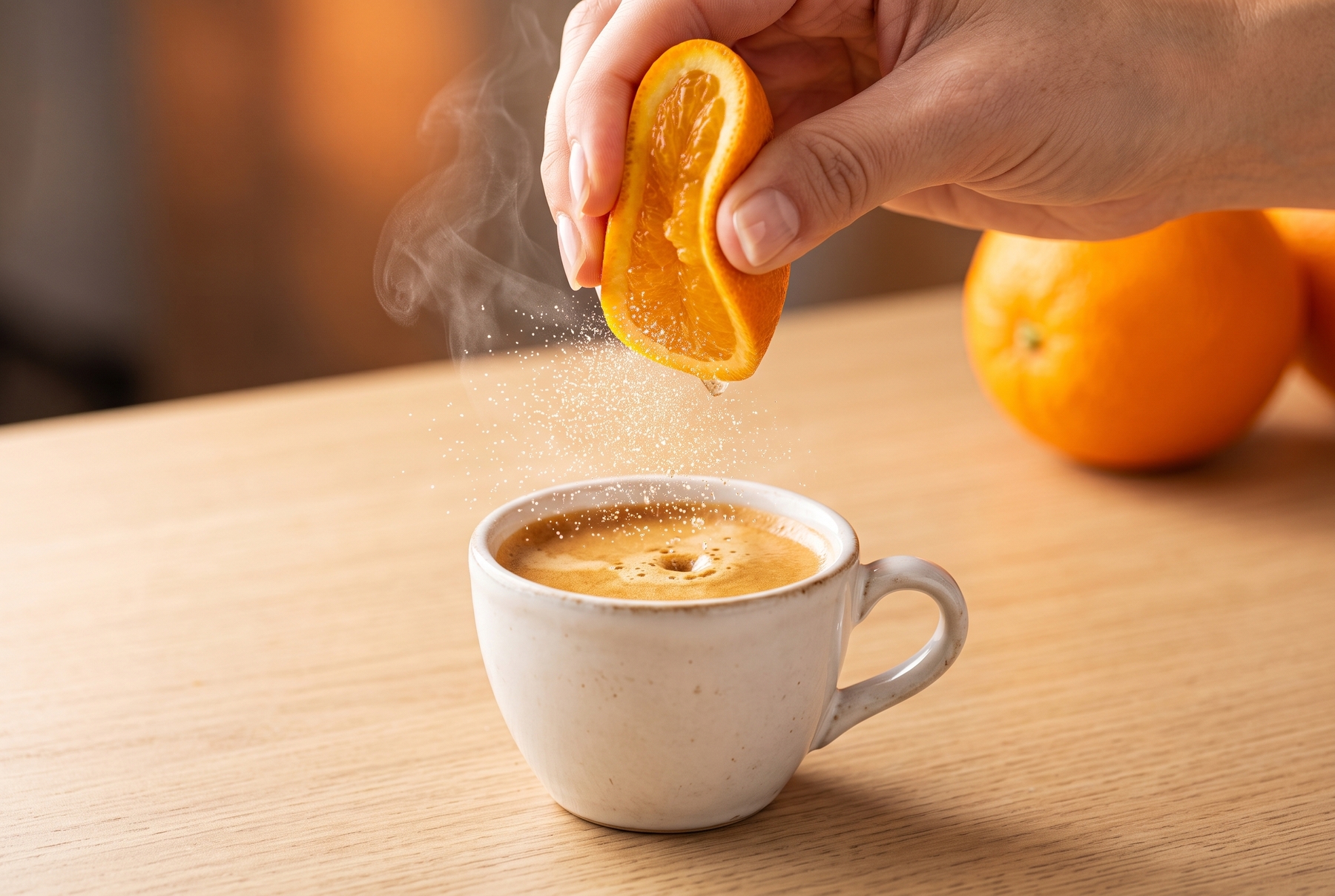
Essential oils expressed from an orange peel highlight the natural citrus and fruit notes in a well-pulled espresso.
5. Melon and Aged Salty Cheese
This pairing follows the exact same formula as watermelon: sweet, juicy fruit meets salt and fat. Cantaloupe or honeydew, however, brings a musky, almost perfumey aromatic profile to the table, making it far more complex than watermelon.
The ripeness of the melon matters far more than tracking down an exotic cheese. An underripe melon is hard and crunches like a cucumber, and no amount of Parmigiano-Reggiano will save it. Checking the scent near the stem end is the best test: a ripe melon smells distinctly sweet right through the rind, and the blossom end yields slightly to gentle pressure.
Cheeses can be scaled by intensity: mozzarella or burrata offers the mildest pairing, feta brings salt and tang, while aged sheep’s milk cheese (like Pecorino) or Parmesan delivers salt, deep umami, and crunchy tyrosine crystals. Prosciutto and melon is an Italian staple built on the exact same logic—salt and fat cutting through sweet water.
The control point: if salt lingers in the mouth after swallowing rather than the perfume of the melon, there is too much cheese on the fork.
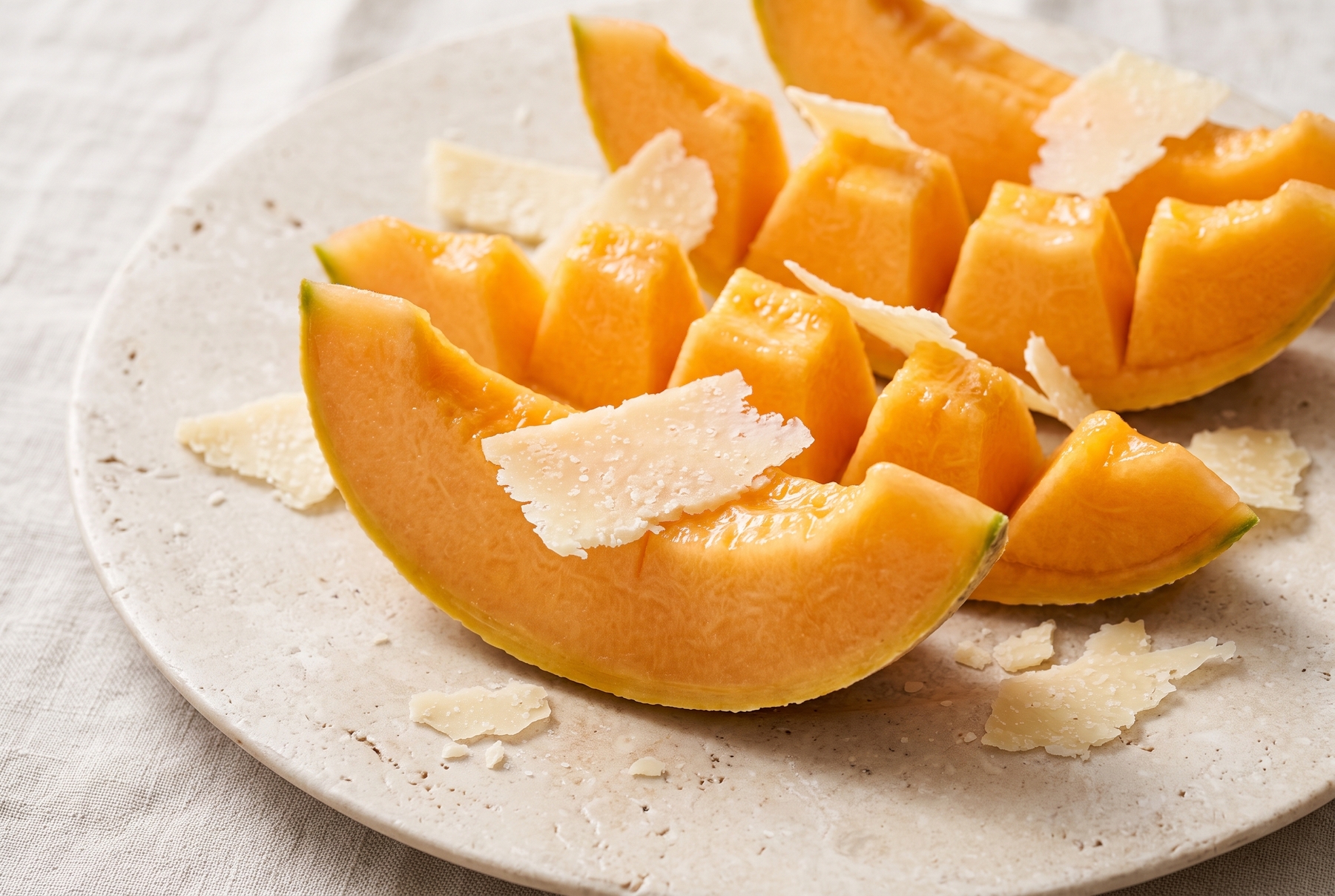
Sweet, musky cantaloupe paired with umami-rich shavings of aged hard cheese.
6. Pear and Blue Cheese
This combination is a masterclass in managing intensity. Blue cheeses bring salt, fat, acidity, and a pungent, funky mold aroma that, in stronger varieties, borders on ammonia. Against this wall of flavor, a pear offers gentle, mild sweetness and high water content. The fruit tames the cheese’s aggression while highlighting its buttery texture.
A predictable beginner’s mistake is reaching straight for the strongest cheese at the counter. Starting with milder, creamier styles like Dorblu (a mild German blue cheese) or Gorgonzola Dolce eases the palate in. Aggressive heavyweights like Roquefort and Stilton are better saved for later, once an appreciation for the flavor profile is established.
Assembling a proper test bite follows a specific ratio:
- Selecting a ripe pear that yields slightly at the neck, smells floral and honeyed, and releases juice when sliced.
- Cutting a slice about 1 cm (0.4 inch) thick.
- Topping the fruit with a piece of blue cheese roughly one-quarter the volume of the pear slice.
- Adding half a walnut, ideally toasted lightly in the oven first.
- Eating the entire assembly in one bite rather than nibbling it in parts.
While honey is a frequent addition to this pairing, a truly ripe pear renders it unnecessary. A drop of honey only makes sense if the pear turns out slightly flat.
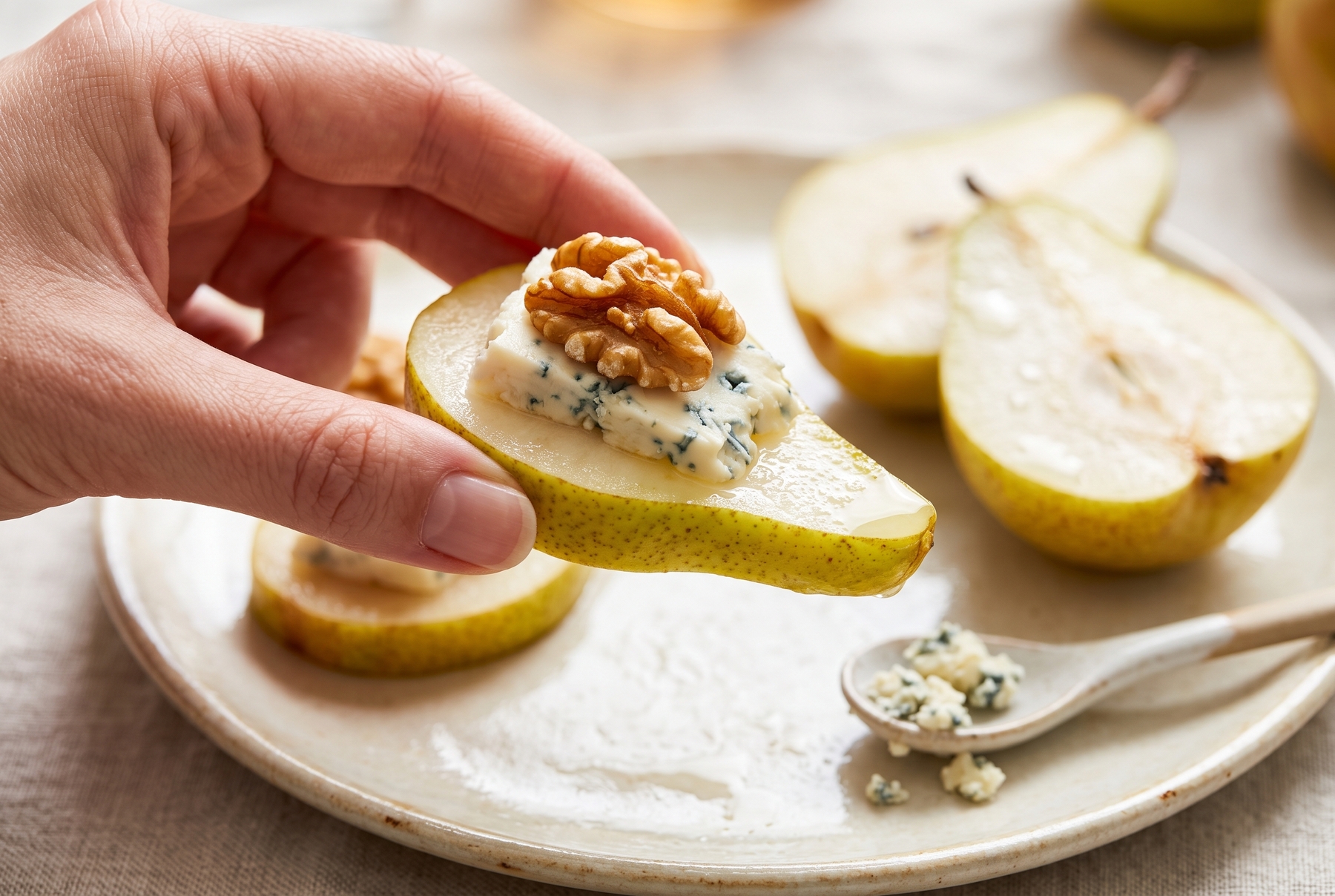
An ideal single-bite appetizer: juicy, honeyed pear balances the sharp pungency of blue cheese.
7. Peach and Tomato
Not every compelling pairing relies on opposites. Here, similarity drives the dish: a ripe peach and a great tomato share a structural kinship—dense, juicy flesh encased in thin skin—and both balance sweetness with acidity. Because the peach leans sweeter and the tomato leans brighter, combining them creates a seamless, quintessential summer dish.
Coarse salt is mandatory here to draw the juices out of both fruits, while olive oil binds those juices into a natural dressing. Fresh herbs like basil or mint introduce a green note that keeps the salad from tasting overly sweet. Sometimes, thinly sliced red onion soaked in ice water for ten minutes is enough to anchor the bowl.
Ingredients for 2 servings:
- 2 ripe peaches or nectarines
- 300 g (10.5 oz) ripe mixed-variety tomatoes
- 1/4 red onion
- 8–10 fresh basil leaves
- 2 tbsp extra-virgin olive oil
- 1 tsp coarse sea salt
- 1 tsp white wine vinegar (to taste)
Assembly:
- Cutting the tomatoes into thick wedges, tossing them with salt, and letting them drain in a colander for 10 minutes concentrates their flavor by shedding excess water.
- Slicing the onion into thin slivers and soaking them in cold water for 10 minutes before draining removes harshness while preserving crunch.
- Cutting the unpeeled peaches into wedges of a similar size to the tomatoes.
- Combining the fruit and onions in a wide bowl, drizzling with olive oil and vinegar, and tossing gently by hand from the bottom up.
- Tearing the basil leaves by hand—a knife bruises the edges, turning them black and releasing a grassy taste—and scattering them over the top.
- Serving immediately before the peaches lose their juices.
Without in-season peaches and sun-ripened tomatoes, this dish falls apart. Pairing a mealy winter greenhouse tomato with a watery peach only produces a bland, wet mess.
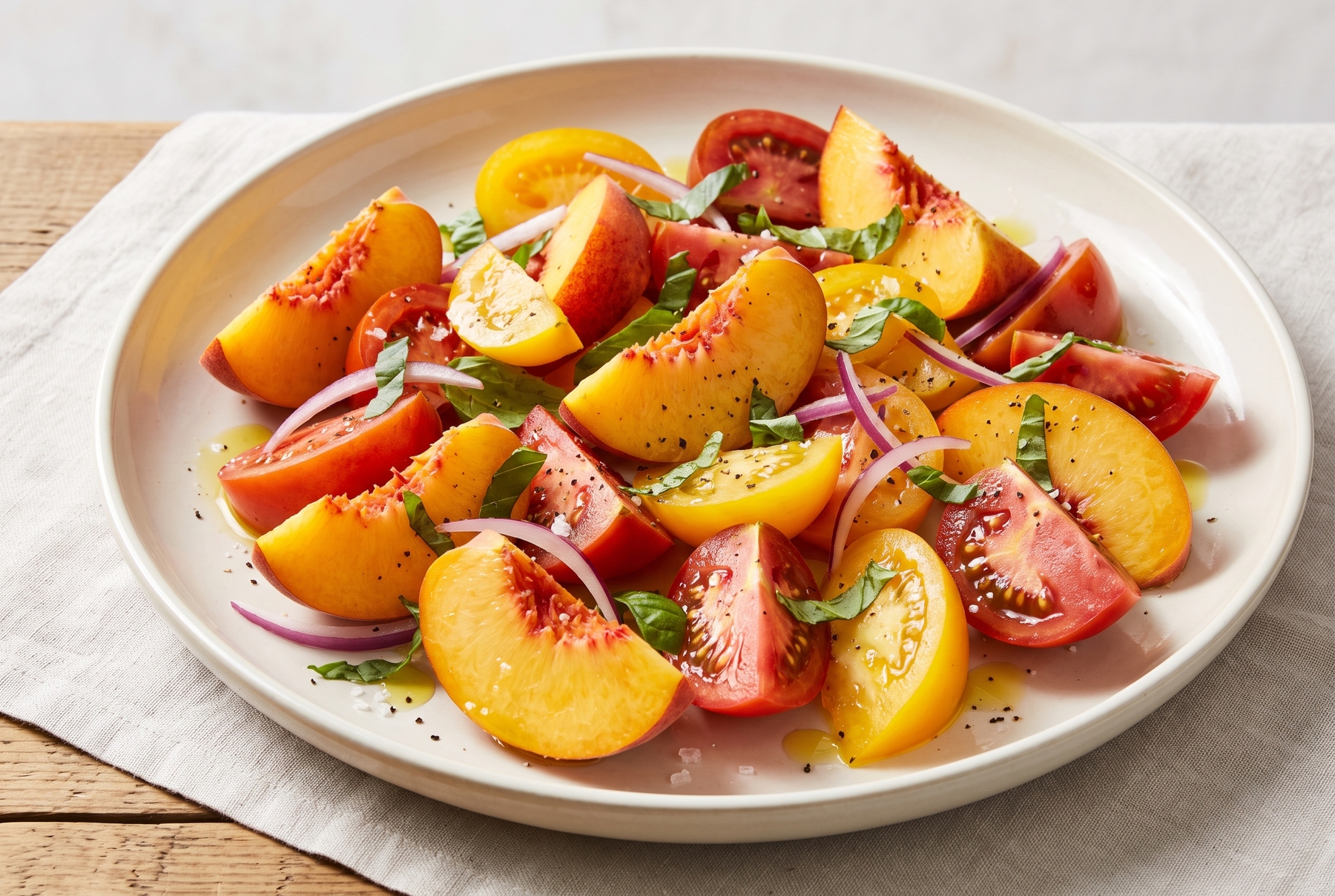
A seasonal salad of sweet peaches and juicy ripe tomatoes tossed with fresh basil and olive oil.
8. Honey and Chili Pepper
In professional kitchens, “sweet heat” operates on a specific timeline: sugar coats the tongue before capsaicin reaches the pain receptors, softening the initial impact of the chili. The burn still arrives a moment later, but it unfolds against a sweet backdrop.
A common misconception about spicy food deserves clarification here: sugar does not neutralize heat. Capsaicin dissolves in fats and alcohol, not in sugar syrup. If a dish turns out unbearably spicy, stirring in honey will simply make it sweet and unbearably spicy at the same time. Rescuing an over-spiced dish requires fat—like sour cream, yogurt, or butter—or simply bulking up the volume of the other ingredients.
Three reliable applications for hot honey:
With cheese. Drizzling chili-infused honey over a dense, aged cheese or a wheel of warm baked Camembert delivers salt, fat, sweetness, and heat in a single bite.
On pizza. A thin ribbon of hot honey over a piping-hot pepperoni or mushroom pie is a staple of modern American pizzerias for good reason—it works effortlessly.
On roasted vegetables. Carrots, sweet potatoes, and Brussels sprouts take naturally to this glaze. Tossing the vegetables in a mixture of olive oil, honey, and chili flakes during the final ten minutes of roasting prevents the sugars from burning and turning bitter.
The control point: a savory dish should never drift into dessert territory. If a sweet aftertaste lingers on the palate for more than a couple of seconds after eating roasted vegetables, there is too much honey in the pan. A squeeze of lemon juice or a splash of vinegar will pull the balance back in line.
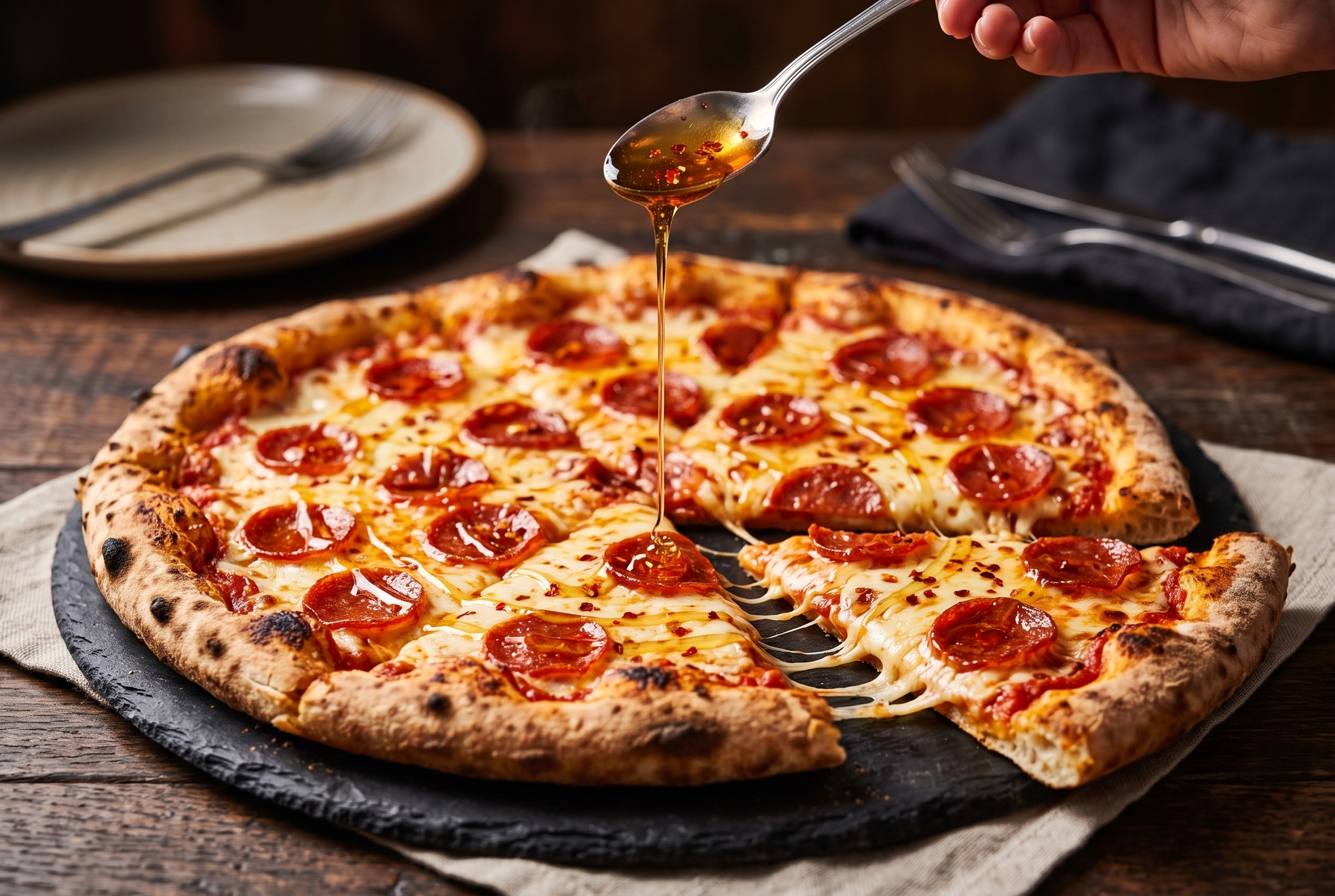
Chili-infused honey softens the bite of the pepper flakes, creating a rich balance of salty, sweet, and spicy notes.
9. Vanilla and Seafood
This is easily the riskiest pairing on the list.
Most people mentally glue vanilla to desserts, even though the spice itself contains zero sugar. A real vanilla bean is pure aroma: warm, floral, slightly woody, with a creamy roundness. That warm, floral scent happens to be brilliant at highlighting delicate, naturally sweet shellfish like sea scallops, langoustines, large shrimp, and occasionally flaky white fish.
A rich sauce acts as the bridge. Vanilla struggles next to seafood on its own; it requires fat as a carrier. The classic French approach relies on a base of butter or heavy cream, a splash of dry white wine, finely minced shallots, and a microscopic amount of vanilla added at the very end. Sometimes, simply dragging a split vanilla pod through the warm sauce before pulling it out is enough.
Dosage is everything here. A single serving of sauce requires only a few tiny seeds—literally what fits on the very tip of a paring knife. If a guest takes a bite and immediately asks, “Is there vanilla in this?”, the dish is ruined. The correct dose remains incognito, simply making the scallop taste rounder and sweeter than usual.
Testing this requires splitting a batch of sauce in two, adding a knife-tip of vanilla to one half, and tasting them side by side. The difference should hover right at the threshold of perception.
The control point: the scallop still tastes distinctly like the sea, and the sauce does not smell like a bakery.
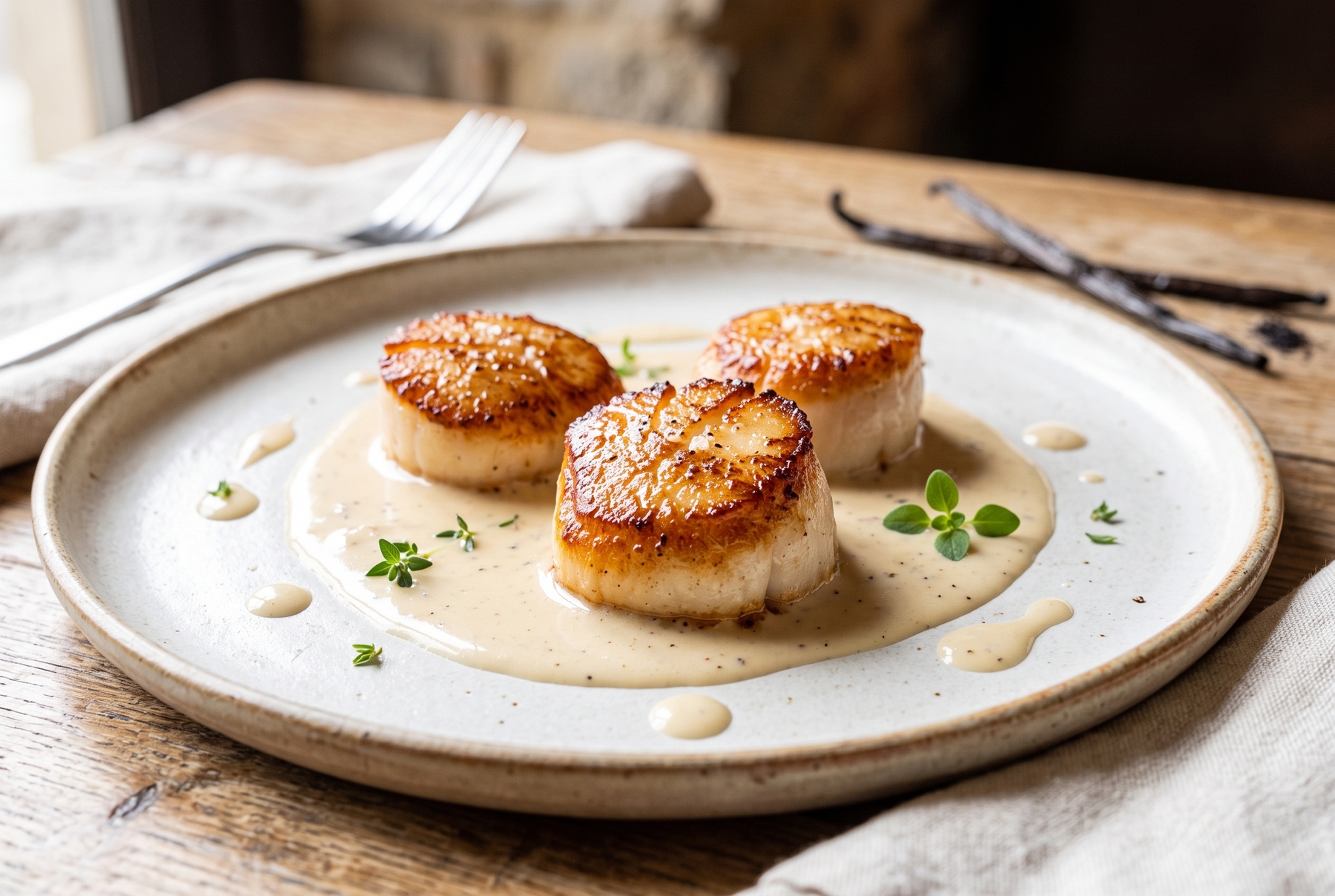
Subtle woody and floral notes of real vanilla bean in a butter sauce underscore the natural sweetness of seared scallops.
10. Cucumber and Strawberry
While cucumbers and strawberries are both packed with water, their aromatic profiles sit at opposite ends of the spectrum. Cucumbers offer green, slightly grassy notes driven by specific aldehydes—the exact compounds responsible for that fresh-cut cucumber scent that many people mistake for melon. Strawberries bring sweetness and bright acidity. Together, they produce a remarkably clean, cooling flavor built for hot weather.
The challenge with pairing two high-water ingredients is their tendency to weep and turn the plate into a puddle. The dressing—not extra solid ingredients—saves the dish. A tight emulsion of olive oil, lemon juice or white balsamic vinegar, coarse salt, and a crack of black pepper holds everything together. Salt draws out the juices, while acid keeps the flavors sharp.
Instead of slicing the cucumber into neat rounds, smashing it with the flat side of a chef’s knife and tearing it into jagged pieces by hand works much better. Craggy, uneven surfaces grip the vinaigrette far more effectively than slick, blade-cut edges.
Choosing just one fresh herb keeps the profile clean. Mint amplifies the cooling sensation, basil introduces a peppery warmth, and tarragon pulls the salad toward anise. Throwing all three into the bowl creates a muddled mess where no single herb stands out.
The control point: the salad should smell brisk and leave a clean finish. If a bitter note creeps in, the cucumber is to blame—peeling the stem end and tasting a slice before tossing it into the bowl prevents any surprises.
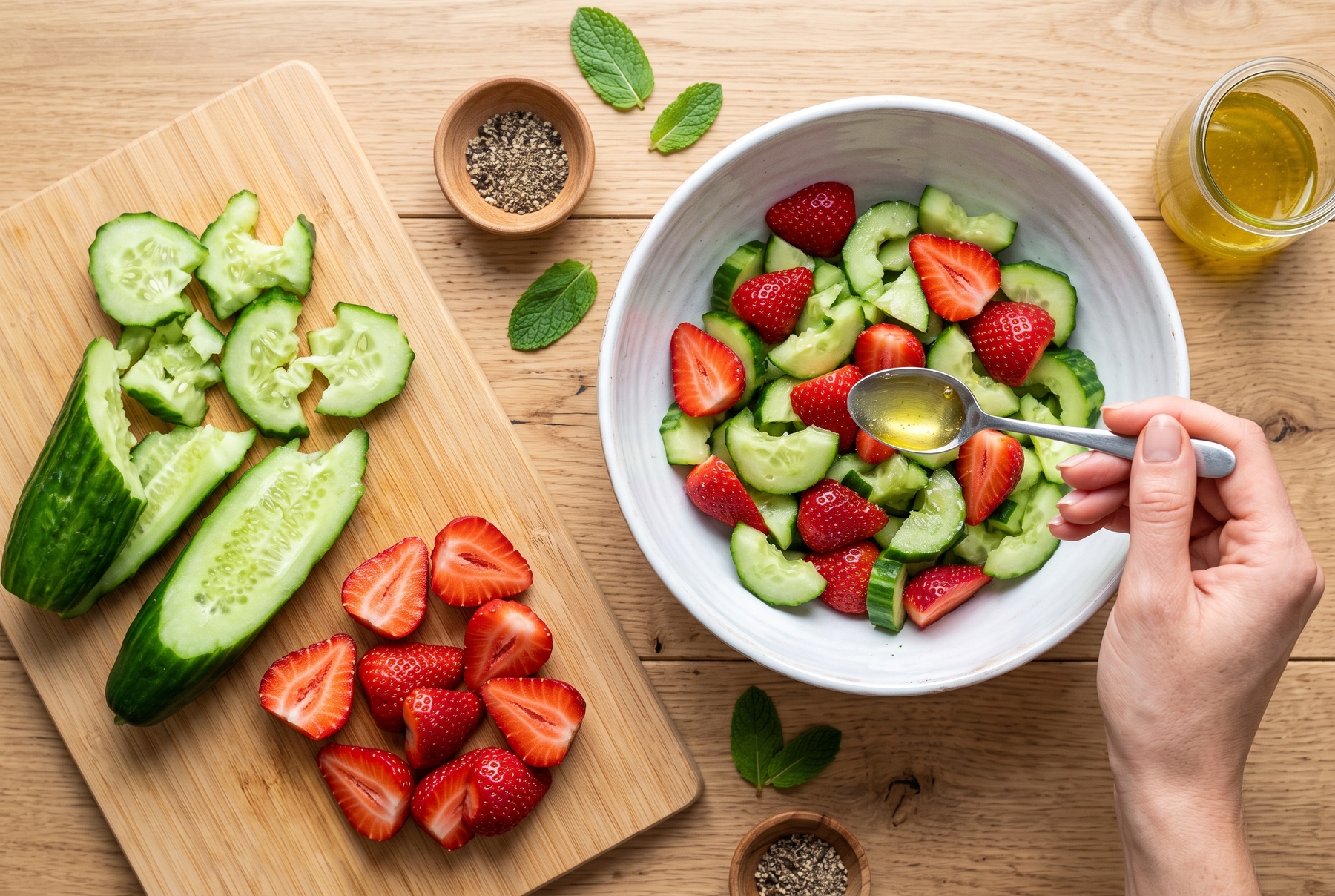
The grassy crunch of smashed cucumbers combined with sweet berries and a bright citrus vinaigrette.
11. Beet and Cocoa
In baking, this combination works on two distinct levels at once.
Aromatically, beets and cocoa are close cousins, both leaning into earthy, slightly mineral territory. Dark cocoa absorbs those earthy notes seamlessly, making the beet nearly impossible to detect as a separate vegetable in a rich chocolate batter.
Structurally, beets act as a moisture insurance policy. They introduce both water and plant fibers that trap that moisture inside the crumb. Chocolate cakes and brownies made with roasted beet purée come out noticeably fudgier and resist drying out for days. Furthermore, the natural sugar content of cooked beets allows bakers to dial back the refined sugar slightly.
Only one major pitfall exists here, and it is obvious when it happens: using too much beet. Overloading the batter leaves the cake smelling distinctly like dirt and produces a heavy, gummy crumb. Keeping the beet purée to no more than one-quarter of the total batter weight prevents this. Roasting the beets in foil rather than boiling them is also essential, as roasting concentrates their sugars and evaporates excess water.
The control point for the finished bake: the crumb looks dark and moist, cocoa hits the palate first, and a subtle earthy note registers only on the exhale at the very end. If the flavor of dirt arrives first, cutting the beet purée in half next time solves the problem.
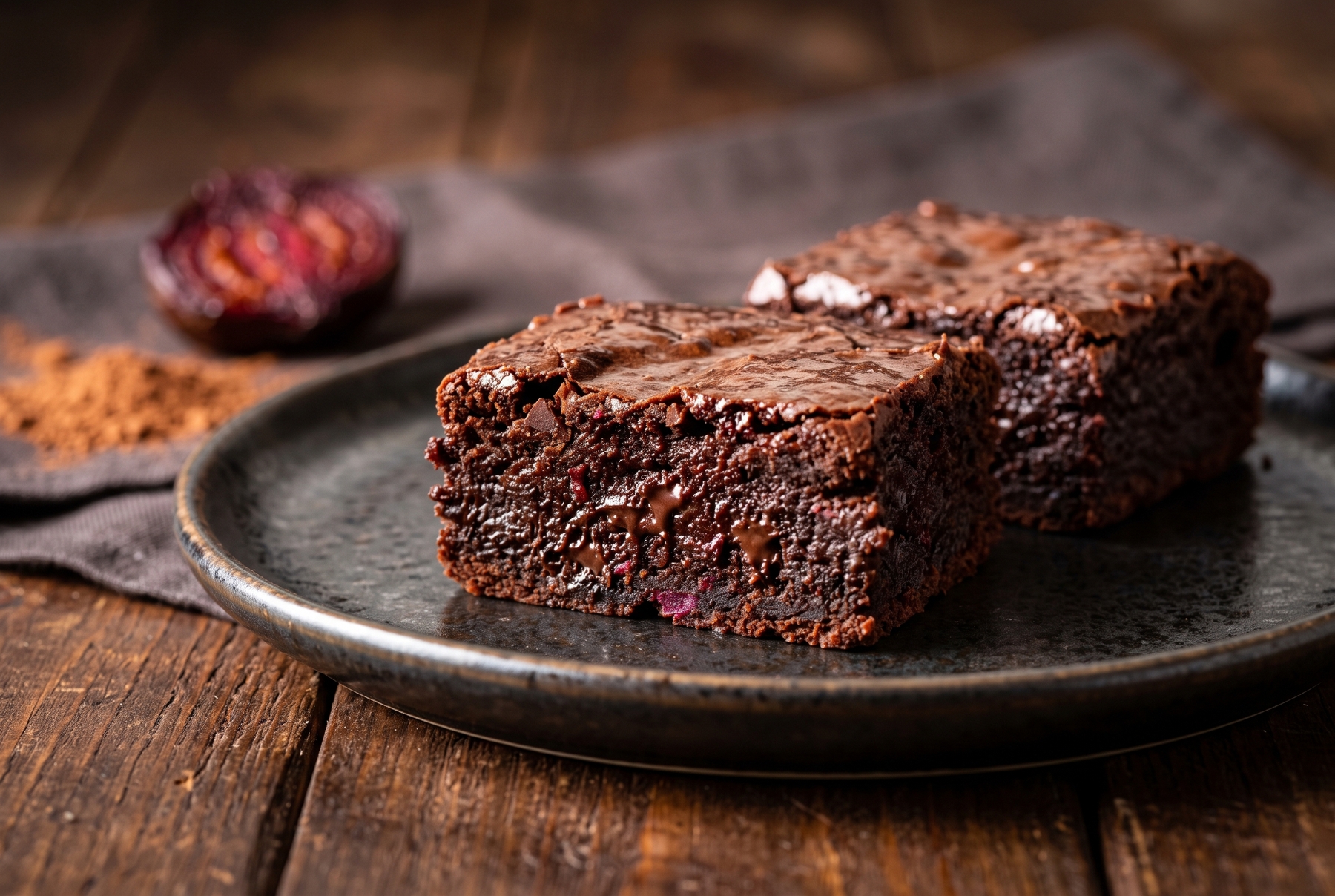
Roasted beet purée locks moisture into chocolate baked goods while deepening the rich cocoa profile.
12. Potatoes and a Sweet-Spicy Glaze
This dish applies the familiar logic of sweet, salty, and spicy to the most neutral canvas in the kitchen.
Everything hinges on the crust. Tossing soft, boiled potatoes in a sticky glaze produces a dismal side dish because there is no textural contrast and nothing for the glaze to grip. Achieving a blistered, deeply roasted exterior is non-negotiable.
Ingredients for 2 servings:
- 600 g (1.3 lbs) waxy or all-purpose potatoes
- 3 tbsp olive oil or neutral vegetable oil
- 1 tbsp honey
- 1 tsp apple cider vinegar
- 1/2 tsp crushed red pepper flakes
- Coarse sea salt
- A few sprigs of fresh thyme
Preparation:
- Cutting the potatoes into thick wedges, parboiling them in salted water for 7 minutes, draining, and letting them steam dry for a couple of minutes sets the foundation.
- Shaking the colander vigorously roughs up the edges of the wedges, creating a starchy paste on the surface that roasts into an ultra-crisp crust.
- Spreading the wedges on a sheet pan, tossing with oil and salt, and roasting at 220 °C (425 °F) for about 30 minutes builds a deep golden shell.
- Whisking together the honey, vinegar, and chili flakes creates the glaze; the vinegar is mandatory here to keep the honey from tasting cloying.
- Pulling the pan from the oven, drizzling the glaze over the potatoes, shaking the pan to coat, and returning it to the oven for 5 minutes sets the sheen.
- Scattering fresh thyme leaves and flaky salt over the wedges right before serving finishes the dish.
The control point: the potato must still taste like a potato. The glaze should register as a glossy, lacquered accent on the crust rather than a puddle of sauce. If sweetness dominates the bite, a few extra drops of vinegar and a pinch of salt will snap it back into focus.
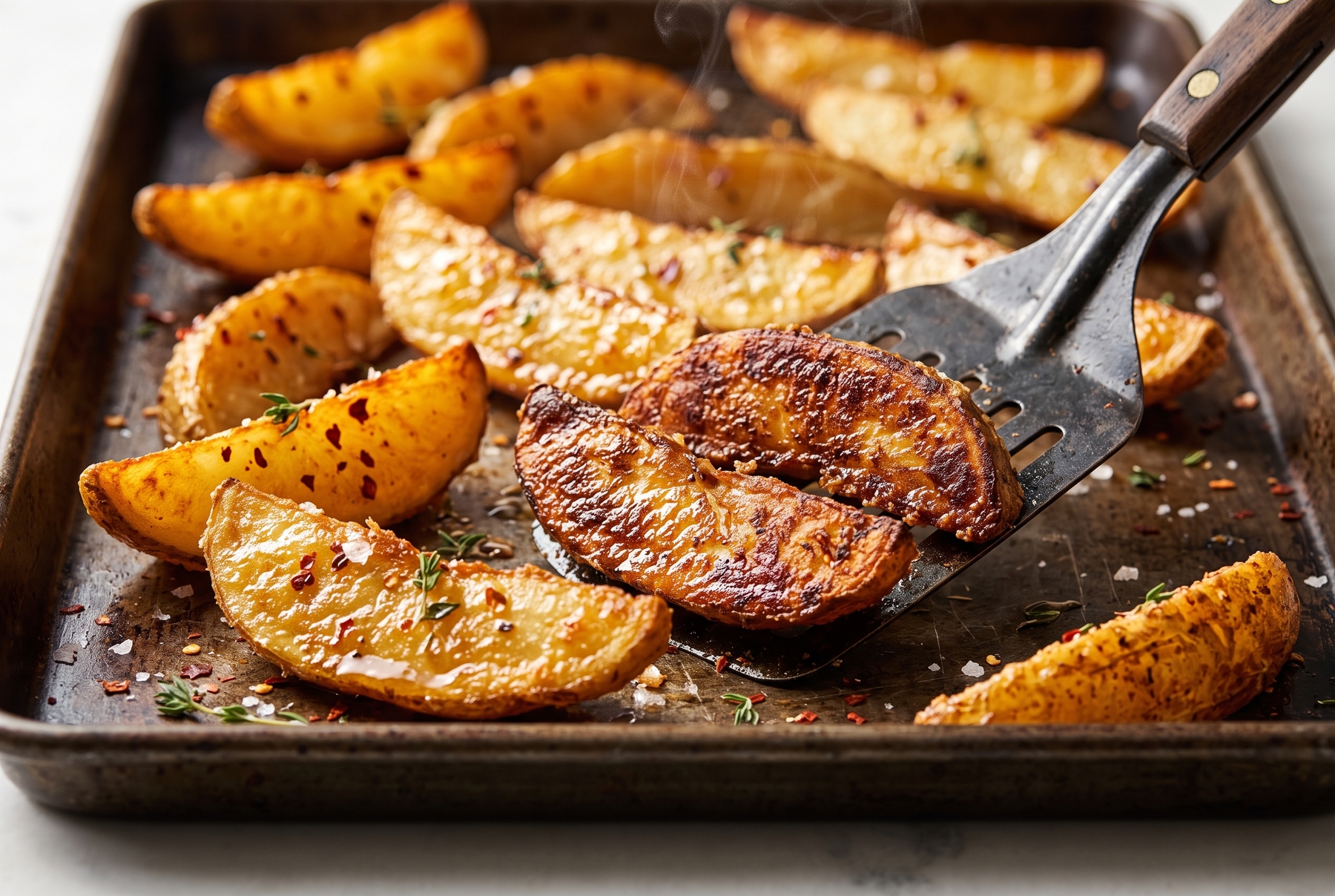
Crispy roasted potato wedges tossed in a glossy glaze of honey, apple cider vinegar, and crushed red pepper flakes.
13. Apple and Soy Sauce
While this pairing looks strange on paper, the underlying mechanics are simple: soy sauce delivers salt and fermented umami, apples bring crisp acidity and fruit sugar, and together they build a savory depth that neither ingredient possesses alone.
This combination adapts to several formats. In a raw salad, thinly sliced tart apples tossed with a few drops of soy sauce, neutral oil, and toasted sesame seeds make a bright slaw. Reduced together in a skillet until syrupy, apple juice and soy sauce form a quick glaze for roasted chicken or pork chops. Grated raw apple mixed with soy sauce, fresh ginger, and garlic serves as a classic Asian-style marinade or dipping sauce for grilled meats.
Precision with the soy sauce bottle determines the outcome. Because soy sauce is aggressively salty and dominant, three extra drops will completely bury the fruit. Tasting a slice of plain apple first, adding just a few drops of soy sauce to test the shift, and then deciding whether the mix needs extra acid (like lemon juice or rice vinegar) or oil keeps the ratios in check.
The control point: the apple must announce itself first. The soy sauce should arrive as a secondary wave of savory depth rather than the primary flavor.
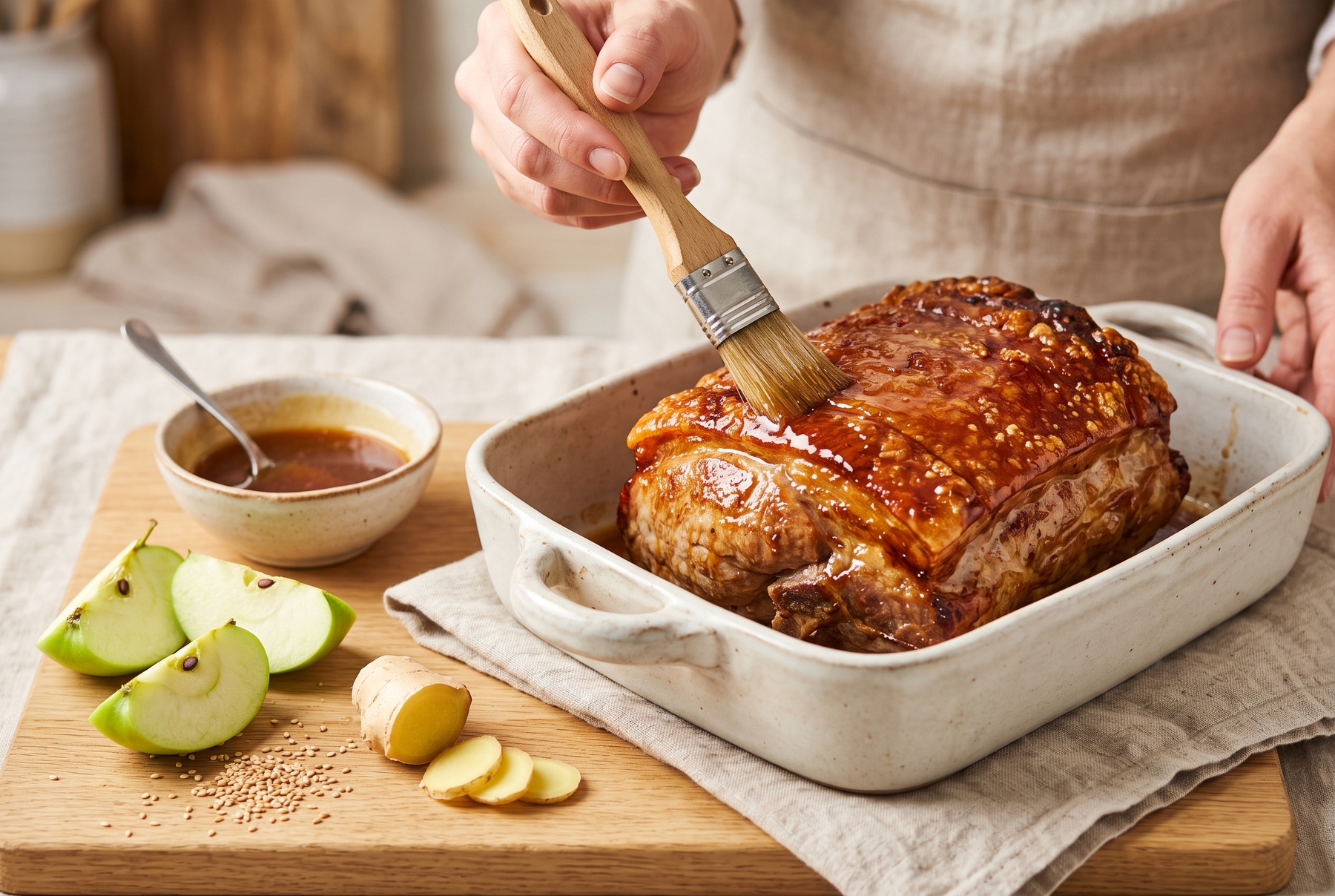
The fruity acidity of apples and the savory umami of soy sauce reduce into an aromatic lacquered crust on roasted meat.
14. Pineapple, Chili, and Salt
Multiple sensory contrasts collide in a single bite here.
Salt goes to work on the fruit’s sweetness by suppressing the perception of acidity and bitterness, making the pineapple taste noticeably sweeter than it actually is. Meanwhile, chili introduces a physical sensation entirely absent from the fruit itself: capsaicin triggers the same nerve receptors that respond to physical heat, tricking the brain into feeling warmth. The result is a cold, juicy piece of fruit that simultaneously warms the mouth.
The pineapple’s natural acidity acts as the third pillar. If a pineapple turns out overly ripe and sugary, a squeeze of lime juice restores tension. Conversely, if the fruit is sharp and acidic, skipping the lime and adding an extra pinch of salt balances the bite.
Eating fruit with salt and chili is a daily ritual in Mexico, where street vendors dust slices of mango and pineapple with Tajín—a vibrant blend of ground chilies, sea salt, and dehydrated lime juice. Similar traditions exist across Southeast Asia. Recreating it at home takes sixty seconds: chilled pineapple wedges, flaky salt, chili flakes or cayenne powder, and a lime wedge.
The control point: the heat should arrive just behind the sweetness and fade cleanly. If a fiery burn obliterates the fruit from the very first second, cut the chili in half.
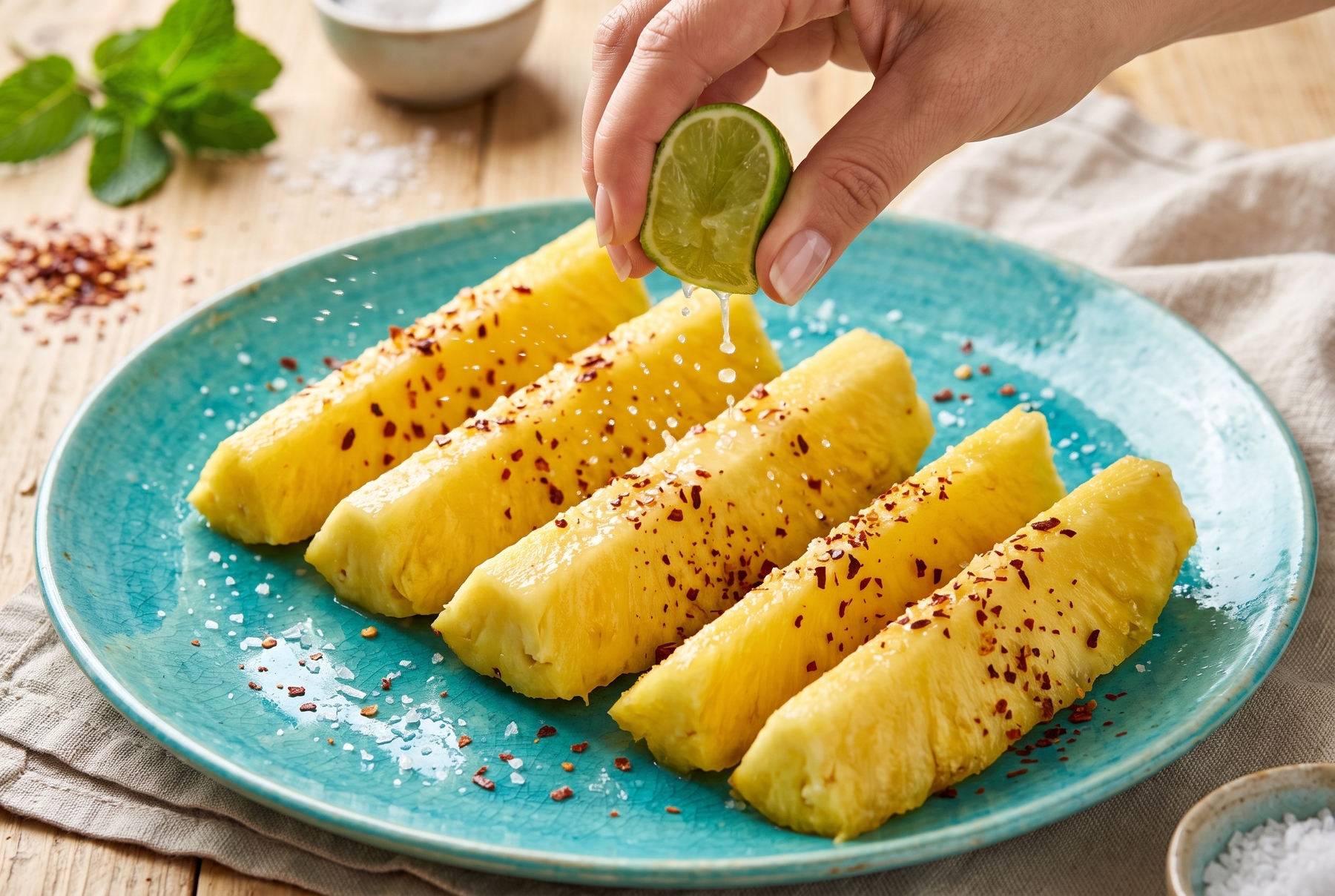
A Mexican street food classic: the vibrant contrast of sweet, juicy pineapple, warming chili heat, and bright lime juice.
15. Vanilla Ice Cream, Olive Oil, and Sea Salt
The final combination on the list requires three pantry staples and two minutes of assembly, serving as the ultimate at-home masterclass for everything covered in this guide.
Running the tasting step by step:
- Scooping high-quality vanilla ice cream into a bowl and tasting a plain spoonful establishes the baseline.
- Letting the bowl sit at room temperature for 3–4 minutes allows the surface of the scoop to soften slightly.
- Drizzling a teaspoon of good extra-virgin olive oil over the ice cream and taking a second bite reveals how fat and bitterness alter the dairy.
- Scattering a few flakes of coarse sea salt along the edge of the scoop and tasting again completes the picture.
The mechanics at play are unmistakable. The olive oil lends an herbal bitterness to the sweet dairy base and stretches the finish, preventing the ice cream from tasting one-note. The flaky salt illuminates the floral vanilla and creates tiny bursts of salinity against the smooth sweetness.
Temperature plays a much larger role here than most people realize. Rock-hard ice cream straight from the freezer mutes the olive oil’s aromatics almost entirely; extreme cold slows the evaporation of volatile compounds, effectively numbing the nose to the oil’s scent. Allowing the ice cream to temper slightly unlocks the oil’s perfume. Tasting two spoonfuls from the exact same bowl five minutes apart yields a startling difference.
The control point: the bite should leave a rounded, creamy finish with a peppery green note at the very end. If the mouthfeel turns greasy and heavy, too much oil was poured—half a teaspoon per scoop is usually plenty.
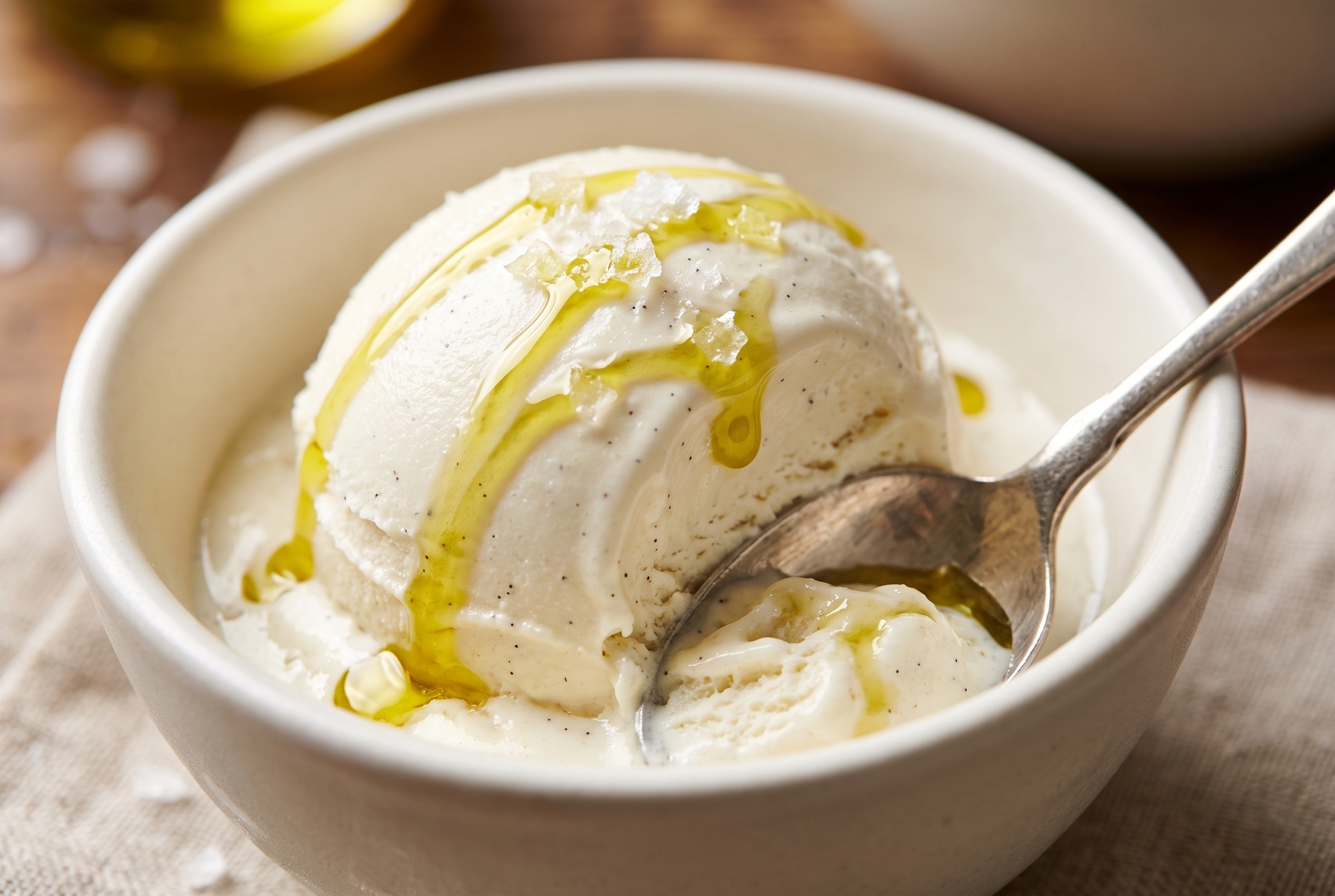
Extra-virgin olive oil lends a grassy depth to rich vanilla ice cream, while flaky sea salt sharpens the sweetness.
How to Invent Your Own Pairings Instead of Copying Recipes
The fifteen examples above form a repeatable framework that any home cook can use to build original combinations.
Start With an Ingredient You Know by Heart
Pairing two unfamiliar ingredients at the same time is a guaranteed dead end. When a dish fails, figuring out which component caused the wreck becomes impossible. Starting with a foundational ingredient whose flavor profile can be recalled with your eyes closed keeps the experiment grounded.
Decide What That Ingredient Lacks
Running the base ingredient through a quick mental checklist—salt, acid, sweetness, fat, bitterness, heat, aroma, temperature, texture—usually reveals the missing piece within ten seconds. An unsalted tomato tastes flat. A heavy cream sauce without acid feels leaden. A plain boiled potato is texturally monotonous.
Add Exactly One Contrast
Relying on proven structural formulas takes the guesswork out of brainstorming:
- Berry plus warm spice;
- Sweet fruit plus salty cheese;
- Rich dairy plus sharp acid;
- Deeply roasted plus sweet;
- Sweet plus savory umami.
Test It on a Single Bite
This remains the most practical habit in the kitchen. Changing a single variable and tasting the variations side by side within sixty seconds reveals the truth immediately. Professional chefs develop new menus this exact way: one tasting spoon, a second tasting spoon with a minor adjustment, and a quick decision.
Build the Dish Only After the Bite Works
A successful two-ingredient pairing is not yet a finished recipe. Turning it into a complete dish requires making decisions about texture (does it need crunch?), temperature (should everything be chilled, or does it need thermal contrast?), seasoning, and portion size. A combination that thrills the palate for a single bite can easily exhaust it by the fifth spoonful.
Why a Promising Pairing Failed at Home
One of the base ingredients simply lacked flavor. The sensory marker: tasting the raw ingredient on its own elicits no reaction whatsoever. A rock-hard, odorless peach, a pale winter tomato, or a mealy watermelon cannot be rescued by clever technique. Waiting for the right season is the only fix.
The proportions were skewed. The sensory marker: the primary ingredient disappears entirely, leaving the accent flavor dominating the mouth. Cutting the secondary ingredient in half and retesting usually solves the issue.
The aromatic component was heavy-handed. The sensory marker: the dish smells like a single note from start to finish, with no evolution on the palate. Vanilla, warm spices, raw garlic, and aggressive herbs are the usual culprits. Dialing the amount back by half—or even three-quarters—restores balance.
The serving temperature was off. The sensory marker: flavors register as cloying and flabby (classic symptoms of warm watermelon, room-temperature melon, or sweating cheese) or, conversely, muted and flat (over-chilled cheese or rock-hard ice cream). Letting the plate come to its proper temperature before judging the pairing makes all the difference.
Too many components crowded the plate. The sensory marker: the bite feels chaotic, no single ingredient stands out clearly, and the aftertaste is muddy. Stripping away the third and fourth garnishes to leave just the base and a single contrast almost always rescues the dish.
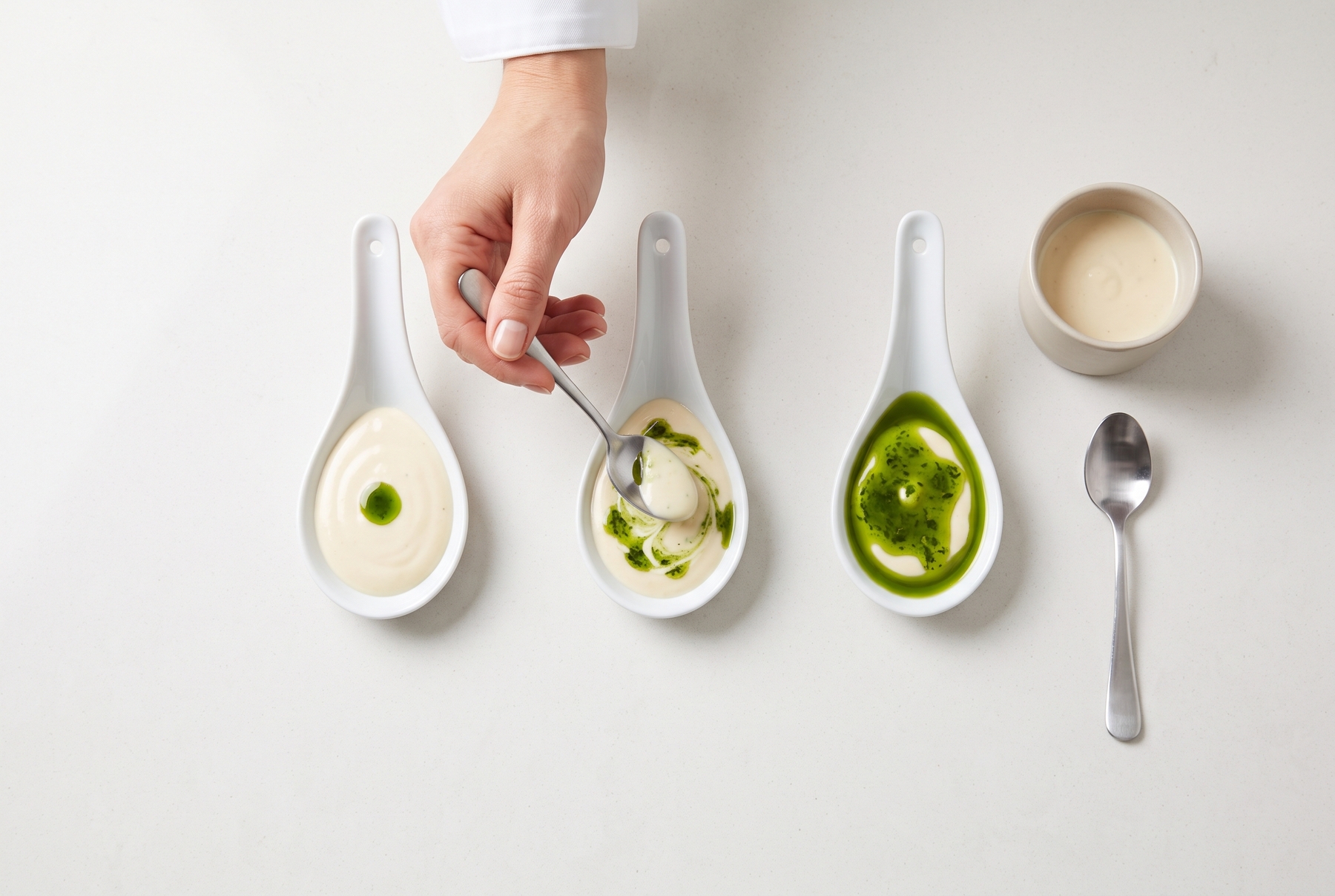
Dialing in the balance of a sauce by incrementally adjusting the proportion of a key aromatic ingredient.
Where to Start
For a low-risk introduction to flavor pairing, watermelon with feta, pear with blue cheese, and hot honey are ideal starting points. The culinary logic behind them is obvious from the first bite, they are difficult to ruin, and getting the proportions wrong is nearly impossible.
The next tier—strawberries with black pepper, apples with soy sauce, and dark chocolate with olive oil—requires a lighter touch. Here, precise dosing matters, and the outcome depends heavily on the quality of the pantry staples.
For cooks looking to push their boundaries further, pairing vanilla with shellfish offers a serious challenge. Pulling it off demands pristine seafood, restraint with the knife tip, and a willingness to toss the first attempt in the trash.
Ultimately, none of these combinations have a single objectively correct ratio. Some palates will never warm up to peppered strawberries, and discovering personal boundaries is a normal part of kitchen experimentation rather than a failure.
A Good Pairing Can Always Be Explained
Returning to the core rule of the professional kitchen: compelling food does not need to be complicated, but every element on the plate must earn its keep. Salt pulls flavor forward, acid cuts through richness, and crunch wakes up a soft dish.
The ultimate test of a successful pairing is simple: once the initial surprise fades, the person eating the dish should intuitively understand why each ingredient is there. If the only explanation available is that it seemed “interesting,” the combination was likely an accident.
Putting this philosophy into practice at home takes five minutes. Picking one pairing from this guide, assembling two or three tiny bites with slightly different ratios of the secondary ingredient, and tasting them back-to-back makes the mechanics of flavor tangible. One version will inevitably stand out above the rest—and the difference will come down to a fraction of a gram rather than a secret ingredient.
0 comments