
Consider a two-thousand-euro refrigerator. It boasts an inverter compressor, seven operating modes, and a sleek touchscreen panel on the door. Delivery crews bring it in, level the feet, plug it into the wall, and leave it on the factory settings. Alternatively, the homeowner switches it to “Eco” mode because nobody enjoys high electricity bills.
Within a week, questions arise. Salad greens in the crisper drawer turn into slime in four days. Sunday’s soup tastes sour by Wednesday. An open bottle of milk stored in the door curdles a full day before its expiration date, and the dairy processor takes the blame.
Incidentally, milk almost always ends up in the refrigerator door. Manufacturers mold a convenient bin right into the liner, sized specifically for a 1-liter (approx. 1-quart) bottle. Industrial designers shaped that bin for the container without considering food preservation, assigning the most unstable product in the kitchen to the most thermally unstable spot in the appliance.
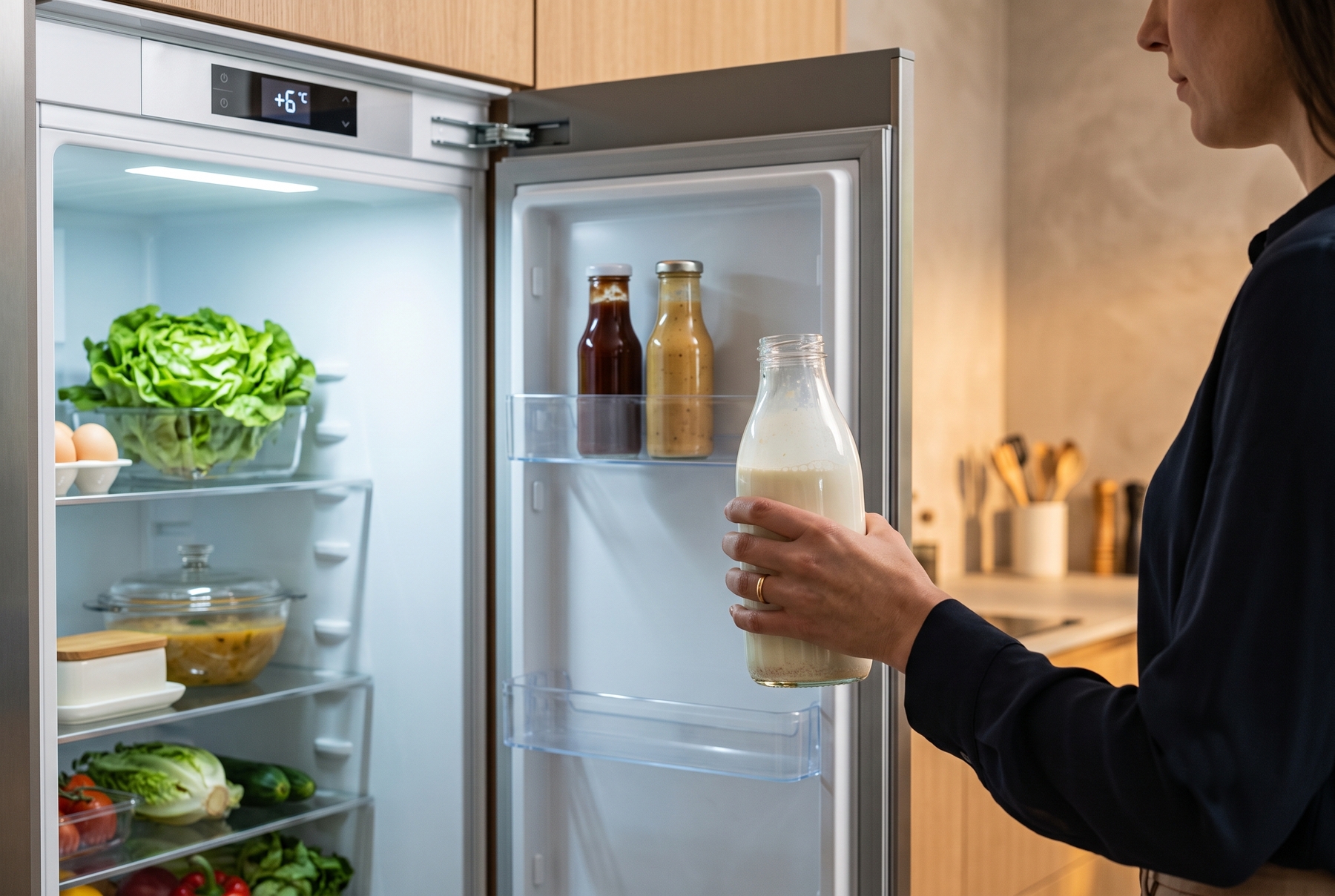
Keeping milk in the refrigerator door is a widespread mistake: constant temperature swings every time the door opens accelerate spoilage.
Table of Contents
Between +2°C and +4°C (35°F to 39°F): Why These Numbers Beat the “Eco” Mode
Setting the main compartment between +2°C and +4°C (35°F and 39°F) is essential for food safety. Food scientists did not pick these numbers for aesthetics: around +5°C (41°F), the microbial inhibition zone ends, and active growth begins for most spoilage bacteria and pathogens.
Cold temperatures do not kill microflora; they merely buy you time. Before a bacterial cell divides, it goes through a lag phase (a period where it adapts to the environment without reproducing), and the length of this phase depends directly on temperature. At +2°C (35.6°F), ground meat stays safe for a full day with room to spare. At +7°C (44.6°F), that exact same ground meat breezes through its lag phase, and spoilage becomes a matter of hours.
Certain microorganisms continue to grow even inside the refrigerator. Listeria monocytogenes and Yersinia enterocolitica reproduce at +4°C (39°F), just at a slower pace. Soft cheeses, pâtés, and sliced deli meats still spoil at +4°C (39°F), only more gradually.
Dropping the temperature lower is counterproductive as well. Below +1°C (34°F), the water inside the cells of leafy greens begins to crystallize, rupturing cell membranes and leaving thawed lettuce covered in dark, translucent bruises. Cucumbers suffer the exact same fate, looking intact on the outside while turning into wet cotton inside.
The external display reads data from a sensor located in a single spot inside the cabinet (usually near the top back wall, closest to the evaporator). By the time that cold air reaches your food, the numbers shift. In standard household models, the discrepancy between the digital display and the actual temperature on the middle shelf easily reaches 2°C (3.6°F), which is more than enough to sour milk ahead of schedule.
Why Different Refrigerator Shelves Have Different Temperatures
The physics here are straightforward. Cold air is denser than warm air, causing it to sink while warmer air rises toward the ceiling of the cabinet. In refrigerators with a cycle defrost system (often called a “weeping wall” in Europe, where frost periodically builds up and melts down the back panel), the temperature gap between the top and bottom shelves can reach 3°C (5.4°F). In No-Frost models, a fan circulates air mechanically, narrowing the gap without eliminating it entirely.
The Bottom: Meat, Fish, and the Chiller Compartment
The coldest shelf sits at the very bottom, directly above the vegetable drawers. This is the designated spot for raw meat, poultry, fish, and anything currently thawing. Temperature is only half the reason: if raw chicken juices leak from a container on the bottom shelf, nothing sits underneath to get cross-contaminated.
If the appliance features a dedicated chiller compartment or zero-degree zone (an isolated drawer with its own climate control hovering around 0°C or 32°F), raw meat and fish belong there. A steak purchased on Thursday maintains its bright, even color right through Saturday. Left in the main compartment at +4°C (39°F), its edges would already turn gray by then.
Crisper drawers run 1°C to 1.5°C (1.8°F to 2.7°F) warmer than the bottom shelf, but they maintain much higher humidity. Fresh herbs belong here, and they last significantly longer when stored unwashed, since wet leaves rot quickly from the stem up. Wrapping a bunch of parsley in a barely damp paper towel before placing it in the drawer preserves its crispness. Left in an open plastic bag, it dries into brittle straw within forty-eight hours.
The Middle and Top: Cooked Food, Dairy, and Eggs
The middle shelves maintain the most consistent temperatures. While slightly warmer than the bottom, this zone barely fluctuates when the door swings open. Cooked dishes in sealed containers, opened dairy products, cheeses, and eggs thrive here.
Many households habitually store eggs in the door for the exact same reason as milk (the manufacturer provided a molded plastic tray). However, eggs fare noticeably better on the middle shelf inside their original cardboard carton. Eggshells are porous, and every thermal swing causes condensation to form on the cold surface. While moisture itself does not contaminate the egg, it significantly increases the odds of surface microflora migrating inward through the pores.
In a gravity-coil (natural circulation) refrigerator, the top shelf is the warmest zone, making it ideal for beverages, unopened jars, and everyday items that will be consumed within a few days rather than stored for a week.
The Door: The Turbulence Zone
Every time the door opens, ambient kitchen air rushes into the door bins. In the summer, that air sits around +26°C (79°F), and during active stovetop cooking, it easily hits +30°C (86°F). Items stored in the door absorb this thermal shock first, completely unprotected, before slowly chilling back down. Opening the fridge twenty times a day repeats this warming cycle twenty times.
Condiments preserved with vinegar or high salt content, such as ketchup and mustard, handle this turbulence effortlessly, alongside sealed water bottles and butter (which contains very little water and high fat, making it a poor medium for bacterial growth).
Pasteurized milk, heavy cream, infant formula, and homemade sauces based on raw egg yolks or sour cream cannot tolerate these swings. Once opened, a carton of milk is already inoculated with airborne microflora and bacteria from the pouring lip. From that moment on, temperature dictates shelf life, and the door temperature is constantly wandering.
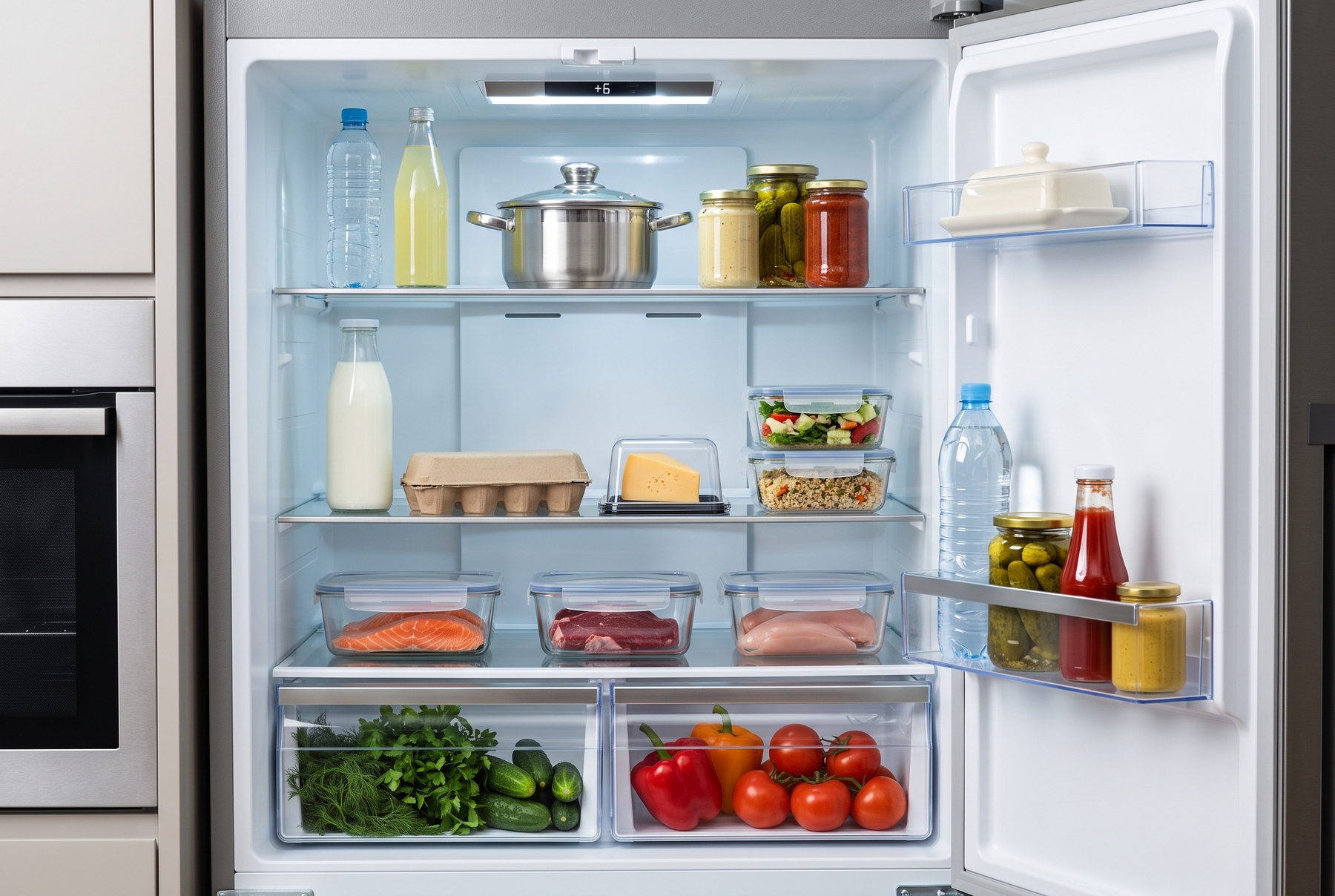
Smart food placement by temperature zone: raw meat and fish on the bottom, cooked meals on the middle shelves, and produce in the crisper drawers.
How to Stock a Refrigerator Without Blocking Airflow
Moving air is what actually cools your food. Without circulation, the refrigerator cabinet turns into an insulated thermos with uneven heat pockets.
Three common mistakes routinely ruin internal airflow:
- Pushing pots flush against the back wall. In cycle defrost models, the evaporator sits right behind that liner. Anything touching it freezes solid and turns soggy upon thawing. Furthermore, blocked walls prevent condensation from draining properly; stray food crumbs clog the drain hole, resulting in a puddle underneath the crisper drawers.
- Building a solid wall of containers along the front edge. Cold air cannot penetrate deeper into the cabinet, creating a warm pocket right inside the door. In an overpacked fridge, the temperature difference between the front and back of the exact same shelf can reach 2°C (3.6°F).
- Blocking the air vents in No-Frost models. These usually look like a series of slots along the back panel. Placing a tall juice carton directly in front of them effectively cuts off half the cabinet from cold air circulation.
A reliable rule of thumb is leaving two fingers of breathing room between food items and the interior walls, keeping the cabinet about three-quarters full. A well-stocked refrigerator genuinely holds its temperature better when the door opens because the chilled food mass acts as a thermal battery. However, that physics trick only works if air can still move freely between the containers.
Hot cookware requires special handling. Placing a warm pot of soup inside raises the temperature of the surrounding shelves and forces the compressor to run nonstop. Conversely, leaving the pot on the counter for hours to reach room temperature is equally risky: the broth lingers right inside the temperature danger zone where bacteria multiply fastest. A much faster and safer approach involves transferring the soup into a wide, shallow container and setting it in a sink filled with cold water for 20 to 30 minutes before refrigerating.
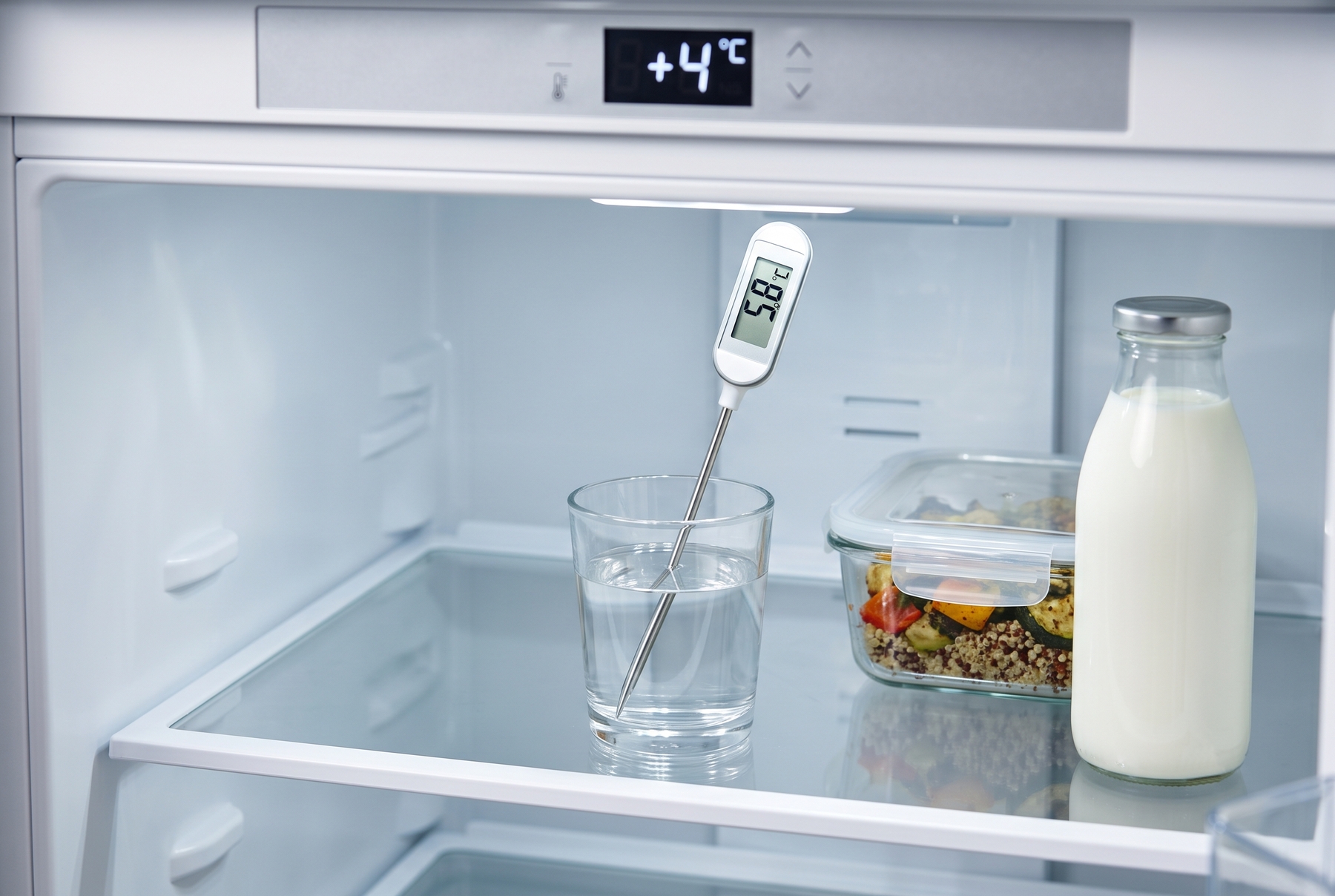
The glass of water test reveals the actual temperature of your food: the discrepancy with the external display can reach 2°C (3.6°F).
The Food Technologist’s Checklist: 6 Signs Your Appliance Is Lying
- a thick coat of ice or heavy frost buildup on the back wall (in a cycle defrost system, the wall should periodically form water droplets and dry out again);
- standing water underneath the vegetable drawers, indicating a clogged defrost drain;
- ice crystals forming on lettuce leaves, or dark, glassy spots appearing on cucumbers and tomatoes, which means the temperature has dropped below freezing;
- unopened milk and sour cream spoiling one to two days before their printed expiration date;
- condensation pooling on the inside of the door liner and fogged-up food containers;
- the compressor humming continuously without cycling off.
How to Check Your Refrigerator Temperature: The Glass of Water Test
Built-in digital displays are notoriously optimistic, and placing a standard thermometer on a shelf only measures air temperature, which plummets and spikes every time the door opens. Measuring water provides an accurate thermal reading.
- Pour tap water into a glass and submerge a standard kitchen thermometer in it.
- Place the glass in the dead center of the middle shelf, close the door, and leave it undisturbed for 8 to 12 hours (overnight works best).
- Read the temperature immediately upon opening the door, without removing the glass from the shelf.
- Repeat the exact same process on the bottom shelf and in the door bin to map out your specific appliance’s microclimates.
Water reflects the actual core temperature of your stored food mass rather than a fleeting draft of warm kitchen air. While testing, it also pays to check the door gasket: close the door on a slip of paper and tug on it. If the paper slides out with zero resistance, the rubber seal has flattened, and the appliance is actively air-conditioning the kitchen.
In my own kitchen, the refrigerator’s digital panel reads +4°C (39°F). Meanwhile, a glass of water on the middle shelf registers +5.8°C (42.4°F). Knowing that discrepancy by heart, I simply keep the digital panel set to +2°C (35.6°F).
0 comments