
A wide slab of watermelon sits on a plate, finished with a thin ribbon of olive oil, flaky sea salt, and chili flakes. The first bite is a revelation. The sweetness remains intact, yet it feels more focused and almost savory around the edges, followed immediately by a rich, buttery weight and a slow peppery warmth. This is an appetizer in its own right. It practically begs for a glass of chilled dry wine and a piece of crusty bread, leaving no trace of dessert behind.
Watermelon is deceptive in this regard, offering far more culinary potential than it typically gets credit for. Most people treat it as a finished dish: you slice it, pass the wedges around, and give it no further thought. Structurally, however, its flesh is much closer to a cucumber or a tomato, defined by high water content, a crisp snap, and restrained sweetness. With that specific set of traits, watermelon easily transitions into savory salads, skewered appetizers, sauces, chilled soups, grilled dishes, and iced drinks.
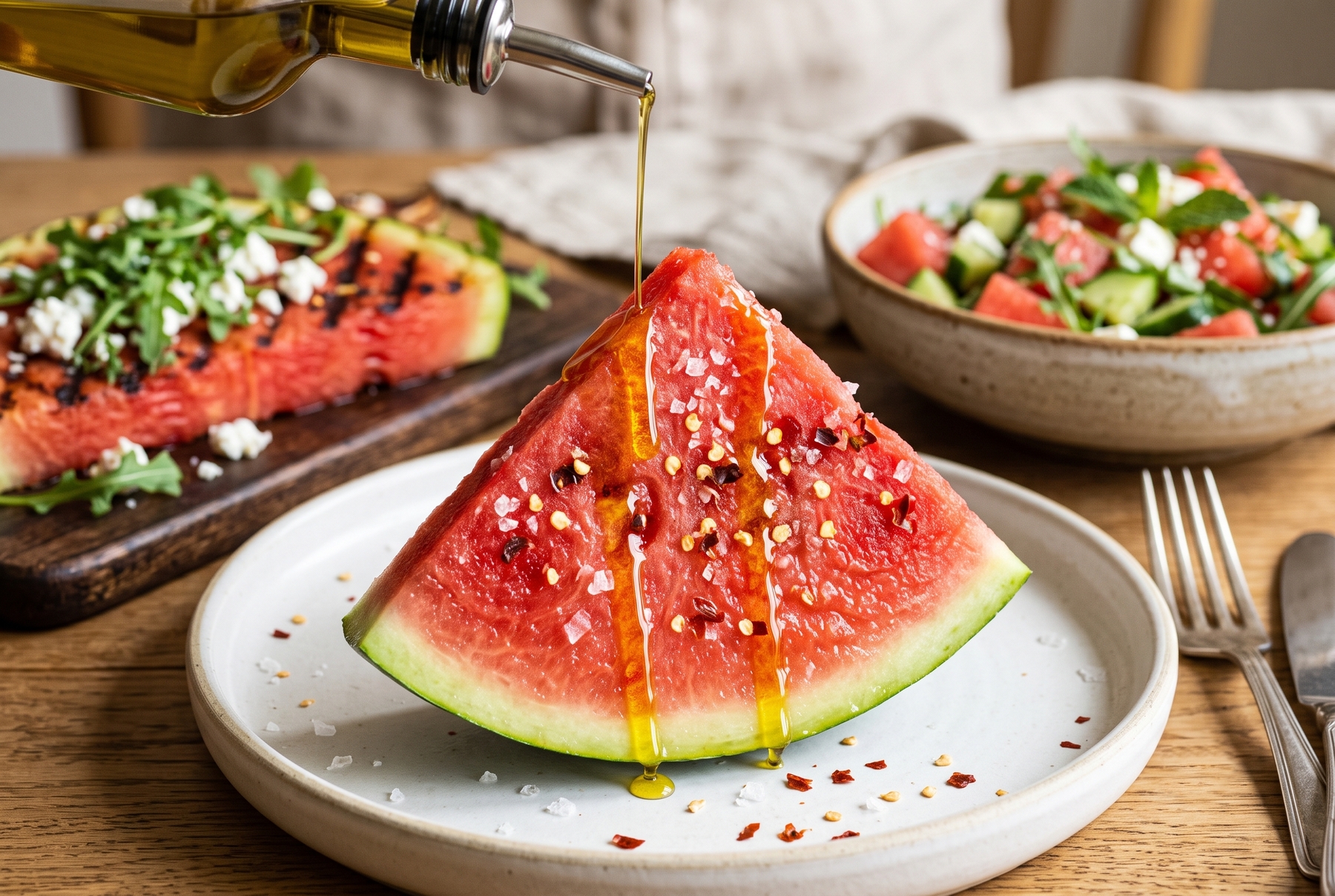
A thick slice of watermelon finished with olive oil, chili flakes, and flaky sea salt makes an unexpected, sophisticated appetizer.
Table of Contents
- Why Watermelon Belongs Beyond the Dessert Plate
- Five Toppings That Transform a Simple Wedge
- Salads Where Watermelon Replaces Tomatoes or Cucumbers
- Heartier Watermelon Salads
- Watermelon Appetizers and Skewers
- Salsa and Quick Pickles
- Grilled Watermelon
- Chilled Watermelon Soups and Sauces
- Watermelon Drinks
- Watermelon Desserts
- What to Make with Watermelon Rinds
- The Flavor Matrix: Building a Dish in 5 Layers
- 7 Reasons a Watermelon Dish Turned Out Watery
- Matching the Melon to the Method
Why Watermelon Belongs Beyond the Dessert Plate
Breaking down its flavor profile reveals why it works so well in savory contexts. Water makes up the vast majority of the flesh, which is why watermelon always registers as refreshing rather than heavy. Its sweetness is gentle, lacking the dense sugariness of honey or a ripe pear, while its aroma is distinctly green and cucumber-like, carrying a grassy coolness. That signature crunch holds up only as long as the flesh remains dense and firm.
Salt works through pure contrast: a few crystals scattered across the cut surface amplify the fruit’s natural sugars because our palates perceive sweetness much more acutely alongside salinity. Acidity pulls the watermelon’s flavor into sharp focus, stripping away any impression of cloying sugar water. Introducing a fat—such as olive oil, cheese, avocado, or nuts—anchors the herbs and spices so they linger on the palate rather than vanishing in two seconds. Finally, heat and spice provide the exact culinary tension that makes serving watermelon so compelling in the first place.
This leads to one core principle: treating watermelon as a juicy canvas that requires just one of four flavor accents—salty, acidic, spicy, or herbal. A single accent is enough for a quick snack, while two will carry a salad. Three accents start competing for attention, and four turn the plate into a muddled mess.
Choosing the Right Watermelon for the Dish
Very ripe, slightly mealy flesh that releases juice the moment the knife touches it is best reserved for drinks, granitas, sorbets, chilled soups, sauces, and freezing. In those applications, texture is irrelevant; only sweetness and aroma matter.
Dense, crisp flesh belongs in salads, on skewers, in marinades, and on the grill. A quick test helps determine where a melon stands: cutting a 2 cm (0.8 inch) cube and leaving it on the cutting board for 10 minutes reveals its structural integrity. If it holds its sharp edges without slumping or sitting in a puddle of its own juice, it is ready for knife work. If the board is flooded and the edges turn soft, the melon belongs in the liquid category rather than a salad.
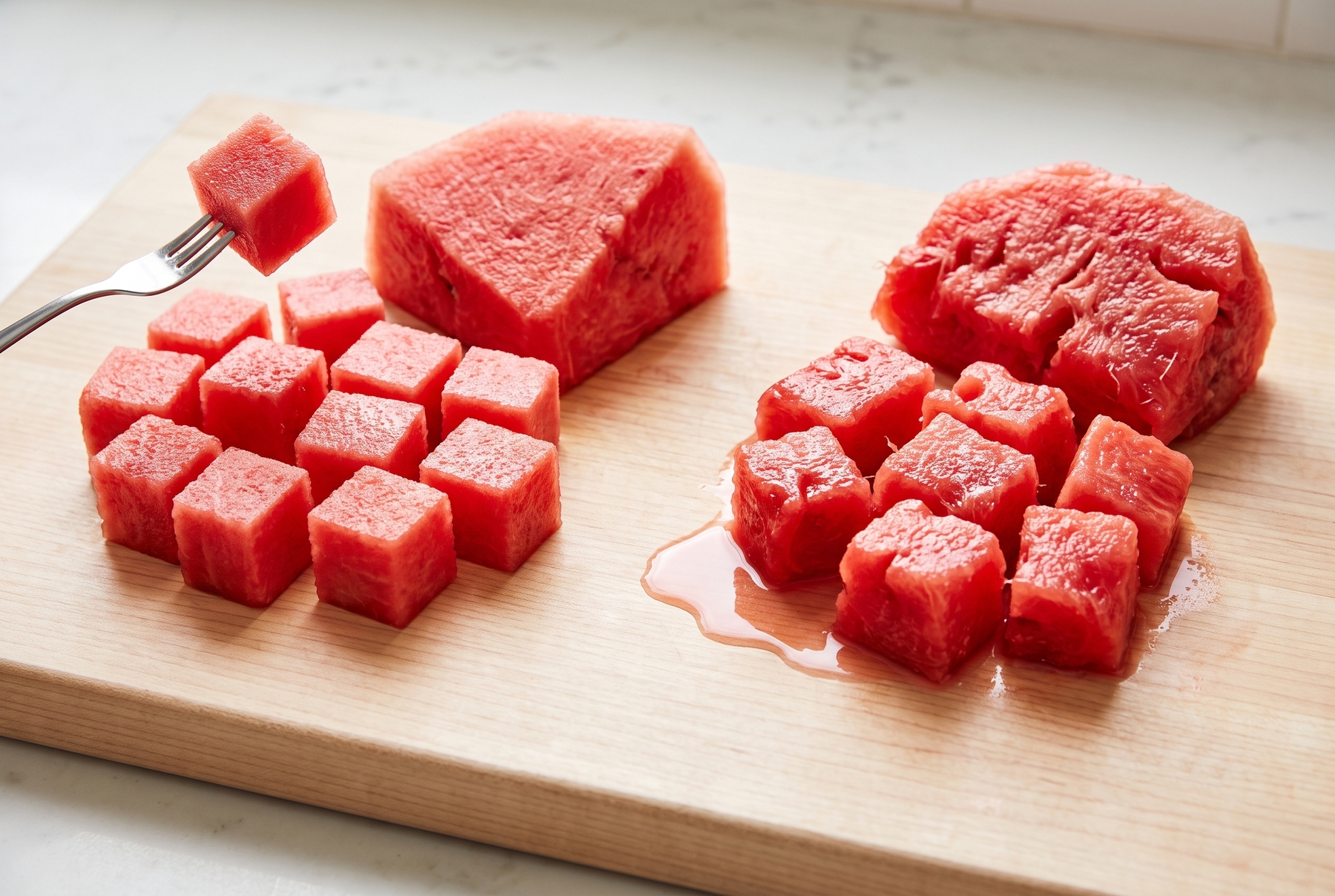
Dense, crisp flesh is ideal for salads and the grill, while watery, overripe melon belongs in drinks and chilled soups.
Five Toppings That Transform a Simple Wedge
This is the shortest route to a new flavor profile. No cooking is required—just a shift in how the sliced fruit is finished.
1. Flaky Sea Salt
Just a few coarse crystals scattered across the cut surface provide a distinct crunch before dissolving. Salting must happen right before eating; salt draws out moisture rapidly, and waiting 15 minutes turns a crisp wedge into soggy flesh sitting in a pink puddle.
2. Chili and Lime
Squeezing the juice of half a lime over a couple of wedges, followed by chili flakes or ground hot pepper and a pinch of salt, replicates a classic Latin American street food tradition, where vendors often use pre-made blends of salt, chili, and dehydrated citrus (like Tajín). Acidity is more important than heat here; without lime, the pepper simply hangs flatly on the tongue.
3. Sumac
Sumac brings a tart, berry-like astringency that replaces lemon juice without adding excess liquid that makes the flesh slip. A generous hand works best—about half a teaspoon per large wedge—because sumac is milder than it looks and gets lost in small amounts. Finely grated lemon zest and a few drops of juice offer a solid substitute if sumac is unavailable.
4. Mint and Black Pepper
Black pepper is here purely for its aroma: freshly cracked and coarse, delivering that piney, resinous bite that pre-ground pepper loses long before it reaches the shelf. It is easy to dismiss this combination as a gimmick at first. Yet three turns of the pepper mill and a few hand-torn mint leaves elevate a plain wedge into a dish that restaurants happily charge good money for.
5. Olive Oil and Coarse Salt
Slicing the watermelon into wide, 2 cm (0.8 inch) steaks and finishing them with a drizzle of peppery extra-virgin olive oil and coarse salt adds immediate depth. The oil gives the fruit a fuller body and acts as a flavor carrier, giving herbs, cracked pepper, and citrus zest something to cling to.
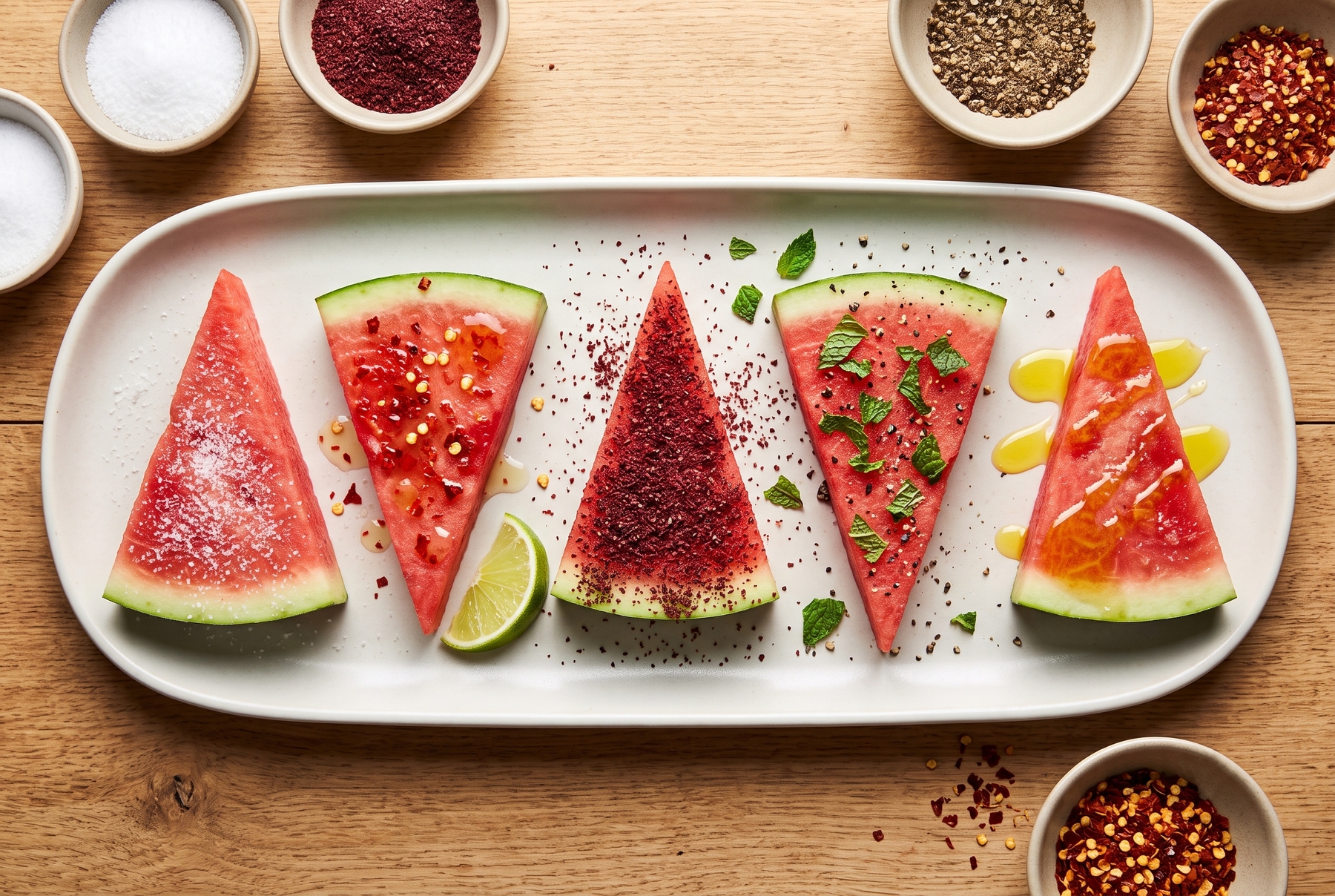
Simple pantry toppings transform a plain wedge: flaky sea salt, chili and lime, sumac, mint with black pepper, or extra-virgin olive oil.
Salads Where Watermelon Replaces Tomatoes or Cucumbers
Anywhere a dish calls for juiciness, cooling relief, and crunch, watermelon can step in for tomatoes or cucumbers, contributing a gentle sweetness that neither vegetable possesses.
6. Watermelon, Brined Cheese, and Cucumber
Serving four requires 500 g (1.1 lbs) of firm watermelon cut into 2 cm (0.8 inch) cubes, 200 g (7 oz) of feta or sheep’s milk brined cheese (such as Eastern European bryndza), one cucumber, half a red onion sliced into thin feathers, fresh mint or basil, 2 tablespoons of olive oil, and the juice of half a lemon. Soaking the sliced onion in the lemon juice for 5 minutes before assembly tames its harsh bite and turns it a vibrant pink. Because the cheese is naturally salty, any extra salt should wait until after the first taste.
Assembly should happen just a couple of minutes before serving. A watermelon salad left sitting for half an hour inevitably turns into a cold soup with floating cubes.
7. Watermelon with Tomatoes and Basil
Combining equal parts flavorful field-grown tomatoes and watermelon—about 400 g (14 oz) of each for four servings—with plenty of basil, 2 tablespoons of olive oil, and 1 teaspoon of red wine or balsamic vinegar creates a study in contrasts. While the textures are similar, the flavors never feel monotonous: the tomatoes deliver acidity and umami, while the watermelon brings sweetness and crunch. Salting the tomatoes separately and letting them sit for 5 minutes before tossing everything together draws out their best flavor.
Heartier Watermelon Salads
8. Watermelon with Avocado and Lime
Pairing avocado with watermelon creates a striking contrast between creamy and juicy textures, finished with lime juice, scallions, and cilantro or parsley (for those who find cilantro soapy). Keeping the avocado to about one-third the volume of the watermelon prevents the salad from becoming heavy and pasty; a single avocado is plenty for 400 g (14 oz) of melon.
The dressing relies on the juice of half a lime, 1 tablespoon of olive oil, a pinch of salt, and a bit of lime zest. Tossing the avocado in the lime juice first before folding in the watermelon helps the acid slow down any browning.
9. Watermelon with Radish and Soft Goat Cheese
Radishes and soft goat cheese give the salad a sharper edge, combining peppery roots with crisp greens and creamy cheese crumbles. Slicing the radishes into thin rounds rather than cubes distributes their heat evenly across the plate instead of concentrating it into a single overwhelming bite. Dressing only the greens is key here; the watermelon will release its own juices, and an extra spoonful of oil will weigh the dish down.
A large bowl calls for 1 teaspoon of white wine vinegar or lemon juice, 2 tablespoons of olive oil, a dab of Dijon mustard on the tip of a knife, salt, and black pepper. The mustard stabilizes the emulsion so the vinaigrette clings to the wet cubes rather than pooling at the bottom of the bowl.
10. Watermelon with Arugula, Cheese, and Nuts
This version pairs the sweet fruit base with bitter greens, salty cheese, and a toasted crunch. Walnuts or pistachios lightly toasted in a dry skillet, crumbled soft cheese, and a squeeze of lemon bring the dish together.
The vinaigrette combines 1 tablespoon of lemon juice, 2 tablespoons of olive oil, a quarter teaspoon of runny honey, salt, and pepper. The honey isn’t there to sweeten the dish, but rather to round out the sharp bitterness of the arugula, which can sometimes clash against the delicate melon.
11. Watermelon with Rice Vinegar and Sesame
Tossing watermelon with cucumber, scallions, toasted sesame seeds, 1 tablespoon of rice vinegar for a large bowl, and just a touch of soy sauce shifts the flavor profile toward East Asia. Half a teaspoon of soy sauce is plenty; any more quickly overwhelms the fresh fruit and tints the flesh a muddy brown. Toasted sesame oil should also be used by the drop, as its roasted aroma easily dominates.
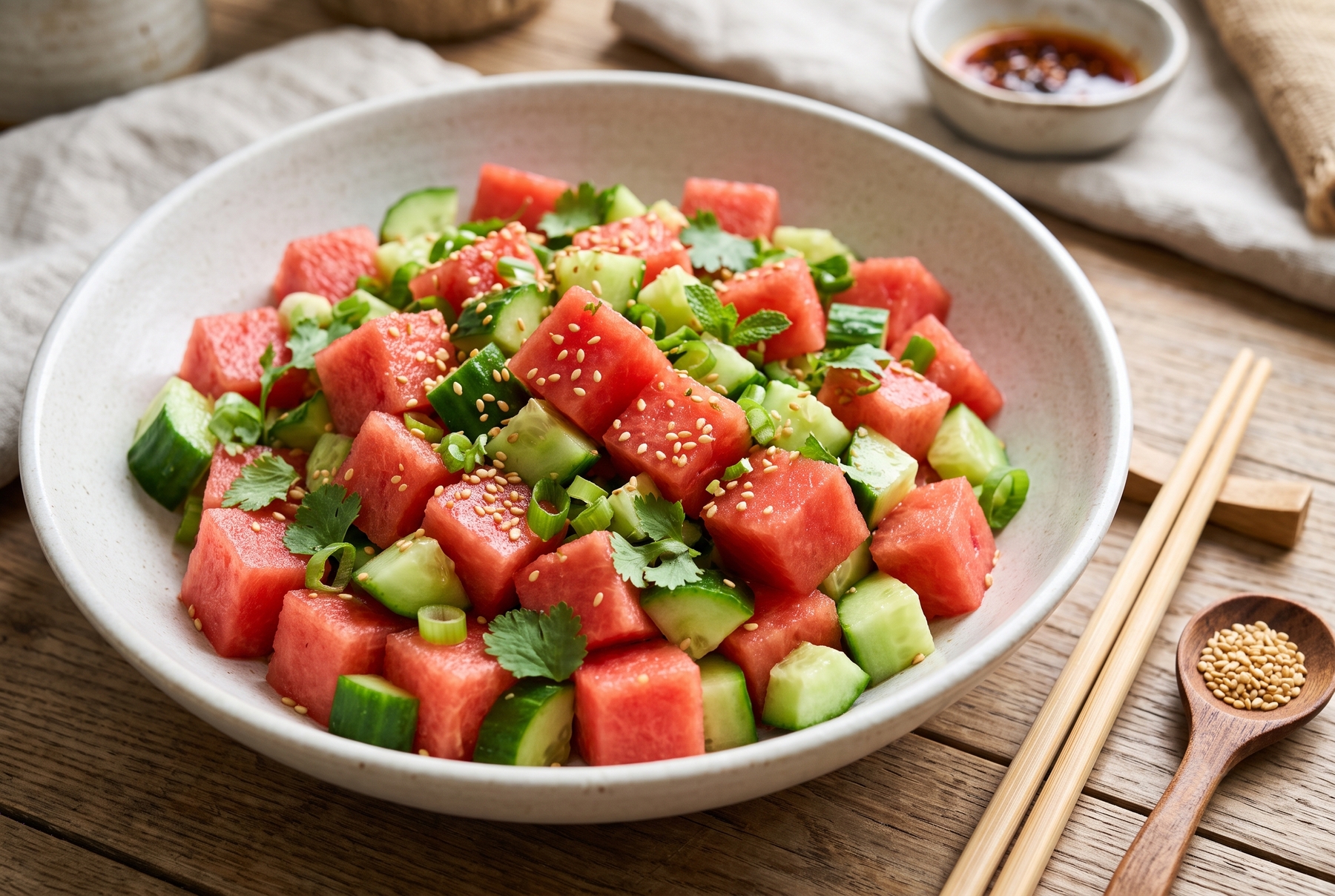
A refreshing watermelon and cucumber salad dressed with rice vinegar, scallions, and toasted sesame seeds.
Watermelon Appetizers and Skewers
Watermelon lends itself well to quick party bites—skewers and canapés—though it demands precise knife work. Each piece must be substantial enough to hold together on a pick without splitting, yet small enough to eat in one or two bites. A 2.5 cm (1 inch) cube is the ideal benchmark.
12. Watermelon with Feta and Mint
This is the most reliable trio in the repertoire: sweet, salty, and cooling. Cutting the feta or brined cheese into cubes slightly smaller than the watermelon prevents its saltiness from overpowering the bite. Tucking the mint leaf snugly between the two keeps it from sticking out like a sail and drying out in the air. Assembling the skewers with the watermelon on the bottom ensures that any escaping juice runs down to the plate rather than soaking the cheese.
13. Watermelon with Mozzarella and Basil
Draining ciliegine (cherry-sized) mozzarella in a sieve and patting it thoroughly dry with paper towels is essential; otherwise, two wet textures meet on the skewer and the flavors wash out. Flaky salt and a drop of olive oil are mandatory here rather than a mere garnish, keeping the bite from tasting flat. Small basil leaves work best, though larger leaves can simply be torn by hand.
14. Watermelon with Aged Cheese and Green Olives
This combination caters to those who prefer a denser, more savory bite. Aged hard cheese brings a nutty dryness that crumbles on the palate, the green olive adds a punchy brined note, and the watermelon tempers both extremes with its juice. Because the olive carries so much salinity, a smaller piece of cheese is all that is needed.
15. Watermelon Canapés with Whipped Cheese
Instead of a tall cube, the base here is a flat square cut about 1.5 cm (0.6 inch) thick; low and wide, it won’t tip over under the weight of a topping. Cream cheese, soft goat cheese, or ricotta goes on top, finished with fresh herbs, a toasted nut, or a drop of hot sauce. Blotting the top surface of the melon with a paper towel right before assembly is crucial, as cheese will slide right off a wet surface and onto the tablecloth.
16. Watermelon with Cured Ham
This follows the exact same culinary logic as cantaloupe and prosciutto, placing sweet, juicy fruit alongside salty, rich fat. There is no need to hunt down a specific imported label; any thinly sliced dry-cured ham, prosciutto, or jamón with a clean ribbon of fat works beautifully. The slices must be shaved thin enough to drape effortlessly over the melon rather than sitting stiffly on top. A crack of black pepper is the only finishing touch required.
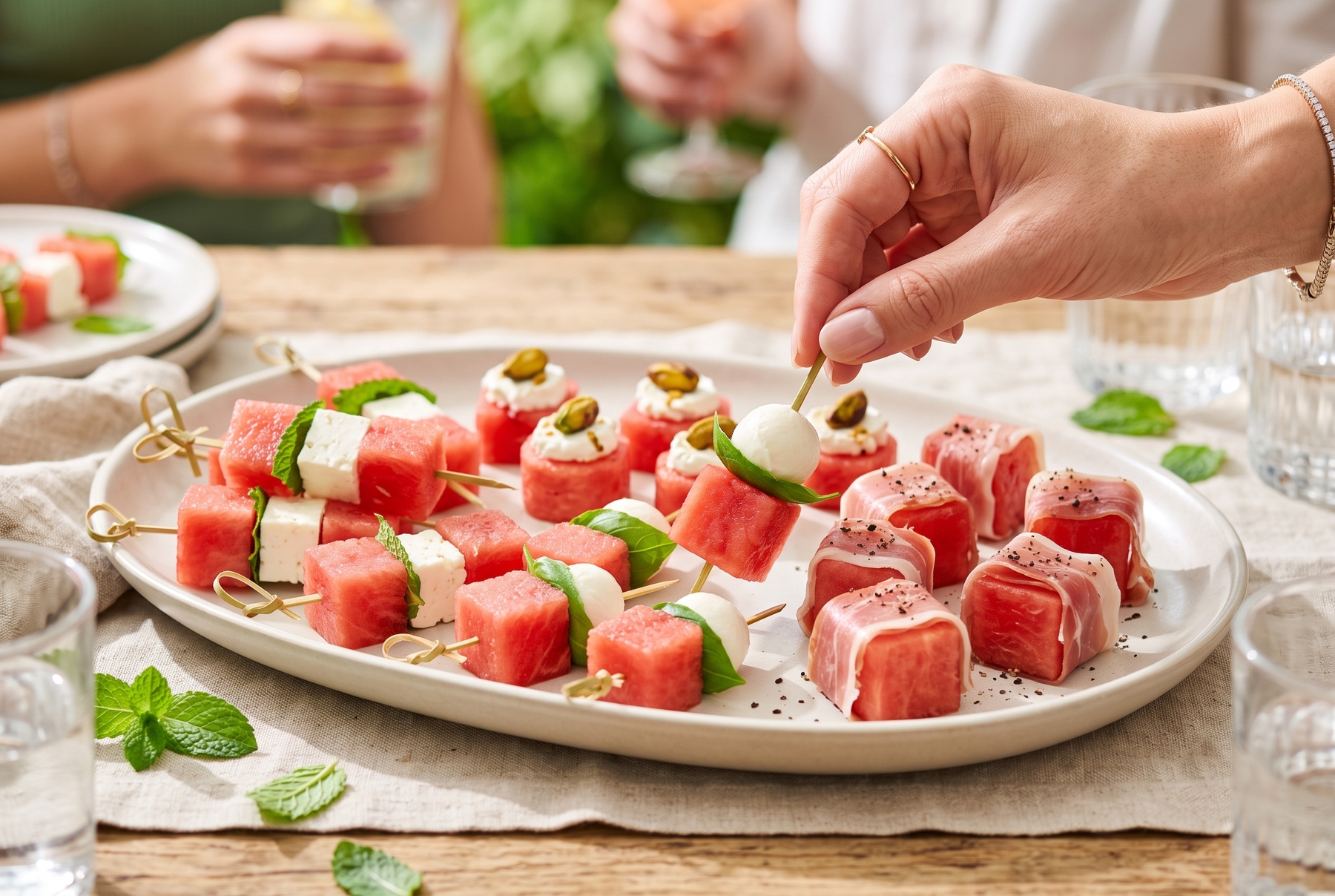
An assortment of bite-sized watermelon appetizers paired with feta, mozzarella, fresh mint, and thinly sliced dry-cured ham.
Salsa and Quick Pickles
17. Watermelon Salsa
Finely dicing 300 g (10.5 oz) of watermelon into 5 mm (0.2 inch) cubes and tossing it with half a small red onion, the juice of one lime, a handful of cilantro, half a seeded chili pepper, and salt creates a vibrant accompaniment. Letting the mixture sit for 10 minutes and draining off the excess liquid prevents the salsa from flooding the plate. It pairs effortlessly with grilled fish, roasted chicken, warm tortillas, or tortilla chips.
18. Quick-Pickled Watermelon Flesh
Selecting the densest, most uniform flesh without fibrous veins is key for pickling. For 400 g (14 oz) of melon cubes, the brine requires 100 ml (3.4 fl oz) of water, 3 tablespoons of apple cider or white wine vinegar, 1 tablespoon of sugar, 1 teaspoon of salt, coriander seeds, pink peppercorns, and a couple of fresh ginger coins. Warming the liquid just until the salt and sugar dissolve, cooling it completely, and pouring it over the cubes so they are fully submerged (any exposed pieces on top will remain bland) sets the stage. Two hours in the refrigerator is all it takes.
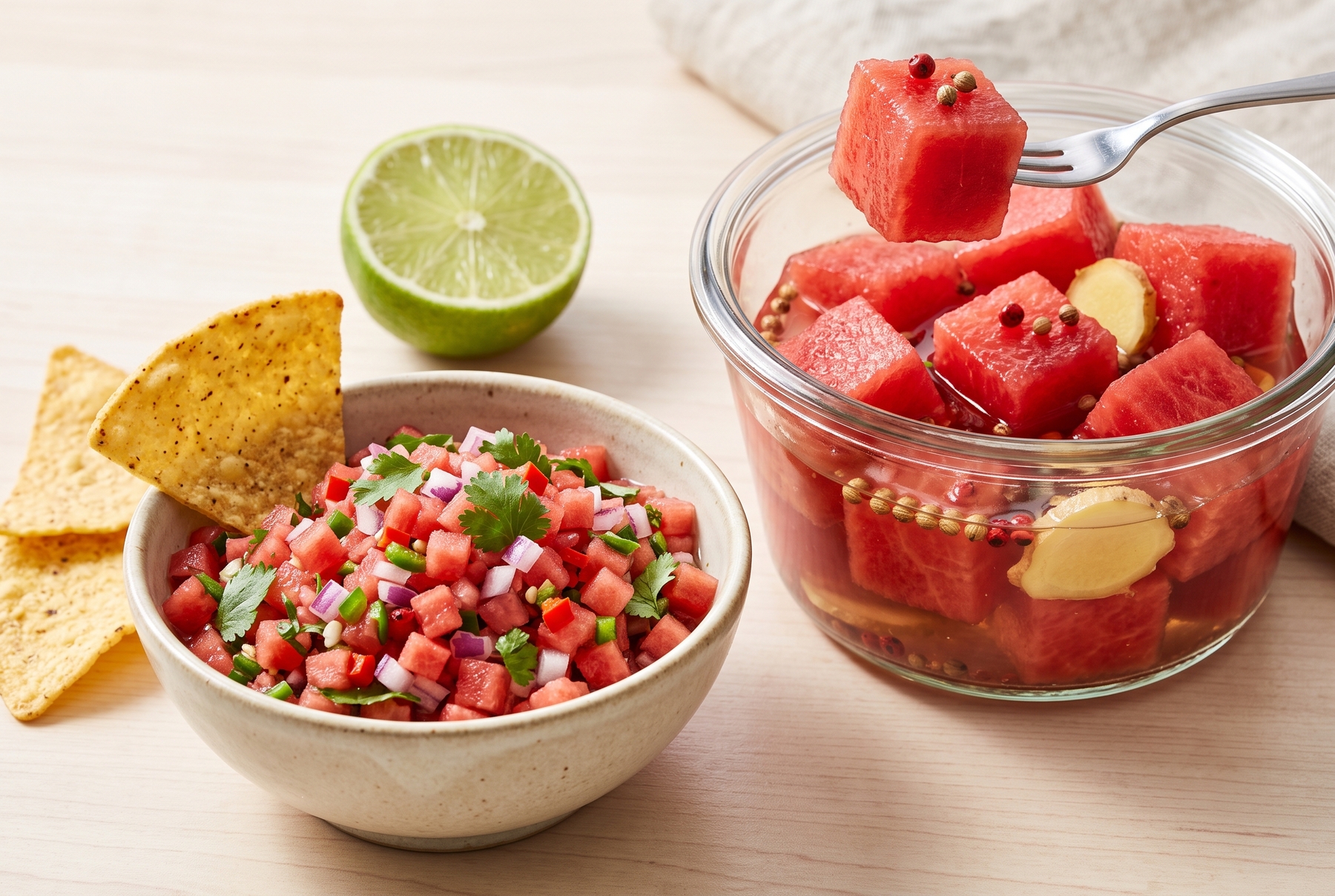
Bright watermelon salsa with lime alongside quick-pickled cubes made from dense melon flesh.
Grilled Watermelon
Intense heat evaporates surface moisture, concentrating the fruit’s flavor while introducing notes of caramelized sugar and woodsmoke around the edges. The result is warm watermelon with a charred crust that tastes softer and noticeably sweeter than it does raw. It pairs brilliantly with salty and acidic accents.
How to Grill It in 5 Steps
- Slice the melon into thick wedges or steaks measuring 2–3 cm (0.8–1.2 inches) across. Anything thinner will lose its structure and fall apart on the grates.
- Blot the cut surfaces thoroughly with paper towels, as wet fruit will steam rather than sear.
- Brush a very thin coat of neutral or olive oil over both sides.
- Heat the grill grates or a cast-iron skillet until it just begins to smoke.
- Sear for 1.5 to 2 minutes per side without moving the slices around.
Visual cues tell the whole story: dark grill marks across the surface, slightly softened edges, and a center that remains firm without collapsing into juice.
Three ways to serve grilled watermelon:
19. Grilled Watermelon with Cheese and Herbs
Scattering crumbled feta, goat cheese, or cream cheese over the warm slabs and finishing with fresh mint, basil, or arugula creates an instant warm-cold contrast.
20. Grilled Watermelon with Honey and Chili
A light hand with honey is essential here: a single teaspoon infused with chili is enough for a whole platter, since grilling already concentrates the melon’s natural sugars. A final pinch of flaky salt on top is non-negotiable.
21. Grilled Watermelon as a Savory Side
As a side dish, grilled watermelon holds its own alongside roast chicken, pork chops, grilled shrimp, and meaty fish like tuna. A bright, acidic dressing and plenty of fresh herbs are necessary to keep the plate from leaning too sweet.
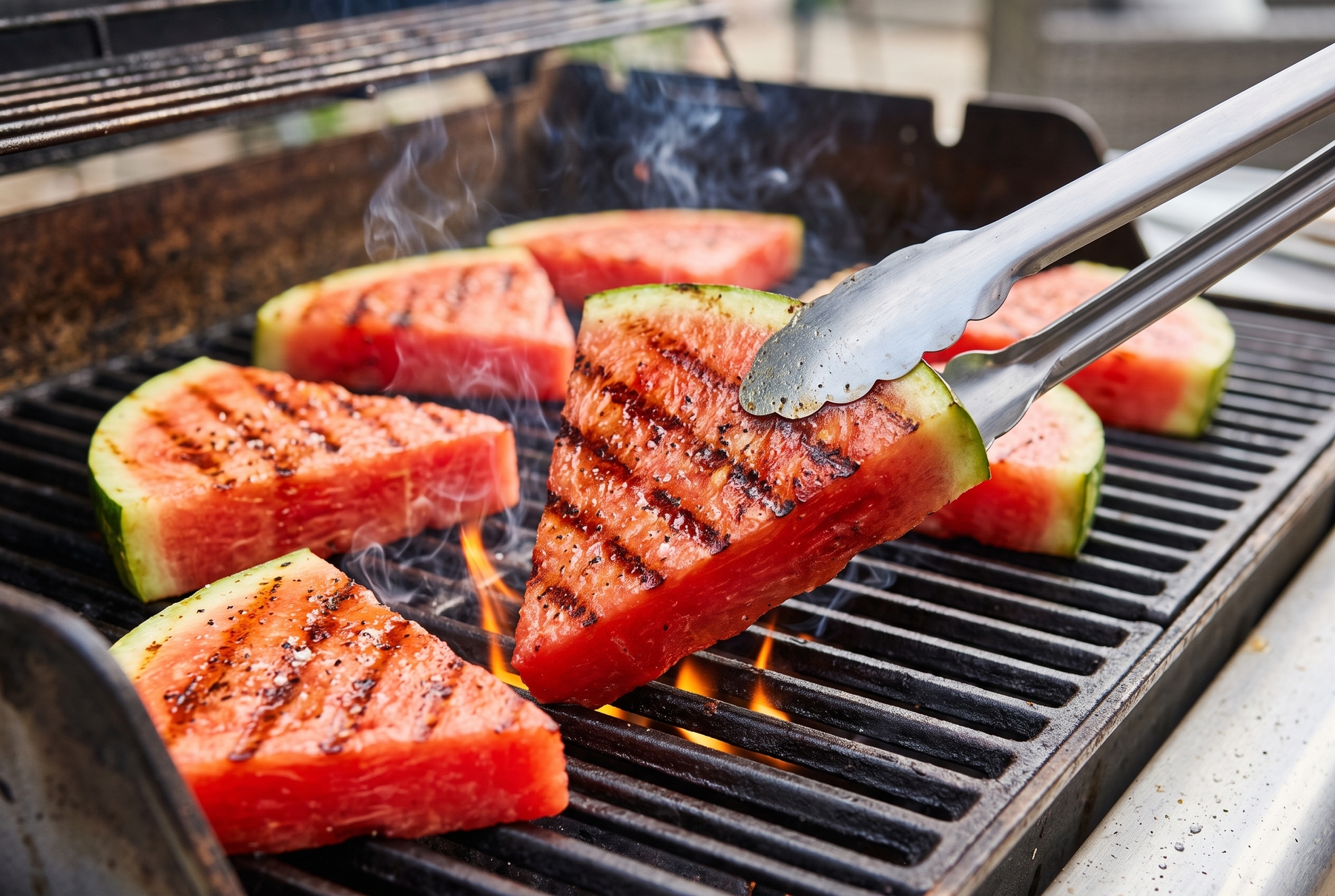
High heat caramelizes the surface sugars on the watermelon, giving the warm fruit a smoky aroma and concentrated sweetness.
Chilled Watermelon Soups and Sauces
22. Watermelon Gazpacho
In gazpacho, watermelon steps in to replace about one-third to half of the tomatoes. Four servings call for 500 g (1.1 lbs) of watermelon, 400 g (14 oz) of ripe tomatoes, one cucumber, half a bell pepper, a small garlic clove, 2 tablespoons of olive oil, 1–2 tablespoons of red wine or sherry vinegar, and salt. This soup almost always demands more acidity than expected; without it, the bowl reads like watered-down juice. Tasting and adjusting the seasoning after chilling is vital, as cold temperatures dull our perception of both salt and acid.
23. Freestyle Chilled Watermelon, Tomato, and Cucumber Soup
A looser, unhurried take on cold soup involves blending watermelon, ripe tomatoes, cucumber, and soft herbs until smooth, chilling the mixture for 2 hours, and adjusting the balance with salt and vinegar right before ladling it into bowls.
24. Watermelon Grill Sauce
Blending 250 g (9 oz) of melon flesh with the juice of one lime, half a hot chili pepper, 1 teaspoon of grated ginger (or a handful of cilantro), and salt yields a bright condiment for grilled meats. Pouring the blended purée into a fine-mesh sieve to drain for 10 minutes removes the thin initial liquid, leaving behind a thicker, much more vibrant sauce. Because it will naturally separate over time, it is best served fresh rather than stored in the refrigerator for the next day.
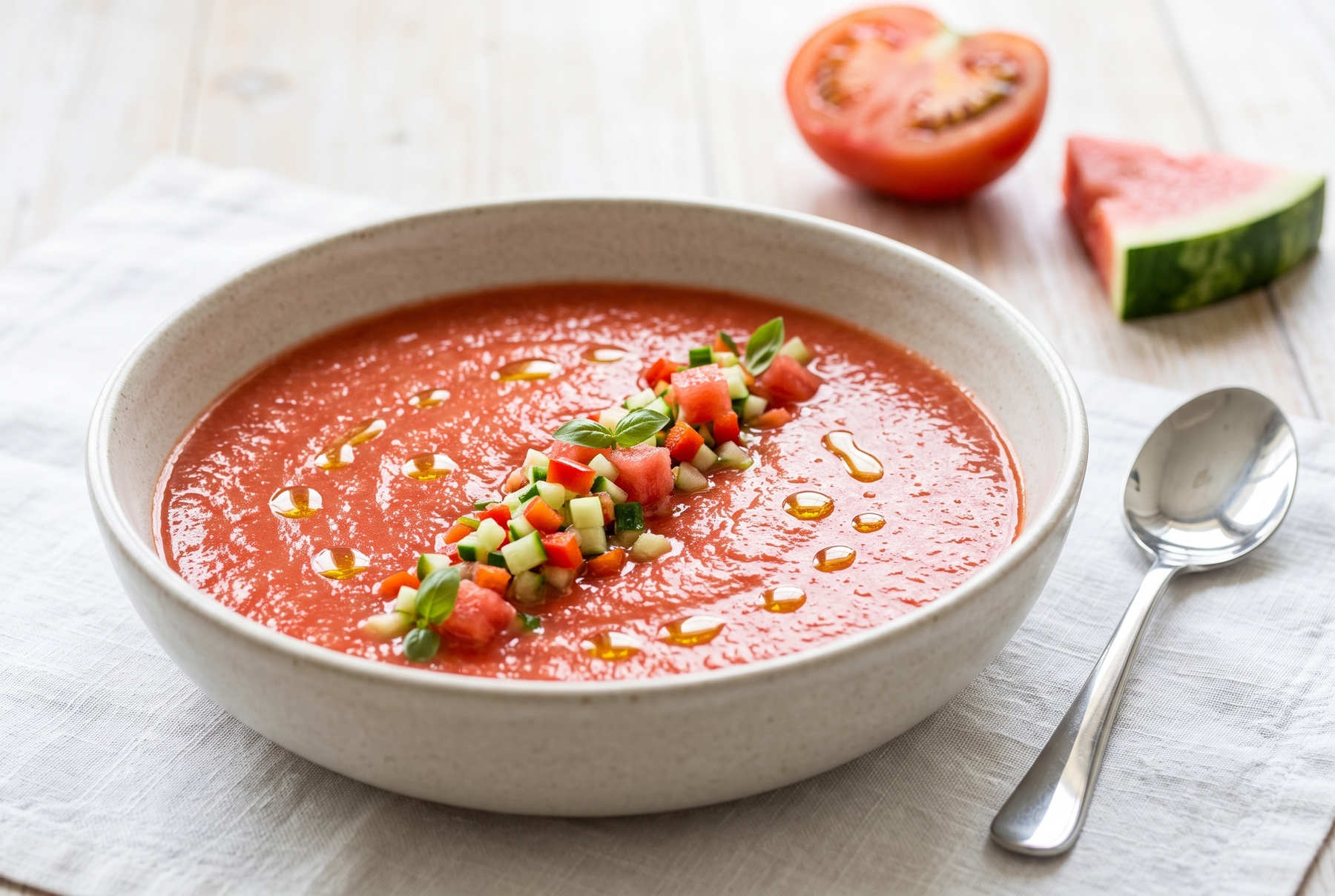
A vibrant chilled watermelon gazpacho blended with ripe tomatoes and cucumber, finished with microgreens and olive oil.
Watermelon Drinks
It is a familiar culinary trap: blending watermelon into a pitcher yields a pale, sweetish water with no real backbone, which guests politely finish without asking for seconds. To truly shine in a glass, watermelon needs acidity, an aromatic hook, and often a tiny pinch of salt to give the flavor dimension.
25. Essential Watermelon Agua Fresca
A proper watermelon lemonade or agua fresca relies on fresh melon juice, lemon or lime juice, cold water, plenty of ice, and sweetener only if the fruit itself is underwhelming.
One pitcher requires 700 ml (24 fl oz) of strained watermelon juice—which takes about 1 kg (2.2 lbs) of raw flesh—along with the juice of one lemon or two limes, 200–300 ml (7–10 fl oz) of cold water, and ice. Straining the purée through a sieve is mandatory; leaving the pulp in causes the drink to separate within half an hour into a frothy pink foam on top and cloudy water underneath.
26. Cucumber-Watermelon Cooler
Blending cucumber into the base creates a calmer, greener profile; the peel can stay on as long as it isn’t bitter.
27. Herb-Infused Watermelon Drink
Herbs require a gentle touch here. Blitzing basil or rosemary directly in the blender releases chlorophyll and bitter compounds, turning the drink murky and astringent. Clapping the leaves between your palms or steeping a whole sprig in the pitcher for 10 minutes before removing it extracts clean aromatics without the bitterness.
28. Watermelon and Tonic
Combining fresh watermelon juice with tonic water and a citrus wedge relies on the sharp bitterness of quinine, which cuts through the fruit’s sweetness even more effectively than lemon juice.
29. Frozen Watermelon Ice Cubes
Freezing cubed watermelon flesh provides an easy upgrade for plain water, lemonade, or iced tea, melting slowly in the glass without diluting the drink. Because freezing ruptures the fruit’s cell walls and turns the thawed flesh spongy, these cubes are strictly for chilling drinks rather than eating whole.
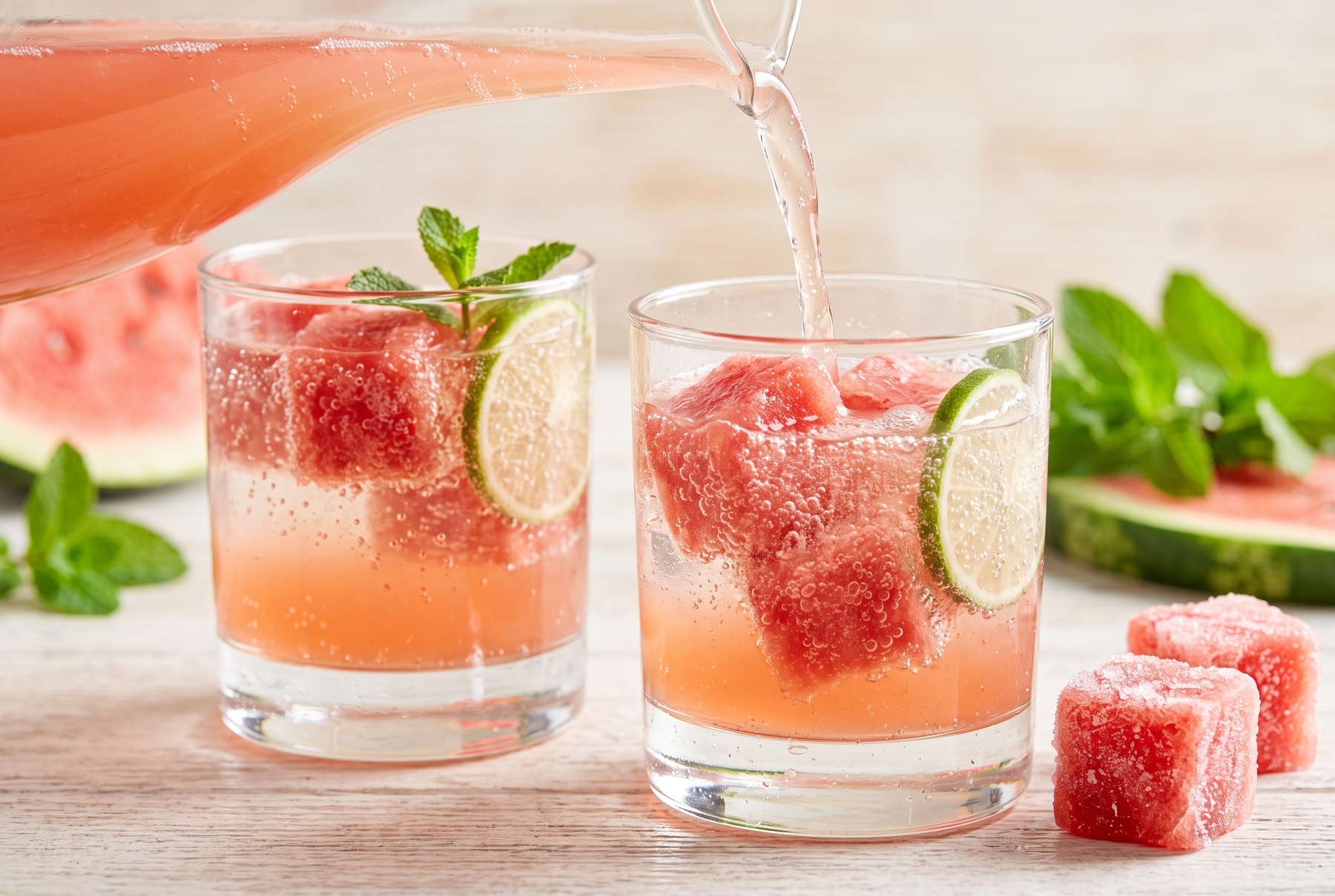
A sparkling drink chilled with frozen watermelon cubes, lime, and mint builds flavor slowly without diluting the glass.
Watermelon Desserts
30. Watermelon Granita
Making a classic granita requires 1 kg (2.2 lbs) of melon flesh, 60–80 g (2–2.8 oz) of sugar, and the juice of half a lemon. Pouring the blended mixture into a wide, shallow baking dish to a depth of 2–3 cm (0.8–1.2 inches) sets it up for the freezer. Scraping the mixture with a fork every 30 to 40 minutes breaks up the ice crystals; repeating this three or four times over three to four hours yields light, snowy flakes. The exact amount of sugar depends entirely on the ripeness of the melon, and a truly sweet fruit may need none at all.
31. Five-Minute Watermelon Sorbet
Sorbet calls for a smooth, unified texture free of coarse ice crystals. Achieving this requires a slightly higher sugar ratio and mandatory acidity to keep the base from freezing into a solid block of ice. For 1 kg (2.2 lbs) of flesh, blending in 120–150 g (4.2–5.3 oz) of sugar, 2 tablespoons of lemon juice, and a pinch of salt creates the right balance. Freezing the mixture in standard ice cube trays and blitzing the frozen cubes in a high-powered blender or food processor produces a velvety sorbet ready for immediate serving. While the texture is slightly more rustic than a churned version, the active prep takes just five minutes.
32. Chocolate-Dipped Watermelon
Melting 100 g (3.5 oz) of dark chocolate is plenty to coat 500 g (1.1 lbs) of watermelon batons. The fruit must be thoroughly chilled and blotted dry twice with paper towels. Melted chocolate seizes and refuses to adhere to wet surfaces, making surface moisture its worst enemy. Dipping each piece halfway, scattering chopped nuts or flaky sea salt over the chocolate, and chilling them on parchment paper sets the shell. This treat must be assembled shortly before serving; the melon continues to release moisture beneath the shell, and after a few hours the chocolate will slip off in a single sheet.
33. Watermelon Ice Pops
Blending watermelon flesh with berries, citrus juice, or yogurt and pouring it into molds—or simply using small plastic cups topped with a sheet of foil to hold the wooden stick upright—makes effortless summer popsicles. Four to six hours in the freezer freezes them solid. Dipping the molds into warm water for a few seconds releases the pops cleanly.
34. Watermelon with Greek Yogurt and Pistachios
Layering cold watermelon cubes over thick, unsweetened yogurt and finishing with chopped pistachios, a drizzle of honey, and grated lime zest makes a sophisticated, low-effort dessert. Choosing a dense, strained Greek-style yogurt is critical; standard runny yogurt will separate within 5 minutes, leaving a pool of pink whey at the bottom of the bowl.
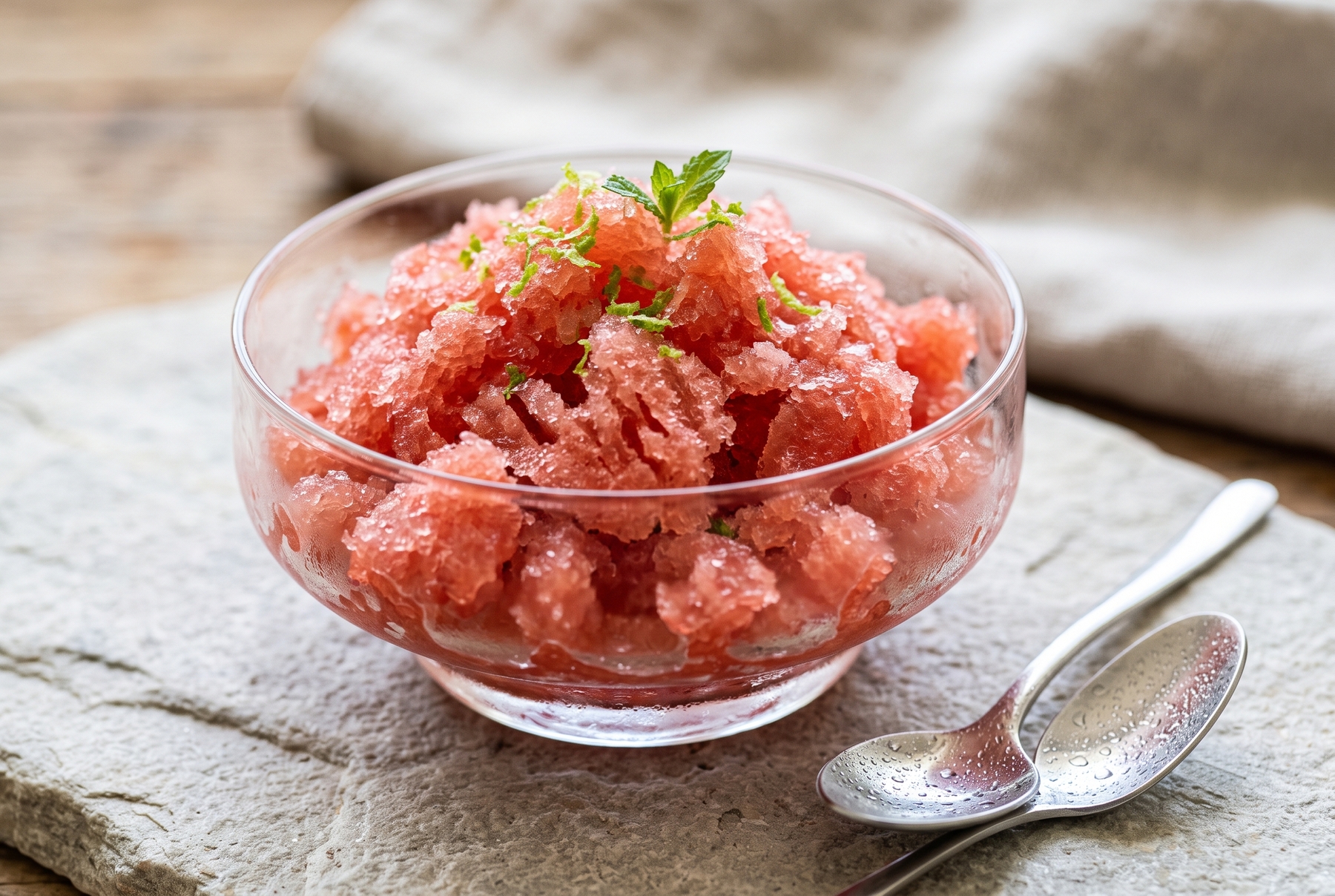
A light, icy dessert made from frozen watermelon purée, bright lemon juice, grated lime zest, and fresh mint.
What to Make with Watermelon Rinds
These techniques focus entirely on the pale, dense white layer situated between the tough green skin and the sweet red flesh. Both the outer green peel and any lingering pink flesh should be trimmed away completely.
35. Quick-Pickled Watermelon Rinds
Simmering batons of the white rind in boiling water for 3 minutes and draining them dry is an essential first step; skipping this leaves the centers stubbornly tough while only the exteriors absorb the brine. Pickling 500 g (1.1 lbs) of trimmed rinds requires a brine of 200 ml (6.8 fl oz) of water, 100 ml (3.4 fl oz) of vinegar, 2 tablespoons of sugar, 1 tablespoon of salt, coriander seeds, and a smashed garlic clove. Pouring the hot brine over the rinds, cooling the jar to room temperature, and refrigerating it overnight yields crisp pickles that keep well in the fridge for several days.
36. Candied Watermelon Rind and Preserves
Turning rinds into candied chews or traditional preserves is a time-tested culinary technique: the dense white flesh eagerly absorbs sugar syrup and aromatics like lemon, ginger, or cardamom while retaining a pleasant, bouncy chew.
The classic ratio for 1 kg (2.2 lbs) of prepped rinds calls for 800 g (1.75 lbs) of sugar, 400 ml (13.5 fl oz) of water, and half a lemon. Simmering the rind pieces in plain boiling water for 10 minutes and draining them softens their rigid structure. From there, the rinds cook in the sugar syrup across three separate stages: bringing the pot to a boil, removing it from the heat to cool for several hours, and repeating the cycle. By the end, the rinds turn translucent and glassy around the edges. For preserves, the process stops there; for candied rinds, draining the pieces in a sieve and drying them in a cracked oven at 60 °C (140 °F)—or simply on a wire rack for a couple of days—creates a dry, sugar-crusted finish.
37. Watermelon Rind as a Cucumber Substitute
The fastest way to use the pale rind is slicing it into paper-thin ribbons, tossing it with salt for 10 minutes, and folding it into a vegetable salad in place of cucumber. The salt isn’t there for seasoning—it draws out excess moisture so the ribbons can be squeezed dry by hand and blotted before dressing the salad. Their crunch is arguably even sharper and cleaner than an actual cucumber’s.
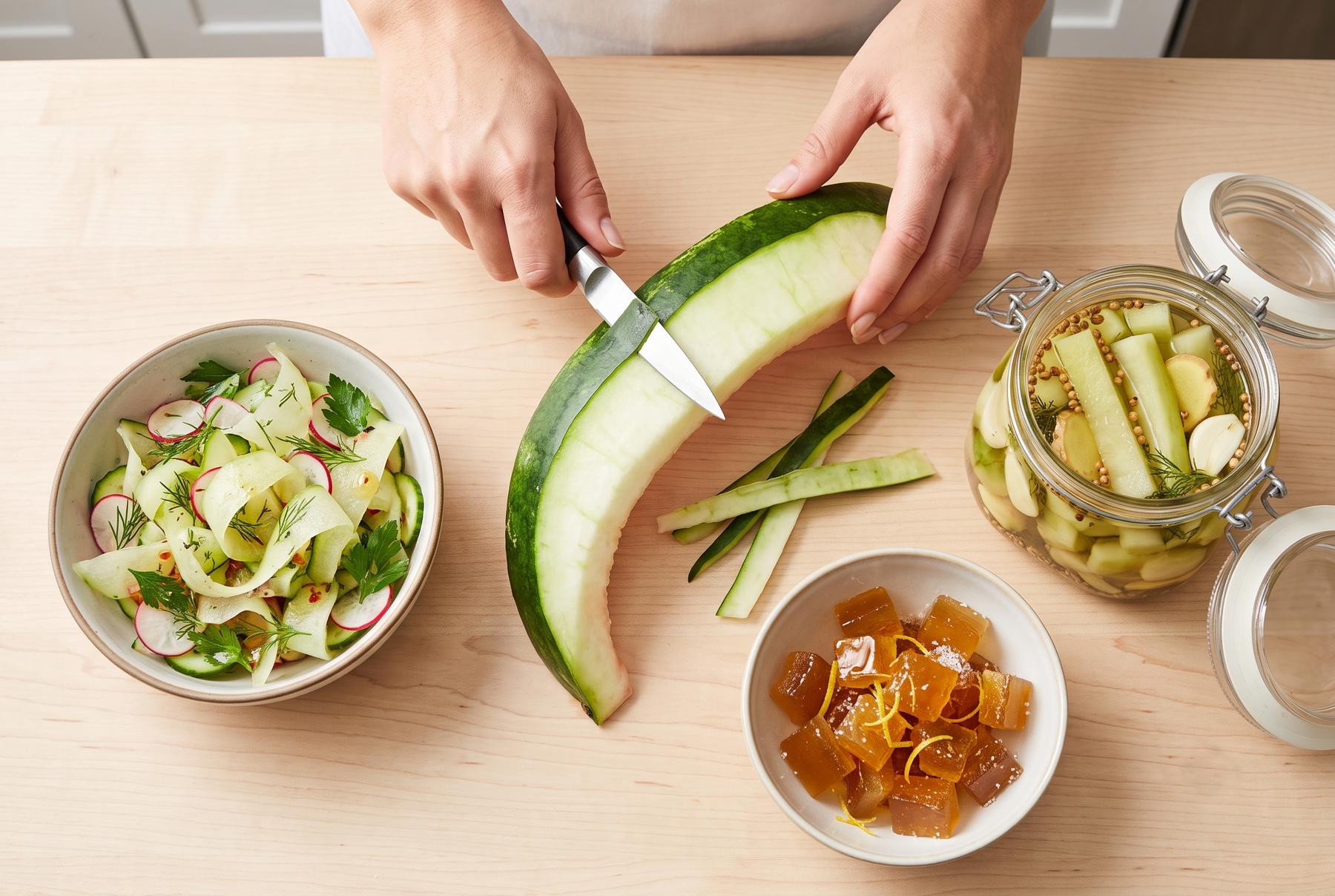
The crisp white layer of the watermelon rind can be turned into tangy quick pickles, candied chews, or a crunchy cucumber substitute in salads.
The Flavor Matrix: Building a Dish in 5 Layers
Constructing an original watermelon dish comes down to layering five distinct elements according to personal taste:
- The Base: chilled raw watermelon, frozen cubes, puréed juice, or grilled steaks
- The Savory Contrast: brined cheese, olives, cured meat, soy sauce, or flaky sea salt
- The Acid: lemon, lime, wine vinegar, rice vinegar, or sumac
- The Aromatics: mint, basil, cilantro, tarragon, rosemary, cracked black pepper, or chili
- The Texture: cucumber, radish, toasted nuts, seeds, croutons, or crisp salad greens
Foolproof combinations to start with include: watermelon + feta + mint + lime; watermelon + tomatoes + basil + olive oil; watermelon + chili + lime + flaky salt; and grilled watermelon + soft goat cheese + arugula.
7 Reasons a Watermelon Dish Turned Out Watery
When a watermelon dish falls flat or floods the plate, the culprit is usually one of seven missteps: starting with overripe, mealy flesh; under-seasoning with acid; skipping the salt; drowning the bowl in dressing; dicing the melon so small that it bleeds out its juice in a minute; assembling the salad ahead of time to let it “marinate”; or crowding the bowl with eight ingredients instead of four.
Fixing a watery dish takes only a moment: draining off the excess liquid through a sieve, sharpening the profile with fresh lemon juice or a splash of vinegar, introducing a salty anchor (like feta, olives, or cured ham), chilling the bowl in the refrigerator for 10 minutes, and finishing with fresh herbs and something crunchy right on top.
Matching the Melon to the Method
Dense, crisp watermelon holds its geometry anywhere a knife is involved: salads, skewers, quick pickles, and the grill. Intensely sweet melons beg for the counterbalance of lime, chili, salty cheese, and bitter greens. Meanwhile, soft, overripe flesh is best routed straight into lemonade, granita, sorbet, chilled soup, or the freezer. If a melon turns out disappointingly bland, hitting it with acid and a pinch of salt will wake it up—adding a touch of honey only if it still needs help.
A firm cube finished with flaky salt and a squeeze of lime will happily hold its shape on a platter for twenty minutes while guests make their way to the table. An overripe melon, on the other hand, needs just ten minutes to become a frosted glass of agua fresca with lemon, ice, and a vital pinch of salt at the bottom.
0 comments